




Abstract
Two recent developments in South Asia have increased the risk of an accelerated arms race between India and Pakistan. One development is Pakistan’s introduction of the Nasr missile, a very-short-range, “tactical” nuclear weapon that threatens India’s conventional forces and could also tempt other countries to develop battlefield-usable nuclear weapons. The other development is India’s announcement that it plans to use its nascent ballistic missile defense program to protect the civilian populations of Delhi and Mumbai, which would weaken Pakistan’s strategy of deterrence by threatening civilian casualties. Although these two developments occurred in response to other perceived threats and are not directly connected, both have introduced new and more dangerous dimensions to the South Asian nuclear scene.
Two separate but significant developments in recent years threaten to destabilize the South Asian nuclear scene. One is the introduction, by Pakistan, of a very-short-range, battlefield-usable nuclear weapon named Nasr. The availability of battlefield nuclear weapons adds a new risk to the hazards posed by strategic nuclear arsenals. The other development is India’s antiballistic missile program, still in its infancy. The dangers posed by the Indian program are less obvious but could be significant in the long run, and could accelerate an arms race between India and Pakistan.
The two developments are not directly connected, in the sense of one being a response to the other. The Nasr missile was a response not to India’s ballistic missile defense program but rather to Pakistan’s concern about a conventional attack by India—a concern accentuated by India’s so-called Cold Start doctrine. After Pakistan-supported terrorists attacked its parliament in 2001, India began mobilizing forces at the India–Pakistan border. This process took nearly a month, prompting India to reorganize its procedures so as to speed up such mobilization in the future. Rapid mobilization is commonly referred to as Cold Start, although India denies that it has any special doctrine to this effect, and insists that the new procedures are simply a matter of military preparedness. Pakistan has expressed considerable concern over India’s allegedly new posture, and this concern might be one of the motivations behind the development of the Nasr missile.
India’s missile defense program was initiated long before the Nasr missile was developed and is not a direct response to it. The Indian program was meant to defend against all missile attacks, from China as well as Pakistan. But although the two developments are independent, together they have introduced new and dangerous dimensions to the South Asian nuclear scene.
Pakistan’s short-range missile
The ancestry of Pakistan’s battlefield nuclear weapons goes back to the tactical nuclear weapons developed by the United States and the Soviet Union during the Cold War. In Cold War parlance, tactical weapons were smaller, short-range weapons mounted on missiles. By contrast, strategic weapons were larger—with yields of hundreds of kilotons or more—and were to be delivered by intercontinental missiles and long-range bombers. The so-called tactical weapons were designed for use in the European theater, where NATO forces wanted to deter any conventional attack by Soviet forces on Western Europe, and also to prevent any European conflict from developing into an all-out nuclear war between the two major powers.
Experts often make a distinction between “tactical” and “strategic” nuclear weapons in the South Asian context, too. But there this categorization is somewhat inappropriate because, given the geography of the subcontinent, any distinction based on the range of missiles is meaningless. India and Pakistan share a long border, and their capitals are just a few hundred miles apart—a distance that can be crossed by a missile in only six minutes. Even a short-range missile or bomber (or a bullock cart driven across the border) carrying a small nuclear warhead from one country to the next would have serious strategic consequences.
But if the term “tactical” is used to refer to small, short-range weapons intended to be used on the battlefield, then there is indeed a significant difference between them and strategic weapons. Such battlefield weapons could include nuclear-warhead-bearing artillery shells as well as short-range missiles.
Alas, the possibility of battlefield weapons has now reared its ugly head in South Asia, through the introduction by Pakistan of the nuclear-capable, short-range missile called Nasr. Part of the Hatf series of Pakistani missiles, the Nasr (also known as Hatf IX) is a surface-to-surface, multi-tube ballistic missile with a range of 60 kilometers, first tested on April 19, 2011 (ISPR, 2011), and again on May 29, 2012 and February 11, 2013.
1
A Pakistan government press release claims that the Nasr can carry “nuclear warheads of appropriate yield with high accuracy” and that it has “shoot and scoot attributes” that enable the launch system to be relocated immediately after firing (ISPR, 2012).
A test-firing of the Nasr in April 2011. Photo credit: ISPR.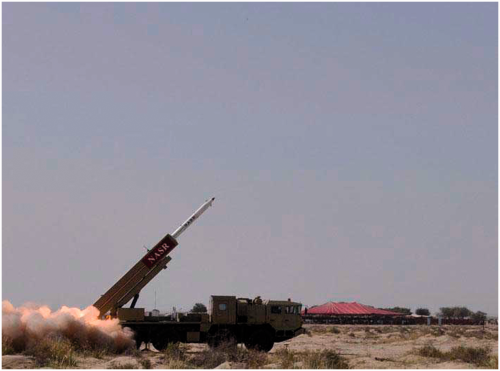
Presumably the Nasr missile is designed to, among other things, halt a possible incursion by the Indian army into Pakistani territory during some future conflict. This motivation for developing the Nasr is plausible, because Pakistan has often publicly declared its concern that India has much larger conventional forces, and has justified its development of a nuclear arsenal as a way of deterring an Indian conventional attack. While Pakistan has no official nuclear doctrine, Lt. Gen. Khalid Kidwai, recently appointed as head of the Strategic Plans Division, is said to have warned in 2001 of red lines that, if crossed by India even in conventional warfare, might warrant a nuclear reprisal (Varadarajan, 2004). Consistent with this, Pakistan has eschewed a no-first-use policy, in order to keep its nuclear options open.
In this context, Pakistan’s development of the nuclear-capable, short-range Nasr missile may seem on its face just a “tactical” extension of the country’s nuclear forces. But in fact, the Nasr is potentially even more dangerous than a full-fledged warhead carried by a longer-range “strategic” missile such as the Shaheen or the Ghauri. The latter are always held in check by a highly centralized command-and-control structure, with firing orders given only by the highest authority in the land. This is true for all countries possessing nuclear weapons, including India and Pakistan.
By contrast, the control of battlefield weapons is, of necessity, less centralized than that of strategic weapons, particularly during wartime. Otherwise, short-range weapons would lose their operational value on the battlefield. With such looser control and broader distribution unavoidable, the risks of inadvertent, hasty, or unnecessary firing that are attendant with strategic weapons become further multiplied for battlefield weapons.
The risk of pilferage by terrorists or other non-state actors also increases. Smaller than heavy-duty nuclear bombs, nuclear artillery shells would be easier to steal, hide, and fire.
Another worrisome aspect of battlefield weapons is that some of the motivation behind developing them could be the desire to build “usable” nuclear weapons. It is well known that the armed forces of nuclear weapon states increasingly view standard nuclear weapons as unsuitable for war fighting. This is because of the immense damage they cause, and the near universal opprobrium they would bring should they be used. (Mere possession attracts far less disapproval, which is an inherent hypocrisy in the public attitude toward nuclear weapons.) In short, nuclear weapons are viewed as useless white elephants. Associated with this there may well be an undercurrent of hunger among hawkish elements in nuclear weapon countries to develop a nuclear weapon that is more “usable” than traditional missile-borne strategic weapons. Once battlefield nuclear weapons are developed by some country, these hawkish elements would be itching to use them, especially in the event of an existential threat to their own country. 2 Rightly or wrongly, Pakistan does fear such a threat from India. That greatly increases the chances of these weapons being exploded in war.
Using nuclear weapons on the battlefield would violate a powerful taboo that has taken root since the initial Hiroshima and Nagasaki bombings. 3 Iconic images of the two flattened cities and of the terrible impact of nuclear radiation on those injured and killed, as well as photographs of giant mushroom clouds emerging from nuclear tests in the Pacific, and not least the numerous movies based on nuclear Armageddon scenarios, have all contributed to building up a deep-rooted fear of nuclear weapons. Such a reaction is not limited to antinuclear activists. It permeates, to some extent, the psyches of all but the most pathological of fanatics. It also colors the calculations, even if not decisively, of the most hardened of military strategists.
The unacceptability of nuclear devastation is the backbone of all deterrence strategies. There is not just a fear of being attacked oneself, but also a strong mental barrier against initiating nuclear attacks on enemy populations, no matter how much such attacks may be contemplated in war games and strategies. As a result, a taboo has tacitly evolved over the decades, preventing nations from pressing the nuclear button even in the face of serious military defeats—such as the Soviet withdrawal from Afghanistan or the US exit from Vietnam.
Once the line dividing nuclear weapons from conventional bombs is crossed, however, even if it is through the use of “small” nuclear weapons on the battlefield, it will become acceptable to use such weapons. A gradual erosion of the feeling of abhorrence toward nuclear weapons—and the radiation they release—is bound to result. Firing a sub-kiloton nuclear artillery shell in the heat of battle could elicit a similar response by the adversary, possibly with a heavier-yield weapon. Even if the adversary does not retaliate in kind, the opening salvo makes it more likely that a nuclear weapon will be used in a later war. The ante will keep going up.
Unlike Pakistan, which went public with its test firing of the Nasr, India’s government has not made any public statements about either possessing or developing its own “tactical” weapon. This does not rule out the possibility that India is quietly developing a counterpart to the Nasr, or another type of battlefield nuclear capacity, but I could not find any reliable evidence to that effect in the public-domain writings of analysts.
There is another front, however, on which India has been putting in considerable effort, much of it well publicized: the development of ballistic missile defense. In its own way, this effort can also increase nuclear dangers in the subcontinent.
India’s ballistic missile defense
India has been developing a ballistic missile defense system since the turn of the century, but it did not start bearing fruit until about seven years ago. On November 27, 2006, in a test 50 kilometers above the Earth, a Prithvi Air Defense (PAD) missile successfully intercepted another modified version of the Prithvi missile. 4 About a year later, on December 6, 2007, India fired a hypersonic interceptor missile that successfully performed an interception at an altitude of only 15 kilometers. The hypersonic interceptor, named the Advanced Air Defense (or AAD) missile, is designed to intercept incoming missiles at altitudes of up to 30 kilometers (Roul, 2008; IANS, 2008). PAD, by contrast, is designed to intercept missiles above the atmosphere, at altitudes of 50 to 80 kilometers.
On March 6, 2009, India’s Defence Research and Development Organisation (DRDO) carried out a second successful test of the PAD interceptor missile. The target was a ship-launched Dhanush missile, which simulated the trajectory of a missile with a range of 1,500 kilometers. PAD destroyed the target, tracked by radar, at an altitude of 75 kilometers.
According to V. K. Saraswat, then the Director General of the DRDO, the next interceptor missile test was to be conducted at a higher altitude of 100 to 150 kilometers in July 2013. “We have developed a new interceptor missile for it,” he told the Hindu last May (Mallikarjun, 2013). The latest interceptor is a two-stage missile, with both stages powered by solid propellants. As of January 2014, the new interceptor missile had not yet been tested.
Earlier, when he was chief controller of the DRDO, Dr. Saraswat had claimed that his organization was “developing a robust anti-missile defense system that will have high-speed interceptions for engaging ballistic missiles in 5,000-kilometer class and above” (Roul, 2008; Sethi, 2009). In the next phase of India’s ballistic missile defense program, two new hypersonic interceptors (named AD-1 and AD-2) capable of intercepting intermediate-range ballistic missiles are planned for deployment by 2016.
Perhaps the most politically important announcement, although arguably the hardest to implement, came in 2012: Delhi and Mumbai, the two most vital metropolitan areas of India, were chosen as the sites for installing radars to track enemy missiles, and interceptor missiles to shoot them down (Kumar, 2012). This is a sensitive matter because it is the first announcement that explicitly talks of protecting large civilian populations, as distinct from military facilities or just the country’s top leaders. That could make the program popular among the populace of Delhi and Mumbai, but it could also provoke strong resentment in other parts of the country.
These Indian plans and their timelines may be optimistic. But even to the limited extent that the program has thus far developed, it is threatening to renew an arms race in South Asia. At first glance this may seem an unfair accusation, inasmuch as ballistic missile defense is a purely defensive program intended to protect India from missile attacks by others. Besides, isn’t an arms race already on between the “archrivals” India and Pakistan?
What is not widely appreciated in the West, however, is that the nuclearization of South Asia had been moving away from being an “arms race” between India and Pakistan. Even though Pakistan was continuing to weaponize with India in mind, India felt that it had enough nuclear weapons to deter Pakistan and was more concerned about the Chinese threat.
India’s missile defense program, however, may renew an India–Pakistan arms race. Both countries rely primarily on countervalue attacks for mutual deterrence. So, if India gives even the slightest impression that it is trying to protect its major cities, that could force Pakistan to enlarge its offensive arsenal to ensure that some of its weapons will reach these cities. That could lead to an endless arms race. It could also delay the day when one or both countries consider their stock of warheads and fissile materials sufficient to enter into the Fissile Material Cutoff Treaty. Already Pakistan has been using India’s ballistic missile defense efforts as an argument for developing cruise missiles and tactical “battlefield weapons.”
In this situation, it is not realistic to ask the Indians to abandon their ballistic missile defense program altogether. That would not be acceptable to the strategic establishment, considering the money, effort, and hype already invested in the program. But it might be helpful if the Indians would limit their missile defense efforts to protecting the apex leadership and centers of command. In a nuclear environment, no country would begrudge another such protection. For a primarily countervalue strategy of deterrence to work, it is essential that the major cities remain vulnerable. In any event, creating a missile shield that protects Delhi and Mumbai will not be a technically easy task to accomplish.
Not only should India limit its ballistic missile defense protection to the apex leadership and command-and-control centers, but this plan must also be conveyed to Pakistan if it is to stop the latter from enlarging its offensive arsenal. That in itself will be a tricky matter. The Indian government cannot very well announce publicly that it is not planning to protect its population centers; that would be politically suicidal in a democracy. Nevertheless, the plan to protect cities must be dropped, and the announcement about Delhi and Mumbai must be allowed to quietly fade from public memory. If Pakistan can be convinced that India will not nullify the former’s deterrence plans by protecting major cities, it may be persuaded not to enlarge its nuclear arsenal beyond current levels.
Indeed, such an argument could apply to other nuclear weapon states, too. To the extent that any of them retains nuclear weapons for deterrence purposes, it may be safer for their adversaries to leave some targets vulnerable. Such are the ironies of nuclearization.
Footnotes
Funding
This research received no specific grant from any funding agency in the public, commercial, or not-for-profit sectors.