




Abstract
How many battlefield nuclear weapons would it take for Pakistan to stop a major armored attack by the Indian army? How big would each bomb have to be? Would the cost in civilian Pakistani deaths—not to mention deaths among its own military caught on the nuclear battlefield—be so great as to make it self-defeating for Pakistan to use the bombs? At first glance, the main advantage of Pakistan’s new battlefield nuclear weapon—known as the Nasr missile—would appear to be its ability to slow down and stop an armored attack by the Indian Army inside Pakistan, before it reaches vital cities. But deeper examination reveals that deploying this particular weapon on the battlefield against an advancing Indian armored column would cause substantial deaths and injuries to Pakistani citizens, rendering its purpose moot. If there is any value to a Pakistani nuclear weapon, it lies instead in the bigger strategic picture: Its mere presence means that Pakistan has the ability to threaten India’s cities and military garrisons with retaliation in response to an Indian incursion.
To respond to continued modernization of India’s armed forces, Pakistan developed a battlefield tactical nuclear weapon: the Nasr. Officially known as Hatf IX, meaning Vengeance IX, the missile completed its first successful test in 2011. The Pakistani military immediately issued a press release claiming that this mobile weapon, with a range of 60 kilometers, is highly accurate and able to carry nuclear warheads. It’s designed for nimble, “shoot-and-scoot” warfare—that is, firing at a target and then immediately dispersing, to avoid enemy counter-fire 1 (Inter Services Public Relations, 2011). In the same press release, the director of Pakistan’s Strategic Plans Division, Khalid Ahmed Kidwai, proclaimed that this short-range nuclear weapons system filled a gap, allowing Pakistan to now theoretically counter threats at all levels of the spectrum of warfare: strategic, tactical, and operational.
Other Pakistanis chimed in. At a 2013 military exercise involving the Nasr missile, the head of Strategic Technology Resources, Shireen Mazari, stated: “We are signaling our acquisition of tactical missile capability and miniaturization technology.” She also said, “This would help stabilize the nuclear deterrence and its credibility” (Shaheen, 2013).
These arguments do not hold up to scrutiny. To be a true deterrent, a tactical weapon would have to impose a price mainly on the attacking side, halting an armed force invading Pakistani territory without unacceptably large costs to Pakistan. Scientific examination reveals that any use of the Nasr inside Pakistan, however, will result in substantial civilian casualties, not to mention damaging effects on Pakistan’s own military forces. Therefore, Nasr will not actually possess a strong deterrent value.
The reasoning behind the Nasr
Pakistan’s scholars and policy makers point to India’s growing conventional military power as the prime motivation for developing the Nasr. Previously, Pakistan’s strategy was to use its army and air force to fight Indian ground forces to a standstill close to the Pakistan–India border, thus preventing a deep invasion and buying time to mobilize international pressure for a cease-fire. But that policy had to change, in light of India’s recent military modernization and upgrades. For example, in Pakistan’s weekly independent newspaper the Friday Times, private security consultant Rodney Jones of Policy Architects International (Jones, 2011) argued that India can now conduct large-scale armored battlefield maneuvers that could outflank Pakistani defenses while simultaneously projecting firepower and airborne units well beyond the battlefield’s forward edge, thereby giving India a significant advantage in any engagement. As a result, the Nasr is popularly seen in Pakistan as a way of making a quick return thrust, much like a fencer’s riposte.
One participant at a conference featuring senior Pakistani ambassadors and military leaders characterized the Nasr’s development as a cost-effective means of bolstering Pakistan’s defenses in place of a costly conventional weapons buildup. According to this participant, 2 the Nasr creates a “balancing dynamic that frustrates and makes futile the power-maximizing strategy of India.” He envisages the Nasr’s shells being used to carry atomic explosives that would annihilate advancing Indian armored thrusts in the southern deserts and blunt Indian advances toward major Pakistani cities such as Lahore (Khan and Masellis, 2012: 28).
Pakistani military personnel have ruminated about using battlefield nuclear weapons since the late 1990s. Writing in the April 1999 issue of the Pakistani Defence Journal, retired military general S. F. S. Lodhi argued: “In a deteriorating military situation when an Indian conventional attack is likely to break through our defenses or has already breached the main defense line causing a major set-back to the defenses, which cannot be restored by conventional means at our disposal, the [Pakistani] government would be left with no other option except to use nuclear weapons to stabilize the situation.” Pakistan would use “a stage-by-stage approach in which the nuclear threat is increased at each step to deter India from attack. The first step could be a public or private warning, the second a demonstration explosion of a small nuclear weapon on its own soil, the third step would be the use of a few nuclear weapons on its own soil against Indian attacking forces. The fourth stage would be used against critical but purely military targets in India across the border from Pakistan. Probably in thinly populated areas in the desert or semi-desert, causing least collateral damage. Some weapon systems would be in reserve for the counter-value role. … India’s superiority in conventional arms and manpower would have to be offset by nuclear weapons” (Lodhi, 1999).
Other professed Pakistani motivations for developing the Nasr include India’s new Cold Start military doctrine and India’s upgrading of its ballistic missile defense program. Cold Start was unveiled by the Indian army in response to the 2001 attack on the Indian Parliament by alleged Pakistani terrorists (Altaf, 2013; Khan, 2011; Lodhi, 2012). Consequently, the doctrine calls for immediate—if limited—offensive operations by Indian forces the next time a major Pakistani terrorist attack occurs inside India. Under Cold Start, India’s forces would be put in place along the border, where they could attack quickly, make shallow penetrations into Pakistan, and seize slices of land. The seized territory would then be used as leverage to force Pakistan to act against terrorists within its borders (Smith, 2011: 207).
The Nasr is meant to deter such limited Indian offensive action by lowering the threshold for the use of nuclear weapons. 3 Another participant at that same conference, known as the US-Pakistan Track II strategic dialogue, argued that by introducing the Nasr into the mix, Pakistan hopes to make any conventional operations by India—even on a limited scale—much more difficult, complicated, and dangerous. The imminent possibility of nuclear escalation would limit how far India would go in any conventional conflict, ensuring “stability of deterrence in the conventional domain” (Khan and Masellis, 2012: 26).
What damage could the Nasr do?
All these arguments assume that the Nasr would be able to stop an invading force. Even if this were true, none of its proponents seems to understand the costs involved for Pakistan or the effects of these costs on deterrence. If Pakistan were to suffer an overwhelmingly large number of civilian and military casualties when a Nasr is detonated, then is the weapon really a deterrent? Is India really convinced that Pakistani leaders are willing to kill and maim tens of thousands of their own people to stop an Indian intrusion? Does the Nasr add anything to the deterrence Pakistan already possesses against India through its strategic nuclear weapons?
Answering these questions is important to evaluating the Nasr battlefield nuclear weapon. To determine what damage low-yield battlefield nuclear weapons could do to an invading force, metrics are needed to calculate the effect of a single such weapon on military personnel, wheeled vehicles or personnel carriers, and artillery transports and armored tanks.
The most accurate and detailed publicly available data on the effects of nuclear weapons is the unclassified US Army Staff Officers’ field manual on nuclear target analysis (Departments of the Army and the Navy, 1968). This manual provides information on the damage caused by battlefield nuclear weapons of various yields, for both low airburst and surface burst conditions. For this article’s purposes, low airburst data is used because airbursts cause the most “across-the-board” damage to battlefield targets while producing only very short-lived initial radiation—the type of conditions most desired by the Pakistani military. In contrast, surface bursts generate a cloud of debris, leading to irradiated, heavier soil particles that fall back to Earth over longer periods (Adams, 2003).
To a Pakistani planner trying to determine the yield needed for a battlefield nuclear weapon to be effective against an advancing Indian armored force, a major complication would be the Indian army’s ability to function on a nuclear battlefield. Evidence suggests that Indian army units operating inside Pakistani territory might possess enough training and protection to fight in a nuclear environment and withstand the effects of a battlefield nuclear weapon like the Nasr. Speaking about this issue in 2001, India’s then-chief of the army, Sundararajan Padmanabhan, claimed: “The [Indian] army will be trained to prepare for a nuclear war … even if it is unlikely to take place” (Baweja, 2001).
Various Indian war games conducted since then, including the 2001 Poorna Vijay exercises, assume that India has been hit with a surprise nuclear attack on the battlefield; and have to recover and then launch a nuclear counterstrike (Baweja, 2001). Given these facts, any Pakistani plans for using battlefield nuclear weapons against the Indian army require increasing the weapon’s yield to overcome such protective preparations.
Using the figures provided by the nuclear target analysis field manual, the yield needed for a single battlefield nuclear weapon to destroy 50 percent of protected Indian troops within a 1,000-meter radius is at least 8 kilotons, or about 40 percent of the explosive force of the atomic bomb dropped on Hiroshima (Rotblat, 1955: 171).
In reality, a bomb that size may be too small. Combat maneuvers rarely occur with just foot soldiers. Instead, modern infantry soldiers are usually riding inside wheeled vehicles with fire support provided by artillery vehicles and tanks. Therefore, Pakistan would have to increase the minimum yield to account for the presence of these armored vehicles. To damage at least 50 percent of trucks and jeeps to a distance of 1,000 meters requires a weapon with a yield closer to 10 kilotons. Moreover, to damage 50 percent of the more heavily protected artillery and armored tanks, it would be necessary to use a battlefield nuclear weapon with a yield bit more than 30 kilotons—or roughly one and a half times that of the Hiroshima bomb.
Calculating the total number of weapons of this size needed to completely stop a major Indian military offensive is beyond this article’s scope. In fact, there is a wide discrepancy over what that number might be. South Asian nuclear security expert Ashley Tellis, for example, argues in India’s Emerging Nuclear Posture: Between Recessed Deterrent and Ready Arsenal that Pakistan would need between 257 and 436 nuclear weapons of 15 kilotons each, just to destroy a single Indian armored division advancing along a 15-kilometer front with a 25-kilometer-deep support column (Tellis, 2001: 133).
In contrast, South Asia scholar Shashank Joshi writes that another researcher suggested that because Indian armored divisions could only move an average of about 20 kilometers per hour, they could not disperse more than a few kilometers in the time it would take for the Pakistani military to target them and drop a bomb. That would be well within the range of a 15-kiloton device. If correct, then just eight weapons of this size—easily within Pakistan’s capability to deliver—could block a four-division advance (Joshi, 2013).
Instead, given the divergent views on the number of battlefield nuclear weapons needed, we will focus on the two most likely situations, in which it is assumed that just one 30-kiloton battlefield nuclear weapon would be exploded on Pakistan’s soil. But it should be remembered that in the real world, more than one such weapon would probably be required in each scenario.
How and where would a battlefield nuclear weapon be used? A scenario
It is difficult to make any prediction about the use of nuclear weapons on the battlefield with absolute confidence. For example, if warfare were to occur in two theaters simultaneously, would Pakistan choose to fire battlefield nuclear weapons in both places? Even in one theater, there are multiple axes of advance. Would Pakistan decide to use battlefield nuclear weapons across all axes? How might using the Nasr change the course and outcome of the war? All these factors are variable and do not lend themselves well to prediction.
An additional complication: Although Pakistan has tested its Nasr battlefield nuclear weapon, there is no evidence that the Nasr has been deployed in the field with the army or that a doctrine of use has been developed. Using such a weapon in actual combat is a complex decision that depends on myriad factors: How would an India–Pakistan war unfold? Where on a battlefield and under what conditions might an event occur that triggers the weapon’s use? Without answering these questions, the ramifications of the use of a battlefield nuclear weapon are only rhetorical.
The first step to understanding how a weapon like the Nasr could be used is to try to predict the effect of a battlefield nuclear explosion on an invading force. That in turn requires knowledge of comparable battles and the forces arrayed against each other. In the case of India and Pakistan, the 1965 war between these two countries provides an example of how combat could unfold. Although that war occurred almost 50 years ago, many of its contributing factors are still in play: The issue of who owns the territory of Kashmir was then and could again be the source of the initial conflict; Pakistani military action would likely occur in Kashmiri towns; and the Indian army would probably aim to march against major Pakistani population and military centers such as Lahore and Sialkot (25 and 14 kilometers from the border, respectively) to ease the military pressure on Kashmir. In addition, the old defensive works of both parties are still in place on each side of the border, beefed up with more modern resources (see Figure 1).
4
Possible battle theaters and axes of advance in an India-Pakistan war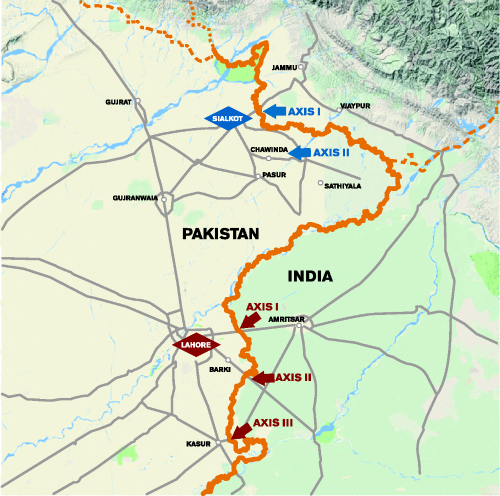
The Lahore offensive in the 1965 war was conducted by the Indian XI Corps along three main axes: astride the Grand Trunk Road leading to the heart of Lahore; going into Lahore via the village of Barki; and coming from the direction of Kasur toward Lahore on the left flank (Cloughley, 1999: 83). These three approaches to Lahore would probably be the same invasion routes taken by an Indian army today, because they still contain the few bridges of sufficient load-bearing capacity to cross the Ichogil canal inside Pakistan. Without access to these bridges, no heavy equipment such as tanks could cross the canal, making any Indian attempts to threaten Lahore futile. But if, despite the odds, Indian forces were able to cross the canal, they could pose a major threat to Lahore. Therefore, if there was one event in the Lahore offensive that was likely to provoke the use of battlefield nuclear weapons by Pakistan, it would be the act of Indian forces getting close to the main bridges over the Ichogil canal—and these locations would also be major choke points, where Indian forces would be forced to cluster together, offering a prime target for maximum destruction of the enemy.
A second scenario
Sialkot was the other significant battleground in the 1965 war. This was also the theater where Pakistan claims to have achieved its major armored victory. This city’s proximity to Kashmir made it a target for Indian actions; taking Sialkot would help choke off the supply lines of Pakistani forces operating there (Bajwa, 2013: 163). This fact of geography is still relevant. Sialkot would likely serve as one of the most important logistics hubs for Pakistani military actions in Kashmir, making it the centerpiece of any Indian military response.
The 1965 Indian offensive on Sialkot occurred along two axes: One division advanced along the Jammu-Sialkot Road passing through the Zafarwal-Bhagowal area and heading to Sialkot, while another, India’s Armored Division 1, advanced through Phillora and Chawinda (Cloughley, 1999: 83, 115). Some of most intense tank battles of the entire war, involving hundreds of tanks operating on a scale not seen since World War II, were fought in the Phillora-Chawinda region (Brines, 1968: 343; Pradhan, 2007: 51). Although a future battle would probably not unfold in exactly the same manner, the theater and the axis might well be very similar. Therefore, in the Sialkot region, Indian armored forces nearing Phillora, Chawinda, or the Zafarwal-Bhagowal area would likely trigger the use of Pakistan’s battlefield nuclear weapons.
Civilian costs of exploding one battlefield nuclear weapon inside Pakistan
Fatalities and injuries from the use of a 30-kiloton battlefield nuclear weapon1 inside Pakistan2
One 30-kiloton explosion would cause 52,160 immediate civilian deaths and 54,920 severe injuries. 6 As the Indian forces move closer to Lahore, the detonation of a single Nasr would cause progressively more deaths and injuries; a single 30-kiloton explosion within Lahore city limits would result in 377,940 deaths and 1,215,410 injuries. Of course, in reality, to genuinely destroy a larger battalion or brigade, more than one weapon would be needed. This means that in real life, the casualties would probably be much higher.
The Sialkot scenario provides a second example, particularly in the Chawinda and Phillora region where intense armored battles were conducted in the 1965 war. The explosion of two 30-kiloton weapons, with one centered in Chawinda and another in Phillora, is shown in the last row of Table 1. The explosions would cause the immediate death of 55,040 Pakistani civilians and 87,690 severe injuries.
Even these figures are probably too low, however, because tank battles are rarely fought with all the tanks in a row. The Chawinda and Phillora armored battles of 1965, for example, occurred over a large area, spread out over several days (Army Education Publishing House, 2005). If the same geographic arrangement of forces happened in the future, it is fair to argue that more than one or two battlefield nuclear weapons would be needed, meaning that the civilian casualties would be expected to go up as well.
In addition, because Indian and Pakistani forces would likely be fighting in close quarters on a shared battlefield, any explosion would probably also cause damage to personnel in the Pakistani army.
Table 1 lists the potential deaths and injuries in various axes along the Lahore and Sialkot theaters when one 30-kiloton weapon is used. The total of expected civilian deaths in Lahore and its environs when a Nasr is used in all three axes of approach—under a best-case assumption where the weapon’s use occurs immediately after Indian forces reach critical trigger points like the Ichogil canal bridges—is approximately 88,000. Using battlefield nuclear weapons later, such as when Indian forces are closer to Lahore and Kasur city, could lead to casualties as high as 500,000.
Similarly, under a best-case scenario, the explosion of a battlefield nuclear weapon in the Sialkot theater would lead to approximately 66,650 immediate deaths. Using any battlefield nuclear weapons near the city of Sialkot would rapidly increase the so-called “collateral deaths” to hundreds of thousands. That means that there could be more than 500,000 deaths from just trying to stop advances in the immediate vicinity of the Lahore-Kasur region by using the Nasr, and another 250,000 near the city of Sialkot. The casualties could be much higher if the deaths that occur later are taken into account, due to the long-term effects of radiation on the land, its people, and their food supply.
With these figures in mind, does it make sense for Pakistan to endure such large casualties to try to stop an Indian advance? Will the threat of using battlefield nuclear weapons against an advancing Indian force be considered valid, given the collateral death and damage to civilians? Does the Nasr deter India?
Pakistani leaders and scholars need to ponder this last question. Battlefield nuclear weapons do not seem to add to Pakistan’s deterrence. Indian decision makers could very well assume that Pakistani leaders would not sacrifice so much of their own population to stop an Indian operation if there were still conventional options left, whereas Pakistan might indeed be ready to do so at some threshold. The evidence and the arguments point to the conclusion that the strength of Pakistan’s nuclear deterrence against India lies not in the use of battlefield nuclear weapons, but in Pakistan’s strategic nuclear capability.
Footnotes
Acknowledgements
All civilian fatalities and injuries were calculated using the nukemap tool (http://nuclearsecrecy.com/nukemap/) hosted by Alex  .
.
Funding
This research received no specific grant from any funding agency in the public, commercial, or not-for-profit sectors.