




Abstract
In this Nuclear Notebook, the authors write about nonstrategic nuclear weapons—starting with the difficulty of finding a universal definition for them. Although the United States and Russia have reduced their nonstrategic stockpiles, significant inventories remain. And other nuclear weapons states appear to have nonstrategic nuclear weapons as well. Today, at least five of the world’s nine nuclear weapons states have, or are developing, what appears to meet the definition of a nonstrategic nuclear weapon: Russia, the United States, France, Pakistan, and China. The authors present information on the weapons at each of these arsenals.
After two decades of neglect, nonstrategic nuclear weapons are receiving new attention, with the United States and NATO seeking an agreement with Russia on reducing inventories and increasing transparency. At the same time, newer nuclear weapon states are beginning to develop nuclear weapons that appear to be intended for use in scenarios other than those normally envisioned for strategic weapons.
Today, at least five of the world’s nine nuclear weapons states have, or are developing, what appears to meet the definition of a nonstrategic nuclear weapon. Combined, we estimate that these five countries have approximately 2,800 nuclear warheads for delivery by nonstrategic nuclear-capable delivery vehicles (see Table 1).
Countries with estimated nonstrategic nuclear weapons, 2012
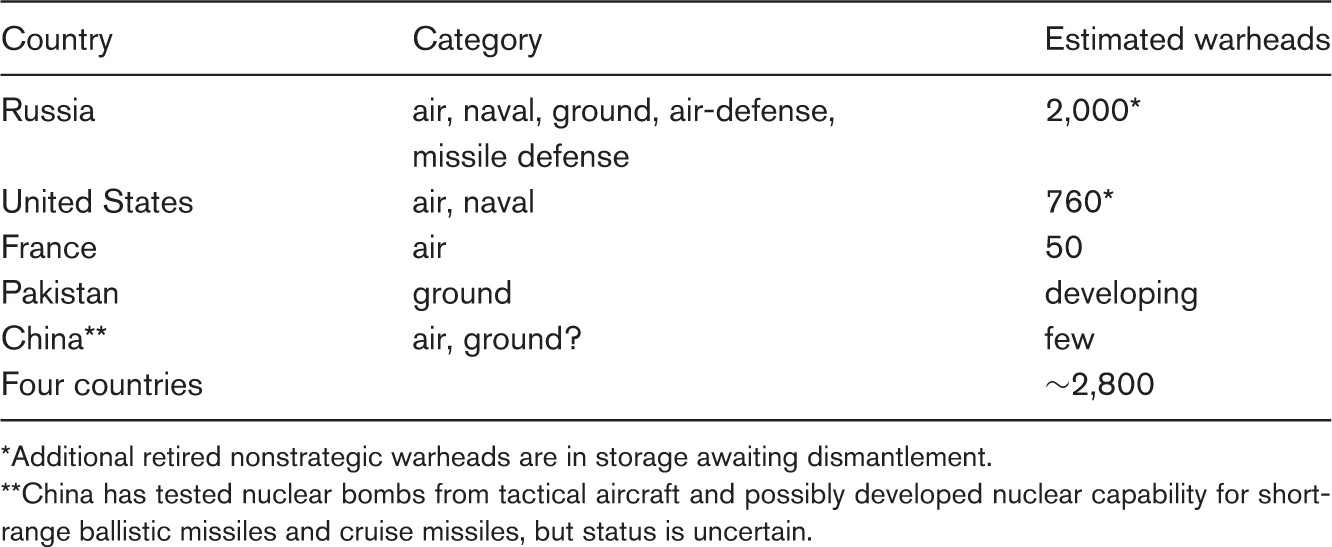
Additional retired nonstrategic warheads are in storage awaiting dismantlement.
China has tested nuclear bombs from tactical aircraft and possibly developed nuclear capability for short-range ballistic missiles and cruise missiles, but status is uncertain.
Definitions
There is no internationally agreed upon definition on what constitutes a nonstrategic nuclear weapon. Terminology varies depending on what is being described or where it is published. In addition to “nonstrategic,” frequent terms used to describe this category of weapons include “battlefield,” “short-range,” “tactical,” and “theater” nuclear weapons. While these terms sometimes help clarify matters, they also create some ambiguity or uncertainty.
One widely used definition is that a nonstrategic nuclear weapon is a weapon that is not covered by strategic arms control treaties. This may be true for Russia and the United States, but strategic nuclear weapons from other nuclear weapon states are not covered by existing arms control treaties.
A second way of defining nonstrategic nuclear weapons is by range. According to this criterion, strategic nuclear weapons have an intercontinental range, whereas nonstrategic weapons do not. But several nuclear weapon states call their nuclear weapons “strategic” even though they do not have intercontinental range.
Use of the terms “tactical” and “battlefield” nuclear weapons imply a different purpose than strategic weapons. During the Cold War, these terms referred to the potential use of nuclear weapons in so-called “war-fighting” scenarios against other military forces in a confined theater of operations (usually Europe, Korea, or at sea).
Part of the ongoing confusion stems from the fact that most nuclear terminology still derives from the Cold War and the US–Soviet relationship. This may no longer be appropriate for today’s world. But old habits die hard, and “nonstrategic” may still be deemed relevant and useful to US–Russian nuclear talks. The US Defense Department’s (2010) Dictionary of Military and Associated Terms (as of April 15, 2012) defined “nonstrategic nuclear forces” this way: Those nuclear-capable forces located in an operational area with a capability to employ nuclear weapons by land, sea, or air forces against opposing forces, supporting installations, or facilities. Such forces may be employed, when authorized by competent authority, to support operations that contribute to the accomplishment of the commander’s mission within the theater of operations.
The US Nuclear Posture Review Report from 2010 allocates considerable space to “nonstrategic” nuclear weapons but does not define what it means. The Nuclear Matters Handbook, published by the Office of the Secretary of Defense in 2011, on the other hand, clearly defines “nonstrategic” in relation to the strategic nuclear triad by declaring: “All other nuclear weapons are nonstrategic.” According to this definition, nonstrategic nuclear weapons include dual-capable aircraft, atomic demolition munitions, ground-launched cruise missiles, ground-launched ballistic missiles with ranges less than 5,500 kilometers, artillery, air-defense weapons, and nuclear depth bombs (US Defense Department, 2011).
By this definition, French cruise missiles, all Indian, Israeli, and Pakistani nuclear weapons, and most Chinese nuclear weapons (except DF-4, DF-5, DF-31, DF-31A, and JL-2) would be nonstrategic. But France, Israel, Pakistan, and China consider their weapons strategic.
Russia
There is considerable uncertainty about how many nonstrategic nuclear warheads Russia has and which delivery systems are capable of launching them. The US Defense Department refers to unspecified and unclassified estimates that Russia has approximately 2,000–4,000 nonstrategic warheads (see Creedon and Weber, 2012). We estimate that Russia has roughly 2,000 warheads assigned to nonstrategic forces, with several thousand retired warheads awaiting dismantlement (see Table 2). 1 Other analysts estimate even fewer weapons (see, for example, Sutyagin, forthcoming).
The issue of the size of the Russian inventory is important because the US Congress in 2010 made its approval of the New Strategic Arms Reduction Treaty (New START) contingent on the White House pursuing “an agreement to address the disparity between the nonstrategic (tactical) nuclear weapons stockpiles of the Russian Federation and of the United States and to secure and reduce tactical nuclear weapons in a verifiable manner.” 2 Likewise, NATO’s Strategic Concept from 2010 and the Deterrence and Defense Posture Review published in 2012 both state that any additional reductions of NATO’s nonstrategic nuclear weapons must take into account Russia’s larger inventory of such weapons. If the Russian inventory were smaller, disparity accordingly would be less of an issue.
Whatever the precise number may be, the current inventory represents a significant reduction since 1991, which estimates at the time placed between 15,000 and 21,700 nonstrategic nuclear warheads. Russian officials stated in 2005 and again in 2010 that the stockpile of nonstrategic nuclear weapons has been reduced by 75 percent. Even without a new arms reduction agreement, we anticipate that the stockpile will continue to decrease over the next decade as older systems are phased out and not replaced.
Russian nonstrategic nuclear weapons are not thought to be carried aboard delivery vehicles under normal circumstances but stored in about a dozen central storage facilities. While some of these facilities are in central Russia, others are located in the Far East, in western Russia, and on the Kola Peninsula relatively close to bases with delivery systems. 3
Air forces
At least three nonstrategic aircraft are thought to have a secondary nuclear mission: the Tu-22M3 Backfire-C, Su-24M Fencer, and Su-34 Fullback. The Backfire (Tu-22M3) can deliver AS-4 Kitchen dual-capable cruise missiles, possibly AS-16 Kickback short-range attack missiles (there are rumors the AS-16 has been retired), and gravity bombs. The two other aircraft can deliver gravity bombs. Although an improved Fencer (Su-24M) is in production, the Fullback (Su-34) is expected to replace it.
It is possible (but probably unlikely given limited resources) that other types of aircraft may be nuclear-capable, including the Su-22 Fitter, Su-25 Frogfoot, MiG-27 Flogger, Su-27 Flanker, and MiG-29 Fulcrum.
Since 1991, half of the stockpile of nuclear warheads for tactical aircraft has been destroyed, according to Russian officials. We estimate that approximately 730 warheads are currently assigned to nonstrategic aircraft, with many more scheduled for dismantlement.
Naval forces
The Russian Navy maintains a large force of more than 150 nuclear-capable ships, submarines, and anti-submarine aircraft. This includes an aircraft carrier, cruisers, destroyers, frigates, corvettes and patrol boats, ballistic missile and attack submarines, and maritime aircraft and helicopters. These platforms can deliver anti-ship cruise missiles, land-attack cruise missiles, anti-submarine rockets, surface-to-air missiles, torpedoes, and depth bombs.
Russian officials say one-third of its stockpile of naval nonstrategic nuclear weapons has been destroyed since 1991. Today, we estimate that these naval forces are assigned 700 nuclear warheads, with others in reserve for dismantlement.
Ground forces
Russia promised in 1991 to eliminate all warheads for ground-launched forces. Although probably more than 90 percent have been eliminated, we estimate that 100–200 warheads remain for Russia’s short-range ballistic missiles: SS-21 Scarab and its replacement SS-26 Iskander. Some analysts also suspect that a small number of nuclear artillery shells may still exist (Sutyagin, forthcoming). Many more warheads await retirement and eventual dismantlement.
Air-defense forces
There is considerable uncertainty about which interceptor types—used on the different versions of the S-300 air-defense system—are nuclear-capable and how many launch units are assigned a secondary nuclear mission. The US intelligence community reported in the 1980s that the SA-10 Grumble probably had nuclear capability (US Director of Central Intelligence, 1985), and IHS Jane’s credits the SA-10, SA-12, and SA-20 systems with some nuclear capability (2011).
There is also uncertainty about how many air-defense launch units are deployed. Approximately 80 S-300 air-defense unit launch sites are visible on commercial satellite imagery across Russia. Each site has an average of 4–12 launchers, each with four missiles. 4 In addition, several reloads are thought to be in storage for an inventory of more than 2,500 missiles.
Only a small portion of those missiles are assigned nuclear warheads. According to Russian officials, the inventory of nuclear warheads for air-defense systems has been reduced by 60 percent since 1991. At that time, the inventory was estimated at 3,000, according to one Russian source (Arbatov, 1999), which would leave approximately 1,200 air-defense warheads today. An American source estimated 2,700 air-defense warheads in 1991 (Norris and Arkin, 1991), which would leave nearly 1,100 warheads today. Many of the warheads in those estimates were for SA-2 and SA-5 missiles, both of which have since been scrapped, and SA-10 missiles have been almost completely replaced with SA-12 and SA-20 missiles, which appear to carry most of the nuclear air-defense mission today. We estimate that 300–400 warheads are currently assigned to air-defense forces, with many more awaiting dismantlement. Some analysts estimate fewer than 100 warheads in this category (Sutyagin, forthcoming).
Ballistic missile defense forces
Russia has about 68 nuclear-capable Gazelle (53T6) interceptors deployed in silos at five locations around Moscow as part of the A-135 missile defense system. Another 32 nuclear Gorgon (51T6) interceptors previously deployed at four sites appear to have been withdrawn from service.
In a future treaty on reductions of nonstrategic nuclear weapons, the Russian ballistic missile defense system apparently would be excluded by the US Senate condition to its New START approval: “It is the policy of the United States that such negotiations shall not include defensive missile systems” (US State Department, 2010).
Coastal defense forces
Estimated Russian nonstrategic nuclear forces, 2012
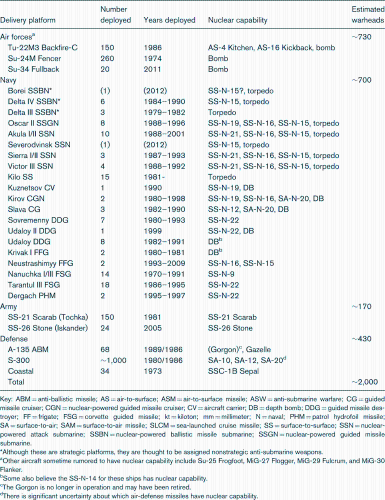
Key: ABM = anti-ballistic missile; AS = air-to-surface; ASM = air-to-surface missile; ASW = anti-submarine warfare; CG = guided missile cruiser; CGN = nuclear-powered guided missile cruiser; CV = aircraft carrier; DB = depth bomb; DDG = guided missile destroyer; FF = frigate; FSG = corvette guided missile; kt = kiloton; mm = millimeter; N = naval; PHM = patrol hydrofoil missile; SA = surface-to-air; SAM = surface-to-air missile; SLCM = sea-launched cruise missile; SS = surface-to-surface; SSN = nuclear-powered attack submarine; SSBN = nuclear-powered ballistic missile submarine; SSGN = nuclear-powered guided missile submarine.
Although these are strategic platforms, they are thought to be assigned nonstrategic anti-submarine weapons.
Other aircraft sometime rumored to have nuclear capability include Su-25 Frogfoot, MiG-27 Flogger, MiG-29 Fulcrum, and MiG-30 Flanker.
Some also believe the SS-N-14 for these ships has nuclear capability.
The Gorgon is no longer in operation and may have been retired.
There is significant uncertainty about which air-defense missiles have nuclear capability.
United States
The United States has an estimated 760 nonstrategic nuclear warheads for delivery by dual-capable aircraft and sea-launched cruise missiles. This is a reduction of more than 90 percent from its inventory of more than 6,600 nonstrategic warheads in 1991. This reduction completely eliminated ground-launched nuclear weapons and nearly de-nuclearized the Navy. The only remaining nonstrategic naval nuclear weapon—the nuclear Tomahawk land-attack cruise missile (TLAM/N)—is in the process of being retired. Once completed, the United States will have de-nuclearized three former nuclear services: the Army, Navy, and Marines.
Approximately 500 of the remaining 760 warheads are B61 gravity bombs for delivery by short-range, dual-capable aircraft: F-15E Strike Eagle, F-16 Falcon, and PA-200 Tornado. Nearly 200 of the B61s are forward deployed in Europe at six bases in five NATO countries (Belgium, Germany, Italy, the Netherlands, and Turkey). 5 A small number of bombs stored in the United States are earmarked for potential deployment to the Pacific region if directed by the president. The rest are reserve weapons.
The Obama administration is planning an expensive and significant modernization of its remaining nonstrategic nuclear arsenal. One of three nonstrategic B61 versions, the B61-4 with four selective yields ranging from 0.3 kilotons to 45 kilotons, will be “life-extended” and equipped with a new guided tail kit to increase its accuracy and be able to hold at risk the same targets as the 360-kiloton B61-7 strategic bomb. 6 Although the B61-4 is already one of the safest weapons in the US stockpile, the new version, designated the B61-12, will also be equipped with new safety and security features, although these will be fewer and less intrusive than initially envisioned. The B61-7 will be retired, as will the B61-3 and B61-10. This will result in further reduction of the nuclear stockpile and the nonstrategic nuclear arsenal.
The B61-12 will be backfitted onto F-15Es, F-16s, and Tornados initially but is primarily intended for delivery by the new stealthy F-35 Lightning II (Joint Strike Fighter) and the B-2 strategic bomber. Three of five European countries that currently have nuclear strike missions with the B61 bomb may purchase the F-35 (Italy, the Netherlands, and Turkey), but the European financial crisis could curtail those plans significantly. The cost of the B61 life-extension program has already increased from $4 billion to $10 billion, and the F-35 is seriously over budget. Adding nuclear capability to the aircraft may cost at least $340 million.
Importantly, although the B61-12 is mainly portrayed as a commitment to continuing the extended nuclear deterrent mission in Europe, the program will mark the end to designated nonstrategic nuclear bombs in the US stockpile. Currently, the stockpile plan lists the B61-3, B61-4, and B61-10 as tactical bombs and the B61-7 as a strategic bomb; in the future, there will be only the B61-12 for both nonstrategic and strategic missions.
France
The French government does not consider any of its nuclear weapons to be nonstrategic. It deploys about 50 ASMPA short-range cruise missiles for delivery by aircraft. The United States and Russia would consider them to be nonstrategic.
The issue is more than academic, because if Russia and the United States manage to negotiate a new arms reductions treaty that addresses nonstrategic nuclear weapons—perhaps even withdrawing US nonstrategic nuclear weapons from Europe and Russian nonstrategic nuclear weapons away from NATO’s borders—the French cruise missiles would be the only nonstrategic-like nuclear weapons remaining in Europe.
Pakistan
Like France, Pakistan characterizes all its nuclear weapons as strategic. However, Pakistan is developing a new short-range rocket with nuclear capability that certainly would be characterized as a nonstrategic nuclear weapon if it belonged to Russia or the United States. Moreover, even the Pakistani statements about the weapon clearly place it in a different category.
The new weapon, the Nasr, is a 60-kilometer ballistic missile launched from a mobile twin-canister launcher. Following its first test launch in April 2011, the Pakistani military news organization, Inter Services Public Relations, described the Nasr as carrying a nuclear warhead “of appropriate yield with high accuracy,” with “shoot and scoot attributes” that was developed as a “quick response system” to “add deterrence value” to Pakistan’s strategic weapons development program “at shorter ranges” in order “to deter evolving threats” (Inter Services Public Relations, 2011).
This language, which has been repeated after subsequent Nasr tests, strongly indicates a weapon with a new mission that resembles nonstrategic nuclear weapons.
China
Rumors of Chinese nonstrategic nuclear weapons have been around for a long time, but there is little reliable public information about their current status. China conducted a nuclear test in the 1960s with a nuclear bomb delivered from a fighter-bomber. It is possible, but unknown, that a few fighter-bomber squadrons may have a secondary nuclear capability today.
Likewise, the US intelligence community at various periods has assessed that a nuclear capability may have been developed for short-range ballistic missiles such as the DF-15. Moreover, the US intelligence community describes the DH-10 ground-launched cruise missile “conventional or nuclear,” a designation also used for the Russian dual-capable AS-4 cruise missile.
Footnotes
Funding
This research was carried out with a grant from the Ploughshares Fund and Carnegie Corporation of New York.