




Abstract
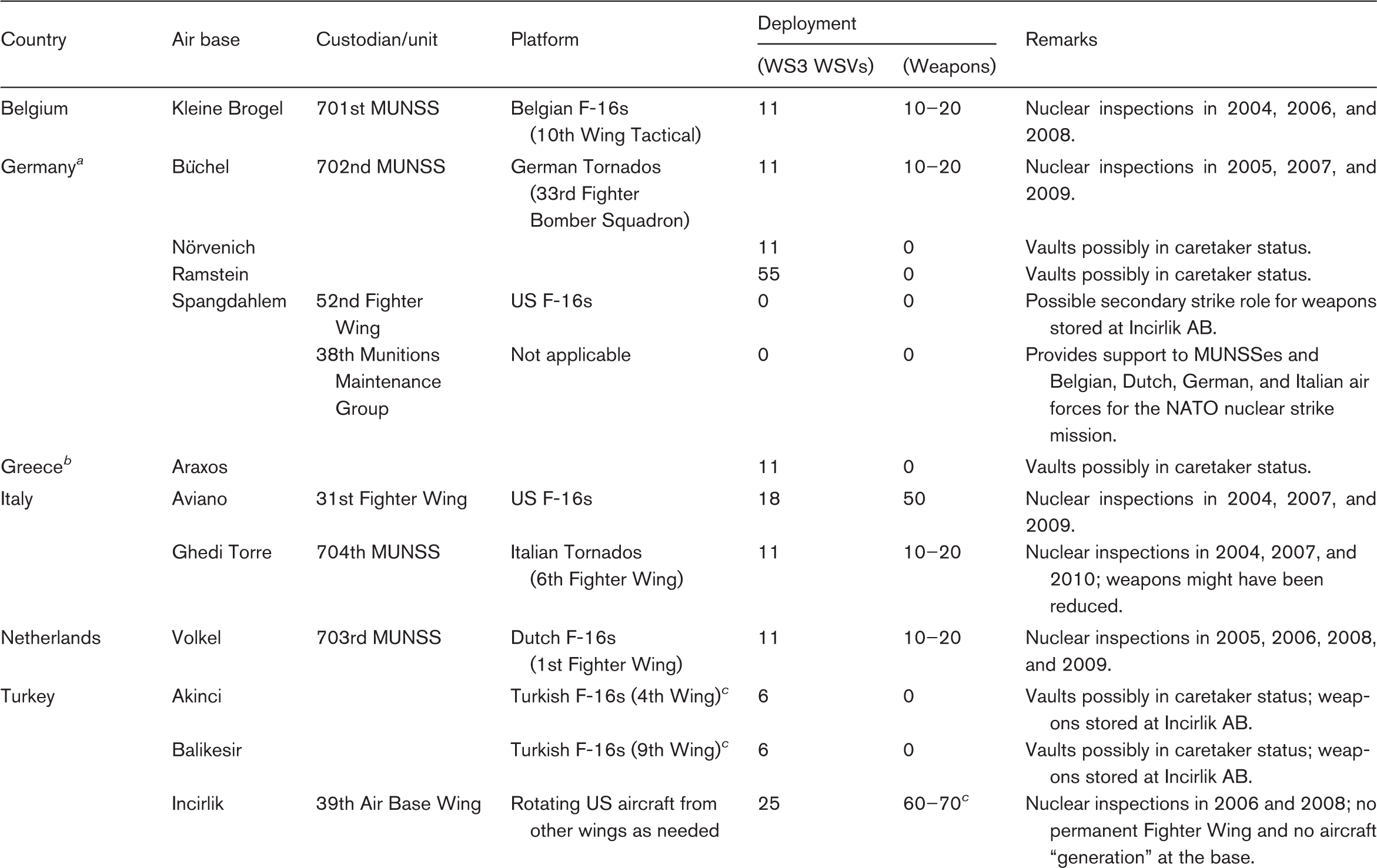
The authors write about US tactical nuclear weapons in Europe, and how NATO’s new Strategic Concept, adopted in November 2010, places less importance on these weapons. Though the current Europe-based arsenal is only a fraction of what it was at its peak in 1971, 150–200 bombs are currently deployed in Europe and stored at six bases in five countries: Belgium, Germany, Italy, the Netherlands, and Turkey. The authors present information on the weapons at each of these arsenals.
The new Strategic Concept, adopted by NATO at the Lisbon Summit in November 2010, reaffirmed the continued importance of nuclear weapons to the security of the alliance. The document, which is intended to establish consensus on NATO missions and methods in light of new security challenges, did not, however, include a decision on the fate of the roughly 150–200 B61 tactical (nonstrategic) nuclear weapons that the US Air Force deploys in Europe for the purposes of extended deterrence. Instead, the NATO countries decided to tie the fate of the deployment to reductions in the Russian tactical nuclear weapons arsenal.
In the first decade of the twenty-first century, the United States unilaterally reduced its inventory of B61 bombs deployed in Europe by more than half. 1 When the George W. Bush administration entered office in 2001, the United States had a stockpile of 480 bombs in Europe; the removal of weapons from Greece in 2001 combined with the effect of moves made under new nuclear policy guidance in 2004 reduced the stockpile to approximately 200 weapons by 2007. This included the withdrawal of weapons from two large US air bases in Europe: Ramstein in Germany and Lakenheath in the United Kingdom. It is also possible that the numbers of weapons at the US base at Incirlik in Turkey and from smaller national bases have been reduced. We estimate that the United States now deploys 150–200 B61 bombs in Europe. A reference to 180 warheads made by US Principal Deputy Under Secretary of Defense for Policy Jim Miller during a July 2009 NATO briefing appears to validate our estimate. 2
The current level represents a tiny fraction of the 1971 peak of 7,300 US tactical nuclear weapons deployed in Europe. Since then (with the exception of a period in the mid-1980s), the Europe-based arsenal has been shrinking. The most dramatic reductions occurred in 1986–87, when the United States withdrew nearly 2,000 weapons from European soil, and in 1991–93, when it removed more than 3,000 weapons (see Figure 1). A December 2008 Defense Department report on the US nuclear mission stated that the number of US nuclear weapons in Europe has been reduced “by more than 97 percent since their peak in the 1970s” (Defense Department, 2008: 59). Guy Roberts, NATO’s deputy assistant secretary-general for weapons of mass destruction policy, said in June 2010: “We only have a few hundred nuclear weapons, B61 gravity bombs, US nuclear weapons, in Europe today” (NATO Review, 2010).
US nuclear weapons in Europe.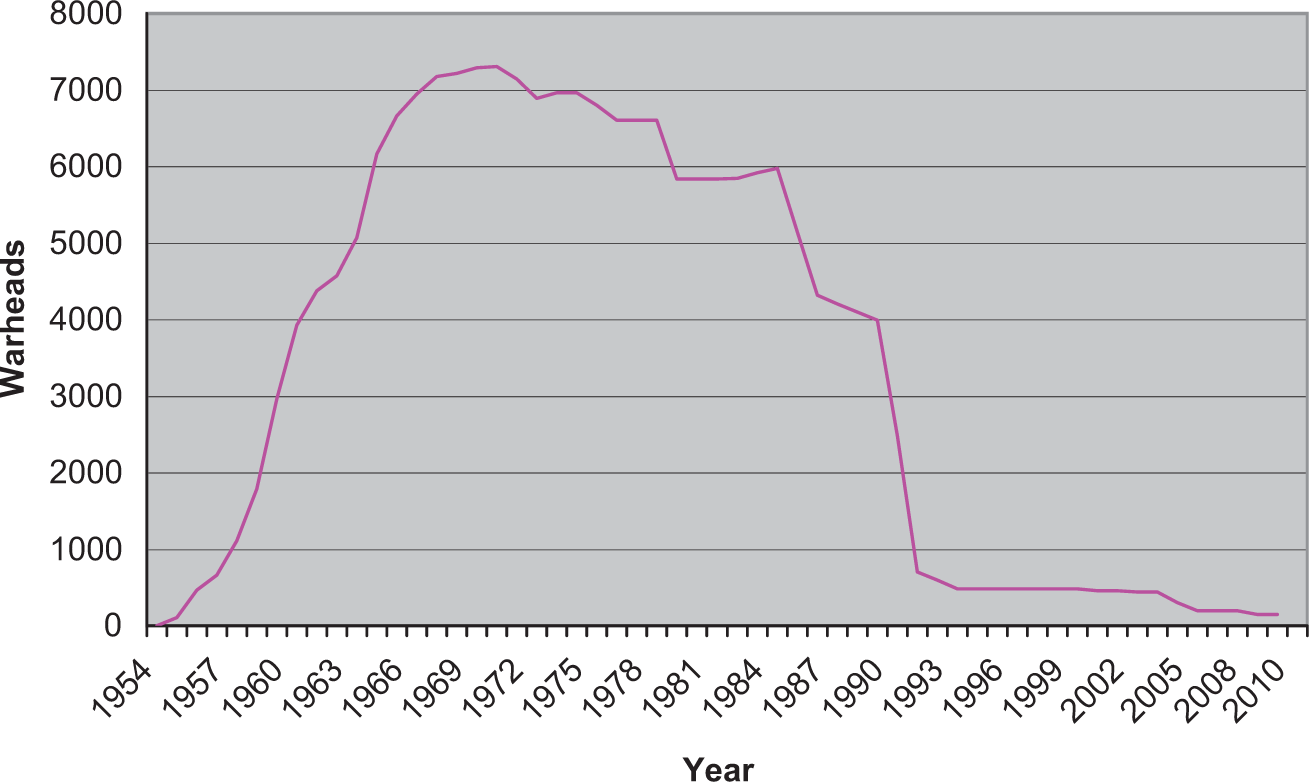
Status of US nuclear weapons in Europe, 2011
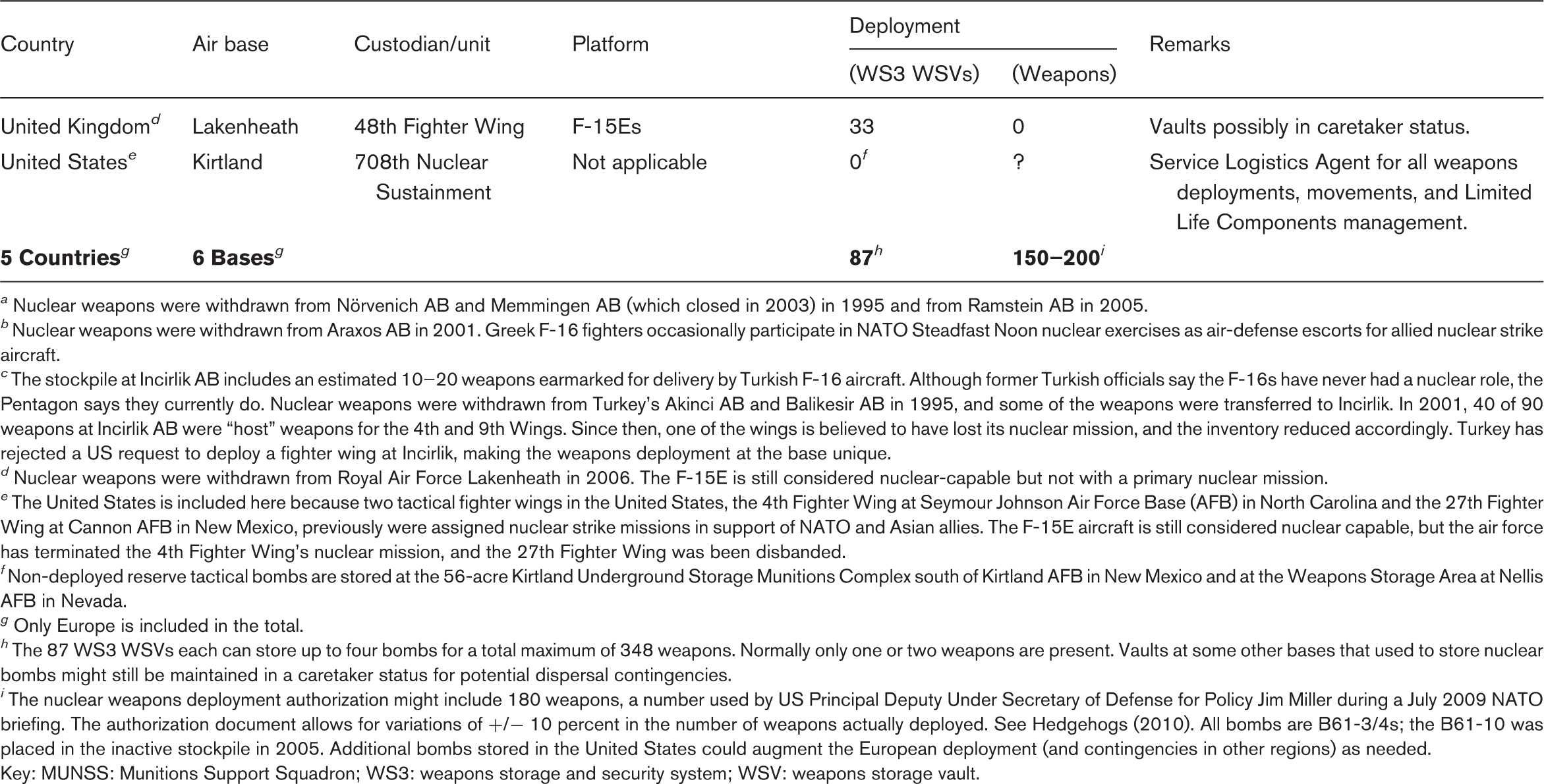
Nuclear weapons were withdrawn from Nörvenich AB and Memmingen AB (which closed in 2003) in 1995 and from Ramstein AB in 2005.
Nuclear weapons were withdrawn from Araxos AB in 2001. Greek F-16 fighters occasionally participate in NATO Steadfast Noon nuclear exercises as air-defense escorts for allied nuclear strike aircraft.
The stockpile at Incirlik AB includes an estimated 10–20 weapons earmarked for delivery by Turkish F-16 aircraft. Although former Turkish officials say the F-16s have never had a nuclear role, the Pentagon says they currently do. Nuclear weapons were withdrawn from Turkey’s Akinci AB and Balikesir AB in 1995, and some of the weapons were transferred to Incirlik. In 2001, 40 of 90 weapons at Incirlik AB were “host” weapons for the 4th and 9th Wings. Since then, one of the wings is believed to have lost its nuclear mission, and the inventory reduced accordingly. Turkey has rejected a US request to deploy a fighter wing at Incirlik, making the weapons deployment at the base unique.
Nuclear weapons were withdrawn from Royal Air Force Lakenheath in 2006. The F-15E is still considered nuclear-capable but not with a primary nuclear mission.
The United States is included here because two tactical fighter wings in the United States, the 4th Fighter Wing at Seymour Johnson Air Force Base (AFB) in North Carolina and the 27th Fighter Wing at Cannon AFB in New Mexico, previously were assigned nuclear strike missions in support of NATO and Asian allies. The F-15E aircraft is still considered nuclear capable, but the air force has terminated the 4th Fighter Wing’s nuclear mission, and the 27th Fighter Wing was been disbanded.
Non-deployed reserve tactical bombs are stored at the 56-acre Kirtland Underground Storage Munitions Complex south of Kirtland AFB in New Mexico and at the Weapons Storage Area at Nellis AFB in Nevada.
Only Europe is included in the total.
The 87 WS3 WSVs each can store up to four bombs for a total maximum of 348 weapons. Normally only one or two weapons are present. Vaults at some other bases that used to store nuclear bombs might still be maintained in a caretaker status for potential dispersal contingencies.
The nuclear weapons deployment authorization might include 180 weapons, a number used by US Principal Deputy Under Secretary of Defense for Policy Jim Miller during a July 2009 NATO briefing. The authorization document allows for variations of +/− 10 percent in the number of weapons actually deployed. See Hedgehogs (2010). All bombs are B61-3/4s; the B61-10 was placed in the inactive stockpile in 2005. Additional bombs stored in the United States could augment the European deployment (and contingencies in other regions) as needed.
Key: MUNSS: Munitions Support Squadron; WS3: weapons storage and security system; WSV: weapons storage vault.
Although the nuclear weapons are deployed at specific bases in specific countries, it is important not to think of the European deployment as fixed; a potential nuclear strike originating from a particular base would not necessarily be limited to aircraft stationed at that base. Aircraft from several bases and countries usually participate in nuclear loading and strike exercises, such as the annual Steadfast Noon. The May 2010 Steadfast Noon exercise at Aviano AB, for example, included more than 20 aircraft from seven countries. In addition to aircraft carrying nuclear bombs, a strike package would include non-nuclear fighter aircraft, electronic jamming aircraft, air-defense suppression aircraft, and tankers. A program known as SNOWCAT (Support of Nuclear Operations With Conventional Air Tactics) enables NATO countries to participate in the nuclear strike mission even if they do not have nuclear weapons on their territory or aircraft tasked to deliver the US nuclear weapons.
NATO nuclear host states
A series of intrusions at Kleine Brogel by unauthorized personnel in recent years has raised serious questions about security there and how the weapons are stored at the base. In the latest known incident, in late January 2010, activists from the peace group Vredesactie (“Peace Action”) organized a “Bombspotting” campaign in which they climbed the fences and were able to walk freely to inspect 15 of the 26 aircraft shelters before eventually being arrested by authorities. The activists believe they were able to identify 8 of the 11 shelters equipped with nuclear weapons storage vaults in two main areas of the base (Bombspotting, 2010). A similar intrusion occurred in November 2009. A Belgian defense official insisted that the activists “never, ever got anywhere near a sensitive area,” and that it would be “another cup of tea” if they approached “sensitive areas” (Dougherty, 2010).
If the official is correct, then the absence of immediate security force intervention would suggest that the 11 shelters the activists missed include the three vaults holding nuclear weapons. Three vaults could potentially store 12 weapons, but it is hard to believe that the activists happened to miss exactly the three vaults with weapons. Possible explanations that could account for the apparently lax security include a permissive security culture at the base, overconfidence in the intrinsic security provided by the underground vaults, a decision to ignore the activists in order not to reveal the actual location of weapons, or that Kleine Brogel no longer stores nuclear weapons. The continued presence of the 701st MUNSS suggests that weapons are still stored there; however, the slow response by security forces does not bestow confidence in the security of US nuclear weapons in Europe.
The German government has decided to retain the Tornado aircraft through 2020. Although it is not clear if this includes the aircraft at Büchel AB, the Ministry of Defense rebutted a report in the Rheinische Post in October 2010 that all Tornados would be retired by 2013, saying the aircraft would be maintained through 2020 and that a final retirement date has not been decided (German Ministry of Defense, 2010). Germany’s next-generation strike aircraft, the Eurofighter, is not equipped to carry nuclear weapons, and Berlin is not believed to have plans to acquire replacement aircraft for the nuclear mission.
Another 10–20 B61s are believed to be stored at Ghedi Torre AB, for delivery by Italian PA-200 Tornado aircraft of the 6th Fighter Wing; the weapons at Ghedi Torre AB are under custody of the US Air Force 704th MUNSS. A decade ago, the base stored 40 bombs, but it is likely that the inventory has been reduced to match the deployment at other national bases.
The Italian Tornado is expected to begin retiring sometime after 2015, to be replaced by the F-35 Joint Strike Fighter (JSF), a US aircraft intended to provide an affordable option to the US and allied armed forces. Italy is tentatively scheduled to receive its first four JSFs in 2014, with additional deliveries slated through 2025, for a total of 131 aircraft (Defense Department, 2010b); approximately 109 aircraft will go to the Italian Air Force. Severe budget constraints may delay or curtail Italy’s participation in the program.
The Dutch F-16s are scheduled for replacement by the F-35 JSF. In 2011, the first of two test aircraft are scheduled for delivery, with full versions following from 2014 through 2023 (Defense Department, 2010b); a small portion of the aircraft delivered after 2018 would be nuclear-capable. However, uncertainty about Dutch participation in the program erupted in mid-2010, when the Dutch minister of defense asked officials of the US Joint Strike Fighter Program to prepare options to take into account possible cancellation of the two test aircraft (Wall, 2010). The Netherlands originally ordered 85 F-35s, but a final procurement decision has now been delayed until after the general election in 2014, with the number of aircraft reduced to fewer than 85.
The remaining 10–20 bombs at Incirlik AB are earmarked for delivery by Turkish F-16A/Bs. Until 1995, Akinci AB in central Turkey and Balikesir AB in western Turkey also stored US nuclear weapons for delivery by the 4th Wing and 9th Wing, respectively, but after the US MUNSS at each base was withdrawn, the bombs (about 40 weapons) were moved to Incirlik. Since then, the number of “Turkish” bombs at Incirlik AB has probably been reduced to 10–20 weapons to correspond to the inventories at other national bases, and one of the two wings lost its nuclear mission.
Turkey’s F-16s are slated to be replaced by JSFs beginning in 2015, when the first six aircraft are scheduled to be delivered. The Turkish Air Force is scheduled to receive a total of 100 JSFs through 2025 (Defense Department, 2010b).
There are conflicting reports about the status of the Turkish nuclear mission. Gen. Ergin Celasin, former commander (until 2001) of the Turkish Air Force, is on record stating that Turkey’s role in the NATO nuclear strike mission ended in the 1990s with the withdrawal of weapons from the national Turkish bases (Kibaroglu, 2010). In contrast, according to Pentagon sources, Turkey currently uses its F-16s to execute the nuclear mission. Moreover, until Turkey acquires a sufficient number of nuclear-capable JSFs over the 15 years, its F-16s are scheduled to receive a “stop-gap” upgrade to make them capable of carrying the new B61-12 bomb that will replace the B61-3/4 beginning in 2017.
The confusion about Turkey’s status may have to do with the aircraft’s degree of nuclear readiness, which has changed over time, ranging from full alert in the 1980s, to withdrawal from national bases in the 1990s, to today’s “pick up the weapons at Incirlik if needed” posture. During these phases, the aircraft status changed from nuclear-capable, certified, and loaded, to nuclear-capable and certified, to nuclear-capable. Today, the Turkish aircraft are nuclear-capable (according to US sources) but neither loaded nor certified. This, combined with the absence of a US wing at Incirlik AB, underscores the special status of the Turkish posture.
US tactical nuclear forces: Changes and modernization
The United States also has made significant changes to its tactical nuclear forces over the last decade. In addition to withdrawing nuclear bombs from Ramstein AB and Lakenheath AB, the US Air Force has reduced its tactical fighter wing capacity in the United States. During the late 1990s and the first part of the George W. Bush administration, the Air Force maintained two tactical fighter wings in the United States as a backup to nuclear contingencies in NATO, the Middle East, and Northeast Asia: the 4th Fighter Wing at Seymour Johnson Air Force Base (AFB) in North Carolina, and the 27th Fighter Wing at Cannon AFB in New Mexico. The F-15Es of the 4th Fighter Wing are still considered nuclear-capable aircraft, but the wing no longer has a primary nuclear mission; the 27th Fighter Wing has been disbanded and replaced with the non-nuclear 27th Special Operations Wing.
In addition, the Obama administration announced its decision in the 2010 Nuclear Posture Review (NPR) to retire the nuclear Tomahawk land-attack sea-launched cruise missile (TLAM/N). Approximately 320 TLAM/Ns have been in storage since they were offloaded from the US fleet in 1992. Surface ships lost the capability to carry and launch the weapon in 1994, but the missiles were retained for potential redeployment on a limited number of attack submarines. Approximately half of the TLAM/Ns were earmarked for NATO support, but the 2010 NPR stated that the weapon was redundant and that other nuclear capabilities could adequately provide for the nuclear portion of the extended deterrence mission in support of NATO.
The NPR announced the US decision to equip a portion of the F-35 JSF aircraft (Block IV) with a nuclear capability to eventually replace F-15E and F-16 aircraft starting in 2017–18. As mentioned above, three states with a NATO nuclear strike mission—Italy, the Netherlands, and Turkey—are planning to acquire JSF aircraft over the next 15 years. The United States will begin funding the JSF Block IV in 2011–12; the nuclear capability is expected to cost several hundred million dollars.
Because the JSF is equipped with computer software that is incompatible with the B61-3/4 bombs currently deployed in Europe (and to extend the B61 service life), the Pentagon is planning to build a new version of the B61 bomb: the B61-12. The NPR concluded that the United States should proceed with “full scope life extension of the B61” (Defense Department, 2010c: xiii). The B61-12 will be based on the B61-4 design but will also incorporate features from the B61-3, B61-7, and B61-10 bombs. The B61-12 will have new safety and security features in addition to those that are already installed on the B61 family, some of the safest nuclear weapons in the US stockpile.
The production of a nuclear-capable JSF and a B61-12 bomb, according to the NPR, “ensure[s] that the United States will retain the capability to forward-deploy non-strategic nuclear weapons in support of its Alliance commitments” (Defense Department, 2010c: 27) if necessary.
The political context
NATO’s new Strategic Concept leaves the door open for the full removal of the remaining US tactical nuclear weapons from Europe. Several NATO member countries have called for a review of NATO nuclear weapons policy; Germany has explicitly called for withdrawal, and the overwhelming majority of NATO countries have supported UN resolutions calling for a reduction of tactical nuclear weapons.
It is noteworthy that several major recent policy reviews—the Quadrennial Defense Review, the Ballistic Missile Defense Review, the Nuclear Posture Review, and the report of the Group of Experts led by Madeleine Albright—did not explicitly call for the continued deployment of US tactical nuclear weapons in Europe. All emphasized the importance of providing extended deterrence to the allies, but this does not necessarily require nuclear weapons deployed in Europe.
Even the decision in the 2010 NPR to proceed with production of a nuclear-capable JSF and a new B61 bomb leaves room for the possibility of withdrawal: “These decisions do not presume the results of future decisions within NATO about the requirements of nuclear deterrence and nuclear sharing, but keep open all options” (Defense Department, 2010c: 27–28).
The Obama administration envisions “new, tailored, regional deterrence architectures that combine our forward presence, relevant conventional capabilities (including missile defenses), and continued commitment to extend our nuclear deterrent. These regional architectures and new capabilities … make possible a reduced role for nuclear weapons in our national security strategy” (Defense Department, 2010a: 14).
Compared to NATO’s 1999 document, the new Strategic Concept is significantly different in that it places less importance on US tactical nuclear weapons in Europe. Gone is the previous message that these weapons provide an essential military and political link between Europe and North America. Instead, the new Strategic Concept states that it is the strategic forces of the United States, in particular—and to some extent Britain and France—that provide the “supreme guarantee of the security of the Alliance” (NATO, 2010).
The new document commits to some form of US nuclear presence in Europe by designating “the broadest possible participation of Allies in collective defence planning on nuclear roles, in peacetime basing of nuclear forces, and in command, control and consultation arrangements” (NATO, 2010; emphasis added). But the new language is much more vague than that found in the 1999 document, and could simply be met by the allies’ participation in Nuclear Planning Group meetings, deployment of some US dual-capable aircraft in Europe (without weapons), and the allies’ continued involvement in the SNOWCAT program.
Unfortunately, the new Strategic Concept makes further reductions in US nuclear weapons in Europe conditional on Russian reciprocity. “In any further reductions, our aim should be to seek Russian agreement to increase transparency on its nuclear weapons in Europe and relocate these weapons away from the territory of NATO members. Any further steps must take into account the disparity with the greater Russian stockpiles of short-range nuclear weapons” (NATO, 2010).
While there are many good reasons for wanting reductions to the Russian tactical arsenal and increased transparency, NATO has in fact—on several occasions since the end of the Cold War—been willing to unilaterally reduce the number of US weapons in Europe without making it conditional upon Russian reciprocity. NATO has done so while arguing that its weapons were not directed against Russia. Arguing now that a US withdrawal from Europe is suddenly dependent on Russian reductions after all seems to turn back the clock to a time when the Soviet Union was the enemy and NATO looked to the east when sizing its nuclear posture in Europe.
Just how the language in the new Strategic Concept will affect the US nuclear posture in Europe will depend on the result of a “deterrence review” that NATO plans to undertake in 2011.
Footnotes

2
3
The Protective Aircraft Shelters are sometimes also referred to as Hardened Aircraft Shelters.
Auhtor biographies