




Abstract
The Obama administration’s disclosure of its stockpiled and dismantled warhead numbers through September 2009 was, apparently, a “one-time release”; thus, the question remains as to how quickly—or slowly—the country’s arsenal will decline. Turning to the Nuclear Posture Review and New START, the authors assess what can be expected in terms of force levels and counting rules, and they provide clear analysis of US land-based ballistic missiles, ballistic missile submarines, strategic bombers, and nonstrategic nuclear weapons.
Keywords
The US nuclear arsenal continues to decline, but more slowly than one might think, given the president’s stated commitment to disarmament. Moreover, during its first two years in office, the Obama administration has increased funding for nuclear weapons and pledged to modernize the nuclear arsenal and production complex. As of January 2011, the United States maintained an estimated 2,150 operational warheads. The arsenal comprises roughly 1,950 strategic warheads deployed on 798 strategic delivery vehicles, and up to 200 nonstrategic warheads deployed in Europe. In addition, the United States holds approximately 2,850 warheads in reserve, for a total stockpile of about 5,000 warheads. Several thousand other warheads, probably around 3,500, have been retired from the military stockpile and await dismantlement (see Table 2, on page 74).
Following the Obama administration’s unprecedented May 2010 disclosure of stockpiled and dismantled warhead numbers through September 2009, the administration returned to the earlier policy of secrecy by declining to disclose numbers for September 2010 (Defense Department, 2010b, 2010c). The transparency was a “one-time release,” according to one official. The administration has also declined to specify the number of warheads awaiting dismantlement. 1
Effect of Nuclear Posture Review and New START
During congressional hearings on the New Strategic Arms Reduction Treaty (New START) between the United States and Russia, the Obama administration provided additional information about how the treaty and the new US Nuclear Posture Review (NPR) will affect US nuclear policy and forces over the next decade. Modest reductions in the number of deployed strategic warheads and delivery vehicles can be expected, but the planned cutbacks are a far cry from the “deep cuts” and “dramatic” reductions that Barack Obama promised during his election campaign (Obama for America, 2007, 2008: 71). Nor does the NPR appear to meet Obama’s pledge, made in his renowned April 2009 Prague speech, to “reduce the role of nuclear weapons in our national security strategy” to “put an end to Cold War thinking” (White House, 2009).
Instead, the NPR reaffirms the importance and role of nuclear weapons in US national security strategy. The NPR specifically recommends: retaining a triad of long-range offensive nuclear forces, maintaining the current high-alert readiness level of hundreds of ballistic missiles, retaining large numbers of nuclear warheads in reserve to increase the deployed force if necessary, modernizing nuclear delivery vehicles and warheads, building new warhead production factories, rejecting a no-first-use policy (for now), and continuing nuclear strike planning against non-nuclear adversaries.
In terms of the US nuclear force structure, the administration decided (Senate Committee on Foreign Relations, 2010: 46) on the following force composition:
up to 420 deployed intercontinental ballistic missiles (ICBMs), each carrying a single nuclear warhead, with hundreds of additional warheads in reserve for potential uploading; 14 nuclear-powered ballistic missile submarines (SSBNs)—possibly reduced to 12 toward the end of the decade—with as many as 240 deployed submarine-launched ballistic missiles (SLBMs), each carrying multiple nuclear warheads, with hundreds more in reserve for uploading; up to 60 nuclear-capable heavy bombers equipped for gravity bombs and cruise missiles, with hundreds of warheads in reserve available for uploading.
Estimated US deployed strategic nuclear weapons 2011, 2018
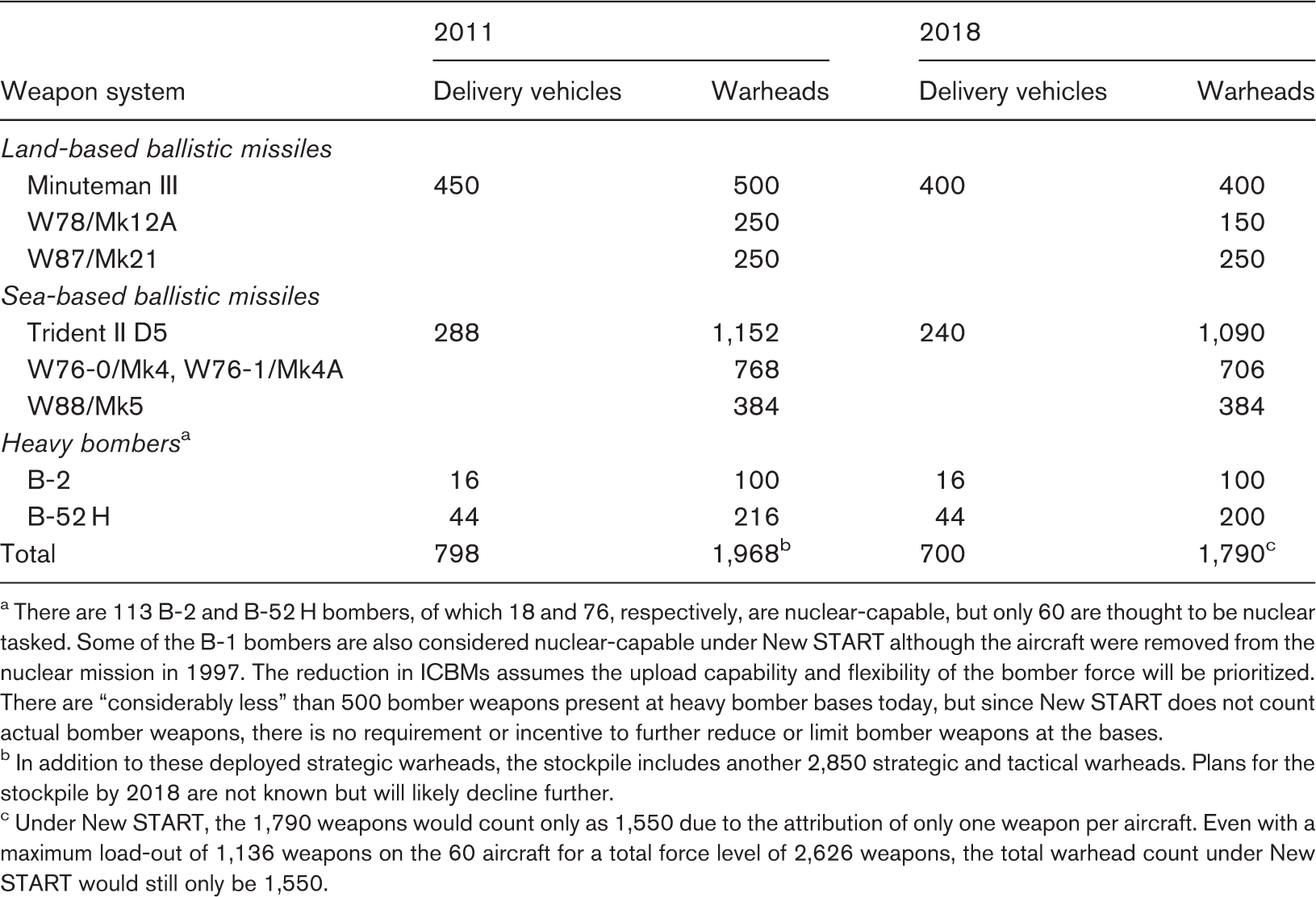
There are 113 B-2 and B-52 H bombers, of which 18 and 76, respectively, are nuclear-capable, but only 60 are thought to be nuclear tasked. Some of the B-1 bombers are also considered nuclear-capable under New START although the aircraft were removed from the nuclear mission in 1997. The reduction in ICBMs assumes the upload capability and flexibility of the bomber force will be prioritized. There are “considerably less” than 500 bomber weapons present at heavy bomber bases today, but since New START does not count actual bomber weapons, there is no requirement or incentive to further reduce or limit bomber weapons at the bases.
In addition to these deployed strategic warheads, the stockpile includes another 2,850 strategic and tactical warheads. Plans for the stockpile by 2018 are not known but will likely decline further.
Under New START, the 1,790 weapons would count only as 1,550 due to the attribution of only one weapon per aircraft. Even with a maximum load-out of 1,136 weapons on the 60 aircraft for a total force level of 2,626 weapons, the total warhead count under New START would still only be 1,550.
New START limits the number of deployed delivery vehicles to 700. It is not yet publicly known whether the Air Force will choose to retire additional ICBMs or bombers from the nuclear mission to meet this requirement, but because the treaty limits do not have to be met until 2018 (New START supersedes the Moscow Treaty) there is ample time to make adjustments. SLBMs and heavy bombers would be the main platforms for uploading reserve warheads in a crisis, a decision that would require the United States to withdraw from the treaty.
Nuclear weapons modernization and production
The Obama administration has made it clear that the United States intends to remain a nuclear weapon state for the foreseeable future. Over the next decade, the Defense Department says it “will invest well over $100 billion in nuclear delivery systems to sustain existing capabilities and modernize some strategic systems” (Senate Committee on Foreign Relations, 2010: 87). In addition, the administration increased by nearly 10 percent its funding request for the nuclear weapons activities of the Energy Department’s National Nuclear Security Administration (NNSA) in fiscal 2011 and by another 8.4 percent for fiscal 2012. The NNSA plans to spend more than $92 billion over the next decade on maintaining and modernizing nuclear warheads and production facilities (NNSA and Defense Department, 2010: 1, 2, 9). Under current plans, all existing warheads will undergo life extension programs and either be equipped with new (in some cases improved) components or significantly modified. Three production facilities will be built to produce and maintain nuclear warheads: the Uranium Processing Facility in Oak Ridge, Tennessee; the Chemistry and Metallurgy Research Replacement (CMRR) Nuclear Facility in Los Alamos, New Mexico; and the Kansas City Plant. These and other nuclear-related construction projects are estimated to cost $180 billion through 2030 (Kristensen, 2010b).
The CMRR facility will have the capacity to produce up to 80 plutonium pits for replacement warheads each year, a total 10 times greater than the number of warheads lost annually to stockpile stewardship-related testing. The NPR promises this extra capacity will allow for a “substantial” reduction of the nuclear stockpile: “By modernizing our aging nuclear weapons-supporting facilities and investing in human capital, we can substantially reduce the number of stockpiled nuclear weapons we retain as a hedge against technical or geopolitical surprise, accelerate the dismantlement of nuclear weapons no longer required for our deterrent, and improve our understanding of foreign nuclear weapons activities” (Defense Department, 2010a: 7).
Extensive life extension and modernization programs for all current nuclear warhead types will provide a sizable workload for the US nuclear complex for the next several decades. The NPR states that the United States “will not develop new nuclear warheads” but will consider the “full range” of life extension program (LEP) options: “refurbishment of existing warheads, reuse of nuclear components from different warheads, and replacement of nuclear components” (Defense Department, 2010a: xiv).
The NPR states that LEPs “will only use nuclear components based on previously tested designs, and will not support new military capabilities” (Defense Department, 2010a: xiv). The first part of that pledge is intended to preclude US resumption of live nuclear testing and therefore ensure US adherence to the Comprehensive Test Ban Treaty. The second part of the pledge, pertaining to no “new military capabilities,” hinges on what is meant by “new.” For example, installing a new arming, fuzing, and firing (AF&F) unit, as several of the LEPs plan to do, can significantly improve the military capability of an existing warhead—but the resulting warhead is not considered new.
2
Several warhead LEPs are scheduled across the coming decades:
W76 strategic warhead. Production of W76-1 warheads will continue through 2017, extending service for another 30 years and adding new nuclear safety features as well as expanding targeting options with the new AF&F unit.
B61 bomb. Production is set for 2018–21 and will consolidate the B61-3/4 tactical bombs and B61-7 strategic bomb into a new B61-12 bomb with a nuclear explosive package based on the B61-4; will also add new AF&F and surety features.
W78 strategic warhead. Production is slated for 2021–25 and will add new AF&F and surety features; will possibly be combined with the W88 LEP into a common warhead.
3
W88 strategic warhead. Production is estimated for 2026–30 and will add new surety features; an emergency AF&F replacement is scheduled for 2018–20.
W80-1 cruise missile warhead. Production is estimated for 2031–35 as the W80-2, probably adding new AF&F and surety features.
B83-1 strategic bomb. Production is estimated for 2026–40, probably adding new AF&F and surety features, and possibly will be combined with B61-11.
W87 strategic warhead. Production estimated for 2041–45, probably adding new AF&F and surety features.
Nuclear war planning and organization
The maintenance of the US strategic war plan—called Operations Plan (OPLAN) 8010 Strategic Deterrence and Global Strike—continued in 2010, along with the maintenance of regional strike plans in support of NATO and other allies. To increase NATO participation in US nuclear force planning in support of the alliance, representation was established at US Strategic Command (STRATCOM) to allow for “substantive participation … on a daily and continuing basis” from NATO and UK personnel in “OPLAN 8010 nuclear-related information in support of NATO operations” (US Chairman of the Joint Chiefs of Staff, 2008: A1, A2). In November 2010, STRATCOM conducted the Global Thunder nuclear exercise to test the readiness of ICBMs, SLBMs, long-range bombers, refueling aircraft, and command and control. In recent years, STRATCOM has expanded Global Thunder from a command post exercise to a full nuclear employment exercise that includes force generation and flying operations. 4
The US Air Force Global Strike Command (AFGSC)—the first completely new command activated by the air force in 27 years—achieved full operational capability on September 30, 2010 after having taken command of all US ICBMs and heavy bombers previously organized under US Space Command and Air Combat Command, respectively. 5 Centralizing the air force strategic nuclear assets under a single command was a reaction to the 2007 incident at Minot Air Force Base (AFB) in North Dakota in which six nuclear cruise missiles were unknowingly loaded onto a B-52 bomber and flown to Barksdale AFB in Louisiana.
The 798th Munitions Maintenance Group (MUMG) assumed command at Minot AFB on July 12, 2010 and will provide maintenance, handling, and control of the ICBM force for the AFGSC. The 498th MUMG at Whiteman AFB in Missouri oversees the bombers, commands the 898th Munitions Squadron and the 708th Nuclear Sustainment Squadron at Kirtland AFB in New Mexico, and is subordinate to the 498th Nuclear Systems Wing at Kirtland, which is responsible for the maintenance of nuclear bombs and cruise missiles.
The air force conducts approximately 10–14 nuclear surety inspections at its nuclear units each year.
Land-based ballistic missiles
The 2010 NPR determined that the United States will retain 400–420 ICBMs under New START. The force currently consists of 450 missiles with 500 warheads. The missiles equipped with multiple warheads will be downloaded to carry one warhead each within the next few years; however, the ICBM force’s capability to carry multiple independently targetable re-entry vehicles (MIRVs) will be retained, leaving open the possibility of uploading hundreds of reserve warheads if necessary.
The 450 ICBMs are organized across three wings: the 90th Missile Wing at F.E. Warren AFB in Wyoming; the 91st Missile Wing at Minot AFB; and the 341st Wing at Malmstrom AFB in Montana. Each wing has 150 missiles in three squadrons, each with 50 missiles controlled by five Launch Control Centers. Whether the treaty-based reduction of 30–50 missiles will occur at one of the wings or be spread across all three bases is not publicly known.
The last W62 warhead was dismantled on August 11, 2010, leaving only W78 and W87 warheads on the ICBM force; the more powerful W87/Mk-21 re-entry vehicle replaced the W62 (NNSA, 2010). Compared with the 170-kiloton (kt) W62, the 300-kt W87 broadens the range of targets that the Minuteman ICBM force can hold at risk.
A multibillion-dollar modernization program is under way to extend the service life of the Minuteman III ICBM to 2030. The NPR stated that an initial “Study of Alternatives” will begin this year or in 2012 to consider a range of possible deployment options for a replacement missile. Specifically, the NPR states that the United States will: “Explore new modes of ICBM basing that could enhance survivability and further reduce any incentives for prompt launch. The assessment will be part of the Department of Defense’s study of possible replacements for the current ICBM force” (Department of Defense, 2010a: 23, 27). In 2014, Defense will recommend to the president a follow-on ICBM (NNSA and Defense Department, 2010).
The air force conducted two Minuteman III flight-tests in 2010, the same number as in 2009. A Minuteman III, probably from F.E. Warren AFB, was launched on June 16 from Vandenberg AFB in California, delivering a single re-entry vehicle more than 6700 kilometers (4160 miles) to an impact point near Kwajalein in the Pacific Ocean. On September 17, a Minuteman III, picked randomly from the 91st Missile Wing at Minot AFB, was test-launched from Vandenberg AFB on an extended flight with a single re-entry vehicle some 8,530 kilometers (5,300 miles) to an impact point southwest of Guam.
In addition to these two flight-tests, several simulated launch exercises were carried out at operational ICBM bases. The AFGSC conducts Simulated Electronic Launch Minuteman (SELM) tests twice each year; the first 2010 SELM under the new command was held at Minot AFB in June. On September 8 and 9, the 341st Missile Wing at Malmstrom AFB conducted multiple tests as part of a SELM exercise to test the operational readiness of the ICBM force.
Ballistic missile submarines
The US Navy has 14 Ohio-class SSBNs: eight based in the Pacific, six in the Atlantic, all of which carry Trident II D5 SLBMs. Twelve of these SSBNs are operational. Each of these subs can carry up to 24 SLBMs, for a total of 288 D5 missiles; each missile is estimated to carry four warheads, for a total of approximately 1,152 warheads. The navy’s other two SSBNs are undergoing overhaul at any given time; their 48 missiles and 192 warheads are not included as “operationally deployed warheads” in treaty accounting. More than 60 percent of US SSBN patrols take place in the Pacific, reflecting nuclear war planners’ shift in focus toward China and other potential adversaries in the Pacific region.
The NPR decided that the United States would retain up to 240 deployed SLBMs distributed among 14 submarines, each of which will have 20 launch tubes—four fewer than the current 24. According to New START, a “deployed SLBM” is defined as “an SLBM that is contained in a deployed launcher of SLBMs.” The treaty defines “deployed launcher of SLBMs” as “an SLBM launcher installed on a submarine that has been launched from port, that contains an SLBM, and is not intended for testing or training” (State Department, 2010). In other words, an SSBN that does not carry an SLBM is not counted against the treaty limit. This means that warheads are not counted for SLBMs that have been offloaded from an SSBN that is in overhaul, even though the missiles and their associated warheads exist and can be redeployed relatively quickly. Likewise, the missiles for an SSBN are not counted against the limits for deployed or non-deployed SLBM launchers.
The navy is planning to replace the Ohio-class SSBNs with 12 new submarines, currently designated as SSBN(X), at a cost of $60–$80 billion. Construction is scheduled to begin in 2019 with launch of the first boat in 2026 and entry into service from 2029, after the first two Ohio-class SSBNs are retired. Each new SSBN class submarine will carry 16 missiles to enable more submarines to operate under future arms control agreements and to ensure operational flexibility. The SSBN(X) will initially carry the D5LE SLBM, a life-extended version of the D5.
The navy plans to purchase 108 D5LEs through 2012 at a cost of nearly $21.5 billion, and it procured 24 of them in 2010. The first D5LE was scheduled for deployment in 2010, but there have been no reports that this happened. The modified D5 will arm the Ohio-class SSBNs for the rest of their service lives through 2042.
Deployment continues of the W76-1/Mk-4 A warhead (a modernized version of the W76/Mk-4), which arms the D5. Roughly 38 percent of the original W76 inventory will be refurbished through 2018, corresponding to approximately 1,200 warheads. 6
During 2010, four D5 SLBMs were test-launched in the Atlantic on two consecutive days in June, all from the Maryland SSBN. The fourth launch marked the 134th consecutive successful flight-test of the D5 since 1989.
Strategic bombers
The air force possesses 20 B-2 and 93 B-52 H bombers, of which 18 and 76, respectively, are nuclear-capable. Of these, only 16 B-2 s and 44 B-52 s are thought to be fully nuclear certified. Some B-1 bombers are also counted as nuclear-capable under New START, even though they were removed from the nuclear mission in 1997. The NPR recommended that some nuclear-capable B-52 s should be converted to a conventional-only role.
The nuclear bombers are organized in six squadrons in three wings at three bases: the 20th and 96th bomb squadrons of the 2nd Bomb Wing at Barksdale AFB; the 23rd and 69th bomb squadrons of the 5th Bomb Wing at Minot AFB; and the 13th and 393rd bomb squadrons of the 509th Bomb Wing at Whiteman AFB.
We estimate that approximately 300 nuclear warheads are deployed with the bombers at the three bases, including B61-7, B61-11 (for B-2 s only), and B83-1 gravity bombs, as well as W80-1 warheads carried on air-launched cruise missiles (ALCMs, for B-52Hs only). Hundreds of additional bombs and cruise missiles are kept off-base in central storage and could be returned to the bases if necessary; as mentioned above, New START provides little incentive to limit bombs and cruise missiles at the bases.
The air force acquired its first B-52 H in 1961; it intends to keep the bomber in its inventory through at least 2035 for both nuclear and conventional missions. A long-range study will be completed early this year to identify future options for a replacement bomber, with approximately $1.7 billion earmarked for the project through 2015. The air force also intends to replace the ALCM, which only the B-52 H carries and is scheduled to be retired in 2030, with the advanced long-range standoff nuclear cruise missile. Studies will be conducted through 2013 with the goal of beginning initial production around 2025 (NNSA and Defense Department, 2010: 11–12).
A $1 billion modernization program is under way to install advanced electronically scanned array antennas on the B-2 bombers. The first B-2 fitted with the new radar was delivered in March 2009; the last of 20 aircraft will be delivered this year.
Heavy bombers conducted several nuclear exercises in 2010, including participation in the Prairie Vigilance aircraft rapid-launch exercises in May and October and the Global Thunder exercise in November.
In its first deployment since activation in September 2009, the 69th Bomb Squadron of the 5th Bomb Wing at Minot AFB deployed to Guam in November 2010 for a six-month overseas deployment to the western Pacific. The squadron was added to the 5th Bomb Wing after the 2007 Minot incident to allow B-52 bomber squadrons to improve their nuclear proficiency by focusing on the nuclear strike mission for six-month intervals. Before deploying, the squadron passed an operational nuclear readiness inspection. “We have been focusing on nuclear operations at this base [Minot] for a long time,” said the commander of the squadron deploying to Guam, “but we hope to have a lot more training through exercises with our joint and combined forces in Guam” (Hernandez, 2010).
Nonstrategic nuclear weapons
The US inventory of nonstrategic nuclear weapons has been reduced over the past few years due to the retirement of the W84 warhead, the removal of some bombs deployed in Europe, the reductions to weapons stored in the United States, and the gradual retirement of the nuclear Tomahawk land-attack missile (TLAM/N). Overall, since 1991, the number of nonstrategic nuclear weapons declined by approximately 90 percent, from roughly 7,600 to an estimated 760 today (Defense Department, 2010c: 1). Some argue that the United States should not further reduce its nonstrategic arsenal without first considering Russia’s larger inventory of such weapons, but others conclude that past unilateral reductions demonstrate that nonstrategic weapons no longer play a basic role in US national security and extended deterrence commitments.
We estimate that the air force maintains up to 200 active B61-3/4 nonstrategic nuclear warheads—almost all of them deployed in Europe. Another 300 inactive weapons remain in storage in the United States, for a total inventory of roughly 500 bombs. The other 260 weapons are the remaining nuclear Tomahawks.
The 150–200 B61-3/4 bombs in Europe are deployed at six air bases in five NATO countries: Belgium, Germany, Italy, the Netherlands, and Turkey. 7 The Belgian, Dutch, and Turkish air forces (with F-16 s) and German and Italian air forces (with PA-200 Tornado aircraft) are assigned nuclear strike missions with US nuclear weapons.
The future of US nuclear weapons on European soil remains unclear. The NPR recommended equipping some of the new F-35 Joint Strike Fighters with the new B61-12 bomb—Italy, the Netherlands, and Turkey are partners in the F-35 program, though its high cost and the declining importance of the nuclear mission make their continued participation uncertain—but did not explicitly state that nuclear weapons should be deployed in Europe. NATO’s new Strategic Concept, published in late 2010, removed much of the old language that explicitly called for the European deployment of US nuclear weapons. 8
The US nuclear arsenal, 2011
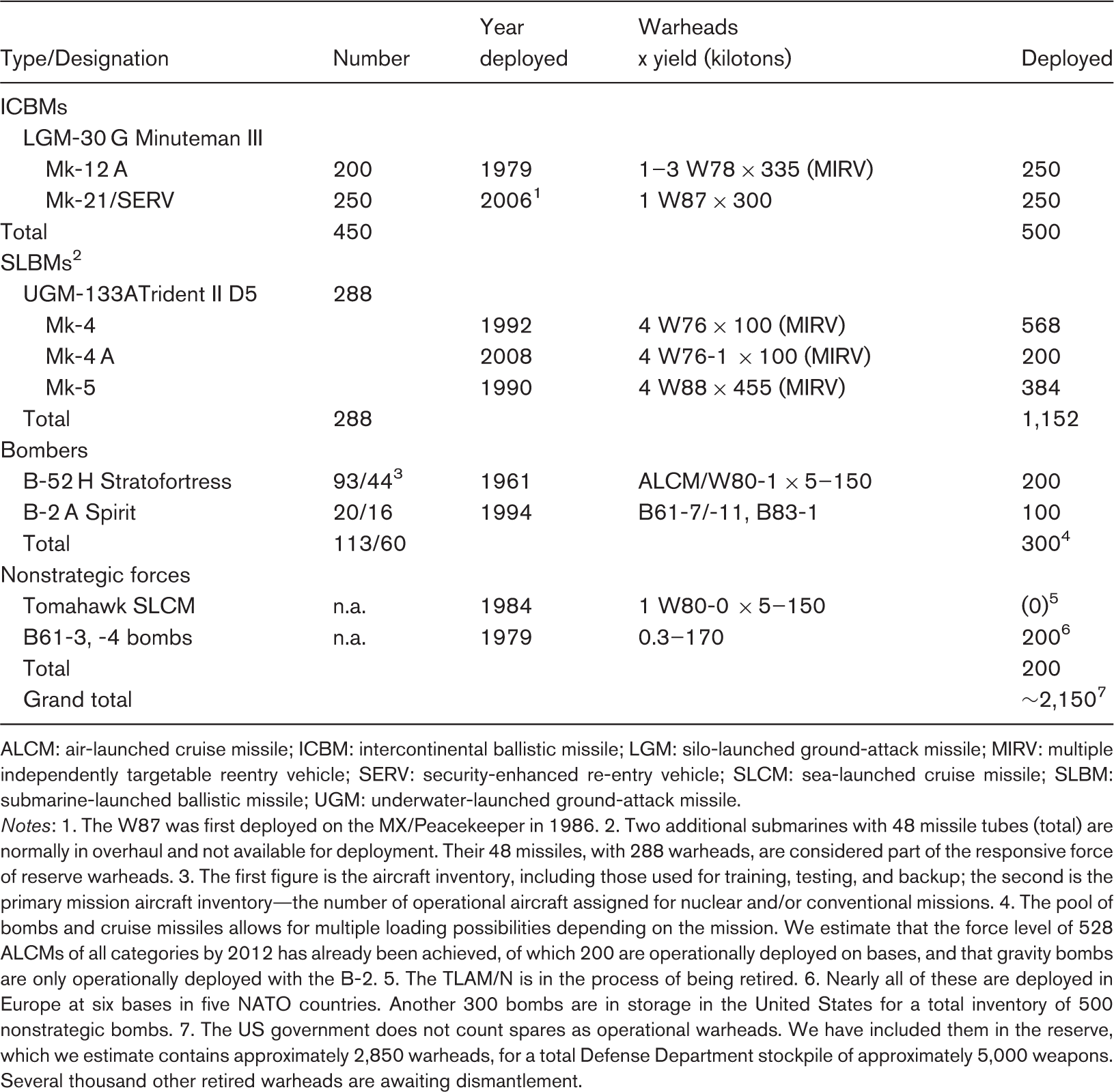
ALCM: air-launched cruise missile; ICBM: intercontinental ballistic missile; LGM: silo-launched ground-attack missile; MIRV: multiple independently targetable reentry vehicle; SERV: security-enhanced re-entry vehicle; SLCM: sea-launched cruise missile; SLBM: submarine-launched ballistic missile; UGM: underwater-launched ground-attack missile.
Notes: 1. The W87 was first deployed on the MX/Peacekeeper in 1986. 2. Two additional submarines with 48 missile tubes (total) are normally in overhaul and not available for deployment. Their 48 missiles, with 288 warheads, are considered part of the responsive force of reserve warheads. 3. The first figure is the aircraft inventory, including those used for training, testing, and backup; the second is the primary mission aircraft inventory—the number of operational aircraft assigned for nuclear and/or conventional missions. 4. The pool of bombs and cruise missiles allows for multiple loading possibilities depending on the mission. We estimate that the force level of 528 ALCMs of all categories by 2012 has already been achieved, of which 200 are operationally deployed on bases, and that gravity bombs are only operationally deployed with the B-2. 5. The TLAM/N is in the process of being retired. 6. Nearly all of these are deployed in Europe at six bases in five NATO countries. Another 300 bombs are in storage in the United States for a total inventory of 500 nonstrategic bombs. 7. The US government does not count spares as operational warheads. We have included them in the reserve, which we estimate contains approximately 2,850 warheads, for a total Defense Department stockpile of approximately 5,000 weapons. Several thousand other retired warheads are awaiting dismantlement.
Footnotes
1
Hans Kristensen’s personal communications with Pentagon officials.
2
To learn more about the effect of the new AF&F unit on the W76, see Kristensen, 2007.
3
For considerations of a joint W78/W88 warhead option, see Kristensen, 2010d.
4
For a description of OPLAN 8010, see Kristensen, 2010a.
5
The ICBMs were transferred to AFGSC on December 1, 2009, and the bombers on February 1, 2010.
6
The W76-1/Mk4 warhead is equipped with a new fuze that allows more flexibility in setting the height of burst to “enable [the] W76 to take advantage of [the] higher accuracy of [the] D-5 missile” and bring more targets, including hard targets, within range (Energy Department, 1997).
7
For an in-depth description of the US nuclear weapons in Europe, see Norris and Kristensen, 2011.
8
For an overview of this change, see Kristensen, 2010c.
Author biographies
Inquiries should be directed to FAS, 1725 DeSales St., NW, Sixth Floor, Washington, DC, 20036 USA; +1 (202) 546-3300.