




Abstract
As of early 2012, the United States maintained an estimated 2,150 operational warheads. The arsenal is composed of roughly 1,950 strategic warheads deployed on 798 strategic delivery vehicles, as well as nearly 200 nonstrategic warheads deployed in Europe. In addition, the United States maintains approximately 2,800 warheads in reserve, bringing the total stockpile to nearly 5,000 warheads. In this article, the authors take a hard look at the US nuclear arsenal, and explore the next steps in the nation’s nuclear strategy.
Keywords
Though the size of the US nuclear stockpile has changed little over the past year, the arsenal continues to evolve under influences that include President Barack Obama’s vision of nuclear disarmament and US obligations under the New Strategic Arms Reduction Treaty (New START). Since the Pentagon’s unprecedented May 2010 declaration that the nuclear stockpile consisted of 5,113 warheads (as of September 2009), official comments seem to confirm that the level has not changed much: In March 2011, the US national security adviser said the stockpile included “approximately 5,000 warheads” (Donilon, 2011), and in November 2011, the principal deputy undersecretary of defense for policy said the level has “dropped slightly” from 5,113 (Parrish, 2011). The administration has unfortunately revealed neither how many warheads have been dismantled since September 2009 nor how many retired warheads await dismantlement.
Despite this, the administration made a positive stride in the direction of nuclear transparency in December 2011, when it released its full unclassified aggregate data under New START. 1 The data include a breakdown of the numbers of US weapon delivery systems but not a breakdown of the warhead distribution. Perhaps the data release—which reversed the administration’s unfortunate June 2011 policy of disclosing only very basic New START data—was influenced by our appeal for improved transparency. 2
The US nuclear arsenal, 2012
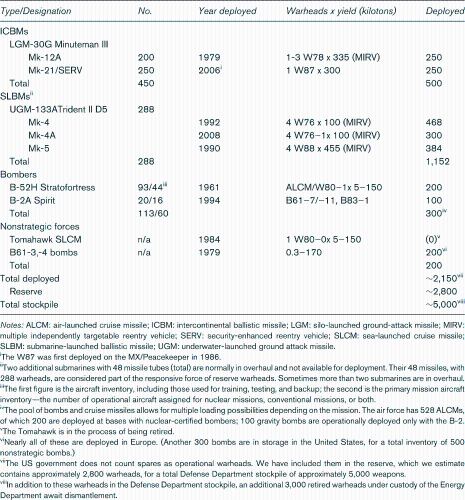
Notes: ALCM: air-launched cruise missile; ICBM: intercontinental ballistic missile; LGM: silo-launched ground-attack missile; MIRV: multiple independently targetable reentry vehicle; SERV: security-enhanced reentry vehicle; SLCM: sea-launched cruise missile; SLBM: submarine-launched ballistic missile; UGM: underwater-launched ground attack missile.
The W87 was first deployed on the MX/Peacekeeper in 1986.
Two additional submarines with 48 missile tubes (total) are normally in overhaul and not available for deployment. Their 48 missiles, with 288 warheads, are considered part of the responsive force of reserve warheads. Sometimes more than two submarines are in overhaul.
The first figure is the aircraft inventory, including those used for training, testing, and backup; the second is the primary mission aircraft inventory—the number of operational aircraft assigned for nuclear missions, conventional missions, or both.
The pool of bombs and cruise missiles allows for multiple loading possibilities depending on the mission. The air force has 528 ALCMs, of which 200 are deployed at bases with nuclear-certified bombers; 100 gravity bombs are operationally deployed only with the B-2.
The Tomahawk is in the process of being retired.
Nearly all of these are deployed in Europe. (Another 300 bombs are in storage in the United States, for a total inventory of 500 nonstrategic bombs.)
The US government does not count spares as operational warheads. We have included them in the reserve, which we estimate contains approximately 2,800 warheads, for a total Defense Department stockpile of approximately 5,000 weapons.
In addition to these warheads in the Defense Department stockpile, an additional 3,000 retired warheads under custody of the Energy Department await dismantlement.
Implementing New START
Though inspections under New START are well under way, reductions to deployed US nuclear forces have yet to begin. To comply with treaty terms, the Obama administration has decided that the United States will reduce, before February 2018, the number of its deployed strategic delivery vehicles to a maximum of 240 submarine-launched ballistic missiles (SLBMs), 420 intercontinental ballistic missiles (ICBMs), and 60 nuclear-capable heavy bombers (Senate Committee on Foreign Relations, 2010: 46). This constitutes a reduction, from current levels, of 48 SLBMs, 30 ICBMs, and 34 B-52Hs. The Defense Department’s budget request for fiscal 2013 does not specify how it will cut these nuclear forces; instead, the plan will be spelled out in the Nuclear Posture Review Implementer, a document that lists which of the review’s decisions will be implemented and when.
Reductions so far have focused on removing equipment from B-1B and B-52G bombers. No longer part of the nuclear strike force, the aircraft were counted under the treaty because they carried equipment once used for nuclear missions; removing the equipment thus denuclearizes the bombers. The last B-1B was denuclearized in early 2011 and—after an exhibition demonstration in March 2011—declared “no longer capable of employing nuclear armaments” under New START (State Department, 2012; US Air Force Public Affairs, 2011). The B-52G was withdrawn from nuclear missions in the early 1990s, but New START aggregate data listed 39 of the aircraft as nuclear-capable as of September 2011. By March 2012, six of those had undergone an elimination process in which the tail section is separated, leaving 33 still to be denuclearized under the treaty (US Air Force Global Strike Command Public Affairs, 2012). 3
Nuclear war plan guidance
Coinciding with implementation of New START, the Obama administration is revising presidential guidance on how the military is supposed to make its plans for potential nuclear weapons use—in effect, creating a new nuclear war plan. Such guidance is necessary to enable deeper reductions to US nuclear forces.
Regarding the new guidance, National Security Advisor Thomas Donilon said in March 2011 that the president had asked the Defense Department “to review our requirements and develop options for further reductions in our current nuclear stockpile,” including “changes in targeting requirements and alert postures that are required for effective deterrence” (Donilon, 2011: 5). Gen. Robert Kehler, head of US Strategic Command (STRATCOM), echoed the administration’s intention to “review and revise the nation’s nuclear strategy and guidance on the roles and missions of nuclear weapons” (Kehler, 2011: 121). The Pentagon will present President Obama with a series of options; he will then decide which to follow (as of March 2012, he had not reviewed any options). After he chooses, the next crucial step will be the writing of a presidential policy directive, which will in turn form the basis of a Nuclear Weapons Employment Policy prepared by the defense secretary and a nuclear supplement to the Joint Strategic Capabilities Plan prepared by the chairman of the Joint Chiefs of Staff. These two documents will then guide STRATCOM’s revision of the strategic nuclear war plan, now known as Strategic Deterrence and Global Strike (or OPLAN 8010). 4 The changes could take several years to implement.
In January 2012, the Pentagon published a new defense strategy that anticipated further nuclear reductions: “It is possible that our deterrence goals can be achieved with a smaller nuclear force, which would reduce the number of nuclear weapons in our inventory as well as their role in U.S. national security strategy” (Defense Department, 2012a: 5, emphasis in the original).
Nuclear warhead production and modernization
In response to the federal government’s financial difficulties, the Obama administration’s 2013 defense budget adjusts some nuclear warhead production and modernization programs (Defense Department, 2012b).
The most noteworthy change is a decision to defer, for at least five years, construction of the expensive Chemistry and Metallurgy Research Replacement-Nuclear Facility at Los Alamos. Faced with ever-increasing cost estimates—currently nearing $6 billion—the plan to increase annual production of plutonium pits at Los Alamos from 20 to 80 is being reassessed. However, plans for a new Uranium Processing Facility at Oak Ridge, Tennessee—projected to cost up to $6.5 billion—continue to move forward. Another new measure, the decision to slow the production rate of the W76-1 warhead, is intended to free up funds so that the new B61-12 bomb can be produced.
The administration’s requested fiscal 2013 budget for the National Nuclear Security Administration (NNSA) is $11.5 billion—a relatively small increase above the enacted level of $11 billion for 2012. The weapons activities account within the NNSA requested budget is $7.6 billion for 2013—just a 5 percent increase from 2012 enacted levels. NNSA originally wanted a 10 percent increase for 2013, and more than $92 billion over the next decade, for maintaining and modernizing nuclear warheads and production facilities (NNSA and Defense Department, 2010: 1–2, 9). Although it is required by Congress, the 2013 budget request does not specify so-called out-year costs for 2014–17—an indication of the considerable uncertainty surrounding the funding environment. Budgets for future years will likely be included in the Energy Department’s revised Stockpile Stewardship and Management Plan for 2013. 5
Land-based ballistic missiles
The US Air Force operates a force of 450 silo-based Minuteman III ICBMs split evenly across three wings: the 90th Missile Wing at F.E. Warren Air Force Base (AFB) in Wyoming; the 91st Missile Wing at Minot AFB in North Dakota; and the 341st Wing at Malmstrom AFB in Montana. Each wing has three squadrons, each with 50 missiles controlled by five Launch Control Centers.
The United States will have to reduce its ICBM force, as required under New START, by at least 30 missiles, for a total of 420. The final number, however, has not yet been announced; it will depend on how many bombers the air force retains. A reduction to 400 missiles could be achieved by cutting one squadron from one of the three bases. A reduction to 300 missiles could be achieved by cutting one squadron from each of the three bases.
The missiles carry either the 335-kiloton W78 warhead or the 300-kiloton W87 warhead. Most of the ICBMs carry a single warhead, although a few still carry multiple W78s. The 2010 Nuclear Posture Review (NPR) stated that all missiles would be downloaded to a single warhead (Defense Department, 2010), but we believe an upload capability will be retained.
The air force is carrying out a multibillion dollar, decade-long modernization program to extend the service life of the Minuteman III to 2030; one component of the project is the Propulsion Replacement Program. New solid-fuel stage motors and refurbished flight controls were installed across the entire force to extend booster service life; the final motor was installed in April 2011.
The fiscal budget for 2013 includes $9.4 million to study a replacement for the Minuteman III missiles; one possible replacement is a mobile ICBM that would increase survivability and reduce the requirement to keep missiles on high alert.
Two ICBM flight-tests were conducted in 2011—the same number as in 2010. A Minuteman III from Minot AFB was test-launched on June 22 from Vandenberg AFB in California. The single W78 unarmed reentry vehicle successfully flew more than 6,700 kilometers (4,160 miles) to an impact point near Kwajalein in the Pacific Ocean. This was the first flight-test that used a new command destruct system—Command Receiver Decoder—developed for the Minuteman program. The second flight-test took place on September 27, when a Minuteman III was launched from Vandenberg AFB to determine the weapon system’s reliability and accuracy. The missile malfunctioned in flight and was destroyed. “When terminated,” according to the air force, “the vehicle was in the broad ocean area, northeast of Roi-Namur,” located on the northern tip of the Kwajalein atoll (US Air Force, 2011).
Nuclear-powered ballistic missile submarines (SSBNs)
All of the US Navy’s 14 Ohio-class SSBNs (eight based in the Pacific and six in the Atlantic) carry Trident II D5 SLBMs. Normally 12 of the SSBNs are considered operational, although the New START data released in December 2011 revealed that, as of September 30, 2011, only 10 SSBNs were carrying a full complement of missiles—24 SLBMs per SSBN (Kristensen, 2011c). If all 12 operational SSBNs carry 24 SLBMs (288 D5 missiles total), and if each missile carries an average of four warheads, then approximately 1,152 warheads are deployed. Two warhead types are deployed on the D5s: the 100-kiloton W76/W76-1 and the 455-kiloton W88.
Each SSBN conducts an average of three deterrent patrols per year, an operational tempo similar to that during the Cold War; to sustain the pace, each boat has two crews. During 2011, the SSBN force conducted 32 deterrent patrols, with more than 60 percent of them in the Pacific Ocean, reflecting nuclear war plans that include targets in China, North Korea, and eastern Russia.
At any given time, nine or ten of the SSBNs are at sea. Five of them are on “hard alert,” which means they are in designated patrol areas within range of the targets specified in their assigned target package in accordance with the strategic war plan. The other four or five SSBNs at sea are in transit to or from their patrol areas, and the remaining boats are in port, likely in dry dock with their missiles removed.
The 2010 NPR stated that the United States would deploy no more than 240 SLBMs at any given time. To help meet that goal, over the next five years four launch tubes on each SSBN will be rendered inoperative so that each deployed submarine will carry 20 SLBMs instead of 24.
The navy has ambitious plans to replace 12 Ohio-class SSBNs with new submarines—currently designated SSBN(X)—at a cost of at least $80 billion. Each boat will carry fewer missiles than the current Ohio-class SSBN, perhaps as few as 16. To save money in the short term, the Obama administration has decided to delay construction of the first boat by two years to 2021, with a launch goal of 2028 and an enter-into-service date of 2031. The first Ohio-class SSBN is set to retire in 2027, with the others to follow at a rate of one per year. Unless the Ohio-class SSBN service life is extended (by slowing the burn-up of reactor fuel rods via fewer deterrent patrols, for example), the SSBN fleet will shrink to 10 boats by 2030 before increasing to 12 when the SSBN(X) boats eventually enter service.
Beginning in 2015, the navy will begin deploying the D5LE SLBM, a life-extended version of the D5, on its SSBNs; the new missile will also arm the new SSBN(X). The navy plans to procure 12 D5LE missiles in 2012 and to continue purchasing them until it has a total of 108 D5LE SLBMs—at a cost of more than $4 billion.
Strategic bombers
The air force operates 20 B-2 and 93 B-52H bombers, of which 18 and 76, respectively, are nuclear capable. Of these, only 16 B-2s and 44 B-52s are thought to be fully nuclear certified and assigned nuclear weapons.
The nuclear bombers are organized across three bases, each with one wing and two squadrons. The 69th Bomb Squadron is the newest, added in 2009 after the notorious August 2007 incident in which six nuclear-armed advanced cruise missiles were flown from Minot AFB in North Dakota to Barksdale AFB in Louisiana without authorization. The 69th Bomb Squadron achieved full operational capability in June 2011.
Approximately 300 nuclear weapons for bombers are stored at Minot AFB and Whiteman AFB in Missouri, including B61-7, B61-11 (for B-2s only), and B83-1 gravity bombs, as well as W80-1 warheads carried on air-launched cruise missiles (ALCMs, for B-52Hs only). Central storage facilities at Kirtland AFB in New Mexico and Nellis AFB in Nevada hold hundreds of additional bombs and cruise missiles that could be returned to the bases if necessary. Plans to reestablish nuclear weapon storage at Barksdale AFB have apparently been abandoned (Airforce-Magazine.com, 2011; Ferrell, 2012).
The air force is designing a new long-range bomber that will eventually replace the B-2 and the B-52H; the fiscal 2013 budget request includes $300 million for the project, with $6.3 billion projected through 2017. The long-term plan envisions building 80–100 bombers at a price tag of between $38 billion and $55 billion. The ALCM, which is limited to use by the B-52H and slated for a 2030 retirement, will be replaced by the advanced long-range standoff nuclear cruise missile. The 2013 budget includes $610 million for the new missile through 2017, with the goal of initial production starting around 2025.
Nonstrategic nuclear weapons
We estimate that the US stockpile includes approximately 760 nonstrategic nuclear weapons (Norris and Kristensen, 2011). This includes: nearly 200 active nonstrategic B61 bombs deployed in Europe; 300 inactive B61s in storage in the United States; and 260 W80-0 warheads for the navy’s nuclear Tomahawks, which are in the process of being retired.
The B61 bombs in Europe are deployed at six air bases in five NATO countries: Belgium, Germany, Italy, the Netherlands, and Turkey. The Belgian, Dutch, and Turkish air forces (with F-16s) and German and Italian air forces (with PA-200 Tornado aircraft) are assigned nuclear strike missions with the US nuclear weapons (Norris and Kristensen, 2011). At its 2012 summit meeting in Chicago, the NATO alliance is expected to approve an updated military posture that incorporates the findings of the Defense and Deterrence Posture Review initiated at the 2010 Lisbon summit.
Some of the countries that host US nuclear weapons in Europe participate in the Joint Strike Fighter (JSF) program; the United States has committed to equipping the new F-35 JSF with a nuclear capability: the B61-12, which is under development. The B61-12 consolidates four existing B61 types into one and will be outfitted with a new tail kit assembly for increased accuracy. The B61-12 will be deliverable by B-2 and B-52H bombers, as well as F-15E, F-16, and PA-200 Tornado fighter-bombers, and of course the F-35. 6
Footnotes
Funding
This research was done with a grant from the Ploughshares Fund and Carnegie Corporation of New York.