




Abstract
Despite the promise of a more transparent future after Russia's ratification of New START in January 2011, the international community’s ability to monitor developments in Russia’s nuclear forces has become more difficult because the Kremlin does not release full aggregate treaty numbers of the country’s strategic nuclear forces and the United States has agreed not to make the information available as it did during START I. Despite these obstacles, the two authors estimate that Russia has more than 4,400 nuclear warheads assigned to its military forces that are undergoing widespread modernization.
Keywords
The governmental transparency that is required to effectively track and monitor Russian nuclear forces is unfortunately diminishing. Unlike the United States, Russia does not publish complete aggregate numbers outlining its strategic nuclear forces that are counted under the New Strategic Arms Reduction Treaty (New START). Under the previous START, the US government provided, upon request, the detailed breakdown of Russian deployments (most recently in July 2009); however, under New START it is not supplying that information. 1 As a result of the Russian and US policies, it is becoming harder for the international community to follow the status and trends of Russian nuclear forces.
Despite this unfortunate barrier to analysis, using recent statements made by Russian military officials and our knowledge of Russian nuclear forces, we estimate that as of early 2012 Russia assigned approximately 2,430 nuclear warheads to its operational intercontinental ballistic missiles (ICBMs), submarine-launched ballistic missiles (SLBMs), and heavy bombers. However, only about 1,560 of these weapons are counted under New START. (The treaty counts the full number of warheads on deployed ballistic missiles, but it does not count the total number of bomber weapons. Instead, for treaty purposes, a single weapon is attributed to each aircraft—regardless of its actual assigned load.) 2
At any given time, several of Russia’s nuclear-powered ballistic missile submarines (SSBNs) are in overhaul and do not carry their allocated missiles and warheads; likewise, under normal conditions, bombers are not loaded with nuclear weapons. Therefore, of Russia’s approximately 2,430 strategic offensive nuclear warheads, we estimate that nearly 1,490 are deployed on 434 operational ballistic missiles, with another 950 warheads assigned to SSBNs in overhaul and to 72 heavy bombers.
Russia also keeps an inventory of an estimated 2,000 nonstrategic warheads for potential use by ships, aircraft, and air defense forces. All are said to be in central storage. All combined, we estimate that Russia currently has approximately 4,430 nuclear weapons assigned to its armed forces. An additional 5,500 already retired strategic and nonstrategic warheads may be awaiting dismantlement, for a total inventory of nearly 10,000 nuclear warheads (see Table 1). 3
ICBMs
In mid-December 2011, Lt. Gen. Sergey Karakayev, commander of Russia’s Strategic Missile Forces (SMF), stated that 86 new SS-27 Mod. 1 (Topol-M) and SS-27 Mod. 2 (RS-24) missiles at that time made up 28 percent of Russia’s deployed ICBM force (Star TV, 2011). If his numbers are accurate, it indicates that Russia currently deploys approximately 322 ICBMs with nearly 1,090 warheads. The ICBMs are organized into three missile armies with 12 divisions, a structure Karakayev says will continue through 2016 and beyond (Interfax-AVN, 2011b). 4
Over the next decade, Russia’s ICBM force is scheduled to undergo significant changes. By 2016, according to Karakayev, SS-18, SS-19, and SS-25 missiles will constitute only about 40 percent of the ICBM force, down from approximately 72 percent today (Interfax-AVN/BBC, 2011a). To meet this goal, over the next four years Russia will have to retire more than half of its ICBM force, mainly SS-25s. By 2021, Russia plans to retire 98 percent of its old missiles (Interfax-AVN/BBC, 2011b). The current production and deployment rate of new ICBMs is not fast enough to offset the old-missile retirements. Even if Russia manages to deploy an average of 20 new missiles per year—something it has not been able to accomplish during the past two decades—by the early 2020s the overall size of its ICBM force will still likely shrink to around 250 missiles.5
SS-27
Russia deploys three kinds of Topol-M missiles: the SS-27 Mod. 1, a single-warhead missile that comes in either mobile (RS-12M1) or silo-based (RS-12M2) variants, and the SS-27 Mod. 2 (RS-24), called the “Yars” in Russia, a mobile missile equipped with multiple independently targetable reentry vehicles (MIRVs). Russia will complete its deployment of SS-27 Mod. 1s this year, for a total of 78 missiles: 60 silo-based missiles with the 60th Missile Division in Tatishchevo and 18 road-mobile missiles with the 54th Guards Missile Division at Teykovo.
Russian nuclear forces, 2012
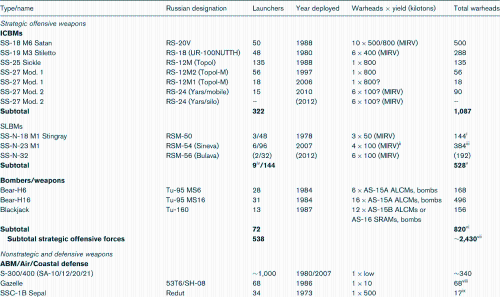
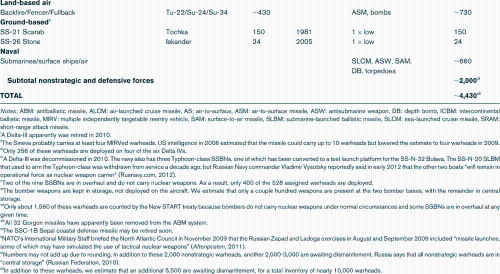
Notes: ABM: antiballistic missile, ALCM: air-launched cruise missile, AS: air-to-surface, ASM: air-to-surface missile, ASW: antisubmarine weapon, DB: depth bomb, ICBM: intercontinental ballistic missile, MIRV: multiple independently targetable reentry vehicle, SAM: surface-to-air missile, SLBM: submarine-launched ballistic missile, SLCM: sea-launched cruise missile, SRAM: short-range attack missile.
A Delta-III apparently was retired in 2010.
The Sineva probably carries at least four MIRVed warheads. US intelligence in 2006 estimated that the missile could carry up to 10 warheads but lowered the estimate to four warheads in 2009.
Only 256 of these warheads are deployed on four of the six Delta IVs.
A Delta-III was decommissioned in 2010. The navy also has three Typhoon-class SSBNs, one of which has been converted to a test launch platform for the SS-N-32 Bulava. The SS-N-20 SLBM that used to arm the Typhoon-class was withdrawn from service a decade ago, but Russian Navy commander Vladimir Vysotsky reportedly said in early 2012 that the other two boats “will remain in operational force as nuclear weapon carrier” (Rusnavy.com, 2012).
Two of the nine SSBNs are in overhaul and do not carry nuclear weapons. As a result, only 400 of the 528 assigned warheads are deployed.
The bomber weapons are kept in storage, not deployed on the aircraft. We estimate that only a couple hundred weapons are present at the two bomber bases, with the remainder in central storage.
Only about 1,560 of these warheads are counted by the New START treaty because bombers do not carry nuclear weapons under normal circumstances and some SSBNs are in overhaul at any given time.
All 32 Gorgon missiles have apparently been removed from the ABM system.
The SSC-1B Sepal coastal defense missile may be retired soon.
NATO's International Military Staff briefed the North Atlantic Council in November 2009 that the Russian Zapad and Ladoga exercises in August and September 2009 included “missile launches, some of which may have simulated the use of tactical nuclear weapons” (Aftenposten, 2011).
Numbers may not add up due to rounding. In addition to these 2,000 nonstrategic warheads, another 2,000-3,000 are awaiting dismantlement. Russia says that all nonstrategic warheads are in “central storage” (Russian Federation, 2010).
In addition to these warheads, we estimate that an additional 5,500 are awaiting dismantlement, for a total inventory of nearly 10,000 warheads.
SS-18 (RS-20V)
The SS-18 ICBM is a 10-warhead heavy ICBM first deployed in 1988. Approximately 50 SS-18s carry roughly half of Russia’s deployed ICBM warheads. Karakayev announced in 2010 that Russia would extend the service life of the SS-18s to 2026 (RIA Novosti, 2010), but in 2011 he instead declared plans to retire nearly all of Russia’s older ICBMs by 2021 (Interfax-AVN/BBC, 2011a).
SS-19 (RS-18 or UR-100NUTTH)
The silo-based, six-warhead SS-19 entered service more than three decades ago in 1980. Today Russia deploys 288 warheads on its SS-19s; 48 of the missiles remain in service, but most might be withdrawn by 2017 (Interfax-AVN, 2011a).
SS-25 (RS-12M or Topol)
Russia has been reducing its number of single-warhead SS-25 missiles for the last several years, removing one to three regiments (9–27 missiles) from service annually. The SS-25, which first entered service in 1988, was expected to be fully retired in 2015, but Karakayev said in 2011 that the missile could remain in service until 2019 (RIA Novosti, 2011f). Today, Russia has approximately 135 of the SS-25 missiles in service.
Russia is apparently developing a new liquid-fueled heavy ICBM; the SS-18 replacement is listed in Russia’s arms procurement program through 2020, with a goal of deployment in 2018 (Gorenburg, 2011; VPK News, 2011). The SMF has also begun deployment of a new digital-alert transmission system for silo and mobile missiles (RIA Novosti, 2011b, 2011i).
SSBNs
The number and breakdown of Russia’s active nuclear submarine fleet has been relatively constant for several years: six Delta IVs and three Delta IIIs that can carry a combined 144 SLBMs with up to 528 warheads. Not all SSBNs carry missiles at any given time, and the overall aggregate data released under New START indicates that as of September 1, 2011, only seven of the nine SSBNs were loaded.
The mainstay of Russia’s SSBN force consists of the six third-generation Delta IV SSBNs, each equipped with 16 SLBMs and built between 1985 and 1992; the Delta IVs are part of the Northern Fleet based at Yagelnaya Bay on the Kola Peninsula. Since 2007, Russia has been upgrading the Delta IVs to carry a modified SS-N-23 SLBM known as the “Sineva.” 6 Each missile carries up to four warheads. Upgrades are complete for four of the subs (Bryansk, Karelia, Tula, and Yekaterinburg); an upgrade of the fifth boat (Verkhoturye) has been delayed until this year, and the sixth boat (Novomoskovsk) is also expected to return to service in 2012. The Yekaterinburg test-launched a Sineva SLBM on May 17, 2011, and later went into dry dock, where a fire broke out in December 2011. The accident may delay its return to service until 2014. As a result of all of this, only four of six Delta IVs carried missiles at the start of 2012.
Three Delta III-class SSBNs remain in service on the Kamchatka Peninsula as part of Russia’s Pacific Fleet. Each boat is equipped with 16 SS-N-18 M1 Stingray (RSM-50) SLBMs with three warheads each. One Delta III, the Svyatoi Georgii Pobedonosets, collided with a fishing vessel in Avachinsky Bay on September 21, 2011. Initial reports said the submarine suffered a crack in its main ballast tank, but Pacific Fleet leaders later denied this, saying the sub “does not need repair” (RIA Novosti, 2011g; Rusnavy.com, 2011). All Delta IIIs will be replaced by new Borey-class SSBNs over the next decade.
The Russian navy plans to build up to eight Borey-class SSBNs, each equipped with 16 SS-N-32 (Bulava) SLBMs that can carry up to six warheads apiece. The first fourth-generation Borey-class SSBN, the Yuri Dolgoruki, is expected to enter service in 2012, after more than 15 years of design and construction. 7 On December 23, 2011, the submarine launched a salvo of two Bulava SLBMs while operating submerged in the White Sea, after which President Dmitry Medvedev said the Bulava cycle of flight-tests had been completed: “Now it will be put into service” (RIA Novosti, 2011a). Once it is declared operational, the Yuri Dolgoruki will transfer to the Kamchatka Peninsula to begin the replacement of the Delta IIIs.
The second Borey-class SSBN, the Alexander Nevsky, was launched in 2010 and has been on sea-trials ever since. 8 The submarine still needs to conduct a series of missile test-launches before it can be declared operational, possibly late this year or in 2013. The third boat, the Vladimir Monomakh, is expected to be launched sometime in 2012, although delays are possible. 9
This year the keel will also be laid for the fourth Borey-class SSBN (possibly to be named the Svyatitel Nikolai), 10 which will be an improved version known as the Borey-A; Russia’s plans for 2012 also reportedly include keel-laying for the fifth and sixth Borey-class boats (RIA Novosti, 2011d).
Russian SSBNs conducted five strategic deterrent patrols in 2011. For the past decade, Russia has not run continuous at-sea deterrent patrols but instead deployed SSBNs on training patrols. However, from mid-2012, according to the Russian Navy, Russia “will resume constant patrolling of the world’s oceans by strategic nuclear submarines” (RIA Novosti, 2012a).
Strategic bombers
Four Tu-95MSs may have been withdrawn from service in recent years (Podvig, 2009), dropping the number of strategic bombers that Russia operates to 72 aircraft: 13 Tu-160s (Blackjacks), 28 Tu-95MS6s (Bear H6s), and 31 Tu-95MS16s (Bear H16s). The aircraft can carry the nuclear AS-15A Kent (Kh-55) air-launched cruise missile; the Tu-160 can also deliver the AS-16 Kickback (Kh-15) short-range attack missile. 11 Not all of the aircraft are fully operational; some are used as test aircraft, and others are undergoing upgrades.
The bomber fleet is capable of carrying a total of 820 nuclear weapons, but the aircraft do not carry nuclear weapons under normal circumstances. We estimate that Russia stores only a couple of hundred warheads at bomber bases, as the US bomber fleet does, with the balance having been moved to central storage facilities. Under New START, only a single bomb is attributed to each bomber, a method that allows for maximizing the warhead loads on ballistic missiles (a counting rule that benefits the United States as well).
Russia has begun design studies of a new strategic bomber that may emerge as a prototype by the early 2020s. The new aircraft would replace Tu-160 and Tu-95MS heavy bombers as well as the Tu-22M3 nuclear-capable, medium-range bomber (Itar-Tass, 2010; RIA Novosti, 2009). 12
Nonstrategic (tactical) weapons
Russia has more nonstrategic nuclear weapons than the United States. US and NATO policy dictates that further US arsenal reductions must take into consideration the disparity with the Russian arsenal.
We estimate that Russia currently has approximately 2,000 nonstrategic nuclear warheads assigned for delivery by air, navy, and air-defense forces. Russia has stated that it has reduced its number of nonstrategic nuclear warheads by 75 percent since 1991 and that all are in central storage (Russian Federation, 2010: 8). Further reductions appear to be on the horizon. 13
We estimate that Russia’s tactical air forces are assigned 730 AS-4 air-to-surface missiles and bombs; Tu-22M (Backfire) intermediate-range bombers can deliver both the missiles and bombs, whereas Su-24 (Fencer) and Su-34 (Fullback) fighter-bombers deliver bombs only. Russia is modernizing some of its Fencers, but the aircraft will be replaced by Su-34 (Fullback) fighter-bombers; deployment of the Fullback has started at bases in the western Russia. Some other aircraft may also have a nuclear capability.
The approximately 660 warheads assigned to Russia’s naval nonstrategic delivery platforms are for cruise missiles, antisubmarine weapons, anti-air missiles, torpedoes, and depth bombs. Russia’s first new Severodvinsk-class (Yasen-class) nuclear-powered attack submarine is conducting sea-trials before entering operations with the Russian navy. The submarine is equipped for nonstrategic nuclear weapons, including antisubmarine rockets, and has eight vertical launch tubes for cruise missiles. Russia’s arms procurement program for 2011–2020 indicates that it will build a total of 10 Yasen-class subs (Lenta.ru, 2011). In late 2011, all naval attack aircraft (Tu-22M3 and Tu-24) and their assigned nuclear weapons were transferred to air force control.
Russia appears to be preparing for the conversion of some primary naval platforms from nuclear to non-nuclear capability. One example includes plans to convert the Oscar-class guided missile submarines and Kirov-class guided missile cruisers from carrying nuclear SS-N-19 cruise missiles to non-nuclear SS-N-26 and SS-N-27 cruise missiles (RIA Novosti, 2011c, 2011e, 2011h; World Maritime News, 2011).
Russia maintains air-defense and antiballistic missile forces that we estimate are allocated around 430 warheads. The warheads are used in Gazelle antiballistic missile interceptors around Moscow and in part of the S-300/S-400 air-defense system. The air-defense interceptors are believed to have some capacity against ballistic missiles. Russia deploys several S-400 regiments (with about eight launchers and 32 missiles each) around Moscow, and over the next several years it plans to deploy at least 18 systems to form the core of Russia’s air and missile defenses through at least 2020 (RIA Novosti, 2008a, 2008b).
Despite the fact that in 1991 and 1992 Russia declared it would eliminate all of its ground-launched nonstrategic nuclear warheads, it has not done so (Aftenposten, 2011). We estimate that approximately 175 warheads are earmarked for use by SS-21 Scarab (Tochka) and SS-26 Stone (Iskander) short-range ballistic missiles.
Footnotes
Funding
This research was done with a grant from the Ploughshares Fund and Carnegie Corporation of New York.
Notes
Author biographies
Inquiries should be directed to FAS, 1725 DeSales St., NW, Sixth Floor, Washington, DC, 20036 USA; +1 (202) 546-3300.