




Abstract
As of early 2013, the United States has continued to reduce its nuclear stockpile, and retirement alone has accounted for a dip of over 250 warheads since last year. Of the total stockpile of approximately 4,650 warheads, an estimated 2,150 warheads are deployed. The arsenal is composed of roughly 1,950 strategic warheads deployed with approximately 800 missiles and bombers, as well as nearly 200 nonstrategic warheads deployed in Europe. In this article, the authors scrutinize the US nuclear arsenal.
Keywords
The US Defense Department maintains a stockpile of an estimated 4,650 nuclear warheads for delivery by more than 800 ballistic missiles and aircraft. Compared with last year, that is a reduction of approximately 260 warheads due to the retirement of W80-0 warheads for the Tomahawk land-attack cruise missile, and a reduction of roughly 560 warheads compared with September 2009, when the United States announced that the Defense Department’s stockpile contained 5,113 warheads.
The US nuclear arsenal 2013
In addition to the warheads in the US stockpile, approximately 3,000 retired, but still intact, warheads are in storage and await dismantlement, for a total inventory of roughly 7,700 warheads.
Implementing New START
As of September 1, 2012, the United States was counted under the New Strategic Arms Reduction Treaty (New START) as having 1,722 strategic warheads attributed to 806 deployed missiles and bombers—a modest reduction of 15 warheads and 6 launchers compared with the previous count in March 2012. Since the treaty entered into force in February 2011, the United States has reduced a total of 78 strategic warheads and 76 launchers (Kristensen, 2012b).
Due to the counting rules established between Russia and the United States, however, these numbers do not reflect the actual deployment of strategic warheads and launchers, mainly because a large number of bombers that are not assigned nuclear weapons are still counted as nuclear launchers. Moreover, each bomber is counted as carrying only one weapon, even though each of the B-52 bombers can carry up to 20 cruise missiles. At this point in the treaty implementation, the reductions reflect the elimination of so-called “phantom” launchers—aircraft that are no longer assigned a nuclear mission but still are counted due to left-over equipment, like mechanical and electronic interfaces—as well as the fluctuating number of launchers in overhaul at any given time.
In December 2012, the US State Department (2012) released its full aggregate data in a detailed status report. The data show that the United States is implementing the treaty by eliminating phantom weapons first, but that reduction of actual nuclear launchers will not occur until later this decade. Starting in 2015, for example, the Navy will begin reducing missile tubes on each nuclear-powered ballistic submarine (SSBN) from 24 to 20, and later in the decade the Air Force will probably reduce the ICBM force from 450 to 400 missiles.
Nuclear policy guidance
The Obama administration’s long-awaited nuclear weapons targeting review (sometimes referred to as the post-NPR review or Nuclear Posture Review Implementation Study) was delayed by the 2012 presidential election. The review is intended to identify “options for further reductions in our current nuclear stockpile,” including “changes in targeting requirements and alert postures that are required for effective deterrence” (Donilon, 2011: 5). Once the president selects from a range of options, a Presidential Decision Directive (PDD) will be issued to form the basis of a Nuclear Weapons Employment Policy (NUWEP), prepared by the defense secretary, and a nuclear supplement to the Joint Strategic Capabilities Plan (JSCP-N), prepared by the chairman of the Joint Chiefs of Staff. These documents will then guide Strategic Command’s revision of the strategic nuclear war plan, now known as Strategic Deterrence and Global Strike (or OPLAN 8010) (Kristensen and Norris, 2011). The changes could take several years to implement.
Hints about the conclusions come from the January 2012 defense strategy that concluded: “It is possible that our deterrence goals can be achieved with a smaller nuclear force, which would reduce the number of nuclear weapons in our inventory as well as their role in US national security strategy” (Defense Department, 2012a: 5, emphasis in the original). Moreover, the Defense Department’s May 2012 review of Russian nuclear forces concluded that a Russian disarming first strike against the United States “will most likely not occur,” but even if Russia cheated and broke out of New START and attacked the United States, it “would have little to no effect on the US assured second-strike capabilities that underwrite our strategic deterrence posture” (Defense Department, 2012b, emphasis added by authors). In fact, the Defense report concludes that Russia “would not be able to achieve a militarily significant advantage by any plausible expansion of its strategic nuclear forces, even in a cheating or breakout scenario under the New START Treaty, primarily because of the inherent survivability of the planned US strategic force structure, particularly the Ohio-class ballistic missile submarines, a number of which are at sea at any given time” (Defense Department, 2012b: 7, emphasis added by authors; Kristensen, 2012a).
As a result, the post-NPR review reportedly has concluded that the United States can meet its national security obligations with 1,000–1,100 deployed strategic warheads, or 450–550 warheads less than allowed by New START (Smith, 2013). The conclusion about a reduced force level is expected to form the basis for a new arms control proposal to Russia by the Obama administration this year.
Land-based ballistic missiles
The US Air Force operates a force of 450 silo-based Minuteman III ICBMs split evenly across three wings: the 90th Missile Wing at F. E. Warren Air Force Base (AFB) in Wyoming; the 91st Missile Wing at Minot AFB in North Dakota; and the 341st Wing at Malmstrom AFB in Montana. Each wing has three squadrons, each with 50 missiles controlled by five launch control centers. New START data show that 449 ICBMs were operational on September 1, 2012, and another 263 ICBMs were in storage (Kristensen, 2012b).
Each missile carries either the 335-kiloton W78 warhead or the 300-kiloton W87 warhead. The last 25 or so Minuteman IIIs equipped with multiple independently targetable re-entry vehicles (MIRVs) are in the process of being downloaded to single warhead configuration, which will leave all ICBMs each armed with a single warhead, as decided by the 2010 Nuclear Posture Review (Defense Department, 2010). Despite the download, the ICBM force will retain a re-MIRV capability to increase the warhead loading if conditions called for such an option.
The US plans to reduce the ICBM force to no more than 420 missiles under New START to meet the limit of no more than 700 deployed nuclear missiles and heavy bombers by 2018. We expect the force will be reduced to 400 ICBMs by inactivating one of three missile squadrons at one of the three bases.
The Air Force is carrying out a multibillion dollar, decade-long modernization program to extend to 2030 the service life of the Minuteman III. The final Propulsion System Rocket Engine (PSRE) placement of the fourth stage was completed at Minot AFB in September 2012. The PSRE program began in 2005 and cost $210 million, a fraction of the total $7-plus billion ICBM modernization program. Although the United States is officially not deploying a new ICBM, the upgraded Minuteman IIIs “are basically new missiles except for the shell” (Pampe, 2012). The total modernization program will be completed in 2015 and will extend the life of the ICBM force through 2030.
The Air Force budget request for 2013 includes $9.4 million to study a replacement for the Minuteman III missiles, and the Air Force Requirements Oversight Council on May 17, 2012, signed off on an “initial capabilities document” for a next-generation ICBM (Grossman, 2012). One potential option is a mobile ICBM that would increase survivability and reduce the requirement to keep missiles on high alert.
Two ICBM flight tests were conducted in 2012 from Vandenberg AFB in California, the same number as in 2011. The first flight occurred on February 25, when a missile randomly picked from a silo operated by the 90th Missile Wing at Warren AFB delivered a single W87 JTA (an unarmed mock-up of the W87/Mk21 re-entry vehicle) to an impact point near the Kwajalein Atoll in the Marshall Islands approximately 7,800 kilometers (4,846 miles) down range in the Pacific Ocean. The second flight test took place on November 14, 2012, and involved an ICBM from the 341st Missile Wing at Malmstrom AFB. The missile carried one unarmed re-entry vehicle.
In addition to the flight tests, two simulated launches—known as Simulated Electronic Launch Minuteman (SELM)—were carried out in 2012. The first took place in early May at Minot AFB and involved the 741st Missile Squadron. The second SELM took place at Warren AFB in late September and involved the 321st Missile Squadron. A SELM “is the most complete test of the operational capability of our ICBMs,” according to Air Force personnel, and “tests the people and equipment from the initial ‘on alert’ transmission all the way to simulated first-stage ignition” (Balken, 2012; Tryon, 2012).
Nuclear-powered ballistic missile submarines
All of the US Navy’s 14 Ohio-class SSBNs (eight based in the Pacific and six in the Atlantic) carry Trident II D5 SLBMs. Normally 12 of the SSBNs are considered operational, with the 13th and 14th boats in overhaul at any given time, but New START data show that normally fewer than 12 SSBNs are fully equipped with missiles. As of September 1, 2012, for example, only 239 missiles were counted as deployed, 49 less than the capacity of 12 boats, so three SSBNs were not deployed at the time of the count.
The warhead loading of the deployed SLBMs is not specified in the unclassified New START aggregate data, but it is nonetheless possible to estimate. Of the 1,722 total deployed warheads attributed to SLBMs, ICBMs, and bombers, 449 ICBMs each carry 500 warheads, and 118 bombers each count as 118 bombs, so the 239 deployed SLBMs must carry 1,104 warheads—or an average of 4.6 warheads per missile. In practice each missile probably has three, four, or five warheads, depending upon the requirement of the war plan. Loading with fewer warheads increases a missile’s range.
Three versions of two basic warhead types are deployed on the SLBMs: the 100-kiloton W76-0, the 100-kiloton W76-1, and the 455-kiloton W88. The W76-1 is a refurbished version of the W76-0, with the same yield but with an added safety device, a dual strong link detonation control. Moreover, a new arming, fuzing, and firing unit was installed on the re-entry body with improved targeting capabilities. Full-scale production of an estimated 1,200 W76-1 s is under way at the Pantex plant in Texas. So far, roughly 400 W76-1 s have replaced the W76-0 s on Trident II SLBMs and production is scheduled to continue through 2018 or 2021. W76-1 s are also being supplied to Britain’s SSBNs (Kristensen, 2011a).
US SSBN operations are being modified. During 2011, the Atlantic and Pacific SSBN fleets conducted a total of 28 deterrent patrols, a reduction from 33 in 2010 (see Figure 1). The reduction continues a downward trend that started in 2000, after 64 patrols in 1999, a significant change that means that each SSBN now conducts an average of 2.5 patrols per year compared with 3.5 patrols a decade ago. The average duration of a patrol is 70 days, with a few lasting over 100 days. More than 60 percent of the patrols take place in the Pacific Ocean, reflecting nuclear war planning against China, North Korea, and eastern Russia.
US ballistic missile submarine patrols 1960–2011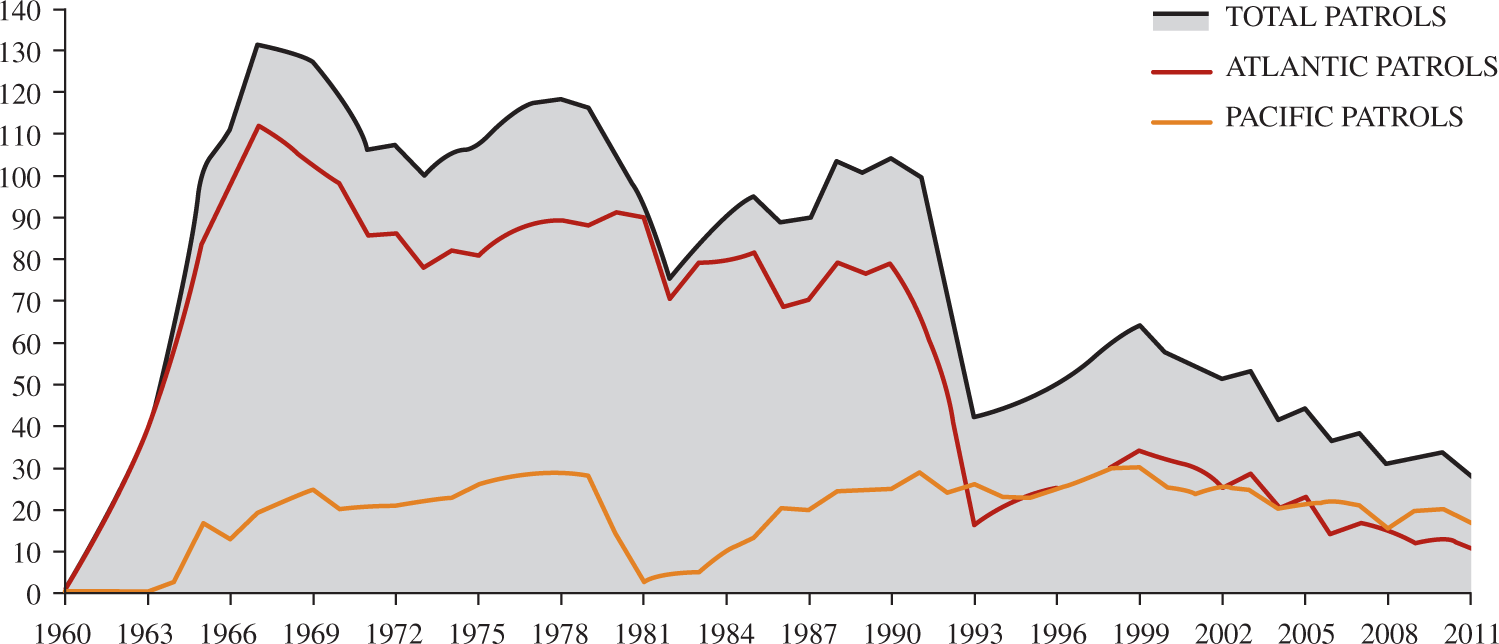
At any given time, eight or nine of the 12 operational SSBNs are at sea. Four or five of the at-sea boats are on “hard alert,” which means they are in designated patrol areas within range of the targets specified in their assigned target package in accordance with the strategic war plan. The other three or four SSBNs at sea are in transit to or from their patrol areas, and the remaining boats are in port, including two in dry dock with their missiles removed.
Starting in 2015, the number of missile tubes on each Ohio-class SSBN will be reduced by four, from 24 to 20. The reduction is intended to reduce the number of deployed SLBMs, to no more than 240 SLBMs at any given time, to meet the 2018 limit on deployed strategic launchers set by New START.
The Navy has ambitious modernization plans to replace the Ohio-class SSBNs with a new design. The Navy has chosen a submarine that is 2,000 tons larger than the Ohio-class submarine, but with 16 missile tubes instead of the current 24—four fewer than the 20 planned under New START (Brougham, 2012). Twelve replacement SSBNs (tentatively known as SSBNX) are planned, a reduction of two boats compared with the current fleet of 14, at an estimated cost of $90.4 billion. Procurement of the first boat is scheduled for 2021, with deployment on deterrent patrol starting in 2031 (O’Rourke, 2012).
At least during the first decade of its service life, the SSBNX will be armed with a life-extended version of the current Trident II D5 (D5LE) SLBM. The D5LE, which has a new guidance system designed to “provide flexibility to support new missions” (Draper Laboratory, 2006: 8) and make the missile “more accurate,” (Naval Surface Warfare Center Crane Division, 2008: 14) will also be backfitted onto existing Ohio-class SSBNs for the remainder of their service life, starting in 2017. The D5LE will also be deployed on Britain’s SSBNs.
Strategic bombers
The Air Force currently operates a fleet of 20 B-2 and 93 B-52H bombers at three bases. Of those, 18 B-2 s and 76 B-52Hs are nuclear-capable. An estimated 60 bombers (16 B-2 s and 44 B-52Hs) are assigned nuclear weapons under the strategic nuclear war plan.
Each dedicated B-2 can carry up to 16 nuclear bombs (B61-7, B61-11, and B83-1). The dedicated B-52Hs are assigned air-launched cruise missiles (ALCMs). Although the B-52Hs can also carry gravity bombs, those are currently planned for delivery solely by the B-2. From the 2020s, the B-2 is scheduled to receive the planned B61-12 precision-guided nuclear bomb—a program currently estimated to cost in excess of $10 billion. It is estimated that approximately 1,000 nuclear weapons, including 528 ALCMs, are assigned to the bombers. Most of these weapons are in central storage at Kirtland AFB in New Mexico and Nellis AFB in Nevada, but a small number (we estimate 200 to 300) are stored at Minot AFB and Whiteman AFB in Missouri (nuclear weapons are no longer stored at Barksdale AFB in Louisiana) (Air Force Magazine, 2011; Ferrell, 2012). Although not deployed on the bombers under normal circumstance, the stored weapons could be loaded onto the aircraft in a few days.
The Air Force is designing a new bomber intended to begin replacing existing bombers from the mid-2020s. Procurement of 80–100 aircraft is envisioned, some of which are planned to be nuclear-capable, at a cost of perhaps $55 billion. The new bomber might be equipped to deliver the planned B61-12 precision-guided bomb and B83-1 gravity bomb (if it is retained in the stockpile). The Air Force also is planning a nuclear ALCM, currently known as the Long-Range Stand-Off (LRSO) missile. The current ALCM is scheduled to remain operational through the 2020s. The administration has promised that it will not produce “new” nuclear warheads, so the LRSO could either use a life-extended version of the ALCM’s W80-1 warhead or a life-extended version of the retired W84 warhead that once armed the Ground-Launched Cruise Missile. The LRSO program could cost as much as $1.2 billion, with more millions of dollars needed to reproduce the warhead.
During the last year, the Air Force continued to realign units and increase the nuclear focus to reinvigorate the bomber force. The 705th Munitions Squadron replaced the 17th Munitions Squadron at Minot AFB as part of a multiyear effort to realign the nuclear command structure more directly to Air Force Global Strike Command. A Defense Nuclear Surety Inspection recertified the base in February 2012, and in June the B-52Hs from the 5th Bomb Wing at Minot and the 2nd Bomb Wing at Barksdale conducted a rapid launch exercise with 17 bombers at Minot AFB. In October, the 5th Bomb Wing carried out rapid-launch exercises as part of Strategic Command’s Global Thunder exercise, a worldwide field training and battle staff exercise designed to practice deterrence and strike operations with emphasis on nuclear command and control.
At Barksdale AFB, the 96th Bomb Squadron conducted an eight-hour training flight in April 2012 to practice “nuclear and conventional missions, rapid global strike capabilities, and the ability to reach hardened targets anytime, anywhere” (Air Force Global Strike Command, 2012).
The following month, Barksdale AFB participated in Strategic Command’s Global Lightning nuclear strike exercise, which in 2012 supported Pacific Command’s Terminal Fury exercise by evaluating how the Air Force Global Strike Command provides the theater Joint Force Air Component Commander with heavy bombers against “extremely difficult target sets” (Richard, 2012). The exercise scenario for Global Lightning involved “several crisis action planning and time-sensitive planning problem sets never before seen in Terminal Fury” (Richard, 2012).
Five months later, in October 2012, the 96th Bomb Squadron from Barksdale AFB forward-deployed to Anderson AFB in Guam as part of the Air Force Global Strike Command’s extended deterrence mission in the Pacific. The four B-52H squadrons that have nuclear missions (the 20th and 69th Bomb Squadrons of the 2nd Bomb Wing at Barksdale AFB, and the 23rd and 69th Bomb Squadrons of the 5th Bomb Wing at Minot AFB) and the two B-2 squadrons (13th and 393rd Bomb Squadrons) of the 509th Bomb Wing at Whiteman AFB all rotate through Guam on extended deployments. The deployments began in 2004, each lasting four months, but in 2012 the duration was extended to six months. The nuclear weapons for the bombers deploying to Guam are stored in the continental United States.
Nonstrategic nuclear weapons
Although the US military has yet to make a formal announcement, we estimate that the remaining nuclear Tomahawk land-attack cruise missiles (TLAM/Ns) and their W80-0 warheads have now been retired. The Pantex Plant in Texas has already “dismantled a very substantial number of W80-0” (Cook, 2013). This completes a historic multi-decade unilateral elimination of all US nonstrategic nuclear weapons. The decision to retire the TLAM/N was made by the 2010 Nuclear Posture Review despite opposition from some, and without demands that Russia also retire such weapons.
As a result of the TLAM/N retirement, we estimate that the US inventory of nonstrategic nuclear weapons now includes approximately 500 warheads, all B61 gravity bombs. Nearly 200 of the bombs are deployed in Europe at six bases in five NATO countries: Belgium, Germany, Italy, the Netherlands, and Turkey. The Belgian, Dutch, and Turkish air forces (with F-16 s) and German and Italian air forces (with PA-200 Tornado aircraft) are assigned nuclear strike missions with the US nuclear weapons (Norris and Kristensen, 2011). The weapons in Europe no longer serve a military purpose and are not tasked with providing the ultimate security guarantee to NATO, a mission that is assigned to strategic weapons.
Although the May 2012 NATO Summit in Chicago approved the Deterrence and Defense Posture Review conclusion that the existing “nuclear force posture currently meets the criteria for an effective deterrence and defense posture” (North Atlantic Treaty Organization, 2012: paragraph 8), NATO has approved a modernization of the nuclear posture in Europe through the deployment of the new guided B61-12 bomb with increased accuracy, and the deployment of the stealthy F-35A Lightning II Joint Strike Fighter in Europe. The B61-12 will also be deliverable by F-15Es, F-16 s, PA-200 Tornado tactical fighter-bombers, and the strategic B-2 stealth bomber (Kristensen, 2011b; Kristensen, 2012c).
Footnotes
Funding
This research was carried out with a grant from the Ploughshares Fund.