




Abstract
Today, China is the only one of five original nuclear weapon states that is increasing its nuclear arsenal. According to some estimates, the country could “more than double” the number of warheads on missiles that could threaten the United States by the mid-2020s. Earlier this year, China published a defense white paper, which repeated its nuclear policies of maintaining a minimum deterrent with a no-first-use pledge. Yet China has yet to define what it means by a minimum deterrent posture. This, together with the fact that it is deploying four new nuclear-capable ballistic missiles, invites concern as to the scale and intention of China’s nuclear upgrade. The authors estimate that China has a total inventory of approximately 240 nuclear warheads. Reviewing one of the world’s most opaque nuclear forces, they assess the country’s land-based missiles, submarines and sea-based missiles, and cruise missiles.
Keywords
In a new defense white paper published earlier this year, China reiterated its long-held nuclear policies of maintaining a minimum deterrent with a no-first-use pledge and shunning any nuclear arms race (PRC, 2011). Yet Beijing has never defined, in quantitative or qualitative terms, what it means by a minimum deterrent posture. 1 This, combined with the fact that it is deploying four new nuclear-capable ballistic missiles (the DF-21, DF-31, DF-31A, and JL-2), leads its neighbors and other states to worry about the scale and intention of China’s nuclear modernization.
Chinese nuclear forces, 2011
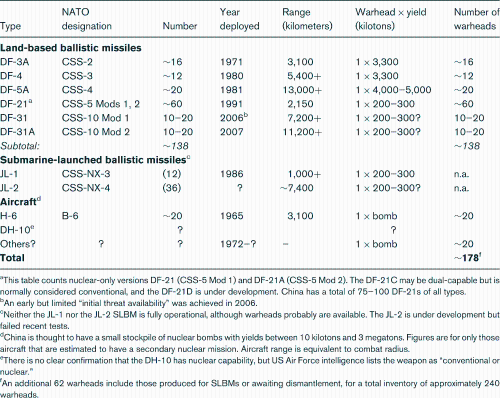
This table counts nuclear-only versions DF-21 (CSS-5 Mod 1) and DF-21A (CSS-5 Mod 2). The DF-21C may be dual-capable but is normally considered conventional, and the DF-21D is under development. China has a total of 75–100 DF-21s of all types.
An early but limited “initial threat availability” was achieved in 2006.
Neither the JL-1 nor the JL-2 SLBM is fully operational, although warheads probably are available. The JL-2 is under development but failed recent tests.
China is thought to have a small stockpile of nuclear bombs with yields between 10 kilotons and 3 megatons. Figures are for only those aircraft that are estimated to have a secondary nuclear mission. Aircraft range is equivalent to combat radius.
There is no clear confirmation that the DH-10 has nuclear capability, but US Air Force intelligence lists the weapon as “conventional or nuclear.”
An additional 62 warheads include those produced for SLBMs or awaiting dismantlement, for a total inventory of approximately 240 warheads.
China is the only one of the five original nuclear weapon states that is increasing its nuclear arsenal; by how much and how quickly is uncertain, though it is clear that China is improving its arsenal. China has been assigning a growing portion of its warheads to long-range missiles, and the US intelligence community predicts that by the mid-2020s, China could “more than double” the number of warheads on missiles that are capable of threatening the United States to “well over 100” (Maples, 2009: 23; US Air Force, 2009: 3). We estimate that China’s current arsenal includes as many as 72 operational missiles that can strike US territory, 5 including 12 DF-4s, 20 DF-5As, up to 20 DF-31s, and up to 20 DF-31As; however, of these, only 40—the DF-5As and DF-31As—can reach the continental United States.
In its new white paper, China stated that it “pursues an open, transparent and responsible nuclear policy” (PRC, 2011: Section X). Unfortunately, neither the white paper nor any other governmental source gives basic information about the size of China’s nuclear arsenal or its future plans. Lt. Gen. Ma Xiaotian, deputy chief of the People’s Liberation Army General Staff, reportedly acknowledged to American officials in 2009 that there were “areas of China’s nuclear program that are not very transparent” and declared, “It is impossible for [China] to change its decades-old way of doing business to become transparent using the US model” (Dorling, 2011).
The US government has complained for years that China is too opaque regarding its military forces and budgets and that it needs to be more open. It was therefore surprising and paradoxical that in its 2011 report on China’s military—one of the most widely used public sources for following Chinese nuclear developments—the Pentagon decided not to provide a detailed breakdown of the Chinese missile arsenal, as it had done in previous volumes. The Pentagon’s omission inadvertently assists Chinese nuclear secrecy.
Land-based missiles
China has approximately 140 land-based, nuclear-capable ballistic missiles of six types: the DF-3A, DF-4, DF-5A, DF-21, DF-31, and DF-31A. Only the DF-5A is silo-based; the rest are in some way mobile, which helps to increase their survivability. The US intelligence community has consistently assessed all six missile types as single-warhead weapons, but the Pentagon recently repeated its projection that “China may also be developing a new road-mobile ICBM [intercontinental ballistic missile], possibly capable of carrying a multiple independently targeted re-entry vehicle (MIRV)” (Defense Department, 2011: 3). If the US ballistic missile defense system is expanded or improved, it could potentially trigger China to deploy missiles that have MIRVs and/or decoys (although this would significantly reduce their range).
The oldest missile in China’s inventory, the DF-3A, is nearing retirement and being replaced by the DF-21. The liquid-fueled, single-stage, intermediate-range DF-3A can deliver a 3.3-megaton warhead. Only one brigade of perhaps eight launchers with 16 DF-3As remains operational.
A single brigade also remains of China’s second-oldest missile, the DF-4 ICBM (which can also deliver a 3.3-megaton warhead); the brigade has approximately 12 of the two-stage, liquid-fueled missiles for roughly the same number of launchers. The DF-4 is being replaced by the DF-31.
China’s DF-5A—a liquid-fueled, two-stage, silo-based ICBM—has a range that stretches beyond 13,000 kilometers (8,100 miles) and has been used to target the United States and Russia since the early 1980s. It is unclear whether China will replace its DF-5A with the DF-31A or maintain them both. We estimate that China has as many as 20 DF-5A ICBMs.
China’s primary regional nuclear missile is the DF-21. The US intelligence community estimates that China’s inventory of DF-21s has tripled from 19–50 missiles in 2006 to 75–100 missiles in 2011 (Defense Department, 2006, 2011). Five years ago, all of China’s DF-21s were nuclear, but it has since deployed a conventional version (the DF-21C) and is developing the DF-21D, a conventional anti-ship missile. Therefore, it is likely that only a portion of the 75–100 DF-21s listed in the recent Pentagon report are nuclear versions; we estimate that 60 of the missiles are nuclear. 6 The mix of nuclear and conventional DF-21s is potentially disastrous: If China were to ready conventional DF-21Cs for launch in a conflict, it could create the risk of misunderstanding, miscalculation, and the potential for escalation if its adversary mistook the conventional DF-21s for their nuclear counterparts.
Deployment of the DF-31, first introduced in 2006, continues at a slow rate; China is using the DF-31 ICBM to replace its older DF-4 missiles. We estimate that China deploys 10–20 DF-31s, with the same number of launchers. The three-stage DF-31, which is carried on a six-axle transporter-erector-launcher in a 15-meter canister, has a range of more than 7,200 kilometers (4,500 miles), which is insufficient to target the continental United States. The DF-31 is believed to be taking over regional targeting of Russia, India, and Guam from the DF-4.
The DF-31A—a solid-fueled, three-stage, road-mobile ICBM—is an extended-range version of the DF-31, yet its range (11,200 kilometers) and payload (200–300 kilotons) are smaller than those of the DF-5A ICBM. We estimate that China deploys 10–20 DF-31A ICBMs; the size of the DF-31A inventory is now approaching the number of DF-5As. Ten years ago, the US intelligence community estimated that by 2015 China would have 75–100 missiles targeted primarily against the United States (CIA, 2001); whether this prediction comes to pass depends on the deployment of several dozen DF-31As over the next few years.
A recent article reported a deployment of the DF-31A near Shaoyang in Hunan Province (Stokes and Hsiao, 2011) that may be for regional targeting; a DF-31A launched from this southern position would not be able to reach portions of the continental United States, including Washington, DC. In the 2011 Pentagon report, a map indicates that the entire continental United States is within reach of the DF-31A, but this is misleading because the range is measured from the Chinese border rather than the actual deployment sites inside the country (Defense Department, 2011). The report states that the DF-31A can reach “most locations” within the continental United States (Defense Department, 2011: 3), but apparently not all—that still requires the longer-range DF-5A.
Submarines and sea-based missiles
China has experienced difficulties with its sea-based nuclear weapons program. Its old Xia-class nuclear-powered ballistic missile submarine (SSBN) is not considered operational, and its efforts to deploy JL-2 submarine-launched ballistic missiles (SLBMs) on its new Jin-class SSBNs have suffered setbacks. Because of this, China does not have any operational SLBMs.
The JL-2, which is a modified version of the DF-31, has apparently failed several flight-tests. Five years ago, the Pentagon predicted that the JL-2 would reach initial operational capability in 2007–10 but now says that when the Jin/JL-2 will become fully operational is “uncertain” (Defense Department, 2006: 27; 2011: 34).
In its 2011 report, the Pentagon has revised its previous estimate of the JL-2’s range slightly upward to “some 7,400” kilometers (4,600 miles), a distance sufficient to target Alaska, Guam, Russia, and India from waters near China—but not the continental United States (Defense Department, 2011: 3).
It is still unclear how many Jin-class SSBNs China plans to build; US naval intelligence projected in 2007 that the number might be five (Kristensen, 2007a). That year, a Jin-class sub was first spotted at the Xiaopingdao Submarine Base using commercial satellite imagery from 2006, and two subs were photographed at a shipyard in Huludao (Kristensen 2007b, 2007c). In 2008, China deployed the first Jin-class SSBN to Yulin Naval Base on Hainan Island (Kristensen, 2008). In March 2009, a Jin-class sub with open missile launch tubes—perhaps an indication of missile test preparations—was docked at Xiaopingdao, where in March 2011 two SSBNs were seen moored together (Kristensen, 2010, 2011). The first Jin-class subs appear ready to enter service, according to the Pentagon (Defense Department, 2011). The satellite images and Pentagon analysis could indicate that China has launched three Jin-class SSBNs and has more under construction. With 12 missile launch tubes per sub, three Jin-class SSBNs could carry 36 missiles (five of the subs could carry 60 missiles)—a significant increase from the maximum of 12 SLBMs that a sole Xia-class submarine could carry.
The precise mission of the Chinese SSBN fleet is something of a mystery because of its doctrinal, operational, and technical constraints. It is unlikely that China’s Central Military Commission, which controls the country’s nuclear arsenal, would hand over custody of nuclear warheads to the navy during peacetime, which means that China could not deploy a fully functional sea-based deterrent similar to that of the United Kingdom or the United States. In a crisis, the SSBNs would have to be first outfitted with warheads and then deployed. No Chinese SSBN has ever sailed on a deterrent patrol, so China’s navy and the Central Military Commission have essentially zero experience with operating an SSBN during realistic military operations.
To add to the difficulties, even if China deployed SSBNs in a crisis, where would they sail? For a JL-2 to reach the continental United States, a Jin-class SSBN would have to sail through the East China Sea and well into the Pacific Ocean, through dangerous choke points where it would be highly vulnerable to hostile antisubmarine warfare. Regional targeting is a different matter; the JL-2 can reach Guam, all of India, and most of Russia (including Moscow) from port.
China’s main concern is the survivability of its minimum nuclear deterrent, and it spends considerable resources on dispersing and hiding its land-based missiles. This makes its SSBN program even more puzzling, for it is much riskier to deploy nuclear weapons at sea, where the SSBNs could be sunk by unfriendly forces. 7
Cruise missiles
China produces and fields a number of cruise missiles, including the DH-10 land-attack cruise missile, which has a range of more than 1,500 kilometers. The Pentagon recently included the missile in a table about China’s “conventional precision strike” capabilities (Defense Department, 2011: 30), but in 2009 US naval intelligence listed it as “conventional or nuclear,” indicating that it might also have a nuclear capability (US Air Force, 2009: 29). The number of DH-10s has stalled at somewhere between 200 and 500 missiles, and the number of launchers between 40 and 55—the same levels as in 2010 (Defense Department, 2010, 2011).
Funding
This research was done with a grant from the Ploughshares Fund and Carnegie Corporation of New York.
Footnotes
1
For an insightful review of Chinese nuclear doctrine, see Kulacki (2011).
2
Nuclear weapons are stored in central facilities under the control of the Central Military Commission. Should China come under nuclear threat, the weapons would be released to the Second Artillery Corps to enable missile brigades to go on alert and prepare to retaliate. For a description of the Chinese alerting concept, see Kristensen (2009a). For more on warhead storage in China, see Norris and Kristensen ( : 134–141).
3
Given its history of nuclear tests using weapons dropped by short- and medium-range aircraft, China is likely to have a small quantity of nuclear bombs that would be delivered by H-6 bombers. China’s nuclear bomber capability is minor and involves secondary missions for only a small number of aircraft.
4
The Chinese nuclear stockpile is slightly larger than the British stockpile of approximately 225 warheads and smaller than the French stockpile of roughly 300 warheads.
5
US territory includes Alaska, Hawaii, Guam, American Samoa, and many other tiny Pacific islands. The “continental United States,” as used here, includes the 48 lower states and not Alaska or Hawaii.
6
The Second Artillery’s organization of DF-21s is unclear, but it is thought that nuclear and conventional units are kept separate. For insightful studies of China’s missile force, see Stokes and Easton (2010); .
7
Chinese SSBNs are apparently very noisy (Kristensen, 2009b).
Author biographies
Inquiries should be directed to FAS, 1725 DeSales St., NW, Sixth Floor, Washington, DC, 20036 USA; +1 (202) 546-3300.