




Abstract
The Obama administration has approved an upgrade to the B61 nuclear bomb that will, through use of a new tail kit assembly, become a guided standoff nuclear bomb. If the upgrade—the 12th modification of the original B61 design—is pursued as planned, the US Air Force will obtain the low-yield, precision-guided nuclear weapon it first sought in the 1990s, despite concerns that it could increase the likelihood of use. The weapon’s overall price tag is expected to exceed $10 billion, with each B61-12 estimated to cost more than the value of its weight in gold.
The Obama administration has approved an upgrade to the B61 nuclear bomb, one of the most versatile and numerous nuclear warheads in the US stockpile. The new type, known as the B61-12, uses a new tail kit assembly to convert the B61-4 into a guided standoff nuclear bomb (see Figure 1). By increasing the accuracy of the weapon, the 50-kiloton warhead from the B61-4 can be used to hold at risk the same targets that today require the higher-yield B61-7.
The B61-12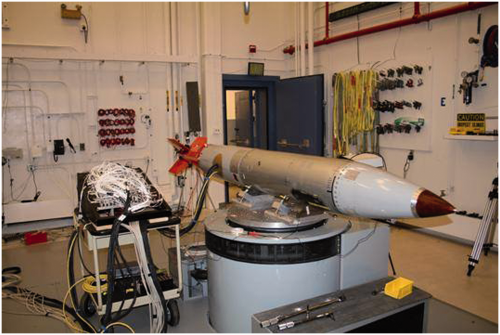
B61 versions and characteristics
Today, five B61 versions remain in the stockpile: the B61-3, -4, and -10 tactical bombs; the B61-7 strategic bomb; and the B61-11 strategic earth-penetrating bomb. The administration is planning to retire three of these and convert the B61-4 into the B61-12 to serve all gravity bomb missions in the future on both strategic and tactical aircraft.
Over the past decade and a half, more than half of the B61s in the stockpile have been retired, with the total number falling from approximately 1,725 in 1998 to about 820 today. The most significant reduction has been in nonstrategic B61s (Mods 3, 4, and 10), which have seen inventories decline from 1,200 to 500. In the same period, the number of strategic B61s (Mods 7 and 11) has dropped from 525 to 300. Of the remaining 820 B61s, we estimate that only 300 are deployed at bases with operational aircraft, including 184 B61s deployed in Europe.
If the B61-12 upgrade is pursued as planned, the Air Force will obtain the low-yield, precision-guided nuclear weapon it first sought in the 1990s, despite concerns that it could create a more usable weapon. The weapon’s price tag will be extraordinary, with each B61-12 estimated to cost more than the value of its weight in gold.
B61 history
In January 1963, shortly after the Cuban Missile Crisis, Los Alamos was assigned the Phase 3 milestone (development engineering) for the B61, and a series of underground tests was conducted over the next five years at the Nevada Test Site to certify the yield and confirm the military characteristics. One of the half dozen B61-associated tests conducted during 1966 is suspected of having been fired at full yield. Shot Halfbeak was detonated on June 30 of that year and is estimated to have been in the 350-kiloton range. Nuclear testing resumed in the mid-1970s to perfect the Mod 3 and 4 versions, produced and stockpiled in 1979–1990.
The B61 bomb can be delivered as a free-fall or a retarded airburst, a free-fall surface burst, or in a “laydown” mode from aircraft flying as low as 50 feet. The latter method requires that the bomb survive ground impact, which is accomplished through use of a parachute that quickly slows the bomb’s descent and controls its trajectory. A 17-foot-diameter, all-nylon parachute was initially used; later models have a 24-foot-diameter, hybrid nylon/Kevlar chute.
Over the years, the bomb has been deployed on a wide variety of tactical and strategic aircraft. The strategic versions have been carried on B-52, FB-111, B-1, and B-2 bombers. The B-52s are still capable of capable of carrying gravity bombs but are not assigned any under the war plans. The tactical versions, with lower-yield options, have been deployed on a variety of US and NATO aircraft that include the F-100, F-104, F-4, F-105, F-15E, F-16, F-111, F-117, and Tornado. The US Navy and Marines have used the B61-2/5s on A-4, A-6, A-7, and F/A-18 aircraft. After the Navy quietly terminated the nuclear strike mission from US aircraft carriers in the early 1990s, those bombs were retired and disassembled.
The B61 has also served as the basic design for three other warheads: the W80-0 sea-launched cruise missile warhead; the W80-1 warhead for the air-launched cruise missile and the Advanced Cruise Missile; and the W85 warhead for the Pershing II missile. The Pershing II was one of the missiles eliminated by the 1987 Intermediate-Range Nuclear Forces Treaty (INF). While the missiles and launchers were destroyed by mid-1991, as the treaty called for, the warheads were retained, converted, and initially returned to European air bases in the early 1990s. (Since 2005, the B61-10 has been stored in the inactive stockpile in the United States.) The W85 missile warhead design used in the Pershings is a close variant of the B61 Mod 4 bomb. After the “physics package”—the guts of the nuclear explosive—was removed, it was placed inside a bomb casing and re-designated the B61 Mod 10. While not technically illegal under the letter of the INF, it can be argued that this conversion of missile warheads to bombs violated the spirit of the pact.
The current strategic B61-7 version for the B-52 and the B-2 is a variable-yield gravity bomb, and the earth-penetrating model, the B61-11 for the B-2, has a single yield of 400 kilotons. The B61-7 was produced between 1985 and 1990. After the B-2 stealth bomber became operational in the nuclear war plan in October 1997, the B-2 was chosen as the designated carrier of the B61-11, which replaced the old nine-megaton B53 that was carried by the B-52. With its hardened steel case and nose cone—adding 450 pounds of weight—the B61-11 can penetrate frozen soil to a depth of 3 to 6 meters. Approximately 50 B61-11s were produced in 1997–1998. B61-7 and B61-11 bombs are stored at Whiteman Air Force Base in Missouri and Kirtland Air Force Base in New Mexico.
The B61-7 laydown bomb also served as the basis for the W61 program in the late 1980s and early 1990s, an effort to equip a small intercontinental ballistic missile (Midgetman) with a strategic earth-penetrating warhead. Engineering authorization was granted for the W61 in 1990, only to be canceled 18 months later when the George H.W. Bush administration discontinued the Midgetman as the Cold War wound down.
The current tactical versions of the B61 are the Mods 3, 4, and 10. Approximately 180 of the Mod 3 and 4 versions are deployed with US Air Force units at six bases in five NATO countries—Belgium, Germany, Italy, the Netherlands, and Turkey. The rest are stored in the United States at Kirtland Air Force Base. The B61 bomb has the distinction of being the only remaining US nuclear weapon deployed outside US borders (excluding the missile warheads on patrolling nuclear submarines).
The basic bomb weighs approximately 700 pounds, is slightly more than 13 inches in diameter, and is 11.8 feet long, from nose to fin-tip. The earth-penetrating version, the B61 Mod 11, weighs an additional 450 pounds.
The B61-12: The next chapter
The Obama administration has approved development of the B61-12, a new guided standoff bomb intended to serve all gravity bomb missions in the future. Advertised as simply a life extension of the existing B61, the B61-12 will have improved accuracy to enable it to threaten targets currently requiring higher yield. The B61-12 entered Phase 3 (engineering) in 2013, and the first production unit is scheduled for 2020. It is thought that approximately 480 B61-12s will be produced through the mid-2020s.
The B61-12 program has been controversial because of its high price tag. It was estimated in 2010 to cost $4 billion, but the National Nuclear Security Administration’s estimate ballooned to $8 billion in 2012, and the Defense Department set the cost at $10.4 billion in 2013. The new guided tail kit will cost another $1.8 billion and integration on five different aircraft will cost hundreds of millions more. The B61-12 program is probably by now the most expensive nuclear bomb program in US history. Each B61-12 is estimated to cost more to produce than if it were made of solid gold.
In the new B61-12 design, the parachute will be removed and the weapon instead will use a guided tail kit to provide a limited standoff capability to increase delivery aircraft safety. The B61-12 will have both air- and ground-burst capability. The B61-12 will initially be integrated with B-2, F-15E, F-16, and Tornado aircraft. From the 2020s, the weapon will also be integrated with, first, the F-35A (replacing the F-16) and later the LRS-B next-generation long-range bomber.
While the B61-12 will be capable of holding at risk the same targets as current gravity bombs in the US stockpile, it will do so with less yield and thus less collateral damage, including radioactive fallout. Congress rejected Air Force requests for new, low-yield, precision-guided nuclear weapons in the 1990s because of concern that such weapons would be seen as more usable than larger strategic warheads. With the B61-12, which will have several low-yield options, the military appears to obtain a guided low-yield nuclear strike capability after all.
In Europe, the effect of the B61-12 will be even more profound because the high-yield, strategic versions of the B61 are not currently deployed there. With the increased accuracy and standoff capability, especially when mated with the stealthy F-35A fighter-bomber in the future, the B61-12 will represent a considerable enhancement of NATO’s nuclear posture in Europe.
Footnotes
Funding
This research was carried out with a grant from the Ploughshares Fund.