




Abstract
Although social comparisons are ubiquitous in leadership, previous scholarship in public administration has not yet studied comparative aspects of how followers perceive and respond to leadership. This study addresses this gap and disentangles the link between leadership and work engagement from a socio-cognitive and relational perspective. It examines how public employees compare their real leaders against ideal leaders and how perceived gaps between both affect their work engagement through leader–member exchange (LMX). Building on leadership and job demands–resources theory, a priming study using the Semantic Misattribution Procedure (SMP) extracts participants’ Implicit Public Leadership Theories. Structural equation modeling reveals that work engagement is substantially higher (lower) when characteristics of the supervisor resonate with positive (negative) prototypes of ideal leaders, with this association being fully mediated by LMX. The study shows how implicit information processing matters for the emergence of leader–follower relationships and, in turn, for important follower outcomes. It thus contributes to, and combines, a socio-cognitive and a relational approach to leadership in the public sector.
Introduction
The visibility of leaders in the organizational hierarchy and their exposure to followers make them easy targets of comparison. Consciously or not, followers compare their leaders with those of their colleagues in other teams, they compare their current leader with his or her predecessor in the same position, or they compare their leaders in their current and former jobs within or outside the organization (Festinger, 1954; Greenberg et al., 2007). As with any human cognition (Fiske & Taylor, 2017; Kahneman, 2013), followers’ social comparisons of leaders reside to considerable extents at levels below full consciousness, which makes them inevitable to occur but difficult to observe. Nevertheless, many leaders will know, or at least have a hunch, that followers compare them with others because they do the same with their own leaders.
Scholarship in public administration (PA) has recently advanced along these lines and explored deeper into the socio-cognitive foundations of public leadership (Hesmert et al., 2022; Vogel & Werkmeister, 2021). This research suggests that comparisons are not limited to real leaders whom followers met in person or know more distantly from media or stories, but followers might also compare their leaders with ideal leaders (van Quaquebeke et al., 2014). Ideal leaders are abstract images of successful leaders with prototypical characteristics, regardless of whether these characteristics occur in a real leader of whom followers think (Junker & van Dick, 2014; Lord et al., 2020).
While previous research has extracted prototypes of public leaders (Vogel & Werkmeister, 2021), no prior study has examined how these implicit theories feed into social comparisons of leaders at the workplace and what consequences these comparisons have. Depending on the leader prototypes that followers bring to their jobs, they will evaluate leaders against different standards. Real leaders are likely to live up to these standards and match the characteristics of ideal leaders to very different extents. The consequences for the relationship between leaders and followers are unclear: On the one hand, perceived gaps between the real and ideal leader may be detrimental to the quality of the exchange because followers find their expectations toward a leader disappointed, which lowers the potential to identify with him or her and, in turn, to develop a high-quality relationship (Epitropaki & Martin, 2005). On the contrary, a perceived mismatch between the real and ideal leader may not be harmful and even improve the exchange because imperfection makes leaders more authentic and approachable (Diddams & Chang, 2012), thus reducing the social distance between leader and follower.
Given the strong evidence for beneficial follower outcomes of high-quality relationships between leaders and followers (Martin et al., 2016), the question of whether and how LMX is contingent on followers’ comparisons of real with ideal leaders deserves scholarly and practical attention. The research question of this study thus reads:
How does the match between public employees’ real and ideal leaders affect LMX and, in turn, their engagement at work?
The focus is on work engagement as a follower outcome because it has recently attracted increasing attention in public management (e.g., Borst et al., 2020; Monks et al., 2022). A number of studies have demonstrated that work engagement is one of the most robust predictors of employee performance (Bakker et al., 2012; Demerouti et al., 2010). Work engagement is particularly relevant to public organizations, as disengaged and low-performing employees impede the reliable delivery of public goods and services (Borst, 2018; Luu, 2019; Vigoda-Gadot et al., 2013; Zahari & Kaliannan, 2022).
To answer the research question, the study integrates an implicit priming technique into an online survey among public employees in Germany. Implicit methods capture those parts of individuals’ information processing that occur automatically and spontaneously and are not subject to introspection or explicit control (Epitropaki et al., 2013). As a specific form of implicit methods, priming tools measure how individuals’ subconscious knowledge structures influence their behavior in a subsequent decision-making task (Ngoye et al., 2020). More precisely, the Semantic Misattribution Procedure (SMP; Imhoff et al., 2011) was applied. Structural equation modeling (SEM) reveals that a match between participants’ implicit, idealized images of public leaders and their real leaders’ traits increases employees’ LMX substantially. In addition, LMX mediates the positive relationship between the IPLT prototype match and work engagement, while no mediation effect occurs for the IPLT antiprototype match.
With these findings, the study makes two contributions to public leadership research and practice: First, it advances the socio-cognitive approach to public leadership by accounting for implicit comparisons in the perception of leadership. Public leadership research largely agrees that leadership is “in the eye of the beholder” (Jacobsen & Andersen, 2015), with the vast majority of studies measuring leadership from the perspective of followers (Backhaus & Vogel, 2022). However, followers do not perceive their leaders in isolation and independent of implicit benchmarks. As the role of these comparisons in perceptions of public leadership has neither been theorized nor researched so far, previous scholarship has missed an important aspect that helps disentangle these perceptual processes. Second, the study joins relational approaches to public leadership (Crosby & Bryson, 2018; Uhl-Bien & Ospina, 2012) by illuminating the mediating role of LMX in the association between followers’ leadership perceptions and work engagement. Previous studies in PA have repeatedly demonstrated the beneficial outcomes of LMX (Hassan & Hatmaker, 2015; Liu & Meng, 2023), which makes it all the more interesting to further explore the conditions under which high-quality relationships grow.
Theoretical Framework
Figure 1 shows the theoretical framework of the study, including the core constructs and hypotheses.
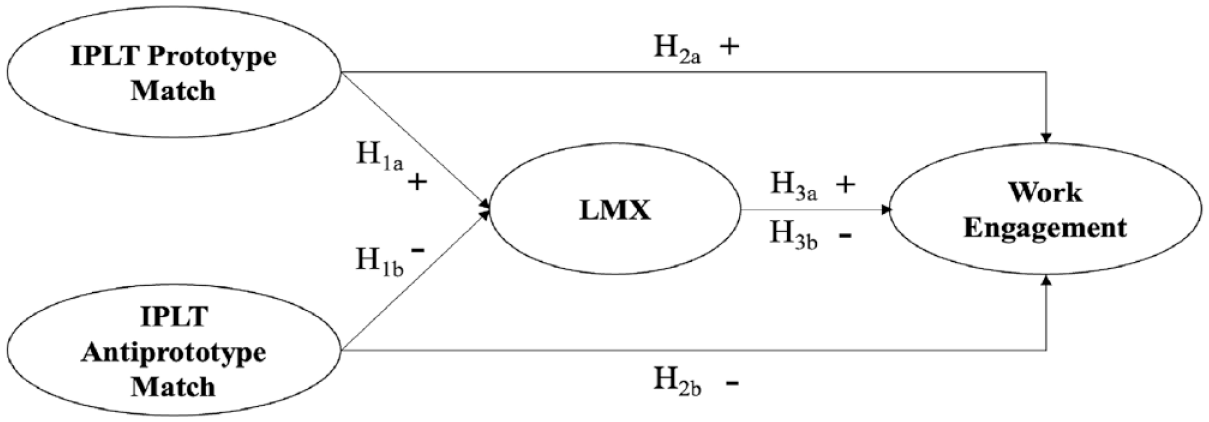
Theoretical Framework and Hypotheses.
Implicit Public Leadership Theories
Most public management scholars would agree that leadership is a socially constructed phenomenon (Ospina, 2017; Ospina & Sorenson, 2006; Uhl-Bien, 2011; van Wart, 2004). Building on this premise, a socio-cognitive approach to leadership highlights the role of followers’ implicit information processing in the emergence and outcomes of leadership (Epitropaki et al., 2013; Shondrick & Lord, 2010). Research in this stream places particular emphasis on Implicit Leadership Theories (ILTs; Eden & Leviatan, 1975), individuals’ ex-ante images of and expectations toward leaders. Two distinctions are important in the conceptualization of ILTs: First, ILTs can be either typical or ideal. While typical ILTs refer to traits that average representatives of the leader category show, ideal ILTs lend themselves to the extreme ends of the distribution and comprise traits of extraordinary leaders. Second, ILTs build on leadership prototypes and antiprototypes, thus conveying images of both good and bad leaders. Prototypes refer to positive, desirable traits of typical or ideal leaders, whereas antiprototypes include negative, undesirable characteristics that people associate with typical or counter-ideal leaders (Epitropaki et al., 2013; Lord et al., 2020).
The focus of this article is on ideal ILTs, covering both prototypical and antiprototypical leaders. The reason why public management scholars and practitioners should pay attention to those everyday theories about leaders is that they play an important role in how followers evaluate their real leaders. Followers bring their ILTs to the leadership relationship and compare their leaders against preexisting (anti-)prototypes of ideal leaders. ILTs are thus cognitive frames and benchmarks that are involved in the process of leadership categorization (Epitropaki et al., 2013; Lord et al., 1984). The comparison between real and ideal leaders is automatically triggered and resides to considerable extents at levels below full consciousness and introspective access. The outcome of this comparison (i.e., the degree to which a real leader shows ideal traits) might determine the classification of the target as a leader or non-leader or as a good or bad leader. In turn, it shapes followers’ attitudes and behavior toward that leader (for a review, see Junker & van Dick, 2014).
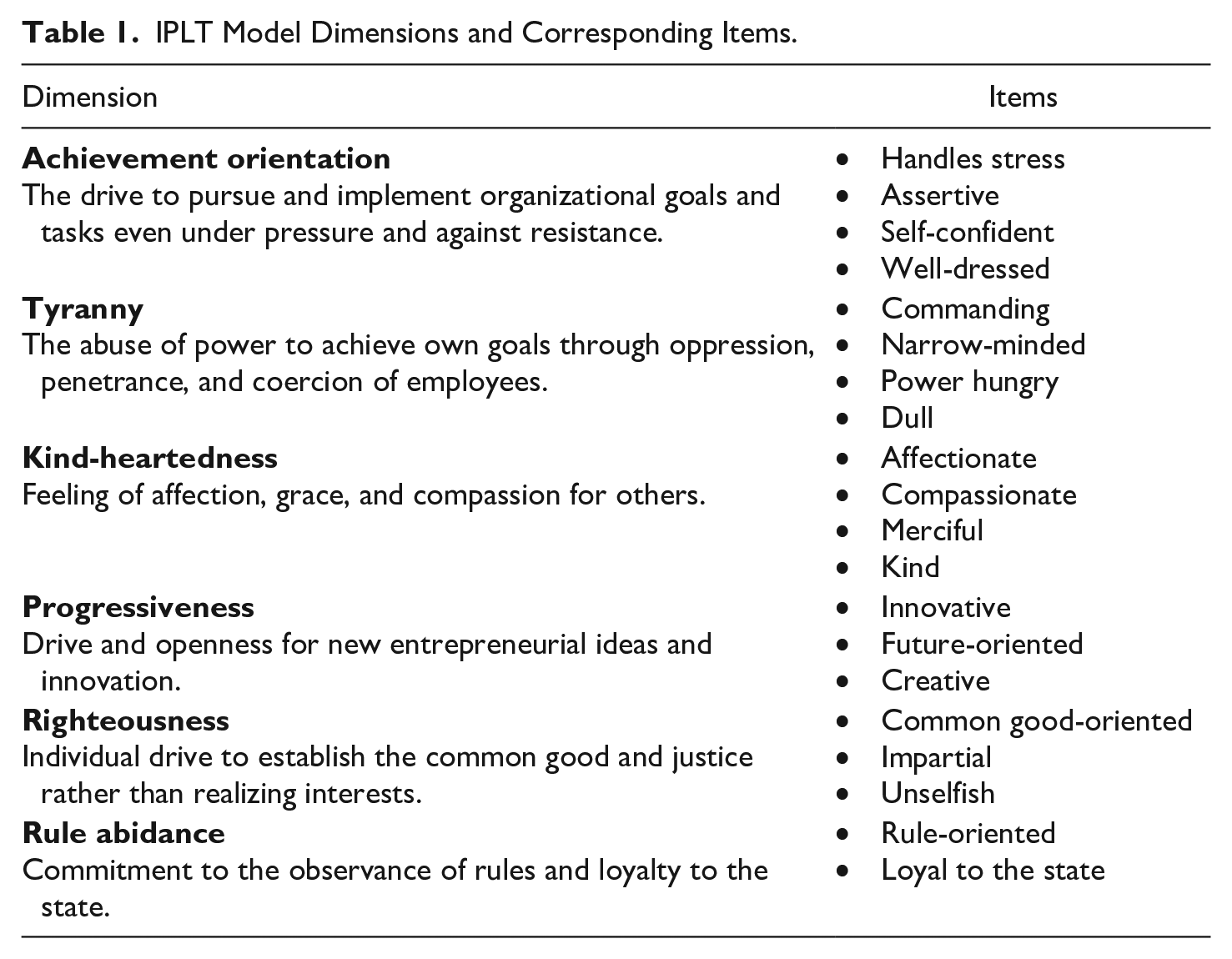
While research on ILTs has added significantly to a conceptualization of leadership as a social phenomenon that is constructed by both leaders and followers, up until recently, research has been limited to the private sector. Advancing a socio-cognitive approach to public leadership, Vogel and Werkmeister (2021) have applied the study of ILTs to the public context and empirically identified a model of Implicit Public Leadership Theories (IPLTs). These implicit images of public leaders are neither completely different from nor identical to ILTs about general leaders (Vogel & Werkmeister, 2021). However, employees rely on their IPLTs to distinguish public from private leaders and to attribute traits to leaders even when they are not familiar with them (Hesmert et al., 2022). Table 1 lists the dimensions and corresponding items of the IPLT model.
IPLT Model Dimensions and Corresponding Items.
Implicit Public Leadership Theories and Leader–Member Exchange
A socio-cognitive approach to public leadership suggests that individuals’ IPLTs and the degree to which they are met by a real leader are important predictors of leader–member exchange (LMX). LMX refers to the quality of the relationship between leaders and followers (Graen & Uhl-Bien, 1995). In the case of high quality, the relationship matures into a social exchange characterized by mutual trust, respect, and commitment among leaders and followers. In contrast, low-quality relationships correspond to an economic exchange within the limited scope of the employment contract and do not go much beyond the transaction of resources. Leaders do not, and cannot, have the same relationship with all followers. The quality of LMX thus differs considerably across leadership dyads, fostering social distinctions between the in-group with high LMX and the out-group with low LMX (Dansereau et al., 1975).
The extent to which a real leader resonates with followers’ implicit conceptions of an ideal leader is likely to have consequences for the quality of LMX. On the one hand, a mismatch with an ideal leader may make a real leader “only human” (Diddams & Chang, 2012) and, in turn, more approachable and authentic. This should particularly apply in the case of leaders who demonstrate self-awareness of their weaknesses given that self-awareness is at the core of both authentic (Gardner et al., 2011) and humble leadership (Kelemen et al., 2023). Leaders indeed express humility when they acknowledge their imperfections, for example by reflecting upon their own mistakes (Hu et al., 2022). Authenticity and humility, in turn, should reduce social distance between leaders and followers and foster LMX. Previous research supports the assumption that authentic leadership is positively related to LMX (e.g., Sürücü & Yıkılmaz, 2023).
On the contrary, a match, rather than a mismatch, between the real and ideal leader may facilitate LMX. This reverse perspective is less rich in assumptions and more consistent with previous scholarship on ILTs (Epitropaki & Martin, 2005; Riggs & Porter, 2017). People generally show positive responses to environments that resonate with their expectations given that this resonance reduces cognitive efforts, increases psychological safety, and enables orientation (Fiske & Taylor, 2017). In the more particular case of a leader who conforms to an idealized image of a good leader, an additional effect is that followers experience self-esteem and self-enhancement from having a trustful social relationship with that leader (Afshan et al., 2022). Van Quaquebeke and colleagues (2010) argue that followers are more likely to identify with leaders who represent the values that followers cherish. The traits that leaders bring in their leadership are expressive signals of their values, such as respect and benevolence. The more these values of the real leader conform with what followers expect from an ideal leader, the higher the perceived value congruence between leader and followers is, and the more followers will identify with that leader. Based on this identification, followers are more likely to accept the leader as a role model, fostering their trust, respect, and commitment and facilitating further investments in the relationship (van Quaquebeke et al., 2010). Moreover, followers’ ratings of their relationship with that leader are likely to be positively biased given that an ideal leader shows socially desirable traits (Junker & van Dick, 2014). Followers not only compare their real leaders to ideal leaders, but they also compare the quality of their leadership relationship to those of other followers (Henderson et al., 2009; Hu & Liden, 2013; Matta & Van Dyne, 2020). Being in the “in-group” of an ideal leader is likely to elevate followers’ status in the organization, which will further increase their self-esteem. Therefore, in the case of a real leader matching the image of an ideal leader, positive implications for employee-rated LMX are to be assumed. Hence, the first hypothesis reads as follows:
The hypothesized mechanisms are likely to reverse in the case of antiprototype match. As antiprototypical leaders show traits opposed to those of an ideal leader (Junker & van Dick, 2014), followers will avoid a relationship that goes beyond what is necessary. Rather than gaining self-esteem and self-enhancement, followers risk depreciation and depletion from exchange with a counter-ideal leader. Bad leadership qualities may exacerbate and culminate in toxic leadership behaviors (Pelletier, 2010), with even more detrimental consequences for LMX. Membership in the in-group of a counter-ideal leader will send unfavorable signals to other organizational members, and followers of those leaders are likely to underrate the quality of the leadership relation. Accordingly, the second hypothesis is:
Implicit Public Leadership Theories and Work Engagement
In addition, a positive association between prototype match and work engagement and a negative relationship between antiprototype match and work engagement are proposed. Work engagement is a positive psychological state, which is characterized by high levels of energy, vitality, and mental strength (vigor), the feeling of pride and significance (dedication), and a state of intense focus and immersion in one’s work (absorption; Ancarani et al., 2018; Schaufeli et al., 2006). Highly engaged employees are enthusiastic about their work, more emotionally involved than employees with lower engagement, and feel highly rewarded for their tasks. Work engagement is positively related to several other beneficial employee outcomes in the public sector, such as in-role (Hakanen et al., 2008; Luu, 2019) and extra-role performance (Borst et al., 2019), organizational commitment (Agyemang & Ofei, 2013), and job satisfaction (De Simone et al., 2016). In addition, work engagement can buffer occupational stress arising from red tape, organizational reforms, or economic pressure (Bakker, 2015; Borst, 2018).
More than an average leader, and contrary to a counter-ideal leader, an ideal leader is a job resource, given that ideal characteristics of leaders often pertain to supportive orientations toward individuals and teams (Dorfman et al., 2012). The notion of job resources is borrowed from the job demands–resources (JDR) theory, which predicts attitudinal and behavioral outcomes at the workplace as a function of job characteristics (Bakker & Demerouti, 2007). Those characteristics can be distinguished into job resources and job demands, both of which can refer to physical, psychological, social, and/or organizational aspects of the job. Job resources are those aspects that are functional to the achievement of goals and foster personal growth, learning, and development. In the presence of job resources, a gain cycle is triggered, resulting in heightened levels of motivation and, in turn, beneficial outcomes (such as work engagement). In contrast, job demands are those aspects of the job that require sustained effort or skills and are therefore associated with certain physiological and/or psychological costs. They foster a loss cycle in which employees perceive high levels of strain at work and respond with detrimental attitudes and behaviors. The gain cycle might interfere with the loss cycle, but the nature and strength of these compensatory effects are still subject to conceptual debate and empirical inquiry (Bakker & Demerouti, 2007).
Leadership can interfere with the associations predicted by the JDR model in various ways (Tummers & Bakker, 2021). Positive, constructive forms of leadership are likely to increase job resources and decrease job demands (Tummers & Bakker, 2021). This should be the case for leaders who match prototypes because prototypes represent ideal, desirable characteristics of leaders, such as kindness and compassion. These traits should provide additional job resources to followers and reduce perceptions of job demands, thus releasing a gain cycle and translating into employee motivation and engagement. In contrast, more negative, destructive forms of leadership impose additional job demands on followers (Tummers & Bakker, 2021). This should apply to leaders who match antiprototypes because those leaders show counter-ideal, undesirable traits, such as narrow-mindedness and hunger for power. In this case, the real leader is more a job demand than a job resource, fostering a loss cycle with detrimental consequences for work engagement. The second pair of hypotheses thus reads as follows:
Leader–Member Exchange and Work Engagement
In line with LMX theory (Clark et al., 2014; Graen & Uhl-Bien, 1995; Henderson et al., 2009; Ospina, 2017), the theoretical framework is completed by a direct link between the quality of the leader–follower relationship and followers’ work engagement (Figure 1). For example, Ancarani and colleagues (2018) found a positive association between a high-quality social exchange and followers’ work engagement in an Italian public hospital. The authors concluded that high LMX is associated with specific job resources (Bakker & Demerouti, 2007), such as the provision of feedback, emotional and instrumental support, and psychological safety (Ancarani et al., 2018). From this perspective, work engagement is a response to the resourceful work environment provided by the leader in a high LMX relationship. Access to those resources also helps address basic human needs, such as the strive for relatedness and competence (Ryan & Deci, 2000). Followers in a high-quality leader–member relationship are more likely to develop a sense of belonging and to feel acknowledged and recognized by their leader than followers in low LMX, with this satisfaction of needs fueling motivation and engagement.
It follows from the reasoning above that the relationship between the extent to which a real leader shows traits of an ideal leader and employees’ work engagement is mediated by LMX. Put differently, it is through a better relationship quality with their supervisor that (anti-)prototype match has a positive (negative) effect on public employees’ work engagement. This proposition is supported by evidence from other settings, where LMX fully mediates the effects of ILT congruence on organizational outcomes (Epitropaki & Martin, 2005; Foti et al., 2017; Lord et al., 2020; Riggs & Porter, 2017). The last pair of hypotheses thus reads as follows:
Method
Research Strategy
The overall strategy to test the theoretical framework empirically was to account for the “implicit” in IPLTs and thus to combine traditional survey instruments with a novel technique from the family of implicit methods. Such methods have recently attracted growing attention in PA scholarship (e.g., Asseburg et al., 2020; Hesmert et al., 2022; Marvel & Resh, 2019). This study applied an implicit priming method, which allows to measure followers’ IPLTs below their awareness and thus fosters consistency between the implicit nature and measurement of IPLTs (Lord et al., 2020). Priming methods build on the effect that exposure to certain stimuli influences individuals’ subsequent judgments and decisions below the level of awareness (Bargh, 2006). In the Semantic Misattribution Procedure (SMP; Imhoff et al., 2011), the primes are single words or short phrases (hence “semantic”). Participants are exposed to these primes for very short periods of time, wherein fully conscious processing of the information is impossible. Afterward, the participants see a neutral cue for a longer period of time. The original versions of the SMP and related methods suggest to use an Asian character because without command of the respective language, the character cannot have meaning to the participants (Imhoff et al., 2011; Payne et al., 2005). The participants are then asked to indicate whether this character does, or does not, fit the target category (in the case of this study, a leader). Given that the participants were previously primed with a meaningful word or phrase, the attribution of the neutral character to the target category occurs non-randomly. While the participants wrongly attribute the character to the target (hence “misattribution”), the “true” attribution is that of the prime to the target category. As these attribution processes occur subliminally and under time pressure, they reveal an implicit dimension of associative cognition that is not accessible by traditional questionnaires. Given that other constructs in the theoretical framework refer to more explicit attitudes, this study combines the SMP with frequently applied and validated survey instruments (for a similar procedure, see Hesmert et al., 2022). The study was implemented in an online survey.
Procedure
Figure 2 illustrates the procedure schematically, while Online Supplemental Appendix A gives a detailed step-by-step overview, including all materials and instructions.
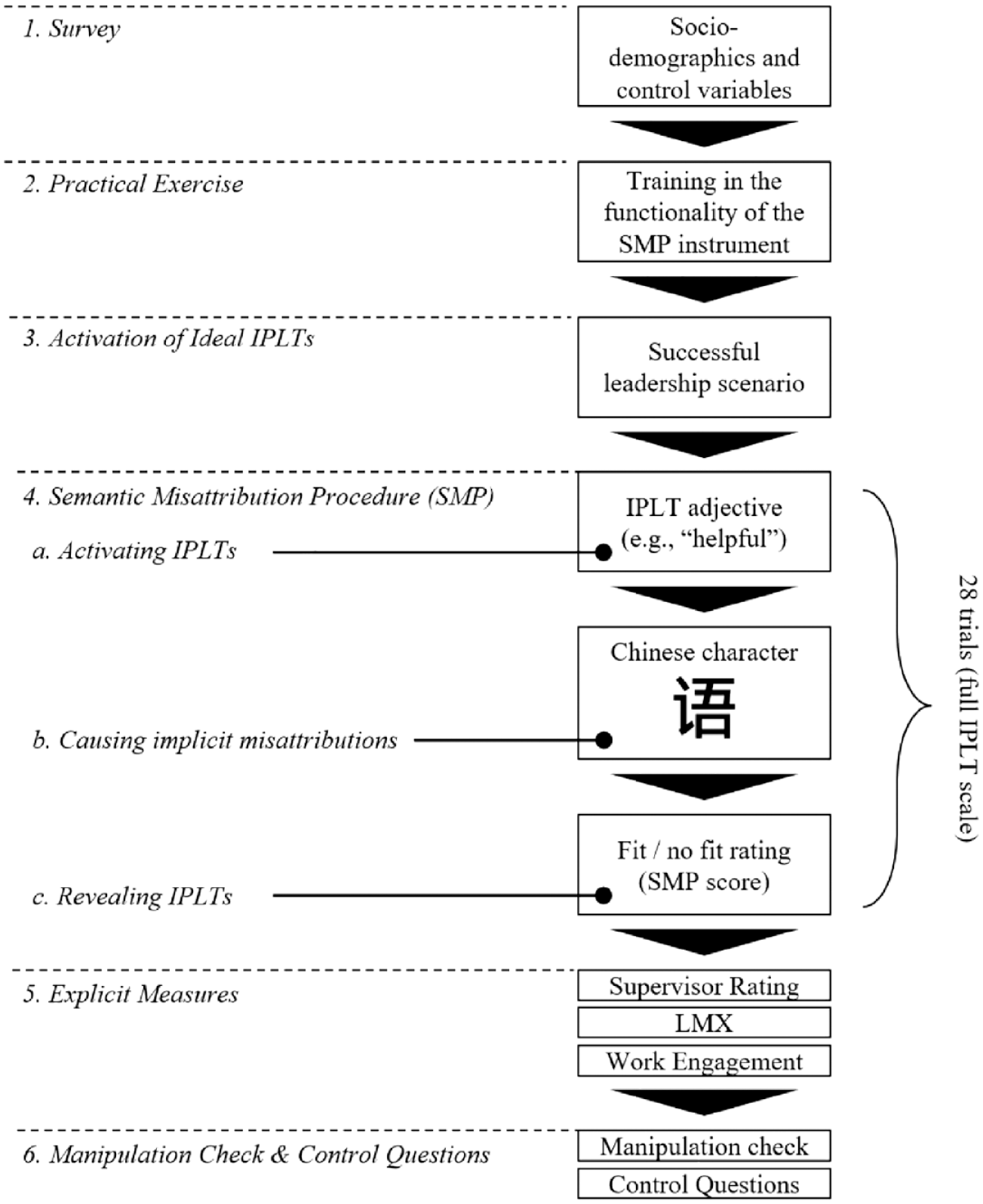
Procedure.
Survey
After reading the instructions and agreeing to the consent and privacy forms, participants reported their demographics, such as age, gender, and work experience.
Practical Exercise
To make participants familiar with the instrument and to increase their response times, they first completed several rounds of the SMP for training purposes. The primes in this practical exercise were non-ambiguous pictures and words, each succeeded by a Chinese character and the question of whether the character matches a target category. A match was indicated by pressing the “L” key on the keyboard and a mismatch by pressing the “A” key. None of the exercises was related to the subject of leadership.
Activation of Ideal IPLTs
Due to their embeddedness in implicit cognitive structures, IPLTs first need to be made salient, that is, more susceptible to cognitive processing. This has to occur without participants’ awareness of the measurement object (i.e., their IPLTs) to minimize interference with explicit information processing (Epitropaki et al., 2013). A useful means to indirectly trigger leadership-based associations is scenario designs pertaining to fictitious leadership situations (Haslam & Ryan, 2008). The scenario used in this study described a successful, high-performing team and its leader (named Alex), supported by a chart indicating a positive performance forecast (see Online Supplemental Appendix B): Alex is leading a team in an organization. This year, the team performed very well. Alex’ team realized all of the set performance targets set last year and even exceeded some of them. The client satisfaction survey results indicated a particularly positive development. The forecasts for the upcoming fiscal quarter seem to confirm this rising performance trend.
The situational framing is intended to trigger individuals’ inference-based information processing, wherein (anti-)prototypes are activated merely through the perception of performance cues and even in the absence of a leader (Lord & Maher, 2002). The description of a successful leadership situation thus activated participants’ ideal IPLTs.
Semantic Misattribution Procedure
After finishing reading the scenarios, participants were instructed about their task. A detailed description of the SMP procedure is provided in Online Supplemental Appendix A. In 28 trials, participants were first primed with an adjective from the full IPLT scale (Vogel & Werkmeister, 2021, see Online Supplemental Appendix C), which was presented for 100 milliseconds (ms) and occurred in random order. After a blank screen, participants saw one of 28 neutral Chinese characters for 200 ms. In each trial, participants had to indicate whether the character did or did not fit the leader described in the scenario. The number of fit ratings per prime category was averaged across trials to obtain a SMP score for each IPLT dimension. Participants’ SMP scores are thus used as a measure of participants’ ideal IPLTs.
Explicit Measures
Following the SMP, participants completed a survey that assessed their real leaders’ traits, LMX, and work engagement. To assess the real leader, participants rated the same adjectives that previously fed into the SMP. They were asked to indicate how well the attributes described their actual supervisor on a seven-point Likert-type scale (ranging from 1 = not at all to 7 = extremely well). The reliability of the scale was excellent (α = .90). IPLT match was operationalized as the absolute difference between participants’ SMP score in each of the six IPLT dimensions and their ratings of their real leader on the same dimensions. To facilitate interpretation, the variable is reported as the negative of the difference score.
To assess participants’ perceived LMX, this study applied a German variant of the LMX-7 scale (Graen & Uhl-Bien, 1995; Schyns & Paul, 2002). A sample item is: “How would you characterize your working relationship with your leader?,” with answers ranging from 1 = extremely ineffective to 7 = extremely effective. In line with other research in the public sector (Mostafa & Abed El-Motalib, 2020; Tummers & Knies, 2013; Yeo et al., 2015), the reliability was excellent (α = .94).
To measure participants’ work engagement, the well-validated, 9-item variant of the Utrecht Work Engagement Scale (Schaufeli et al., 2006) was applied in German (Sautier et al., 2015). With three items each, the scale (α = .85) measures the three dimensions of work engagement: vigor (e.g., “At my job, I feel strong and vigorous”), dedication (e.g., “I am enthusiastic about my job”), and absorption (e.g., “I am immersed in my work”). Answers on a seven-point Likert-type scale ranged from 1 = completely disagree to 7 = completely agree.
Manipulation Check
The study concluded with a final set of questions to validate participants’ correct understanding of the scenario and to ensure that the manipulation had the intended effects. Participants were asked “How did the team in the scenario perform?” and “What was the name of the leader?”
Sample
To increase the external validity of the results, participants were sampled among public sector employees in Germany. Current employment was a recruiting criterion to ensure that participants were part of an active leader—follower relationship and that their IPLTs had evolved through socialization and experience in the public sector. An online panel data provider carried out the sampling, including the payment of a small monetary incentive for participants (€0.75). The provider follows the codes and guidelines for social research and data analytics by the International Chamber of Commerce (ICC) and the European Society for Opinion and Market Research (ESOMAR). The initial sample size was n = 116.
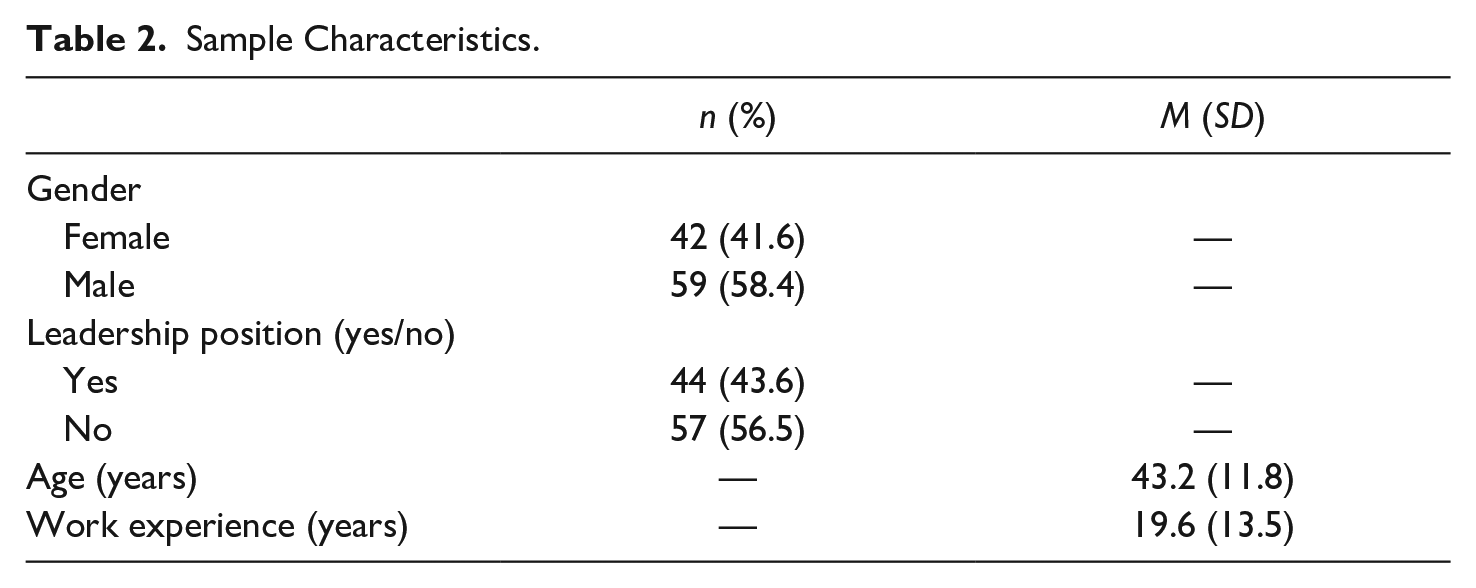
With 872 ms per SMP trial (Step 4 of the procedure) participants’ average reaction was within the conventional response time range of 100 to 10,000 milliseconds for implicit tests (Greenwald et al., 2003). To ensure the effects of the manipulation, participants were excluded if their reaction times were outside of this time range in more than 10% of the cases (Sava et al., 2012), if they indicated an ability to read Chinese characters (Sava et al., 2012), or if they failed to respond correctly to the questions in the manipulation check. This reduced the initial sample to a final size of n = 101 participants. Table 2 shows some sample characteristics.
Sample Characteristics.
Results
Means, standard deviations, reliabilities, and correlations of the study variables are presented in Online Supplemental Appendix E. To test the hypothesis, SEM with bias-corrected bootstrap confidence intervals was performed in RStudio. This approach outperforms simple regression-based mediation approaches in terms of bias and confidence interval coverage and allows for a more precise modeling of the causal relationships between variables (Cheung & Lau, 2008; MacKinnon et al., 2012). Since Henze-Zirkler’s test indicated that the data did not comply with the assumption of multivariate normality, the robust maximum likelihood method and the Satorra-Bentler correction were used. The chi-square value is a principal fit indicator. A significant chi-square value means that the empirical covariance matrix differs substantially from the model-implied covariance matrix, which indicates that the theoretically proposed model does not fit the data. As the chi-square value is very sensitive to violations of normal distribution (Schermelleh-Engel et al., 2003), the root mean square error of approximation (RMSEA), the comparative fit index (CFI), and the Standardized Root Mean Square Residual (SRMR) provide additional information given that these measures are less sensitive to sample size (Browne & Cudeck, 1993).
To test the robustness of the theoretical model, it was compared to alternative models using the Akaike Information Criterion (AIC) and Bayesian Information Criterion (BIC). Relative and absolute model fit statistics as well as goodness-of-fit indices of all competing models are presented in Online Supplemental Appendix F. Both a baseline model (null model; CFI = .875, RMSEA = .101, SRMR = .265), assuming three uncorrelated latent variables, and a simple regression model (Model 1; CFI = .884, RMSEA = .098, SRMR = .248), specifying only direct effects of (anti-)prototype match on work engagement, show an insufficient fit to the data. Model 2, adding a relationship between (anti-)prototype match and LMX, shows a better but still unsatisfactory fit (Model 2; CFI = .918, RMSEA = .085, SRMR = .103, ΔX²YB = 49.66, p < .001). Model 3, including the effects of (anti-)prototype match on work engagement both on a direct and an indirect path and corresponding to the theoretical model in Figure 1, provides the best absolute fit (Model 3; CFI = .933, RMSEA = .064, SRMR = .070). A direct model comparison also confirms that Model 3 accounts best for the observed data structure (ΔX²YB = 82.10, p < .001). Figure 3 shows the structural part of the final model. The full model, including the measurement model and control variables in unstandardized parameters, is presented in Online Supplemental Appendix D.
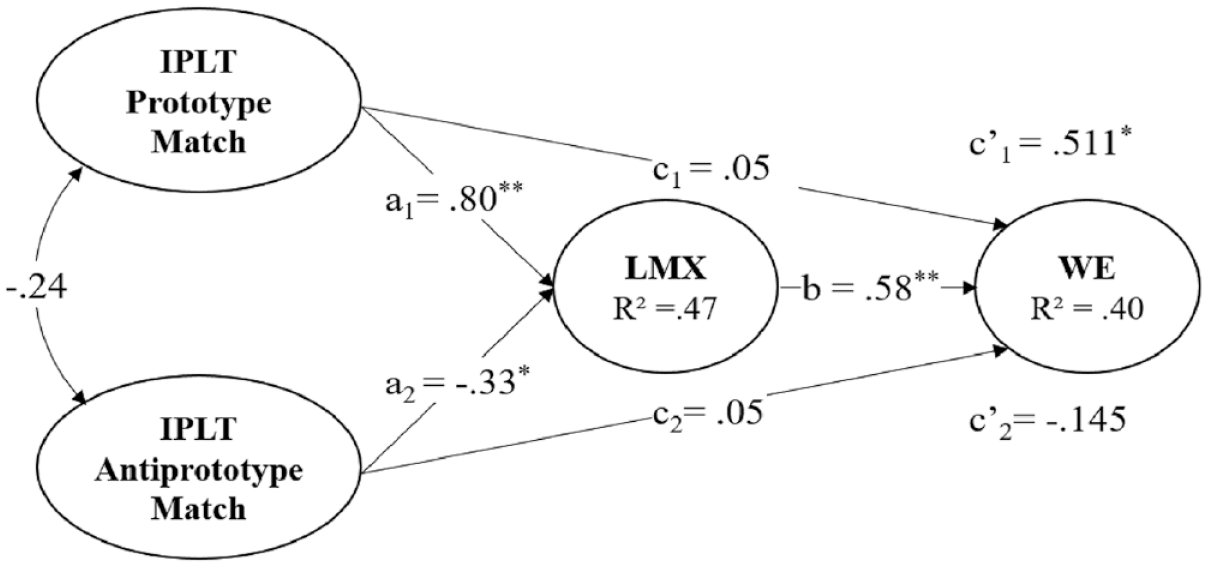
Path Coefficients of the Final Model.
Table 3 presents the standardized regression path coefficients for all latent variables and the indirect and total effects. Bias-corrected bootstrapped confidence intervals with 1,000 samples are reported for the estimates.
Standardized Path Coefficients and Bootstrapped Confidence Interval of Hypothesized Effects of the Final Structural Equation Model.
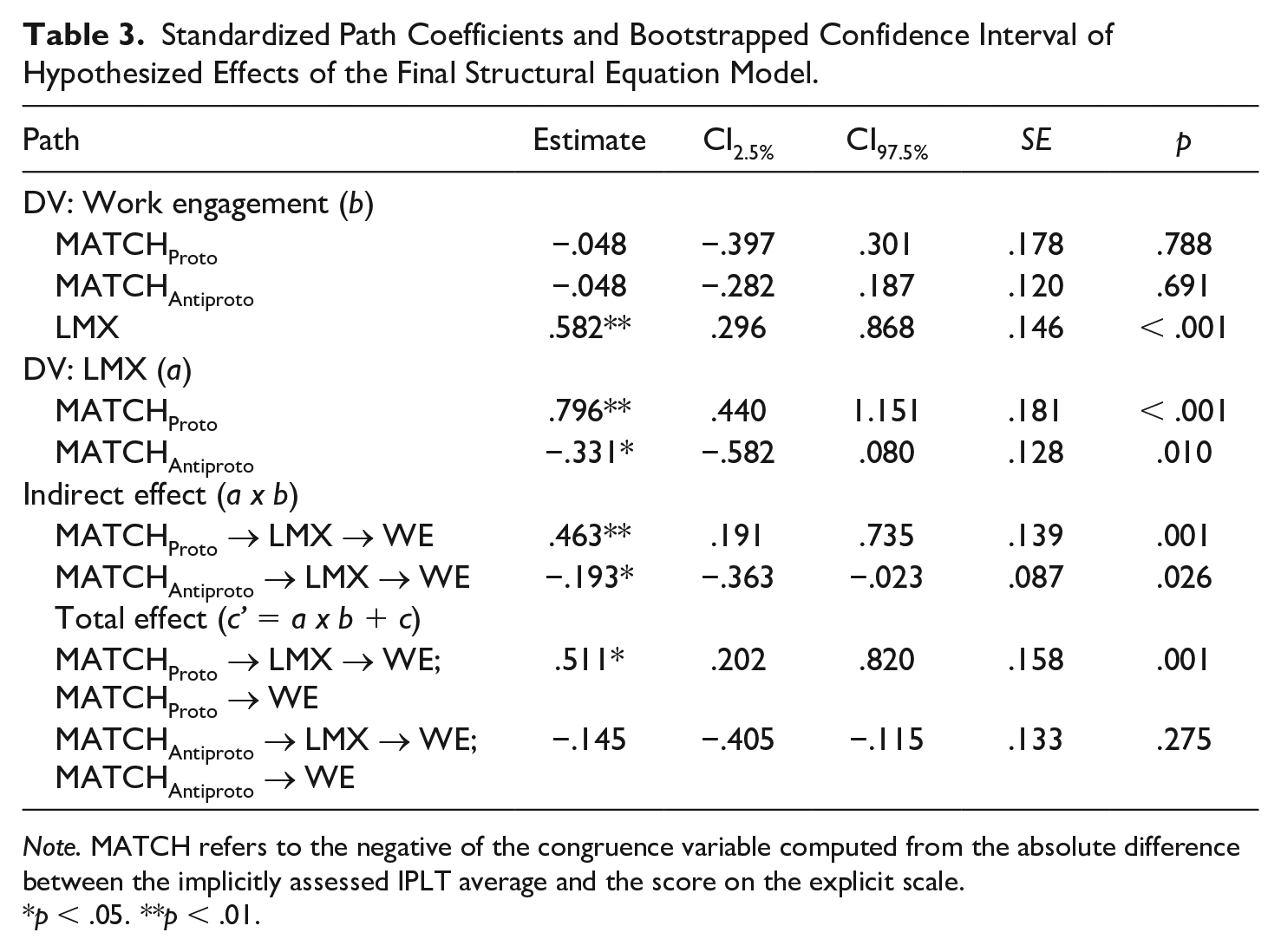
Note. MATCH refers to the negative of the congruence variable computed from the absolute difference between the implicitly assessed IPLT average and the score on the explicit scale.
p < .05. **p < .01.
Hypothesis 1a and 1b state that LMX is contingent on the degree to which the employees’ supervisor embodies the leadership traits they implicitly consider ideal. Indeed, prototype match is positively related with LMX ( β Proto =.796, p < .001), indicating that followers’ evaluations of the leader–follower relationship quality increase the more their leader embodies their ideal leadership images. Analogously, the higher the match between participants’ undesired and their supervisors’ actual trait profiles, the lower participants’ LMX ( β Antiproto = –.331, p = .010). These findings lend support to H1a and H1b.
The second set of hypotheses predicts a direct positive relationship between IPLT match and work engagement. The path coefficients of (anti-)prototype match on work engagement ( β Proto = .048, p = .788; β Antiproto = .048, p = .691) do not reach the significance level required to reject the null hypotheses. Thus, both H2a and H2b are rejected.
The last set of hypotheses predicts that LMX mediates the positive relationship between IPLT match and work engagement. The significant path coefficients for an indirect positive effect of prototype match on work engagement via LMX ( β Proto = .463, p = .001) and a significant total effect (c’Proto = .511, p = .001) support H3a. While the more traditional causal step approach (Baron & Kenny, 1986) requires a significant direct effect of the independent variable on the dependent variable, the SEM bootstrapping approach allows to conclude a mediation effect from a significant indirect path only (Cheung & Lau, 2008; Preacher & Hayes, 2008). Thus, despite the insignificant total effect of antiprototype match on work engagement (c’Antiproto = –.145, p = .275), its significant indirect effect ( β Antiproto = −.193, p = .026) lends support to H3a and H3b.
Discussion and Conclusion
Social comparisons are ubiquitous in the workplace, and leadership is no exception to this rule (Festinger, 1954; Greenberg et al., 2007). Although leaders are constantly exposed to comparisons by their followers, still little is known about what the outcomes of these comparisons are, depending on whom leaders are compared to. This study has focused on a particular piece in this puzzle, namely comparisons of real leaders to ideal leaders as conveyed in implicit theories that employees bring to their jobs (Lord et al., 1984; Vogel & Werkmeister, 2021). The results support the assumption that a perceived match of their real leader with leader prototypes and a mismatch with antiprototypes translate into the quality of the leader–follower relationship and, in turn, work engagement. With these findings, the study makes contributions to a socio-cognitive and relational approach to public leadership, bridging both.
The more public leaders show ideal traits along the dimensions of achievement orientation, kind-heartedness, rule abidance, righteousness, and progressiveness, the higher follower-rated LMX with these supervisors is. In addition, the perceived extent to which leaders deviate from the antiprototype of tyranny and related traits is positively associated with followers’ LMX ratings, allowing for the conclusion that followers who feel that their leader embodies their image of an ideal leader bring more favorable attitudes and trust to the leadership relationship. This invigorates the process of social exchange, encouragement, and support, which may ultimately nourish the “gain spiral” leading to higher work engagement (Hakanen et al., 2008). These findings corroborate the theoretical proposition that a high-quality leader–follower relationship can operate as a job resource that positively and directly affects followers’ work engagement (Ancarani et al., 2018; Borst et al., 2019; Mostafa & Abed El-Motalib, 2020).
Interestingly, and contrary to the hypotheses, the analyses have not yielded a significant direct effect of a match between the real and ideal leader on work engagement. Although the literature has discussed that perceived “fits” of organizational members with their environment (e.g., person–organization fit) have the potential to increase work engagement (Vigoda-Gadot et al., 2013), the results indicate that a fit between public employees’ implicit public leadership images and their actual leader is not a direct driver of work engagement. Rather, the results show that this relationship is fully mediated by LMX. The study thus helps to disentangle the leadership–engagement link and suggests not to miss relational job resources emerging from high LMX. This relational perspective, which has often been neglected in previous research, has recently gained momentum in public management scholarship (e.g., Bauwens et al., 2019; Molines et al., 2022; Ospina, 2017). This study responds to calls for deeper explorations into the antecedents of LMX, more specifically “the social construction processes through which relationships are developed and leadership produces outcomes” (Hassan & Hatmaker, 2015, p. 22).
The significant positive association of antiprototype mismatch (i.e., leaders’ deviance from tyrannical aspects of leadership) with LMX and, indirectly, work engagement contradicts earlier research, which found significant effects of ILT congruence only for prototype match (Epitropaki & Martin, 2005; Riggs & Porter, 2017). The authors of these studies held response biases, such as social desirability or positivity bias, in employees’ ratings responsible for the insignificant results. Thus, on the one hand, the significant effects of antiprototype match in this study might result from the implicit assessment of IPLTs and the subsequent elimination of such biases. Methodologically, this study therefore offers a bias-free measurement alternative to explicit measures in the field of public leadership (Crosby & Bryson, 2018; Ngoye et al., 2020).
On the contrary, the incongruent findings might point to actual empirical differences between general ILTs and IPLTs, and public and private employees, respectively. While the above studies analyzed general (i.e., not sector-specific) ILTs with samples of employees from private industries, the present study examined IPLTs with a sample consisting of public employees only. Amid the differences between public and private employees (Andersen et al., 2011; Boye et al., 2022; Boyne, 2002) as well as variations in the content and structure of generic ILTs and IPLTs (Vogel & Werkmeister, 2021), it is possible that sector-specific contingencies of the link between socio-cognitive job resources and employees’ engagement drove the effects. This underlines the importance of incorporating the sector-specific, socio-cultural, and institutional context when studying engagement in the public sector (Fletcher et al., 2020).
Practical Implications
The present study also has some important practical implications. Given that our results showcase the important role of LMX for followers’ work engagement, practitioners should have elevated interest in the development and cultivation of high LMX in leader–follower dyads. One way to do so is to increase leaders’ match with prototypes and to decrease their match with antiprototypes. In the first place, this requires awareness about what ideal images of “good” and counter-ideal images of “bad” leaders followers hold. For this purpose, leaders should encourage followers’ introspection and ask them for their leadership prototypes and antiprototypes, for example in onboarding interviews or performance reviews. Such feedback from followers might initiate leaders’ self-reflections on gaps or overlaps between their traits and those appreciated or rejected by followers. Accordingly, leaders can train and motivate followers to provide open feedback on their expectations toward leaders and the degree to which these expectations are met. This feedback might help leaders to set goals and priorities in their personal development.
HR managers might support the feedback process by establishing formalized systems, such as 360-degree feedback. Such feedback systems are likely to be even more effective if they are accompanied by corresponding training interventions. Given the constant low self–other agreement between leaders’ and followers’ ratings of leadership (Jacobsen & Andersen, 2015), these interventions should include strong components of leaders’ feedback-seeking behaviors and self-reflection abilities. The content of the feedback could inform further HR development practices intended to foster prototypical and reduce antiprototypical leadership traits and related behaviors. However, feedback can trigger considerable emotional distress on the part of leaders, more so when it reveals that actual leader traits are misaligned with those of ideal leaders or, even worse when they are aligned with traits of counter-ideal leaders. HR management thus might support the feedback process with training opportunities in stress management. To conclude, this study encourages leaders and HR managers to pay attention to the socio-cognitive antecedents of LMX and to use those levers that foster ideal leader traits while avoiding counter-ideal traits.
Limitations and Directions of Future Research
Some limitations of this study are worth noting and might inspire future research. First, although a major strength of this study is the application of an implicit priming method to assess IPLTs, the application of explicit self-report scales to measure the dependent variables might still have yielded response biases, such as social desirability. A remedy to this problem could be the application of other measures, such as other reports, observational, or actual performance data (Jacobsen & Andersen, 2015; Lord et al., 2020). Second, this study only assessed followers’ LMX ratings but did not obtain leaders’ evaluation of the leader–follower relationship. Since former studies have shown that self- and other-perceptions of LMX are likely to differ (Schriesheim et al., 1999), future research should also incorporate leaders’ evaluations of the leadership relationship. Finally, this study can only claim limited external validity. Although the manipulation checks indicated that participants interpreted the leadership scenarios in the intended way, the descriptions remained hypothetical for participants. Research of IPLTs would benefit from field studies, which could also examine the activation and evolvement of IPLTs in a variety of organizational settings, e.g., in recruiting or promotion decisions.
Concluding Remarks
This study has bridged a socio-cognitive and a relational approach to public leadership, thereby advancing both. Although the role of social comparisons in leadership processes is intuitive to scholars and practitioners, they have hitherto received little attention in public leadership research. Followers hold implicit theories about ideal leaders, and the extent to which their real leaders live up to these ideals is relevant to the relational job resources that develop through LMX and facilitate work engagement. The significance of leadership thus not only results from the attitudes and behaviors that leaders actually show but also from a priori categories that followers bring to the workplace and against which they compare their supervisors. Leaders have little direct and immediate influence on these everyday theories because they reside in followers’ long-term memory, where experiential processes of socialization have left traces that are difficult to overwrite. However, once leaders develop a better understanding of their followers’ IPLTs and their role in the emergence of LMX, they can make efforts to change their attitudes and behaviors accordingly.
Supplemental Material
sj-pdf-1-ppm-10.1177_00910260241249146 – Supplemental material for Following Your Ideal Leader: Implicit Public Leadership Theories, Leader—Member Exchange, and Work Engagement
Supplemental material, sj-pdf-1-ppm-10.1177_00910260241249146 for Following Your Ideal Leader: Implicit Public Leadership Theories, Leader—Member Exchange, and Work Engagement by Laura Hesmert and Rick Vogel in Public Personnel Management
Footnotes
Declaration of Conflicting Interests
The author(s) declared no potential conflicts of interest with respect to the research, authorship, and/or publication of this article.
Funding
The author(s) received no financial support for the research, authorship, and/or publication of this article.

Supplemental Material
Supplemental material for this article is available online.
Author Biographies
References
Supplementary Material
Please find the following supplemental material available below.
For Open Access articles published under a Creative Commons License, all supplemental material carries the same license as the article it is associated with.
For non-Open Access articles published, all supplemental material carries a non-exclusive license, and permission requests for re-use of supplemental material or any part of supplemental material shall be sent directly to the copyright owner as specified in the copyright notice associated with the article.
