




Abstract
Many public organizations implement teleworking: an organizational innovation expected to improve the working conditions of public servants. However, it is unclear to what extent teleworking is beneficial for public servants. This study adds to the literature by studying the effects of teleworking on a day-to-day basis. We used a daily diary methodology and followed public servants across five consecutive working days. Studies that apply a daily survey method are more accurate than cross-sectional measures because they reduce recall bias. The results highlight that public servants experience quite negative effects from teleworking, including greater professional isolation and less organizational commitment on the days that they worked entirely from home. Contrary to predictions, working from home did not affect work engagement. We also found that higher leader–member exchange (LMX) reduced the impact of teleworking on professional isolation. These findings not only contribute to the literature by showing the unfavorable effects of teleworking but also highlight that LMX can, to some extent, reduce these negative effects.
Introduction
Currently, one of the major challenges facing public organizations is adapting to the societal, administrative, and technological changes confronting them (Osborne & Brown, 2005). For instance, due to more women in the workplace, two-career families, and employees wanting to manage and/or balance work and life responsibilities, there is a growing employee demand for more flexible work–life programs (Baltes, Briggs, Huff, Wright, & Neuman, 1999; Caillier, 2013b). This calls on public organizations to innovate, that is, to develop and adopt new practices that create a discontinuity with the past (de Vries, Bekkers, & Tummers, 2016; Osborne & Brown, 2005).
In this regard, one organizational innovation that is increasingly being adopted in public organizations is teleworking (Caillier, 2012; de Vries, Tummers, & Bekkers, 2017). With teleworking, “employees have been given the opportunity to perform some or all of their duties at home or at an alternative location” (Caillier, 2012, p. 461). Telework can be seen as a typical “magic concept” (see Pollitt & Hupe, 2011) in that its use both inspires and seduces policymakers. For instance, Barack Obama stated that “attracting and retaining employees who are more productive and engaged through flexible workplace policies is not just good for business or for our economy—it’s good for our families and our future” (The White House, 2010). However, what is really known about the effects of teleworking on the working life of public servants (see Caillier, 2012)—is teleworking truly beneficial?
This study aims to partly fill this knowledge gap by examining the effects of public servants’ teleworking on organizational commitment, on work engagement, and on professional isolation. We focus on the most often used aspect of telework: the possibility to work from home (home-based teleworking). In studying the relationship between home-based teleworking and the three above-mentioned outcomes, this study is both theoretically and methodologically innovative.
Theoretically, our study adds to the public administration literature by providing a more complete overview of the effects of teleworking by including both positive (i.e., work engagement) and negative (i.e., professional isolation) effects, along with an effect for which the findings in the literature have been mixed (i.e., organizational commitment). These specific effects of teleworking were chosen because they are frequently discussed in the teleworking literature and often the subject of extensive discussions (e.g., Demerouti, Derks, ten Brummelhuis, & Bakker, 2014; Golden, 2006; Golden, Veiga, & Dino, 2008; ten Brummelhuis, Bakker, Hetland, & Keulemans, 2012; for overviews, see T. D. Allen, Golden, & Shockley, 2015; Gajendran & Harrison, 2007). In so doing, we deliberately chose to include the work engagement dimension, rather than related concepts such as work motivation, because, particularly in work and organizational psychology, teleworking has been frequently linked to increased work engagement (e.g., Demerouti et al., 2014; ten Brummelhuis et al., 2012). However, this has not been tested in the public administration field. In this regard, Vigoda-Gadot, Eldor, and Schohat (2013) express surprise that the concept of employee engagement is seldom used by public administration scholars. Moreover, given that scholars have hinted that the cognitive-psychological dimensions of leadership may be key to ensuring employee satisfaction and commitment in a teleworking environment (e.g., Golden & Veiga, 2008; Green & Roberts, 2010), we also include one potential mechanism that might influence the effects of working from home on the aforementioned outcomes, namely, leader–member exchange (LMX; Graen & Uhl-Bien, 1995). This aspect has not been previously studied despite the possibility that high-quality relationships might reduce the negative effects of teleworking, such as isolation, and enhance its positive outcomes, such as commitment.
A major methodological contribution of this study is that we adopt a within-person approach by using a daily diary methodology. We followed 61 public servants, working for a Dutch municipality, across five consecutive working days, and this yielded a total of 259 completed surveys (i.e., observations). Daily surveys have recently been advanced as a methodological solution to address the inconsistent findings regarding the effects of teleworking (Biron & van Veldhoven, 2016; R. P. Vega, Anderson, & Kaplan, 2015). These inconsistencies are seen as being due to current approaches focusing on “differences between individual workers in different work arrangements (differences between high-intensity and low-intensity teleworkers or between office workers and teleworkers)” (Biron & van Veldhoven, 2016, p. 1318). However, as the majority of teleworkers engage in part-time telework, combining days in the office with days working from home, it is important “to focus not only on differences between individual workers but also on differences within workers and, more specifically, between days worked in the office and days worked at home” (Biron & van Veldhoven, 2016, p. 1318).
Moreover, another important advantage of diary studies is that they reduce recall bias (Bolger, Davis, & Rafaeli, 2003; Kahneman, Krueger, Schkade, Schwarz, & Stone, 2004). Recently, researchers in work and organizational psychology have become increasingly interested in the everyday experiences of working individuals. Diaries provide a means to garner these experiences because they focus on short-term processes (Ohly, Sonnentag, Niessen, & Zapf, 2010). As these authors argue, most behaviors fluctuate over time and depend on personal and/or situational conditions. Therefore, how employees feel on a specific day is likely to depend on what happens or occurs that day and their overall experiences. By using diary studies, these variations become visible because employees rate their experiences much closer to when they occur and only have to think back over a few hours rather than weeks or months. As such, variables measured on a daily basis are arguably far more accurate than cross-sectional measures (Bolger et al., 2003; Kahneman et al., 2004).
Based on these arguments, we examine, in the present study, teleworking from the within-person perspective. In so doing, both our design (measuring the effects of teleworking across five working days) and the outcomes included (i.e., organizational commitment, work engagement, and professional isolation) align with other diary studies. These have frequently included, alongside outcomes related to changes in affect (e.g., work engagement, for instance, Tims, Bakker, & Xanthopoulou, 2011), other outcomes such as commitment, and have shown that these are not always stable constructs and can vary from day to day within individuals (e.g., Akçabozan, McDaniel, Corkery, & Curran, 2017; Totenhagen, Butler, Curran, & Serido, 2016).
Based on the above discussion, this article aims to answer the following research question:
In the following section, we discuss the “Theoretical Framework” used and present our hypotheses. In the “Method” section, we present our research design, followed by the “Results.” Finally, in the “Conclusion” section, we discuss the contribution this study makes to the public administration literature.
Theoretical Framework
We start by providing an overview of the development of teleworking. Following this, we develop hypotheses regarding the relationships between home-based telework and public servants’ organizational commitment, work engagement, and professional isolation.
Evolution and Types of Teleworking
Teleworking, sometimes referred to as telecommuting, is a flexible work arrangement in which “employees perform all or a substantial part of their work physically separated from the location of their employer, using IT for operation and communication” (Baruch, 2001, p. 114). Interest in teleworking was initially sparked in the 1970s, when the term telecommuting was used to denote working away from the office, primarily using telephone communication as a substitute for physical proximity (Nilles, Carlson, Gray, & Hanneman, 1976). In the 1980s, interest in teleworking continued to grow, including among workers, employers, transport planners, communities, and the telecommunications industry (Handy & Mokhtarian, 1996). The 1990s saw a proliferation of teleworking, and more recent reports indicate that teleworking has become one of the most prevalent bases of flexibility programs (WorldatWork, 2015), with the expectation that the practice will become even more commonplace in the near future (Society for Human Resource Management [SHRM], 2014). Moreover, census data from the United States and the European Union show that, respectively, 23% and 5% of employees telework at least some of the time (Eurostat, 2016; U.S. Department of Labor, 2015).
There are different types of telework, and authors have offered various classifications including,
home-based telework where work duties are carried out at home; teleworking from remote offices where the work is done at offices that are remote from the main office . . .; and mobile telework where work is done by people whose work usually involves travel and/or spending time on customers’ premises . . . (Daniels, Lamond, & Standen, 2001, p. 1154)
While working from locations other than from home is increasing, evidence shows that most teleworkers work at home (European Foundation for the Improvement of Living and Working Conditions [EFILWC], 2010; Standen, 2000). Therefore, in this article, we focus on home-based teleworking as this is the most common and frequently used form.
Potential Effects of Home-Based Teleworking on Organizational Commitment, Work Engagement, and Professional Isolation
Starting with a brief overview of teleworking, we develop hypotheses regarding the relationship between working from home and the organizational commitment, work engagement, and professional isolation of public servants.
In considering organizational commitment, we draw on social exchange theory (Blau, 1964; Homans, 1958) and predict that working from home will positively influence public servants’ organizational commitment. Nevertheless, we also acknowledge that some studies on teleworking conclude the opposite: that working from home is negatively related to organizational commitment. This contradiction results in the development of two competing hypotheses. However, when it comes to work engagement, the evidence is more consistent, and we expect working from home to have a positive influence on public servants’ work engagement. We further expect working from home to be positively related to public servants’ perceptions of professional isolation.
Organizational commitment and work engagement are conceptually distinct in that organizational commitment is a positive attitude toward the organization, whereas work engagement “stresses the assumption of “optimal functioning” at work in terms of well-being” (Hallberg & Schaufeli, 2006, p. 120). Organizational commitment further differs from work engagement in that it “appears to be more dependent on job characteristics than personal factors, indicating that it has less to do with intrinsic motivation than extrinsic circumstances” (Hallberg & Schaufeli, 2006, p. 120).
Organizational commitment has been defined as “the relative strength of an individual’s identification with and involvement in a particular organization” (Mowday, Steers, & Porter, 1979, p. 226). N. J. Allen and Meyer (1990) argued that there are three types of commitment: commitment based on necessity (continuous commitment), commitment based on obligation (normative commitment), and affective organizational commitment. While these three dimensions of organizational commitment are all important, this research focuses on affective organizational commitment since this is seen as the most relevant form when it comes to organizational identification (Gautam, van Dick, & Wagner, 2004). Affective commitment refers to feelings of belonging, and a sense of attachment, to the organization and can be seen as a “psychological bond” that ties an employee to the organization (N. J. Allen & Meyer, 1990).
Social exchange theory (Blau, 1964; Homans, 1958), which was derived from public choice theory and the norm of reciprocity, has frequently been used in the context of teleworking to explain the relationship between teleworking and an increase in employees’ commitment to their organization. Social exchanges are those in which “the voluntary actions of individuals are motivated by the returns they are expected to bring from others . . . [with the] exact nature [of the return] never specified in advance but . . . left to the discretion of the one who makes it” (Blau, 1964, pp. 91-92). As such, this theory argues that employees will feel obliged to reciprocate if they perceive that the organization they work for has given them a favorable benefit. In this regard, examples of favorable benefits that activate reciprocity mechanisms are training and development programs, greater worker empowerment, and involvement in decision-making processes (Gould-Williams & Davies, 2005). Furthermore, the possibility to telework has also been put forward as one of the benefits that triggers reciprocation (Golden, 2006). This is because telework is considered a discretionary benefit and helps employees in balancing their work and life (Bailey & Kurland, 2002; Golden, 2006). Thus, teleworkers see their supervisors as providing them with help to manage their work and life balance, and, therefore, they want to stay because this is what is expected of them under the norm of reciprocity (Gajendran & Harrison, 2007; Golden, 2006; Hornung, Rousseau, & Glaser, 2008). Hence, the core argument is that teleworkers are willing to reciprocate, with higher levels of organizational commitment, in return for having more flexibility and greater control over their job. However, in reaching these conclusions, the studies viewed commitment as a “stable” construct and did not consider potential variations in public servants’ commitment due to daily differences in job location. Therefore, we are particularly interested in whether any increase in commitment might vary from day to day due to public servants’ teleworking patterns. This leads to the following hypothesis:
However, as noted earlier, it has also been argued that teleworking might decrease organizational commitment because the challenges involved in developing identification and commitment toward one’s organization are magnified when one is working remotely (Thatcher & Zhu, 2006; Wiesenfeld, Raghuram, & Garud, 1998). For instance, Wiesenfeld et al. (1998) argued that traditional organizations utilize relatively tangible elements in establishing connections between employees and the organization. However, such aspects may be less available and meaningful in virtual settings. As such, the diffusion that characterizes employment in virtual settings is likely to weaken the psychological ties between an organization and its members. Based on this argument, we formulate the following competing hypothesis:
We now turn to the concept of work engagement, which has also recently received attention in the public administration literature (e.g., van der Voet & Vermeeren, 2017; Vigoda-Gadot et al., 2013). We hypothesize that working from home has a positive influence on work engagement because of the positive emotions it creates. Work engagement is “a positive, fulfilling work-related state of mind that is characterized by vigor, dedication, and absorption” (Schaufeli, Bakker, & Salanova, 2006, p. 702). Vigor refers to “high levels of energy and mental resilience while working, the willingness to invest effort in one’s work, and persistence even in the face of difficulties” (Schaufeli et al., 2006, p. 702). Dedication is characterized by “being strongly involved in one’s work and experiencing a sense of significance, enthusiasm, inspiration, pride, and challenge” (Schaufeli et al., 2006, p. 702). The third dimension of engagement, absorption, refers to “being fully concentrated and happily engrossed in one’s work, whereby time passes quickly and one has difficulties with detaching oneself from work” (Schaufeli et al., 2006, p. 702). Hence, engaged employees are well able to deal with the demands of their job. Furthermore, they are full of energy and effective (Schaufeli et al., 2006).
Related to this expected positive relationship between working from home and work engagement, various outcomes of teleworking have been mentioned as being expected to increase work engagement. Here, we draw on the affective events theory (AET; Weiss & Cropanzano, 1996), which argues that the experience of different work circumstances can influence a person’s affective state. According to this theory, when employees experience positive events, they will experience associated positive emotions. Here, authors have argued how various aspects of the teleworking environment may result in a higher rate of positive events, which may then lead to more positive emotions (Anderson, Kaplan, & Vega, 2015, p. 883). For instance, teleworking has been associated with stronger feelings of autonomy because teleworkers have greater choice in the location and the planning of their work tasks (Gajendran & Harrison, 2007), aspects that have been associated with well-being (Thompson & Prottas, 2006). Furthermore, teleworkers can avoid interruptions at work (Haddad, Lyons, & Chatterjee, 2009).
As such, the nature and defining characteristics of a teleworking environment (increased autonomy and decreased interruptions) suggest that working from home should be associated with an increase in experienced positive events, which will increase work engagement (Anderson et al., 2015). In this regard, we also refer to a study by ten Brummelhuis et al. (2012) which showed how employees’ daily flexible working practices were positively related to their daily work engagement. Based on this, we have formulated the following hypothesis:
We further expect working from home to be positively related to public servants’ perceived professional isolation. Diekema (1992) defines professional isolation as a state of mind, or belief, that one is out of touch with others in the workplace. In essence, professional isolation reflects the belief that one lacks sufficient connection to “critical networks of influence and social contact” (Miller, 1975, p. 261). Teleworkers can sense isolation on the professional and social levels (Cooper & Kurland, 2002; Golden et al., 2008). Professionally, employees fear that working at another place than the office may reduce their possibilities for promotion and organizational rewards. Socially, employees highlight the lack of informal interaction with colleagues. Given that such feelings of isolation generally involve both professional and social connectedness, in this study, we define professional isolation as encompassing beliefs regarding the sufficiency of both professional and social contacts (Golden et al., 2008, p. 1413).
Indeed, a very frequently cited obstacle to employees embracing flexible working practices is the fear of isolation. Various studies have suggested that professional isolation may leave teleworkers feeling excluded in terms of office interactions (Golden et al., 2008; G. Vega & Brennan, 2000). For instance, various authors have argued that virtual working arrangements can lead to constraints on social interactions between employees (Baker, Moon, & Ward, 2006; Golden et al., 2008).
When it comes to the relationship between working from home and professional isolation on a daily basis, the most significant factor appears to be the frequency of teleworking (Golden et al., 2008). These authors, based on a survey of 261 teleworkers and their managers, found that the impact of professional isolation increased with the amount of time spent teleworking. That is, the negative impact of professional isolation on job performance was greater with those who spent most of their time teleworking. However, their study did not employ a diary design and did not study whether, on a daily basis, working from home results in greater professional isolation. Nevertheless, based on the above, we hypothesize the following:
Moderating Impact of LMX
In addition to the expected main effects of home-based teleworking on organizational commitment, work engagement, and professional isolation, we also expect these effects to be influenced by LMX. We hypothesize that the maintenance of a high-quality superior–subordinate relationship is particularly important when working from home. In so doing, we are consistent with other key diary studies that have investigated the impact of various leadership behaviors on a daily basis (e.g., Breevaart et al., 2014; Tims et al., 2011).
LMX describes the quality of the relationship between a leader and a member. According to this theory, “effective leadership processes occur when leaders and followers are able to develop mature leadership relationships (partnerships) and thus gain access to the many benefits these relationships bring” (Graen & Uhl-Bien, 1995, p. 225). Generally, such relationships are based on social exchange, wherein each party needs to offer something that the other party sees as valuable, and each party needs to see the exchange as reasonably equitable or fair (Graen & Uhl-Bien, 1995). In high-quality relationships, such mechanisms of reciprocity and social exchange become highly effective: the leader and the employee trust each other, employees feel valued by their supervisor, and effective working relationships develop. In contrast, exchanges in low-quality relationships are purely contractual. Here, “leaders provide followers only with what they need to perform, and followers behave only as required and do only their prescribed job” (Graen & Uhl-Bien, 1995, p. 230).
We are not aware of any studies that have investigated the role of LMX as a moderating factor in the relationships between working from home and the aforementioned outcomes, with most studies treating telework itself as a moderator (see, for instance, Golden & Veiga, 2008). This is despite various studies on leadership having suggested that, particularly, the cognitive-psychological dimensions of leadership may play a key role in ensuring employees’ satisfaction and commitment in a teleworking environment (e.g., Golden & Veiga, 2008; Green & Roberts, 2010; Hoch & Kozlowski, 2014). Here, Green and Roberts (2010) argue that, particularly, leaders of virtual teams are important, as such leaders can reduce perceived loss of connectedness by realizing high-quality communications and trust. These are challenges in any organizational setting but particularly important in virtual settings. Hence, we would expect the presence of a high-quality superior–subordinate relationship to be of particular importance for those employees who telework frequently (see Golden & Veiga, 2008). In a teleworking environment, direct coworker support and empathy may not be available, and subordinates may then have a greater need for considerate behavior from their leader. Thus, one might expect public servants, on the days that they work from home, to particularly rely on a high-quality relationship with their supervisor. This brings us to Hypothesis 5:
In the following section, we describe our data collection and the methods used to test these hypotheses.
Method
Participants and Procedure
An email sent to all members of a medium-sized Dutch municipality invited employees to participate in our study. In addition, participation was encouraged by placing a message on the municipality’s online discussion group site and in a meeting led by the first author. Although this approach to gaining respondents might influence the representativeness of the sample, it is frequently applied in diary studies because of the difficulty in collecting sufficient data (as diary studies require a substantial commitment given that respondents have to fill out surveys over several days; for instance, Biron & van Veldhoven, 2016; Demerouti, Bakker, Sonnentag, & Fullagar, 2012, see also Ohly et al., 2010). In the invitations and the meeting, the employees were given information on the design of the study, their anonymity was guaranteed, and instructions for participation were provided. The data were collected in a one-week period in June 2016. Diary questionnaires were sent electronically every day at 4 p.m. (with a reminder at 5 p.m.). Respondents were asked to complete these on the day they received them. On the first day, respondents also received some background questions on their gender, age, education, and position. Sixty-five public servants ultimately participated in our study. Some of the daily responses were discarded due to missing data, resulting in a total of 61 employees and 259 completed daily surveys (i.e., observations). As such, the sample size can be considered acceptable for a diary study and is comparable with other key diary studies. Due to the high commitment required, given that respondents have to fill out surveys for several days, such studies typically include around 40 to 100 respondents (e.g., Breevaart et al., 2014; Demerouti et al., 2012; Tims et al., 2011). The final sample consisted of 22 male participants (36%) and 39 female participants (64%). The mean age of the participants was 45 years, and most (59%) had completed higher vocational education.
Measures
We used daily diaries to measure our study variables. We adapted the timeframe of the items included accordingly, and the questionnaires were reduced in length wherever possible given that we were asking public servants to fill out the diary on five successive days (see Ohly et al., 2010). An overview of all the questions included in the study is provided in the supplementary material. For the majority of the items, and unless otherwise stated, participants were expected to respond on a 7-point Likert-type scale, where 1 indicated very weak support for the item statement and 7 indicated very strong support.
Daily working from home
We created two dummy variables to measure the extent to which respondents worked from home on a daily basis (“working fully from home” and “working partly from home”), with values based on the answer to the following survey question: “Today, did you work from home?” (no, partly, yes).
Daily LMX
Daily LMX levels were measured by adapting three items from the seven-item LMX scale by Scandura and Graen (1984), an example item being “Today, my supervisor understood my problems and needs.” The daily Cronbach’s alpha values varied between .86 and .89.
Daily organizational commitment
Daily levels of organizational commitment were measured by adapting four items from the affective commitment scale developed by N. J. Allen and Meyer (1990). We rephrased the negatively worded items to ensure that all items were similarly phrased. An example item is “Today, I felt a strong sense of belonging to my organization.” The daily Cronbach’s alpha values varied between .86 and .91.
Daily work engagement
Daily levels of work engagement were measured using an adapted version of the nine-item Utrecht Work Engagement Scale (UWES; Schaufeli et al., 2006). 1 Example items are “Today at my work, I felt bursting with energy” (vigor) and “Today, I was immersed in my work” (absorption). The daily Cronbach’s alpha values varied between .93 and .96.
Daily professional isolation
Daily levels of professional isolation were measured by adapting four items from the seven-item scale by Golden et al. (2008), an example item being “Today, I missed informal interaction with others.” The daily Cronbach’s alpha values varied between .79 and .89.
Control variables
In addition to the variables described above, some commonly used individual control variables were included in the analysis, namely, gender, age, education, and position. We coded gender as a dummy variable (with 0 = female). Position was also coded as a dummy variable (with 0 = nonsupervisory). Age was a continuous variable ranging from 28 to 64. Reflecting the Dutch educational system, educational level was divided into five categories (1 = primary education, 2 = secondary education, 3 = intermediate vocational education, 4 = higher professional education, and 5 = academic education).
Analysis Strategy
The data have a hierarchical structure with days nested within persons. This leads to a two-level model with a series of repeated measures on the day level (within-person: n = 259 study occasions) and of individuals on the person level (between-person: n = 61 participants). Sample sizes smaller than 30 at the between-person level may lead to biased results (Scherbaum & Ferreter, 2009), and, as such, our sample size (n = 61) is adequate for a diary study, implying that we have sufficient power to test our hypotheses. Consistent with Ohly et al.’s (2010) recommendations, our day-level variables, apart from the dummy variables, were centered on the group (i.e., person) mean because we were interested in how daily fluctuations from the baseline in the predictor variables are related to daily fluctuations from the baseline in the outcome variable. Person-level variables were centered on the grand mean. We analyzed our data with multilevel models using hierarchical linear modeling (HLM). Before testing our hypotheses, we tested whether HLM was an appropriate approach by running null models to examine the between-person and within-person variance components of the dependent variables. For organizational commitment, the within-individual variance was 66%, Level 1 intercept variance (1.055) divided by the total variance (1.055 + 0.535). For work engagement and professional isolation, the within-individual variances were 62% and 42%, respectively. These high levels of within-individual variance highlight that there are substantial differences in within-person scores across the days, thereby supporting our approach to measure the effects of teleworking on a daily basis. When testing our hypotheses, we used the full maximum likelihood procedure within HLM (Hox, 2002).
Results
Descriptive Analysis
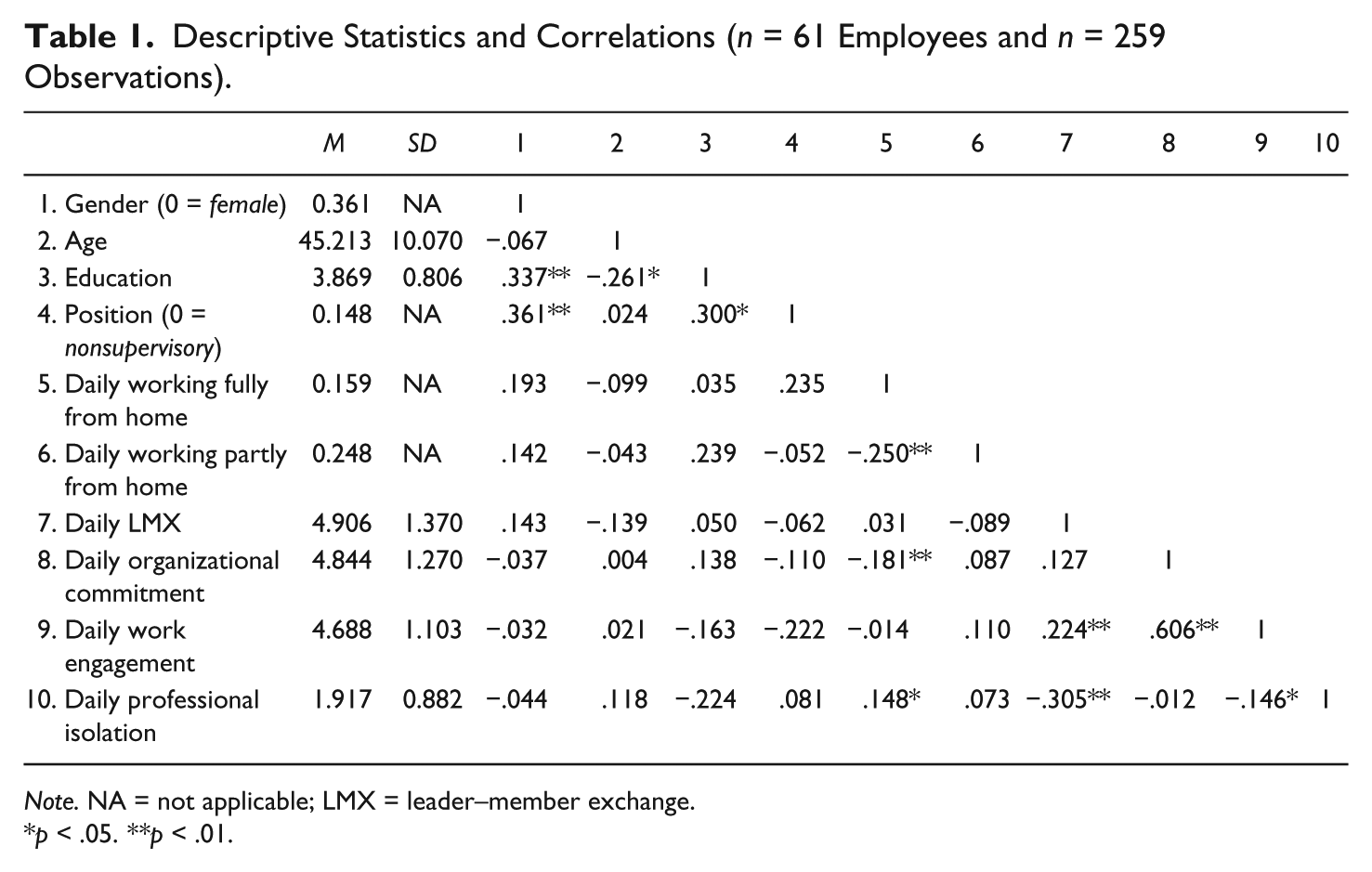
Table 1 presents the means, standard deviations, and correlations of the variables.
Descriptive Statistics and Correlations (n = 61 Employees and n = 259 Observations).
Note. NA = not applicable; LMX = leader–member exchange.
p < .05. **p < .01.
Results of HLM Analyses
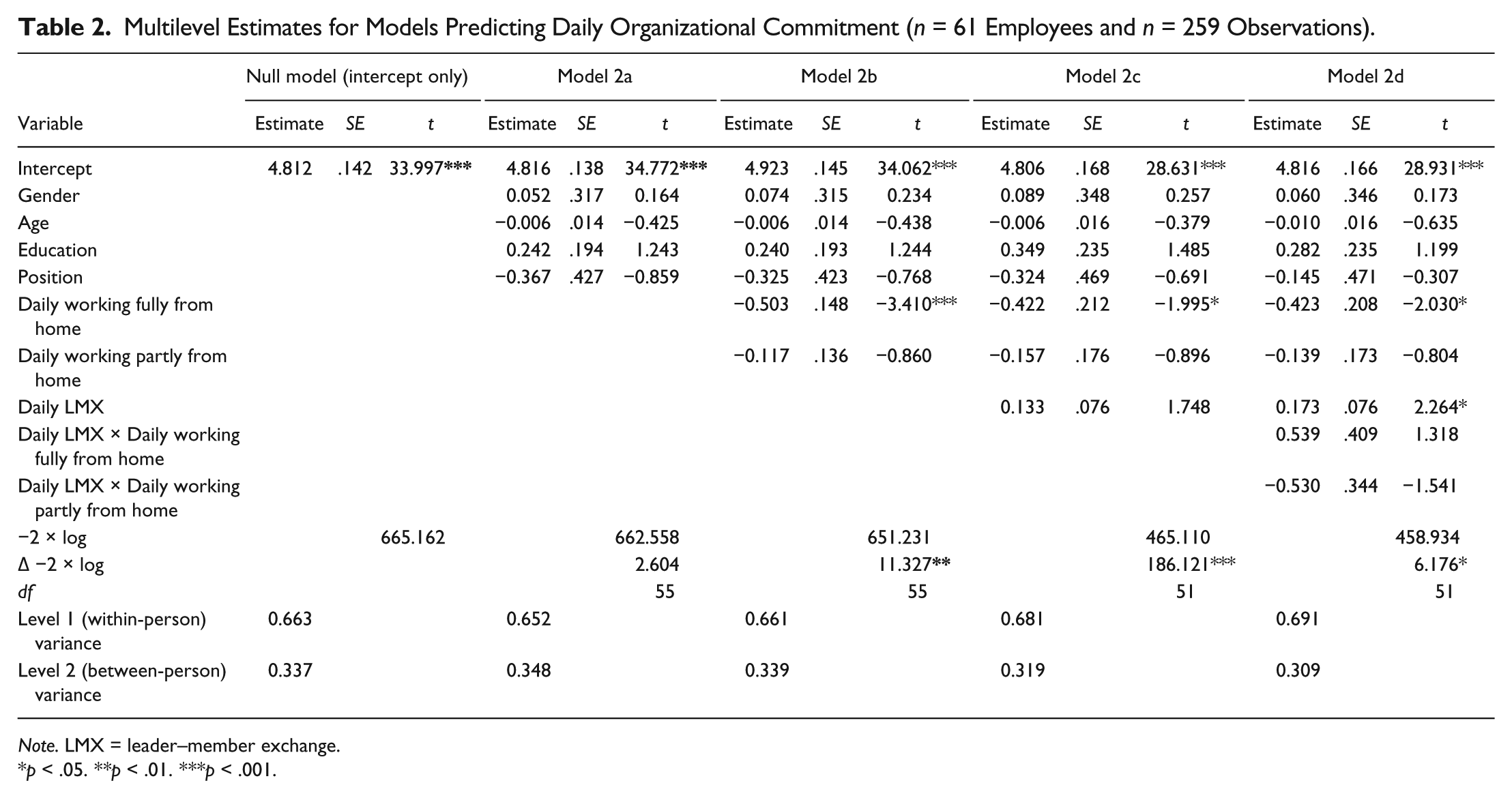
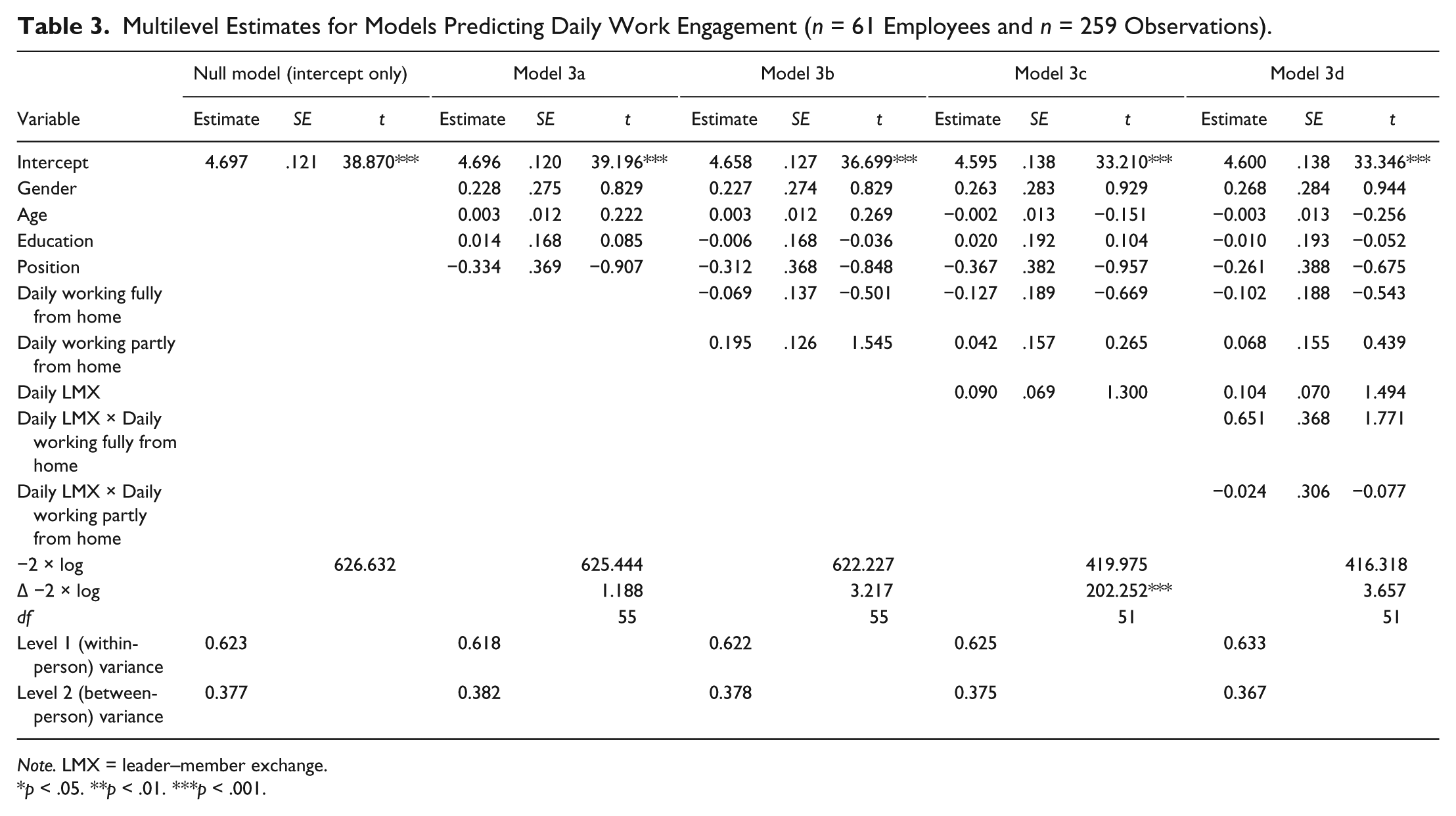
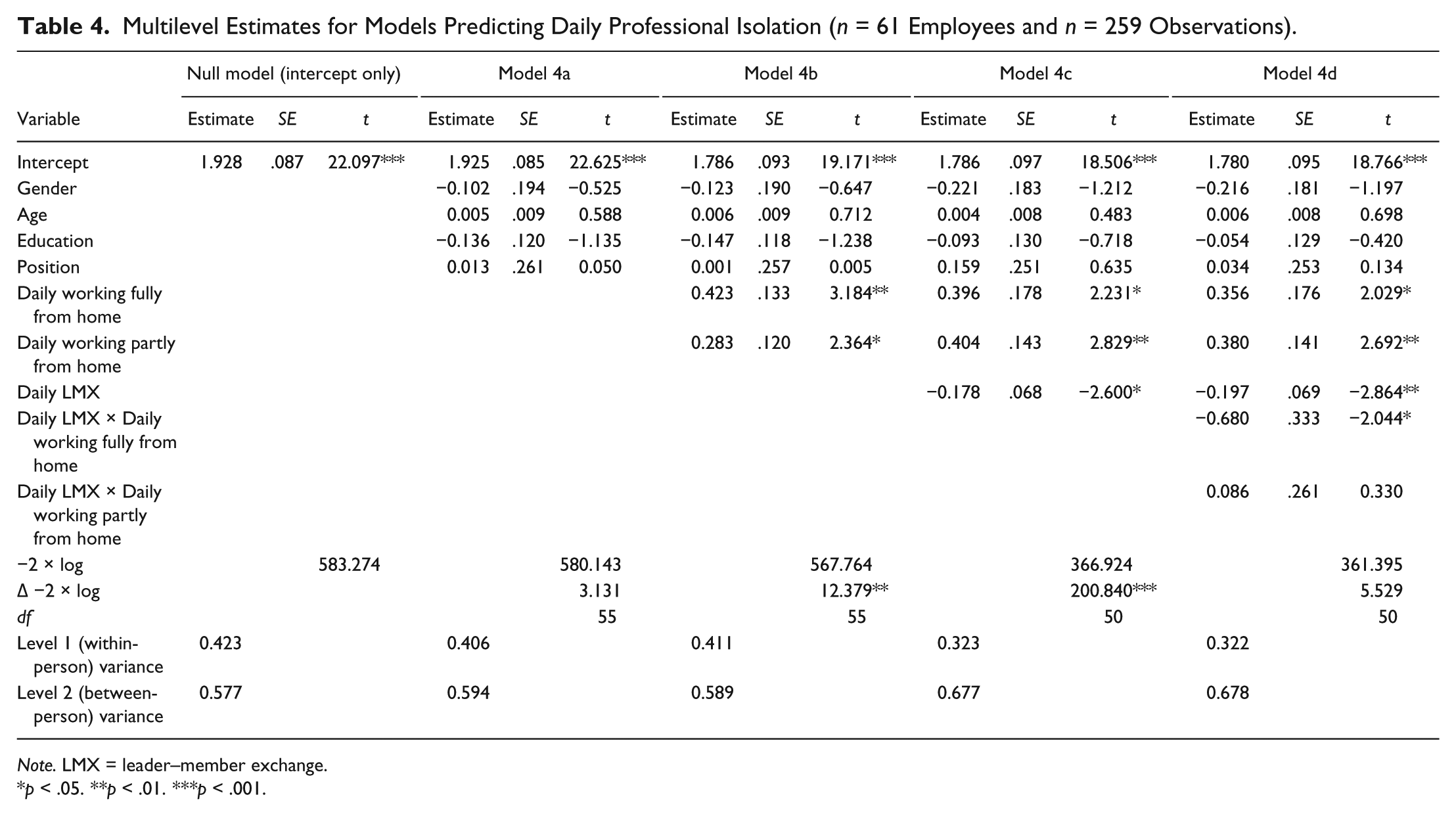
To test our hypotheses, we ran three models (see Tables 2, 3, and 4), one for each of our dependent variables (organizational commitment, work engagement, and professional isolation). By employing multilevel analysis, we were able to test and compare several model variants starting with a null model that included only the intercept and did not specify any predictor variable. In the subsequent steps, predictor variables were consecutively added enabling the improvement in fit obtained by adding this additional variable to be examined using a likelihood ratio statistic.
Multilevel Estimates for Models Predicting Daily Organizational Commitment (n = 61 Employees and n = 259 Observations).
Note. LMX = leader–member exchange.
p < .05. **p < .01. ***p < .001.
Multilevel Estimates for Models Predicting Daily Work Engagement (n = 61 Employees and n = 259 Observations).
Note. LMX = leader–member exchange.
p < .05. **p < .01. ***p < .001.
Multilevel Estimates for Models Predicting Daily Professional Isolation (n = 61 Employees and n = 259 Observations).
Note. LMX = leader–member exchange.
p < .05. **p < .01. ***p < .001.
In this process, for each dependent variable, we started with a null model that included the intercept as the only predictor. In the subsequent models (2a, 3a, etc.), we added the control variables; in the next step (Model 2b, etc.), we added the predictor variables related to working at home; and then, in the next step (Model 2c, etc.), we added the LMX predictor variable. Finally, because we had hypothesized that LMX would have a moderating affect, we added (in Model 2d, etc.) the interaction terms between LMX and working at home.
Hypothesis 1 states that daily working from home will be positively related to daily organizational commitment. The relevant results are shown in Table 2, and we see that adding the independent variables (working fully and partly from home) in Model 2b provided a significant improvement (Δ −2 × log = 11.327, df = 55, p < .01) over Model 2a (control variables only). However, the analyses further indicated that working fully or partly from home on a daily basis was not significantly positively related to daily levels of organizational commitment. That is, we did not find support for Hypothesis 1. However, Hypothesis 2, which states that daily working from home will lead to less daily organizational commitment, was partly supported. Here, the analyses indicated that daily working fully from home is significantly and negatively related to daily organizational commitment (estimate = −.503, SE = .148, t = −3.410, p < .001). That is, on the days when public servants worked fully from home, they experienced a lower degree of organizational commitment. However, days spent working partly from home were not associated with significant falls in daily organizational commitment (estimate = −.117, SE = .136, t = −0.860, p = ns).
Hypothesis 3 states that, on a daily basis, working from home will be positively related to daily work engagement. However, as can be seen in Table 3, neither working fully (estimate = −.069, SE = .137, t = −0.501, p = ns) nor partly from home (estimate = .195, SE = .126, t = 1.545, p = ns) was significantly related to daily work engagement. Consequently, Hypothesis 3 is rejected.
Hypothesis 4 states that working from home would be positively related to daily professional isolation. Here, as evident in Table 4, working from home, both fully (estimate = .423, SE = .133, t = 3.184, p < .01) and partly (estimate = .283, SE = .120, t = 2.364, p < .05), was significantly related, on a daily basis, to a sense of professional isolation. Thus, Hypothesis 4 is supported.
To test Hypothesis 5, that daily LMX moderates the relationship between working from home and the dependent variables, we included the interaction terms “Daily LMX × Daily working fully from home” and “Daily LMX × Daily working partly from home” in the final “d” versions of the model for each dependent variable. Of the six interaction effects tested, only one was statistically significant. As shown in Table 4, daily LMX moderates the relationship between professional isolation and working from home when the latter is undertaken for complete days. This suggests that although LMX is successful in reducing the professional isolation of public servants whether they are working at the office or at home, a high-quality LMX is particularly important for public servants on the days that they work from home. Overall, therefore, Hypothesis 5 was partly supported.
Conclusion
This article makes a distinct contribution to the public administration field by employing a diary methodology in which we followed public servants through five consecutive working days to investigate the impact of working at home (home-based teleworking). By adopting a daily diary approach, this study goes beyond the commonly used between-person tests. Studies that adopt a daily survey method are argued as being more accurate than those using cross-sectional measures because they reduce recall bias (Bolger et al., 2003; Kahneman et al., 2004) and have recently been put forward as a way to address the inconsistent findings regarding the effects of teleworking (Biron & van Veldhoven, 2016; R. P. Vega et al., 2015). Our findings highlight that, for public servants, home-based teleworking, measured on a daily basis, leads to greater professional isolation and less organizational commitment. Our results also failed to identify a frequently claimed advantage of teleworking, namely, enhanced work engagement. Furthermore, we also showed that LMX is a promising mechanism for reducing the negative impact, in the form of professional isolation, of public servants’ home-based teleworking.
A valuable contribution of this article concerns the type of leadership required in a teleworking environment. Authors have argued that hierarchical forms of leadership are less appropriate in teams and organizations characterized by a high degree of virtuality (e.g., Dahlstrom, 2013; Hoch & Kozlowski, 2014). This is because, in such contexts, communication is less formal and less hierarchically based. Furthermore, due to the lack of face-to-face contact and geographical dispersion, it is also more difficult for leaders to enact traditional hierarchical leadership behaviors (Bell & Kozlowski, 2002; Hoch & Kozlowski, 2014). Our findings, at least to some extent, support this view by particularly showing how a high-quality LMX, in which the leader and the employee trust each other, can reduce public servants’ professional isolation on the days they spend working fully from home. Thus, our results highlight how relationship-oriented leadership approaches, in particular, might be beneficial and even required in a teleworking environment. Hence, our findings also provide empirical evidence to add to the literature review by Dahlstrom (2013) in which two types of leadership behavior (i.e., task-orientated and relationship-orientated) in a teleworking environment were discussed, and relationship-oriented leadership behaviors especially advocated. The reasoning is that, in a teleworking environment, direct coworker support and empathy may not be available, and subordinates may then have a greater need for consideration behavior from their leaders.
Given these findings, we would encourage future studies to further unravel the mechanisms through which a high-quality LMX can be developed and maintained between managers and their remote subordinates. For instance, supportive communication (using email, Skype meetings, etc.) could be useful in boosting LMX on the days that public servants work from home. In addition, given that our findings highlighted some negative effects of public servants’ teleworking, it would be interesting to see whether these negative outcomes, such as increased professional isolation, have the potential to result in positive effects. For instance, it could be that public servants sometimes choose to work from home, despite them feeling isolated, to get more work done. Future studies could examine whether there is such a trade-off.
Another contribution of this research relates to the identified negative effects of daily teleworking on public servants’ organizational commitment, and the potential impact of the measurement level in this regard. Here, our findings do not support social exchange theory, which asserts that employees will reciprocate (i.e., become more committed to their organization) after they are given a certain benefit, such as the possibility to telework. This lack of support for social exchange theory is in line with various studies by Caillier (2012, 2013a). For instance, related to intentions to quit, Caillier (2013a) found that, in federal agencies, teleworking did not exact a social exchange in that teleworkers and nonteleworkers reported similar intentions to leave. Similarly, teleworkers did not necessarily report higher levels of work motivation than nonteleworkers (Caillier, 2012). One possible explanation for the discrepancy between our finding of decreased commitment compared with those studies showing increased commitment, due to public servants’ teleworking or satisfaction with telework (e.g., Caillier, 2013b; Golden, 2006), is related to the research design of this study. Although we did not test this, our findings suggest that outcomes such as commitment might be evaluated quite differently by public servants when measured on a between-person basis and on a daily basis. This is because, in a between-person analysis, individuals provide an “average” rating of overall commitment and the extent of teleworking, while in reality, there may be a large variation in public servants’ daily levels of commitment as a function of where they are working on that particular day. In other words, although public servants might overall feel quite committed to their organization, their sense of commitment might drop significantly on the days that they work from home. In this regard, previous studies have also demonstrated that relationships between constructs can change in magnitude, and even in direction, when examined on different levels of analysis (see Dalal, Lam, Weiss, Welch, & Hulin, 2009 and Vancouver, Thompson, & Williams, 2001, for examples). Furthermore, in a recent study, Stritch (2017) highlighted the theoretical importance of, and therefore the need to incorporate, “time” as a construct in public management research. The argument was that cross-sectional data, which are commonly used by public management scholars, are static, whereas management theories are, in essence, theories of change and, thus, need dynamic data. Our study responds to this call by using daily surveys, and offers new insights beyond existing studies by unraveling the micro-dynamics of teleworking at the daily level. Given our findings, we would urge future researchers to take such short-term variations into account, preferably comparing the resulting findings with between-person tests, to see whether differences in outcomes might indeed result from contrasting levels of analysis. In this regard, it would be particularly interesting to see whether, on a daily level, teleworking might also negatively affect other important work outcomes such as job performance (Hassan & Hatmaker, 2015).
The present study also has some important practical implications for public organizations and individual managers. Many public organizations are allowing employees to work from home but failing to address the challenges and implications inherent to this type of intervention. Public organizations have often implemented teleworking initiatives without taking the time to evaluate their programs. Maybe because of this, many telework programs have not been successful, and teleworkers can feel dissatisfied with their introduction. Given the potential downsides highlighted in this study, telework programs should be carefully designed and implemented, and organizations should take the necessary steps to reduce the potential negative effects. Here, one possibility would be to focus on the role of managers and help them develop the necessary sensitivity to the needs of their subordinates. Managers who are used to supervising office-based employees may need to be convinced of the benefits of developing high-quality relationships, based on mutual respect and trust, with employees who are increasingly home-based. Our results suggest that such an approach could lead to home-based public servants feeling less professionally isolated.
Although the present study has clear strengths related to its research design, it is not without limitations. First, the use of self-reporting increases the risk of common method bias (Podsakoff, MacKenzie, Lee, & Podsakoff, 2003). Second, the specific sample and Dutch context in which we tested our proposed relationships questions the generalizability of our findings. As such, additional research could usefully examine whether our findings can be generalized to employees in other countries and other organizations. Moreover, diary studies cannot fully capture causal effects. Therefore, future studies could usefully adopt a field experiment design in which public servants are randomly selected and allowed either to be able to work from home or not.
To conclude, this research is, to the best of our knowledge, among the first to investigate the daily effects of teleworking by public servants. By investigating the effects of teleworking on the within—as opposed to the between—person level of analysis, we were able to study its effects on a day-to-day basis. Not only did our findings emphasize how working from home reduces organizational commitment and increases professional isolation, but our research also suggests possible approaches for alleviating the undesirable effects of increased professional isolation. In particular, we showed that increasing LMX quality could reduce the negative effects of working from home, in the form of professional isolation. Given that teleworking is a rapidly growing working arrangement, and one that influences key workplace outcomes, this topic certainly warrants greater research attention.
Footnotes
Acknowledgements
We would like to thank the three anonymous referees who offered valuable critiques and provided us with constructive suggestions, thereby improving the article substantially. Our gratitude also goes to Dr. Bert George from Erasmus University Rotterdam for his excellent assistance with the statistical analyses. Further, we would like to thank Wilco Mastenbroek for helping us with the data collection. Lars Tummers acknowledges funding of The Netherlands Organisation for Scientific Research (NWO) grant VENI-451-14-004.
Declaration of Conflicting Interests
The author(s) declared no potential conflicts of interest with respect to the research, authorship, and/or publication of this article.
Funding
The author(s) disclosed receipt of the following financial support for the research, authorship, and/or publication of this article: This work was supported by the European Union Seventh Framework program (Project Learning From Innovation in Public Sector Environments [LIPSE], 320090). The project focuses on studying social innovations in the public sector ( ).
).
Notes
Supplemental Material
Supplementary material for this article is available online.
Author Biographies
References
Supplementary Material
Please find the following supplemental material available below.
For Open Access articles published under a Creative Commons License, all supplemental material carries the same license as the article it is associated with.
For non-Open Access articles published, all supplemental material carries a non-exclusive license, and permission requests for re-use of supplemental material or any part of supplemental material shall be sent directly to the copyright owner as specified in the copyright notice associated with the article.
