




Abstract
Contrary to the idea that neighbourhood cohesion is something that inherently benefits the poor or counterbalances the forces of social exclusion, in this article we argue that it can also function as a mechanism of cumulative advantage. In order to explore this proposal, we offer a definition and key dimensions of neighbourhood cohesion based on three components: place attachment, local relations and commitment to the local common good. We test our proposal in a highly segregated Latin American city: Santiago, Chile. A combination of survey data and georeferenced information was obtained from a random sample of 700 residents. The results reveal the existence of four neighbourhood cohesion types: Communitarians, Belongers, Strangers and Outsiders. As expected, we found that people who reside in affluent areas and perceive themselves to live in more reputable neighbourhoods are those who report the strongest patterns of neighbourhood cohesion. We conclude by questioning the scope and effectiveness of policies which have promoted neighbourhood cohesion as a ‘tool’ of governance without first attempting to reduce socio-spatial rifts. We also ask whether these notable spatial differences in neighbourhood cohesion contribute to improving the overall social cohesion at the city level.
Introduction
As a highly ‘tentative’ concept in both academic and political fields, social cohesion remains an elusive subject. Some scholars have put social cohesion into the same category as community, collective efficacy and social capital (e.g. Letki, 2008; Putnam, 2000; Sampson et al., 1997), while others have considered it a relevant element of social well-being (e.g. Botterman et al., 2012; Kearns and Forrest, 2000). This conceptual ambiguity has led to questioning of its potential as a governing tool (Dekker and Kempen, 2009). Some scholars have even claimed that the implicit arguments upon which the concept is based obscure its most fundamental aspects, and that a clearer definition of its socio-political and ideological content has yet to be proposed (Maloutas and Pantelidou Malouta, 2004).
From an urban perspective, the concept of social cohesion addresses interactions between residents and the value of collective life. It is frequently considered to be inherently positive, in that it promotes non-conflictual local relations and counteracts problems like social isolation which otherwise could lead to ‘the cut off of deprived groups and poor areas from mainstream society’ (Dekker and Kempen, 2009: 111). However, questions remain as to whether cohesion per se can save deprived communities from the ills that afflict them (Eizaguirre et al., 2012; Fuller and Geddes, 2008; Mayer, 2003). Defilippis et al. (2006: 674), for example, have broadly described these accounts as ‘the romanticised conceptions of community-based efforts’, tending to downplay the impact of larger neighbourhood contexts – that is, the social, demographic, financial and spatial structures that condition the medium- to long-term temporalities in which the fate and fortune of local communities are shaped. On the one hand, vulnerable groups can pursue defensive and survival strategies that reinforce their unequal positioning rather than being effective mechanisms to help overcome their conditions. Members of more privileged groups, on the other hand, can develop closure mechanisms (Cassiers and Kesteloot, 2012) that boost mutually beneficial transactions (Dekker and Kempen, 2009). This is what Maloutas and Pantelidou Malouta (2004: 457) describe as ‘middle-class self-serving civic engagement’.
In this article, we argue that this field of study still lacks a clearly-defined conception of what social cohesion is at the neighbourhood level, or an accurate understanding of the theoretical link between inequality in access to sociospatial resources and neighbourhood cohesion. The present article seeks to address this by adopting a relational and multidimensional approach. First, it conceptualises neighbourhood cohesion as a disposition, and operationalises its dimensions through the interrelation of the following three major components: neighbourhood attachment, neighbourhood relations and commitment to the local common good. Second, we provide a sociological perspective on the relationship between socio-spatial resources and neighbourhood cohesion that suggests neighbourhood cohesion acts as a form of privilege (i.e. a cumulative and accumulated disposition of residents of wealthier areas of the neoliberal city, wielded to the detriment of those who reside in more deprived and marginalised places). Third, we propose the existence of a tangle of socio-spatial stratification resources which are likely to influence different forms of neighbourhood cohesion: socio-economic resources (household income, goods and services and occupation), cultural capital (educational level, cultural practices), social capital (contacts and social networks) and spatial conditions (e.g. segregation, land value, density).
Logically, there has been prior research concerning the relationship between these factors of socio-spatial stratification and neighbourhood cohesion. For example, studies have shown that the activities and social networks of people with higher levels of education extend beyond the limits of their residential context (Dekker and Bolt, 2005; Fischer, 1982). These residents also tend to show more place attachment than others do (Dekker and Bolt, 2005; Woolever, 1992). In addition, individuals with the highest incomes tend to have better relationships with their neighbours, as well as greater levels of trust, social support and identification with the neighbourhood (Campbell and Lee, 1992; Fischer, 1982; Savage et al., 2005; Woolever, 1992). With regard to individual social capital, evidence has indicated that people with higher-status networks have a greater number of local relationships, as they are more attractive as neighbours (Volker and Flap, 2007; Volker et al., 2007).
Regarding spatial conditions, evidence has suggested that residents of impoverished urban areas suffer not only from a lack of contact with traditional institutions, but from an absence of social ties with their neighbours and of the potential benefits that these connections can bring (Massey and Denton, 1993; Wilson, 1987). Furthermore, these groups tend to exhibit lower levels of solidarity, neighbourly trust and sense of belonging, as well as smaller community social networks (Bailey et al., 2012; Wacquant, 2008). Ethnic and racial diversity have also been shown to diminish neighbourly trust, solidarity and community ties (Letki, 2008; Small, 2007), especially within smaller spatial units, as residents tend to ‘hunker down’ (Putnam, 2007). Some studies have also showed that higher density is associated with the ghettoisation of the poorest areas, and with lower levels of place attachment, participation, local ties and neighbourly trust (Dempsey et al., 2012; Woolever, 1992). Other findings have suggested that high levels of criminality, violence, physical decline and social disorder tend to erode social relations, local participation and place attachment (Letki, 2008). Finally, it has been proved that processes of territorial stigmatisation make living together more stressful, reducing neighbourly trust, rootedness, local social solidarity and social support networks, leading ultimately to problems of social isolation (Wacquant, 2008; Warr, 2005).
Despite the above evidence, there have been no systematic attempts to fully connect these socio-spatial dimensions to a broader and more complex understanding of neighbourhood cohesion, or to study their interrelations. To contribute to this issue, we approach neighbourhood cohesion as a form of privilege using a novel methodology that focuses on the relationships between characteristics and observations (based on principal component methods and hierarchical clustering techniques). We examine the case of a highly segregated Latin American metropolis – Santiago, the capital city of Chile – that has experienced four decades of neoliberal policies in the urban, economic, cultural and political realms (Garretón, 2017). The results of our relational analysis are brought together in a hierarchised typology of neighbourhood cohesion that comprises four types of residents: Communitarians, Belongers, Strangers and Outsiders. Our findings show that the various forms in which neighbourhood cohesion is found are closely related to individuals’ socio-economic resources, as well as their position within the larger urban configuration in which they reside.
Understanding neighbourhood cohesion: Conceptualisation, components and dimensions
Social cohesion has been addressed frequently in relation to the inclusion and integration of socio-economically, ethnically and/or racially diverse social groups. However, significant discrepancies can be seen in the identification of its components and dimensions (Chan et al., 2006; Schiefer and Van der Noll, 2017). The influential work of Kearns and Forrest (2000) regarding the relationship between urban policy and social cohesion has been crucial to establishing a clearer definition of the concept at the neighbourhood level. Neighbourhood cohesion is seen as fundamental to greater cohesion at the macro-social level, but in times of global economics and intense competition for resources, conservation of more communitarian social interactions is increasingly difficult within cities (Forrest and Kearns, 2001). According to this view, neighbourhood cohesion may occur when residents work together to contribute to the collective project and to the well-being of all participants (Kearns and Forrest, 2000), and the authors propose a set of components, namely: shared values and civic engagement; social order and control; solidarity and reduction of economic inequality; social networks and social capital; and territorial belonging.
Although the present article builds on some of these components, we focus on neighbourhood cohesion as experienced by residents instead of more ‘objective’ conceptualisations, such as those related to social order and security, or other phenomena such as well-being (e.g. Botterman et al., 2012; Chan et al., 2006; Kearns and Forrest, 2000). We also exclude those ‘subjective’ dimensions of social cohesion related to shared norms and values among residents (e.g. Berger-Schmitt, 2002; Putnam, 2000; Sampson et al., 1997). Even though we share the need to connect cohesion studies to problems of social exclusion in contemporary cities, we do not intend to position ourselves within the larger discussion concerning the conceptualisation of social cohesion as a problematique (see Miciukiewicz et al., 2012; Novy et al., 2012). Rather, we advocate an analytical approach focused on the study of residents’ dispositions and, for the purposes of operationalisation, we suggest specific components and dimensions.
We propose that neighbourhood cohesion is something more than a condition (or a social force), and should be defined as the state or disposition of the collective – i.e. the residential togetherness experienced by residents – visible in the interrelation of attitudes and practices concerning attachment, neighbourhood relations and commitment to the local common good. Table 1 offers a summary of our proposal that includes three major components of neighbourhood cohesion, each incorporating a number of dimensions.
The essential components and dimensions of neighbourhood cohesion.
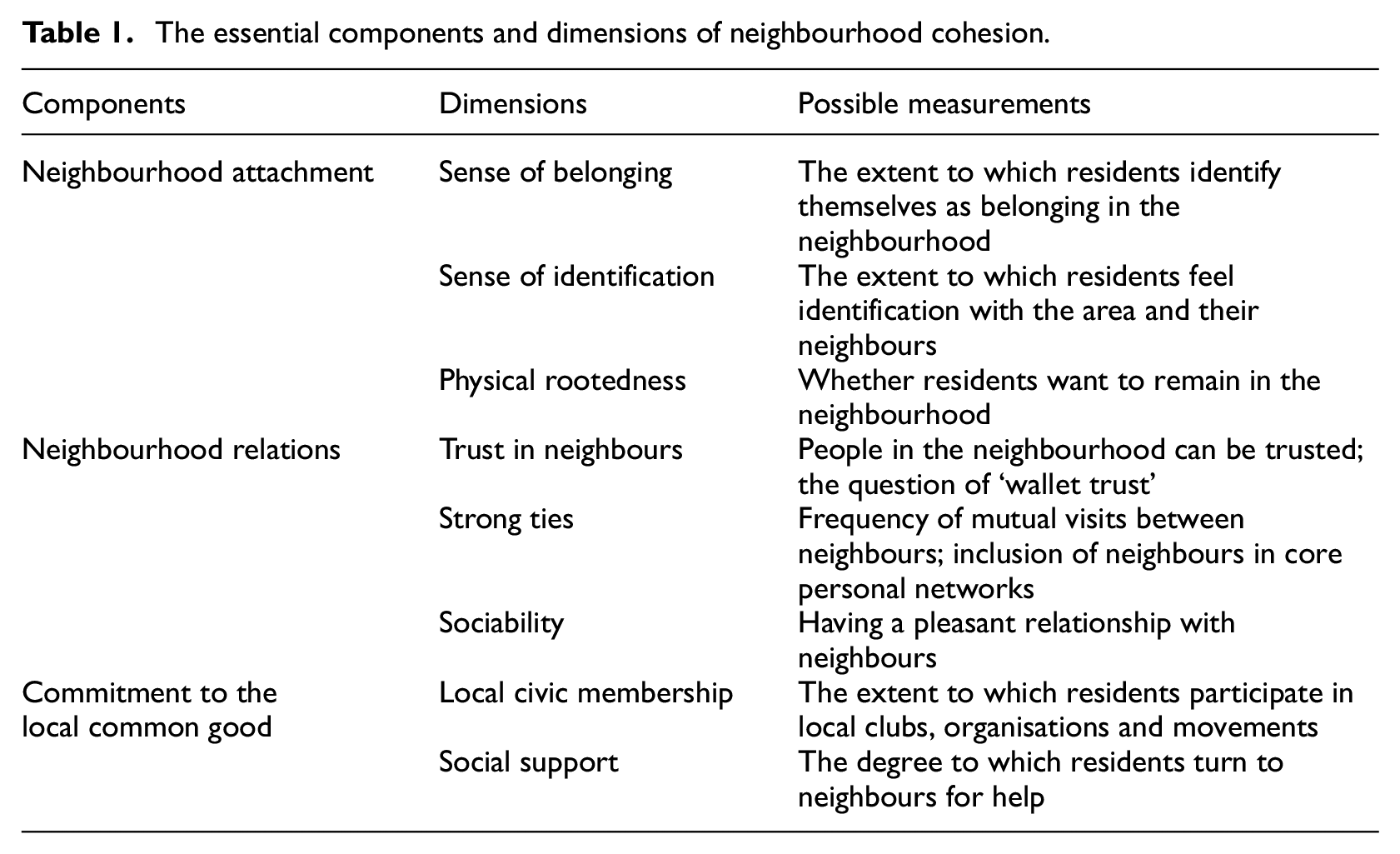
Place/neighbourhood attachment
The terms sense of (territorial) belonging, physical rootedness, place identity or sense of identification are frequently associated with, or encompassed by, the concept of place/neighbourhood attachment (e.g. Casakin et al., 2015). One useful distinction identifies two levels of place attachment: physical and social (Hernández et al., 2007). The first has to do with aspects such as proximity to services, and is associated primarily with rootedness, or the desire experienced by people to remain in a certain place (e.g. Scannell and Gifford, 2010). The second refers to matters relating to fellow residents, such as feelings of integration and belongingness to the neighbourhood (e.g. Bonaiuto et al., 2015). In this case, it is assumed that people connect with places because the latter promote social relations and permit the generation of a group identity.
Neighbourhood relations
Dispositions such as neighbourly trust, as well as the quality and type of social interactions that neighbours enjoy, have often been used as dimensions of social relations at the neighbourhood level (Kearns and Forrest, 2000). Most studies of community ties have focused on explaining how local relations are the key to resolving everyday life problems and to receiving social support in times of need. Some have suggested the importance not only of ‘strong ties’, but also of those pleasant interactions involving ‘weak ties’ of mutual recognition between residents (Blokland and Nast, 2014; Henning and Lieberg, 1996). Close ties can be measured by assessing whether people have friends in the neighbourhood, whether they visit each other’s homes, whether they spend their afternoons together or whether they consider their neighbours to be part of their core network (Campbell and Lee, 1992; Volker and Flap, 2007). By contrast with the intimacy that characterises close relationships, more distant relationships or ‘unpretentious everyday contacts’ (Henning and Lieberg, 1996) usually constitute superficial links of sociability and are evaluated through inquiries as to the number of neighbours that people know, the ease of establishing ties (e.g. Warr, 2005) and their day-to-day recognition of others within public space (Blokland and Nast, 2014).
Trust in the local context may be understood as a degree of certainty that the behaviour of residents that share a given space is oriented by good intentions (Putnam, 2007). A number of studies have operationalised neighbourhood trust by measuring the perceived likelihood of lost wallets or letters being returned to their owners (e.g. Gundelach and Freitag, 2014; Letki, 2008). Others have employed a direct measure of social trust by asking residents about the degree of trust in their neighbours (e.g. Putnam, 2007).
Commitment to the local common good
In this component, we consider two dimensions: local civic membership, and social support or solidarity among residents. Unlike other proposals which suggest that civic engagement is simply a form of social interaction (e.g. Schiefer and Van der Noll, 2017), we propose that it represents an individual orientation or disposition to act in favour of the common good. This is because the connections developed within local associations are clearly of secondary importance to collective objectives. In practice, it seems logical to consider that this type of association not only constitutes a relationship in its own right, but also strengthens pre-existing trust and interpersonal ties between residents (e.g. Mata and Pendakur, 2014).
Civic engagement at the neighbourhood level can often be seen in voluntary membership of local organisations (e.g. Ruef and Kwon, 2016). Bodies such as tenant associations, crime watch groups or special-interest neighbourhood coalitions (Logan and Rabrenovic, 1990) seek to present a challenge to or influence the management of local affairs, and thus to respond with greater justice and inclusion to residents’ demands. More ‘political’ forms of collective action may also be involved, such as neighbourhood movements against territorial displacement (e.g. anti-gentrification) and resistance to territorial stigmatisation, where residents come together to make more general demands about the political and economic system (Angelcos and Méndez, 2017).
Finally, the different forms of social support and solidarity generated between neighbours have provided insights into people’s inclination to view their personal needs as secondary to the common good of their residential surroundings, regardless of whether that person is known or not (Schiefer and Van der Noll, 2017). This may often involve asking neighbours for financial assistance, company and help in childcare and house-sitting during periods of absence or illness (Drouhot, 2017). This type of interaction has been seen to increase when residents participate in local organisations, present stronger feelings of belonging and have an extensive network of contacts within the neighbourhood (Mata and Pendakur, 2014; Sampson et al., 1997).
It should be noted that the components and dimensions of neighbourhood cohesion described here have generally been studied separately, without much consideration of their intersectionalities (c.f. Dekker and Kempen, 2009). On the occasions that they have been studied in combination, this has usually involved establishing a hierarchical order among them. However, we argue that rather than being dependent on or independent from each other, dimensions such as attachment and trust are interconnected and mutually reinforcing. From this multidimensional and interrelated perspective, we consider that these elements are not interchangeable and should be studied simultaneously (Botterman et al., 2012; Dekker and Bolt, 2005).
In sum, we understand neighbourhood cohesion as residential togetherness among people who share a given geographical space, visible in three major components: neighbourhood attachment, neighbourhood relations and commitment to the local common good. Our perspective, nevertheless, brings to the forefront the question of the conditions under which neighbourhood cohesion is accomplished. We assert that this kind of cohesion is in a constant state of accumulation and that it is not equally attainable by all members of society, especially under current neoliberal conditions. We will explore this problem in the following section.
Understanding neighbourhood cohesion as a privilege
Sociological accounts (most notably, those derived from the work of Bourdieu) show us that the earliest experiences of socialisation – among which the experience of living in highly segregated places is extremely important – tend to shape schemes of perception and appreciation and, more generally, contribute to the emergence of particular dispositions that orient social practices without necessarily relating directly to economic or social calculation. As Bourdieu argues, these dispositions tend to rule out misalliances and provide ‘spontaneous compliance’ (Bourdieu, 1990: 160) between those in similar positions (who have accumulated similar dispositions). Thus, we could argue that one of the most relevant of these dispositions is the sense of belonging to a place. This is the point at which socio-spatial inequalities and cohesion become two fundamental issues that must be analysed in a relational manner.
We suggest that the overall socio-spatial tangle of class stratification is strongly related to the functioning of neighbourhood cohesion. We engage in an exploration of how objective and subjective socio-spatial advantages are key to informing and generating a disposition towards, for example, residential belonging, class identity in space, involvement in local practices and performative practices of place-making. We argue that this disposition is maintained and accumulated in the form of a ‘relative privilege’ (Benson, 2013) – that is, a privilege available to those members of the population situated in the upper echelons of the social structure, and therefore unattainable by others who reside and are socialised in deprived areas of the city. In other words, neighbourhood cohesion would work as a commodity that is ‘paid for’ through the housing market, manifested as comfort with place and sense of belonging and possibly even becoming a form of moral ownership of places of residence (Savage et al., 2005; Watt, 2009).
We are aware that our arguments may come across as defiant of the idea that poorer communities are more likely to develop greater neighbourhood cohesion given that trust, cooperation and local organisation are usually identified as their main strategies of coping with adverse circumstances. Although we recognise that a long tradition of studies views these practices as a depository of agency from these communities – most notably those inspired by a neo-communitarian vein, but also those characterised by a (neo)-institutionalist approach (Gerometta et al., 2005; Putnam, 2000; Saegert et al., 2001) – we contend that these approaches have offered a rather decontextualised portrait of underprivileged communities in contemporary urban life. They tend to assume that local communities possess and are able to accumulate the resources that are required in order to confront their problems. In doing so, however, they pay little attention to structural factors and power relationships to do with control of the resources of the most impoverished areas (Defilippis et al., 2006; Eizaguirre et al., 2012; Fuller and Geddes, 2008; Mayer, 2003).
An understanding of neighbourhood cohesion as privilege involves acknowledgement of a central aspect as the basis of this cumulative disposition, namely the possibility of and comfort with the exercise of choice. Larger – and, in the case of Chile, long-standing – processes of privatisation of education, housing and healthcare have paved the way for a neoliberal subjectivity built upon what has been described as dispositions of choice (Andreotti et al., 2015; Mau, 2015; Vincent and Ball, 2007). As has been argued by authors in the field of social reproduction, current upper-middle-class and upper-class subjectivities aim to develop these dispositions in the transmission of class position and privilege in the form of preferences, tastes and decisions that are seen and experienced as a ‘natural choice’ among peers sharing similar lifestyles. Thus, the exercise of choice in terms of education or access to services such as healthcare or leisure is neither equally available nor an extended opportunity. In the case of neighbourhood cohesion, this appears as a fundamental aspect in terms of the actual chances that people may or may not have to choose the place in which they live and to which they feel attached.
For example, Méndez and Gayo (2019) studied Santiago’s high-income geographical cone where the majority of movement by upwardly-mobile citizens into upper-middle-class areas has taken place over the past four decades. The consolidation of this area is rooted in the forced exclusion and displacement of the urban poor towards the periphery during the Pinochet dictatorship, beginning in the late 1970s. The authors focus on the case of the inheritors and achievers who – although different in terms of their socio-spatial trajectories into this social group – share patterns of social reproduction that include private schooling, certain cultural practices and residential choice in this area. They inhabit homogeneous social spaces in which the exercise of choice is crucial to being seen as an equal. We are referring here not only to closed or gated communities (Borsdorf et al., 2016), but also to those extensive areas of the city designed for higher-income families whose sociability is based more on choices of residence, schooling and politics than on daily face-to-face interactions. We argue that the sense of belonging and entitlement to these neighbourhoods, the schools located within them and, ultimately, the social class which occupies them are a fundamental aspect of their perceived cohesion and the commitment to that common good.
At the other extreme, in contexts of low-income segregation in the periphery, practices and dispositions to do with neighbourhood cohesion are not easily cultivated, particularly in circumstances of informal labour, overcrowding, concentrated poverty and long travel distances to central or wealthier parts of the city. In these cases, it is highly unlikely that the disposition of choice will be pursued, as most of these residents are tied to social housing allocated over decade-long periods and forced to endure the low school attainment provided by generally poor-quality public education (e.g. Otero et al., 2017).
There are, of course, also extensive mixed-income areas where people from middle- and lower-middle-class backgrounds cohabit, share public space, attend similar (government-subsidised) educational institutions and use common means of transportation. Our argument is that these mixed areas are proof of the gradient of urban cohesion, in that most of the residents – although they may exhibit degrees of cohesion – are not necessarily exercising their disposition of choice in their places of residence. In most cases, the real estate market has either decided for them or is constantly exerting pressure to modify the housing offering in order to increase profitability (López-Morales, 2016; Méndez, 2018).
In summary, we suggest that, in this current neoliberal regime, neighbourhood cohesion is being accumulated and transmitted in and through time as a disposition that enables individuals to claim belonging and which, in turn, allows them to mobilise their interests as they internalise a sense of place. We hypothesise that the socio-spatial tangle of class stratification, which includes different forms of capital, reflects opportunities and constraints for neighbourhood cohesion. As such, residents of more privileged neighbourhoods should have a higher disposition towards neighbourhood cohesion than their socio-spatially disadvantaged counterparts. In order to test this assertion, an approach must be adopted which interprets socio-economically conflictive relations as inherent to the urban dynamic.
The case of Santiago, Chile
Santiago, the capital city of Chile, has 7 million inhabitants, representing 40.5% of the country’s total population. The Metropolitan Area is divided into 37 municipalities, each of which is governed autonomously by a local council. The socio-spatial transformation of Santiago took place in two phases. Between 1992 and 2002, urban growth occurred mainly in the form of urban sprawl and was heavily concentrated in the southern sector of the city. Between 2002 and 2012, the process and tendency of urban growth was geographically heterogeneous, and sprawl and densification occurred simultaneously in different areas of the city. A new combination and diversification of patterns of urban growth emerged between 2012 and 2017, with expansion, dispersion and densification occurring simultaneously in different areas of the city (De Mattos et al., 2016). In Santiago’s central areas, land and housing prices soared as the state adopted an entrepreneurial role, applying laissez-faire policies that maximised land exploitation and generated high revenues for the private construction sector. Housing demand among the poorer segments of society largely draws on state housing subsidies, although more recently a growing mortgage market has increased demand even further, enlarging the mortgage debt burden on middle-class households and driving house prices even higher (López-Morales, 2016).
Despite this, Santiago remains a highly segregated city which continues to drive low-income groups towards peripheral areas to the south and west, while more affluent populations are concentrated in the city’s northern and eastern municipalities (see Garretón, 2017; Méndez and Gayo, 2019). Figure 1 clearly illustrates the residential segregation by socio-economic group.
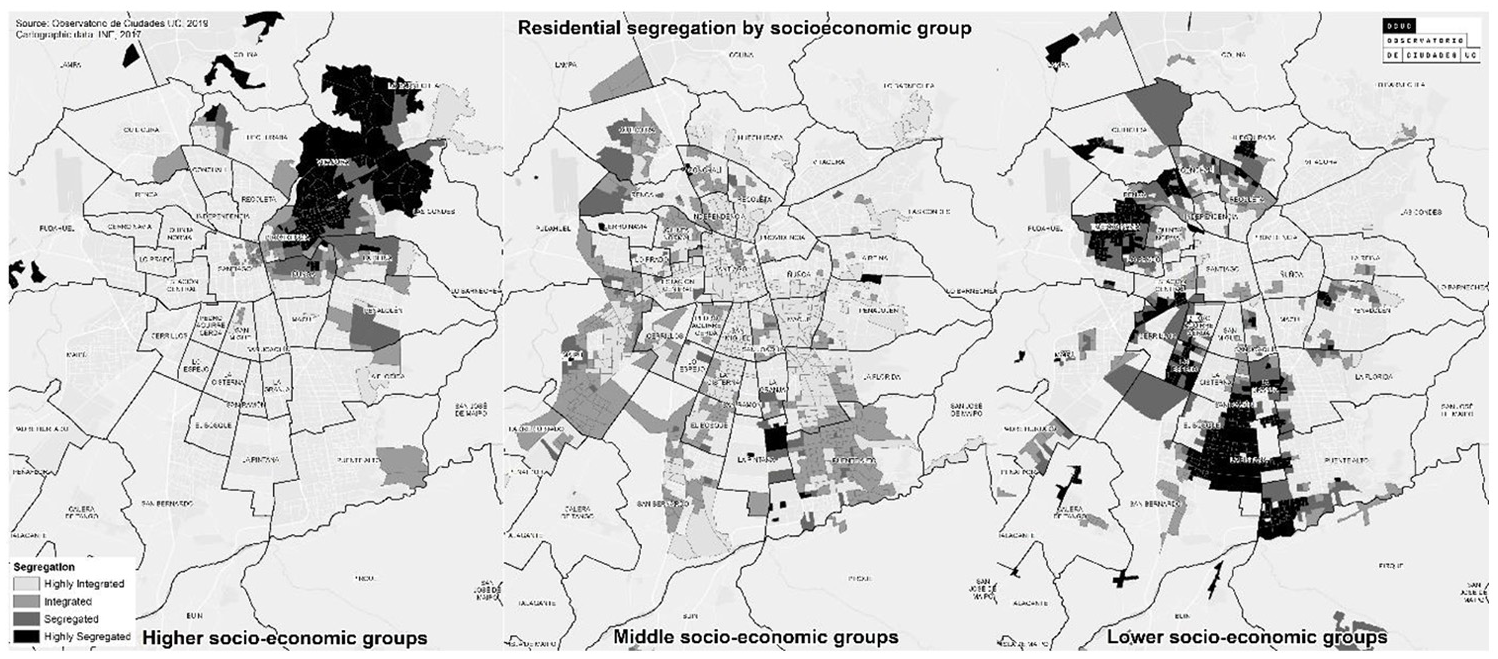
Residential segregation by socio-economic group in Santiago, Chile.
Data and methods
The present study uses survey data collected in 2016 during the first wave of the Chilean Longitudinal Social Survey (ELSOC), designed by the Centre for Social Conflict and Cohesion Studies (COES). Following proportional stratification into six population scales, a random probabilistic sample of 2984 individuals aged between 18 and 75 years was selected within street blocks, representing 93% of the urban population and 77% of the national population. ELSOC seeks to measure issues related to social cohesion and conflict in Chile. Topics studied include perceptions of neighbourhood relations, local participation, attitudes to democracy, pro-social behaviour, perceptions of inequality and social justice, and social networks. The panel survey incorporates demographic and georeferenced information for individuals and their areas of residence.
The present study focused exclusively on the Metropolitan Area of Greater Santiago (MAGS). We used data from a total of 700 residents and complemented it with georeferenced administrative information for 181 census tracts. The georeferenced information was produced by the Centre for Territorial Intelligence (CIT) and based on a range of sources: a pre-census survey from 2011; satellite images from 2014 onwards; administrative data about cultural centres supplied by the National Council for Culture and the Arts in 2014; information from welfare records held by the Ministry for Social Development; and the 2002 census.
Method
In the present study, we applied the Hierarchical Clustering on Principal Components (HCPC) approach. HCPC allows the combination of multiple methods used in exploratory multivariate interdependence analyses, such as Principal Component Analysis (PCA), Multiple Correspondence Analysis (MCA) and clustering techniques. Specifically, the method performs an agglomerative hierarchical clustering based on results from different factor analysis techniques. In this process, both PCA and MCA can be considered as the first step towards obtaining a more stable grouping later on. This type of stage-based statistical procedure permits identification of robust typologies through use of a mixed algorithm for the clustering process, combining the Ward classification method with the K-means algorithm (Husson et al., 2011). This approach is clearly relational in the sense that its emphasis is on the interrelations between the observed characteristics of individuals/units. It could therefore be said that the method is consistent with our theoretical proposal, which focuses on the interrelations between the different dimensions of neighbourhood cohesion and the multidimensional nature of socio-spatial resources. It should be noted that this kind of analysis has been conducted previously to explore trajectories and class-based differences in residential and school choice strategies (Méndez and Gayo, 2019).
In our case, HCPC was used in order to establish: (1) the socio-economic status (SES) of individuals, and (2) the different spatial configurations within Santiago. In addition, we have also combined these techniques in order to build a typology of neighbourhood cohesion and to examine how the SES and spatial conditions of individuals are related to different forms of neighbourhood cohesion.
Measuring the socio-spatial tangle
In this article, we propose a series of socio-spatial characteristics that are traditionally used by sociologists in stratification studies (e.g. Savage, 2015) to study the hypothesised link between socio-spatial stratification and neighbourhood cohesion. Specifically, we consider: (1) economic capital, i.e. household income, goods and services; (2) occupational class, i.e. labour market positions; (3) cultural capital, i.e. educational level, cultural practices; and (4) social capital, i.e. contacts and social networks. We complement these factors with different indicators used by scholars in the field of urban studies (hereafter, spatial conditions); for example, segregation and density.
Socio-economic status
We have created a multidimensional measure of individuals’ SES by considering several factors or capitals: total monthly household income; occupational class, using the classification devised by the UK National Statistics Socio-Economic Classification (NS-SEC); cultural capital, considering the maximum level of education obtained by some household members, as well as the number of books available in the household; and social capital, as the number of contacts that individuals have in higher SES occupations. Of the 13 occupations presented to respondents using the well-known Position Generator instrument (Contreras et al., 2019), four fall into this category (doctor, lawyer, university professor and director of a large company).
To construct our SES variable, we combine these measures through HCPC. In order to conduct the clustering analysis, we began by carrying out an MCA, which is suitable for analysing relationships between categorical data. Those variables that are not originally categorical, such as income and social capital, were recoded in order to facilitate their analysis along with the other socio-economic factors. We achieved a solution of five clusters that were clearly different from one another. For instance, individuals from the highest SES group (12%) have high economic capital (average monthly household income of approximately US$3518); tend to work as high-level managers/professionals (86.1%), e.g. engineering professionals, lawyers and doctors; and have a university education (75.3%). By contrast, individuals from the lowest SES group (13%) have low economic capital (average monthly household income of approximately US$554); have no formal education (64.4%); and tend to work in routine occupations (47.8%), e.g. cleaners, domestic workers and carpenters. The medium-high, medium and medium-low SES groups represent 20%, 29% and 26% of individuals, respectively. The detailed results of the clustering can be found in the supplemental materials, Section A.
Spatial conditions
Rather than analyse each of the geographical indicators separately, we conducted an HCPC using georeferenced data provided at the census tract level to build a variable that represented the different spatial configurations of Santiago. We considered several spatial characteristics: land price, socio-economic segregation, density, immigration and criminal behaviour. These variables were grouped into quintiles in order to reduce bias generated by the presence of atypical values. In this case, we pre-processed the indicators using MCA prior to clustering. Based on our analysis, we were able to identify four distinct types of urban zone within the MAGS. We have assigned a name to each cluster to aid identification during subsequent analysis. Detailed information concerning the variables used and the results of the clustering can be found in the supplemental materials, Section B.
-
-
-
-
In addition, we included a more subjective variable of stratification derived from the ELSOC survey: perceived neighbourhood reputation. The question posed was: How do you think those that live elsewhere evaluate your neighbourhood? Responses ranged from ‘very negatively’ to ‘very positively’ on a five-point Likert-type scale. The measure was eventually recoded into three categories.
It is important to note that we rely on the idea of neighbourhoods as ‘the bundle of spatially based attributes associated with clusters of residences, sometimes in conjunction with other land uses’ (Galster, 2001: 2112). Such attributes consist of the combined characteristics of, for example, the built environment, demographic and class status indicators, political and environmental issues, social interactions and affective aspects. We therefore emphasise the importance of spatial attributes – both of the neighbourhood itself and of the surrounding area.
Results
Patterns of neighbourhood cohesion
In this section, we examine the interrelationships between the different components of neighbourhood cohesion, along with the proposed dimensions. The only dimension missing from our analysis is social support, as we do not have an adequate measure with which to represent it (see Section C of the supplemental materials for details of the variables).
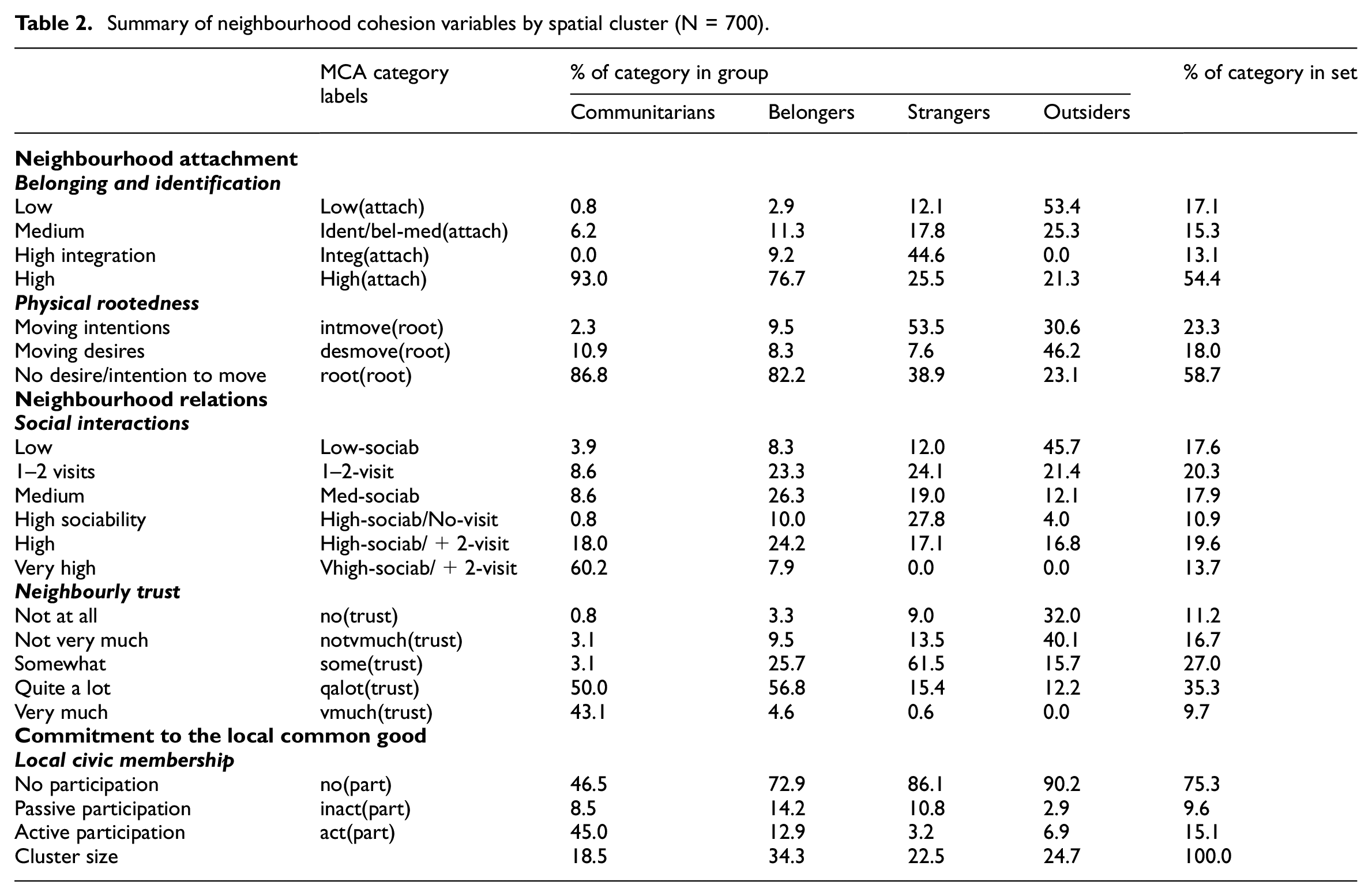
In order to explore the neighbourhood cohesion experienced by residents of the MAGS, we began with an MCA (Figure 2). This type of statistical technique does not seek to measure the effect of a particular set of variables; rather, it facilitates the construction of meaningful typologies of individuals. Please see the MCA category labels in Table 2.
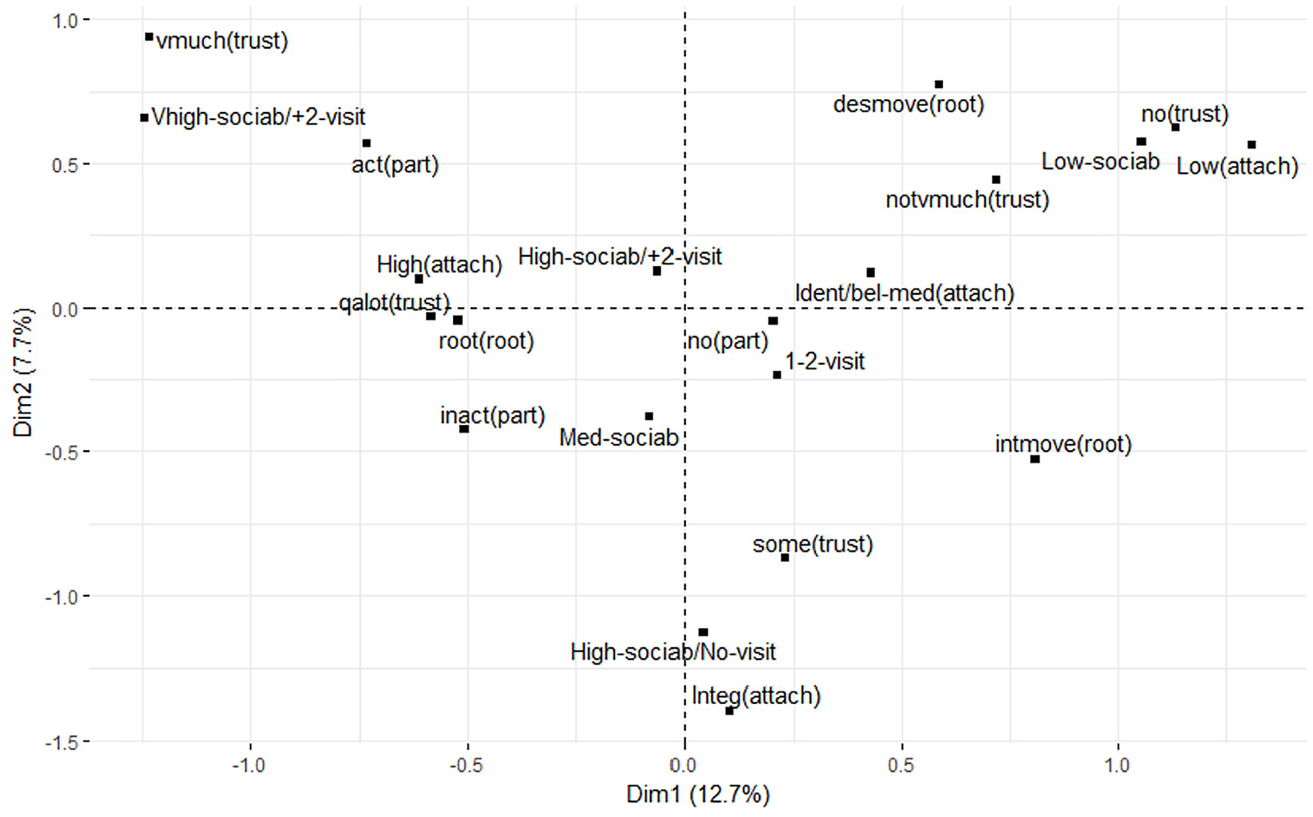
MCA of perceived neighbourhood cohesion.
Summary of neighbourhood cohesion variables by spatial cluster (N = 700).
Reading Figure 2 from left to right, we can see in the far top left that perceptions of neighbourly trust, very high levels of sociability and strong ties with neighbours are all closely linked to active participation in neighbourhood organisations. These categories are also associated – albeit less intimately – with feelings of strong neighbourhood attachment. In summary, the series of attitudes linked within this part of the graph reveal relatively strong neighbourhood cohesion. The opposite is true in the far top right of the plot, where those individuals with low physical rootedness are linked to perceptions that clearly indicate very low neighbourhood cohesion: no/little trust, low attachment and low sociability.
The two lower quadrants of Figure 2 encompass residents with another type of neighbourhood cohesion. Inclination towards strong sociability, without the presence of close relationships, is related with a special type of neighbourhood attachment that includes strong feelings of integration but little belonging and identification. These attitudes that combine a form of sociability based primarily on cordiality with more general attachment are associated with individuals that have ‘some’ neighbourly trust. In practice, this may be an indication of a more instrumental or functional pattern of cohesion, with a lower level of community commitment (e.g. Volker et al., 2007).
To gain a more detailed understanding of the relations that arise between the various dimensions and components of neighbourhood cohesion, we conducted an HCPC. There were a number of reasons for adopting this multi-phase approach at this stage of the analysis. Most importantly, it allowed us to observe aspects of the original variables that are usually invisible. Furthermore, it enabled us to focus our analysis on individuals and to clearly represent the patterns identified in the MCA, presented in Figure 2. Four groups emerged from the analysis, and the results of the clustering are detailed in Table 2. We have assigned a name to each group of residents in order to aid identification in the following section.
In brief, we report that a little over 18.5% of residents experience a high level of neighbourhood cohesion. This group of individuals, whom we have named ‘Communitarians’, state relatively positive attitudes towards all of the components and dimensions addressed in our proposal. This shows a degree of connection to the ideas of ‘neighbourhood unit’ and ‘community’ (Campbell and Lee, 1992; Wellman and Wortley, 1990), based on high levels of sociability (60%), local participation (45%), neighbourly trust (43%) and identification and the feeling of physical belonging (93%). Then come the much larger group of so-called ‘Belongers’ (34.3%). These comprise residents who report high levels of neighbourhood attachment in terms of sense of belonging and identification (77%) and physical rootedness (82%). There follows a group with lower levels of neighbourhood cohesion, particularly in terms of physical rootedness (39%). The so-called ‘Strangers’ (22.5%) are particularly characterised by strong feelings of integration in their neighbourhoods (45%), but also by a lack of strong social ties. This disposition is probably the clearest reflection of the idea of communities of interest, characterised above all by more functional interactions (Wellman and Leighton, 1979).
Finally, individuals that fall into the ‘Outsiders’ cluster (24.7%) represent a clear pattern of ‘non-community’ and social isolation. These are residents who express that they live in neighbourhoods with no cohesion at all (Meegan and Mitchell, 2001; Wacquant, 2008), particularly in terms of low levels of attachment, physical rootedness and social interaction, and limited neighbourly trust and local participation.
Neighbourhood cohesion as a form of privilege
In order to complete our study, we conducted a final correspondence analysis, followed by an HCPC. We analysed our typology of neighbourhood cohesion – described in the previous section – alongside the residential reputation perceived by the individuals. We also included the individuals’ SES, along with the identified socio-spatial clusters. We began by analysing the attitudes revealed by the survey data, i.e. the relationship between cohesion and reputation (Figure 3).
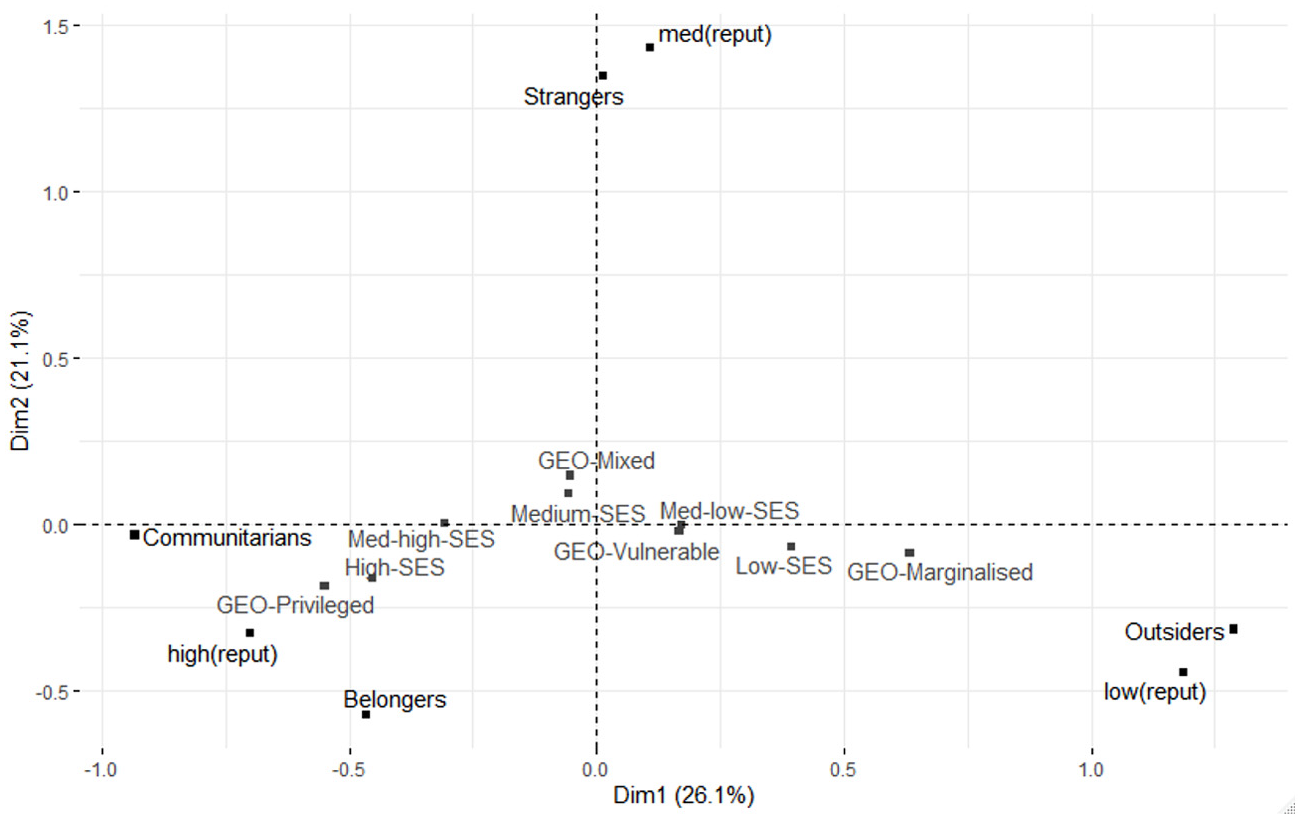
Correspondence analysis of neighbourhood cohesion and perception of neighbourhood reputation.
In the lower left quadrant of Figure 3, just below the x axis, we can see that the Communitarians and Belongers are positioned close to perceptions of very positive neighbourhood reputation. By contrast, in the lower right quadrant, we can see that Outsiders correspond to a perception of territorial stigma. Finally, far above the x axis, we can see that Strangers are clearly distinguished by the presence of intermediate evaluations of neighbourhood reputation.
To gain a more detailed understanding of the relationship between neighbourhood cohesion and socio-spatial resources, we have incorporated the two variables that represent the most objective aspects of stratification: individual SES, and georeferenced spatial characteristics. These measures were treated as supplementary variables and thus, rather than influencing the structure of the graph, their categories are only projected onto the geometric space that has already been configured. In order for them to stand out, they have been coloured grey in Figure 3. We see that high SES and living in privileged areas are associated not only with perceptions of good reputation, but with the presence of Communitarians and Belongers. Similarly, we can see that low SES and living in marginalised areas are associated not only with perceptions of territorial stigma, but with the presence of Outsiders.
Having demonstrated the clear relationship between neighbourhood cohesion and socio-spatial resources, we took the analysis one step further with a final HCPC using the results of the MCA (Figure 3). The aim was to formalise the observed patterns by creating a ‘meta-cluster’. By doing this, we were able to establish three final patterns of neighbourhood cohesion. The detailed results of the clustering can be found in the supplemental materials, Section D.
In brief, we report that the first group comprises only Communitarians (37%) and Belongers (63%), and that these claim a positive neighbourhood reputation. They tend to live in privileged areas and are of high SES. The second group primarily comprises Strangers (62%), and these perceive an intermediate neighbourhood reputation. For the most part, they live in mixed or middle-class areas and are of varying SES. Finally, the third group comprises primarily Outsiders (72%), who perceive strong territorial stigmatisation. They are generally of low SES and live in marginalised or vulnerable areas. Similar to Communitarians and Belongers, the third group tends to be segregated or concentrated in a few districts of the MAGS. Thus, it is evident that neighbourhood cohesion is a predominant disposition among the most socio-spatially privileged groups and is lacking among residents of more marginalised areas.
Conclusions
In this article, we have addressed the question of how the socio-spatial tangle is related to dispositions of neighbourhood cohesion. Our approach to this question points to the relevance of processes of accumulation of both objective and symbolic advantages that in turn enhance neighbourhood cohesion. We argue that neighbourhood cohesion is neither socio-economically nor spatially homogeneous, and that it works alongside wider processes of neoliberal urbanisation. Under these conditions, residents of more affluent neighbourhoods perceive greater place attachment, spend more time together and exhibit greater participation around common goals than the rest of the population. It could be said that this occurs not only because they see themselves as equals (Andreotti et al., 2015; Mau, 2015; Méndez and Gayo, 2019; Vincent and Ball, 2007), but because their material and symbolic assets help them to do so. We have contributed conceptually and empirically to illustrating the ways in which social cohesion at the neighbourhood level is mutually connected with social cohesion at higher levels in society (Dekker and Kempen, 2009).
The evidence we have gathered suggests that rather than being the result of a ‘gradual’ phenomenon or ‘natural’ process in the neighbourhood life cycle, cohesion is closely linked to the resources and conditions available to residents in their residential surroundings. Our results are brought together to form a typology of neighbourhood cohesion, comprising four types of residents: Communitarians (18.5%), Belongers (34.3%), Strangers (22.5%) and Outsiders (24.7%). We showed that Communitarians and Belongers claim strong and very strong levels of cohesion with their privileged neighbourhoods, while Outsiders appear to be very socially isolated, living in neighbourhoods with a perceived bad reputation. We are aware, however, that the sense of community that we have identified among Communitarians could resemble what Méndez and Gayo (2019: 127) define as ‘networked pragmatism’, a cultural and political repertoire in which social capital and sociability are key aspects in social reproduction. Every single cultural, educational, sporting or social activity is conducted within relevant groups, and this reinforces a sense of identity and belonging. As such, strong valuation of social ties may indeed exist, but not exclusively due to the symbolic aspects involved in their cultivation; they may also be part of class reproduction on a larger scale, not only in the immediate community.
By showing that inequality in access to socio-spatial resources is strongly related to different forms of neighbourhood cohesion, we demonstrated the ways in which certain advantages and disadvantages are nurtured in space in order to reproduce certain positions. Santiago, as an example of a highly segregated metropolis in Latin America, constitutes an alarming case in which neighbourhood cohesion works as a form of privilege accumulated by particular residents in particular areas. In other words, along with the concentration of residents of a similar SES in neighbourhoods that possess a certain positive reputation, these areas are also characterised by their low density and high land prices. On top of these socio-spatial advantages, they score better in terms of sense of belonging, place attachment, sociability and commitment to the local common good.
It is important to note that the present study emphasises the two extreme cases characterised, on the one hand, by accumulation of resources and cohesion and, on the other, by an absence or weakness of these. Our primary aim, however, is not to overemphasise this polarisation, but to show that the urban dynamics of segregation are present and have visible and long-standing consequences. Most importantly, cases such as Santiago show that dynamics of segregation are difficult to counterbalance, and have medium- to long-term consequences. Among these consequences are the gravitational effect on areas which, for the time being, are mixed, but which may eventually end up being sucked into this polarising pattern.
Our interconnected approach has provided an important theoretical and empirical contribution to theories of urban studies by suggesting that contemporary neoliberal urban contexts can reinforce socio-spatial inequality by weakening neighbourhood cohesion through a reduction in elements such as place attachment and commitment to the local good. These findings constitute a counterargument to the notion of neighbourhood cohesion as something that inherently benefits the poor or counterbalances the forces of social exclusion (Gerometta et al., 2005; Putnam, 2000; Saegert et al., 2001), and warn of the deterioration of this crucial dimension of urban life in the most deprived areas. As such, our proposal also has significant political implications, and shows the city as an arena of political conflict (Méndez, 2018; Miciukiewicz et al., 2012) in which commitment to the urban scale as a whole is unlikely to blossom.
Our proposal has shown that cohesion cannot simply be installed as an ‘injectable’ condition among the residents of a given neighbourhood. A failure to consider the ways in which neighbourhood cohesion may act as an accumulator of advantage could become an ‘obstacle to the eventual solution of social problems that are outwardly specified or implied’ (Maloutas and Pantelidou Malouta, 2004: 450). Neighbourhood cohesion as a form of privilege implies a certain disconnection from or ‘blindness’ towards the lives of others. In highly segregated and unequal contexts in which the rich and parts of the middle classes are not necessary exposed to the poor, we should question the scope and effectiveness of policies which do not involve serious consideration of the geographies of cohesion (and conflict), and which seek to promote neighbourhood cohesion without first attempting to reduce socio-spatial rifts.
Supplemental Material
USJ914549_Supplemental_material – Supplemental material for Neighbourhood cohesion as a form of privilege
Supplemental material, USJ914549_Supplemental_material for Neighbourhood cohesion as a form of privilege by María Luisa Méndez, Gabriel Otero, Felipe Link, Ernesto López Morales and Modesto Gayo in Urban Studies
Footnotes
Acknowledgements
We are grateful for the support received from the Centre for Social Conflict and Cohesion Studies – COES. In addition, we would like to thank Prof. Tom Slater for his helpful advice on earlier drafts of this article. Finally, we truly appreciate all the constructive suggestions and the detailed feedback of three anonymous reviewers as well as the valuable insights of the Urban Studies editors to improve this article.
Declaration of conflicting interests
The author(s) declared no potential conflicts of interest with respect to the research, authorship, and/or publication of this article.
Funding
The author(s) disclosed receipt of the following financial support for the research, authorship, and/or publication of this article: Comisión Nacional de Investigación Científica y Tecnológica, grant/award numbers: CONICYT PFCHA/DOCTORADO BECAS CHILE/2017 – 72180515, ANID/FONDAP/15130009, CONICYT/FONDECYT under Project No. 1140136, CONICYT/FONDECYT under Project No. 1151287, CONICYT/FONDECYT under Project No. 1161550, CONICYT/FONDECYT under Project No. 1190094, CONICYT/FONDECYT under Project No. 1190724 and CONICYT/FONDECYT under Project No. 1191440.

Supplemental material
Supplemental material for this article is available online.
References
Supplementary Material
Please find the following supplemental material available below.
For Open Access articles published under a Creative Commons License, all supplemental material carries the same license as the article it is associated with.
For non-Open Access articles published, all supplemental material carries a non-exclusive license, and permission requests for re-use of supplemental material or any part of supplemental material shall be sent directly to the copyright owner as specified in the copyright notice associated with the article.
