




Abstract
From a sociological perspective, sacredness is a social construction. In this article, I stand at the intersection of the tradition of domestic shrines and the contemporary use of photography, from a perspective of lived religion. The aim is to clarify what are the sacred realities that structure daily life for Latin American participants. I argue that the practice of displaying pictures at home is a form of ‘sacralization practice’. The research is based on data from a sample of 25 respondents from three cities (Córdoba, Argentina; Lima, Perú; Montevideo, Uruguay), four religious affiliations (Catholics, Protestants, Umbanda, Non-Affiliated), and two socioeconomic statuses (lower and upper/middle). Employing a layered analysis of pictures displayed at home (PDH), I studied the materiality, the context of the display, and the motifs portrayed. The results show that participants, both religious and non-affiliated, sacralize foundational relationships and moments, even the events scholars disregard.
The construction of the sacred
Different academic disciplines have different ways to determine what is sacred. From a sociological perspective, sacredness is not a quality inherent to certain things, but one that those realities acquire when they are set apart. Sacredness is the outcome of social practices that separate some realities from the profane rest (Alexander, 2003; Durkheim, 1990 [1912]; Lynch, 2012); a symbolic social boundary produced in social interactions; and a category that orders the world (Fitzgerald, 2000; Lamont et al., 2015). In that sense, ‘sacred’ not only opposes to ‘profane’ but also to ‘chaos’ (Berger, 1990).
This structuring quality is true about both ‘secular’ and ‘religious’ sacred. Since sacredness is a social construction, it can be built around secular realities, for example, moral issues (the idea of universal human rights) that are regarded as non-negotiable and therefore structure a secular worldview (Knott, 2013).
Within the more specific sub-field of the sociology of religion, Ammerman (2014, 2021) and Martín (2009) think of the sacred–profane binary more as a continuum than as an all-or-nothing distinction. There are certain ‘practices of sacralization’ (Martín, 2009) that inscribe human realities in a dimension different from the rest – dimensions of life that Ammerman calls ‘other than’ ordinary (Ammerman, 2021). They think of a range in this process, going from the mundane to the sacred. Religious (and secular) actors build sacredness placing things, persons, and ideas in a different realm, relating them with an ‘other than’ ordinary reality that structures subjects’ lives.
While religious institutions have a role in that construction, in keeping the sacred/profane distinction, the capacity of sacralizing is not exclusive to religious organizations and authorities. Regular people, through certain practices, have the power to build and define what is sacred to them (Martín, 2009; Morello, 2019), modifying the borders between the sacred and profane.
In this article, I explore how participants in three Latin American cities construct sacredness in their ordinary lives through pictures displayed at home (PDH). Technology has made digital photography widely accessible. Most persons with access to a cell phone can shoot a picture. There are things that, for them, are worthy to photograph. Among those photographs, there are ones that are worth printing. Within this latest group, some were chosen kept in a box, others were placed in photo albums, and others were displayed at home. Respondents took the time not only to print them (as opposed to keeping them in the cloud or electronic devices) but also to frame them and display them at their places (as opposed to storing them in an album or a box). Because of the process of shooting a picture with a cellphone, printing and framing it, and placing it at home, I understand that PDH are pointing to something that is ‘other than’ ordinary. The process differentiates a picture from more ordinary ones (see Graphic 1).
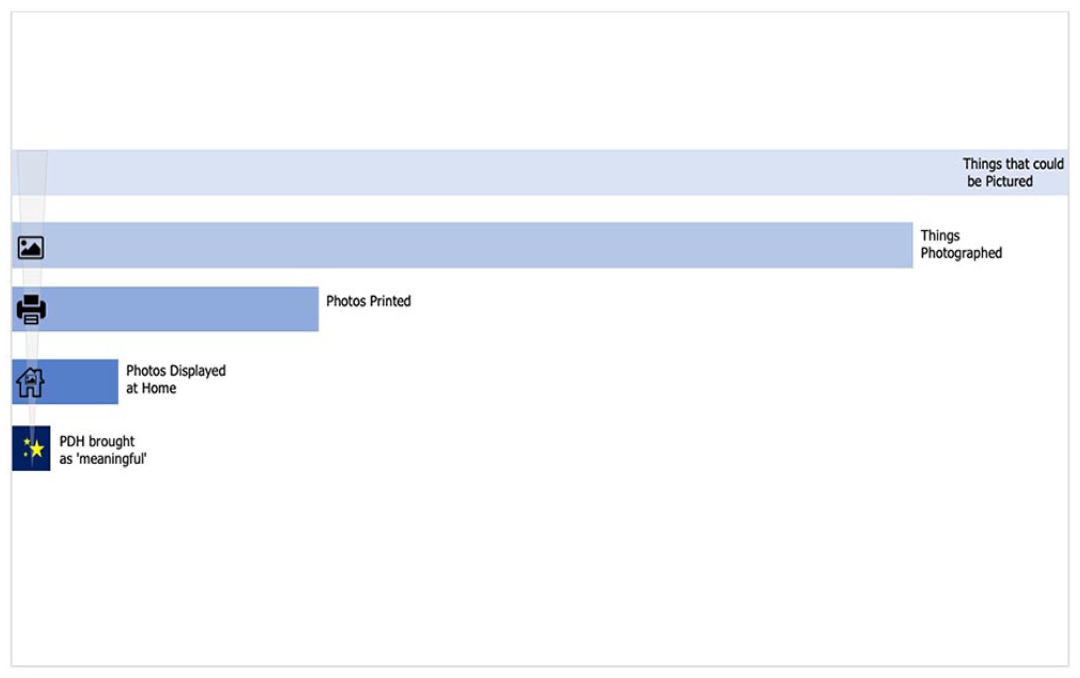
Process of setting pictures displayed at home apart.
Building the sacred in Latin America
Forms of religiosity are shaped by historical circumstances and local cultures, generating a repertoire of practices that can be used by religious people (Ammerman, 2021). While Latin American religious culture has been shaped by Native, Afro, and Christian religiosities, today most urban believers have access to narratives and symbols from different religious, spiritual, and secular traditions. That diversification of idioms is a novelty that nurtures everyday religiosity in today’s Latin America (Ameigeiras, 2008; Fernandes, 2022; Pew Research Center, 2014; Rabbia et al., 2019).
To understand how contemporary, urban Latin Americans build the sacred, I employed a lived religion framework that focuses on practices, looking at religion as an ongoing human relationship with a supra-human power (Morello, 2021). Lived religion pays attention to the concrete historical and cultural context, to the practitioner’s material and embodied engagement with the ‘other than’ ordinary realm. Religious things happen when there is a relationship (Ammerman, 2021). When talking about lived religion, we are not necessarily talking about a reality that conforms with churches’ mandates, nor necessarily with the bar sociologists have been using to measure religious practice (church attendance) (Ammerman, 2021; Morello, 2021).
The lived religion approach shows the capacity of the actors to produce and express spiritual meaning in daily life, highlighting the practitioners’ agency in the religious field. However, religious activities are cultural realities that go beyond any given individual. Lived religion, even if it is personal, is not a private category. People express themselves through practices informed by both institutional and popular traditions they have at hand.
Images and sacralization practices
Photographs establish a new relationship with space and time, life and death – a means of representation and connection with something ‘other than’ ordinary (Suárez, 2008; Williams, 2015). Photos display cultural models, social imaginaries and meanings, and social rules condition their use. Therefore, photos allow us to explore how hierarchies, tastes, and values are naturalized into the life of a social group. Photos show and hide social structures. They chose, suggest, and impose a specific vision of the world. An image bears the photographer’s system of socially constructed categories to see and analyze the world (Suárez, 2008).
People use photography to control, as much as possible, the narrative of their own lives and memories (Edwards, 2005b). However, from the theoretically infinite things, persons, places, and experiences that are meaningful, there is a finite universe that can actually be pictured. Cultural tastes, socioeconomic status, and religious traditions limit the possible available options. And among these available options, people select a finite set of pictures and things portrayed (Bourdieu, 2003). It is because of this selection process that pictures set apart a reality in life that is considered ‘other than ordinary’. I argue that studying photos displayed at home is a way to study concrete practices of sacralization, both secular and religious. Inquiring about photos has the potentiality of awakening feelings and emotions, latent memories; the stories around the pictures may articulate what respondents consider sacred, and how that reality orders their world (Suárez, 2008).
To some extent, photos are in continuity with the Latin American religious tradition of veneration of religious images (De la Torre, 2021; Salas and De la Torre, 2020). The believers’ relationship with icons that connect them with an ‘other than’ this ordinary life has a long history in the region. Images have been present in homes since pre-Columbian times (Marzal, 2007; Parker Gumucio, 1993). Today’s repertoire of images is the result of political, aesthetic, and religious struggles (Gruzinski, 1994).
Images are evocative, allowing access to different parts of human consciousness and helping researchers to pay attention to reality in different ways. Because of that, visual materials are useful data to explore layers of experience that cannot easily be put into words, to access interpretative frameworks that order the world helping people to make sense of it (Salas and De la Torre, 2020).
Religious images sacralize the ordinary, shedding light on how participants order their world and make sense of it (Bagnoli, 2009). People set apart objects that are valued differently in domestic shrines. Sometimes, these spots are built around official religious idioms (Native deities, crosses, images of the virgin Mary, saints). However, people also add other mementos, sculptures, pictures of persons dead and alive, flowers, cards, and candles – things that are deemed ‘other than’ similar ones that remain in the mundane (Ameigeiras, 2008; De La Torre, 2012, 2016; Pérez, 2019; Suárez, 2015).
In this article, I study Latin American practices of building the sacred from a methodological standpoint that is attuned to the practices explored. From a perspective of lived religion, I stand at the intersection of the contemporary use of photography and the tradition of domestic shrines. In doing so, my goal is to explore what are these ‘other than ordinary’ realities that structure daily life for Latin American participants. I argue that the practice of displaying pictures at home is a form of ‘sacralization practice’, a way of inscribing something in an ‘other than ordinary’ dimension of life, even when exhibited in secular contexts. What pictures are printed and displayed at home? In which context are they exhibited? What is represented in those pictures? What is the sacred they show?
Data collection and selection of the corpus
The data used for this article come from a wider research project on lived religion in Latin America. 1 It explored practices that respondents do to connect with a supra-human power in three cities: Lima (Peru), Montevideo (Uruguay), and Córdoba (Argentina).
Almost 71% of Argentina’s 45 million inhabitants identify as Catholic, 15% as Protestant, 11% as unaffiliated, and 3% identify with other religious traditions. In Córdoba, Argentina’s second-largest city with 1.3 million, about 60% of the population identifies as Catholic, 8% as Protestant, 29% as Non-Affiliated, and 1% as members of other traditions (Morello and Rabbia, 2019).
Peru has a population of about 33 million inhabitants; 76% of them identify as Catholic, 17% as Protestants, 4% considered themselves unaffiliated, and 3% as members of other traditions. In Lima, the country’s capital with a population of more than 10 million, 78% identify as Catholics, 16% as Protestant, 3% as unaffiliated, and 3% as members of other traditions (Romero-Cevallos, 2019).
Almost 42% of Uruguay’s 3.5 million inhabitants declare to be Catholic, 37% unaffiliated, 15% Protestants, and 6% members of other religious traditions. In Montevideo, 1.7 million, we found the same religious distribution (Da Costa, 2019).
In these three locations, researchers built a non-random sample of 251 respondents (89 in Córdoba, 82 in Lima, and 80 in Montevideo) upon two variables: (1) religious self-identification segmented in four different categories: Catholics, Protestants (including mainline Protestants, Evangelicals, and Pentecostals), Other Traditions (Jewish, Mormons, Buddhists, Jehovah Witnesses, Adventists, Muslims, Umbanda), and Non-Affiliated (unaffiliated or disaffiliated believers, agnostic and atheist); and (2) socioeconomic status (SES) segmented in two categories: upper/middle, and lower SES. Investigators considered the religious affiliation as the one self-reported by the subjects at the moment of the first contact with them (as opposed to assigning the label of ‘practicing’ or ‘nominal’, as others have done; see Christian et al., 2015; Latinobarómetro, 2018; Valenzuela et al., 2007) and they balanced the sample in terms of gender and age since these features might influence their religious practices.
Researchers met participants twice: for an in-depth interview and an ‘object’ elicitation meeting. The interview inquired about regular routines and practices that respondents deemed religious; stories about practices they might (or might not) do at home, work, and church. The ‘object elicitation’ was a modification to the ‘photo-elicitation practice’. The prompt requested the participant to bring ‘an object’ or ‘photograph of an object’ that was ‘significant’, or ‘meaningful’ for them. The object could be an artifact or a picture that represents places, persons, or things that cannot easily be shown in other ways (Rose, 2016; Williams, 2015). This wording allowed respondents to think about things, persons, and places that were meaningful in their lives. Researchers did not ask for something ‘sacred’ nor ‘religious’ because they wanted to avoid the idea of a ‘sacred icon’ that might have alienated Protestants (who in Latin America can be iconoclasts) (Da Silva Moreira, 2018) and Non-Affiliated participants.
Respondents mostly took pictures with their mobile phones. The quality of the images obtained depends on the ability of the respondents and the device they had. In some cases, participants asked the researcher to take pictures of the objects they brought. Even when they did not shoot some pictures, participants ‘produced’ all of them. However, these are not ‘spontaneous’ pictures, but ones that arose out of interaction with the researcher (Bagnoli, 2009; Suárez, 2008; Williams, 2015).
Because participants produced the data, the ‘other than ordinary’ quality of the thing was not defined just by the researcher, but with the participation of respondents who brought what was meaningful for them to the interview. They were invited to describe the object/photo, tell the story of its origin, and talk about its significance at that moment in their lives (Banks and Zeitlyn, 2015; Harper, 2012; Williams, 2015; Williams and Whitehouse, 2015).
Researchers collected a total of 877 photographs from 228 respondents (23 did not bring objects or pictures). I started analyzing the material doing a ‘realistic coding’ registering and sorting the pictures for what I saw in them (Pink, 2013). The photos portrayed 501 different motifs (sometimes, respondents took many different pictures of the same motif from different angles; at other times, they displayed more than one motif in a picture).
For this study, I selected a specific corpus of pictures of ‘photos displayed at home’ (PDH), that is, pictures whose motifs were other pictures exhibited in the household. While these pictures were produced upon researchers’ requests, the PDH pictured were not; they were already exhibited in the household. PDH was a code within the ‘photographs’ category, which also included ‘screenshots’, ‘photo albums’, and ‘photos shown to researchers’. In total, 67 respondents brought a picture of some sort, and 25 of them brought 48 PDH (see Graphic 2).
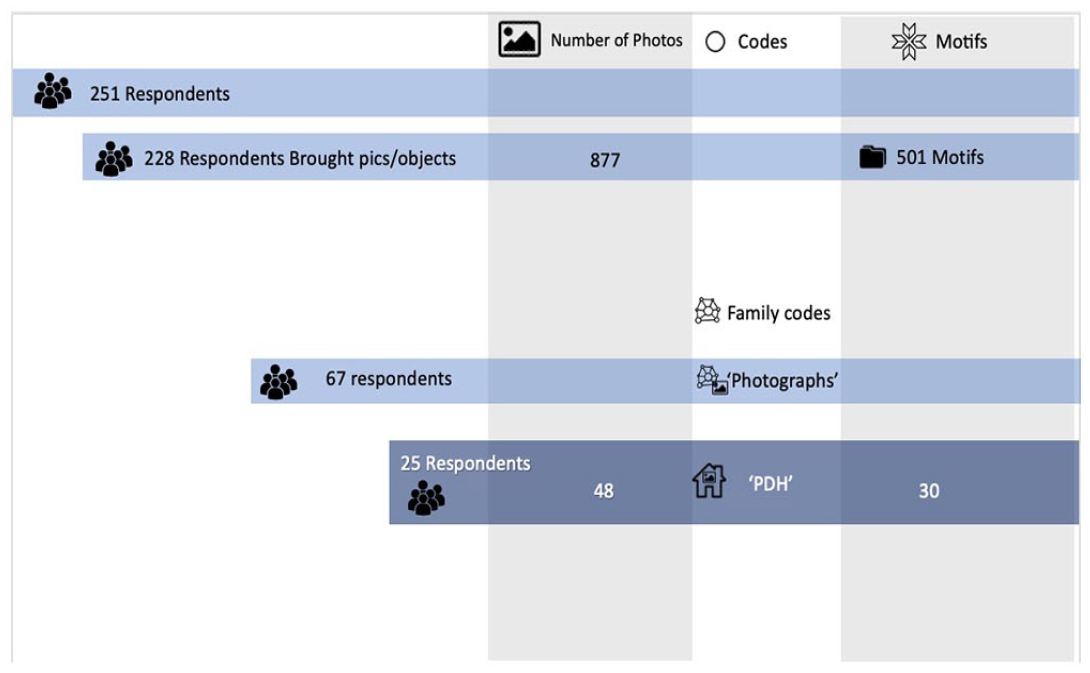
Corpus selection and coding processes.
Analysis
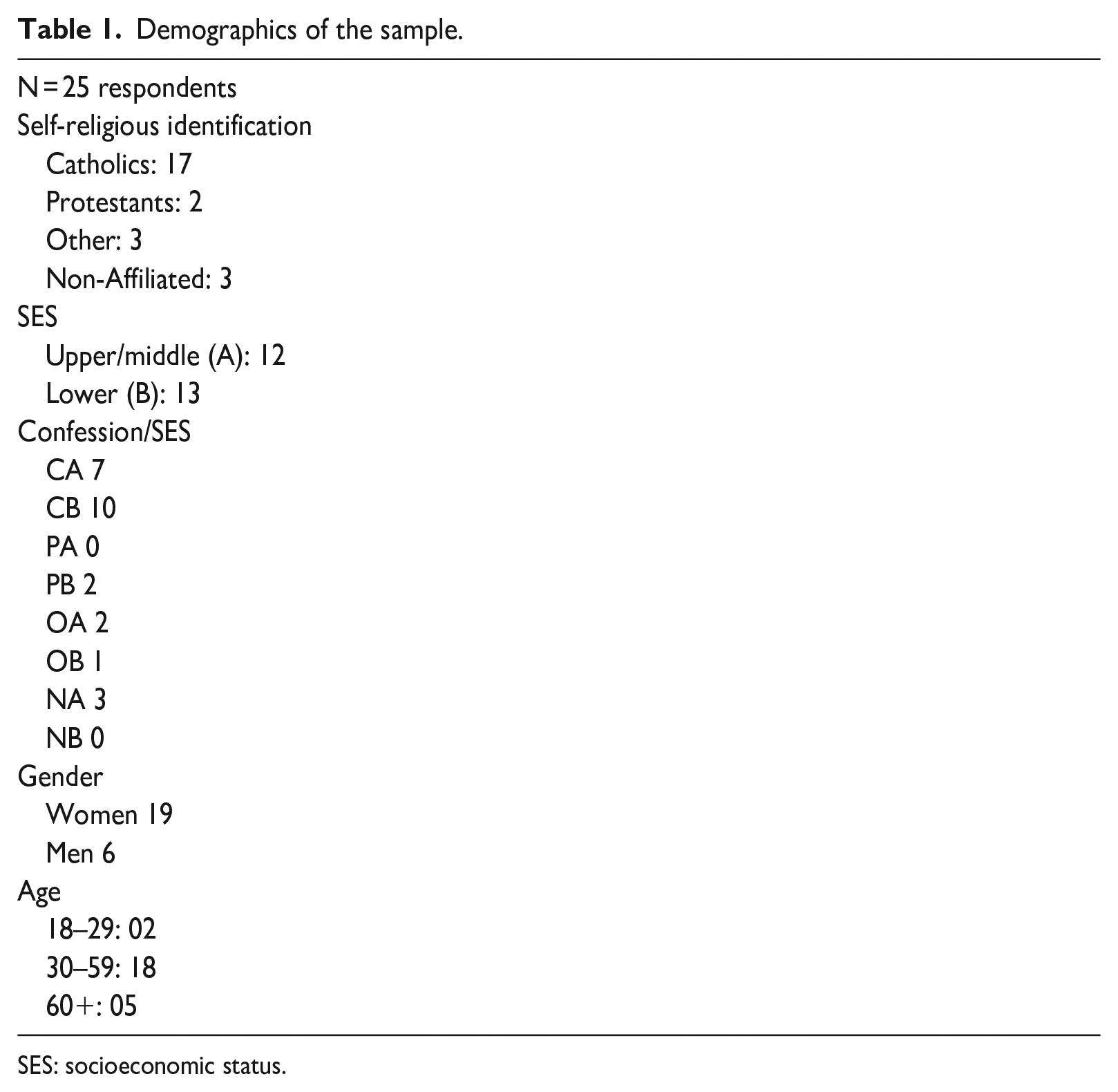
A demographic analysis of the participants shows that, in terms of SES, 12 participants were in the upper/middle level and another 13 in the lower status. In terms of self-identified religious affiliation, 17 were Catholics, 2 were Protestants, 3 were Umbanda, and 3 were Non-Affiliated. 2 Even when this is not a random sample, in terms of percentages, this is close to Latin America’s religious landscape: 68% of Catholics and 32% from other religious confessions (According to Pew Research Center, 2014, 69% of the population identify as Catholic). Since they are present among affiliated and non-affiliated households, PDH seem to be a legitimate path to explore the religious and secular construction of the sacred.
Most respondents were women, 19 of them, and between 30 and 59 years old (see Table 1). We can assume that adult women in the sample have more agency than men in the organization of their homes, and therefore in displaying photos that are meaningful to them in the domestic space.
Demographics of the sample.
SES: socioeconomic status.
Based on the work of Oliffe et al. (2008) and Glaw et al. (2017), I did a ‘layered’ analysis of the pictures and narratives. I started the analysis with a basic distinction between the ‘form’ and ‘content’ of the photos displayed at home (Banks and Zeitlyn, 2015). By ‘form’, I understood the materiality of the picture (just printed, if also framed, hang, and the context of the display), and by ‘content’, what is portrayed on them (people, places, things).
Then, I conducted a ‘realistic coding’ by looking at the pictures without using the narratives. In a third step, to have a better sense of the context, I studied the other objects respondents brought to the interview, searching for other possible contextual cues (Edwards, 2012), like the presence of religious images nearby PDH. After that, I incorporated the narratives into the analysis. Since respondents generated the pictures, the meaning intended by the participant, became paramount (Banks and Zeitlyn, 2015). I read the complete interview transcripts, summarized them, and attached them to the pictures.
For the fifth and final step, I displayed the ‘pictures + narratives’ documents on a table big enough to hold all of them and started a process of manually analyzing and sorting the information with emerging codes regarding the form of display and the content displayed.
Form: materiality and context of display
Since the uses of photographs are associated with their material forms (Edwards, 2005b), I explored, first, materiality and contexts of display: under what conditions the photographs are seen? (Becker, 1998; Edwards, 2012). Photos are displayed at homes in a wide range of ways: from just pinned on a board, to place on a shelf, to framed and hang on a wall. After different attempts, I ordered the pictures in a spectrum from domestic shrines to simply pinned down pictures on a blackboard. Then, I explored who chose what location, and a description of that spot. I defined certain spots as shrines, while others were ‘spiritual nooks’, 3 different from ‘framed pictures hung on a wall’. In any case, it is worth noticing that all the photo arrangements, even the ones that could be easily moved, seem permanent.
Regarding the physical location of the display, respondents’ narratives ranged the pictures from a sort of ‘for everyone to see’ to ‘only for me’ spectrum; going from the lobby space at the entrance of the house, passing through the main room, nestled inside the house, to the bedroom. A total of 10 respondents displayed the pictures in rooms that anyone who visits the house would have access to; however, in many cases, those are the same rooms where participants spend most of their time at home. Six respondents mentioned more intimate spaces deep inside the house, where only family members usually have access, like their bedrooms. Seven respondents did not mention the location of the display, but since these interviews were conducted at the participant’s home, the researchers noted the pictures’ location in their field notebooks.
PDH in the context of supra-human powers
As mentioned before, the veneration of icons and religious images at home, since pre-Hispanic times, has a long history in Latin America (Gruzinski, 1994; Marzal, 2007). Some pictures are displayed in that context, with objects that are, in the Latin American culture, connected to the sacred. In many cases, the ‘other than’ ordinary feature of it was highlighted with a shrine, among religious iconography, and the photo was part of it. Other pictures are displayed in an implicit dialogue with religious images, placed nearby religious icons.
Some PDH are placed among pictures or statuettes depicting Jesus, the Virgin Mary, or a saint; some are bounded by rosaries, crosses, bibles, miniatures of praying hands, chapels, and angels; others are enclosed by candles, printed prayers, holy cards, flowers (natural, paper or plastic ones), olive branches, and babies’ shoes (see Picture 1). These are spots that are used exclusively for that purpose, set apart from other domestic uses, separated spaces in the house, and demarked in different ways. Some occupy a whole piece of furniture (a chest, a chest and a hutch, a bookshelf, a shelf). Sometimes, those spaces are covered by a doily or framed by some other elements like wrapping colorful papers.
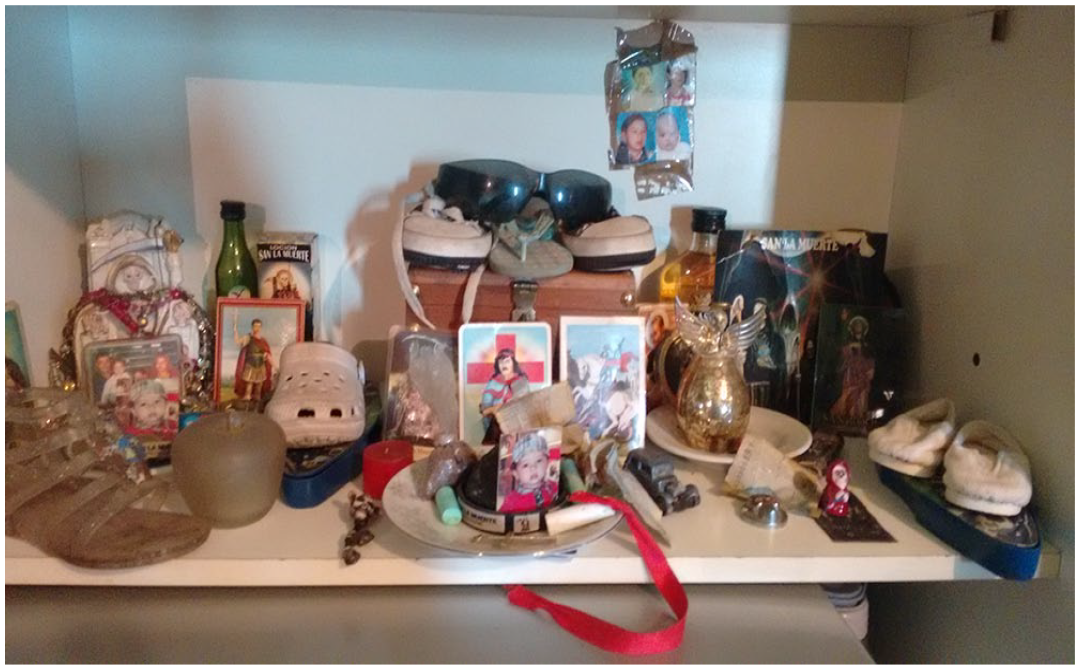
Marcela’s (Córdoba, Catholic, lower SES).
Photos were either framed and hung or just placed unframed among others – in a collage with other pictures or just standing alone. Sometimes, different kinds of containers were placed in the shrine: urns, liquor bottles, milk boxes, water glasses, and flower bases.
Mares, a 57-year-old Catholic woman in Lima, explained that her father used the same spot of the house, in the living room, as an altar. She calls it ‘my magic zone’. Miguel, a 50-year-old Catholic in Córdoba, has a complete drawer and hutch in a corner of the family room. His wife and he wanted to build a special room dedicated to their religious activities (a small chapel) but they could not afford it, so they ‘reserved a place, a corner to have an altar … a place where we can meet with the Lord … separated for that’. Clarita, a 40-year-old cordobesa Catholic woman, built a shrine dedicated to the memory of her departed baby boy. Lucy’s husband built a shelf especially to be their shrine, where now Lucy (49-year-old Catholic in Córdoba) displays some pictures and keeps his ashes. At the feet of St. Cayetano (in Argentinean religious tradition, the patron saint of workers), she displays a picture of the man who got her husband a stable job when he was unemployed.
This context of display only includes Catholics. Six respondents brought this kind of picture: 3 upper/middle and 3 lower SES; 5 women and 1 man; 4 from Córdoba and 2 from Lima.
There are other pictures placed on shelves, chests, walls, dressers, and spaces in the house that are confined to ‘spiritual nooks’. These are spots that, without being a shrine, are enclosed by objects that in the Latin American culture have religious connotations (like bells, saints, angels, crosses, olive branches, candles, flowers, and clay figures). They are usually displayed on a doily that defines which is the surface that is considered ‘different’, separated from the rest of the space where there are usually other elements displayed (sound system, keychains, ashtray, book).
Ten respondents brought pictures placed in this way: 8 Catholics, 1 Umbanda, and 1 Protestant; 7 lower and 3 upper/middle SES; 2 men and 8 women; 6 from Córdoba, 1 from Montevideo, and 3 from Lima.
Hernan, a 38-year-old Catholic in Córdoba, displays a picture of her daughter with his wife’s uncle, besides an image of Baby Jesus on a drawer in the living room, a spot in his house he judged important: ‘they are here not by chance’ (see Picture 5). Maria Luz, a 60-year-old Protestant limeña, showed a framed portrait of her parents. She said she keeps it on her nightstand, beside her bible and a candle. In this way, she has them in sight every night when she prays to them for blessings upon her family.
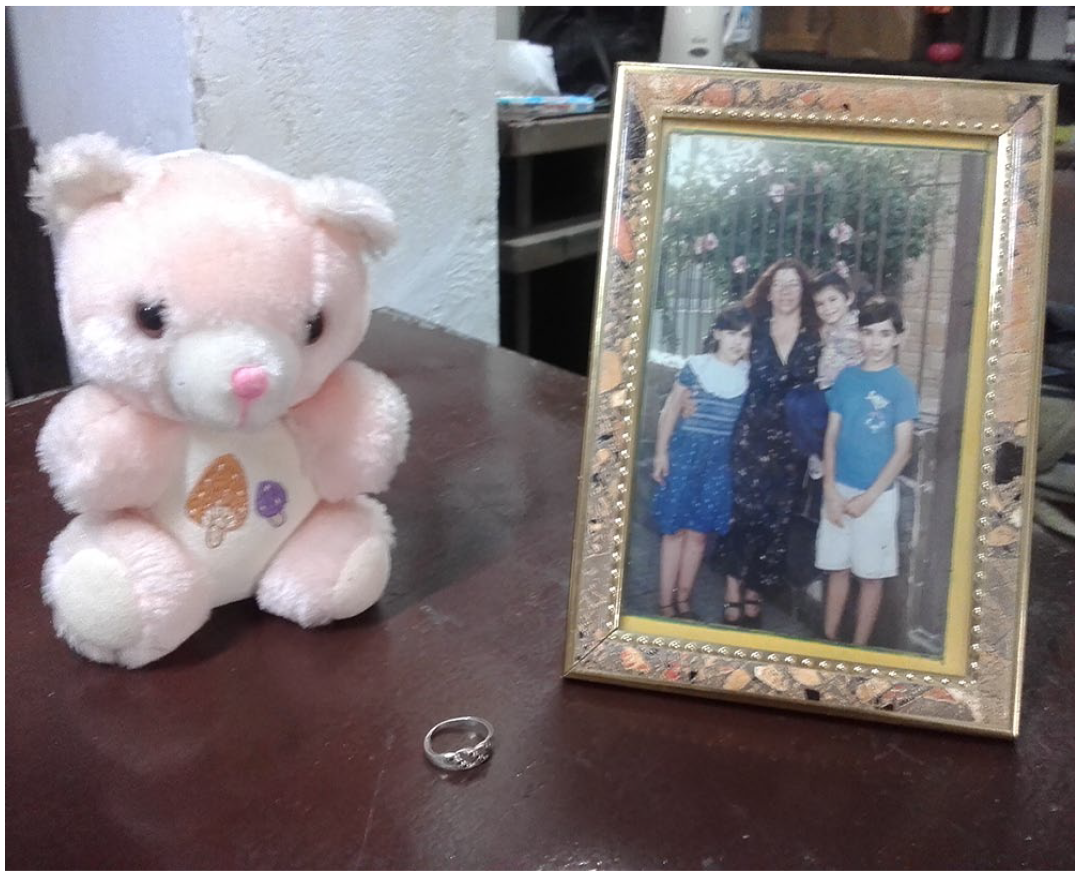
Marina is a 53-year-old Umbanda practitioner in Montevideo, who has received messages from other people in her dreams but has not been able to dream with her husband since he died, 3 years before the interview. Receiving a message from the departed in a dream is part of Marina’s Umbanda religious experience. Marina displays an arrangement with pictures of her late husband (see Picture 2) in a very visible place at her house to trigger a dream with him, ‘I sit in front of him and drink some mate [a typical tea in some countries in South America], I look at him… I talk to him, but he does not speak’. The arrangement is displayed among clay figures that mark the spot.
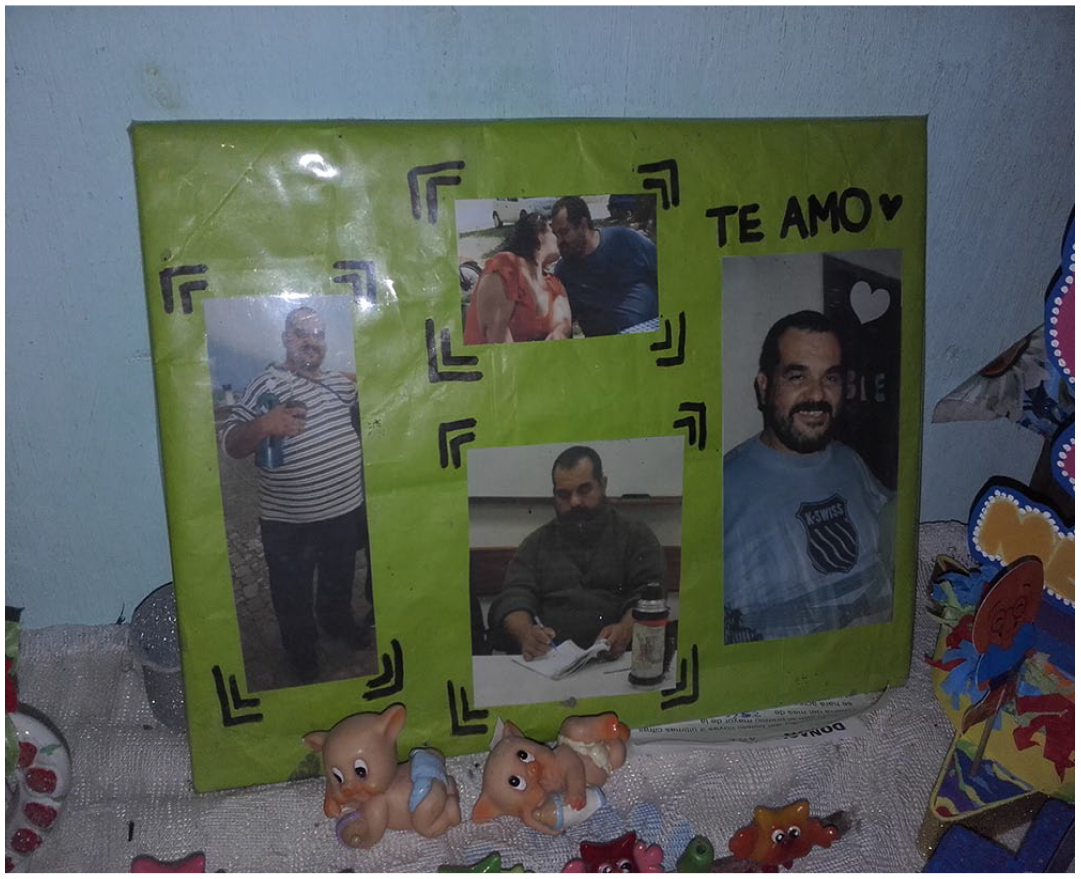
Marina (Montevideo, Umbanda, lower SES).
In secular contexts
Some respondents showed pictures hanging on a wall. I assume that hanging a framed picture on a wall indicates more engagement than only framing it and displaying it on a drawer dresser. The size of the pictures varies; some of them are about 20 inches, while others were standard 6 × 4 inches prints. Several pictures were arranged in multi-photo frames while others were in a single one. Some were displayed in a composition: multiple frames in one fixed set, multiple framed single pictures displayed together, or close enough in a similar style.
Five respondents brought photos that fall in this category; 3 Catholics and 2 Protestants; 4 lower SES and 1 upper/middle; 5 women; 3 from Lima and 2 from Córdoba. Blanca, a 57-year-old Pentecostal woman from Lima, showed a picture of her parents, standing in from of their house in the Peruvian Andes, where Blanca spent her childhood: ‘I had a good time with my parents’ (see Picture 3).
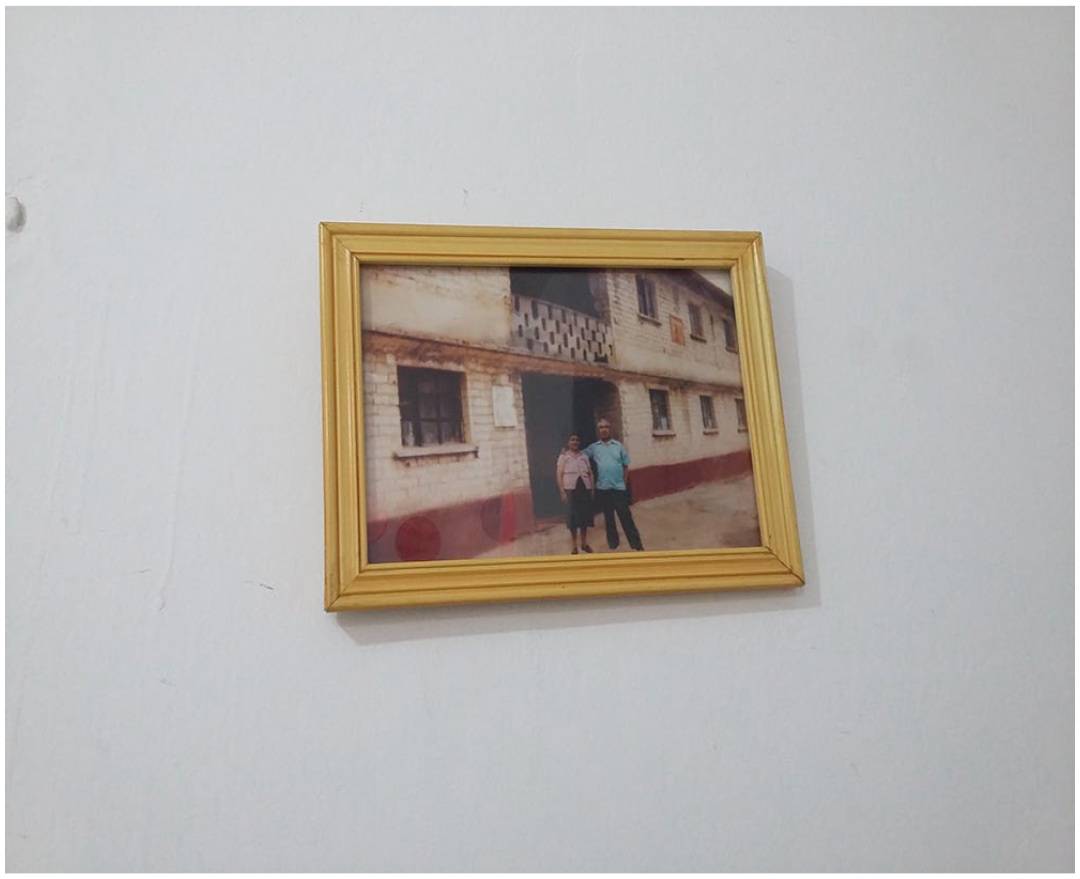
Blanca (Lima, Protestant, lower SES).
Other participants showed framed pictures displayed on a shelf. These pictures could be moved from one place to another. Some frames seem to be homemade. Some are black and white pictures. The pictures are displayed with other pictures, but with no other objects. Some pictures form a collage in one frame, some are displayed in multi-frames, and one frame indicates the picture is a memory from a funeral mass.
Eleven respondents brought pictures that fall into this category; 6 Catholics, 2 Umbanda, 1 Protestant, and 2 Non-Affiliated; 5 lower and 6 upper/middle SES; 3 males and 8 females; 5 from Montevideo, 4 from Córdoba, and 2 from Lima.
Sol, a Non-Affiliated 28-year-old woman in Lima has a picture of her mother pinned on a board in her bedroom. The picture is printed and displayed, but neither framed, hung on a wall, nor displayed in a particular setting. I assumed it indicated a greater degree of fragility than in the other cases. However, in her interview, Sol said that her grandmother throws away things when she cleans the house, and Sol is afraid she would discard this picture. Pinning the picture is her way to protect it.
Materiality summary
When analyzing the context of the display, we saw a spectrum that goes from shrines to pinned down on a board, from framed to just printed. While only Catholics in this sample placed pictures in a shrine, we have Umbanda and Protestant practitioners that do place them in the context of religious images. While the cultural idioms are different depending on the religious tradition, the process of setting apart and differentiating them from the rest is similar. Since this process is a set of specific actions that set things apart, things that are deemed important, I argue that PDH are a ‘sacralization practice’, even when they are not displayed in a context of religious images.
Content: motifs depicted in the pictures
A realistic coding of the content of the pictures shows that all the pictures depict persons, groups, and individuals. They portray adults and children, and many of them depicted both. Some persons are aware of being photographed – they are looking at the camera; many show physical proximity that evidences some sort of intimacy: holding hands, hugging each other, children in the laps of adults, all gestures that in Latin American culture can be attributed to close relationships. The pictures seem to materialize the bounds respondents have with the persons portrayed.
Based on the interviews, I sorted the motifs into two groups, ‘persons’ and ‘moments’.
Persons
All PDH show persons. Departed ones are mentioned by 13 respondents (5 from Lima, 2 from Montevideo, and 6 from Córdoba; 8 lower SES and 5 upper/middle SES; 1 Protestant, 1 Umbanda, 2 Non-Affiliated, and 9 Catholics) using PDH to ‘cheat the finality of death’ (Edwards, 2005a). However, 12 participants described only alive persons. There is more going on than memorialization.
Carlos, a 49-year-old Catholic from Córdoba showed a framed portrait of his mother, ‘because she is my role model, she shows me how I should live’. The picture was one of her last birthdays: ‘She dared to live, even when her life was a martyrdom’. This framed portrait is the only thing he kept from her. Sandra, a 50-year-old Non-Affiliated woman in Córdoba, also showed a picture of her mother’s last birthday: ‘She wanted to live, she didn’t want to go’.
Julio, a Non-Affiliated 65-year-old montevideano, brought a double frame with a picture of his parents (see Picture 4). His mother’s ‘is a picture from her id. At that point, we were planning to migrate to Australia. It didn’t happen’. About the other picture, Julio explains, ‘He wasn’t my father, but despite everything, he deserves my respect, he was very honest … but I discovered he was not my father by chance when I was about 20…’ They ‘have left marks in my life, very important ones’.
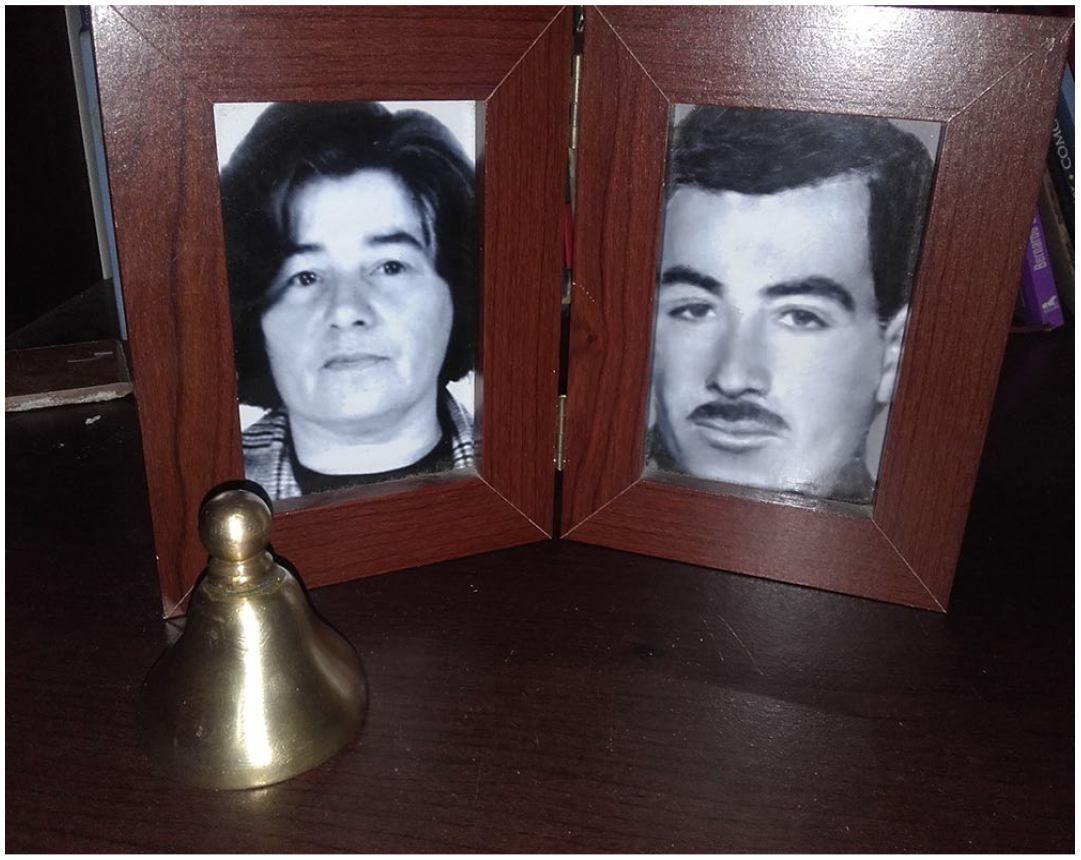
Julio (Montevideo, Non-Affiliated, upper/middle SES).
Rosa, a 75-year-old Catholic from Lima, exhibits in her house a picture of her aunt, the woman who took care of her when she was an orphan. She criticizes her during the interview; it seems she did not have a good relationship with her; however, the picture is displayed among religious images. Hernán, a 38-year-old Catholic in Córdoba, shows a picture of his daughter in the arms of ‘my wife’s uncle, he passed away… I adored him, he was a war hero, a fantastic man … he was behind the radar when they sunk a British ship’ (during the Islas Malvinas/Falkland Islands War, 1982) (see Picture 5).
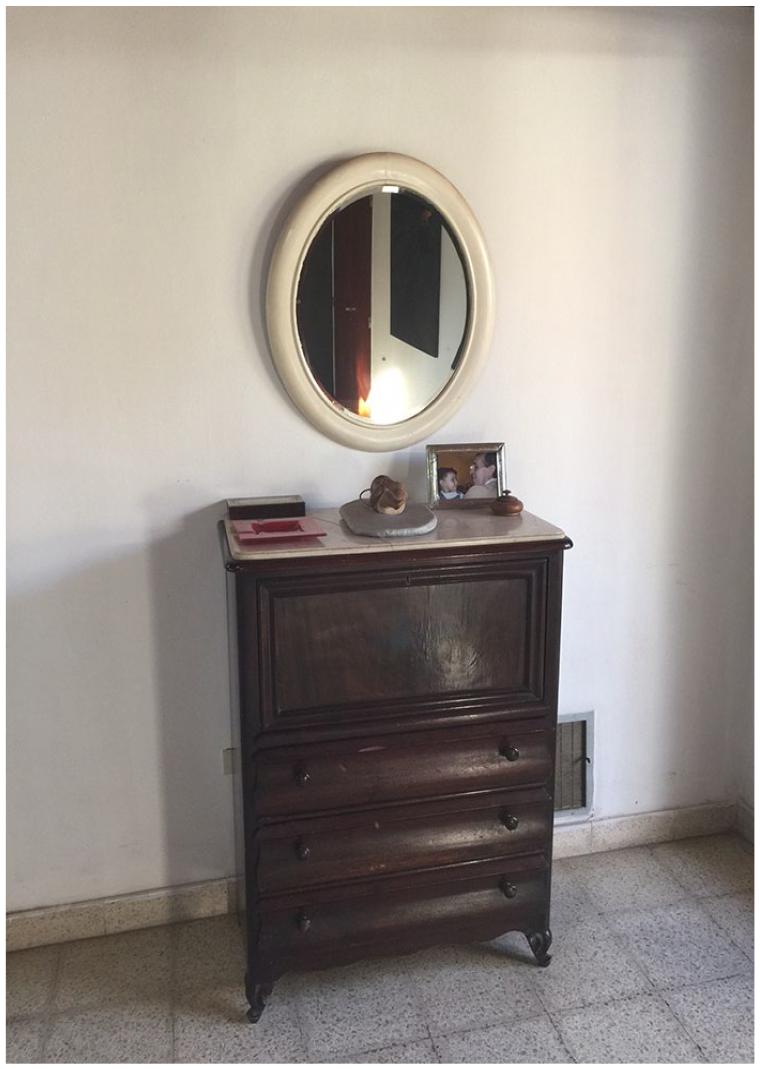
Hernán (Córdoba, Catholic, Upper/middle SES).
Graciela, a 43-year-old Umbanda practitioner in Montevideo, displays at her home a photo of her sister’s family, ‘my beloved ones’. She lived with them in Buenos Aires (Argentina) for many years until she took ‘the most important decision’ in her life: to return to Uruguay. Felicia, a 54-year-old Catholic from Córdoba, states that her ‘family was always the most important thing. I did whatever it took to keep it. I quit my studies…’ She brought a framed picture of her husband and children. Her daughter made the frame when she was 9 years old, for the school’s Father’s Day celebration. She is not in the photo because she was the one taking the picture of them having fun, seated in the trunk of their car. The picture ‘is not in the living room but nestled inside the house. It is not for other people to look at it…’ (see Picture 6).
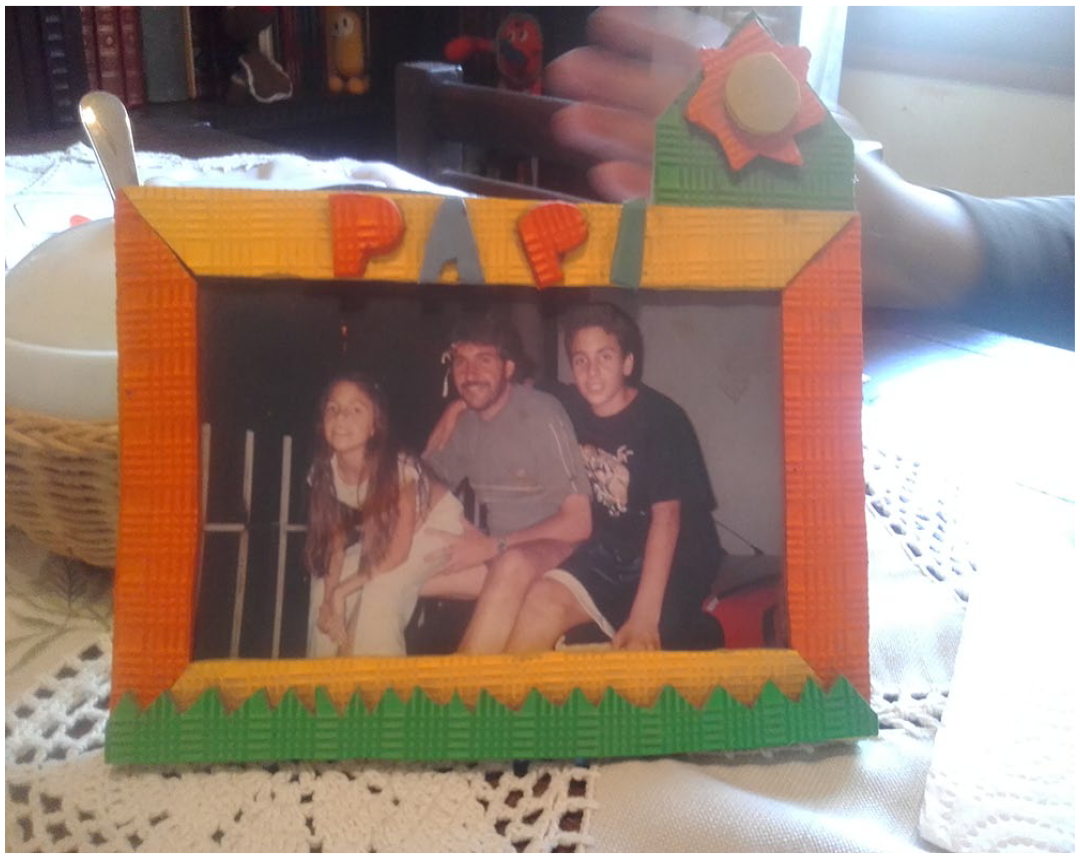
Felicia (Córdoba, Catholic, upper/middle SES).
Clarita, a 40-year-old Catholic from Córdoba, agrees with the importance of family and displays a picture of her children at the bottom of the shrine she made for her deceased son. Looking at the picture, she reflected, ‘They are very important to me, my children’. She mentioned she prays to her departed son for protecting her children.
Moments in life
While depicting persons, dead and alive, some respondents emphasized in their interviews the ‘moment’ captured in the photo. Some reminded respondents of ‘the best moments of my life’, in such or similar words. As I said in the introduction, photos established a different relationship with time, bringing to the present a memory of the past.
That is the case of 6 participants: 5 females and 1 male; 3 from Montevideo, 2 from Córdoba, and 1 from Lima; 2 from lower and 4 from upper/middle SES; 1 Protestant, 2 Umbanda, and 3 Catholic. Usually, those moments have to do with a joyful time in the past (that continues in the present, like the birth of a child), people present in the picture (grandparents, parents, children, and their complete family), and places (both during holidays and at home).
Gabriela, a 37-year-old Catholic cordobesa, brought a picture of her 4-year-old son: ‘It was the most beautiful moment of my life … there is something special between a mother and a son … He is blessed, my son’. Zulma, a 54-year-old Umbanda woman in Montevideo, showed a picture that depicts her and her children, ‘in front of the house, in the garden. A girlfriend took it, it was a very happy time’ (see Picture 7). That picture, displayed in a hutch in her living room, is also Zulma’s statement. She has her children despite her husband and mother’s advice of having an abortion (they were in a very bad economic situation when she got pregnant with her first child). Against their advice, Zulma went on with her pregnancy, ‘I have my children because I wanted. I didn’t give a shit about what the others said. They were MY children, I am like that… now my daughter has a daughter, and she is MY grandchild, they are MINE’.
Zulma (Montevideo, Umbanda, upper/middle).
Ines, a 28-year-old Catholic woman from Montevideo, has a picture on her nightstand that portrays her as a baby, in the arms of her grandparents, and their children, Ines’ uncle and aunt. They are the ones who taught her a ‘joyful faith’; they were members of the ‘John XXIII grass-root community’ to where she now belongs to. It was taken at her grandparent’s place, and she has it in her bedroom: ‘In that house, I lived the happiest moments of my life’. Juan, a 22-year-old Catholic in Córdoba, showed a picture depicting ‘my mum, my dad, and my brother. We were on holiday … I was 12 or 13 years old … These are the people I love the most in the world’. This was a time in his life when he ‘felt happy with the people I love’.
Six respondents, all Catholics, mentioned their pictures were memories of religious celebrations, like baptisms, first communions, bar mitzvahs, weddings, and funerals. Four of them were from Córdoba and 2 from Lima; 3 were from lower and 3 from upper/middle SES.
Juli is a 32-year-old Catholic woman in Córdoba, who displays pictures of her wedding and the baptism of her firstborn in her living room. Her husband is Muslim, and they have performed some rituals at the Mosque. They have an altar at home with the Bible and the Quran, but no pictures are displayed there. Also in Córdoba, Miguel displays in his Catholic shrine the picture of a family friend’s bar mitzvah. Yeimi, a 39-year-old Catholic woman from Lima, showed a framed picture from her father’s funeral mass (see Picture 8). She keeps it on her drawer chest, in her bedroom where she can see it when doing the house chores, and asks him for help to raise her children: ‘Dad, help me here’. And she added, ‘I will never forget him. My father will always be in my mind and heart’.
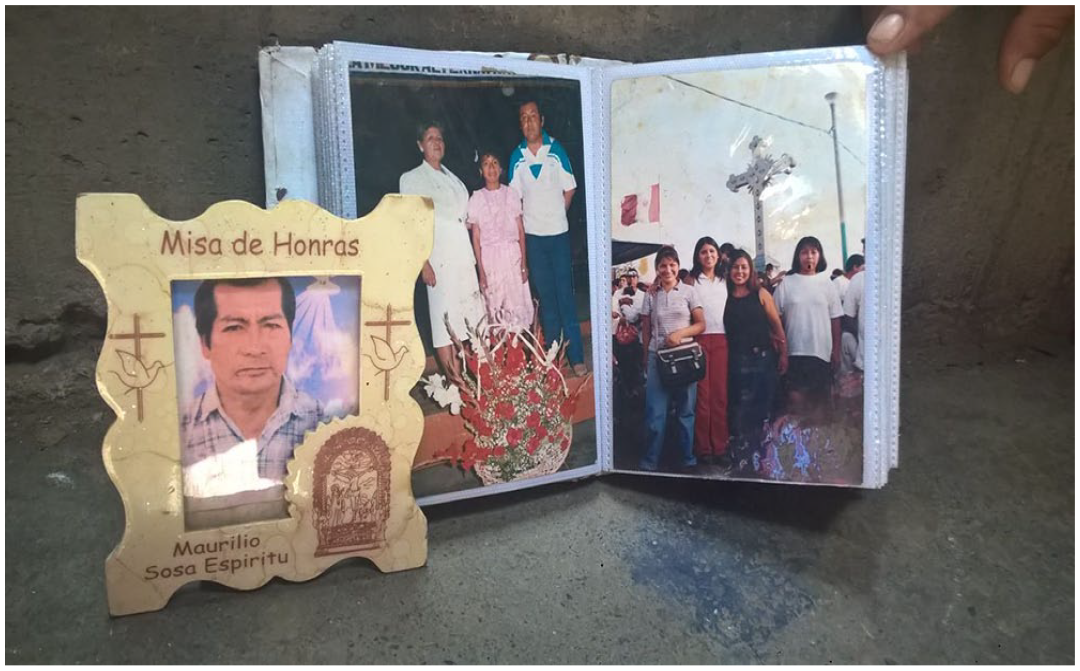
Yeimi (Lima, Catholic, lower SES).
Content summary
In terms of content, the realities that are deemed ‘other than’ ordinary are persons. Some are alive, some departed, but meaningful persons with whom respondents shared a bond, and/or a special moment in their lives. The pictures materialize role models, encouraging figures, and mentors that inspire participants in their daily struggles. Many are members of the immediate family, like parents, siblings, children, spouses, and whole families. However, they are set apart not just because of biological membership but due to their ‘other than’ ordinary relationship. Respondents did ‘whatever it took to keep’ them, they are ‘very important’ presences in their lives, the ones who bring joy and happiness. This extraordinary bond is not limited to the biological family. There are extended family members that raised respondents, persons they admire, who taught them about heroism and faith, acquaintances that opened up career opportunities, and friends that became their support network. These are ordinary connections (family, mentors, relatives, friends) that became extraordinary relations.
PDH also represent ‘moments’ that marked who respondents are. The moments fixed in images represent different crossroads, that have consequences in respondents’ present lives: last birthdays of departed mothers, moving from one place to another, births, childhood, a moment of happiness that they want to fix in time. Some of those crossroads are religious celebrations. Only affiliated participants brought PDH about ‘moments’. In this sample, religion matters when pictures are displayed in a religious context and when PDH portrays decisive ‘moments’ in the lives of participants.
Discussion
Respondents keep PDH in a visible place because they want to see them, to be in touch with the sacralized reality. Some are displayed in ‘spiritual nooks’. That quality is given because those were the places where ancestors prayed, a member of the family built, or where respondents perform their religious practices. In many cases, those are spots that respondents have at hand, so they can look at them while doing their daily routines. PDH are exhibited in liminal places, locations that are both ‘at hand’ and connect participants with a dimension ‘other than’ regular life. PDH are portals to the ‘other than’ ordinary dimensions of life.
In terms of religious affiliation, these findings show the importance of paying attention to people’s practices beyond confessional mandates and researchers’ expectations. While we tend to think about domestic shrines as Catholic, we see that there are also spiritual nooks in non-Catholic households. Changing categories for more encompassing ones (from ‘domestic shrine’ to ‘spiritual nook’, for example) brings to the front practices that are overlooked helping us to better grasp the Latin American religious landscape.
Respondents’ participation in producing the pictures shows what matters to them, and not necessarily to the researchers. This is very important to understand Latin American religiosity. Most surveys disregard religious celebrations like weddings, baptisms, and funerals. Usually, surveys ask respondents (with these or similar words), ‘Except for weddings and funerals, how often do you go to church?’ (Pew Research Center, 2014: Q45; World Values Survey, 2020: V145). PDH indicate that people attribute religious ceremonies an importance that researchers do not. Researchers’ bias (basically a North Atlantic Protestant expectation of what ‘real religious’ practice should be; Bender et al., 2013) might have been hiding what Latin Americans considered sacred, and the practices they do to connect with it.
So, what is sacralized? What is the non-negotiable reality set apart that orders Latin American respondents’ daily life? Respondents in this sample set apart certain relationships (motherhood, parenthood, their close families, sister’s family, aunts and uncles, children, and mentors). These relations are considered sacred and are going to be preserved, beyond the lightness of life. This is a sacred shared by affiliated and non-affiliated persons, indicated in different forms (from a picture pinned on a blackboard to one exposed in a shrine). Respondents sacralized relationships, anchoring them from the fluidity of life. In some cases, the beloved one became a superhuman figure. In this specific corpus, we also found that sacralized mother figures are usually associated with the idea of sacrifice (‘Her life was a martyrdom’, ‘I quit my career’ for the family).
The moments that are celebrated are memories of family life and of the personal flourishing associated with those relationships. The religious celebrations mentioned are also related to family life: the welcoming of a new member (baptism), the beginning of a new household (wedding), and the end of another one (funeral).
Participants push the boundaries of religious traditions in three main ways. First to include their beloved ones, dead and alive, among sacred figures. Only respondents who self-identified as ‘affiliated’ (Catholics, Protestants, Umbanda) display pictures in religious contexts. When the pictures are placed within a religious context (and in today’s Latin America that is indicated not only by Catholic idioms but also by Afro, Christian, and other spiritual and secular traditions), the persons portrayed are put in contact with supra-human powers; they are sacralized. However, that placement also indicates that sacred figures (saints, bibles, orishas, and angels) become close relations, almost like family members. PDH in spiritual nooks are at the same time a human connection with the supra-human and a supra-human gate into the human dimension of life.
Second, when most religious traditions will emphasize a certain kind of family structure (heterosexual, married parents with their children), we see that respondents’ lives include a broader reality (with extended families playing a stronger role, mothers assuming prominent positions, non-married couples, aunts and uncles having mentoring roles). Many sacralized the closer family, but they are not limited by that. Persons who were important in their lives are sacralized. Religious institutions are still trying to figure out how to deal with these new family structures; however, ordinary practitioners are already addressing the issue by incorporating these relations among the ones that are beyond ordinary, sacred, and therefore structuring their lives.
Third, more than worried about eternal life (as some religious economic theorists would assume), this sample seems to be engaged in practices that help them to preserve the memory of this earthly life. They showed pictures of people who shaped and made this human life better, and moments they want to preserve.
Conclusions
This is not a study of domestic altars, but of PDH; some are displayed in a religious context, and some in secular ones. However, while there are some studies on domestic altars as mentioned above, more is needed to understand religious practices in Latin America and other regions, and among affiliated and non-affiliated persons. Also, we need more research on the use of photography as religious objects. The pictures displayed among religious figures have a role that needs to be clarified, and it might be attuned with the photos’ ability to change the relationship with time and space, of ‘cheating’ the finitude of life.
Within the discipline of sociology of religion, the contributions of this article are, first, the exploration of the construction of the sacred in daily life through photographs displayed at homes, in secular and religious contexts and, second, a methodology to study that process.
First, PDH are the result of a ‘sacralization practice’ that goes from snapping a picture with a cellphone to a printed framed photograph placed among religious objects, and a picture of that arrangement brought upon researchers’ request. They portray moments and persons set apart from the rest. PDH represent relations that order respondents’ worlds, giving meaning to them. Finally, PDH materialize the agency of the subjects who can sacralize things, setting them apart (beyond scholars’ assumptions) and inscribing them, or not, with religious objects (beyond confessional boundaries).
Respondents sacralize relationships that are meaningful to them, beyond the limits of the traditional nuclear family. Those relationships are the ones that shaped who respondents are, where they stand in their lives, their roots, and support networks. PDH are portals to ‘other than’ ordinary bounds, artifacts to keep memories alive and inscribe ordinary relations in that ‘other’ dimension.
Second, in terms of methodology, I adapted the one used in nursing studies that focused on participant-produced images upon researchers’ request. This methodology (layered analysis of form and context, photo content, and narratives) helped to unpack the meaning behind the PDH. I hope this methodology contributes to a wider use of participant-produced images in the sociology of religion, as a means to recover practices that researchers might be neglecting. While this article explored a limited population, an intentional sample of participants from three cities, it presents a methodology that helped me to capture the processes of construction of the sacred among individuals living outside North-Atlantic religious traditions.
The findings also raise some reflections about the methodologies we use when we explore the sacred. Incorporating photography, even when there are social constraints at stake, helped researchers to better understand respondents’ religious experiences. As mentioned, photos established a different relationship with time and space; Edward’s idea that pictures cheat the finitude of life is attuned with Latin American religious culture and the presence of the departed in daily life. PDH helped us to explore this presence, since both departed and pictures go beyond the limits of life.
I speculate that applying this methodology to another cultural context, and keeping in mind these pictures’ feature of cheating the finitude of life, may provide new understandings about how people build the sacred in those contexts, and about the relations between the departed and the alive persons, and therefore different locations for the sacred. Researchers at the Urban Sacred Project (Beekers et al., 2016) also point in this direction.
These discoveries keep challenging the categories we scholars use when inquiring about religion. While ‘domestic shrine’ is a common one, when we name the same phenomenon as ‘spiritual nooks’, non-religious sacred come into the discussion. A similar situation occurred when researchers opened up the definition of ‘religious’: people talk about persons dead and alive; they talk about ‘this worldly’ experience. Religion is not only an idea about the afterlife: departed are present in this earthly life; many things that respondents assumed as sacred are ‘mundane’ experiences. Participants blurred the lines between this life and the afterlife. Listening to participants contributed to incorporating in the research what matters to them, not just to us scholars.
Footnotes
Acknowledgements
I am grateful to Santiago Morello who designed the graphics.
Funding
The author(s) disclosed receipt of the following financial support for the research, authorship, and/or publication of this article: This publication was made possible through the support of a grant from the John Templeton Foundation (#58079 ‘The transformation of lived religion in urban Latin America: a study of contemporary Latin Americans’ experience of the transcendent’). The opinions expressed in this publication are those of the author(s) and do not necessarily reflect the views of the John Templeton Foundation.

Notes
Author biography
Address: Department of Sociology, Boston College, 140 Commonwealth Ave., Chestnut Hill, MA 02467, USA.
Email: