




Abstract
In this article, the author argues that some contemporary tattoos might be considered ‘sacralization practices’, that is, processes whereby the subjects distinguish some reality they deem special from the rest. The author studied Latin Americans’ tattoos in a context of mainstream life, while paying attention to designs, meanings, and the interaction of tattoos with religious membership. Based on a non-random sample of 21 subjects from three different cities, socio-economic statuses, gender, and religious affiliation, this article explores what realities are sacralized by urban Latin Americans in contexts of daily life by getting them under their skin. The findings show that tattoos are a preferred way for Non-Affiliated persons to express their inner realm, that tattoos sacralize some experiences that are different from the profane giving them permanence, and finally that tattoos even when they are very personal and intimate, involve a connection with a community.
I’ve got you under my skin I have got you, deep in the heart of me So deep in my heart that you’re really a part of me I’ve got you under my skin
Tattoos, religion, and sacralization practices
Tattoos have been present in human culture since the ice age, and they have been linked with religions since antiquity (Gustafson, 1997), but the relationship between religion and tattoos, and the assessment researchers have done of that relation, have changed. Some literature, following what we can call an ‘Enlightened’ trend, assumed that tattoos were introduced into the western world by British explorers who colonized the Pacific Islands. The Enlightenment’s idea of civilization put tattoos on the side of the primitive and not westernized cultures. They were considered practices of peoples and persons at the margins of civilization: natives, remote islanders, sailors, miners, soldiers, and more recently members of urban tribes and gangs. This scholarship assumed that, because Judeo-Christian and Islamic religious traditions banned (Islam and Judaism) or at least discouraged them (Western Christians), religious tattoos were not present in ‘civilized’ Europe (Bell, 1999; Cruz-Reguillo, 1991; Walzer Moskovic, 2015).
Studies about religious tattoos in Latin American are scarce and follow this ‘Enlightened’ trend. Most have looked at marginalized populations, studying religious tattoos among inmates, gang members, or religious organizations that help reformed criminals to erase their tattoos (Alvarez Licona and Sevilla González, 2002; Brenneman, 2012; Galera and López Fidanza, 2012; López Escoboza, 2018; Ramos, 2002; Yllescas, 2018). Some public health scholars, have paid attention to tattoos as a deviant or unhealthy practice, and in that context noted differences between Catholics and Atheists getting tattoos (Cossio et al., 2012).
However, there is a ‘historical’ trend of research that pays more attention to peoples’ practices than to institutional commands. These studies have re-discovered tattoos as sacralization practices with a long presence in the western world. The Roman Emperor tattooed his slaves, leaving an indelible mark of infamy on their forehead (something that our society saw during the Nazi regime in the twentieth century). Early Christians reacted to that imposition voluntary tattooing themselves as a deliberate way of undercutting and reversing the punisher’s intent: if they were tattooed against their will to shame them as slaves of the Emperor, Christians started to tattoo themselves to identify as ‘slaves of Christ’ (Gustafson, 1997). Externalizing the signs of pain, tattoos transformed the figure of the infamy into an expression of faith and a symbol of martyrdom (Guerzoni, 2018; Petkoff, 2019). Something similar is reported nowadays among children and grandchildren of Holocaust survivors’ who are tattooing the number given to their ancestors as memorial of the Shoah (Rudoren, 2012). Procopius of Gaza (465–528) mentioned some Christians marking their bodies with the name of Jesus or a cross. In 787, the Council of Calcuth (Northumberland, England) approved tattoos that were worn to honor God, and become signs of devotion and protection (Scheinfeld, 2007). Tattoos after a pilgrimage, as a way of memorializing a journey, became a common practice in some parts of the Byzantine and Latin world. They were memories of the holy places visited, a physical transformation as a result of a religious experience, a strategy to preserve the memory and identity (Petkoff, 2019). Tattoos were worn by Crusaders coming back from Jerusalem. In the Sanctuary of Loreto, in Italy, researchers found engraved tablets that were used to stamp the image on the devotee’s body, and then pierce it, linked to the Franciscan and Jesuit orders (that started in the thirteen and sixteenth century) and Jesus’s sacred heart (a devotion that expanded in the eighteen century). The devotional tattoo was a literal incarnation of the faith, personal sanctuaries, on visible parts of the believers limbs; a practice that seemed to have continued into at least the eighteenth century (Guerzoni, 2018).
Both ‘enlightened’ and ‘historical’ scholarship placed tattoos within a religious community. Those communities were the contexts, the reason, or the provider of the designs and meanings for the tattoos. On the contrary, literature about contemporary tattoos see them as a struggle for individualization (Johnson, 2006), a sign of an individualized connection with supra-human powers. Religious tattoos are a reminder of a foundational experience (Firmin et al., 2008), an encounter with, a commitment to, or an attempt to get closer to something sacred (De Mello, 2000; Ramos, 2002), they convey a personal spiritual meaning (Johnson, 2006), memories of commitments and calls (Koch and Roberts, 2012), of overcoming situations of hardship and struggle (Tokarski, 2016) or therapeutic spiritual experiences (De Mello, 2000).
Religious transformations in Europe and the United States have changed the relationship between religions and tattoos. Today, religious tattoos are practices that go beyond institutional borders (Heessels et al., 2015). Since cultural contexts and cosmologic visions shape tattoos (Knott, 2005; Maloney and Koch, 2019), contemporary tattoos do not need to convey an explicit religious figure to be religious. In Spain, religious people get tattoos that are not obviously religious; such as letters or abstract motifs (Walzer Moskovic, 2015). Studies in the Netherlands show that tattoos are used among Non-Affiliated young adults to memorialize the departed (Heessels et al., 2015). Those studies suggest that, even in deeply secularized societies, tattoos might be practices that connect the inked person with supra-human realities.
The Latin American religious landscape has also gone through transformations (Da Costa et al., 2019; Rabbia et al., 2019) that question the use of traditional sociological categories to understand its current developments. Therefore, studies that look at the people’s religiosity beyond institutional mandates might be more helpful: what are the practices that contemporary subjects deem as sacred, even when religious institutions and seculars scholars do not do so (Morello, 2019). Today, tattoos are not a sign of uncivilized deviance, but socially accepted practices that have become a privileged venue among young adults to express their interiority (Castro and Aragonés, 2016; Heywood et al., 2012; Koch and Roberts, 2004; Maloney and Koch, 2019; Pérez Fonseca, 2009).
My hypothesis is that some tattoos are the outcome of processes whereby individuals separate anything ordinary (persons, ideas, objects, places, experiences) and inscribe them (by tattooing), in a differentiated level of reality. Getting a tattoo thus is a way of setting apart from the ordinary a specific experience/idea/object that helps them to make sense of their lives and to articulate their stories in their own terms. The tattoo distinguishes something sacred from the profane rest (Anttonen, 1996, 2000; Knott, 2005; Martín, 2009; Wuthnow, 1994) and binds the subjects with a community. In this hypothesis, the tattoo indicates the elementary forms of religious life: the differentiation between sacred and profane, and the presence of a moral community that is bound by that differentiation (Durkheim, 1965 [1915]).
In this article, I explore tattoos in a context of mainstream life (as opposed to marginalized ones) in three Latin American cities. I pay attention to the designs, the meanings that the tattoos hold for their bearers, and the interaction of tattoos with religious membership. The goal is to answer these questions: in context of daily life, what realities do urban persons in Córdoba, Lima and Montevideo, sacralize by tattooing them? What do tattoos tell us about the religiosity of these subjects?
Sample, data collection, and methodological issues
The sample used here comes from a bigger research project on Lived Religion in Latin America. The aim of that project was to explore religion as practiced by subjects in their daily life, and did not specifically inquire about tattoos. Three teams in the cities of Lima (Peru), Córdoba (Argentina), and Montevideo (Uruguay) interviewed twice a total of 253 persons. Participants were selected according to socioeconomic status – SES (middle-upper and lower 1 ) and religious self-identification at the time of the first interview (Catholic, Protestant – mostly Evangelicals and Pentecostals, Other, None). Interviews were conducted in Spanish between November 2015 and December 2016. I translated and edited the quotations for this article.
The research teams used a snowballing process to recruit participants. Because these referrals came from people the new subjects already knew, the ‘snowballing’ approach improved the trust that new subjects placed in the researcher. The first meeting was an in-depth interview about respondents’ religious practices. At the end of that meeting, researchers asked participants to take 3–4 pictures with your cell phone of places / objects / people that help you to connect with God / supreme entity. (. . .) It could be any object that you appreciate [a book, a stamp, a piece of jewelry, a statue of a saint, a journal, a special place, a symbol, a plant, etc.], any personal tattoo, mark or sign, or any place. If it’s possible, please bring that object with you at our next meeting. If it’s not possible, please take some pictures of that object, sign or place with your cell phone, so that we will be able to talk about that.
In the second interview, researchers inquired about those images/object, their origin, meaning, and the reasons the respondents gave to bring those and not other ones to the interview.
Out of 253 interviewees, 20 respondents discussed their tattoos, and 1 mentioned she was thinking about getting one. Four respondents (three Non-Affiliated from Montevideo, one Catholic from Córdoba) brought pictures of the tattoos. One interviewee brought only pictures of tattoos (as opposed of bringing pictures of other significant objects). The sample selection was non-probabilistic, as it was the case with some other studies that explored tattoos in Latin America (Soto Roman et al., 2009). Since these individuals considered those tattoos as something that helped them to connect with God or a supra-human entity, I took those 21 respondents as the sample for this research.
I analyzed this corpus in successive waves (Maloney and Koch, 2019). The first one was general; I identified and classified respondents by city of origin, religious affiliation, sex, age, socioeconomic status, type of image inked, age of the first one, and number of tattoos.
In the second wave, I did a thematic analysis of the quotations about tattoos manually, and then used software (Atlas.ti) looking for paragraphs that included the word ‘tattoo’ as a respondent’s answer (as opposed to a researcher’s question). I looked for the subjects’ descriptions of the tattoo, and the circumstances when they got them (Sastre Cifuentes, 2011; Walzer Moskovic, 2015). Three basic categories emerged from the data about the current evaluation of the tattoos: they were regarded as meaningful, purely aesthetic, or regrettable (Naudé et al., 2017).
In the third wave, I explored the meanings participants give to their tattoos. I focus on the tattoos that were considered ‘meaningful’ and ‘regrettable because of religious reasons’. These participants reported their tattoos were related to special moments in their lives, to other persons, to something that identifies them, and to some kind of connection with supra-human beings (gods, spirits, energy, departed humans) (see Table 1).
Register of the three waves of analysis.
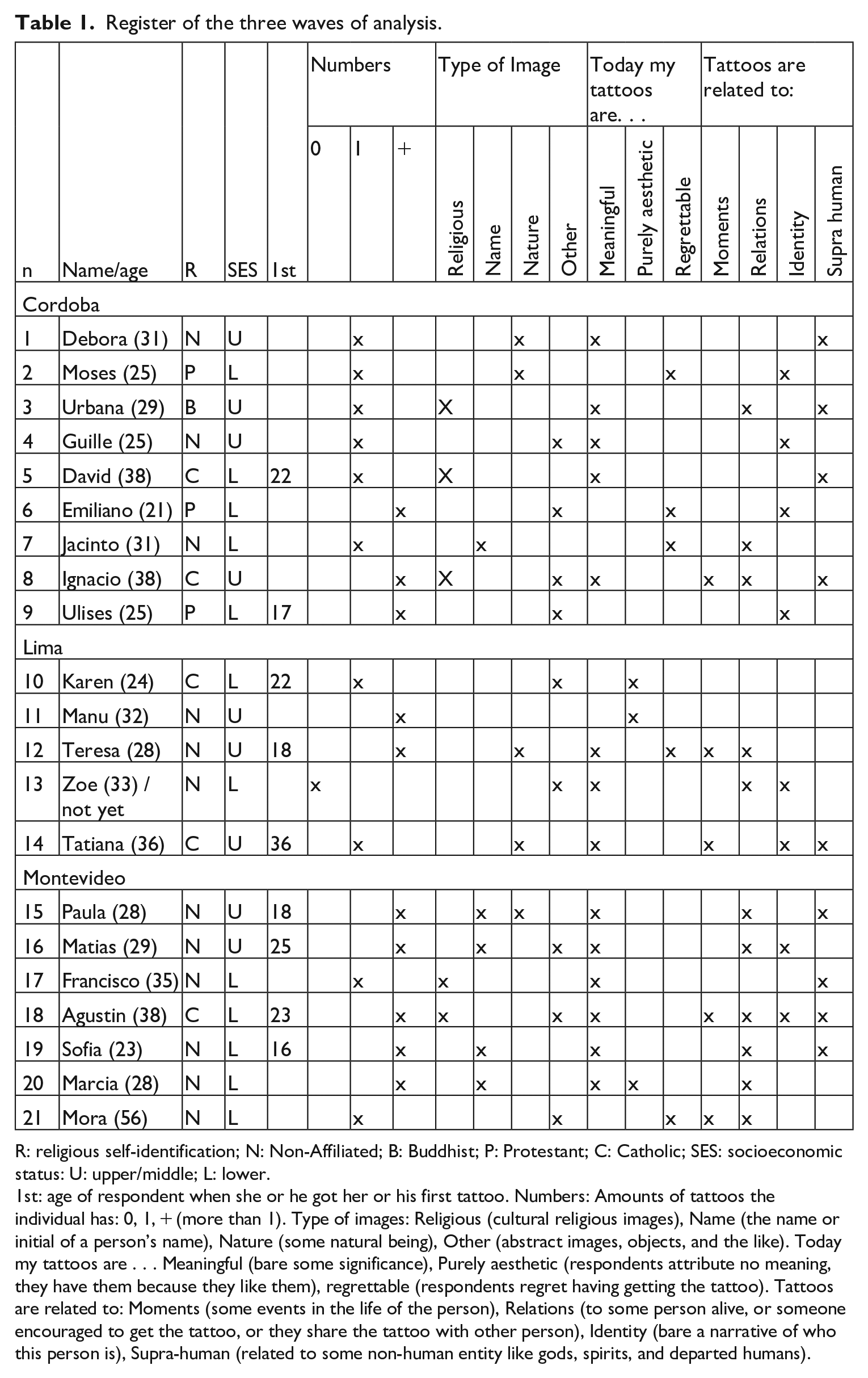
R: religious self-identification; N: Non-Affiliated; B: Buddhist; P: Protestant; C: Catholic; SES: socioeconomic status: U: upper/middle; L: lower.
1st: age of respondent when she or he got her or his first tattoo. Numbers: Amounts of tattoos the individual has: 0, 1, + (more than 1). Type of images: Religious (cultural religious images), Name (the name or initial of a person’s name), Nature (some natural being), Other (abstract images, objects, and the like). Today my tattoos are . . . Meaningful (bare some significance), Purely aesthetic (respondents attribute no meaning, they have them because they like them), regrettable (respondents regret having getting the tattoo). Tattoos are related to: Moments (some events in the life of the person), Relations (to some person alive, or someone encouraged to get the tattoo, or they share the tattoo with other person), Identity (bare a narrative of who this person is), Supra-human (related to some non-human entity like gods, spirits, and departed humans).
What do people in South America get tattooed? First and second waves of analysis
All tattooed respondents but one (Mora, who was 56 years old at the moment of the interview) were between 21 and 38 years old. Most respondents did not mention the age at which they got their first tattoo. For the nine who did mention age, it was usually got in their twenties. Ten respondents reported having only one tattoo, and other 10 participants stated more than one. In terms of socioeconomic status (SES), 9 respondents were from upper/middle SES and 12 from lower SES.
In Montevideo, most of the respondents with tattoos were Non-Affiliated (six) and only one self-identified as Catholic. In Lima, three ‘Nones’ and one Catholic reported having them (plus one Non-Affiliated thinking about getting one). In Córdoba, respondents of all religious identifications reported having at least one tattoo. However, Protestant respondents (three) regretted having them.
Tattoo bearers in this sample were mostly Non-Affiliated, then Catholic and finally one Buddhist. We find in this sample the same trend other scholars found regarding confessions and tattoos. In this multi-city, convenience sample of respondents in Montevideo, Lima and Córdoba, Catholics tend to have fewer tattoos than Non-Affiliated, as found in Santiago de Chile (Cossio et al., 2012) and Protestants tend not to have tattoos or to regret the ones they got when they ‘were not in Christ’, similar to what some have noted in the United States (Rivardo and Keelan, 2010).
In the second wave, I did thematic and content analysis of the quotations, looking for the subjects’ descriptions of the tattoo and, the circumstances when they got them. Three respondents (one Catholic, two Non-Affiliated) did not attribute any religious/spiritual meaning to their tattoos, declaring they got them only for aesthetic reasons (two respondents from Lima: Karen, a 24-year-old Catholic and Manu, a 32-year-old Non-Affiliated; and one of the two tattoos of Marcia, a 28-year-old Non-Affiliated woman from Montevideo). ‘I do have a couple of tattoos, but they aren’t particularly meaningful, I just like them, the art, their style . . . it is a kind of art for me. I have them, but they have no deep meaning at all’ (Manu).
Six respondents regret having at least one of their tattoos. Three of them were Protestants and three Non-Affiliated. These three Non-Affiliated respondents who mentioned regrets about a tattoo, said they were too young, or they repent the aesthetic choice they made. Mora, a 56-year-old Non-Affiliated woman in Montevideo mentioned that ‘I do have a tattoo, but it is because I lost a bet! And I have to get it! I regret it till today, but it’s done. I was a kid!’
The case of Protestant respondents is different. They mentioned they had gotten tattoos before they joined or became more active in their Evangelical churches. ‘I do have tattoos, but I got them when I still wasn’t in Christ. I got them when I had a different life . . . I regret having got them’ (Emiliano). These respondents regret their tattoos on the basis of their current religious commitment. We do not have in our sample respondents who declared getting a tattoo while they were active members of an Evangelical congregation.
Some participants got tattoos with obvious religious figures in the Latin American cultural context: three with images of Christ, one with one of Virgin Mary of Guadalupe, another respondent got two: a gargoyle and the monogram of a Catholic religious order (the Jesuits’ I.H.S.). Finally, one got a word in Spanish: Creo (I believe). Another group of tattoos have to do with other people (dead and alive). Names or their initials usually represented persons: mothers, parents and grandparents, nieces, children, and friends. Respondents also mentioned other beings, like a tree, birds, cats, a lion; and objects like hearts, hats, coins, and eyes.
So deep in the heart of me. Third wave: tattoos and their meanings
Out of the 21 individuals of the original sample, I excluded all tattoos that respondents mentioned having or regret having for aesthetics reasons. That means six tattoos from five participants were excluded. So in this wave of analysis, I pay attention only to subjects who mentioned having at least one tattoo that was either ‘meaningful’ or ‘regrettable for religious reasons’. I explored the processes whereby participants set apart something in their lives, regarding it as important as to tattoo it, that helps them to make sense of their life and to narrate their story. I focused the analysis on 16 respondents and explored patterns of interpretations applying the three categories from the literature on religious tattoos: reversal, devotional, and foundational.
Reversal tattoos
These are tattoos that a subject gets as a way to reverse a situation that has been painful, dis-empowering, or marginalizing. These respondents’ attitudes are similar to those of the first century Christians, who transformed the humiliation of being tattooed as criminals by Roman authorities into a mark of their Christian identity (Petkoff, 2019). Historically, some tattoos were an expression to undercut a humiliation imposed from an external power. They became an election, a pain suffered because of an allegiance instead of an imposition (Guerzoni, 2018; Gustafson, 1997; Petkoff, 2019). Subjects decided why and how to suffer. Tattooing put the person back in control. Tattoos may be a sign of overcoming an illness, hardship, or painful situations (De Mello, 2000; Tokarski, 2016).
Urbana, a 29-year-woman from Córdoba was raised Catholic, left the church tired and upset after high school, became an atheist for a while, and later, during a severe illness (rheumatoid arthritis), a friend put her in contact with Buddhism. She read her illness as a message from her body ‘pay attention to me’; she found in Buddhism a way to be mindful about it. She got a tattoo that reads Creo, inspired by a rock song, 2 and pushed by a group of friends who encouraged her to get it. She thinks it is a ‘positive word’, a ‘force that push you forward (. . .) It is a word that has to do with faith and hope too’. Urbana’s tattoo is a way of claiming her body from the illness. The tattoo puts her in partial control of her body; she administers the pain she can endure.
Agustin is a 38-year-old man from Montevideo who identifies as Catholic, but on his own terms, meaning that ‘nobody will tell me how to believe’. He shows his faith with a figure of Christ in his arm, crowned with thorns, made by a friend. Agustin lives in Montevideo, a city where the state has been imposing a regime of secularization since 1919 (Da Costa, 2009). His obviously religious tattoos (he also has one of Our Lady of Guadalupe) are countercultural marks that emphasize his statement ‘nobody will tell me how to believe’.
Devotional tattoos
These tattoos are signs of supra-natural beliefs and convey otherworldly meaning (Ganter, 2006; Johnson, 2006; Koch and Roberts, 2004). They signal a supra-human relation (with gods, spirits, departed human beings), point toward something beyond this world, or sign some sort of supra-human protection (Guerzoni, 2018; Petkoff, 2019; Scheinfeld, 2007). Tattoos depicting conventional religious signs, and memories of beloved departed ones, fall into this category.
Religious images
These tattoos can also be seen as the embodiment of Latin American popular religiosity that has a long tradition of veneration of icons, similar to what Guerzoni (2018) found in Italy. The images move from the altar to the body (Yllescas, 2018). As mentioned, Agustin has a tattoo of Our Lady of Guadalupe. He told us that when his nice Guadalupe was ill, he promised he would get a tattoo of the Virgin Mary when the girl would recover. His tattoo is a sign of his devotion to the Virgin, but also of the love for his niece.
Ignacio, a 38-year-old Catholic from Córdoba has eight tattoos, two of them are religious images and two about persons (He did not describe the rest). Let’s focus now on the gargoyle one (see Photo 1), tattooed on his shoulder. He explains that the gargoyle protects him from bad spirits. Ignacio’s tattoo is about his personal reinterpretation of a traditional religious figure. Tattooing a gargoyle, he treats his body as a gothic cathedral that needs protection of a supra-human entity.
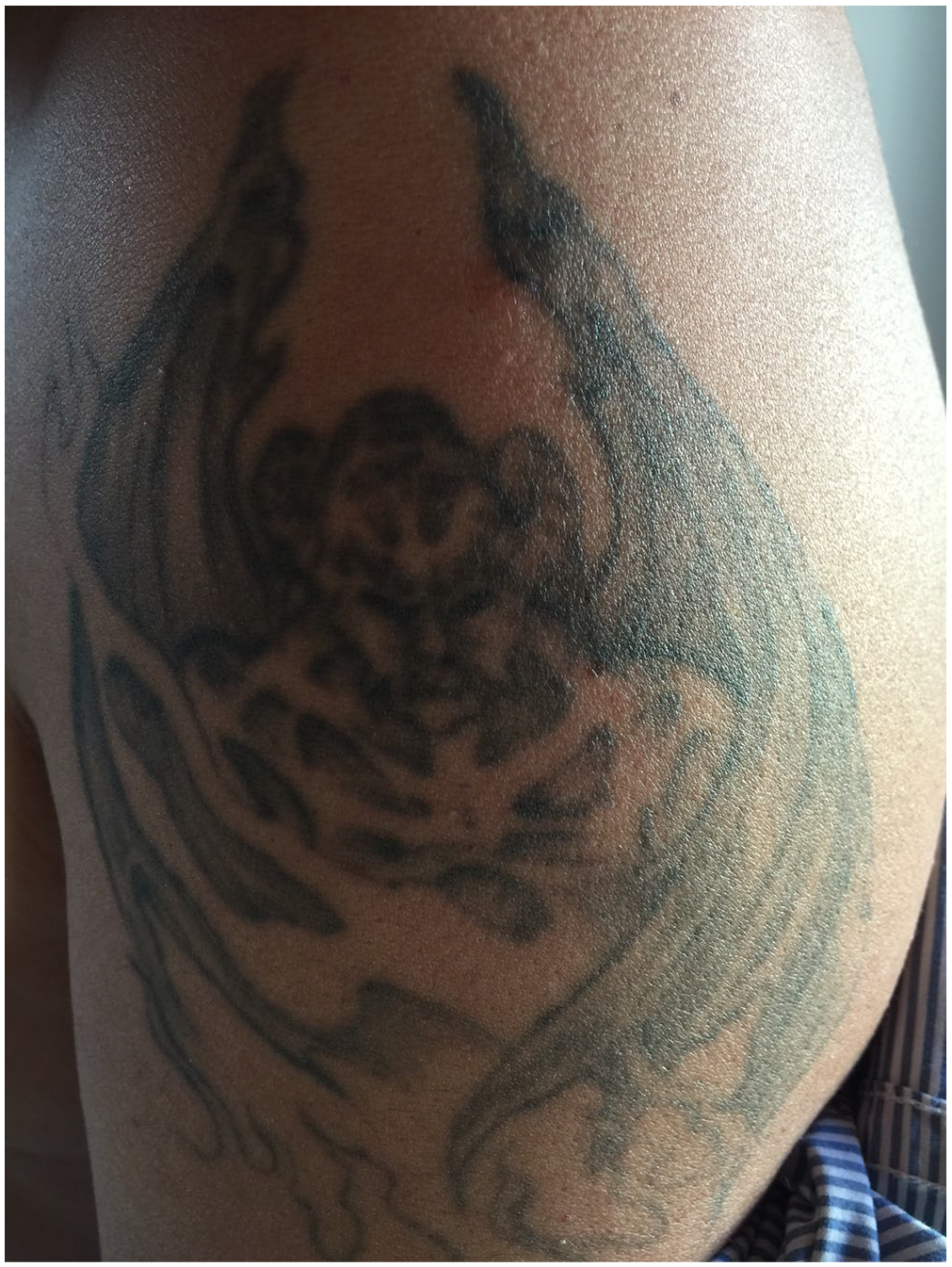
Ignacio’s gargoyle tattoo, on his shoulder. Photo taken on 10 August 2016 by Hugo Rabbia.
Departed ones
Paula, a 28-year-old Non-Affiliated woman in Montevideo, got a tattoo with the signature of her mother on the top of her feet (see Photo 2). She finished the design with ‘a creeper . . . that ends in a yellow rose, because she loved them’. She mixed in one tattoo her mother’s handwriting, a yellow rose and the idea of ‘roots, origins’. Her mother passed away 3 years before the interview, but she kept referring to her death as something of this world; for her there is another dimension in life, and her mother is there now. The tattoo is a way of materializing that spiritual presence.
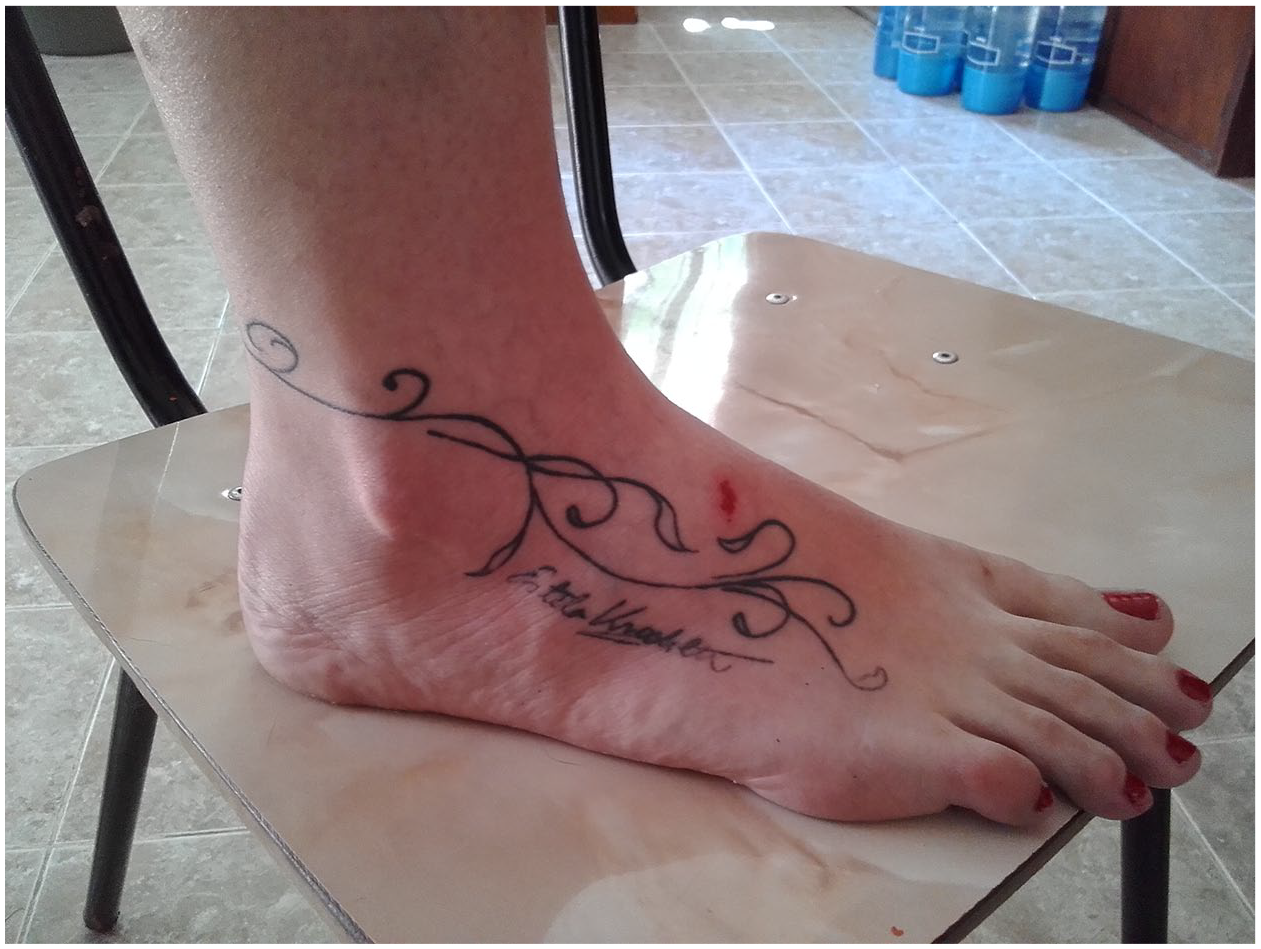
Paula’s tattoo of her mother’s signature, on her foot. Photo taken on 23 December 2015 by Valentina Pereira.
Sofia (Non-Affiliated, Montevideo) has a tattoo of his grandfather’s signature on one of her wrists; her sister has the same tattoo. They wanted to stay connected with this grandfather 2 years after he passed away. Both got the same tattoo in the same part of their bodies. Agustin (38, Catholic, Montevideo) has also tattooed departed beloved ones: his grandparents and ‘Emma, a woman who was very important in my life, a beloved neighbor. . . they [Emma and his grandparents] were important presences in my life’. Ignacio (38, Catholic, Córdoba) has a tattoo of an ‘Egyptian [figure] that a friend of mine who died in an accident had. After he passed away, I got the same one’.
These tattoos are signs of the devotion to a ‘supra-human’ relation, a way to make present and permanent the beloved departed ones, keeping a privileged connection with them.
Symbols of something beyond
Debora, a 31-year-old Non-Affiliated woman from Córdoba, has a tattoo of a tree. She sees in trees a ‘representation of human spirit’: trees are grounded, in touch with the earth but working constantly and almost imperceptibly to elevate themselves, to reach and open up to heaven, without losing ground on earth. Guille, a 25-year-old Non-Affiliated male from Córdoba, got a tattoo of a hat because ‘everything is in your head’. He identified as Non-Affiliated and believes, ‘in interpersonal relationships . . . in the network of relations . . . in treads that relate everything’. He says he has his own library ‘in my head . . . I understand many things . . . I have many different points of view stored in my head, even from people I disagree with’. Debora and Guille’s tattoos depict a humanistic spirituality, an appreciation of humanistic values that might or might not relate to a supra-human reality, but that in any case point toward something beyond the individual: ‘elevated’, ‘forward’, a ‘network of relationships’ are mentioned to indicate a spirituality that guides them beyond themselves.
Foundational tattoos
These are tattoos that sacralize an experience that has transformed the lives of the subjects, shaped their identity in a way that was deemed special for the person. They can be memories of journeys to sanctuaries or holy places, a physical transformation after being in contact with the sacred (Petkoff, 2019; Scheinfeld, 2007), a physical mark of an intense experience of something supra-human (De Mello, 2000; Firmin et al., 2008; Ramos, 2002).
David, a 38-year-old Catholic in Córdoba, has a tattoo depicting Jesus. He got it when he was a young adult working in a Catholic parish and pondering becoming a Catholic priest. He did not choose that path. Instead he got a tattoo because ‘I wanted to show I believe in Jesus . . . I identified with Jesus’; that he thought at some point of his life of becoming a priest, and he also wanted to remember ‘I lived through great times at that point, and now they are happy memories (. . .) I said to myself, ‘something that represents me’ and what I got? Jesus face when he was crucified, with the thorns and that was the only [tattoo], I would not have a second one’. Ignacio, another Catholic from Córdoba whom we already met, was also thinking about becoming a priest, but then met the woman who would be his wife. So instead of joining the Jesuits, a Catholic religious order, he tattooed the monogram of the congregation (I.H.S.) in his back, ‘Once I met my wife and decided to get married, I got this tattoo’.
For Ignacio and David, this intense experience of the sacred and their choice of a life path have been materialized in a tattoo. Their tattoos, outcomes of foundational encounters with the sacred, define who they are now. It is a sign for anyone to read it. However, these signs need some interpretation; they represent the path they did not follow (priesthood).
On the opposite side of the spectrum, there are three subjects (also males, but in this case Evangelicals) for whom an intense religious experience meant the rejection of tattoos they already had. Moses, a 25-year-old man migrated from Perú to Córdoba. Once he arrived, he got a tattoo of a lion in his back, because his friends ‘out of church’ known him as Leo (Leo is close to león, Spanish for lion). At some point, the tattoo meant Moses’s migrant journey, but after he became Evangelical, it meant the life he left behind. Today he regrets having it, a rejection of his old self.
Emiliano, a 21-year-old from Córdoba, has tattoos ‘but I didn’t get them in Christ (. . .).’ His conversion implies a rejection of his former life, ‘I do regret having them’. When Ulises (Córdoba) was 17 years old, he inked a strong statement that represented his life at that time: ‘Dead to the police’. The figure is a sword ‘with ribbons, with flames’. Now that he is 25 years old, converted to Evangelicalism and having given up his life in crime, he regrets having it, ‘if I could erase it I would do it immediately’.
These Evangelical males have already gotten a tattoo but they reject it after a religious experience. When the sacred in the life of these respondents changed, so did their will to have a tattoo. The three of them keep it, but they are ashamed. What the tattoos represent, their past life (‘out of church’, ‘not in Christ’) is no longer their sacred. They did not show their tattoos to the researchers.
Francisco, a Non-Affiliated 35-year-old in Montevideo, does not identify with any church, ‘I am not partisan of anyone’. Nevertheless, he got a tattoo ‘of a cross, that is made of thorns, like the crown they put on Jesus[’s head] the day of his crucifixion’. He mentioned that through the tattoo he felt Jesus’s presence in different moments of his life. He was a ‘singer of tropical music’ but decided to quit that life and start a family. Francisco said that God helped him to make that decision, to prioritize his family against ‘a career in the night’ where he would have risked his relationship with his wife and children. The tattoo reminds him of his commitment and God’s protection. On the other side, Tatiana (Lima) identifies as Catholic. However, her tattoo does not depict a religious figure but three seagulls flying away. The vulnerability of the birds was always ‘a way to remember . . . how fragile and vulnerable we are, aren’t we?’ She struggled to get it. ‘I was raised with a mentality full of prejudice because I was raised by my grandparents’. So her tattoos mean ‘freedom, breaking a paradigm, to understand that we are more than the label society gave us’. Tatiana’s tattoo embodied her perceived situation in the world: fragile but free.
Matias’s (Non-Affiliated, Montevideo) first tattoo memorializes his passage to fatherhood: the name of his first-born. Two of the other tattoos (he mentioned having more, but did not discuss them in the interview) are drawings his son has made (see Photos 3 and 4). He got them a week before the interview because the boy is ‘starting another stage . . . his childhood . . . and I don’t share much time with him’ since he broke up with the kid’s mother. The tattoos help Matias to keep his son’s childhood present.
I think having it on my skin is like . . . like the tattoos are a picture of a moment in your life, of what you feel, of the certainties you have in life . . . something you cannot erase, that you bear your whole life.
Since his feeling for his son is intangible and that the boy’s childhood is running away, he made it tangible and permanent with a tattoo.
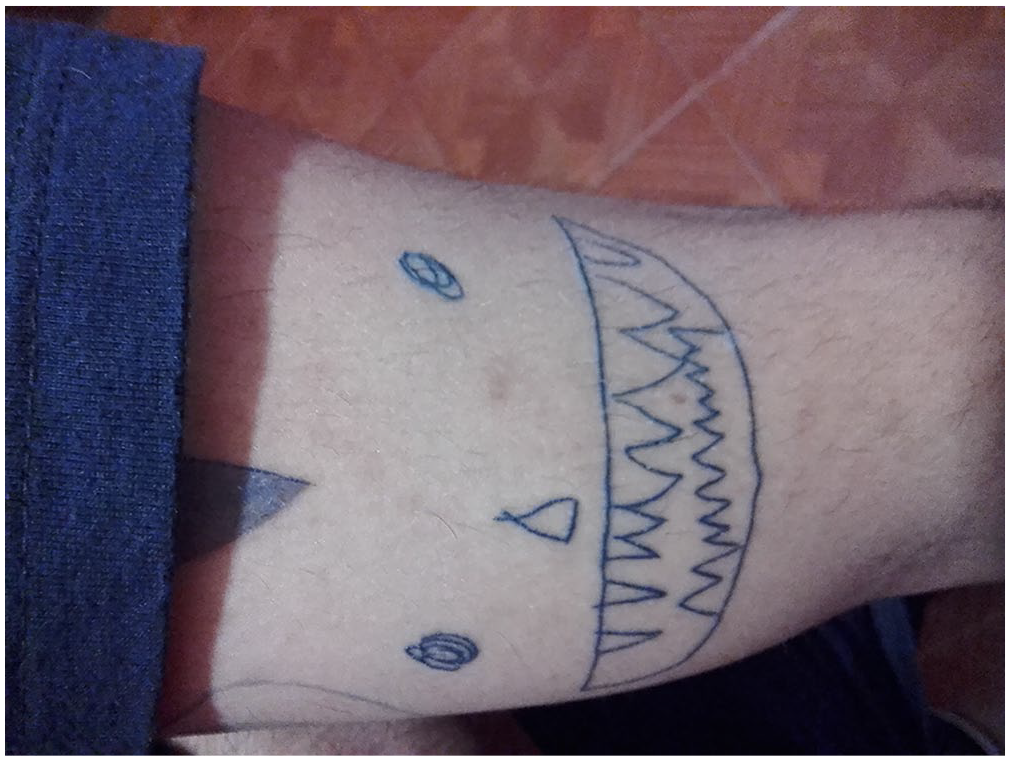
Matias’s forearm tattoo of his son’s drawing. Photo taken on 3 March 2016 by Valentina Pereira.
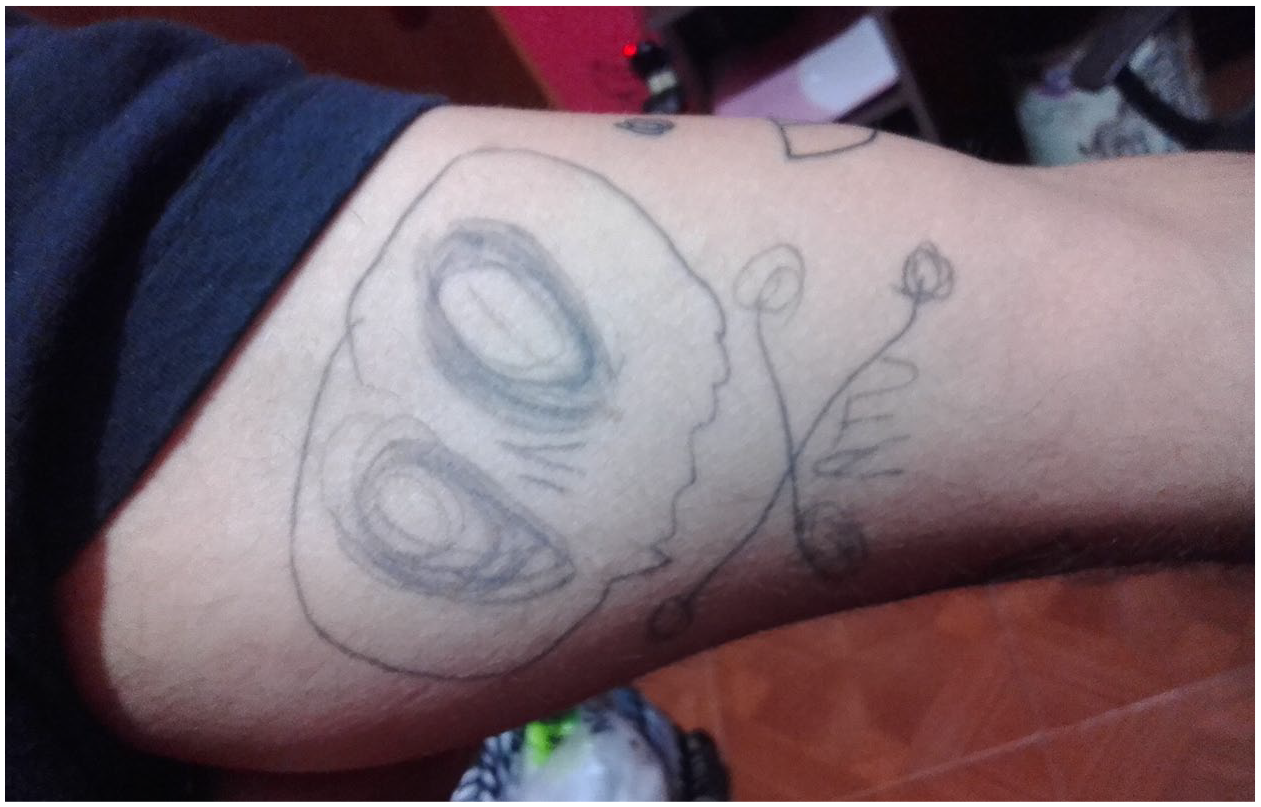
Matias’s arm tattoo of his son’s drawing. Photo taken on 3 March 2016 by Valentina Pereira.
These respondents sacralized a foundational moment, when they discover who they are, or when they have to reassure their identity. Their tattoos communicate their identity to the rest of the society. The tattoo is a way to preserve a certainty in life in the midst of what they perceive as a challenging and changing social environment.
I got you: relational tattoos
I found in the sample that an important number of respondents also mentioned tattoos that did not fit in any of those categories: they refer to relationships with persons that are alive. Ten respondents mentioned they got their tattoos to signal a meaningful relationship. These participants want to differentiate and memorialize a bond that is different from the rest.
Respondents also mentioned the influence of other persons as a reason to get a tattoo. In most of the cases, the role of others was supportive like when friends encouraged the respondents, or because participants got a shared tattoo with someone else (in this sample two participants mentioned a sibling). Finally, in some cases the undefined ‘others’ became the audience for the tattoo, the intend recipient of respondents’ spiritual statements.
These data pointed toward the role of other persons in the sacralization process. When we explored the history of religious tattoos, we saw that the community (that is the ‘church’) was present even when not explicitly mentioned: the tattoo was a sign of belonging to a group, and they were usually gotten during a religious celebration (Guerzoni, 2018; Gustafson, 1997; Petkoff, 2019). That communal element is not explored in many contemporary analyses that deal with tattoos as individual form of religious manifestation. Tattooing is seen as a struggle for individualization in an impersonal society (Johnson, 2006).
I found unexpectedly diverse communal elements present among respondents’ tattoos. First, the obvious religious tattoo places the person in a broader community, and in the case of Ignacio and David, in concrete religious groups that they were thinking about joining at some point. A similar thing can be said about Protestant participants rejecting their tattoos: because they become members of a community that sees tattoos as deviant, respondents reject the ones they already had.
More interesting is that the ‘moral community’ (Durkheim, 1965 [1915]) is also present among the Non-Affiliated. Tattoos reference a community that help to sacralize some experience distinguishing it from the profane rest. Teresa, a 28-year-old Non-Affiliated woman from Lima has a tattoo of a cat in her forearm. It is not a cat, but a cartoon of a cat by American poet Sylvia Plath Curious French cat. Her tattoo is not even about Plath’s poetry. It is about her mother. ‘She likes Sylvia Plath a lot’. The tattoo ‘represent my family, my heritage. The women of my family (. . .) my mum raised me alone, and she has a strong gender identity. . . and also because usually the strongest persons that surrounded me were always women’. Teresa’s tattoo is about her mother, and a network of strong women.
Even when the communitarian element was not mentioned in the literature discussing contemporary religious tattoos, participants in this study declared meaningful relationships when talking about their tattoos. Daughterhood appeared three times (Teresa, Paula, Sofía) and in two cases (Teresa and Paula) a single mother was the person who raised the respondents. Sisterhood/brotherhood appeared twice, with siblings sharing the same tattoo in the same body part (Sofía, Ignacio). Motherhood (Marcia, Zoe) and fatherhood (Matias) are also sacralized. One respondent mentioned a niece (Agustín) in a context of a healing promise to a supra-human power (Our Lady of Guadalupe). Other respondents tattooed meaningful relationships outside their families that modeled their lives for good (Ignacio, Agustín) or bad (Ignacio).
Sofia, a 23-year-old woman Non-Affiliated from Montevideo, got two tattoos that represent who she is in relation with her family. We have already discussed one about her grandfather. The other one (the first she got) is of his parent’s initials, because ‘they mean everything for me, everything’ (see Photo 5).
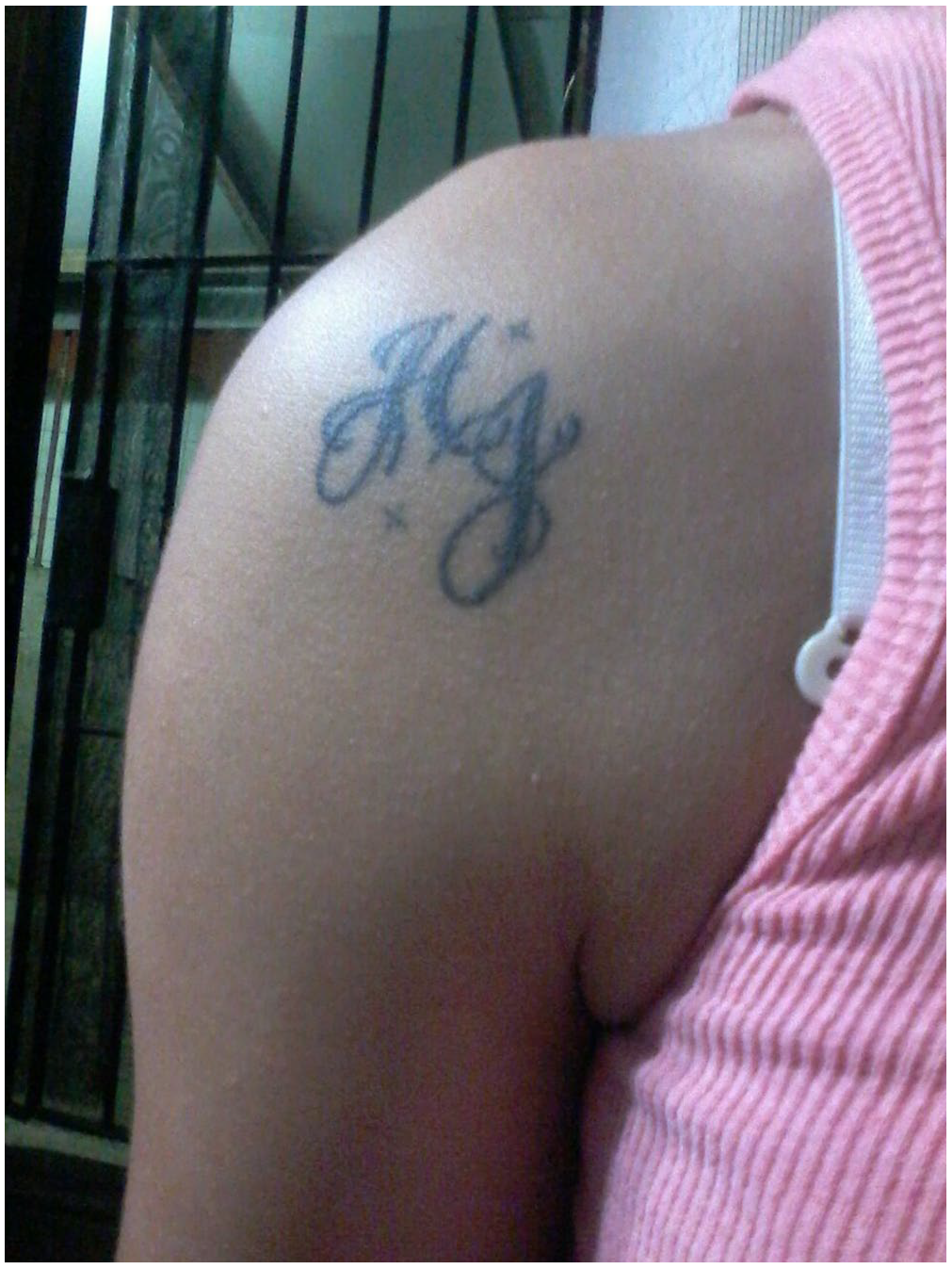
Sofia’s tattoo of her parents’ initials on her shoulder. Photo taken on 15 December 2016 by Florencia Casarotti.
Zoe, a 33-year-old Non-Affiliated woman in Lima, wants to have a tattoo of her children, ‘they mean a lot for me’. She has the design: a ‘sakuran flower’ (cherry blossom) but she is still thinking about it, ‘I don’t have the courage’. Marcia, a 28-year-old Non-Affiliated woman in Montevideo, has two kids, and she tattooed their names, F. and N., in each of her wrists.
You can imagine they are the most important thing in my life (. . .) I always said that if I have children I would tattoo their names, but I really thought I would not have children, so I was thinking in getting a tattoo with my nieces’ names. But then my children came, and I inked their names, because they are the most important thing.
We can place here, together with these motherhood tattoos, Matias’s one about fatherhood.
This trend is not limited to unaffiliated respondents. Ignacio (Catholic, Córdoba) has one tattoo of a coin shared with his brother. He also has one that marks a falling apart with a friend. He tattooed two eyes in his back ‘I got them after a big treason of someone I considered a friend. Everyone asked me, ‘Why the eyes?’ To see when someone stabs you in your back’.
These relational tattoos are a sort of legend to interpret the map of relationships, the spiritual tribes (Ammerman, 2014) to which respondents belong. The data suggest that among these participants tattoos are not individualistic practices. For sure they are embodied, personal, almost intimate practices; but the ‘others’ are present not only as ‘audience’, or ‘supporters’ but as the reason to get one: they ‘mean a lot’ for respondents. Tattoos examined here present the elementary forms Durkheim (1965 [1915]) established for a religion: the differentiation between sacred (what is tattooed) and profane (what is not) and the presence of a moral community bound by the ritual of tattooing. Tattoos are outcomes of sacralization practices that tell stories about binding with other persons who were influential in defining what is sacred in the subjects’ lives.
Analysis
One first thing that is important to keep in mind is that tattoos are in general an aesthetic choice. As we have seen in this sample, not all tattoos are meaningful; there are tattoos that have a religious meaning even when they are not religious designs; and some tattoos convey sacred meaning, becoming materializations of intangible experiences, ideas, and relationships.
Tattoos as sacralization practices
Why sacralization? Because tattoos separate from the fragility of life and differentiate it from the rest of profane things, setting them apart from the ordinary. At the same time, tattoos incorporated those experiences to a different texture of reality that touches a foundational moment in the life of the persons. The tattoo is the product of both a basal experience and the process of selecting an image to represent it, separating that experience and its representation from the rest of the subject’s life story. Tattoos occupy respondents’ skin, which is a limited resource. It is the process what makes the tattoo a sacralization practice, not necessarily the image inked.
As Matías (Non-Affiliated, Montevideo) described them, a tattoo is ‘a picture . . . of certainties you have in life . . . that you cannot erase’. The tattoo sacralizes that certainty, separating it from the rest of ideas and experiences respondents might have, making them permanent and communicating them to others.
Tattoos and religious affiliations
While an intensification of the religious experience is a reason for Catholics to get a tattoo (incorporating a venerated figure into their bodies), the same sort of experience is the reason for Evangelicals to reject the ones they have already gotten. Among Catholics, tattoos are a way of showing their faith (Ignacio, Francisco, Agustín, Claudio), or to express their inner experience (Tatiana).
There is a common trend about tattoos and religious self-reported affiliations: Non-Affiliated persons tend to have more tattoos than Catholics, and Protestants (at least in Latin America) tend to reject them. For what I have called ‘Enlightened’ literature, that the Non-Affiliated or atheist get more tattoos than religious persons meant fewer ‘moral constraints’ and therefore a more deviant and risky life. My hypothesis is different: tattoos are one of the few ways Non-Affiliated persons have to express their inner life in their own terms. Religious persons in these three Latin American cities have a bigger cultural repertoire to communicate their spiritual lives (a necklace given in a communion, an altar at home where you can place a picture of someone beloved, dead or alive). In the case of the Non-Affiliated, tattoos symbolize their religious-cultural location: a non-religious way of expressing inner life. Whereas religious traditions have alternative ways of expressing their identities, for non-believers’ tattoos might be one of the few venues to manifest their spiritual convictions. The Non-Affiliated (especially those who believe) do not have many options to express their sacred in their own terms, at least in the religious context of the three cities studied. Even when religious persons use tattoos as a sacralization practice, tattoos are not associated primary with a religious practice. Tattoos have become an available cultural practice to express one’s interiority in a Non-Affiliated way.
Tattoos and community
Analyzing tattoos as sacralization practices point us toward new ways of constructing the sacred/profane differentiation and moral communities. As a deeply embodied, personal practice, like inking one’s skin, tattoos talk about ‘you’. Getting others tattooed might tell us something about the contemporary nature and role of ‘moral communities’ in the relation with the sacred. Sometimes, the others became the sacralized reality. Other times, they are the community that supports, encourages, reads, and gives sense to the tattoos. This community might not be what Durkheim considered a ‘church’; perhaps it looks more like Ammerman’s (2014) ‘religious tribes’ that gather around some sacred stories. If the cultural available practices to express one’s interiority are changing, we can assume that the role of the community and its configuration is also changing. Ammerman’s (2014: 291) suggestion of understanding the separation between sacred and profane as a continuum, more than a dichotomy, can be also applied to the communal aspect: more than a dichotomy between ‘magic’ and ‘church’, we might have a continuum, from accidental gatherings to highly structured moral communities (Durkheim, 1965 [1915]).
Conclusion
Among many participants in this sample, tattoos are a relational practice, something that is personal and intimate but connects the subject with others and has public dimensions. For respondents, religiosity is something private and public, intimate and social, an individualized embodied commitment and a public statement, personal and communitarian. Even when non-affiliation means a rejection of the established institutions, Non-Affiliated persons relate with supra-human powers and bind together in moral communities.
Exploring lived religion, religiosity as practiced by the subjects, we came across tattoos as an embodiment of religious experiences. Analyzing them, even when the images they depicted were not obviously religious, we discovered that tattooed persons used them to sacralize something in their lives that put them back in control of their own body, express their interiority, and shape their identity. At the same time, tattoos bind them with a moral community, that may or may not coincide with their biological family or religious tradition, but in any case, is a ‘tribe’ of their choice that helps them to make sense of their experience.
When we look at people’s practices, to what they consider religious (something that connects them with a supra-human power) we found that some practices that were overlooked became relevant. Looking at embodied, materialized, out of church practices, we might discover novel ways of re-defining what is sacred and profane. And we can also discover new ways of relating with communities, and explore the interactions between those communities and what is considered sacred.
Footnotes
Funding
The author disclosed receipt of the following financial support for the research, authorship, and/or publication of this article: This publication was made possible through the support of a grant from the John Templeton Foundation (id # 58079). The opinions expressed in this publication are those of the author and do not necessarily reflect the views of the John Templeton Foundation. I am grateful to the John Templeton Foundation, and the local team directors: Néstor Da Costa (Montevideo), Hugo Rabbia (Córdoba), Catalina Romero (Lima); and also to Alyssa Pullin at that point a Boston College undergrad student, who helped with the literature review through a grant from Boston College’s Morrissey College of Art and Sciences Undergraduate Research Fellowship program. The John Templeton Foundation project: ‘The transformation of lived religion in urban Latin America: a study of contemporary Latin Americans’ experience of the transcendent’ (id #58079).

Notes
Author biography
Email: