




Abstract
In Latin American social studies, the lived religion approach has emerged as a fresh perspective for examining individuals’ tangible interactions with the sacred in their daily lives. Through a qualitative systematic review, this article sheds light on the academic production utilising the lived religion framework to unravel Latin American spirituality. By navigating thematic nuances and scholars’ critical findings, this study reveals the contributions of the lived religion approach within the Latin American context, exploring scholars’ motivations for its adoption. Amid this exploration, a central question arises: Is lived religion genuinely innovative for Latin American religious studies? This article aims to critically assess the incorporation of the lived religion approach in Latin American literature, examining its motivations and contributions to the perspective of lived religion from the Global South.
Introduction
In recent years, the lived religion approach has gained prominence in Latin American studies of the religious phenomenon. This perspective that focuses on ‘everyday life’ is part of a transformative process that has been taking place in the social sciences: a return to attention to the daily aspect (Ferrarotti, 1990; Tweed, 2015), questioning traditional categories and seeking new approaches to explain and understand contemporary societies. The emergence of lived religion as a theoretical and methodological framework is often associated with the work of Orsi (2002) or with David Hall, who invited scholars to think of religion ‘dynamically’ in terms of practices linked to specific social contexts and proposing lived religion as a starting conceptual point (Hall, 1997).
Subsequently, McGuire (2008) defined it as a focus on how the religious and the spiritual are experienced, practised, and expressed by ‘ordinary’ people (the ‘non-expert’) in their everyday lives. Ammerman (2013) defined lived religion as the perspective on the experience of the religious in everyday life and on the places and moments where the sacred intersects with the every day. Pereira Arena and Morello (2022) defined lived religion as the practices that people carry out in everyday life situations to connect with supra-human powers, practices that incorporate corporality, materiality, spaces, times, and discourses, chosen by individuals (from a repertoire of religious practices of the society, which is not limited by their confessions) with autonomy and creativity.
Regarding the use of the lived religion approach in Latin America, extensive qualitative research was conducted in the last years, and their academic products, discussed in this article, reveal how the interests in approaching lived religion are diverse, debated, and nurtured. However, despite its growing presence and significance, incorporating this approach into Latin American literature requires a critical evaluation. Instead of simply noting its presence in the region, it is crucial to interrogate how and why Latin American scholars have adopted this approach, assess its implications in the study of religion in the region, and how this approach relates to or resembles other approaches that have been characteristic of Latin American academia. While North American authors have emphasised the need for an approach that moves away from the commonplaces of classic sociology (Ammerman, 2016; McGuire, 2008), it is worth asking whether, for the Latin American continent, there is also a need for other perspectives, or what limitations or issues Latin American scholars adopting lived religion seek to address.
In the Latin American academia, although a lived religion approach has not been explicitly adopted, the religious experience from the perspective of the subjects and everyday life has been addressed. Aspects such as narratives (Esquivel, 2013; Manchado, 2017; Wright, 2015), the material, the corporeal, the emotional (Aguilar Ros, 2021; Leite, 2017; Milsev Santana, 2021), and the spatial (Flores, 2020; Odgers Ortiz, 2008; Suárez, 2021), have been explored to complexify dimensions that have been overlooked according to North American lived religion scholars. In some sense, Latin Americans have been making ‘lived religion’ for a long time.
Also, while the development of lived religion in Northern countries has responded to the growing awareness of a ‘Protestant bias’ in the socio-anthropological understanding of religion as argued by McGuire (2008), Latin American scholars, as described by De la Torre (2021), have developed their strategies to address the imposing public presence of Catholicism, especially popular Catholicism, which certainly takes into account the margins, the believers’ autonomy, and their abundant material production.
So, is lived religion a genuinely novel approach for Latin American religious studies? If it has something to contribute, what is it? This article sets out to develop a critical stance on the incorporation of the lived religion approach in Latin American literature. It aims to thoroughly examine the motivations for its use and the contributions to the perspective of lived religion from the Global South.
Methodology
The present article employs a qualitative systematic review, a specific approach that synthesises current research on a particular topic (Prieto and Rumbo Prieto, 2018). This approach was chosen for its ability to assess and review research on the same theme, in this case, regarding the study of lived religion in Latin America and what has been produced from or about this approach by Latin American authors or regarding the Latin American religious experience.
The qualitative systematic review was conducted through the following procedures. First, a specific research question was identified, serving as a fundamental guide for the review:
Research Question. What has been produced about lived religion in studying the Latin American religious experience, why this approach has been chosen, and what discussions have these studies suggested?
Subsequently, the type of studies to include in the review was chosen: any article, thesis, or book written by Latin American authors that, in addressing the Latin American religious experience, use or discuss the perspective of lived religion. Therefore, an extensive search was conducted on the Google Scholar platform using the keywords ‘lived religion’ and ‘lived religiosity’ in three languages: Spanish, English, and Portuguese, filtering and selecting articles that met the following conditions: (1) were written by Latin American authors and (2) were written about the religious experience of Latin Americans. Besides empirical studies, theoretical works reflecting this approach and its utility for studying religion in Latin America were also selected.
Exclusion criteria included: (1) studies not focusing on Latin American religious experiences or theoretical discussions not conducted by Latin American authors on lived religion; (2) studies lacking full-text access; and (3) non-academic sources like blogs, websites, or popular media not peer-reviewed. In addition, theological articles referring to lived religion were later excluded due to their focus on practical theology, often analysing cultural media rather than individual religious experiences, prioritising social science articles instead.
Subsequently, the productions were analysed and categorised according to the type of work (article, book, thesis, other), year of publication, authors, disciplinary field, and country of origin. Keywords (if available), abstracts, methodology, the concept of lived religion used, and the subjects or objects of study were also catalogued. In addition, the works were thematically classified, and notes were taken regarding the reflections from reading and reviewing these materials. Finally, as part of this review, a meta-synthesis was conducted to understand better the findings obtained.
What has been produced on lived religion in Latin America?
Type of production and countries
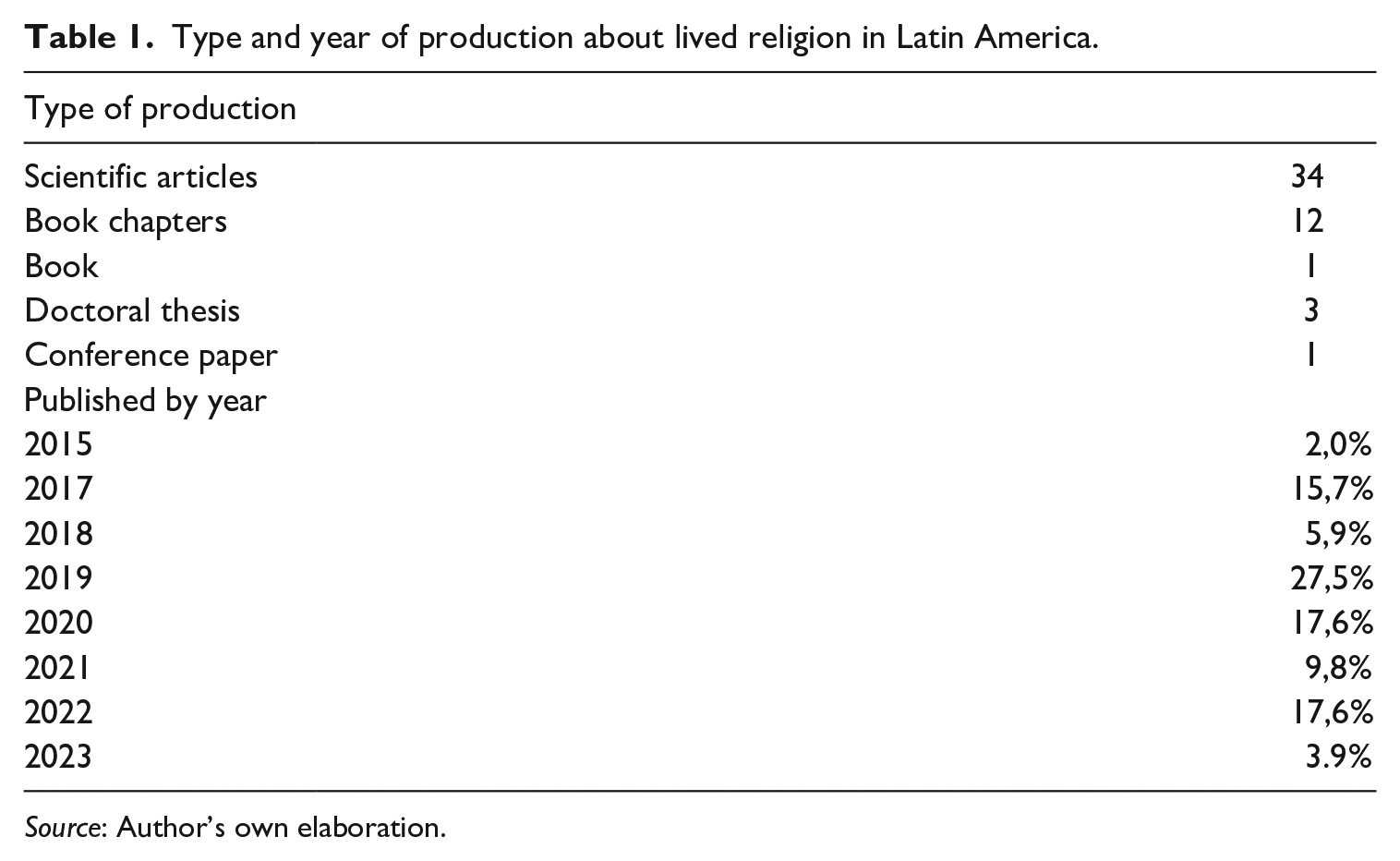
Following the previously mentioned steps, 51 productions meeting the inclusion criteria were found 1 : among them, 34 scientific articles, 12 book chapters, one book, 3 doctoral theses. All these productions were written between 2015 and 2023, with the years 2019, 2017, and 2022 being the years with the highest academic production.
Despite varied publication rates, 51 scientific works over 7 years highlight increasing interest in the study of religion’s intersection with daily life in the region. Moreover, the variety of production types, including scientific articles, book chapters, theses, and conference presentations, indicates a multifaceted and interdisciplinary approach to studying this topic.
Regarding the country of origin of the academic production’s principal author, Argentine scholars have the highest academic production on lived religion, surpassing the production of the following countries, Uruguay (9) and Peru (9), by nearly double. Argentina, Uruguay, and Peru have published 69% of lived religion production. It makes sense when considering the project on the ‘Transformation of lived religiosity in Urban Latin America’ (2015–2018), which entailed 3 years of research by academics from these three countries, resulting in various products derived from the study.
Disciplinary fields and keywords
Sociology is the field that produced the most works on lived religion: 36 out of the 51 reviewed products are written from a sociological perspective. Following it, in order, are anthropology (8), communication (3), cultural studies (2), gender studies (1), and science of religions (1). Given the Latin American predominance of sociologists and anthropologists advocating for the study of religion on the continent, it is interesting to note that this prevalent use and interest of sociologists in lived religion may be attributed, as De la Torre (2021: 268) has pointed out, to the fact that ‘studying religiosity from the practical conception of its practitioners is not a novelty in anthropology, and even less so in Latin American anthropology’.
Type and year of production about lived religion in Latin America.
Source: Author’s own elaboration.
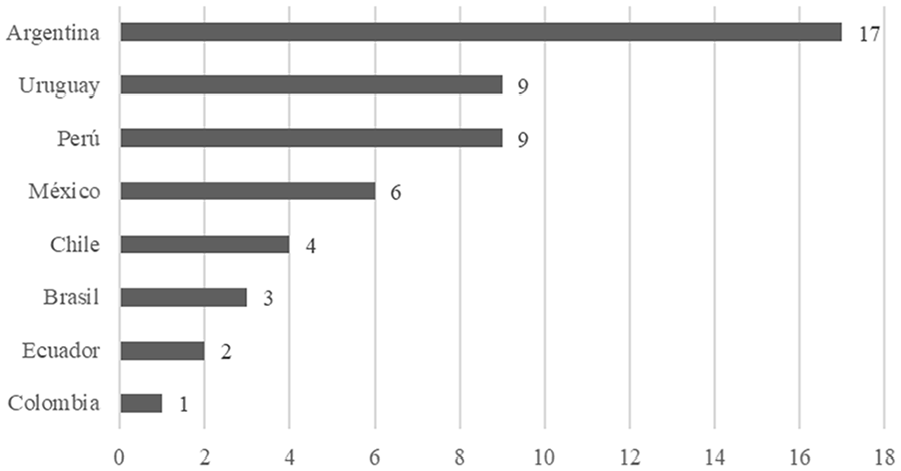
Lived religion productions per country.
This aligns with Ammerman’s (2016) view that sociology’s focus on secularisation in modernity has often overlooked the continuing religious practices in individuals’ daily lives. Ammerman (2016) regards lived religion as an implicit reaction to criticisms directed at sociologists for their methods of studying religion. In Latin America, authors like Frigerio (2018, 2021b) argue that the sociology of religion was primarily focused on studying religions from institutional and Catholic-centred perspectives. In this sense, sociology appears to present itself as a disciplinary field in greater need of review and an approach from grassroots perspectives. 2
Another way to approach this Latin American production on lived religion involves examining keywords, which help highlight key themes in academic literature. Among the 51 selected productions, 39 included keywords.
As depicted in Image 1, specific keywords dominate, such as ‘religion’ (27), ‘religiosity’ (12), and ‘lived’ (20), indicating a focus within this specific field of production. The presence of ‘Catholicism’ (7) and ‘popular’ (5) suggests a particular emphasis on Catholicism and popular religious expressions in the region. In addition, words like ‘believers’ (4) and ‘unaffiliated’ (4) highlight an interest in beliefs and the unaffiliated population. The frequencies of ‘Hinduism’ (4) and ‘Pentecostalism’ (4) are notable, indicating attention to other religious traditions beyond Catholicism. The repetition of ‘secularization’ (4) and ‘pluralism’ (3) suggests potential discussions or connections with these concepts, as further explored later.
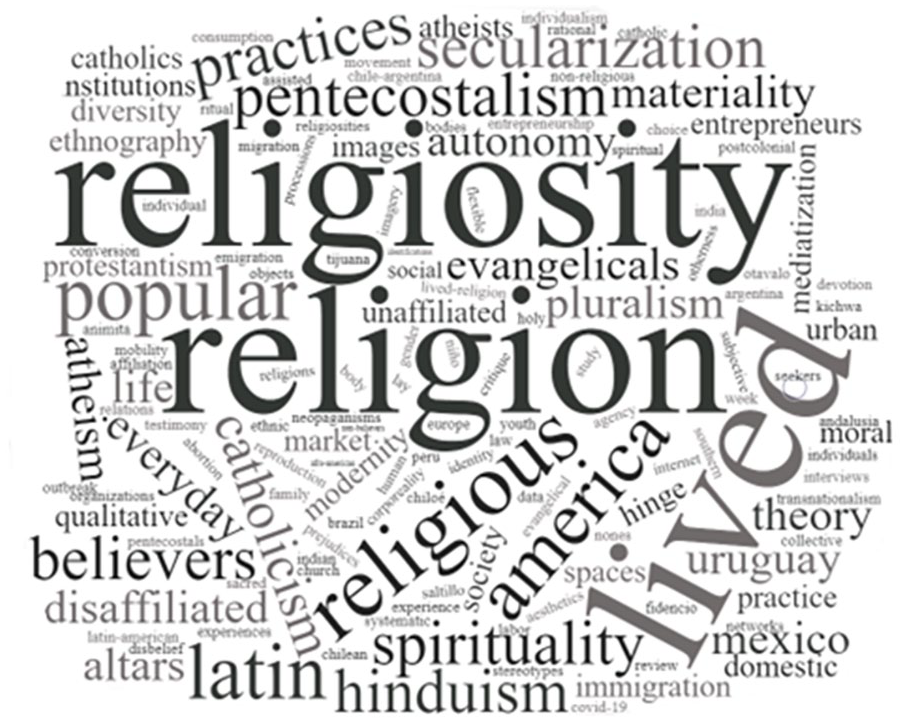
Wordcloud representing keywords of lived religion productions.
In addition, it is essential to mention that 115 words appeared with a frequency between 2 and 1, revealing a thematic diversity in the lived religion production.
Definition of lived religion, referenced authors and languages
Another aspect considered for the analysis was the number of publications explicitly defining lived religion to see how much Latin American scholars expect their readers to be familiar with it. In this sense, 14 out of the 51 publications do not define what is meant by lived religion, of which seven correspond to chapters of a book that defines the approach in its introduction. This widespread tendency towards definition could suggest that Latin American scholars appear to be aware of that their work may reach a diverse audience in terms of familiarity with lived religion. By providing a definition, they are making their research more accessible.
Furthermore, upon analysing the definitions presented in the other 44 productions, it is observed that the most frequently cited authors for defining the perspective are Ammerman (2007, 2013, 2016), McGuire (2007, 2008), and Orsi (2002). Ammerman is the most frequently referenced author in these definitions, with 44 mentions, while McGuire is mentioned 20 times, and Orsi, 19. Regarding Latin American authors, the most frequently referred academic for discussing lived religion is Morello (2017, 2019, 2020), with 11 references. Other authors cited concerning the definition include Hall (1997), Edgell (2012), Fedele and Knibbe (2020), Frigerio (2018), Morello and Rabbia (2019), Roof (1999) and Tweed (2015).
This indicates a predominance of utilising North American authors for defining or framing the perspective. While other Latin American authors are cited and engaged in the development of the work, the key references regarding the definition remain Ammerman, McGuire, and Orsi.
Another issue to consider is the language of publications. The analysed corpus mainly consists of Spanish publications, comprising 90.2% of the documents reviewed. English and Portuguese publications accounted for 5.9% and 3.9%, respectively. This distribution highlights Spanish as the dominant language among Latin American scholars exploring lived religion. While English and Portuguese publications offer opportunities for dialogue with colleagues from other regions, the prevalence of Spanish may hinder the accessibility and visibility of Latin American academic work globally.
Methodologies and subjects
Publications’ methodologies can be categorised into two main groups: those involving fieldwork and those that do not. Out of 51 publications, 44 involve fieldwork, employing qualitative research methods such as interviews (in-depth, biographical, life history), ethnography, participant observation, elicitation of photos and objects, and cartography. This aligns with the lived religion perspective, as it falls within the theoretical framework of symbolic interactionism (Cooley, 1902; Mead, 1985; Rose, 1974), an approach that attributes vital importance to the meanings that human beings assign to situations within their social world. From the sociological perspectives on religion, symbolic interactionism focuses on how individuals interpret their religious experiences, emphasising that beliefs and practices are only sacred if people consider them so. Once regarded as sacred, they acquire a special meaning and give significance to people’s lives (Emerson et al., 2011).
In the case of the seven publications that do not involve fieldwork, they consist of literature reviews and theoretical discussions related to lived religion. They either present the approach and its contributions to the study of religion in Latin America (Frigerio, 2018, 2021b; Morello et al., 2017; Pereira Arena and Morello, 2022; Roldán and Pérez, 2020) or discuss its relationship with other categories and approaches, such as ‘hinge religiosity’ (De la Torre, 2021) or ‘enchanted modernity’ (Morello et al., 2017).
Both types of publications are valuable: those conducting fieldwork offer insights into religion’s role in Latin Americans’ lives, while others integrating the approach into discussions provide critical and relational perspectives on lived religion’s relevance in the region.
Subjects in the analysed publications include believers and non-believers in a cross-sectional approach (15), migrants (7), Evangelicals (5), Catholics (4), women (4), non-religious individuals (4), ‘devotees’ 3 (3), entrepreneurs (1), and youth (1). Notably, 15 of these publications fall under the first category, with a broad focus on studying specific dynamics in lived religion beyond demographic or religious identities. These dynamics include consumption, the relationship between institutions and individuals, the relationship with the public space, images of God, and religious mediatisation. In addition, objects like altars are part of the studies, serving as concrete material expressions to study how religion is lived.
The variety of study subjects in the empirical-oriented publications reflects the breadth and complexity of subjects and objects of study and the apparent usefulness of this approach to address both general aspects of lived religion and specific issues related to different population groups.
Contributions of lived religion from the perspective of Latin American authors
Seeking to conduct a thematic and cross-sectional analysis to identify emerging patterns and common themes, the initial observation from the review underscores the tendency to emphasise lived religion’s contributions to studying religions in Latin America. These contributions often feature prominently in methodological justifications and are revisited in conclusions to illustrate the approach’s utility. The ensuing contributions are inherently interconnected, from acknowledging potential limitations in traditional approaches and shifts in the Latin American religious landscape. Researchers highlight these points to justify adopting the lived religion perspective. Consequently, the following themes emerge as significant contributions.
The ‘other’ subjects and dimensions
Latin American authors consider some of the main contributions of lived religion (as scholars from other regions share) mainly the highlight on the study of ‘margins’ (Ammerman, 2016; Neitz, 2011) and the ‘underexplored dimensions’ of religious experience (Edgell, 2012; Williams, 2010).
The attention to these ‘other’ subjects and the ‘other’ dimensions of religious experience is considered especially relevant for addressing or complicating classical perspectives, especially in the sociology of religion, which may have overlooked the religious experience of particular populations or some dimensions of religious experience.
Regarding the ‘other subjects’, it is noteworthy that seven of the analysed publications used this approach to study the religious experience of migrants, a population that requires a more precise examination and whose religiosity may be overlooked in religious studies that typically focus primarily on the native population.
Authors have advocated for using lived religion to examine migrant populations, emphasising its capacity to unveil the specific conditions, places, and tangible rituals through which migrants connect with the sacred locally and transnationally. Author Pereira Arena (2024) presents the approach’s efficacy in discerning migrants’ unique religious experiences vis-à-vis the native population, highlighting the influence of the host context’s plausibility structures (Berger, 1990) and factors such as social networks, time constraints, and available resources. López Olivares (2022) grounds her research on migrants in Tijuana from lived religion, elucidating how this perspective allows for a nuanced exploration of their religious manifestations and adaptations. This approach sheds light on religious experiences divergent from Western cultural norms and reveals insights inaccessible through traditional analytical frameworks.
Furthermore, several publications reviewed have utilised the lived religion approach to examine women’s experiences, recognising its capacity to reclaim women’s narratives from societal expectations and institutional impositions. Vaggione et al. (2021) assert that lived religion enables a focus on how women construct, adapt, and reshape religious beliefs amid abortion contexts, bypassing theological debates or institutional stances. Similarly, Brusoni (2019) highlights the importance of lived religion in understanding the significance of institutional mandates in women’s everyday lives.
Johnson (2019) explores the intersection of religion, reproductive technologies, and women’s autonomy, emphasising lived religion’s capacity to observe how women exercise agency within their faiths. This perspective aligns with Avishai’s (2008) suggestion to focus on how women ‘practice religion’, acknowledging individual agency. These findings resonate with Ammerman’s (2016) emphasis on personal agency in understanding women’s religious engagements, contributing to a more nuanced comprehension of women’s experiences within religious contexts.
Finally, within the study of ‘the other subjects’, non-religious or unaffiliated individuals (Rabbia, 2017; Romero and Lecaros, 2017) could also be included. In Latin America, in comparison to the long-standing academic production on religious matters in the continent, the study of the experiences of non-religious believers, atheists, and agnostics still requires greater attention, mainly due to their pronounced growth in the region, making up an essential part of the continent’s religious diversity landscape.
In the present sample, 4 4 academic productions have utilised the approach to study unaffiliated people. The contribution of this approach to the study of non-religious individuals is presented as it is considered a broad theoretical-methodological framework that does not limit the study of religion to what happens concerning religious institutions or popular devotions. Starting from the everyday and the subjects’ perspective, they claim this approach enables the study of spiritual narratives that do not necessarily include ‘classic’ divine actors, membership in specific communities, or religious identifications in the classical sense of the term (Da Costa, 2017; Rabbia, 2017; Romero and Lecaros, 2017).
Moving on to ‘other dimensions’, another of the most frequently mentioned contributions in the analysed productions is the attention the approach provides to the religious experience beyond cognitive aspects, beliefs, or institutional spaces. The material, spatial, bodily, and emotional dimensions of the religious experience (Bahamondes González and Marín Alarcón, 2022; De la Torre, 2021; Pereira Arena and Morello, 2022) are part of the narrative of the contribution consistently pointed out by Latin American authors.
Not only is the value of taking materiality, bodies, emotions, and sensations more seriously highlighted in an abstract sense, which was often minimised as degraded expressions in contrast to the study of religion that privileged ideas, theology, and meanings (De la Torre, 2021), but this value has also been empirically considered. Among the surveyed productions, for example, materiality is addressed through the study of altars and ‘animitas’ (De la Torre and Salas, 2020; Frigerio, 2021a; López Olivares and Odgers Ortiz, 2022; Urzúa-Martínez and González Franzani, 2022), concrete expressions of great relevance for understanding the religiosity practised by thousands of Latin Americans.
Studying domestic, semi-private, and public altars, these authors emphasise the value of lived religion perspective as it allows for a deeper exploration of the material and spatial aspects of religiosity practised by individuals, particularly from a non-ecclesial perspective.
The material aspect is also approached from the consumption perspective (Bahamondes González and Marín Alarcón, 2022) to display the everyday motivations for consumption beyond the offerings of the religious market theory or in dialogue with it (Lecaros and Rolleri, 2022).
Regarding the spatial dimension, authors have argued that using lived religion has enabled them to study other spaces where religious experiences are lived. Among these, social media (de Melo Bottino et al., 2020; Pérez Vela, 2019, 2023) stand out as fundamental sites for understanding the religious experience in the modern era. Also, domestic spaces, intermediate transit spaces, work, and nature (Pereira Arena and Brusoni, 2017); public spaces (Gatica, 2019); and transnational spaces generated by the religious experiences of migrants (Saldívar Arellano, 2019).
To a lesser extent, some works have chosen this approach because it is considered helpful for understanding the religious experience concerning the bodies, especially those of women (Olmos Rebellato, 2019; Vaggione et al., 2021).
Religious diversity, congruence, and autonomy
Another contribution highlighted by the authors relates to the potential for making religious diversity visible, which they consider often goes unnoticed by the ‘analytical radars’ due to how the religious experience on the continent has been predominantly addressed (Bahamondes González and Marín Alarcón, 2022; Frigerio, 2021b), attributing to lived religion the ability to overcome certain limitations. One of the issues raised is Catholic centrism: according to Frigerio (2018), by naturalising this idea of Catholicism’s hegemony, diversity has been rendered invisible, relegated to residual categories such as ‘esotericism’, ‘hybridism’, or simply ‘other religions’.
Another noted limitation concerns the continued tendency to subsume religion under religious identifications (Frigerio, 2018; Rabbia, 2019). From the lived religion standpoint, authors argue that understanding religious diversity entails examining how individuals engage with the transcendent in their daily lives, irrespective of their religious self-identifications. Rabbia (2019) introduces the concept of the ‘fallacy of religious congruence’ (Chaves, 2010), suggesting that religious identification is often mistakenly equated with religious practice and belief. This fallacy leads researchers to expect individuals to conform to certain behaviours or beliefs solely based on their religious identification, which is only partially accurate. Lived religion, however, demonstrates how religious experiences transcend these identifications, as evidenced by divorced Catholics who reject confession and receive communion or Evangelicals who believe in past lives without perceiving a contradiction (Rabbia, 2019: 35).
In this regard, the recognition of autonomy may become one of the key contributions for some of these authors (Rabbia, 2019; Romero, 2019). By acknowledging the capacity for sacralisation and practice beyond this supposed religious congruence, the autonomy with which individuals adapt their environment’s spiritual resources and narratives to their life circumstances becomes visible. According to Morello et al. (2017: 36), lived religion allows for an approach to believers understanding that they are not passive recipients of religious traditions but rather creators and agents and should not be evaluated according to standards imposed by religious leaders or academics.
Lived religion, an alternative
For several of the analysed works, lived religion is presented as an alternative (Frigerio, 2018). Continuing with the previous line of argument in which the authors present what they understand as limitations of classical studies, the word ‘alternative’ is frequently used as an adjective to describe lived religion.
According to Frigerio (2018), the approach is presented as a valid alternative to the overly institutional and cognitive emphasis in the study of religion, as it allows overcoming the excessive ‘dichotomization’ of group-individual in which most analyses seem to be situated, as it does not implicitly involve any specific religious organisation or extreme individualism (Frigerio, 2018: 67). Other authors also agree on the potential to overcome this and other dichotomies: by paying particular attention to everyday discourses and practices, lived religion would allow for the exploration of aspects of religiosity that challenge the dichotomies of public/private, material/spiritual, reason/emotion (Rabbia, 2019; Romero et al., 2020).
This excessive dichotomisation has also been presented as problematic for the study of specific populations, such as migrants. In this regard, López Olivares and Odgers Ortiz (2022) argue for the adoption of the lived religion approach to address the experience of migrants because other methods are limited in presenting the religious aspects with dichotomies like public or private or by associating images or symbols with specific religious traditions, concluding that, for various actors, lived religion serves as a better interpretative framework for analysing their cases.
Another interpretation of the term ‘alternative’ is evident in the challenge posed by the study of everyday life to the perspective of secularisation in Latin America (Morello et al., 2017; Morello and Rabbia, 2019). Recent studies rooted in lived religion explicitly address empirical challenges and debates surrounding the theory of secularisation and its applicability to Latin American contexts. However, it is crucial to note that everyday life’s significance as a discourse locus predates the formal emergence of lived religion in Latin American discussions. Scholars such as Mariz and Machado (1994) and Semán (2007) had previously argued that examining believers’ daily lives revealed dynamics incongruent with the secularisation narrative. Thus, lived religion facilitates ongoing scrutiny of secularisation theory while providing methodological and theoretical frameworks for dialogue with scholars from other regions (De la Torre, 2021).
Articulations of lived religion with Latin American theory
Beyond the arguments that Latin American authors use to explain why this approach offers potential and various contributions to the study of religion in the continent, even being presented as an ‘alternative’, it is equally necessary to understand how the approach has engaged with academic discourse and generated a series of categories that aim to adapt the focus on the every day to the Latin American narrative. The theoretically oriented productions analysed aim to go beyond lived religion, proposing categories and articulating concepts rooted in theories from the Global South.
One of the categories used to describe the landscape of Latin American religiosity based on the study of lived religion is the ‘enchanted modernity’ (Morello, 2020; Morello et al., 2017; Romero, 2019). It represents a type of modernity in which religion is not perceived as a reaction to secularity but as an intrinsic way of confronting everyday life. This perspective starts from the premise that the theory of secularisation, primarily developed in the context of the North Atlantic, never perfectly fit the reality of Latin America, where modernity has generally been very receptive to religiosity. The authors who employ the concept of ‘enchanted modernity’ argue that religious diversification in Latin America has not solely resulted from the dynamics of migration or globalisation but from internal pluralisation. This pluralisation is rooted in a long history of tensions between religious institutions and popular religiosity, which often reinterpret and give new meaning to religious practices (Smilde and Pérez Hernáiz, 2021). Therefore, this ‘enchanted modernity’ is understood as a different form of coexistence between modernity and religion in Latin America (Romero, 2019).
Equally interesting is revisiting the analytical concept of ‘hinge religiosity’ (Juárez Huet et al., 2022), a concept that stems from the criticism previously offered by De la Torre (2021) towards lived religion, pointing out an individualistic bias in neglecting the attention to impacts on the public sphere and the reconfiguration of secularisation. The authors propose ‘hinge religiosity’ to include a relational perspective in examining lived religion, emphasising the need for an additional analytical effort to situate biographies and personal meanings within the framework of social and institutional life. To achieve this, they argue for conceiving religious experience from a relational perspective, placing it at the junctures where individual expectations negotiate with the system of institutional norms and values. This perspective also includes adapting traditions to changes and the impact of faith on transformative action within secular contexts (Juárez Huet et al., 2022: 123–124).
The metaphor of the ‘hinge’ had previously been used in Latin American academia (De la Torre, 2013; Juárez Huet, 2011) to emphasise the supports on which elements from different belief systems are reappropriated and are capable of coexisting coherently and complementarily from the subject’s perspective. However, it is interesting to observe how, within the theoretical and methodological framework of lived religion, there is a move towards the concept of ‘hinge’ to better account for dynamics considered distinctive within Latin American religiosities.
Finally, it is worth mentioning the articulation of lived religion with decolonial theories and popular religiosity. In this regard, while recognising its contribution to the study of Latin American religiosities, De la Torre (2021) proposes lived religion as a valuable tool for analysing popular religiosity from a decolonial perspective. Considering that decolonial theory aims to challenge the structures of power and domination established in the world through colonisation and modernity, lived religion can articulate, through analysis, how people have resisted and adapted to these power structures through their religious practices. The proposal is to connect it with the realms of public action, following the colonial threads of new transformations to understand the new directions, new frameworks, and emerging meanings that the concept of lived religion holds (De la Torre, 2021: 290).
Conclusion
This work aimed to provide a general and critical review of the Latin American production related to lived religion, considering the growing body of work and its relevance to Latin American scholars. Conducting such a review is crucial to elucidate the reasons for its rise and the contributions of Latin American scholars, as well as reflect on possible adjustments and how scholars can construct a theoretically and methodologically more suitable approach to Latin American realities.
Upon analysis, it is noteworthy that the approach enjoys a generally well-regarded reputation: a significant portion of the production introduces and justifies the use of lived religion for its contributions and insights or because it is considered an alternative approach with the necessary foundation to continue challenging the thesis of secularisation.
There is the perception of a still conceptual solid legacy from the North American authors who shaped the proposal. However, there has been an increasing interest in the dialogue of this perspective with Latin American theory. This dialogue holds promise for its potential to harness the contributions while adapting the proposal to the region’s material, social, and historical realities.
After the previous review, a fundamental question remains: Is lived religion truly a novel approach for researchers in the Global South? The answer, as we explore, is nuanced. On one hand, as mentioned, Latin American authors have a rich tradition of studying religion from their own analytical perspectives. While we cannot delve deeply into this due to space constraints 5 we can affirm that, especially within the anthropological tradition, various dimensions proposed by the study of lived religion have been explored for years, such as the material, corporeal, and emotional dimensions (Algranti, 2018; De la Torre, 2008; Milsev Santana, 2021). In addition, approaches like popular religiosity (Ameigeiras, 2008; De la Torre, 2013; Fernández, 2004) have also focused on practices and agency and emphasised the believer’s autonomy.
However, there has yet to be a unified theoretical-methodological framework that addresses specific dimensions like narratives, spaces, times, materiality, corporeality, and emotionality from the subject’s perspective. Unlike popular religiosity (highly valuable for studying dynamics and experiences within popular Catholicism), lived religion encompasses experiences across various social strata and religious affiliations, transcending the religious congruence fallacy (Rabbia, 2019). It examines dynamics beyond demographic or religious identities, gathering collective, individual, and intermediate stories.
Beyond its novelty (or lack thereof), lived religion fosters academic dialogue across geographical (South to North, South to South) and disciplinary boundaries, facilitating a nuanced understanding of Latin American religiosity. Unlike secularisation and religious market theories, which often impose Eurocentric perspectives, lived religion embraces a bottom-up approach, acknowledging diverse expressions of religiosity without presupposing a Christian or European lens. It allows a nuanced exploration of what individuals consider sacred without imposing categories or assumptions about religion or religious actors.
On the other hand, as an approach, lived religion appears to offer practical utility by delineating specific strategies and dimensions, leading to a more precise understanding of religious practices in diverse contexts.
At this point, the challenge lies in articulating these everyday experiences with the historical structures of power and domination and in the decolonisation of the Latin American religious experience. Could lived religion be a valuable medium for decolonial theories, opening the range and considering religiosities classically marginalised in religious studies? Emerging concepts like ‘enchanted modernity’, ‘hinge religiosity’, or ‘lived religion’ to analyse religion from a decolonial perspective appear promising and deserve further scholarly attention and production.
Footnotes
Acknowledgements
The author would like to express her sincere gratitude to the anonymous reviewers for their insightful comments and suggestions, which have contributed to improving the quality of this work. She is also deeply thankful to the editors for their careful consideration and guidance throughout the review process.
Funding
The author(s) received no financial support for the research, authorship, and/or publication of this article.

Notes
Author biography
Address: Universidad Católica del Uruguay, Av. 8 de Octubre 2738, Postal Code 11600. Montevideo, Uruguay.
Email: