




Abstract
A large body of literature analyzes trends of religious decline across Western Europe and North America. Often rooted in secularization theory—the idea that modernization reduces religious beliefs and practice—this research lacks attention to global, comparative contexts. In this study, the author addresses that gap by examining religious trends spanning two decades across 17 Latin American countries to analyze changes in religious affiliation, church attendance, and religious importance. The author demonstrates that institutional religiosity, measured by affiliation and church attendance, is declining, whereas personal religiosity, measured by religious importance, remains resilient and is even increasing. This fragmented secularization is distinct from patterns observed in Western Europe and the United States. Further analyses highlight additional differences, showing that religious dimensions in Latin America are less tightly correlated and that the religiously unaffiliated maintain stronger religious beliefs and practices than their counterparts in the West. To account for this divergence, the author integrates insights from the neosecularization paradigm with Latin American theories of popular religiosity and lived religion. This synthesis provides a more precise framework for understanding secularization in Latin America and offers a model for applying secularization theory to non-Western contexts, in which modernization unfolds in diverse ways.
Religious decline has upended societal norms and practices across Western Europe and North America, reshaping the landscape of belief and belonging in unprecedented ways (Hout and Fischer 2014; Voas and Chaves 2016, 2018). Secularization theory broadly posits that as societies modernize, religious belief and practice diminish (Bruce 2011). However, this scholarship is limited by insufficient attention to global, comparative contexts (Brenner 2016; Stolz 2020). The utility and validity of secularization theory are contested, in large part because of this narrow focus on Western countries (Gorski and Altınordu 2008). Other regions exhibit different patterns and in many places outside the West, religion is actually growing (Hackett et al. 2015; Stark 2015; Toft, Philpott, and Shah 2011). This raises an important question: does secularization occur in other places, and if so, what form does it take?
Latin America’s strong historical ties to religion and diverse religious landscape make it an ideal case for examining secularization theory (Morello et al. 2017). Religion is a foundation of culture and identity, and sociologists of religion maintain the continuing importance of religion in Latin American society, politics, and daily life (de la Torre and Martín 2016; Hervieu-Léger 1996). However, over the past 50 years, Latin America has experienced tumultuous religious change, including intense religious competition and rising disaffiliation (Somma, Bargsted, and Valenzuela 2017). These two realities—the deep-rooted religious tradition and recent shifts in religious affiliation—have sparked debate among scholars. Although some predict that Latin America will follow the established pattern of modernization leading to religious decline (Inglehart 2021; Kasselstrand, Zuckerman, and Cragun 2023), others contend that Eurocentric secularization models overlook the region’s distinct religious dynamics, calling for alternative frameworks (Martin 2005; Morello et al. 2017; Parker 1996; Somma et al. 2017). Moreover, broad comparative empirical studies of religious decline in the region are sparse, highlighting the need for more extensive research.
In this study, I address three core research questions: Is Latin America secularizing, and what is the nature of that secularization? What factors best explain secularization in Latin America? and In what ways does Latin American secularization differ from Western patterns? Drawing on repeated cross-sectional survey data spanning 20 years from 17 Latin American countries, complementary survey data from Western Europe and the United States, and national development indicators, I examine these questions and their theoretical implications.
First, I show that Latin America is undergoing institutional secularization, with long-term declines in religious affiliation and church attendance that align with classic secularization expectations. Second, I identify a distinct pattern of fragmented secularization—whereas institutional religiosity is declining, religious importance remains resilient and even increases over time. This contrasts with Western contexts, where institutional decline is typically accompanied by a broader erosion of belief (Field 2022; Inglehart 2021; Voas 2009). Third, by comparing Latin America with Western Europe and the United States, I provide further evidence of its distinct trajectory. The unaffiliated in Latin America are more likely to retain theistic views, attend church, and value religion in their lives. Finally, factor analysis reveals that religiosity measures are less tightly correlated in Latin America.
Taken together, these findings fill a critical gap by documenting trends of decline across Latin America, a region that has received little quantitative attention in secularization research. More broadly, they speak to the ongoing challenge of applying secularization theory beyond the West. Extending analysis to diverse contexts is necessary to refine the secularization paradigm, distinguishing universal processes from regionally specific patterns (Bruce 2011; Bruce and Voas 2023). This study provides such an opportunity.
I demonstrate that Latin America’s fragmented secularization both affirms the value of secularization theory and underscores the need for theoretical refinement. My analysis builds on the neosecularization paradigm, which conceptualizes secularization as the erosion of religious authority rather than religion itself, to better explain how institutional forms can decline while personal devotion remains strong (Chaves 1994; Yamane 1997). At the same time, I draw on scholarship on popular and lived religion, which highlights the persistence of faith outside formal institutions (Morello 2021; Parker 1996). By integrating these perspectives, this study provides a more precise framework for understanding secularization in Latin America and models an approach for examining religious change in non-Western contexts where modernization unfolds in diverse ways.
Background
Defining Secularization: Modernization and Religious Decline
Secularization theory, with its varied definitions, metrics, and proposed causes, has been subject to decades of debate, alternating between widespread adherence and intense scrutiny (Gorski and Altınordu 2008). 1 Even when clear empirical data are considered, the question “Is this secularization?” depends on one’s definition: some scholars highlight the decline of individual religious belief and practice, whereas others emphasize broader processes of cultural or institutional differentiation (Gorski and Altınordu 2008). 2 In his influential work, Public Religions in the Modern World, Casanova (1994) argued that secularization actually unfolds across three distinct but interrelated dimensions: the decline of individual religiosity, the privatization of religion, and the differentiation of secular institutions from religious influence.
Although these dimensions emphasize different aspects of religious change, the most dominant explanation for secularization across them is modernization (Bruce 2011; Gorski and Altınordu 2008). Modernization leads to the rationalization of society, differentiation of social institutions, and the decline of religious authority, which collectively diminishes religion’s influence in both public and private life (Wilson 1982). A key posited mechanism in this framework is the “modernization of ideologies,” when rising levels of education and the growth of science promote an empiricist, secular worldview seen as incompatible with traditional religious perspectives (Ruiter and van Tubergen 2009). This is what Weber ([1920] 1993) described as the “disenchantment of the world.” Relatedly, the “modernization of social ties” is when industrialization and urbanization weaken the size, strength, and homogeneity of social networks that religious communities rely on to maintain commitment (Bruce 2001; Ruiter and van Tubergen 2009).
The most prominent critique of the assumption that modernization leads to religious decline came from rational-choice theorists. Drawing on broad historical and cross-cultural evidence, they argued that religiosity persists even in highly modernized societies and that secularization results not from modernization itself but from fluctuations and failures in religious markets (Finke and Starke 1992; Stark and Bainbridge 1986). Finke and Stark (1992) and Stark and Finke (2000) contended that where religious monopolies restrict competition, such as state-controlled churches in Europe, religion declines because of a lack of institutional responsiveness. In contrast, pluralistic religious markets, such as in the United States, foster competition and innovation, sustaining religious participation (Stark and Finke 2000).
Sociologist Chaves (1994) responded to these arguments with a “reformulation of secularization rather than a defense of the classical view,” arguing that “secularization is best understood not as the decline of religion, but as the declining scope of religious authority” (p. 750). 3 Contrary to many secularization theorists, Chaves recognized the resilience of religious belief and admitted that modernity and religion were compatible. This reformulation challenged the understanding of secularization across multiple levels, but at the individual level—the focus of this study—it shifted attention from belief in the supernatural to the extent that religious authority shapes personal choices and actions. Expanding on this framework, Yamane (1997) formalized the “neosecularization paradigm,” 4 expanding Chaves’ argument and refining how secularization unfolds at the individual level. He argued that a secularized society is not necessarily one in which religious belief disappears, but rather one in which individuals feel free to believe and act in ways that diverge from or even contradict religious authorities. In this context, “people’s views and behaviors will be characterized by autonomy and choice” (Yamane 1997:116). Moreover, Yamane critiqued traditional measures of religiosity for their institutional focus, cautioning that they may miss more qualitative, individualized forms of secularization.
Although neosecularization reframes secularization as a shift in religious authority, other scholars have emphasized a different causal mechanism for religious decline: existential security. Rather than modernization itself, Norris and Inglehart (2011) argued that rising levels of protection, longevity, and social stability in postindustrial societies diminish the need for religious belief at both societal and personal levels. In a cross-national analysis, they demonstrated how the “public’s demand for transcendent religion varies systematically with levels of vulnerabilities to societal and personal risks and threats” (Norris and Inglehart 2015:3390). Similar findings have been consistently observed in other studies (Höllinger and Muckenhuber 2019; Kaufmann 2008; Ruiter and van Tubergen 2009). Unlike classic secularization models, which assume a “universal and unidirectional process” (Inglehart 2021:38), this framework views secularization as contingent rather than inevitable, occurring only in societies that have achieved sustained levels of security. Moreover, because existential insecurity can return in periods of economic or political instability, religious resurgence remains a possibility (Inglehart 2021).
Defending Secularization: Critiques and Empirical Challenges
Despite decades of debate, certain realities continue to challenge key claims of secularization theory. By largely resisting the shift toward the neosecularization paradigm, mainstream secularization theorists have had to repeatedly address two major inconsistencies: the persistence of religiosity outside institutional structures and the enduring high levels of religious belief and practice in the United States.
First, multiple strands of scholarship have highlighted how the persistence of personal religiosity, alongside institutional decline, challenges the traditional secularization model, which predicts that all forms of religiosity will erode together. Sociologist Grace Davie (1990) introduced the concept of “believing without belonging” to describe a national pattern in which religious belief persisted despite declines in church attendance. However, defenders of secularization argue that at the individual level, the divergence identified by Davie does not hold, as religious belief tends to decline alongside institutional participation (Bruce 2011). Moreover, they highlight that religious belief, like church attendance, exhibits weak transmission to the next generation (Aarts et al. 2008; Voas and Crockett 2005).
A related challenge comes from scholars who emphasize the persistence of popular or folk religion: a diverse set of beliefs and practices that blend superstition, Christian themes, rituals, and localized spiritual traditions (Sykes 2005; Williams 1999). Critics argue that this informal religiosity contradicts secularization’s assumption of uniform religious decline. One of the theory’s most ardent contemporary champions, sociologist Bruce (2011), directly engaged this critique in Secularization: In Defence of an Unfashionable Theory. He contended that although scholars of popular religion in the West often rely on historical examples, they overlook a crucial contemporary trend: popular religion has declined alongside institutional religion. Drawing on longitudinal case studies of British villages, he ultimately concluded that popular religion has no future apart from the institutions it once relied upon, arguing, “Once there is no institutional religion, there is nothing to which people can occasionally conform” (p. 98).
However, this conclusion reinforces a broader critique of secularization theory: that institutional measures such as church attendance and religious affiliation are insufficient for capturing the full scope of religious expression (Davie 2002; Hervieu-Léger 2000; Wuthnow 1998). Despite growing recognition of religion’s persistence outside formal institutions, empirical research on secularization continues to rely heavily on these indicators (Norris and Inglehart 2015; Schnabel and Bock 2017; Voas and Chaves 2016). Bruce (2011) defended this practice, arguing that church attendance is a “reliable index of underlying belief and commitment” (p. 16). Others have gone further, presenting robust cross-national evidence that religious belief, belonging, and attendance are not only correlated but tend to decline in tandem, reinforcing the view that secularization is a broad and interconnected process (Brauer 2018; Crockett and Voas 2006; de Graaf and te Grotenhuis 2008; Field 2022; Inglehart 2021; Voas 2009).
Responses to these critiques, which challenge secularization theory’s approach to personal religiosity and measurement, rely almost entirely on evidence from Western Europe, particularly England, where institutional decline has been most pronounced. However, these patterns have not always held in other modernized societies. Nowhere has this been more evident than in the United States, where high levels of religiosity have persisted despite advanced modernization, presenting a long-standing challenge to the core assumption that modernization leads to religious decline.
However, recent studies highlight a slow but consistent downward trend in U.S. religiosity, driven primarily by generational change (Hout and Fischer 2002, 2014; Voas and Chaves 2016). Intergenerational population replacement steadily occurs as older, more religious cohorts are gradually replaced by younger, less religious ones (Hout and Fischer 2014). In their seminal article “Is the United States a Counterexample to the Secularization Thesis?” Voas and Chaves (2016) compared the United States with other Western nations and concluded that it should no longer be considered a counterexample because religious change in the United States follows the same generational pattern that drives decline elsewhere in the West: “each successive cohort is less religious than the preceding one” (p. 1517). Yet the extent to which similar patterns apply globally remains an open question. In Latin America, religious change has unfolded in a distinct trajectory shaped by unique historical, cultural, and institutional factors that complicate standard secularization narratives.
Challenging Secularization: Religion, Modernization, and Transformation in Latin America
Over the past 50 years, Latin America has experienced tumultuous religious change. The region’s Catholic population has dropped from more than 90 percent to an all-time low of 69 percent (Pew Research Center 2014). This decline has been attributed primarily to rapid Evangelical growth (Morello et al. 2017; Somma et al. 2017), which far exceeded even the most favorable early projections (Blanton 2022; Stoll 1990). Another significant trend is the rise of the religiously unaffiliated, growing from less than 1 percent in 1900 to more than 8 percent in 2014 (Pew Research Center 2014; Zurlo 2023). Beyond affiliation, the region has also seen recent declines in church attendance (Inglehart 2021; Roberts 2023).
Despite clear trends of institutional decline, few scholars of Latin American religion accept secularization theory as traditionally espoused. First, secularization theory has no clear answer for why, after a century of rapid modernization, the vast majority of Latin Americans still hold religious identities and beliefs (Morello et al. 2017). Even among the unaffiliated, contrary to other regions, most still believe in God; rather than atheists or agnostics they are “believers in their own way” (Esquivel 2017; Parker 2009:166). Most unaffiliated in the region also believe in miracles and angels, and substantial minorities subscribe to biblical literalism and report that religion is “very important” in their lives (Pew Research Center 2014).
Second, secularization theory is limited by its Euro-normative perspective on what constitutes religion, and how it is measured (de la Torre 2012; Morello et al. 2017). For a range of historical and cultural reasons, traditional measures of institutional belonging (affiliation) and practices within that institution (church attendance) are particularly limited in capturing the complexities of religiosity in Latin America (Morello 2019, 2021). Since the European conquest, Latin America has been a dynamic context of “religious syncretism and cultural hybridization” (Parker 1996:236). Thus, Latin Americans often act as “religious entrepreneurs,” blending traditions to form personalized religious identities rather than adhering to mutually exclusive notions of institutional belonging (Ameigeiras 2010; Morello et al. 2017; Semán 2001).
Church attendance is also a poor proxy for religious engagement in the region. The historical scarcity of clergy, particularly in rural areas, meant that Catholicism developed in ways that were somewhat independent of formal church structures (Lynch 2012; Morello et al. 2017). With limited institutional oversight, local communities cultivated their own religious practices, often blending official doctrine with popular devotion. As a result, much of religious life happens outside of ecclesial structures (Parker 1996).
Defense of these institutional measures, based primarily in Western European data, overlook how they might fail to account for religious change in regions with different institutional and historical trajectories. 5 This could lead secularization theorists to overlook vibrant religiosity outside religious structures and mistakenly conclude that the region is experiencing broad religious decline (Morello 2021; Parker 1996).
In light of these limitations, Latin American scholars have proposed alternative frameworks to better capture the region’s dynamic religious landscape (de la Torre 2012; Morello 2019; Parker 1996; Somma et al. 2017). A key element in these perspectives is their reassessment of modernization as a uniform process. Because of their distinct histories and entrenched inequality, Latin American societies experience modernity differently, resulting in diverse religious reactions that challenge the expectations of traditional secularization theory (Morello 2019; Thorsen 2023).
One major approach to this reassessment focuses on popular religiosity, which emphasizes the adaptability of religious practices outside religious institutions (de la Torre 2012; de la Torre and Martín 2016; Morello et al. 2017). Scholars in this tradition argue that religious meaning in Latin America is often shaped by communities and families in culturally resonant, informal ways (Parker 1996). A foundational work in this field, Chilean sociologist Cristián Parker’s (1996) Popular Religion and Modernization in Latin America, 6 argues that rather than a straightforward path to development, Latin America has undergone “peripheral modernization,” a process that has deepened economic inequality, exacerbated both relative and extreme poverty and fueled social challenges such as rising crime and migration (p. 53). Although this modernization weakens institutional religious authority and loosens adherence to prescribed beliefs and behaviors, it does not diminish the everyday religious expressions embedded in the region’s cultural fabric (Parker 1996, 2006). In fact, the very exploitation, marginalization, and technological advancements tied to modernization create the ideal conditions for the resurgence of religious practices and beliefs (Parker 1996). As Parker (1996) argued, capitalist modernization “creates conditions for a ‘secularization’ in the classic sense, while at the same time leading to the ‘resacralization’ of modern life (p. 83).
Building on these perspectives, other scholars draw on the concept of lived religion (Ammerman 2016) to further emphasize how individuals create religious meaning in their daily lives, often beyond the confines of traditional institutions (Morello 2021; Morello et al. 2017). 7 Argentinian sociologist Morello (2021) argued that through a lived religion lens, one will see more religion in Latin America than secularization theory would assume, but in a different form than traditional religious institutions would prescribe. Contrary to Weber’s ([1920] 1993) prediction that modernity would lead to a “disenchantment of the world,” Latin America exemplifies “enchanted modernity,” in which modernization fosters vibrant, creative expressions of faith beyond traditional institutions. This environment legitimizes individual religious creativity and fuels the expansion of alternative religiosities, such as Pentecostalism and syncretistic forms of Christianity (Levine 2012; Martin and Skinner 2009; Morello 2021; Thorsen 2023).
Together, the related frameworks of popular religiosity and lived religion provide a lens through which to understand the Latin American “modern proliferation of belief” amidst institutional decline (Hervieu-Léger 1996:39). This paradox directly challenges the traditional secularization narrative of “the more modernization, the less religion” (Morello et al. 2017:310). As such, Latin American scholars argue that traditional secularization theory is not necessarily incorrect but incomplete (Hervieu-Léger 1996; Morello 2021; Parker 1996). Although some of its core processes, such as institutional decline, are evident in the region, secularization theory cannot account for the enduring and dynamic religiosity that persists outside of formal structures.
However, these patterns align with the neosecularization paradigm (Chaves 1994; Yamane 1997), which conceptualizes secularization as the retraction of religious authority rather than the disappearance of belief and practice. Integrating this perspective with theories of popular religiosity and lived religion provides a more precise framework for analyzing Latin America’s evolving religious landscape. By recognizing both institutional erosion and the persistence of noninstitutional faith, this approach moves beyond the limitations of traditional secularization models and offers a broader lens for understanding religious transformation in diverse global contexts.
Data and Methods
Data
The primary data source for this study is the AmericasBarometer, a biennial survey conducted by the Latin American Public Opinion Project across 34 countries. These surveys use a stratified cluster design to ensure nationally representative probability samples of voting-age adults, with an average survey size of 1,500 participants per wave in each country. Conducted through face-to-face interviews, the AmericasBarometer surveys gather demographic information and respondents’ opinions on a wide range of public issues. The main analytical sample in this study is a pooled dataset from nine waves (2004, 2006, 2008, 2010, 2012, 2014, 2016, 2018, and 2023) 8 in the 17 Latin American nations of Argentina, Bolivia, Brazil, Chile, Costa Rica, Colombia, the Dominican Republic, Ecuador, El Salvador, Guatemala, Honduras, Mexico, Nicaragua, Panama, Paraguay, Peru, and Uruguay (n = 230,177). As recommended for the analysis of merged AmericasBarometer datasets, each survey is weighted and organized according to the stratification and clustering design (Castorena 2021).
For comparative analysis, I draw from additional surveys from Western Europe and the United States. In 2018, the Pew Research Center conducted nationally representative surveys across 15 countries in Western Europe (n = 24,599) (Sahgal, Cooperman, and Schiller 2018). Together, this survey, Being Christian in Western Europe, was intended to gauge the nature and consequences of religious change in the region. The estimate for theism among the unaffiliated in the United States come from a Pew Research Center study on religious “Nones” (Smith et al. 2024), and measures of church attendance and religious importance come from the 2018 Cooperative Election Study (n = 60,000) (Schaffner, Ansolabehere, and Luks 2019). The Cooperative Election Study is a national stratified sample survey administered by YouGov that includes measures of demographics, and political attitudes and behaviors. Measures from these surveys are similar to those in the AmericasBarometer, with notes on harmonization included in Appendix A.
Measures
Religion
To measure religion in the AmericasBarometer, survey participants were asked, “What is your religion, if any?” The interviewer then categorized responses as Catholic, Protestant/mainline Protestant/non-Evangelical Protestant, Evangelical and Pentecostal, traditional religions/native religions, or other. Interviewers were instructed that if a respondent said that they did not have a religion, they were to probe whether they should be categorized as agnostic/atheist or none (believes in a supreme entity but does not belong to any religion).
I generated a simplified religion variable with only four categories: Catholic, Protestant (including all non-Catholic Christians), unaffiliated (including atheists, agnostics, and nones), and other for all other responses. 9 To facilitate binary comparisons, I created two dichotomous variables: one indicating “affiliated” (including all affiliated Christians) with all other categories as the reference and another indicating “unaffiliated” with all other categories as the reference. 10
For church attendance, respondents were asked, “How often do you attend religious services?” with response options including “more than once per week,” “once per week,” “once a month,” “once or twice a year,” and “never or almost never.” This measure is available from 2008 to 2018. For analysis, I collapsed “more than once a week” and “once per week” into one category, “at least once a week.” To measure religious importance, respondents were asked, “Could you please tell me: how important is religion in your life?” with response options ranging from “very important” (1) to “not at all important” (4). This question was asked in surveys conducted from 2010 to 2023 and captures personal religiosity that may extend beyond institutional practices. I reverse coded the responses for both church attendance and religious importance so that higher values indicate higher religiosity (1–4).
Demographics
Demographic measures include sex (female = 1, male = 0), marital status (married = 1, all others = 0), age (continuous, in years), education 11 (continuous, in years), and geographic density (urban = 1, rural = 0). As income is an unreliable proxy for socioeconomic status in Latin America (Poirier, Grépin, and Grignon 2020), I include a household wealth score based on an asset index that reflects economic conditions across urban and rural areas, calculated separately within each country (Córdova 2009). This also better approximates vulnerability and existential security (Norris and Inglehart 2015).
National-Level Predictors of Secularization
I analyze four national-level indicators to understand their relationship with religious decline across Latin America, drawing from the frameworks of modernization and existential security. First, like Ruiter and van Tubergen (2009), I use proxies for modernization. To reflect the “modernization of social ties” and “modernization of ideologies,” I include urbanization and educational attainment. Urbanization refers to the percentage of the national population living in urban areas, and educational attainment represents the percentage of the population 25 years and older who have completed at least upper secondary education. Next, following Inglehart (2021), I include per capita gross domestic product and life expectancy at birth as measures of existential security. I follow the established practice of using measures drawn from decades prior to the current survey period (Inglehart 2021; Ruiter and van Tubergen 2009). These reflect the environment that shaped values during the formative years of contemporary birth cohorts rather than present-day conditions. Detailed descriptions and sources for all indicators are provided in Appendix B.
Analytical Approach
First, to consider the question “Is Latin America secularizing, and what is the nature of that secularization?” I examine trends in religious affiliation, church attendance, and religious importance in three ways: mean values, categorical distributions, and generational trends. For the generational analysis, I follow Voas and Chaves (2016) in first presenting graphs of each religious measure with separate lines for each birth cohort before employing Firebaugh’s (1989) decomposition method. This method separates cohort replacement effects from within-cohort change, making it useful for analyzing religious trends in repeated cross-sectional data (Harley and Firebaugh 1993; Stolz et al. 2023; Voas and Chaves 2016). For full details on the decomposition methodology and the construction of Table 2, see Appendix C.
A major challenge in age-period-cohort analysis is the identification problem: these three factors are perfectly collinear, making it impossible to fully separate their independent effects. Although advanced statistical models have been proposed to address this issue, they have received substantial criticism (Bell and Jones 2014; Held and Riebler 2013). Even researchers who advocate for these approaches recognize that no method fully resolves the identification problem (Yang and Land 2013). Rather than attempting to model all three effects simultaneously, Firebaugh’s (1989) decomposition provides a transparent way to distinguish aggregate change due to generational replacement from individual-level change occurring within cohorts over time. However, it does not fully capture how religiosity evolves as individuals age within cohorts. To address this, I plot each religiosity measure by age within cohorts, ensuring that newer generations are compared with older generations at the same stage of life.
For the second question, “What factors best explain secularization in Latin America?” I analyze the relationship between religiosity and national-level indicators using two complementary approaches. First, I present a correlation matrix of national religiosity and secularization indicators, capturing associations between countries. Second, I estimate within-country fixed-effects ordinary least squares (OLS) regression models using a time-varying panel of national measures to assess how changes in secularization indicators predict religiosity over time. At the individual level, I examine the sociodemographic profile of different religious groups and estimate regression models predicting each measure of religiosity. These models incorporate predictors aligned with the theoretical frameworks while also controlling for gender, marital status, and country and survey wave fixed effects. Finally, to explore the question “In what ways does Latin American secularization differ from Western patterns?” I compare theism, church attendance, and religious importance across Latin America, Western Europe, and the United States, and conduct a factor analysis to examine regional differences in how religious measures align.
Results
Is Latin America Secularizing?
The Rise of the Unaffiliated
Figure 1a displays the growth of the religiously unaffiliated using locally weighted scatterplot smoothing (loess)–smoothed curves based on AmericasBarometer data from 2004 to 2023, with plotted data points for each year. The regional average shown is the average of national proportions. 12 During the 19-year period, the unaffiliated more than doubled in size (from 7 percent to 18 percent). Figure 1b provides a breakdown of these growth trends for each country in the sample using loess-smoothed curves. 13 The proportion of unaffiliated increased in 15 of 17 nations and more than doubled in 7 nations.
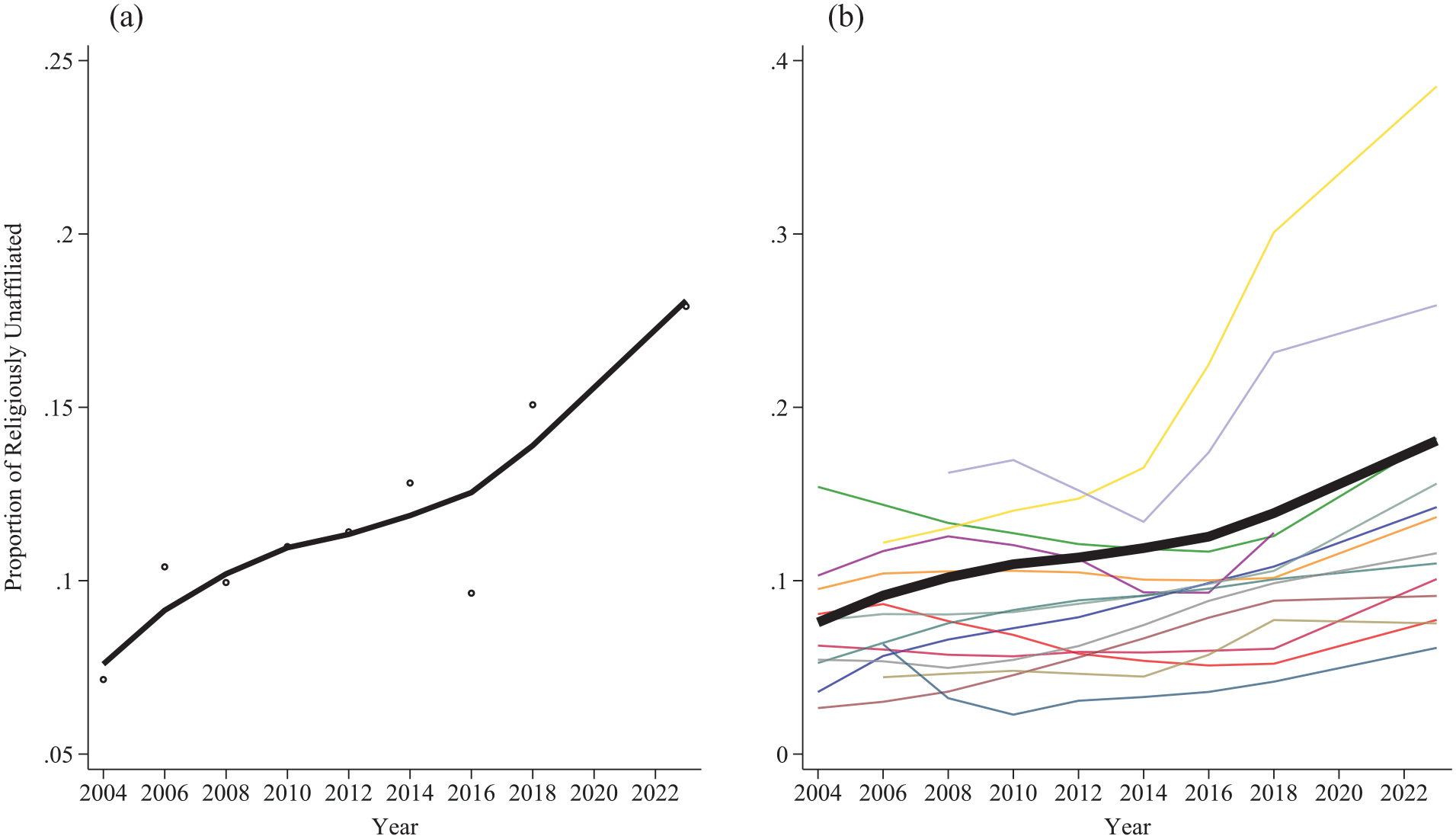
Trends in religious disaffiliation, 2004 to 2023: (a) regional average of national proportions and (b) national trends.
In 2023, 77 percent of AmericasBarometer participants claimed a Christian affiliation of some kind, and 18 percent reported no religious affiliation of any kind. There is significant variation between nations (Table D1 in Appendix D). Uruguay has the highest share of unaffiliated, making up more than half of the population (63 percent). On average, there are more unaffiliated in South America (21 percent) than in Mexico and Central America (13 percent). After Uruguay, Chile, Argentina, and the Dominican Republic have the highest proportion of the unaffiliated, while Paraguay, Peru, and Guatemala have the lowest proportions, at less than 9 percent of the population.
The consistent and unmistakable growth trend in religious disaffiliation across Latin America represents an unprecedented shift in the region’s religious landscape. However, although religious disaffiliation is a significant indicator of secularization, it is essential to also consider other measures of salience and practice for a more nuanced picture of religious dynamics.
Church Attendance and Religious Importance
Considering the debates on how the measurement of religiosity can obscure underlying trends (Schnabel and Bock 2017; Voas and Chaves 2016, 2018), I analyze overall mean values, categorical distributions, and generational patterns of religious importance and church attendance. The AmericasBarometer surveys have included questions about church attendance and religious importance since 2008 and 2010, respectively. These questions are asked to all participants, regardless of religious affiliation. As a reminder, these variables are measured on a scale ranging from 1 to 4, with 4 being the most religious response. Table 1 displays the mean values for church attendance and religious importance for all available years.
Mean Religious Importance and Church Attendance, 2008 to 2023.

Note: This table shows the average scores for church attendance and religious importance each year. Dashes indicate that the question was not asked in that year. Responses are on a scale ranging from 1 to 4, with 4 being the most religious response.
Although mean church attendance is moderately high, there is a clear decrease in over the period from 2008 to 2018, from 2.75 to 2.59. Religious importance remains consistently high across the surveyed years. Although there are minor fluctuations, the overall score stays around 3.4, indicating that religion is considered very important by the population. Overall, these data suggest a generally high and stable level of average religiosity across Latin America, which contrasts with the clear rise of the unaffiliated. However, mean values can obscure underlying patterns in the distribution of responses.
Figure 2 displays the categorical distribution of trends in church attendance and religious importance. Religious importance is plotted with loess-smoothed curves and data points for each year (2010–2023). As there are insufficient observations for loess curves in church attendance, these are plotted with line graphs (2008–2018).

Trends in church attendance and religious importance, 2008 to 2023: (a) church attendance and (b) religious importance.
Although the most common response each year was attending “once monthly,” this group declined modestly from 39 percent in 2008 to 36 percent in 2018. Similarly, the proportion of individuals attending “at least once a week” decreased from 28 percent to 24 percent. These declines are mirrored by a corresponding increase in the share reporting they “never” attend church, which rose from 18 percent to 25 percent during the same period. The “once or twice yearly” category remained relatively stable throughout. These patterns help contextualize the decline in the mean level of church attendance. Notably, despite these declines, between 56 percent and 67 percent continued to report attending church at least once per month across all waves.
For religious importance, the distribution is markedly different. In this measure, the largest category, by far, is those who consider religion “very important,” followed by “somewhat important.” The smaller categories, “not very important” and “not at all important,” each represent about 10 percent of the population or less. There is some noticeable change here: an increase in the “very important” (from 60 percent to 64 percent) group paralleled by a decrease in the “somewhat important” group (from 25 percent to 19 percent), while the other two categories remain stable. This suggests that there might have been some individuals moving from “somewhat important” to “very important,” reflecting a deepening of religious commitment, as hinted at by the trends observed in the mean values.
Generational and Within-Cohort Change
The mean values and categorical distributions for church attendance and religious importance highlights the presence of a persistent, intensely religious majority in Latin America. Alone, these data do not suggest a secularizing trend. However, secularization is a slow process usually driven by generational replacement (Voas and Chaves 2016). As such, this pattern can be difficult to detect, especially without long-term data spanning decades. Examining generational trends in religiosity can help elucidate secularization, even in settings where intense religiosity is the norm (Voas and Chaves 2018).
Figure 3 plots three binary variables of religiosity—religious affiliation, regular church attendance (at least once monthly), and religion being very important—over time by decade of birth. Because of sparse cells, all individuals born before 1940 are aggregated into one group. Individuals born in the 2000s do not appear in the data until 2018. First, as we would expect from the mean values explored earlier, there is an overall within-generation decline in affiliation, a decline in regular church attendance, and an increase in religious importance (except for those born in the 2000s). Moreover, in all three measures, there is a marked difference between the groups, largely decreasing stepwise with each newer birth cohort, with a few exceptions. The smallest differences between cohorts are in affiliation, as being affiliated remains a common, “symbolic attribute” (Norris and Inglehart 2015). Yet between the most religious and least religious birth cohorts, in the latest year, there are ranges of 12, 16, and 21 points for affiliation, regular church attendance, and religious importance, respectively.

Trends in religiosity by decade of birth, 2004 to 2023: (a) religiously affiliated, (b) regular church attendance, and (c) religion very important.
Although Figure 3 reveals clear cohort differences, it does not formally separate how much of the aggregate change over time stems from cohort replacement (younger generations entering the population with different religious profiles) versus within-cohort shifts that occur as people age or respond to period influences. To address this, I apply Firebaugh’s (1989) linear decomposition method, which partitions the total observed change in each religiosity measure into (1) between-cohort effects (generational replacement) and (2) within-cohort effects (shifts occurring over individuals’ lifespans). Table 2 presents the results for religious affiliation, regular church attendance, and high religious importance.
Decomposition of Religious Change into Cohort Replacement and Within-Cohort Components, 2004 to 2023.
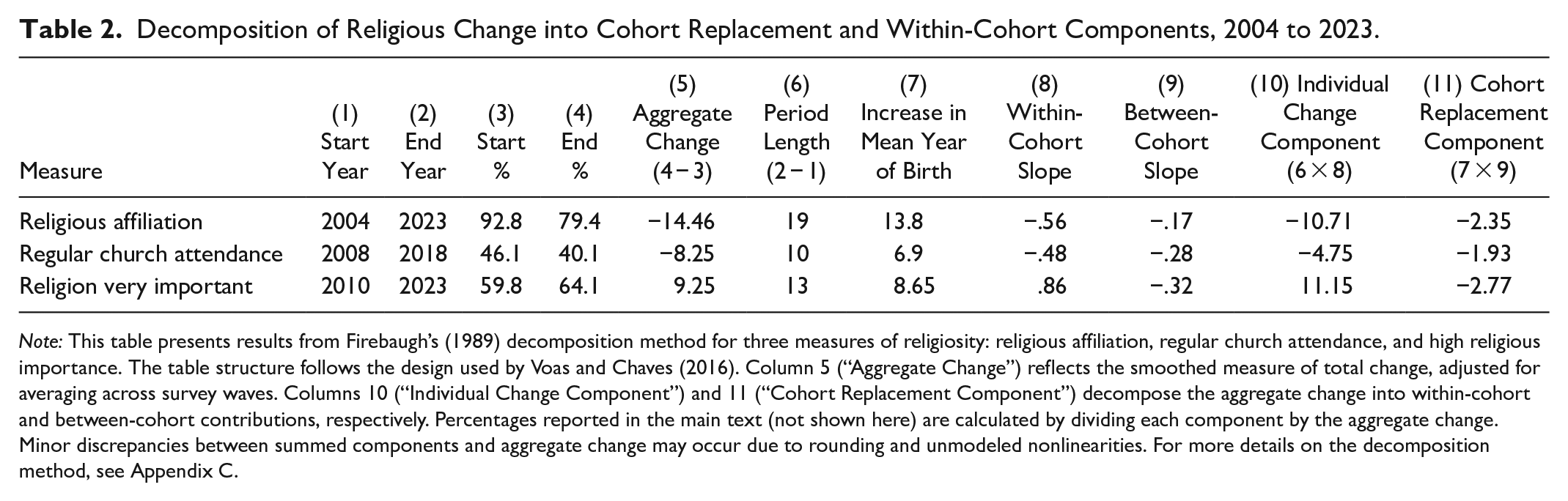
Note: This table presents results from Firebaugh’s (1989) decomposition method for three measures of religiosity: religious affiliation, regular church attendance, and high religious importance. The table structure follows the design used by Voas and Chaves (2016). Column 5 (“Aggregate Change”) reflects the smoothed measure of total change, adjusted for averaging across survey waves. Columns 10 (“Individual Change Component”) and 11 (“Cohort Replacement Component”) decompose the aggregate change into within-cohort and between-cohort contributions, respectively. Percentages reported in the main text (not shown here) are calculated by dividing each component by the aggregate change. Minor discrepancies between summed components and aggregate change may occur due to rounding and unmodeled nonlinearities. For more details on the decomposition method, see Appendix C.
First, although cohort replacement does contribute to institutional religious decline, most of the decline is driven by within-cohort change. Specifically, generational turnover accounts for only about 18 percent of the total decline in affiliation and about 29 percent of the decline in church attendance. The remaining 70 percent or more comes from within-cohort shifts: individual change over time. This contrasts sharply with recent analyses of Western nations, where generational replacement tends to dominate (Voas and Chaves 2016). Second, the increases in religious importance are driven entirely driven by within-cohort gains. A modest negative cohort effect partially offsets that rise. In other words, younger cohorts start slightly lower on religious importance, so if not for that cohort replacement component, the overall increase would be even larger.
However, this decomposition does not fully distinguish how aging might mask (or exaggerate) generational differences. In any given survey year, older generations are compared with younger generations who are at earlier stages in the life course. In other words, older cohorts might appear more devout simply because they are older, not inherently because of when they were born. To address this, Figure 4 plots each religiosity measure by age, within each cohort, thus holding age constant across cohorts and providing a clearer picture of how younger generations compare with older ones at the same stage of life.
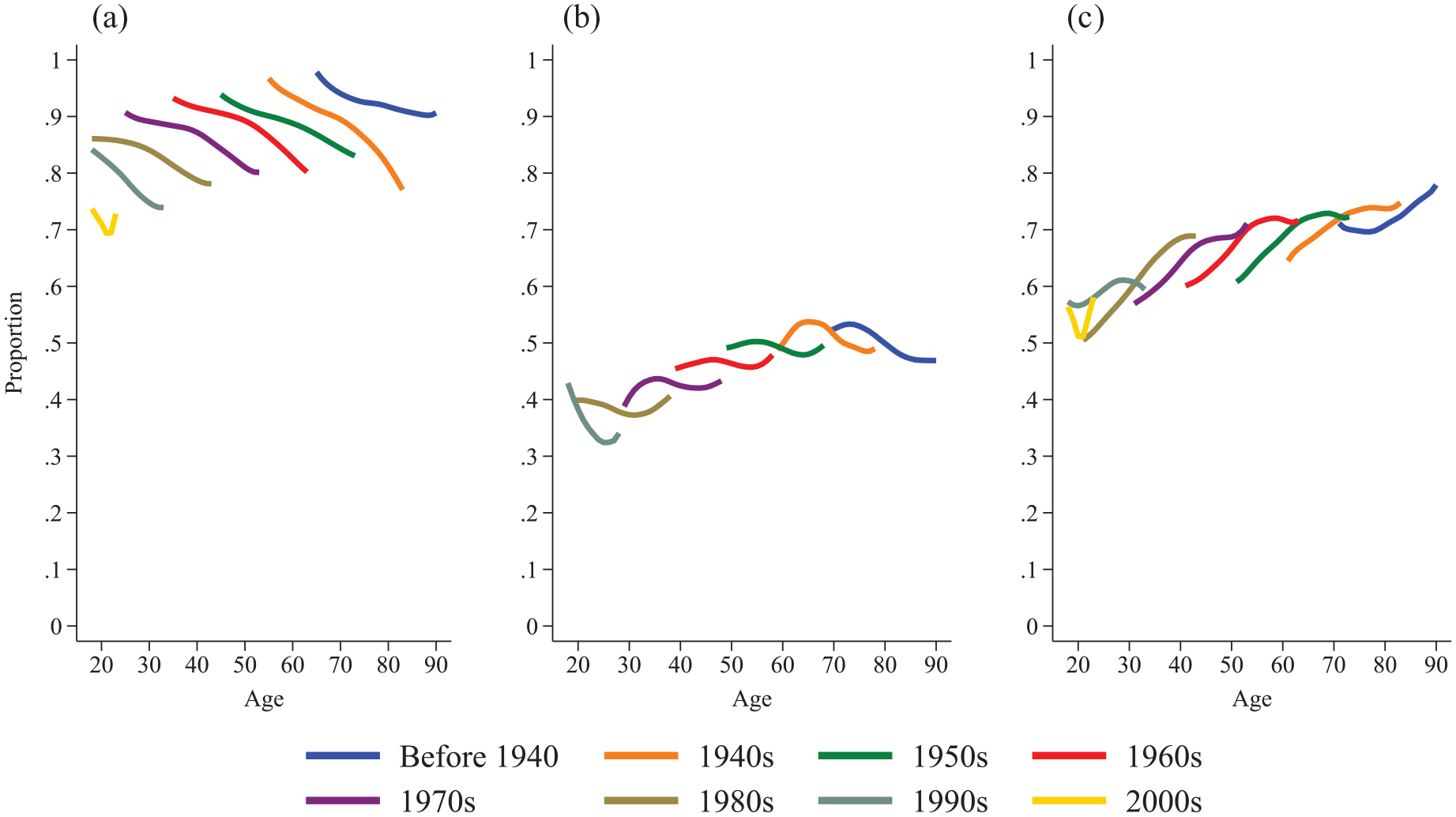
Age-specific trends in religiosity by decade of birth: (a) religiously affiliated, (b) regular church attendance, and (c) religion very important.
Generational gaps in affiliation and attendance are smaller when viewed by age, but newer cohorts remain less institutionally religious than older ones were at the same age. For example, at age 30, 89 percent of those born in the 1970s reported being religiously affiliated, compared with 84 percent of those born in the 1980s and only 74 percent of those born in the 1990s. At age 60, 58 percent of those born in the 1940s report regular church attendance, while only 48 percent of those born in the 1950s did. In contrast, again, religious importance follows a markedly different pattern. Newer cohorts are more likely to value religion as “very important” at the same age. For instance, at age 30, 55 percent of those born in the 1970s reported high religious importance, compared with 59 percent of those born in the 1980s and 62 percent of those in the 1990s. At age 53, 63 percent of those born in the 1950s reported high religious importance, while 70 percent of those born in the 1960s and 75 percent of those born in the 1970s did.
In summary, in Latin America, most people are affiliated with Christianity, a significant share (though fewer) value religion, and even fewer attend church regularly. Institutional religiosity is in decline, with clear, stepwise decreases by birth cohort. Even when comparing by age, younger cohorts are less institutionally religious than older ones when measured at the same life stage. However, while these declines partly operate through generational turnover, they are mostly through broad within-cohort declines evident in a relatively short period of time. Religious importance does not follow this pattern. Driven entirely by within-cohort increases, religious importance continues to climb despite a small negative birth-cohort effect. However, despite starting at lower levels, younger generations demonstrate higher levels of religious importance than older generations when measured at the same age. This suggests that if these strong within-cohort increases remain stable, newer cohorts may eventually catch or even surpass older cohorts’ levels of personal devotion.
So, is Latin America secularizing, and what is the nature of that secularization? As discussed earlier, the answer depends on how secularization is conceptualized. If defined through traditional institutional measures—declining affiliation and church attendance—then Latin America is indeed experiencing secularization. However, this process is fragmented. Unlike in Western contexts, where institutional decline is typically accompanied by a broader erosion of belief, Latin America exhibits a distinct decoupling of institutional and personal religiosity. In the next section, I assess the role of modernization and existential security, traditionally viewed as drivers of secularization, in assessing these trends.
What Explains Secularization in Latin America?
What factors best explain Latin American patterns of religious decline? I begin by examining the relationships between religiosity and national-level secularization indicators through correlations and fixed-effects regression models, before moving to an analysis of individual-level predictors of secularization.
National-Level Predictors of Secularization
Table 3 presents correlations between the religious variables of affiliation, attendance, and importance, and national-level indicators from previous decades. 14 Religious measures are national means from the latest available year: 2023 for religious affiliation and religious importance, and 2018 for church attendance.
Correlation Matrix of Religious Measures and National-Level Predictors.

Note: This table presents pairwise correlation coefficients at the national level (n = 17). The religious measures are national means from the latest available year: 2023 for religious affiliation and religious importance, and 2018 for church attendance. National-level predictors are drawn from earlier decades.
p < .05. **p < .01. ***p < .001.
With a few exceptions, nearly all the measures are highly, negatively correlated with the dimensions of religiosity, with most correlation coefficients greater than .7. The strongest association for all three religious measures was with urbanization—the proportion of the population living in urban areas in 1980. In contrast, life expectancy at birth in 1980 had the weakest association with all dimensions of religiosity. Affiliation was the least correlated with the national predictors, with life expectancy showing no significant relationship. On the other hand, church attendance exhibited the strongest overall correlation with the predictors.
To further evaluate these relationships, I constructed a panel dataset of time-varying national-level predictors matched to the survey waves of the AmericasBarometer (2004–2023). Although the correlation matrix highlights relationships between countries, this dataset includes repeated measures for all countries, enabling an analysis of within-country changes over time. I estimate fixed-effects OLS regression models to isolate the relationships between national-level predictors (lagged by one year) and religious measures. This approach rigorously accounts for all immutable characteristics of countries, such as their religious history, cultural legacies, or colonial past, that could otherwise confound the analysis.
Figure 5 presents coefficient plots from these models. All predictors are standardized, with each coefficient reflecting the predicted change in the religious measure per 1 standard deviation increase in the corresponding predictor. Figure 5a illustrates the predicted change in the national proportion of people affiliated with a religion. Figures 5b and 5c depict the effects on the national means of church attendance and religious importance.

Within-country fixed-effects ordinary least squares regressions of national-level predictors on religious affiliation, religious importance, and church attendance.
For religious affiliation, urbanization and expected schooling, both indicators of modernization, emerge as the strongest predictors. For instance, a 1 standard deviation increase in urbanization is associated with a 1.1 percent decrease in the proportion of the religiously affiliated in the following year in the average country. The patterns for church attendance are similar, will all measures negatively associated with the national mean of church attendance.
In contrast, all indicators are positively associated with religious importance. The coefficients for urbanization and life expectancy are both statistically significant, with urbanization showing the strongest effect. This within-country pattern diverges from the cross-national correlations, where secularization indicators are negatively associated with religious importance. Although countries with higher levels of modernization tend to exhibit lower religious importance overall, increases in modernization within countries over time are linked to heightened personal or cultural expressions of religiosity.
Individual-Level Predictors of Secularization
Having examined the national-level predictors of secularization, I now turn to individual-level factors. Table 4 displays the sociodemographic profile of the religiously unaffiliated and affiliated in Latin America, including all the variables used in the subsequent models. The unaffiliated are younger and more likely to be male and unmarried. Sixty-one percent of the unaffiliated are men, while most affiliated are women (53 percent). On average, the unaffiliated are four years younger than their affiliated counterparts and are much less likely to be married (23 percent vs. 38 percent).
Sociodemographic Profile of Religiously Unaffiliated and Affiliated Individuals in Latin America.

Note: The data presented in this table are drawn from the full sample of AmericasBarometer surveys conducted from 2004 to 2023, excluding the 2021 wave (n = 241,013). Statistical significance of group differences was determined using design-based Pearson chi-square tests for categorical variables and survey-adjusted regressions for continuous variables, with all differences found to be significant at p < .001.
The unaffiliated also tend to be wealthier, more educated, and more likely to live in urban areas. The unaffiliated in Latin America are thus a group with consolidated privilege: predominantly male, educated, urban, and wealthy. All group differences were statistically significant (p < .001), as determined using Pearson’s χ2 tests and survey-adjusted regressions.
To extend this analysis, I estimate models predicting the three key measures of religiosity: religious affiliation, and church attendance, and religious importance (Table 5). The models include standardized individual-level predictors that align with the theoretical frameworks for explaining secularization. Education and urbanity are indicators of the modernization framework and household wealth represents existential security. Additional controls are also standardized, and fixed effects for country and survey wave are included but not displayed in the table.
Logistic and Ordinary Least Squares Regression Models for Religious Affiliation, Church Attendance, and Religious Importance.
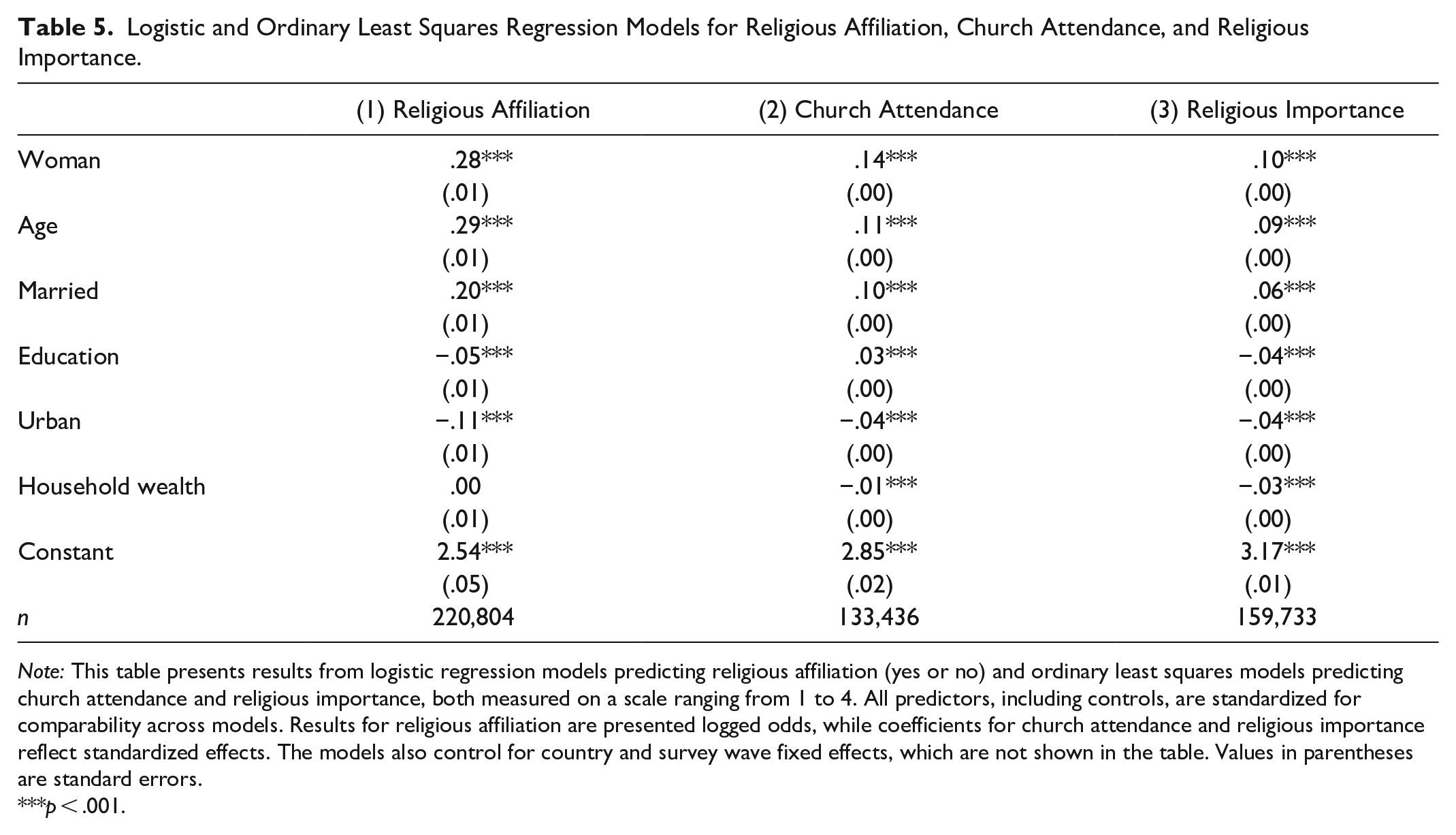
Note: This table presents results from logistic regression models predicting religious affiliation (yes or no) and ordinary least squares models predicting church attendance and religious importance, both measured on a scale ranging from 1 to 4. All predictors, including controls, are standardized for comparability across models. Results for religious affiliation are presented logged odds, while coefficients for church attendance and religious importance reflect standardized effects. The models also control for country and survey wave fixed effects, which are not shown in the table. Values in parentheses are standard errors.
p < .001.
Religious affiliation is modeled using logistic regression, with results presented as log-odds coefficients. For religious importance and church attendance, I use OLS models to predict outcomes treated as continuous measures on a scale ranging from 1 to 4.
Overall, individual-level predictors aligned with the theoretical frameworks are significantly associated with secularity. 15 Within the modernization framework, urban residence had the strongest and most consistent negative association with religiosity across all measures, showing the largest standardized coefficients in magnitude. Education was negatively associated with both religious affiliation and religious importance. However, education was a statistically significant positive predictor of church attendance. In terms of existential security, household wealth was not associated with religious affiliation but was a significant negative predictor of both religious importance and church attendance. Across all three outcomes, education and household wealth are relatively smaller in magnitude.
Although the previous section established clear trends of declining religiosity in Latin America, these findings provide additional depth by identifying key drivers of this change. At both the national and individual levels, institutional religious decline is strongly associated with modernization and existential security, core mechanisms posited by secularization theory. However, religious importance does not follow a straightforward secularization trajectory. Although cross-national and individual-level analyses show negative associations with modernization, within-country changes reveal a more complex pattern, with key indicators, such as urbanization and life expectancy, positively linked to religious importance over time.
In What Ways Does Latin American Secularization Differ from Western Patterns?
Latin American secularization is fragmented, with institutional and personal religiosity following distinct trajectories and driven by different factors. In particular, the unique behavior of religious importance diverges from the more comprehensive secularization processes observed in Western Europe and the United States. To explore additional ways in which secularization in Latin America differs from Western patterns, I conduct a comparative analysis of theism, church attendance, and religious importance among the unaffiliated. Then, I use factor analysis to assess whether the relationships between affiliation, attendance, and religious importance in Latin America are distinct from those in other regions.
Religious disaffiliation does not imply atheism or even agnosticism. As previously mentioned, the majority of the unaffiliated in Latin America are religious “nones,” or those who believe in a supreme being but do not belong to any particular religion (Pew Research Center 2014). How does this compare? In Figure 6, I compare individual Latin American countries with Western European countries and the United States on the overall share of the unaffiliated that believe in God or a higher power.

Belief in God among the unaffiliated: a comparison among Latin America, the United States, and Western Europe, 2018.
These data reveal a stark contrast between regions. In the average Latin American country, 86 percent of the unaffiliated still believe in God or a supreme being. In the top eight countries, this represents more than 90 percent of the group. This trend contrasts sharply with Western Europe, where on average only 30 percent of the unaffiliated believe in God or a higher power. In no European country do theists even make up half of the overall unaffiliated population. In the lowest countries, such as Switzerland, Austria, and the United Kingdom, fewer than 20 percent of the unaffiliated believe in God. The United States sits between these extremes, with a notable share of the unaffiliated maintaining belief in a higher power, though less than in most Latin American countries.
These distinctions remain consistent in measures of church attendance and religious importance. Figure 7 presents a cross-tabulation of the unaffiliated population in Latin America, the United States, and Western Europe based on two variables: frequency of church attendance (horizontal axis) and the importance of religion in one’s life (vertical axis). Each cell represents the percentage of the unaffiliated population that fits into the corresponding category for both variables. Row and column totals are included to provide the overall distribution of each variable within the unaffiliated populations. Row totals represent the distribution of the importance of religion regardless of church attendance, while column totals represent the distribution of church attendance regardless of the importance of religion.
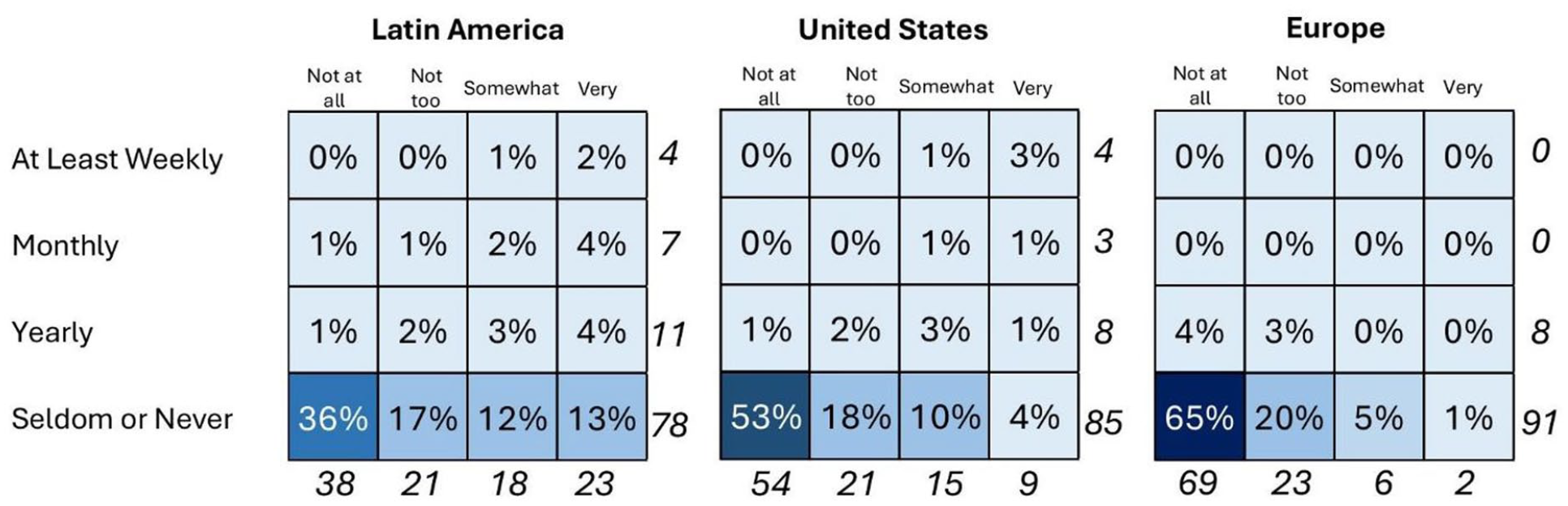
Cross-tabulation of church attendance and religious importance among the religiously unaffiliated in Latin America, the United States, and Western Europe, 2018.
For example, the cell in the first row and first column of the Latin America subgraph shows that 0 percent of the unaffiliated population attend church at least weekly and report that religion is not at all important in their lives. The row total for this cell is 4 percent, indicating that 4 percent of the unaffiliated population in Latin America attend church at least weekly, irrespective of how important religion is in their lives. Similarly, the column total is 38 percent, meaning that 38 percent of the unaffiliated population in Latin America consider religion to be not at all important, irrespective of how often they attend church.
At first glance, there are similarities between the subgraphs. In all three regions, the largest group is individuals who seldom or never attend church and report that religion is not at all important in their lives (bottom left cell). The second largest group across regions is those who seldom or never attend church and report religion as “not too” important. Among the Latin American unaffiliated, however, there is much more diversity in attendance and importance combinations. Here, the largest cell constitutes only 36 percent of the group, compared with 53 percent in the United States and 65 percent in Western Europe. Although 11 percent of the Latin American unaffiliated attend church at least monthly, the share is only 7 percent in the United States and 0 percent in Europe. The proportion of unaffiliated individuals who seldom or never attend church also varies across regions: 78 percent in Latin America, 85 percent in the United States, and 91 percent in Western Europe.
The differences in religious importance, however, are more stark. In Latin America, 23 percent report religion being very important in their lives, compared with only 9 percent in the United States and 2 percent in Europe. Forty-two percent of the Latin American unaffiliated consider religion at least somewhat important, almost twice as many as in the United States (24 percent) and five times more than in Europe (8 percent). Scholars have been critical of the measures of religious affiliation and church attendance for failing to capture the personal, dynamic religiosity in Latin America (Morello et al. 2017). Religious importance, however, could be interpreted differently: the question is about religious importance in the participant’s life, not an affiliation or participation in religious institutions. This raises another question about the distinctiveness of Latin American secularization: do the relationships between these measures of religiosity (affiliation, church attendance, and religious importance) differ in Latin America compared with Europe and the United States?
Although previous research in Western Europe has shown high internal consistency among religiosity measures, often combining them into a single scale (Brauer 2018; Voas 2009), 16 lower internal consistency (α = .69) in this Latin American sample suggests weaker alignment. 17 This further justifies analyzing each measure separately. To assess how these measures align in Latin America, the United States, and Europe, I conduct a factor analysis.
Figure 8 compares factor analysis results for Latin America, the United States, and Europe. Factor analysis examines how well different measures group together into a single concept. The graph shows three key statistics: the overall eigenvalue, which indicates how much variance is explained by the factor; the factor loading, which reflects the strength of the association between a specific measure (in this case, religious importance) and the factor; and the uniqueness, which captures the variance in religious importance not explained by the factor.

Factor analysis of religiosity measures in Latin America, the United States, and Europe, 2018.
These results highlight regional differences in the relationships among measures of religiosity, suggesting that they are less cohesively aligned in Latin America compared with the United States and Europe. For example, the eigenvalue for Latin America (1.33) is substantially lower than those for the United States (1.8) and Europe (1.66), suggesting weaker internal consistency among these measures. The factor loading for religious importance in Latin America is 0.72, compared with 0.91 in Europe and 0.94 in the United States, indicating that religious importance is less closely tied to the other measures in Latin America. Similarly, the uniqueness of religious importance in Latin America (0.48) is much higher than in Europe (0.17) and the United States (0.12), reflecting its distinct role in the region.
Classic comparisons often highlight stark differences between the United States and Western Europe; however, Latin America emerges as even more distinct in its patterns of secularization. Strong majorities of the unaffiliated in Latin America believe in God or a higher power, and nearly half consider religion at least somewhat important in their lives. Factor analysis results further reveal that religiosity measures in Latin America are less cohesively aligned, with religious importance showing high uniqueness and weaker associations with institutional measures. Together, these comparative analyses further reinforce that secularization in Latin America follows a distinct trajectory, one in which institutional and personal religiosity are not tightly linked, disaffiliation does not often lead to atheism or agnosticism, and personal devotion remains resilient even amid declining affiliation and attendance.
Discussion and Conclusion
Summary of Results
This study analyzes religious trends in Latin America using AmericasBarometer data (2004–2023) from 17 nations. The findings unearth new insights into secularization in the region. First, institutional secularization, measured by declines in religious affiliation and church attendance, follows the trajectory predicted by secularization theory, driven by modernization, and, to some extent, generational replacement. Second, this secularization is fragmented: although institutional religiosity is diminishing, personal religiosity remains strong and, in some cases, is even growing. Third, further comparisons reveal that the unaffiliated in Latin America retain significantly higher levels of religious belief and practice than their counterparts in Europe and the United States, and overall, religious importance exhibits weaker correlations with institutional measures of religiosity. These findings advance both secularization theory and the study of religious change in Latin America. The following sections outline the study’s three key contributions.
Latin America’s Institutional Secularization: Patterns and Drivers
Bruce and Voas (2023) emphasized that secularization theory was originally developed to explain past religious decline in the West. If secularization theory accurately explains religious decline there, then it should also predict similar patterns in other societies undergoing modernization “in ways similar to the European experience” (Bruce 2001:201). However, they acknowledge two key complications: modernization does not unfold uniformly across contexts, and the existence of already secularized societies alters how secularization might progress elsewhere (Bruce 2011:180; Bruce and Voas 2023). Although applying and testing the secularization paradigm outside of the West is “highly partisan politics” (Bruce 2011:177), doing so is essential for refining the framework and understanding how secularization unfolds in diverse global contexts.
This study takes up that challenge in Latin America. Its first key contribution is providing robust, long-term empirical evidence that when secularization is understood through its most common conceptualization 18 —declines in religious affiliation and church attendance associated with modernization and generational change—Latin America is indeed secularizing. These declines parallel those observed in Western Europe and, more recently, the United States. This finding underscores the continued relevance of secularization theory, while raising a critical question: will Latin America following the same trajectory as the West, or is its secularization distinct?
A Fragmented Process: Institutional Decline and Resilient Belief
The second contribution of this study is uncovering a fragmented pattern of secularization in Latin America, where institutional religious decline does not correspond with a broader erosion of personal belief. Instead, religious importance remains resilient and, in some cases, is even increasing. This pattern contrasts sharply with trends in Western Europe and the United States, where institutional decline is typically linked to declines in personal religiosity (Aarts et al. 2008; Brauer 2018; de Graaf and te Grotenhuis 2008; Field 2022; Inglehart 2021; Voas 2009; Voas and Crockett 2005). 19 Furthermore, the unaffiliated in Latin America retain higher levels of religious belief and practice than in the West, and religiosity measures exhibit weaker internal consistency, reinforcing the region’s distinct patterns of religious change.
Secularization theory’s core predictions are contingent on modernization unfolding in ways comparable with the European experience, characterized by rising “peace, political stability, and prosperity” (Bruce 2011:201). Latin American modernity clearly does not meet this definition, so even by their own metric, secularization theorists would not predict the “nature and status of religion also to change in similar ways” in the region (Bruce 2011:201). At the same time, the institutional religious decline observed in Latin America is fully consistent with traditional secularization theory. However, where the theory faces a challenge is in explaining ubiquitous, flourishing personal religiosity. Because secularization frameworks focus on institutional decline, they often overlook religious belief and meaning outside formal structures, leaving unresolved questions about the persistence of belief in places like Latin America.
This fragmented secularization reflects deeper historical and structural factors. For centuries, religiosity in Latin America has thrived outside formal structures, shaped by cultural hybridization, religious syncretism, and decentralized devotional practices (de la Torre 2012; Parker 1996; Semán 2001). At the same time, peripheral modernization in Latin America has been characterized by persistent inequality, precarious development, and deep social stratification (Morello 2021; Parker 1996:53). These conditions have weakened institutional religious authority while simultaneously fueling popular religiosity as an anchor, a plausibility structure resilient against even the most destabilizing forces of an uneven modernity (Parker 1996).
This also helps explain an otherwise counterintuitive finding: as Figure 5 shows, although modernization indicators predict within-country declines in institutional religiosity over time, they are also associated with increases in personal religiosity. Although this seems contradictory from a traditional secularization framework, it aligns with Parker’s explanation of how modernization in Latin America weakens formal institutions while simultaneously fueling alternative religious expressions. This response is not anomalous but instead reflects the distinctive epistemology of Latin American popular thought, which follows a “different logic” than the West (Parker 1996). 20 In this “syncretic thought . . . magical and modern scientific rationalities coexist,” there is no division between the sacred and the profane, and religion remains central to “meaning-core” of Latin American popular culture (Parker 1996:233, 251).
Toward an Integrated Approach: Neosecularization, Popular Religiosity, and Lived Religion
The final contribution of this study is the integration of the neosecularization paradigm with insights from popular religiosity and lived religion, modeling an approach that builds on secularization theory while addressing its blind spots. More broadly, this synthesis provides a theoretical lens that can be applied to other non-Western contexts where modernization unfolds differently from the classic Western experience.
Although traditional secularization theory struggles to explain resilient personal belief, the neosecularization paradigm, which shifts the focus from religious decline to changing religious authority, does not (Chaves 1994; Yamane 1997). In fact, Latin American fragmented secularization is entirely consistent with neosecularization’s emphasis on the retraction of religious authority rather than the disappearance of belief. However, as neosecularization theory explicitly “abandons religion as an analytical category when studying secularization,” (Chaves 1994:750) it lacks the tools to explain how religiosity persists and evolves outside institutional structures. Theories of popular religiosity and lived religion (Morello 2021; Parker 1996) help fill this gap by offering tools for understanding how individuals and communities sustain, transform, and create religious meaning beyond formal institutions.
Applying a neosecularization lens allows scholars to avoid being trapped between competing claims, either downplaying personal religiosity to fit traditional secularization models or dismissing secularization altogether. Instead, this approach suggests a more empirical and systematic strategy: rather than making sweeping claims about the total trajectory of religion, scholars can analyze all available measures and distinguish between dimensions of religious authority (such as institutional affiliation, church attendance, or doctrinal adherence 21 ) and dimensions of personal belief and religious salience. By doing so, researchers can separate institutional and personal religiosity, recognizing that different dimensions of religious life may follow different trajectories over time.
This approach has broader relevance for secularization research beyond Latin America. Just as this region has its own version of “enchanted modernity” (Morello et al. 2017), other non-Western societies also experience modernization in ways that produce distinct popular religious responses (Parker 2019; Smith and Vaidyanathan 2010). Moreover, although these findings highlight the broad variability of secularization even within Christian-majority societies, greater divergence is likely across societies with difference religious traditions or greater religious pluralism—and even within the West, recent research points to a growing divergence between institutional and personal religiosity (Schnabel et al. 2025).
Limitations and Conclusion
This study is not without its limitations. First, although it examines data spanning approximately 20 years, this time frame is much shorter than the decades of data from Western contexts that have shaped secularization theory. However, this limitation is mitigated by the breadth of the analysis, which includes 17 countries and represents one of the most comprehensive quantitative studies of religious change in Latin America to date. Second, although the data capture macro-level trends, they cannot illuminate the nuanced meanings individuals attach to considering religion “important” in their lives. However, they complement existing qualitative scholarship (de la Torre 2021; Morello 2021) by providing population-level insights that contextualize individual experiences within religious shifts.
In conclusion, this study demonstrates that although traditional secularization theory explains institutional decline, it fails to account for persistent personal religiosity in Latin America. By integrating the neosecularization paradigm with theories of popular and lived religion, this study advances a more flexible framework that captures both institutional decline and enduring belief beyond formal structures. This synthesis not only refines secularization theory but also provides a model applicable to other non-Western contexts.
Supplemental Material
sj-docx-1-srd-10.1177_23780231251369926 – Supplemental material for Institutional Decline and Resilient Belief: Understanding Secularization in Latin America
Supplemental material, sj-docx-1-srd-10.1177_23780231251369926 for Institutional Decline and Resilient Belief: Understanding Secularization in Latin America by Matthew Blanton in Socius
Footnotes
Acknowledgements
I am grateful to Abigail Weitzman, Jeffrey Swindle, Ken-Hou Lin Brooke Whitfield, and Carolina Aragão for their instructive feedback on this study. I am also appreciative of the members from the Association for the Sociology of Religion, the Society for the Scientific Study of Religion, and the Population Association of America for their insightful perspectives shared during paper sessions at their annual conferences. I am further indebted to the anonymous reviewers for feedback that significantly strengthened this work. All remaining errors are my own.
Author’s Note
The content is solely the responsibility of the author and does not necessarily represent the official views of the National Institutes of Health.
Funding
The author disclosed receipt of the following financial support for the research, authorship, and/or publication of this article: This research was supported by grants P2CHD042849 and T32HD007081 awarded to the Population Research Center at the University of Texas at Austin by the Eunice Kennedy Shriver National Institute of Child Health and Human Development.
Data Availability Statement
Supplemental Material
Supplemental material for this article is available online.
1
Although there is a large and contentious literature on secularization theory, in this article, I do not attempt to provide an exhaustive review. Instead, I focus on the dimensions of secularization most relevant to the research questions and the empirical case of Latin America. For a comprehensive review, see  .
.
2
3
Drawing inspiration from Weber, Chaves defined a religious authority as a “social structure that attempts to enforce its order and reach its ends by controlling the access of individuals to some desired goods, where the legitimation of that control includes some supernatural component, however weak” (pp. 755–6).
4
Chaves did not use the term neosecularization. However, contended that Chaves’ framing of secularization as “declining religious authority” was the “key contribution” to the development of neosecularization theory, which had been informally advanced by different scholars (p. 115). Throughout this article, I use the term neosecularization to refer to the work of both Chaves and Yamane.
5
6
7
8
The 2021 wave did not include questions on religious affiliation, religious importance, or church attendance.
9
In certain survey waves, Judaism was included as an option, while it was not in others. Only in Brazil, respondents were also asked about Spiritism. I include both groups in “other.” Sample sizes are as follows: Catholic, n = 150,772; Protestant, n = 49,595; unaffiliated, n = 25,932; and other, n = 3,878.
10
For direct statistical comparisons between the affiliated and unaffiliated groups, I excluded the “other” category to focus solely on the differences between these two groups.
11
Prior to 2023, education was coded as years of completed schooling. In 2023, a categorical variable for educational attainment was introduced. For this analysis, I generated a new harmonized variable, where categorical responses from 2023 were converted to approximate years of schooling.
12
Although I pool data to highlight regional trends, I recognize the dangers of generalizing across diverse national contexts, agreeing with others who have noted, “Any broad generalization about the Latin American religious landscape . . . would be misleading” (:124). When possible, I comment on whether key patterns hold across individual countries.
13
Uruguay is excluded for visual clarity because of its significantly higher values.
14
I also analyzed these correlations with measures from the most recent available years and found that, in every case, the older measures were better predictors of secularization outcomes.
15
The direction and relative magnitude of associations are largely consistent when models are estimated separately by country, using smaller national samples (n ≈ 7,000–14,000), reinforcing the robustness of these patterns across contexts.
16
18
Despite theoretical advancements, most contemporary empirical research still simplifies secularization to individual religious decline. Even after Chaves’s (1994) “radical suggestion” that secularization is best understood as a decline in religious authority (p. 754), in later work, he defined and operationalizes it with individual patterns of affiliation, attendance, and belief ().
19
20
Drawing from Latin American philosophers, recognized that although there is not a “universal popular thought for the entire Latin American continent . . . there are analogous thought processes, corresponding to structural and historical situations that are analogous as well, which do engender a determinate style, a particular type of mentality” (p. 240).
21
Yamane (1997) argued that the “quantities of individual religious beliefs and behaviors” are not the relevant data for testing the decline of religious authority (p. 116). Rather, scholars should assess “the orientation people have to religious authority structures” (Yamane 1997:116). similarly recommended novel measures on individual beliefs and practices prescribed or decried by religious authorities, such as religious intermarriage, reproductive behavior, voting, and others (p. 768). In this study, I operationalize religious authority through institutional affiliation and church attendance, while religious importance and theism reflect personal religiosity, dimensions that, in the neosecularization paradigm, are extraneous to secularization.
Author Biography
References
Supplementary Material
Please find the following supplemental material available below.
For Open Access articles published under a Creative Commons License, all supplemental material carries the same license as the article it is associated with.
For non-Open Access articles published, all supplemental material carries a non-exclusive license, and permission requests for re-use of supplemental material or any part of supplemental material shall be sent directly to the copyright owner as specified in the copyright notice associated with the article.
