



Abstract
The extended complex Ginzburg-Landau equation serves as a fundamental model for nonlinear wave dynamics, governing diverse physical phenomena ranging from particle motion in plasmas to pulse propagation in optical fibers. In this study, we introduce a hybrid analytical-machine learning framework that synergizes traditional mathematical techniques with modern data-driven approaches to comprehensively explore soliton dynamics within this system. First, we employ two advanced analytical methods, the modified Riccati extended simple equation methodology and the new modified generalized exponential rational function approach to derive a rich spectrum of nonlinear wave solutions. These include bright, dark, kink, and combined solitons, alongside hyperbolic, periodic, and exponential function solutions, thereby providing a comprehensive analytical foundation. On these analytical insights we construct a hybrid symbolic-numeric model, implemented by a multilayer perceptron regressor neural network, to find and synthesize soliton solutions to data. The key soliton types such as dark and bright solitons, combined solitons, and periodic solitons are well represented by the proposed framework with high levels of concurrence with the analytical benchmarks as seen by the low error measures. This combination provides a common platform that allows connecting classical analysis methods with modern machine learning, allowing creating as well as effectively simulating nonlinear wave behavior. This work paves the way to the frontiers of the physics of higher dimensional nonlinear waves by demonstrating the utility of this hybrid approach and highlighting some fundamental nonlinear dynamical properties of the model under consideration, and provides a paradigm that can be extended to understand the phenomena involving complex waves in interdisciplinary contexts.
Keywords
1. Introduction
The study of integrability of any of the forms of nonlinear evolution equations is important in understanding the dynamics of nonlinear waves as well as other related properties. These equations, which characterize time-dependent processes, are often developed from nonlinear partial differential equations (NLPDEs). NLPDEs are now an essential tool for modeling and analyzing natural phenomena in scientific and engineering systems. 1 Mathematical modeling plays a significant role in the analysis and understanding of physical events by engineers and scientists working in the applied field. 2 Solitons, NLPDEs and the Korteweg-de Vries (KdV) equation are concepts that are related to the mathematical sciences. 3 They assist us in comprehension and modeling about the complex systems in nature and engineering. Nonlinear science is the study of disproportionate interactions among variables in a system that can cause chaos, complex patterns and an increase in sensitivity to initial conditions, making it a phenomenon that can result in chaos and complex forms as well as sensitivity of the system to initial conditions. Nonlinear systems can often be meteorology, fluid dynamics and biological systems. NLPDEs are also useful in representing these systems showing how events vary in time and space as nonlinear science is difficult to predict and understand complex systems since relatively small changes can have extremely different impacts. 4
It is a balance between nonlinearity and dispersion that allows solitons to exist as localized wave packets that travel long distances without altering their shape or speed. The study of the behavior of waves and the basic ideas of nonlinear dynamics are fundamental to a broad scientific field which includes plasma physics, fluid mechanics, nonlinear optics, and condensed matter physics. 5 The KdV equation 6 and the nonlinear Schrodinger equation (NLSE) 7 are two paradigm models in this area, which are useful in modeling many diverse physical phenomena, including shallow water waves, fibre optical pulse propagation, and the dynamics of BoseEinstein condensates. In contrast to linear partial differential equations (PDEs), where wave packets irreversibly disperse because of dispersion or diffusion, nonlinear evolution equations can support coherent self-reinforcing structures called solitons. The secret of this extraordinary stability is that, nonlinearity cancels dispersive broadening, and solitons can preserve their integrity on arbitrarily long scales. The nonlinear nature of these equations therefore allows us to learn more about the transport of energy, the interactions between waves and how coherent structures arise out of apparently chaotic processes. Solitons are used in numerous technologies, including fusion dynamics, optical coupling deviation, controllers, and sensors.8,9
In recent years, numerous strategies have been successfully implemented, such as: a novel Jacobi elliptic function expansion technique is employed to investigate a variety of soliton solutions in the (2+1)-dimensional nonlinear electrical transmission line model, as detailed in 10 . The generalized exponential rational function approach, as described in 11 , is used to study the solitary wave dynamics and interaction phenomena of the ultrasonic model. The fractional resonant Schrödinger equation is examined using the auxiliary equation methodology. 12 The chaos and sensitivity analyses, together with the solutions to the truncated fractional telegraph equation, are analyzed in 13 . The Riccati equation mapping technique has been used to examine Brownian motion inside the stochastic Schrödinger wave equation. 14 The solitons of the cubic-quartic nonlinear Schrödinger equation have been examined using the Bernoulli G′/G-expansion technique. 15 The extended nonlinear equation was explored by modified Sardar sub-equation technique. 16 The neural network approach was applied to extract the exact solutions.17,18
With recognition of the importance in many domains, we examine in this work the complex Ginzburg–Landau equation and the nonlinear dynamic properties of soliton solutions. This work’s primary innovation is the utilization of sophisticated, innovative techniques to acquire multiple types of soliton solutions by the application of the advanced integration techniques, such as the modified Riccati extended simple equation technique (RMSEM) 19 and the new modified generalized exponential rational function method (nGERFM). 20 Then, core part of this work is the application of the multilayer perceptron regressor neural network for observing the performance of the soliton solutions. Machine learning improves task performance without explicit programming by identifying patterns in data. In this particular research, the supervised learning is used, and the training models are provided with labeled data, which is divided into training and testing sets to measure the predictive accuracy. Machine learning refers to a revolution in the field of artificial intelligence. It enables computers to learn and become better at data with no explicit programming of each task. Machine learning models can predict and make intelligent decisions by detecting complicated patterns and relationships in the datasets. Its methods include both supervised learning based on labeled data and unsupervised methods based on the discovery of hidden structures.
The findings indicate that the methodologies used are not only beneficial but also strong enough; they can be taken as effective tools having a great impact on engineering and research. The strategies determine substantial results that are progressing in many branches of science and produce new waveforms and solitons. The application of these tools has improved our comprehension of nonlinear dynamics and facilitated the identification of effective solutions. Researchers emphasize the significance of these techniques due to their adaptability; they offer new alternatives for examining nonlinear systems and improve comprehension within that domain. The study has the following sequence as shown in the Figure 1. Flow chart of the study.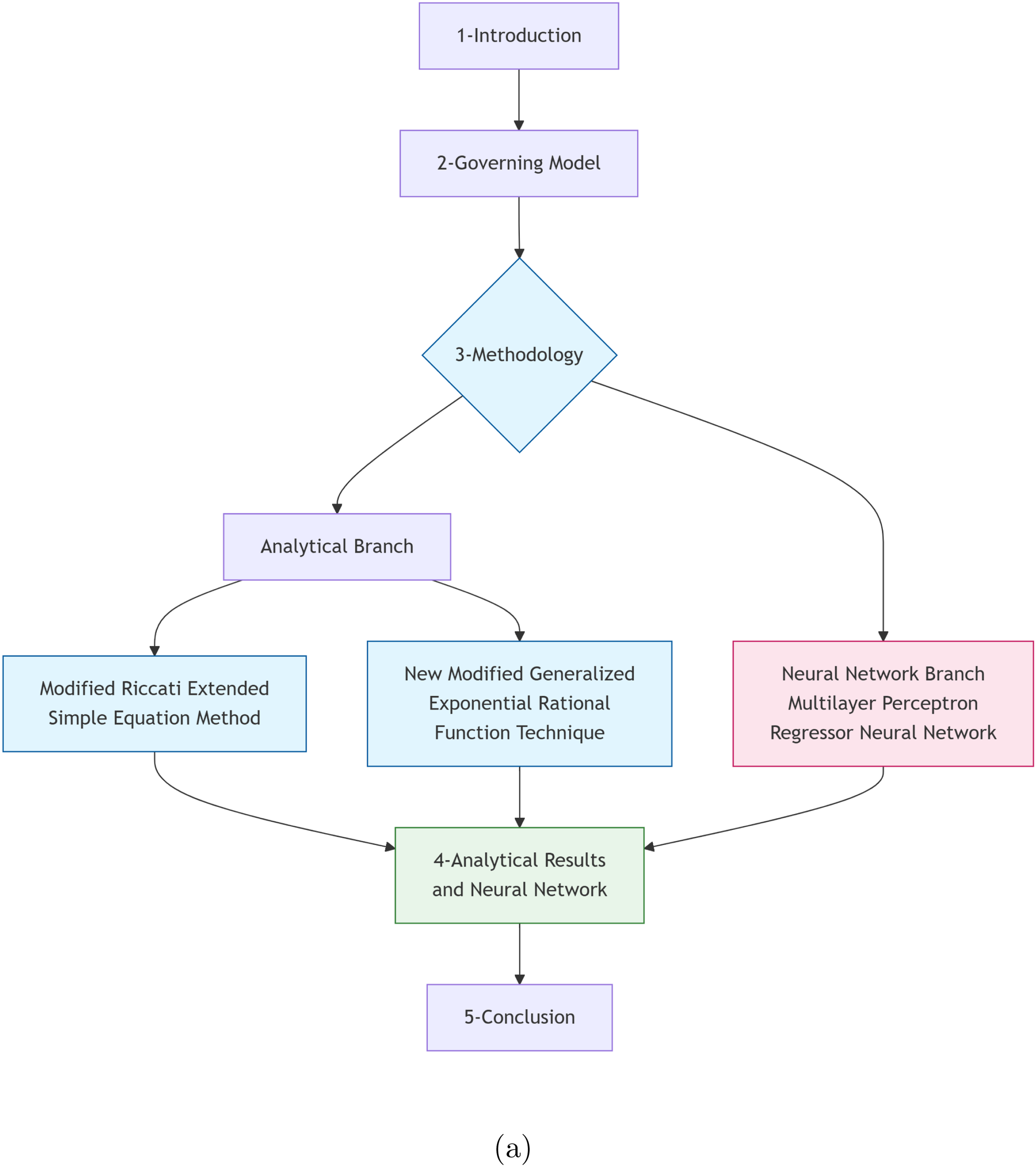
2. The governing equation
The complex Ginzburg-Landau equation is one of the most well-known NLPDE in physics. It describes a wide range of physical phenomena, including nonlinear waves, Bose-Einstein condensation (BEC), second-order phase transitions, superfluidity, superconductivity, liquid crystals, and strings in field theory. To enhance our understanding of nonlinear dynamics, it is beneficial to use mathematical frameworks that elucidate significant concepts across several fields of study. Analytical solutions are required to comprehend the intricate physical effects of nonlinear mathematical problems in nonlinear physics. To study the theory of solitary wave propagation in nonlinear wave dynamics, we need integrable nonlinear models. The complex Ginzburg-Landau equation,21–24 read as:

Moreover, the proposed model was investigated with the application of various techniques, as in 21 trail equation method is applied to describe the soliton solution, where in 22 the new extended direct algebraic method is used to study multiple solitons solution. Also, in 23 Kumar-Malik and generalized Arnous methods are applied to obtain the soliton solutions of the proposed model, where in 24 modified simple equation method is employed for the investigation of Eq. (1). This study examines the use of novel integration analytical as well as the neural network methods to get diverse soliton solutions and their validation for the specified model.
3. Methodology
Consider

3.1. Modified riccati extended simple equation method
To solve Eq. (2) applying RMSEM, the following procedure will be applied as:


The variables γ
j
and χ represent the unknown constants that will be determined later. Where, Δ(ζ) denotes the solution of the following Riccati ODE:

3.2. New modified generalized exponential rational function technique
To obtain the soliton solutions of the presented equation the first step is the same as step 1 in the RMSEM.


The modified Riccati extended simple equation method and the new modified generalized exponential rational function approach offer distinct advantages over existing analytical techniques. In contrast to the more traditional approaches, e.g. the standard tanh-function method, simplest equation method, simple exp-function method, etc, that provide more limited families of solutions, or use restrictive forms of the ansatz, the modified Riccati extended simple equation method employs the Riccati equation as a scaffolding over which a wider and more diverse base of exact traveling wave solutions, e.g. bright, dark, kink and combined, hyperbolic, periodic and exponential functions solutions, are generated within a more general algebraic framework. Along with this, the new modified generalized exponential rational function method generalizes the classical exponential rational function methods through a more flexible ansatz that allows the discovery of new structures of solutions that are often unreachable through the less general methods discussed. These two methods are especially well adapted to the treatment of higher-order nonlinearities as well as perturbation terms, which most current methods can algebraically treat. Moreover, being algorithmic makes them efficient to implement in symbolic computational systems to reduce the complexity of manual algebraic systems, and guarantee their reproducibility. Together these two approaches constitute a complementary hybrid scheme with the draw the benefit of not only broadening the range of phenomena of exact solitons but also creating a strong foundation of analysis upon which future machine learning applications can be built by offering data of high quality ground truth.
3.3. Multilayer perceptron regressor neural network
The Multi-Layer Perceptron (MLP) regression model which starts by normalizing input features and target values in the range [0,1] and divides the data to 80 percent training and 20 percent testing set that is used in this study. The model architecture is a 2-52-46-1 layer structure with sigmoid, sin and tanh activation functions in the hidden layers and linear activation in the output layer and using Xavier initialize weight initialization and Adam optimizer with 0.1 and 0.01 learning rates to optimize the weights efficiently using gradient. In training on 4000 or more epochs, the model uses forward propagation to make predictions, and mean squared error loss, and back propagation to use gradient descent to update weights, and to periodically report progress. Finally, the trained model makes predictions across the entire spatial-temporal grid and reverses the normalization scaling to produce final results comparable to the original target function values. The model was implemented and trained in Python 3.13.0, using Mean Squared Error (MSE) as the loss function to quantify the disparity between predicted and actual outputs.
4. Extraction of solutions and machine learning validation
Consider the transformation provided by:


From imaginary part, we obtain

Here the real part in Eq. (9) is considered an ODE

We find that N = 1 by using the balancing principle in Eq. (12).
4.1. Application of new modified generalized exponential rational function technique
The solution for the nGERFM
20
is represented by



The exponential solution

The explicit hyperbolic solution

The combined soliton solution

The bright soliton solution • Taking ς
n
= [−i, − i, − i, − i] and ϑ
n
= [1, − 1, 0, 0], Eq. (14), offers Δ(ζ) = cosh(ζ), Eqs. (15) and (12) offer η2 = 0, η3 = η1/4, η4 = v − η1, gives the soliton solution as: • For the parameters ς
n
= [1, 1, 1, 0] and ϑ
n
= [3, 2, 0, 0], Eq. (14), transforms to Δ(ζ) = e3ζ + e2ζ, where putting Eq. (15) in (12) gives • Choosing ς
n
= [1, − 1, 2, 0] and ϑ
n
= [2, 0, 0, 0], then Eq. (14), provides Δ(ζ) = e
ζ
sinh(ζ), Eqs. (15) along with (12) results in • Similarly, for ς
n
= [1, 1, 2, 0] and ϑ
n
= [i, − i, 0, 0](n = 1, 2, 3, 4), Eq. (14), implies that Δ(ζ) = cos ζ, Eqs. (15) and (12) provide • Choosing ς
n
= [1, − 1, i, i] and ϑ
n
= [i, − i, 0, 0], then Eq. (14), gives Δ(ζ) = sin ζ, Eqs. (15) and (12) provide •







In this case, our aim is to check the performance of the soliton solution mentioned obtained in Eq. (16). The model architecture consisted of two hidden layers and a sin activation function. The Adam optimizer was used with a learning rate of 0.01 and 1500 training epochs.
In the Figure 2 the subplot (a) show thes exact dynamics and subplot (b) represents predicted dynamics and error in the subplot (c), the combined dynamics is represented in subplot (d) for the real dynamics of the solution (16) for the parametric values v = .01, γ0 = 1.52, l = .056, η1 = .09, χ1 = .52. The graph shows the training loss for each epoch in subplot (e). Plots for the real dynamics of the solution (16).
The corresponding, epoch-wise loss values is mentioned as:
The exact and predicted behaviour of solution (16) at the different values of the t have been discussed in the Figure 3. Graphs for the real dynamics to the solution (16).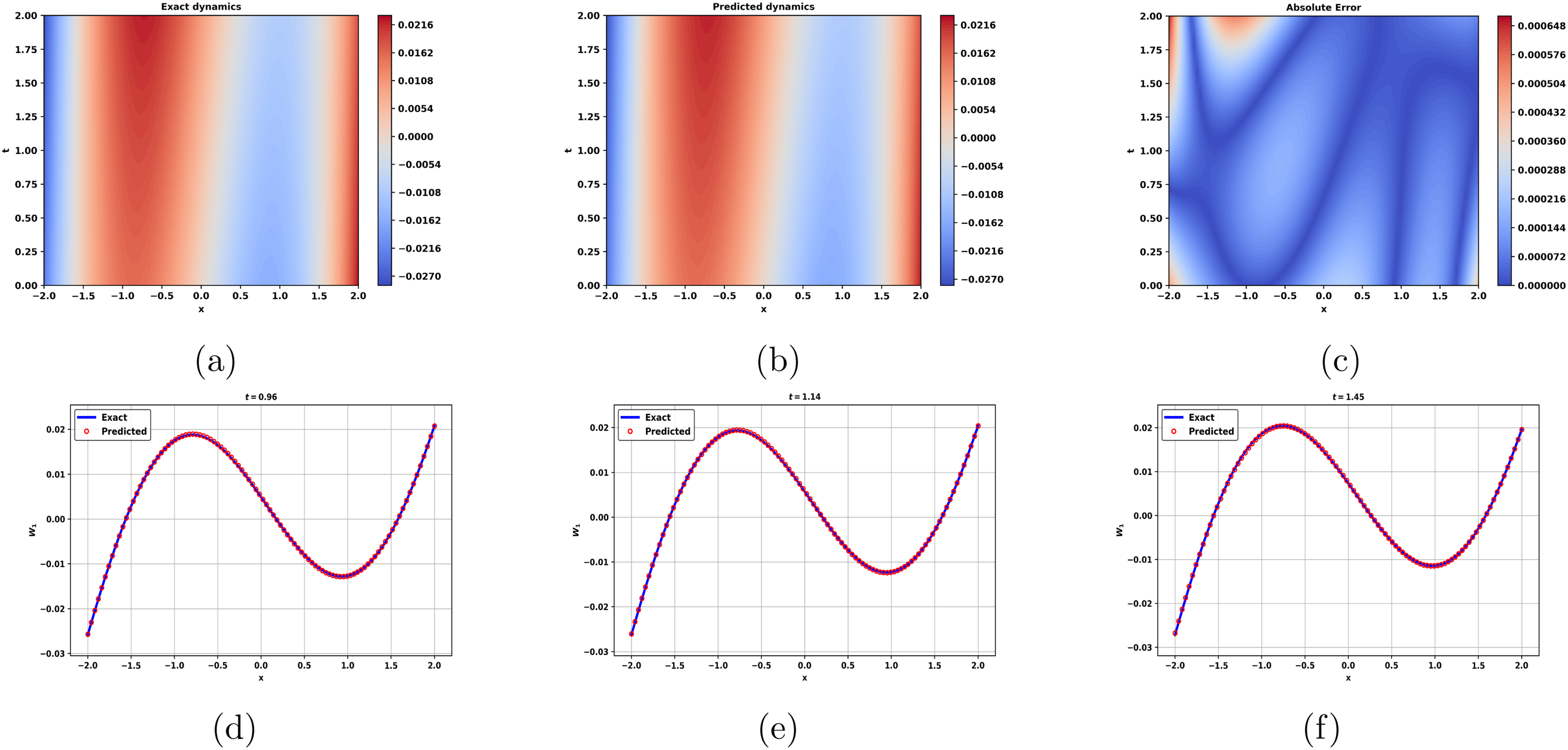
Moreover, the imaginary behaviour of the solution (16) with the parametric values v = .01, γ0 = 1.52, l = 0.056, η1 = .09, χ1 = .52 has been discussed and performance of the solution have been checked. Figure 4 contains five subplots: (a) exact dynamics, (b) predicted dynamics, (c) absolute error, (d) combined exact-predicted dynamics, and (e) training loss by epoch. The epoch-wise loss is mentioned as: Graphs for the imaginary dynamics to the solution (16).
The exact and predicted behaviour of solution (16) at the different values of the t have been discussed in the Figure 5. The above figures illustrate the propagation of the combined and dark soliton solutions. Dark solitons fiber are applied to transmit data in a stable way using dark pulses. They model topological defects and quantum vortices in Bose-Einstein Condensates. Their properties are key for studying nonlinear waves in superfluids and plasmas. They also act as information carriers in developing photonic logic circuits. Moreover, the performance of activation function suggests it should be the preferred choice for similar problems involving nonlinear solutions. • Graphs for the imaginary dynamics to the solution (16).

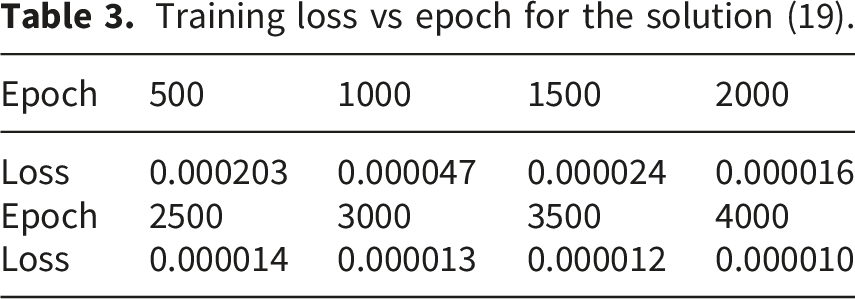
The performance of the absolute behaviour of the solution (19) has been explored with the learning rate 0.1 and sigmoid activation function. The model was trained upto 4000 training epochs. The exact, predicted, combined dynamics and the training loss corresponding to the each epoch for the solution Eq. (19) for the v = 0.01, l = 1.2, η1 = 0.19, γ1 = 0.22 are mentioned in Figure 6 as: Graphs for the absolute behaviour to the solution (19).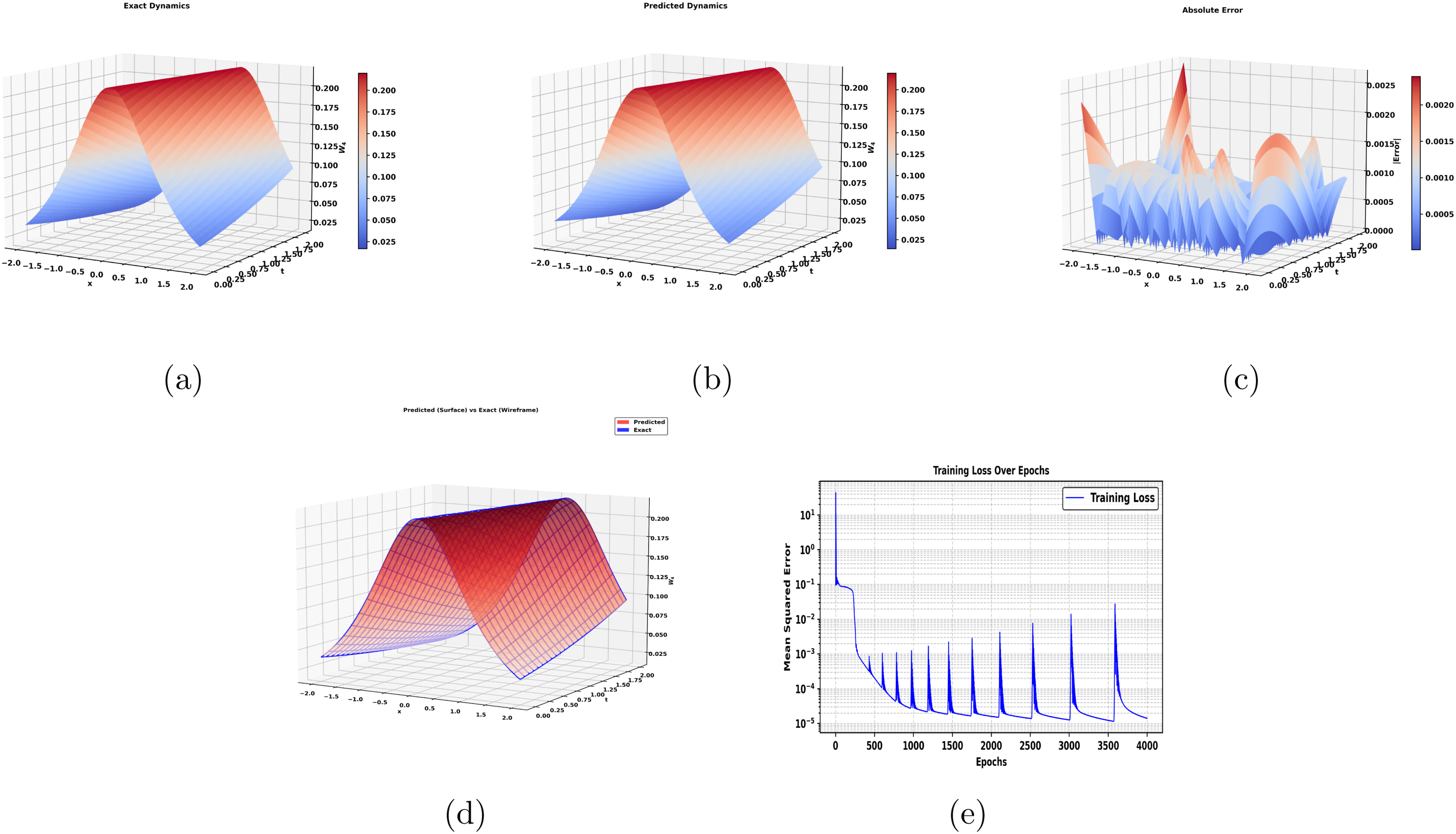
The corresponding, epoch-wise loss values is mentioned as:
The exact and predicted behaviour of solution (19) at the different values of the t have been discussed in the Figure 7. The 3 dimensional, contour and two dimensional graphs show the dynamics of the bright soliton. The plots vividly demonstrate the bright soliton’s stable, particle like propagation maintaining its shape and amplitude over distance a crucial property for optical communication. Moreover, the bright solitons enable ultra-long distance, high-speed data transmission in optical fibers by perfectly balancing nonlinear and dispersive effects, revolutionizing modern telecommunications infrastructure. Graphs for the absolute dynamics to the solution (19).
4.2. Application of modified riccati extended simple equation technique
Consider the
19
as:

Taking N = 1, in Eq. (28) results in

The incorporation of Eq. (28) and Eq. (29) into Eq. (12) produces the solutions as:
Family-1: • •


Family-2: • •


Family-3: • •


Family-4:
When • •


The soliton solution (37) is under consideration for applying the neural networking technique. For this, we have selected the tanh as the activation function with the learning rate 0.01 and the training upto 2000 epochs.
In the Figure 8 the different subplots are discussed for the real dynamics of the solution (37) with the parametric values m = 0.1, v = 0.01, γ0 = 0.1, l = .39, β1 = 2.04, β0 = 0.4, β2 = 1.1. Plots for the real dynamics of the solution (37).
The corresponding, epoch-wise loss values is mentioned as:
The exact and predicted behaviour in the density plots and two dimensional graphs in the blue line represents the actual data and red circles show the predict data behavior of solution (37) at the different values of the t have been discussed in the Figure 9. Plots for the real dynamics of the solution (37).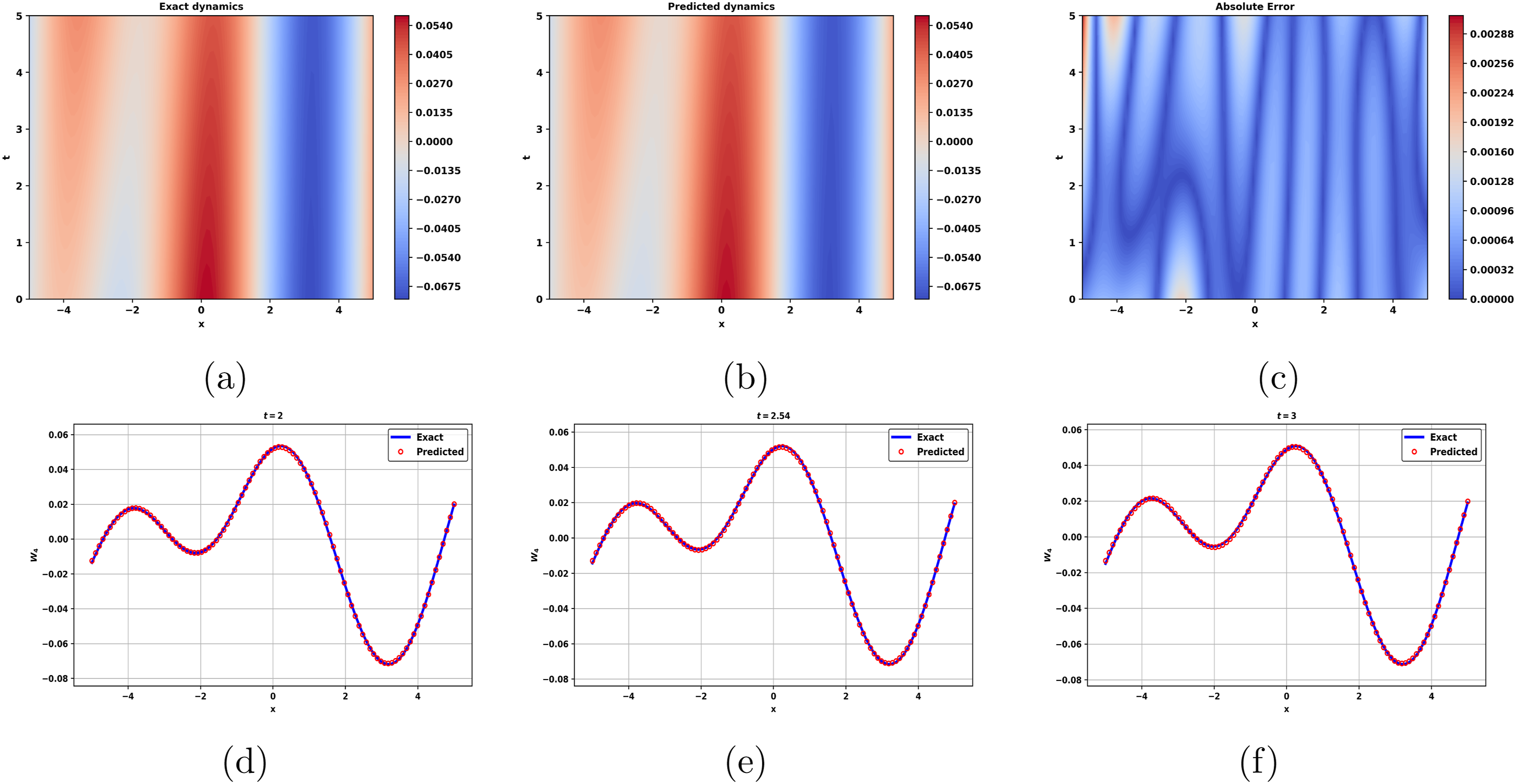
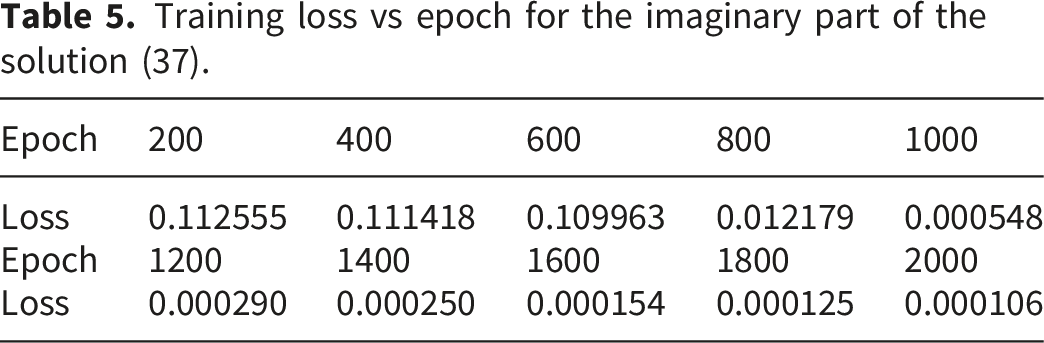
Further more, the performance of the imaginary part of the solution the (37) is discussed with parametric values m = 0.1, v = 2.01, γ0 = 0.1, l = 0.1, β1 = 1.04, β0 = .4, β2 = .1. The tanh is considered as the activation function with the training upto 2000 epochs and learning rate is 0.01. The different aspects are offered in the Figure 10. The corresponding, epoch-wise loss values is mentioned as:(Figure 11) Graphs for the solution for the imaginary dynamics to the solution (37). Graphs for the imaginary dynamics to the solution (37). The exact and predicted behaviour in the density plots and two dimensional graphs at the different values of the t.

Family-5: • •


Family-6:
When
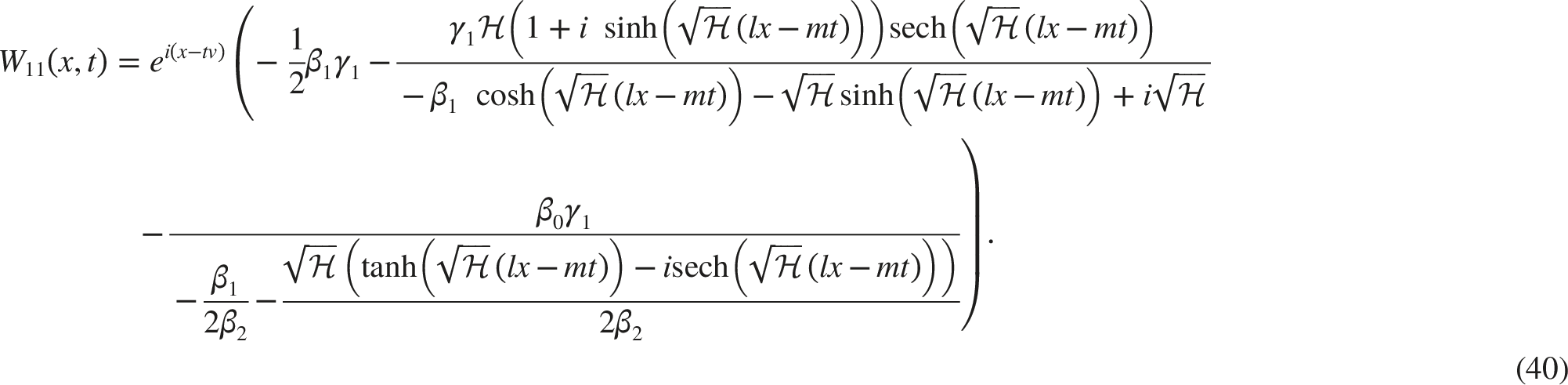
Family-7:
When

Family-8:
When

•
The machine learning validation has been discussed for the absolute behaviour of the solution (44) by applying the sigmoid activation function. The model has been trained upto 2800 epochs with the learning rate 0.01. The exact, predicted, combined dynamics and the training loss corresponding to the each epoch to the solution Eq. (42) for the m = 0.023v = 1.8, γ0 = 0.1, τ = 0.1, h = 2.225, l = 1.34 are mentioned in Figure 12 as: Graphs for the absolute behaviour to the solution (42).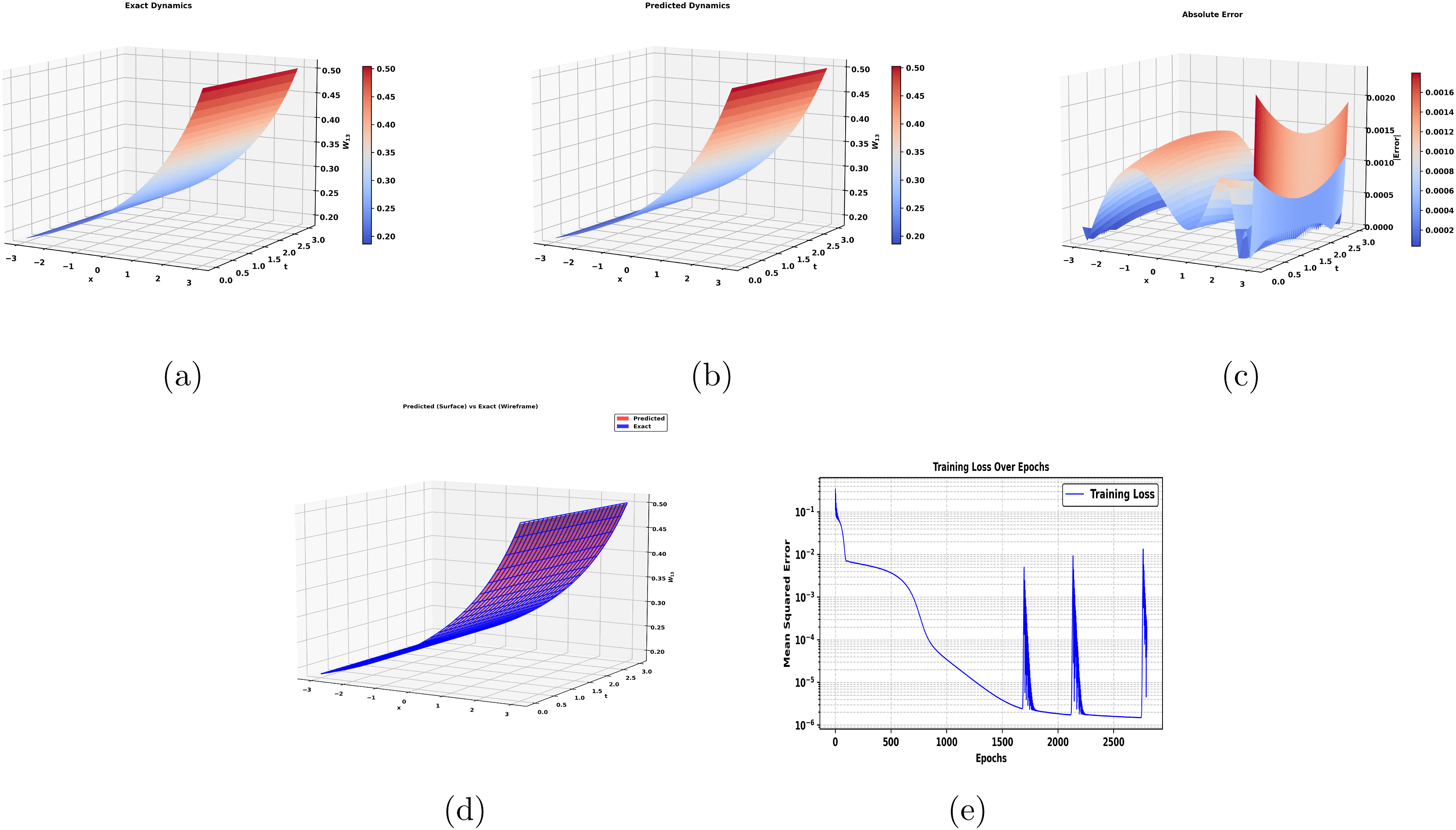
The exact and predicted behaviour in the density plots and two dimensional graphs in the blue line represents the actual data and red circles show the predict data behavior of solution (42) at the different values of the t(Figure 13). Plots for the absolute dynamics of the solution (42).
The corresponding, epoch-wise loss values is mentioned as:
Family-9:
When

Family-10:
When

5. Conclusion
Training loss vs epoch for the real part of the solution (16).

Training loss vs epoch for the imaginary part of the solution (16).

Training loss vs epoch for the solution (19).
Training loss vs epoch for the real part of the solution (37).

Training loss vs epoch for the imaginary part of the solution (37).
Training loss vs epoch for the solution (42).

Footnotes

Author’s contributions
Jan Muhammad: Writing-original draft, Investigation, Methodology, Validation, Resources. Ali H. Tedjani: Graphics, Software, Funding, Methodology. Fengping Yao: Software, Conceptualization, Writing-original draft, Graphics. Usman Younas: Investigation, Visualization, Writing-review & editing. All authors have accepted responsibility for the entire content of this manuscript and approved its submission.
Funding
The authors disclosed receipt of the following financial support for the research, authorship, and/or publication of this article: This work was supported and funded by the Deanship of Scientific Research at Imam Mohammad Ibn Saud Islamic University (IMSIU) (Grant No. IMSIU-DDRSP2602).
Declaration of conflicting interests
The authors declared no potential conflicts of interest with respect to the research, authorship, and/or publication of this article.
Data Availability Statement
The article contains all the data that substantiate the results of this study.