The impact of lateral walls and partial slip with different waveforms on peristaltic pumping of couple stress fluid in a rectangular duct with different waveforms has been discussed in the current article. By means of a wave frame of reference the flow is explored travelling away from a fixed frame with velocity c. Peristaltic waves generated on horizontal surface walls of rectangular duct are considered using lubrication technique. Mathematical modelling of couple fluid for three-dimensional flow are first discussed in detail. Lubrication approaches are used to simplify the proposed problem. Exact solutions of pressure gradient, pressure rise, velocity and stream function have been calculated. Numerical and graphical descriptions are displayed to look at the behaviour of diverse emerging parameters.
Much attention has been received for the research in the domain of Non-Newtonian flows among the researchers due to the fact that this has mutual grounds in plenty of areas such physics, technological and industrial related applications. Fluids of this nature show a relationship of stress with the change of rate of the strain which is nonlinear in its kind. Non-Newtonian liquids may include semiliquid mixtures, macromolecular fluids, medical solutions related to pharmacy, paints, bio and beauty products, etc. Unquestionably engineers, researchers, biologists, mathematicians and analysts are most of the times challenged by the Non-Newtonian liquids’ mechanics. These flows are not only significant because of their technological importance but it is also the interesting mathematics and features involved in these non-Newtonian fluids. While focusing on the rheology, these fluids show a very complex behaviour, and it becomes almost impossible to seek a generic fundamental relation applicable for all the non-Newtonian fluids. 1966 was the year when Stokes managed to develop one theory amongst non-Newtonian theories which was termed as Couple stress theory. This fluid theory is placed with other polar theories which happens to consider the couple stresses in the presence of classical Cauchy stress. It surely became the most generic and simplest explanation of the classical model of such related fluids that can allow polar effects.1 Investigations relevant to the fluid behavioural aspects of the couple stress are very beneficial due to the fact that such investigations tend to have this potential for much improved explanations of the rheology of complex fluids.2 Considering a significant relevance in the wide range of applications, many scholars have investigated the flows in multiple geometries.3–25
Because of the complications linked with the structures of the organs and their materials, studies relevant to the making up of mathematical models of biological systems have been the most typical areas of work. For a human body and its organs, peristalsis is one of the most significant mechanisms for the transportation of biofluids. This mechanism does the transport of the fluids, by the help of stretching walls’ contraction and expansion. Biomechanics and the investigators related to this area, have found this domain tempting to work on in the last couple of decades as multiple applications are relevant in the areas of bio medics and engineering sciences. The mechanism is deployed in multiple applications in a living body like when one swallows the food via oesophagus, flowing of blood and the chyme’s movement in the intestinal tracts. Further, the mechanism can also be used for blood pumping in machines related to heart or lungs. Since the very initial work investigated by Latham,26 other researchers have studied the concerns and issues related to the peristaltic passages by considering numerous geometries, symmetric and non-symmetric flows, uniform and non-uniform tubes.27–35
On the contrary, Reddy et al.36 have presented an idea that for a better approximation of uterus’ sagittal cross section can be done through rectangular cross sectioned tubes. They also showed significance of lateral walls in rectangle shaped ducts for the peristaltic flows. Mandviwalla and Archer37 worked on the extension of the same idea and deliberated on the effect’s peristaltic pumps along the slip bounded conditions in the rectangular shaped ducts. Down the years, many researchers have worked on the extension of the ideas presented in Subba Reddy et al.36 and Mandviwalla and Archer37 by considering Newtonian fluids and non-Newtonian fluid models.38–45 To the best of our knowledge, the study for peristaltic passages especially designed for the rectangle shaped ducts with slip bounded condition is still being researched. Due to this, we have deliberated the idea related to partial slip in the same shaped ducts for couple stressed fluids. Pressure gradients and velocities have been worked upon and their exact solutions have been determined. Furthermore, using numerical methods, calculations have been done to find the expression for the pressure rise. To experience the physical behaviours of these pertinent constraints, graphical representations have been made.
Mathematical composition
We are considering peristaltic flow of an incompressible couple stress fluid in a rectangular duct possess channel height and width Cartesian coordinates system are taking into consideration so that axis, axis and axis is taking in axial direction, lateral direction and vertical direction of rectangular duct respectively (Figure 1). Geometry of walls surfaces are representing as
here (, and are amplitudes of waves, wavelength, velocity propagation and time respectively. The walls parallel to plane stay continuous and are no longer be dependent upon any peristalsis wave movement. We are considering lateral velocity equal to zero due to the fact there’s no alter in lateral path of duct cross section. The velocity for a rectangular duct is
Geometry of the problem.
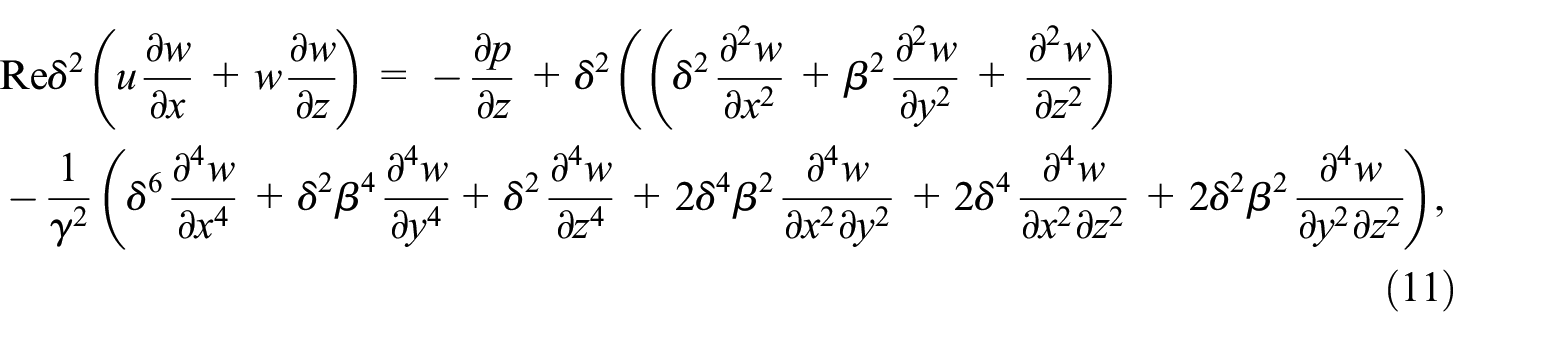
The present flow is governed by the following equations
where is density and is pressure.
The two frames of references (wave and fixed frame) are linked as
Applying lubrication approach (long wavelength and low Reynolds number), overlooking order of terms and higher, equations (8)–(12) reduces to the following form
The consequent boundary conditions are
here , for straight duct and for total occlusion.
Solution of proposed problem
Using the similar procedure as down in,36–37 the exact solution of equation (12) satisfying the boundary conditions (14)–(16) can be defined as
here
The flow rate is given by
The flux is followed by
Over one period average volume flow rate of peristaltic wave can be determined as
From equations (18) and (20), pressure gradient is determined as
Integrating equation (21) over one wavelength concurs
Special cases
In the absence of slip parameter L it is noted that (holding fixed and ), rectangular duct can be reduced to two-dimensional channel. Moreover, for square duct .
Graphical illustration
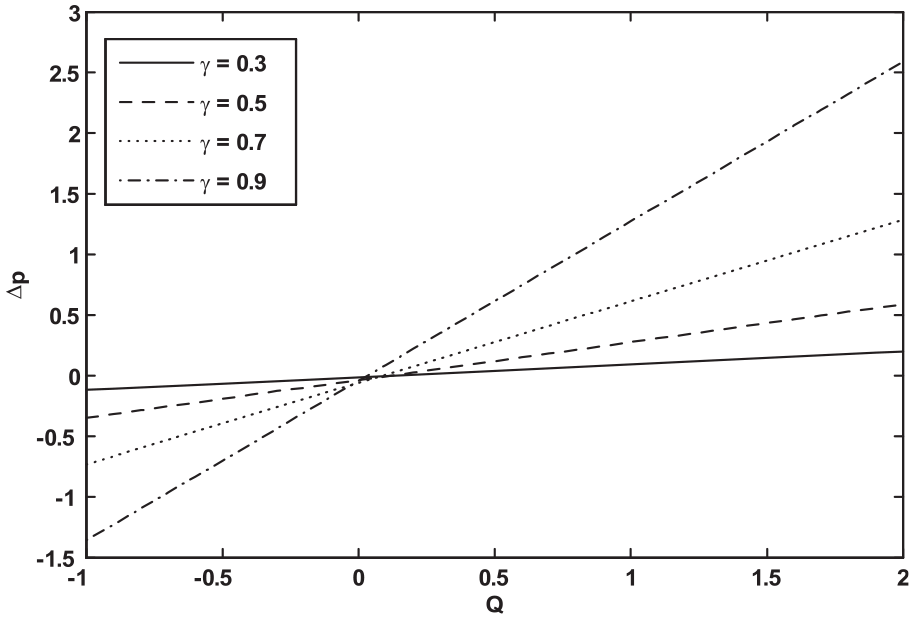
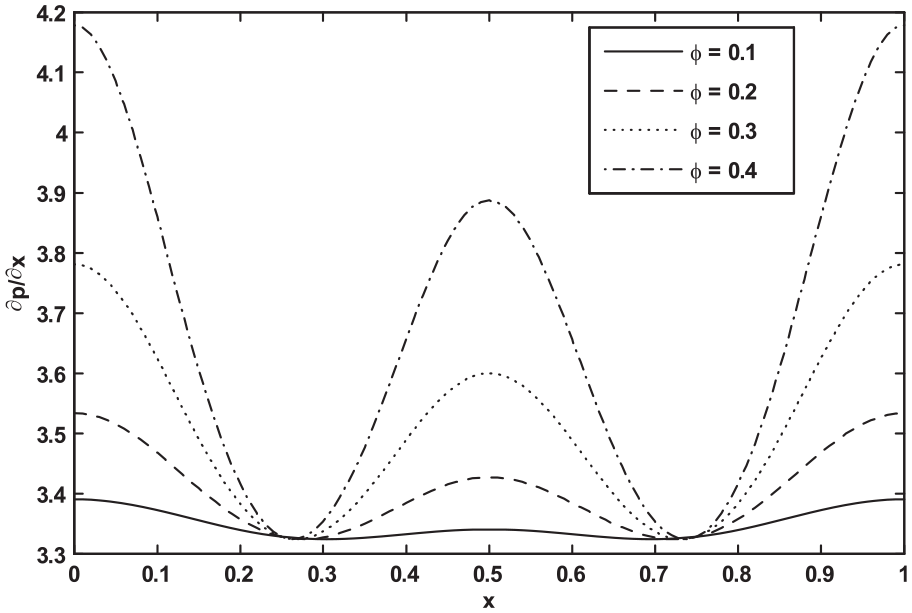
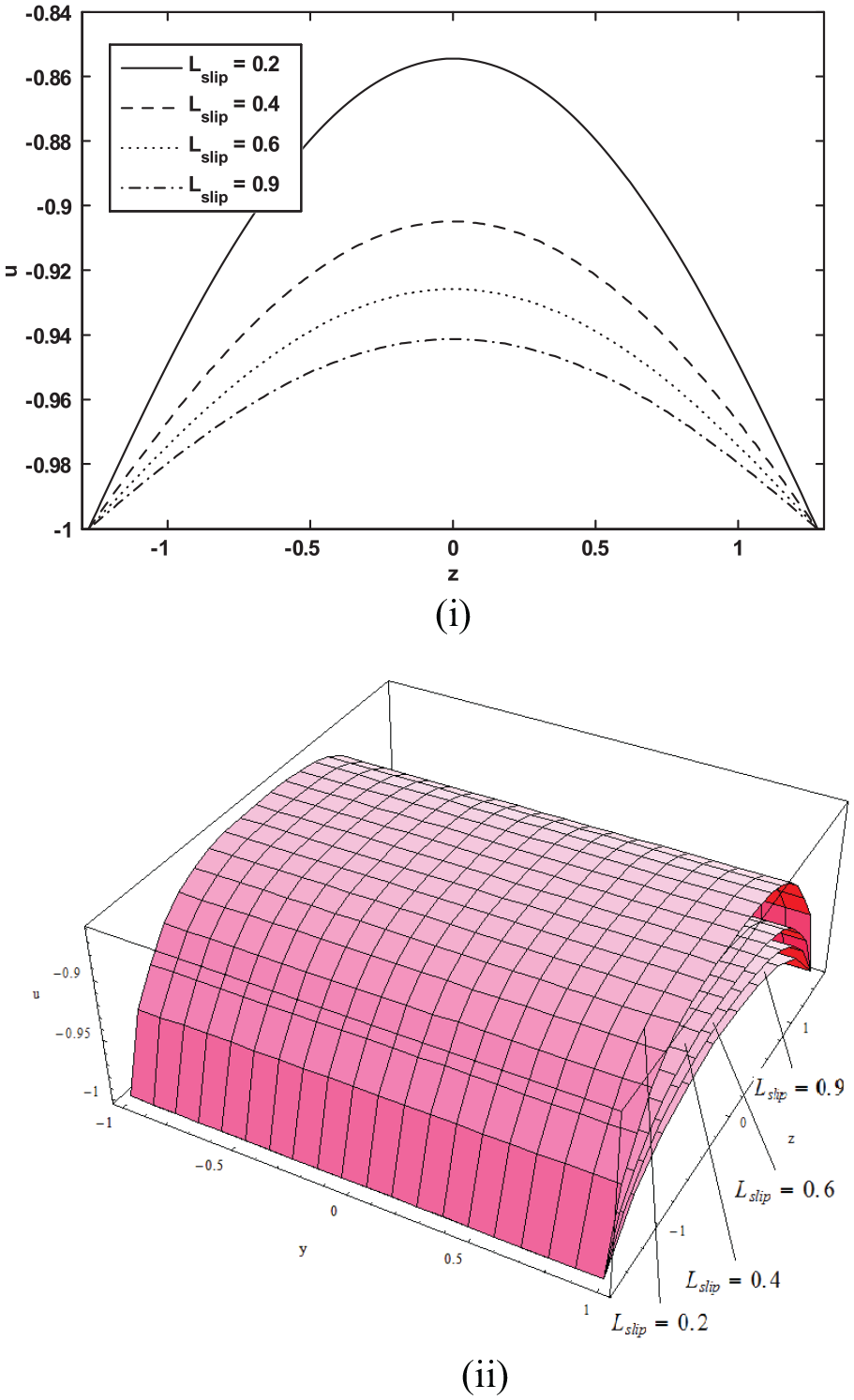
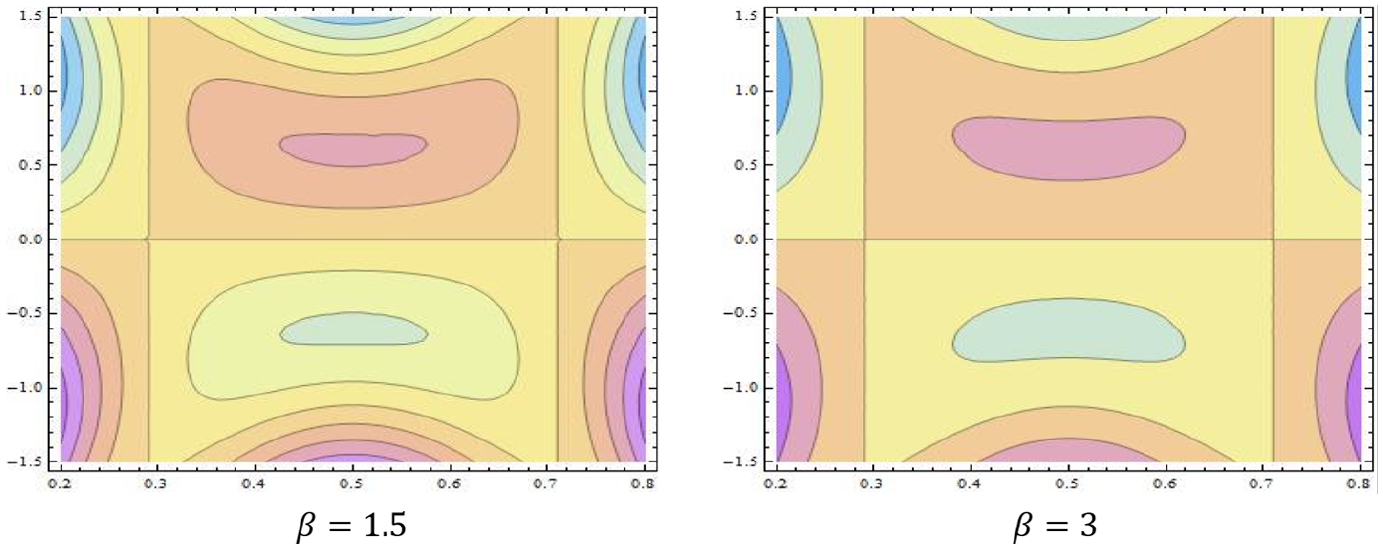
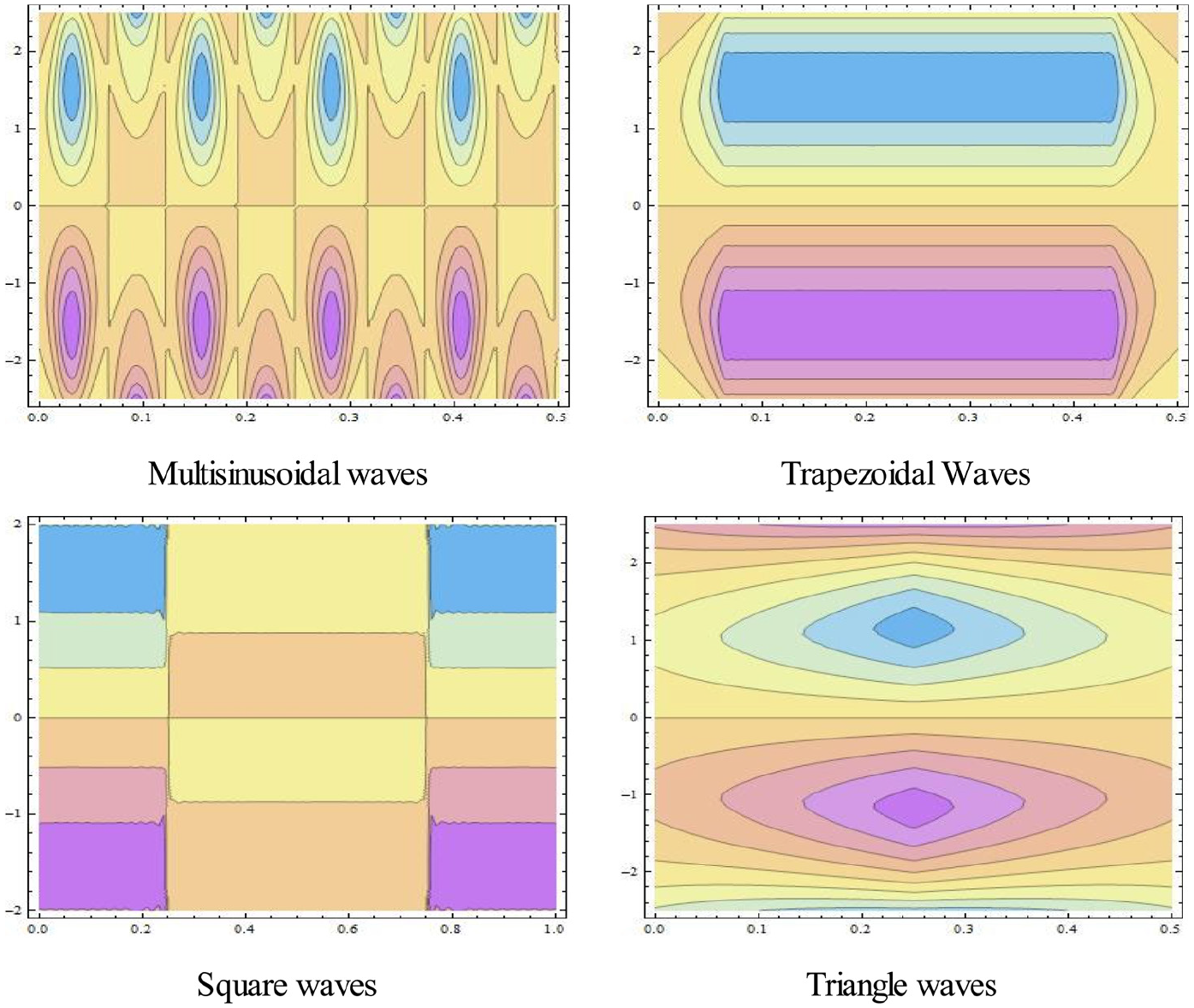
This section is devoted to examining the variational impact of important physical parameters on various flow characteristics, like, pressure rise per wavelength , pressure gradient , axial velocity and streamlines. Various graphs are plotted in Figures 2 to 13 to see the variation trends of dimensionless parameters, for example, material parameter , wave amplitude, wall slip parameter and the aspect ratio of the channel . Furthermore, a comparative analysis among different wave shapes, namely, multi-sinusoidal, trapezoidal, square and triangular shaped waves is also provided. Figures 2 and 3 are reserved to see the variational trend of fluid material parameter and wave amplitude on the pressure-rise per wavelength . It is reflected from Figure 2 that higher values of couple stress fluid parameter establish an upsurge on in the peristaltic pumping zone but an opposite conduct is noticed in the co-pumping area. In the free pumping zone, the impact of on is trivial. From Figure 3 it is noticed that enhances for large values of wave amplitude in peristaltic pumping and free pumping region, whereas this behaviour is reverse in the augmented pumping part. It is also observed that in the pumping and co-pumping channel parts, the magnitude volumetric flow rate rises when large values of are considered. Since the energy carried by the peristaltic wave retains a direct relation with wave amplitude that induces an augmentation in the volumetric flow rate in the elastic duct. From Figures 4 to 6, we consider the pressure gradient against the dimensionless independent variable by varying different parameters. Figure 4 illustrates that high values of couple stress parameter develops an adverse pressure gradient (), and this rise is consistent in the down-stream. Since higher values of indicate the weakening Couple-stress fluid viscosity, therefore, it is concluded from here that Couple-stress fluid hinders the pressure gradient as compare to the viscous fluid. However, to balance the flow rate, an adequate favourable pressure gradient is needed in the deep duct portion. Large amplitude values generate denser and intense waves which endorse peristaltic activity (Figure 5). This increase is more influential in the wider duct zone than in the core part. In Figure 6, a comparative glamp of effect of amplitude ratio () on for various wave shapes. Here it is clear that is maximum sinusoidal/multi-sinusoidal and minimum for square wave the deep duct portion. Figure 7(i–ii) demonstrates the two- and three-dimensional view of axial velocity for various values of volumetric flow rate (), respectively. It is seen that the higher values of cause an intensification in axial velocity through the duct. This increase is more substantial in the central part of the elastic duct as compared to boundaries. Figure 8(i–ii) reveals that slip parameter () supports fluid flow near the centre and elastic boundary of the duct. Here it can be seen that the magnitude of fluid velocity enhances when large values of are considered. This conduct of velocity is obvious in pressure driven flows. Figure 9(i–ii) describes that the small values of couple stress fluid parameter impede fluid velocity throughout the duct, but this hindrance is more noticeable in the contracted portion of the duct. Since the smaller values of material parameter corresponds to large Couple-stress viscosity, therefore, Couple-stress fluid reduce the fluid movement. The negative values of velocity profile indicate the reverse flow.
Pressure rise is plotted against for various values of
Pressure rise is plotted against for various values of
Pressure gradient is plotted against for various values of
Pressure gradient is plotted against for various values of
Pressure gradient is plotted against for different wave forms.
Velocity profile is plotted against in case of two-dimensional and in case of three-dimensional for various values of : (i) for two-dimensional and (ii) for three-dimensional.
Velocity profile is plotted against in case of two-dimensional and in case of three-dimensional for various values of : (i) for two-dimensional and (ii) for three-dimensional.
Velocity profile is plotted against in case of two-dimensional and in case of three-dimensional for various values of : (i) for two-dimensional and (ii) for three-dimensional.
Impact of streamlines for .
Impact of streamlines for .
Impact of streamlines for .
Impact of streamlines for different wave forms.
Trapping is described as the development of internally revolving fluid mass confined by streamlines of propulsive waves. This enclosed bolus is drove ahead along with the progressive wave of contraction and expansion. Figure 10 depicts that the trapped bolus enlarges in size when large values of aspect ratio () are taken into consideration. From Figures 11 and 12, it is concluded that the trapped bolus expands in size when higher values of and smaller values of are selected. Figure 13 reflects the streamlines adopt the similar wave pattern as the type of wave configuration considered.
Concluding remarks
The impact of lateral walls and partial slip with different wave forms on peristaltic pumping of couple stress fluid in a rectangular duct with different wave forms has been discussed in the current article. Peristaltic waves generating on horizontal surface walls of rectangular duct are considered under lubrication technique. Mathematical modelling of couple fluid for three-dimensional flow is first discussed in detail. Exact solutions of pressure gradient, pressure rise, velocity and stream function have been calculated. Graphical descriptions are displayed to look at the behaviour of diverse emerging parameters. The main finding are as follows:
The pressure rise raises in the peristaltic pumping region with the increasing values of couple stress parameter and amplitude ratio whereas the behaviour is quite opposite when .
The pressure gradient increases with the increasing values of couple stress parameter and amplitude ratio . Moreover, it is also noted that when pressure gradient is same for all values of amplitude ratio
The magnitude of velocity profile increases with an enlargement in values of volume flow rate slip parameter and couple stress parameter
The number of trapping bolus reduces with the increasing values of aspect ratio and bolus size increases with the increasing values of couple stress parameter
The trapped bolus size diminishes with an enlargement of slip parameter
Footnotes
Declaration of conflicting interests
The author(s) declared no potential conflicts of interest with respect to the research, authorship, and/or publication of this article.
Funding
The author(s) received no financial support for the research, authorship, and/or publication of this article.
ORCID iDs
Safia Akram
Sufian Munawar
Author biographies
Safia Akram is a Professor of Mathematics at National University of Sciences and technology, (MCS), Islamabad. Her field of research is applied mathematics and computational fluid mechanics. She is recipient of research productive award in year 2010–2011 and 2011 to 2012 by Pakistan Council for Science and Technology. Her research articles have been published in international journals. She is also an editor of international journals.
Najma Saleem earned her PhD degree in mathematics and presently working as an Assistant professor in Prince Mohammed bin Fahd University Saudi Arabia. Her research interest include Physiological flows, nanofluids, entropy analysis and heat mass transfer problems etc.
Mir Yasir Umair received his undergraduate from COMSATS in 2007. He did his Masters in Wireless Networks from University of London in 2009, UK and completed his PhD in Information and Communication from Beihang University, Beijing China in 2015. His areas of research include Indoor Positioning Systems, Software Defined Networks, Localization in 5G, Industrial Automation, Embedded Systems, IoT based Mechanism related to automation and positioning.
Sufian Munawar is PhD in Mathematics and is currently working at Imam Abdulrahman Bin Faisal University (IAU) Dammam in Saudi Arabia as an Assistant Professor of Mathematics. He is a scholar, researcher, and teacher par excellence. He has authored over 40 peer-refereed research articles on a wide variety of topics in heat transfer, thermodynamics, and fluid flow.
References
1.
DevakarMIyengarTKV. Stokes’ problems for an incompressible couple stress fluid. Nonlin Anal Model Contr2008; 1: 181–190.
2.
RamzanMFarooqMAlsaediA, et al. MHD three dimensional flow of couple stress fluid with Newtonian heating. Eur Phys J Plus2013; 128: 49.
3.
HayatTIjaz KhanMFarooqM, et al. Impact of Cattaneo–Christov heat flux model in flow of variable thermal conductivity fluid over a variable thicked surface. Int J Heat Mass Transf2016; 99: 702–710.
4.
Ijaz KhanM. Transportation of hybrid nanoparticles in forced convective Darcy-Forchheimer flow by a rotating disk. Int Commun Heat Mass Transf2021; 122: 105177.
5.
Ijaz KhanMWaqasMHayatT, et al. A comparative study of Casson fluid with homogeneous-heterogeneous reactions. J Colloid Interface Sci2017; 498: 85–90.
6.
I KhanMAlzahraniF. Nonlinear dissipative slip flow of Jeffrey nanomaterial towards a curved surface with entropy generation and activation energy. Math Comput Simul2021; 185: 47–61.
7.
Ijaz KhanMAlzahraniF. Dynamics of activation energy and nonlinear mixed convection in Darcy-Forchheimer radiated flow of Carreau nanofluid near stagnation point region. J Therm Sci Eng Appl2021; 13: 051009.
8.
Ijaz KhanMAlzahraniF. Free convection and radiation effects in nanofluid (Silicon dioxide and Molybdenum disulfide) with second order velocity slip, entropy generation, Darcy-Forchheimer porous medium. Int J Hydrog Energy2021; 46: 1362–1369.
9.
Ijaz KhanMAlzahraniF. Cattaneo-Christov double diffusion (CCDD) and magnetized stagnation point flow of non-Newtonian fluid with internal resistance of particles. Physica Scripta2020; 95: 125002.
10.
Ijaz KhanMAlzahraniF. Numerical simulation for the mixed convective flow of non-Newtonian fluid with activation energy and entropy generation. Math Method Appl Sci2020; 1–12. DOI: https://doi.org/10.1002/mma.6919
11.
Ijaz KhanMAlzahraniF. Binary chemical reaction with activation energy in dissipative flow of non-Newtonian nanomaterial. J Theor Comput Chem2020; 19: 2040006.
12.
Ijaz KhanMAlzahraniF. Activation energy and binary chemical reaction effect in nonlinear thermal radiative stagnation point flow of Walter-B nanofluid: numerical computations. Int J Modern Phys B2020; 34: 2050132.
13.
Ijaz KhanMAlzahraniF. Entropy optimized magnetohydrodynamics Darcy–Forchheimer second order velocity slip flow of nanomaterials between two stretchable disks. Proc Inst Mech Eng Part C: J Mech Eng Sci2020; 234: 4190–4199.
14.
Ijaz KhanMAlzahraniF. Activation energy and binary chemical reaction effect in nonlinear thermal radiative stagnation point flow of Walter-B nanofluid. Numerical Comput2020; 34: 2050132.
15.
Ijaz KhanMAlzahraniF. Transportation of heat through Cattaneo-Christov heat flux model in non-Newtonian fluid subject to internal resistance of particles. Appl Math Mech2020; 41: 1157–1166.
16.
Ijaz KhanMAlzahraniF. Entropy-optimized dissipative flow of Carreau–Yasuda fluid with radiative heat flux and chemical reaction. Eur Phys J Plus2020; 135: 516.
17.
Ijaz KhanMQayyumSKadryS, et al. Irreversibility analysis and heat transport in squeezing nanoliquid flow of non-newtonian (Second-Grade) fluid between infinite plates with activation energy. Arabian J Sci Eng2020; 45: 4939–4947.
18.
NayakaMKAbdul HakeemAKGangabB, et al. Entropy optimized MHD 3D nanomaterial of non-Newtonian fluid: A combined approach to good absorber of solar energy and intensification of heat transport. Comput Method Prog Biomed2020; 186: 105131.
19.
MuradogluMRomanòFFujiokaH, et al. Effects of surfactant on propagation and rupture of a liquid plug in a tube. J Fluid Mech2019; 872: 407–437.
20.
RomanòFFujiokaHMuradogluM, et al. Liquid plug formation in an airway closure model. Phys Rev Fluid2019; 4: 093103.
21.
HuYRomanòFGrotbergJB. Effects of surface tension and yield stress on mucus plug rupture: A numerical study. J Biomech Eng2020; 142: 061007.
22.
RomanòFMuradogluMFujiokaH, et al. The effect of viscoelasticity in an airway closure model. J Fluid Mech2021; 913: A31.
23.
De VriesKLyonsEABallardJ, et al. Contraction of the inner third of myometrium. Am J Obstet Gynecol1990; 162: 679–682.
24.
EytanOEladD. Analysis of intra-uterine fluid motion induced by uterine contractions. Bull Math Biol1999; 61: 221.
25.
ChalubinskiKDeutingerJBernaschekG. Vaginosonography for recording of cycle-related myometrial contractions. Fertil Steril1993; 59: 225–228.
26.
LathamTW. Fluid motion in a peristaltic pump. MSc Thesis, MIT, Cambridge, 1966.
27.
RomanòFSureshVGaliePA, et al. Peristaltic flow in the glymphatic system. Sci Rep2020; 10: 21065.
28.
Ladrón-de-GuevaraAShangJKNedergaardaM, et al. Perivascular pumping in the mouse brain: Realistic boundary conditions reconcile theory, simulation, and experiment. BioRxiv. DOI: 10.1101/2020.07.02.183608.
29.
ShapiroAHJaffrinMYWeinbergSL. Peristaltic pumping with long wavelengths at low Reynolds number. J Fluid Mech1969; 37: 799–825.
30.
TripathiDBégOA. Transient magneto-peristaltic flow of couple stress biofluids: a magneto-hydro-dynamical study on digestive transport phenomena. Math Biosci2013; 246: 72–83.
31.
MekheimerKSAbd elmaboudY. Peristaltic flow of a couple stress fluid in an annulus: application of an endoscope. Physica A2008; 387: 2403–2415.
32.
RameshK. Influence of heat and mass transfer on peristaltic flow of a couple stress fluid through porous medium in the presence of inclined magnetic field in an inclined asymmetric channel. J Mol Liq2016; 219: 256–270.
33.
BhattiMMZeeshanATripathiD, et al. Thermally developed peristaltic propulsion of magnetic solid particles in biorheological fluids. Indian J Phys2018; 92: 423–430.
34.
Gnaneswara ReddyMVenugopal ReddyKMakindeOD. Hydromagnetic peristaltic motion of a reacting and radiating couple stress fluid in an inclined asymmetric channel filled with a porous medium. Alexandria Eng J2016; 55: 1841–1853.
35.
MekheimerKhSAbd elmaboudY. The influence of heat transfer and magnetic field on peristaltic transport of a Newtonian fluid in a vertical annulus: application of an endoscope. Phys Lett A2008; 372: 1657–1665.
36.
Subba ReddyMVMishraMSreenadhS, et al. Influence of lateral walls on peristaltic flow in a rectangular duct. J Fluid Eng2005; 127: 824–827.
37.
MandviwallaXArcherR. The influence of slip boundary conditions on peristaltic pumping in a rectangular channel. J Fluid Eng2008; 130: 124501.
38.
EllahiRHussainFIshtiaqF, et al. Peristaltic transport of Jeffrey fluid in a rectangular duct through a porous medium under the effect of partial slip: an application to upgrade industrial sieves/filters. Pramana2019; 93(3): 34.
39.
AkramSMekheimerKhSYelmaboudA. Particulate suspension slip flow induced by peristaltic waves in a rectangular duct: effect of lateral walls. Alexandria Eng J2018; 57: 407–414.
40.
NadeemSAkramS. Peristaltic flow of a Carreau fluid in a rectangular duct. J Fluid Eng2012; 134: 041201–041207.
41.
AkramSMekheimerKhSNadeemS. Influence of lateral walls on peristaltic flow of a couple stress fluid in a non-uniform rectangular duct. Appl Math Inform Sci2014; 8: 1127–1133.
42.
NadeemSAkramS. Peristaltic flow of a Jeffrey fluid in a rectangular duct. Nonlin Anal Real World Appl2010; 11: 4238–4247.
43.
NadeemSRiazAEllahiR. Peristaltic flow of viscous fluid in a rectangular duct with compliant walls. Comput Math Model2014; 25: 404–415.
44.
RiazAEllahiRBhattiMM, et al. Study of heat and mass transfer in the Eyring–Powell model of fluid propagating peristaltically through a rectangular compliant channel. Heat Transf Res2019; 50: 1539–1560.
45.
EllahiRRiazANadeemS. A theoretical study of Prandtl nanofluid in a rectangular duct through peristaltic transport. Appl Nanosci2014; 4: 753–760.