



Abstract
Wire coating is widely used for electrical insulation to protect the wire from electric shock, prevent electrical leakage, and ensure that the electrical current flows smoothly. In this investigation, a pressurized coating die is used to explore the PTT fluid as a polymer material for wire in a magnetic field. The flow field, flow rate, temperature profile, thickness of the wire coating, volume flow rate, and shear stress are all given exact solutions. Graphs were used to illustrate the effects of certain important technical parameters, including flow rate, wire coating thickness, shear stress, and pressure gradient. It has been noted that as the values of X, Deborah number, and ratio of radii are improved, the volume and thickness of the coated wire rise. The Deborah number has a higher volume flow than the X and radii ratios. A reference to existing literature is made in order to support the validity of the current study.
Keywords
Introduction
Wire coating analysis involves evaluating the quality and effectiveness of the protective layer applied to the surface of a wire. The thickness of the coating layer is measured to ensure that it meets the required specifications. This can be done using various techniques such as micrometer, eddy current, and X-ray fluorescence. The adhesion between the coating and the wire surface is evaluated to ensure that the coating is firmly attached to the wire. Various techniques such as cross-hatch adhesion, peel adhesion, and pull-off adhesion can be used to test the adhesion strength. Wire coating analysis is important to ensure that the coating layer provides the desired level of protection to the wire. By using various testing techniques, manufacturers can ensure that the coating is of high quality and meets the required standards. Agassant et al. 1 discussed the rheology of the wire coating processes. Mark 2 investigated the melting processes for wire coating through a pressurized coating die. Does and Spruiell 3 has credited with creating the steam-heated two-roll process. Capaccio and Ward 4 clearly created the primary smash extruder in 1845, which was utilized in wire coating.
Phan–Thien–Tanner (PTT) fluid is a mathematical model that describes the rheological behavior of polymeric fluids. It is named after the three scientists who proposed the model: Phan, Thien, and Tanner. The PTT model is widely used in the study of complex fluids, such as polymer solutions, polymer melts, and suspensions. The PTT model describes the polymeric fluid as a system of “dumbbells” consisting of two particles connected by a spring-like structure. The behavior of the fluid is governed by the motion of these dumbbells, which are influenced by various factors such as shear rate, temperature, and concentration. The PTT model includes two parameters that describe the fluid's behavior: the relaxation time and the retardation time. The relaxation time represents the time it takes for the dumbbells to align with the direction of flow when the flow is suddenly applied, while the retardation time represents the time it takes for the dumbbells to return to their original orientation after the flow has stopped. The PTT model is particularly useful in the study of viscoelasticity, which is the property of a material to exhibit both viscous and elastic behavior. Viscoelasticity is an important property of many polymeric fluids, and the PTT model can accurately describe this behavior. One of the main advantages of the PTT model is its ability to predict the behavior of complex fluids under different conditions, such as shear rate and temperature. This makes it a valuable tool in the design and optimization of industrial processes involving polymeric fluids, such as polymer processing and material design. In summary, the PTT model is a powerful mathematical tool for studying the rheological behavior of polymeric fluids. Its ability to accurately describe the viscoelastic behavior of complex fluids has made it a valuable tool in both scientific research and industrial applications.
Wire extortion is an imperative and ancient fabricating procedure. Melting extradited is a rule utilized as a fiber/wire sequestration material to ensure it beside misfortune of motorized properties, erosion, and the atmosphere's impacts. Two appliances are utilized within the coating procedures: firstly, the fluid material will be set on an affecting cable persistently and, furthermore, the fiber is pulled in a pass on occupied with liquid to be layered. Today, the progressed foundation of fiber/wire layer procedures is executed concentrated on definite gadgets to decrease the probability of abuse of future electrical items over the wire. Be that as it may, the setup is pointing to be extra compelling and stable. The observational ponders are inconceivably troublesome within the ground of concentration owing to the limited of the mold's minor estimate. This problem is taken care of with exact numerical recreations for industrial operations through distinction conditions, and investigative/mathematical solutions are utilized to illuminate the framework for distinctive stream problems imperiled to an assortment of geometries.
The wire coating mostly depends on the polymer viscosity, geometry of the problem, and the processes used for the wire coating. Feil 5 studied the wire coating processes using coaxial extrusion processes. Zeeshan et al. 6 investigated the wire coating processes using Oldroyd 8-constant fluid as a coating polymer. Mahanthesh 7 studied the effect of variable viscosity on the wire coating using cylindrical type coating die. Figure 1 shows the test set-up of a commonplace wire coating handle. In this setting, the bare wire is dragged at the payoff reel transitory over straightener, a preheater, a cross head, then extruder filled with melting polymer, and get coated. This cured wire at that point permits over a cooling channel, a capstan, and an analyzer finally conclusion on the turning take-up spool. The co-extrusion procedure is basic to utilize, time-saving, and prudent in see of mechanical claims. Nayak et al., 8 Khan et al., 9 and Bhukta et al. 10 contributed to this field of ponder. Moreover, Hussain et al. 11 examined wire covering utilizing different non-Newtonian fluid. Third-order liquid deliberated here as a viscoelastic fluid of mechanical significance. Numerous liquefied were utilized for wire covering purpose. Among these, a viscoelastic fluid demonstrates known as PTTF is broadly utilized for wire covering purpose. Many creators have subsidized to enhancing the field of heat exchange in post-treatment examination of wire covering. Reddy et al. 12 amplified the warm investigation interior as well as exterior the pass on. Khan et al. 13 have considered plastic-hydrodynamic pass on fewer wire drawings. Sajid et al. 14 carried out an investigation of the flow within the decreasing segment of a weight pass on. They have gotten numerical arrangements for the pressure and speed profiles within the kick the bucket. The final product significantly is determined by rate of conserving in fabricating forms. The dominant cooling framework is essential for encouraging the method of an outlined item.

Mechanism of wire coating.
Keeping the significances of magnetic field, numerous investigators had investigated the impact of magnetic field on Newtonian and non-Newtonian fluids. 15 Khan 16 examined an MHD second-grade liquid e-field past an extending sheet. Khan et al. 17 utilized a RK-4 procedure to examine the impacts of varying thickness, thermal, Lorentz force, and heat exchange of a non-Newtonian fluid past an extending surface with temperature varying at the boundary. Siddiqui et al. 18 have considered viscoelastic liquid as a coating fabric in wire investigation within the nonappearance of Lorentz force and utilized the perturbation series solution for the expository arrangement. Furthermore, Zeeshan et al. 19 and Nayak et al. 20 have utilized third-grade liquid polymer in their consideration. The effect of magnetic field was also discussed on velocity and temperature by many researchers.21–24 Shit et al. 25 examined the convective heat transfer over stretching sheet. Mukherjee et al. 26 used nanofluid between two permeable walls with entropy generation. Shit et al.27,28 examined viscoelastic fluid over stretching sheet with heat transfer.
The employment of viscoelastic fluids in several sectors, particularly material processing and electronics industries, has renewed interest in heat transfer concerns including non-Newtonian liquids. Heat exchange assessment is critical for scientific and technological growth; sophisticated equipment such as micro-electro-mechanical devices, laser condensate lines, and small heat transfers are utilized for a variety of reasons. Laminar heating and cooling are becoming more common in such equipment. As a consequence, the findings for quasi-fluid motion and heat exchange are required. A thorough review of the research is impracticable. However, a few investigations are given below as beginning points for a more exhaustive literature search. Shah et al. 29 investigated wire covering analysis under constant temperature variation. Mitsoulis 30 examined the flow of wire covering with heat transmission. Oliveira and Pinho 31 examined the analogous heat transfer issues of properly developed tube and channel movements of PTT fluid. Some recent development can be seen in the work of Animasaun et al.32,33 Similarly, Omowaye and Animasaun 34 investigated the UCM fluid flow over the melting sheet with variable thermo-physical properties subject to thermal stratification.
In the present paper, PTTF is used for wire coating in the influence of magnetic field in a pressurized coating die using cylindrical coordinates system. The flow field is deliberated on dimensional, incompressible, laminar, and isothermal. The governing equation like continuity, momentum, and energy are simplified. The exact solution is obtained for velocity, temperature, shear stress, volume fraction, and thickness of the coated wire. The impact of physical parameters on the physical quantities is discussed graphically. To the best of our knowledge, no studies on the magnetized PTT fluid on wire coating analysis have been conducted. The results from this study are then compared to those from earlier research 21 in limiting cases, and exceptional agreement is established.
Formulation of the problem
Consider a wire covering die through which the stream comes to a control spill element associated to the softening slot. The stream junctions the weight unit afterward moving over the softening chamber. A continuous pressure gradient in the axial direction
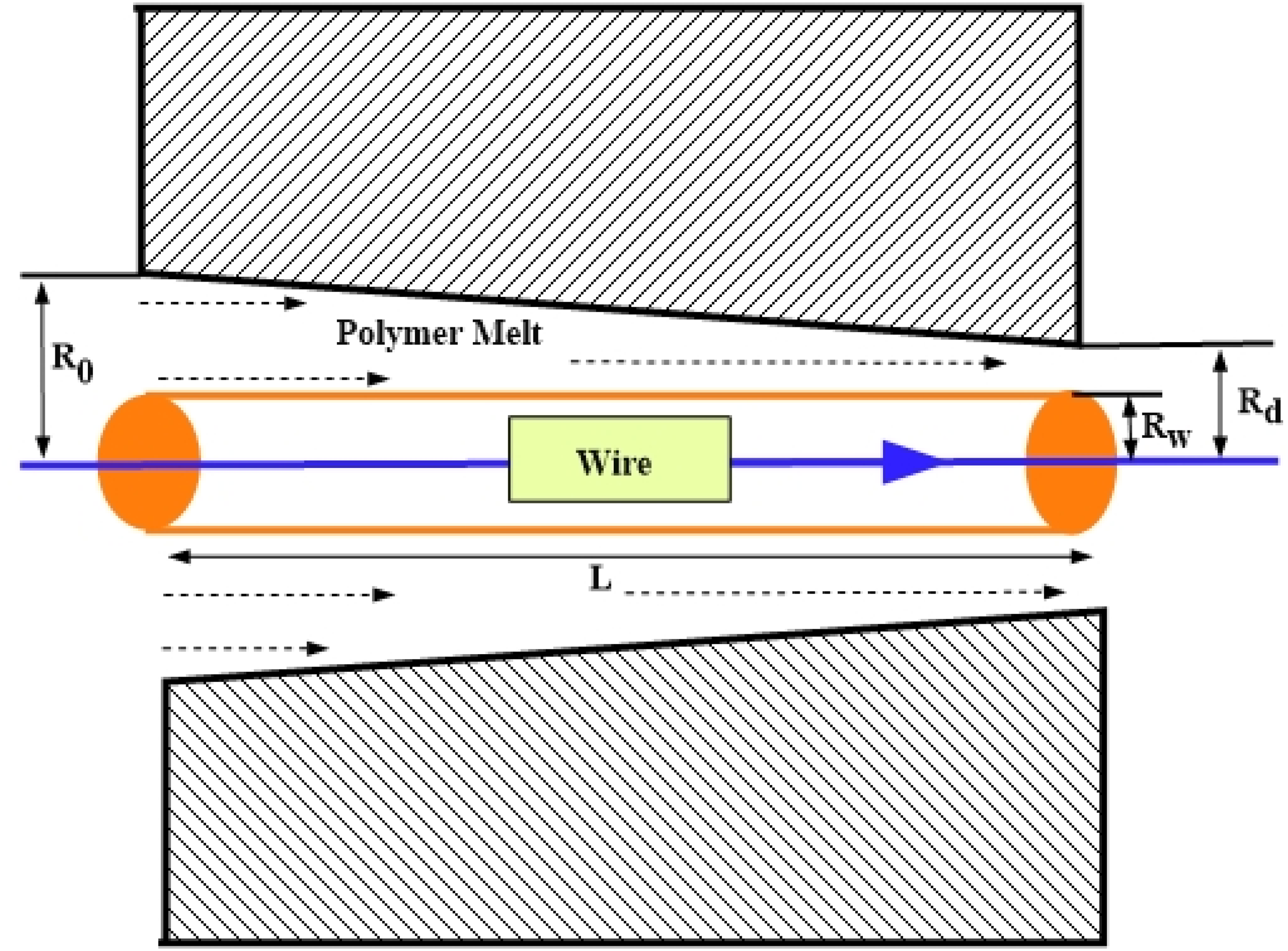
Geometry of the wire coating.
The governing equations for incompressible viscoelastic PTTF are5–11

The energy equation for the present model is16,17,20,22–24

The distribution of fluid velocity and temperature is taken into account.








Equation of motion in general form is given as
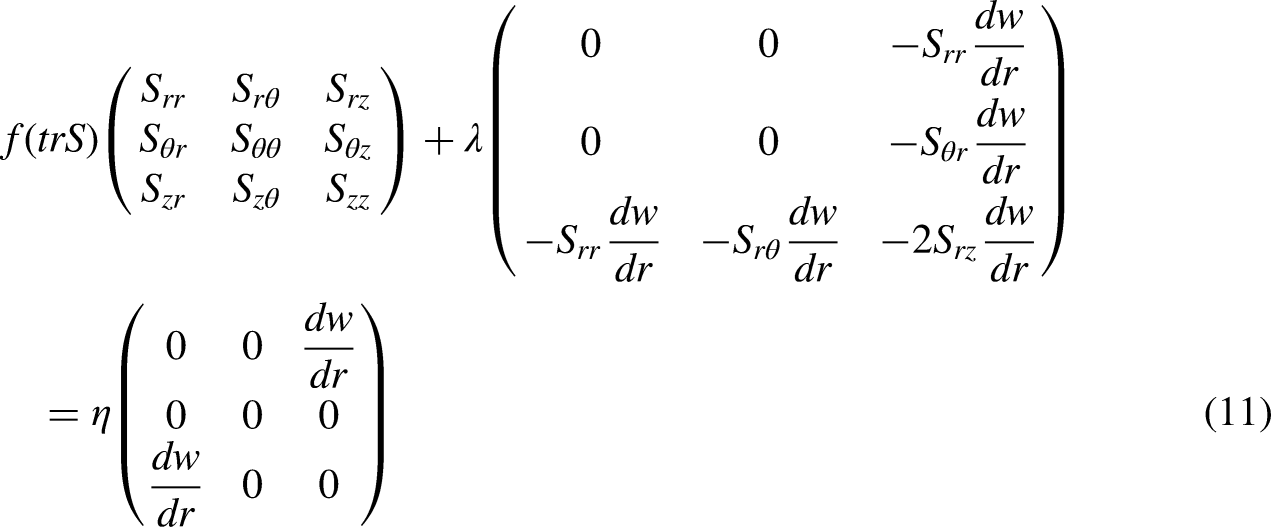





Simplify equation (17)
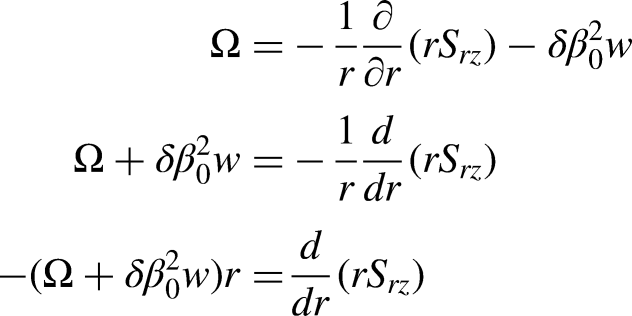

Putting equation (19) in equation (18), we get





The average polymer velocity is


The volume flow rate is





After removing the asterisks from equations (17) and (24), they have the following form:


The volume flow for the wire coating analysis is given by the following formula:



Solution of the problem
Integration equation (32) with veneration to “r” derive velocity field solution, and after significant simplification, we discover that


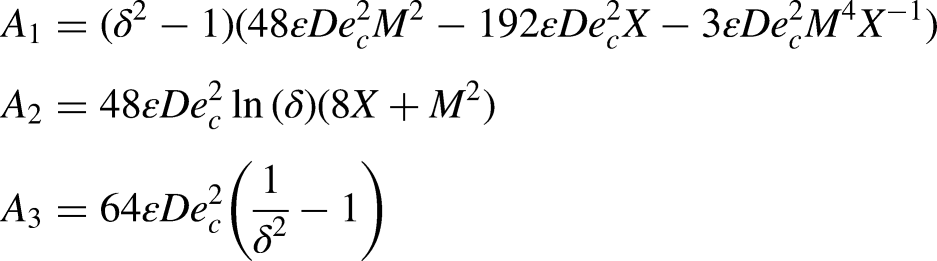



The volume flow rate is


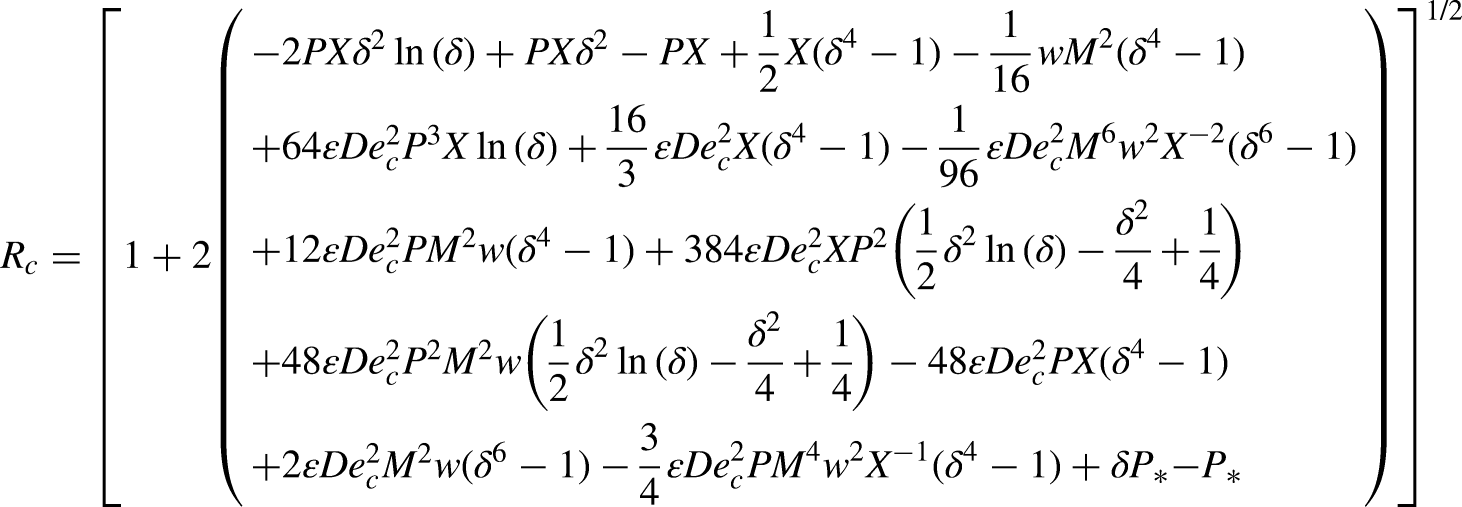
Using the volume flow rate in expression (46), we developed a mathematical model for the thickness of coated wire.

Analysis of results
The PTT fluid for wire coating in a pressurized coating die under the influence of a magnetic field is discussed in the current analysis utilizing a cylindrical coordinate system. The flow field is considered to be isothermal, laminar, dimensional, and incompressible. The governing equations for energy, momentum, and continuity are condensed. For the coated wire's thickness, volume fraction, shear stress, velocity, temperature, and shear stress, the precise answer is discovered. A diagram is used to illustrate how physical parameters affect physical quantities. As far as we are aware, no research on the analysis of the magnetized PTT fluid on wire coating have been done. The consequence of physical factors such as viscoelastic parameter

Non-dimensional velocity profiles with constant values of

Non-dimensional velocity field with constant amount of X = 0.5 and

Dimensionless velocity field for different values of M at fixed values of X = 1.5,

Non-dimensional shear stress profiles with constant values of X = 2.5 and

Force on the coated surface wire for various values of Deborah number.

Thickness of wire coating with constant amount of X = 0.5 and

Wire coating thickness for various values of Deborah number when X = 0.5 and

Non-dimensional temperature profiles with constant values of X = 0.5,

Non-dimensional temperature profiles with constant values of X = 0.2, Br = 4, and

Non-dimensional temperature profiles with constant values of

Dimensionless volume flow rate for numerous values of X.

Dimensionless volume flow rate for numerous amount of DE.
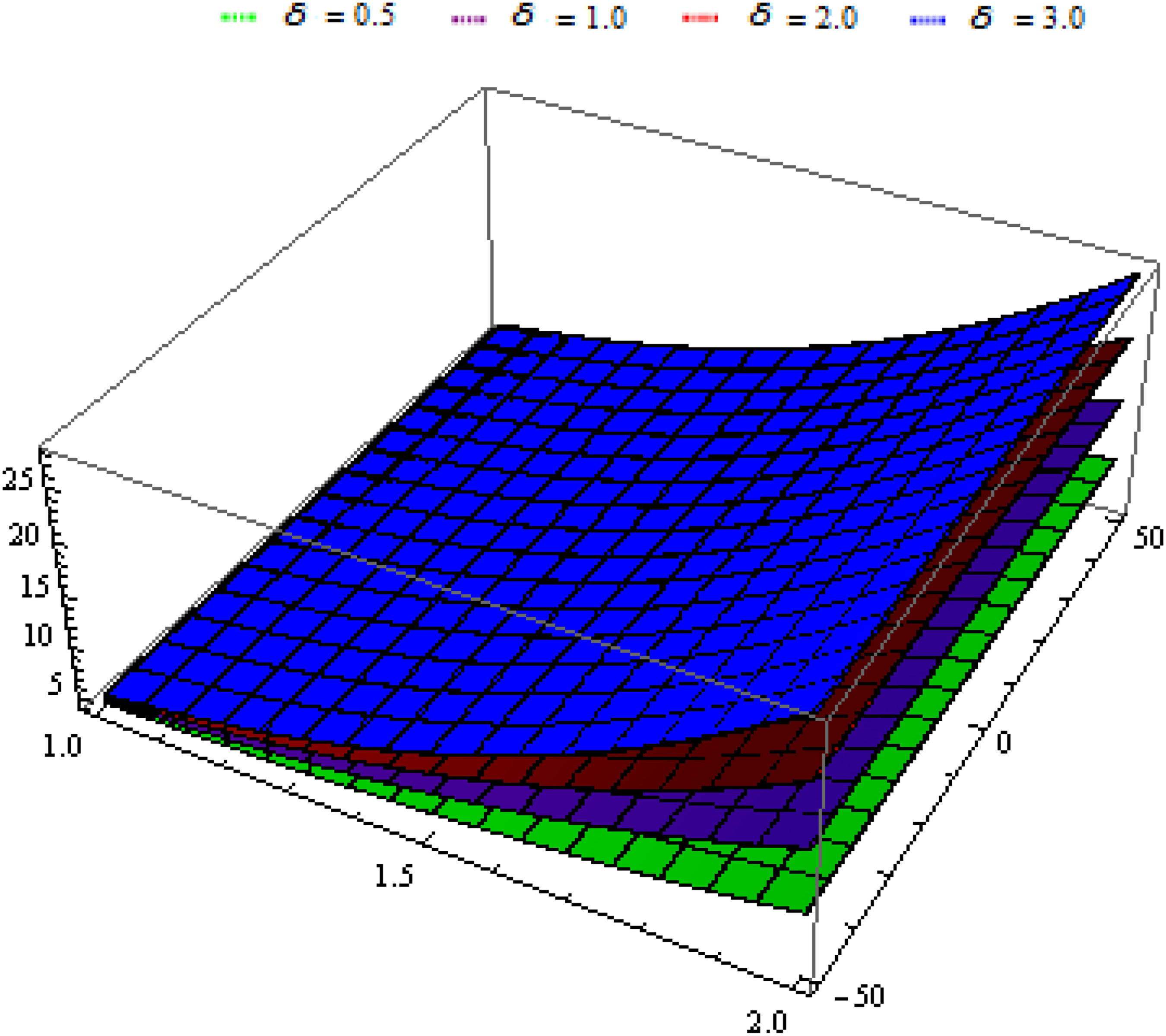
Dimensionless volume flow for numerous amount of

Dimensionless rate of volume for numerous values of M.
Discussion of results
In this paper, we investigate the wire coating in a pressurized coating die using the PTT fluid as a coating polymer. The basic equations of flow are converted to ordinary differential equations. The exact solution is obtained for the velocity profile, temperature distribution, thickness for wire, volume flow rate, and the shear stress at the surface of the total wire. Figures 3–5, respectively, depict the velocity profiles that are functions of r for various amounts of dimensionless numbers X, Deborah number De, and magnetic parameter M. One of the most important quantities in rheology is the dimensionless Deborah number. Any fabric's viscoelastic behavior can be represented using it. The Deborah number is defined as the ratio between perception or exploring time and fabric unwinding time.
In Figure 3, we altered the ratio of pressure drop to wire speed, that is,
In Figures 5 and 6, we examine the non-dimensional shear stress profile and force on the cured wire surface for different value of
The thickness of the wire is examined in Figures 7 and 8 using the numerous values of radii ratio
Figures 9–15 are sketched for the temperature profile to examine the influence of physical parameters like Brinkman number, Deborah number, and dimensionless parameter X. Figure 9 shows the temperature distribution for numerous values of
The non-dimensional volume flow rate at numerous values of X,
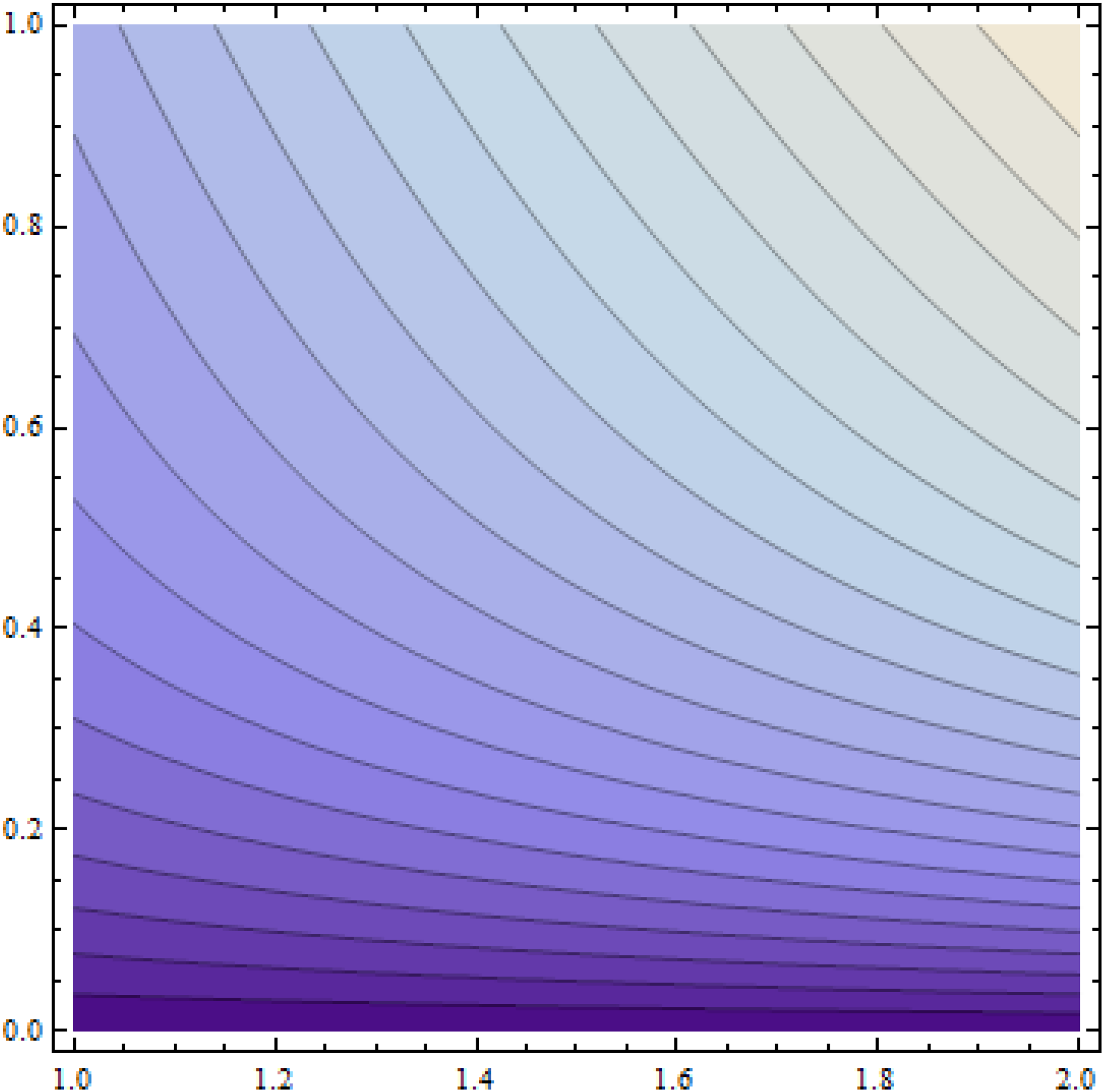
Stream lines for the velocity.
Oliveira 31 discussed the coating analysis for wire using PTTF in a cylindrical covering die in the absence of magnetic force. The uniqueness of the current work is to investigate the coating of wire using PTTF in the incidence of Lorentz force which has not investigated yet, so in limiting cases the current effort is validated with work testified by Oliveira 31 by neglecting magnetic field, and excellent agreement is found which is given in tabular (see Table 1) form for the velocity and temperature profiles.
Evaluation of the current work with available study reported by Oliveira
31
when

Conclusion
The aim of the present study is to investigate the PTT fluid for wire coating under the effect of magnetic field in a pressurized coating die. Dimensional, incompressible, laminar, and isothermal flow fields are considered. The governing equation is reduced to account for continuity, momentum, and energy. For velocity, temperature, shear stress, volume fraction, and thickness of the coated wire, the exact answer is discovered. Graphical discussion is used to show how physical characteristics affect physical quantities. The novelty of the present study is to examine the PTT fluid filled in the pressurized coating die used as a polymer for the wire coating in the presence of magnetic field, which has not investigated yet. So for the stability analysis the present work is compared with published work in limiting cases and excellent agreement is found. List of key findings from the current study are as follows:
It was discovered that the maximum axial velocity occurs at the annulus's center and is dependent on the variables X and In the range The volume and thickness of the coated wire are also increased as the values of X, Deborah number, and ratio of radii are enhanced. The volume flow is higher for the Deborah number as compared to X and radii ratio. Opposite behavior is observed for the magnetic field both for velocity and volume. The temperature of the fluid is dependent on The present research is more general than Maxwell and the linear viscous fluid model by bringing
Footnotes
Declaration of conflicting interests
The author(s) declared no potential conflicts of interest with respect to the research, authorship, and/or publication of this article.
Funding
The author(s) received no financial support for the research, authorship, and/or publication of this article.
Author biographies
Zeeshan recived his PhD in applied mathematics from Abdul Wali Khan university Mardan, Pakistan. He received his MPhil degree from Quaid-e-Azam university Islamabad. He has over 13 years of academic experience in different reputed institutions of the world. He is currently working as Assistant Professor at Bacha Khan University Charsadda, KP, Pakistan. He published more than 80 papers in reputed journals with more than 1200 citations in international peer-reviewed journals, including ISI Indexed/IF Journal publications.
Abdullah Mohamed is Professor in the Research Centre at Future University in Egypt, New Cairo 11835, Egypt. He has received many distinguished faculty and researcher awards. He has published many research articles in different well-reputed international journals. He is reviewer of several journals and remained guest editor of some special issues in reputed journals. His research interest includes nanofluid, nanomaterials, mathematical modeling, computational fluid dynamics, and numerical computing.
Ilyas Khan received his PhD degree in applied mathematics from the Universiti Teknologi Malaysia (UTM) in 2012 and Post Doctorate in 2013 from the same university. He received several distinctions such as senior visiting research fellow and visiting researcher. He has over 15 years of academic experience in different reputed institutions of the world. He is currently working an Associate Professor in the Department of Mathematics, College of Science, at Majmaah University, Saudi Arabia. He has received twice distinguish researcher award from Majmaah University. According to AD-Scientific Index 2022, He has received first place as a best scientist at Majmaah University and 3rd place as a best scientist in Saudi Arabia.
Muhammad Sheraz Khan Mphil student in Department of Mathematics & Statistics at Bacha Khan University Carsadda, KP, Pakistan.
Mansour F Yassen received his PhD degree in applied mathematics from the Department of Mathematics, College of Science and Humanities in Al-Aflaj, Prince Sattam Bin Abdulaziz University, Al-Aflaj, Saudi Arabia He has over 15 years of academic experience in different reputed institutions of the world. He is currently working an Associate Professor in the Department of Mathematics, College of Science, at Majmaah University, Saudi Arabia.
Attaullah received Master of Philosophy in Mathematics from Capital University of Science & Technology, Islamabad, Pakistan. He served as a lecturer at the department of Mathematics & Statistics, University of Lahore. Currently, he is a lecturer at the department of Mathematics & Statistics, Bacha Khan University Charsadda Pakistan. His research interests include Applications of fuzzy systems and related topics, Fuzzy aggregation operators, Fuzzy decision support systems, Fuzzy set and systems, Probabilistic fuzzy decision support systems, Application of soft sets in decision making, Soft computing and artificial intelligence. He has published more than 30 research articles with more than 1000 citations in international peer-reviewed journals, including ISI Indexed/IF Journal publications.