



Abstract
A comparative numerical investigation is carried out to assess the seismic performance of cast-in-place and segmental assembled piers in a continuous beam bridge subjected to near-fault ground motions. A comparative numerical study on the seismic behavior of continuous beam bridges with cast-in-place piers versus segmental assembled piers under near-fault ground motions is presented. A full-scale finite-element model of a six-span continuous bridge is developed using ABAQUS. Within this model, the seismic performance of two pier construction schemes—integral cast-in-place and precast segmental assembly—are investigated and compared. The pseudo-static method (Pushover method) is employed to investigate the seismic performance of various pier segmental assembly configurations, ultimately identifying the optimal configuration of segmental assembled piers that balances energy dissipation and self-resetting capacity. Considering pile–soil interaction and viscoelastic artificial boundary effects, nonlinear dynamic time history analysis is conducted on a bridge model with the optimal segmental assembled pier form. A comparative analysis was conducted on the relative displacement between the pier and beam, as well as the overall damage progression of continuous girder bridges with cast-in-place and segmental assembled piers, subjected to pulse-type and non-pulse-type seismic excitations. This study reveals the damage patterns of bridge structures under near-fault pulse seismic effects. It captures the dynamic response patterns and key failure locations of bridges under pulse effects, providing support for seismic design of near-fault bridges. Conclusions are drawn and can be applied in the actual seismic design and analysis of segmental assembled continuous beam bridges under near-fault ground motions.
Keywords
Introduction
The seismic damage in high-intensity near-fault earthquake areas (e.g. the 2008 Wenchuan Mw8.0, 2017 Jiuzhaigou Mw7.0, and 2022 Menyuan Mw6.9 events) show that velocity pulses can cause characteristic bridge damage. For example, the Sulphur Gully Bridge suffered critical track system failure from high-energy seismic input, requiring over nine months for repairs. Similarly, the 2021 Maduo Mw7.4 earthquake caused the collapse of the G0613 Highway's Wild Horse Flat Double Bridge, disrupting traffic for 14 months. Historical seismic events highlight systematic damage mechanisms: (1) Pier collapse with excessive residual drift (Baihua Bridge, 2008 Wenchuan earthquake); (2) Circumferential cracking in plastic hinge zones (S205 Maoba Bridge); (3) Bearing shear failure with permanent displacement (G213 Donghe Bridge). These damage patterns expose the limitations of traditional seismic systems under long-period, high-amplitude velocity pulses near faults. This study proposes a resilient bridge system with energy redistribution and self-resetting features, aimed at improving damage control and post-earthquake recoverability through performance-based seismic design.
In recent years, research on near-fault ground motion has significantly deepened our understanding of its impact on the mechanisms influencing bridge structures. Hui et al. 1 investigated the response of multi-span, large-span continuous beam bridges under near-fault conditions, considering displacement decay and the spatial variability of ground motion. Wu et al. 2 designed a shake table test to investigate the response of elevated aqueduct arch bridges under near-fault pulse parameters. Jiang et al. 3 studied the impact of different pulse types on the seismic response of large-span railway arch bridges. Wei et al. 4 employed finite-element modeling to study the seismic response of high-speed railway bridge-track systems under near-fault conditions. Kang et al. 5 developed a backpropagation neural network model to predict fault rupture displacement, synthesizing both low-frequency and high-frequency components. Zhang et al. 6 proposed a non-stationary stochastic analysis method for large-span structures subjected to non-uniform seismic excitation, focusing on site effects on high-pier railway bridges. These studies indicate that the immense energy generated by near-fault pulse ground motion within a short duration can lead to irreversible damage to structures.
The seismic behavior of bridges constitutes a complex system response, the performance of which depends not only on ground motion characteristics but is fundamentally governed by the health state of key components and the integrity of force transmission paths. For bridge piers, their state of health—whether manifested through the formation and evolution of plastic hinges in cast-in-place concrete or through joint behavior, prestress loss, and localized material damage in segmental assembled systems—directly determines the structural energy dissipation mechanisms, displacement ductility, and residual deformation capacity. 7 Particularly under near-fault pulse-type ground motions, high-energy input exacerbates these damage mechanisms, potentially leading to catastrophic loss of functionality. On the other hand, the bearing system, serving as the critical link between the superstructure and substructure, significantly influences the transmission and redistribution of seismic inertial forces through its mechanical properties—such as the constraint stiffness of fixed supports and the frictional characteristics of sliding bearings. These properties modulate the bending moment and shear force distributions in the piers, ultimately shaping the global failure mode and displacement response.8,9 Therefore, a comprehensive and reliable seismic analysis framework must be capable of simultaneously and accurately accounting for the health state (or structural system characteristics) of the pier system itself, as well as the realistic boundary conditions of the bearings. However, existing studies on segmental assembled bridges under near-fault effects have predominantly focused on the component or joint level. There remains a notable gap in research that systematically compares the seismic performance of segmental assembled and cast-in-place piers within a holistic bridge system model that incorporates pile–soil interaction and refined bearing modeling. This study aims to address this gap.
Prefabricated segmental assembled bridge piers, as a novel seismic-resistant structural system, have garnered significant attention due to their ability to substantially reduce earthquake damage and enhance post-event functional recovery. Scholars have conducted extensive research on various aspects, including seismic performance, residual deformation, self-centering capability, energy dissipation characteristics, and the impact of prestressing tendon configuration. However, the unique structural form of these piers causes segmental joints to repeatedly open and close under seismic forces, making them susceptible to localized damage. Furthermore, due to the difficulty in forming traditional plastic hinge regions, their energy dissipation capacity is generally limited, which restricts their application mainly to low-intensity earthquake zones. To expand their application in high-intensity earthquake zones near fault lines, researchers have proposed various damage control and energy-enhancement strategies. Bao et al. 10 explored the design of self-centering bridges utilizing energy-dissipating beams to enhance seismic resilience and recovery capabilities. Li et al. 11 proposed a segmental assembly system with a hollow-core steel-concrete composite structure, which not only effectively controls seismic damage but also enhances post-event self-centering ability. Additionally, they established a method for quantitatively evaluating self-centering and energy dissipation capacity. Ichikawa et al. 12 reinforced the plastic hinge region with ultra-high performance concrete (UHPC) to reduce damage, and experimentally verified its effectiveness. Wang et al. 13 also applied UHPC to prefabricated assembled bridge piers and conducted parametric analysis to optimize the synergistic performance of energy dissipation and self-centering. Li et al. 14 conducted an earthquake vulnerability analysis of UHPC bridge piers and compared them with cast-in-place piers. Marriott et al. 15 suggested using replaceable external viscous dampers to enhance energy dissipation capacity, and validated their effectiveness through scaled-down tests. Solberg et al. 16 proposed the installation of steel plate armor at the closed joint regions to reduce localized damage and enhance ductility, assessing its performance through quasi-static and dynamic tests.
Existing studies have advanced seismic design theory for segmental precast bridge piers, providing valuable references. However, research on the seismic performance of precast modular bridge structures under near-field seismic effects is limited. This paper investigates the seismic performance of prestressed segmental highway bridge piers in high-intensity seismic regions, considering viscoelastic boundary conditions and pile–soil interaction. The second section presents the example bridge's background and a nonlinear dynamic model in ABAQUS, validated through comparisons of natural frequency characteristics of integral and segmental piers. A pseudo-static method compares their hysteresis, backbone curves, ductility, and energy dissipation, selecting the optimal pier configuration. The third section selects seismic waves for model input, and the fourth evaluates the safety of the optimal pier under near-fault seismic excitation. The fifth section shows that segmental piers significantly mitigate seismic effects compared to integral piers, offering guidance for their application in high-intensity seismic zones.
Numerical models of segmental assembled and cast-in-place bridge pier continuous beam bridges
This study investigates the influence of different pier construction methods on the seismic performance of a concrete continuous girder bridge, taking a highway bridge located in a high-seismic-intensity region as a case study (Figure 1(a)). To facilitate the comparison, two global finite-element models of the entire bridge were established: one representing the structure with segmentally precast piers and the other with cast-in-place monolithic piers.

Geometric structure and local details of the bridge model.
For the bridge model incorporating segmental precast construction, Piers 1# through 5# were designed accordingly, with their structural configuration illustrated by Piers 1# and 3# in Figure 1(a). Conversely, in the model representing cast-in-place monolithic construction, the same set of piers (1# to 5#) followed the configuration exemplified by Piers 2#, 4#, and 5# in Figure 1(a).
The bridge superstructure consists of a cast-in-place box girder system with a typical span of 16 m, resulting in a total span length of 96 m and an overall bridge length of 108 m. The superstructure is comprised of prestressed concrete continuous box girders of constant depth, constructed using C40-grade concrete. The deck width is 7.9 m, and the girder depth is 1.7 m. The substructure includes circular, solid reinforced concrete column piers supported on pile foundations, both utilizing C35-grade concrete. The piers have a diameter of 1.7 m, while the piles have a diameter of 1.9 m and a length of 15 m. All piers and abutments are supported by JPZ-2016(III) type pot rubber bearings with a height of 35 cm. Among these, the central pier is equipped with a fixed bearing, whereas the end piers incorporate unidirectional and bidirectional sliding bearings, as depicted in Figure 1(b).
Finite-element analysis model
This study adopts an integral cast-in-place bridge pier and two segmental modular construction configurations to establish a finite-element model in ABAQUS. The model utilizes three-dimensional solid reduced integration elements (C3D8R) for the soil, abutments, bridge girder, pier columns, and pile foundations (Figure 2). The soil is modeled using the Mohr-Coulomb constitutive model, while the concrete is represented by the ABAQUS-built Concrete Damage Plasticity model (Figure 3(a) and (c)). Ordinary and prestressed reinforcement are modeled using three-dimensional truss elements (T3D2), with the steel material behavior governed by the buckling model proposed by Gomes and Appleton 17 (Figure 3(b) and (d)). The interface interaction between the steel reinforcement and concrete is simulated by introducing the “tensile hardening” effect. To balance numerical accuracy and computational efficiency, the lateral width of the soil on both sides of the bridge is set to 15 times the pile diameter, and the soil length behind the abutments is set to 15 times the pier diameter. The final full-bridge finite-element model is shown in Figure 2(a). The model employs a multiscale mesh discretization strategy, refining the mesh in the main beam expansion joints and pile–soil contact zones (element size: 0.15 m), while using a coarser mesh (element size: 0.50 m) in the remaining regions. The full bridge model comprises 897,998 elements. To ensure computational accuracy, fixed bearings are modeled using linear spring elements (Figure 2(b)), and sliding bearings are simulated using bilinear spring elements (Figure 2(e)). The material parameters for the model are provided in Tables 1 to 4.

Integrated structural finite-element model: (a) overall finite-element model of the entire bridge, (b) linear spring model for fixed supports, (c) normal interaction between contact surfaces, (d) tangential interaction between contact surfaces, (e) bilinear spring model for sliding supports.

Material constitutive model: (a) uniaxial compression constitutive curve for concrete, (b) reinforcement strength degradation curve model, (c) uniaxial tension constitutive curve for concrete, (d) reinforcement buckling model.
Parameter values for the plastic damage model of C40 concrete.

Support parameters.

Parameters of reinforcement materials.

Summary of soil modeling parameters.

In contrast to the integral cast-in-place model, the segmental pier model incorporates segment joints at the midpoint between the pier system beams and near the beam-pier connection (Figure 4(b)). Both configurations involve reserving grooves on the interior of individual pier segments, which connect adjacent segments via UHPC shear connectors and post-tensioned unbonded prestressed tendons. Compared to integral cast-in-place concrete piers, segmental piers exhibit a certain degree of oscillation. The interactions between the model's structural components include normal and tangential contact forces. Normal contact is simulated using the ABAQUS hard contact formulation to prevent penetration, while tangential friction is modeled using a penalty function. Due to the adverse geological conditions at the bridge site, seismic wave amplification effects may cause substantial foundation sway. This study incorporates pile–soil interaction to enhance the accuracy of the seismic response analysis. Previous studies have explored the variations in structural forces under pile–soil contact interactions18,19 and further investigated the impact of near-fault seismic motions on structural seismic response.20,21 Traditional pile–soil interaction models include the p–y curve model, 22 Penzien model, 23 Novak model,24,25 Nogami model, 26 Naggar model, 27 Otani model, 28 and Boulanger model, 29 among others. However, these models still employ multipoint excitation when accounting for variations in soil layers. This study enhances the traditional pile–soil interaction model, building upon the Mylonakis and Gazetas model30,31 by refining the dynamic stiffness and damping parameters of the pile's distributed spring system. It substitutes multipoint excitation for a single-point excitation at the bedrock, representing pile–soil interaction through spring and damping connections between the pile and the surrounding soil, with additional springs and dampers added between layers to replace the excitation characteristics of multipoint inputs. This simplification streamlines seismic wave input and significantly enhances computational efficiency (Figure 4(c)).

Precast segmental pier model.
Furthermore, to mitigate the low-frequency drift and instability inherent in traditional viscous dynamic artificial boundaries, this study employs a three-dimensional viscoelastic dynamic artificial boundary model.32,33 Through the ABAQUS-Python interface, normal and tangential parallel spring-damping units at the boundary nodes are developed, enabling the equivalent integration of a continuously distributed parallel spring-damping system at the artificial cutoff boundary. This approach significantly improves both computational stability and accuracy.
Pushover analysis of bridge piers
Based on the specimen dimensions shown in Figure 4 of the reference 34 , a column model consistent with that in the original paper was established. Material properties were assigned according to the concrete strength, mortar strength, and steel mechanical properties provided on page 7 of the literature. The boundary condition was set as fully fixed at the column base, with an axial compressive force of 300 kN applied at the column top. A horizontal load was then applied following the displacement-controlled cyclic loading protocol specified in the literature.
According to the numerical simulation results, the peak loads reported in the literature are 285 kN (positive direction) and −300 kN (negative direction), while the reproduced peaks from the simulation are 275 kN (positive direction) and −280 kN (negative direction). The error in the positive peak is approximately 3.5%, and that in the negative peak is about 6.7%, which falls within an acceptable range. These minor discrepancies may stem from slight differences in material constitutive laws, boundary conditions, or contact definitions. Furthermore, the reproduced curve (Verification) agrees well with the literature curve (Literature) in terms of unloading stiffness, reloading paths, and residual deformations. This indicates that the model accurately captures the energy dissipation mechanism and cumulative damage process of the specimen, thereby validating the rationality of the damping, plasticity model, and cyclic rules adopted in the numerical model (Figure 5).

Numerical model verification.
Optimize the pier assembly form that balances energy dissipation and self-resetting using the quasi-static method. The vertical axial pressure at the top of the pier is determined by the axial pressure ratio and remains constant at 350 kN during loading. The quasi-static loading of the bridge pier is controlled by displacement loading, with an increase of 4 mm per level and 3 load cycles per level. The loading is completed when the specimen strength reaches 85% of the maximum strength. The loading system is shown in Figure 6(a).

Loading system and results of quasi-static test: (a) loading system, (b) integral cast-in-place bridge pier hysteresis curve, (c) fully assembled bridge pier self-resetting curve—central layout, (d) partial assembled bridge pier self-resetting curve—central layout, (e) partial assembled bridge pier self-resetting curve—edge layout, (f) comparison of stiffness curves.
The load displacement hysteresis curves of cast-in-place bridge piers, fully prefabricated assembled bridge piers, and partially assembled bridge piers are shown in Figure 6. It can be seen that the hysteresis curve of the entire cast-in-place bridge pier is more full, and its residual displacement gradually increases with the increase of horizontal displacement angle. As the displacement continues to increase, the bearing capacity of the specimen begins to gradually decrease. The hysteresis curve pinching effect of partially assembled prestressed bridge piers and fully assembled prestressed bridge piers is more pronounced, and the residual displacement of both is very small. The overall cast-in-place pier has a high unloading stiffness, which is not conducive to post-earthquake repair. Fully assembled prestressed bridge piers have almost no residual displacement, while partially assembled prestressed bridge piers produce smaller residual displacement after approaching maximum bearing capacity. Both produce a self-resetting effect during the loading process due to the presence of prestress. The skeleton curve obtained from the hysteresis curve is shown in the figure. By comparing the skeleton curves, it can be observed that the initial stiffness of partially assembled bridge piers is roughly the same as that of fully cast-in-place piers, while that of fully assembled piers is lower than the former. The horizontal force of partially assembled and fully assembled specimens did not show any extreme points, while the load-bearing capacity of the overall cast-in-place specimens had obvious extreme points.
It can be seen that the yield load of partially assembled and integral cast-in-place structures is not significantly different, while that of fully assembled structures is smaller than the former. The displacement ductility coefficient of partially assembled bridge piers is the highest, while that of fully assembled bridge piers is the lowest, indicating that the cast-in-place section of partially assembled bridge piers significantly improves the ductility of the bottom of such bridge piers, which is beneficial for earthquake resistance. In terms of energy consumption, the overall cast-in-place has the highest hysteresis energy consumption capacity, followed by the partially assembled type, and the fully assembled type has the smallest. When the hysteresis displacement is 110 mm, the fully assembled type is 8.01% of the overall cast-in-place, and the partially assembled type is 43.6% of the overall cast-in-place. The existence of partially prefabricated pier bottom cast-in-place sections has improved the energy dissipation capacity of this type of pier.
Research on the seismic performance of integral cast-in-place, fully assembled, and partially assembled bridge piers shows that: integral cast-in-place piers have higher energy dissipation capacity and lateral stiffness, while partially assembled piers have improved energy dissipation capacity compared to fully assembled piers due to the presence of a cast-in-place section at the bottom of the pier; the residual displacement of the overall cast-in-place pier is relatively large, while the residual displacement of the fully assembled and partially assembled piers is small, but the bearing capacity is low; the overall cast-in-place pier bottom is prone to forming plastic hinges, and the overall stress level of fully assembled piers is relatively low. Some prefabricated pier bottom cast-in-place sections can also form plastic hinges, and the stress level of prefabricated sections is relatively low. Therefore, they should be designed according to the ductility criterion and the reinforcement ratio can be appropriately reduced. The stress of fully assembled prestressed tendons increases faster and more than the initial prestress, while the growth of partially assembled tendons is more gradual. In summary, some prefabricated bridge piers are preferred for research.
Bridge pier model natural frequency analysis
The vibration mode and natural frequency of a structure are inherent properties and the most fundamental and important parameters of the structure. Firstly, modal analysis is conducted on the overall cast-in-place bridge pier and segmental assembled bridge pier. Through modal analysis, the natural vibration period and corresponding modes of the bridge pier model are obtained. This article mainly focuses on the longitudinal periodic frequency and main vibration mode of the bridge pier in the longitudinal direction.
Figure 7 shows the first six main vibration modes of the integral cast-in-place bridge pier and the prestressed segmental assembled bridge pier. By comparison, it can be seen that the trend of the first six vibration modes of the overall cast-in-place bridge pier and the prestressed segmental assembled bridge pier remains the same. The frequency of the first three stages of prestressed segmental assembled bridge piers is lower than that of the overall cast-in-place bridge piers, and the frequency of the last three stages of prestressed segmental assembled bridge piers is higher than that of the overall cast-in-place bridge piers. Consistent with the structural characteristics, the dynamic features are clear and distinct, and there are no response characteristics of complex dense frequency structures, which verifies the correctness of the model.

Vibration mode diagram of integral cast-in-place bridge pier and segmental assembled bridge pier. (a) to (f) The 1st to 6th vibration modes of the overall cast-in-place bridge pier. (g) to (l) The 1st to 6th vibration modes of the assembled bridge pier in segments.
Determination of seismic inputs (pulse-like and non-pulse-like ground motions)
The characteristics of near fault seismic motion are greatly influenced by the source mechanism. In order to eliminate the influence of source characteristics on seismic motion, this paper uses seismic records from the same earthquake event as input seismic motion to study the dynamic response of cast-in-place bridge piers and segmental assembled bridge piers under near-field earthquake action. Among the earthquakes occurred around the world, the Chi Chi earthquake in Taiwan, China, provided a wealth of near fault ground motion records. Therefore, the target response spectrum was imported into the PEER earthquake database, and 24 earthquake records from the Chi Chi earthquake in Taiwan were selected. Figure 8 shows the response spectrum of the target and the measured near fault seismic motion. It can be seen from the figure that the response spectrum of the selected near fault seismic motion is in good agreement with the target spectrum.

Target response spectrum and measured seismic response spectrum.
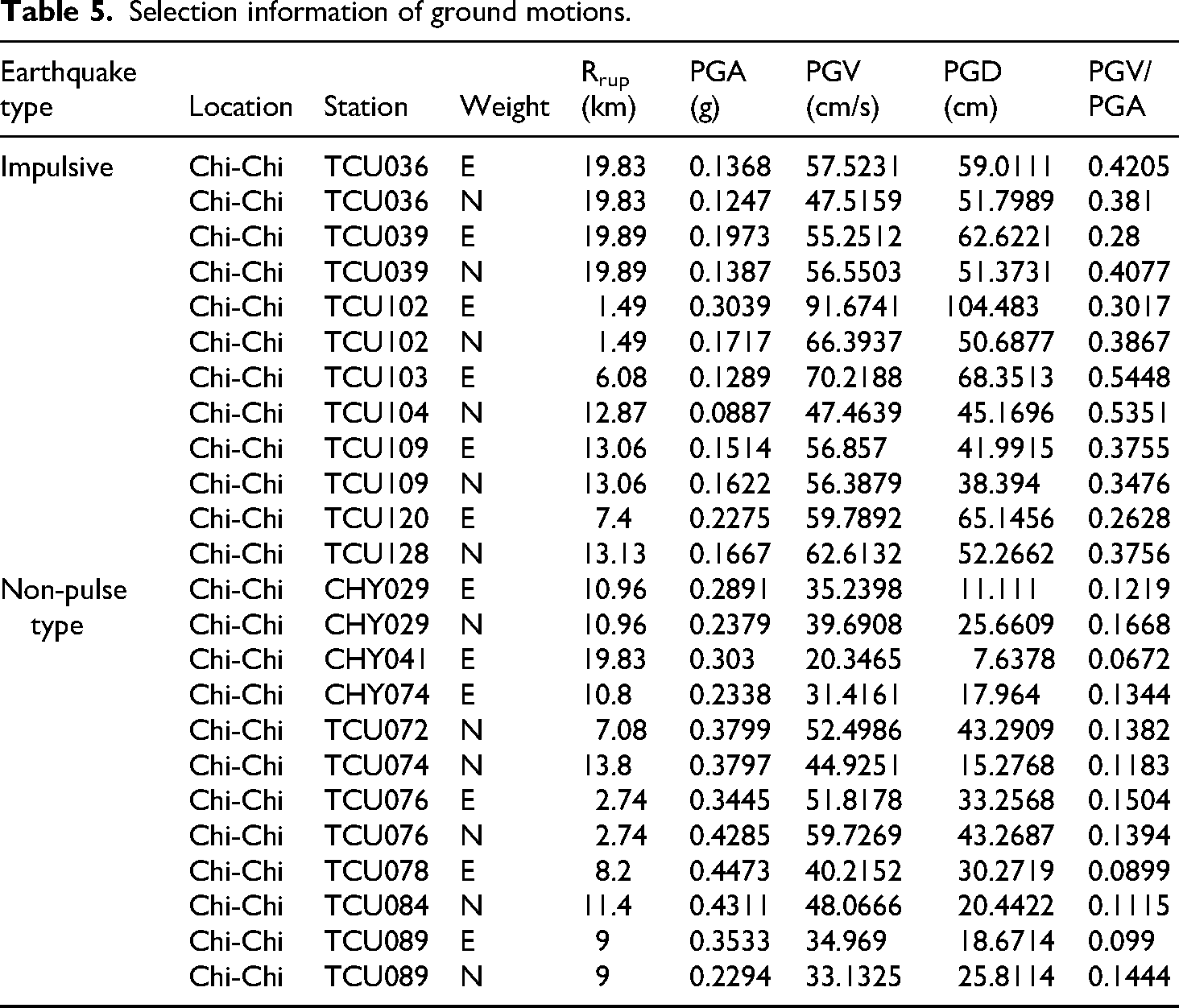
Select 12 near-field pulse and non-pulse seismic waves based on site conditions, and the seismic load information are given in Table 5 and Figures 9 and 10.

Pulsed ground acceleration time history.

Non-impulsed ground acceleration time history.
Selection information of ground motions.
Nonlinear dynamical time-history analysis of two employed bridge modes and discussion
Adjust the PGA of the 12 pulse type and 12 non-pulse type ground motions in Table 5 to 0.1–1.0 g and use them as input ground motions. Perform dynamic response time history analysis using a consistent excitation input method. Due to the main analysis of the influence of PGA on the relative displacement of bridge piers and beams, and the relatively small impact of lateral seismic motion on the relative displacement of bridge piers and beams in the longitudinal direction, only longitudinal seismic input is considered, without considering lateral and vertical seismic motions. The relative displacement of piers and beams of continuous beam bridges under pulse type and non-pulse type earthquakes is shown in Figures 11 and 12, respectively.
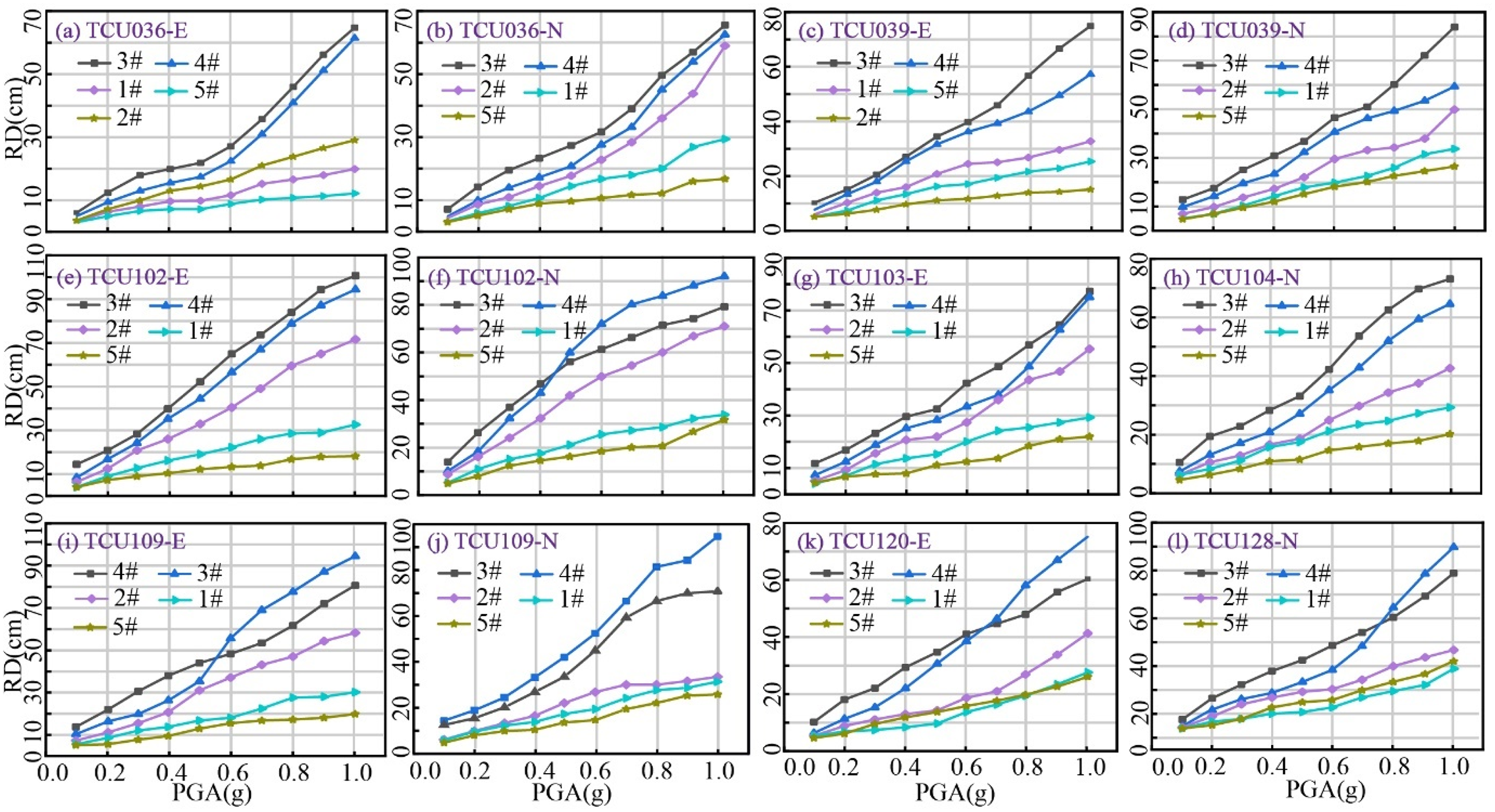
Relative displacement of cast-in-place ridge pier and beam under pulse ground motions.

Relative displacement of cast-in-place bridge piers and beams under non-pulse ground motions. (RD refers to the relative displacement between the pier and the beam.).
From Figures 11 and 12, it can be seen that the relative displacement of the piers and beams of a continuous beam bridge increases with the increase of PGA. However, the increase rate of the relative displacement of the piers and beams under pulse type earthquake action is faster than that under non-pulse type earthquake action, and the effect is more significant than that under non-pulse type earthquake action. This is because the pulse effect of near fault seismic motion significantly amplifies the response spectrum of seismic motion, resulting in the amplification of the structural response as well. When the PGA of the pulse type seismic motion increases from 0.1 to 1.0 g, the relative displacement between the piers and beams of each main pier continues to increase, with a maximum value of 106.2 cm. Theoretically, the beam will experience a drop failure. The relative displacement of the pier and beam at 3# is the largest, with a maximum value of 106.2 cm. The relative displacement between the pier and beam at 2# is the smallest, with a maximum value of 8 cm.
To compare the seismic reduction effect of assembled bridge piers, 12 pulse loads were input into the segmented assembled bridge pier model for calculation. The results are as follows:
As shown in Figure 13, the maximum relative displacement between the segmental assembled bridge pier and the beam still occurs at Pier 3 under the action of pulse load, and the maximum displacement is 82 cm. Compared with the overall cast-in-place bridge pier, the seismic reduction efficiency reaches 25%.

Relative displacement of pier and beam assembled by pulse load segment.
Comprehensive analysis of the damage and failure process of bridge piers
To systematically evaluate the damage mechanisms and performance differences between cast-in-place monolithic and precast segmental piers under seismic action, this section conducts a comprehensive analysis based on nonlinear dynamic time-history results. The analysis focuses on the initiation timing and location of damage, the evolution of damage with increasing seismic intensity, and the fundamental distinctions in damage patterns between the two pier systems.
Damage initiation and evolution process
By monitoring indicators such as the concrete tensile damage factor, steel plastic strain, and segment joint opening displacement, different stages of damage development can be clearly defined.
The damage progression in the cast-in-place monolithic pier follows a typical flexural plastic hinge formation process. Under low-intensity ground motion (e.g. PGA = 0.2 g), tensile damage in the concrete first appears at the pier base (Figure 14(a)). As the seismic intensity increases to PGA = 0.4 g, the tensile damage zone extends upward, longitudinal reinforcement begins to yield, marking the structure's entry into the nonlinear phase and the onset of energy dissipation (Figure 14(b)). Under strong seismic action (PGA > 0.6 g), the plastic hinge zone at the pier base is fully developed, concrete compressive damage intensifies, which may lead to cover spalling or even core concrete crushing, resulting in significant stiffness degradation (Figure 14(c)). The first identifiable damage (concrete tensile damage factor >0.1) typically occurs approximately 3.5 s after the peak ground acceleration is reached, located within a range of 0.5–1.0 times the pier diameter above the base.

Cloud map of overall cast-in-place bridge pier damage. (a) Initial tensile damage at pier base (PGA = 0.2 g). (b) Propagation of damage and onset of rebar yielding (PGA = 0.4 g). (c) Severe damage in the plastic hinge zone at pier base (PGA = 0.8 g).
Damage behavior in the precast segmental pier is governed by both joint opening/closing and plastic deformation of the cast-in-place base segment. Initial damage manifests as repeated opening and closing of the lowest segment joint under seismic excitation. When the PGA reaches approximately 0.3 g, the joint opening displacement first exceeds the design allowable value. Subsequently, major damage shifts and concentrates in the cast-in-place base segment (Figure 15). Under high-intensity ground motion (PGA > 0.5 g), a plastic zone forms in the cast-in-place base segment, while the upper precast segments accommodate deformation primarily through joint rotation and minor local compressive damage. The overall damage level in these precast segments is considerably lower than that in a cast-in-place pier under comparable conditions (compare Figures 14(c) and 15(b)). This transfer of damage mode effectively protects the main body of the precast segments.

Cloud map of damage to pre-stressed segmental assembled bridge piers. (a) Schematic of pier deformation (with joint opening/closing). (b) Damage contour with concentration at the cast-in-place segment and joint of the pier base.
Comparison of damage distribution patterns
The spatial distribution of damage in the two pier systems exhibits fundamental differences (Figure 16), stemming from their distinct force-deformation mechanisms.

Schematic diagram of bridge pier seismic damage. (a) to (e) Development of seismic damage of integral cast-in-place bridge piers during earthquakes. (f) to (j) Development of seismic damage of segmental assembled bridge piers during earthquakes.
The damage (including plastic strain and concrete damage) in the cast-in-place monolithic pier initiates at the base and progressively extends and accumulates upward along the pier height as seismic intensity increases (Figure 16(a) to (e)). This represents a distributed and cumulative damage pattern, ultimately leading to severe, irreversible damage over a considerable height of the pier.
In contrast, damage in the segmental pier is highly localized. It is primarily concentrated in two regions: the cast-in-place base segment (where a plastic hinge forms) and the interfaces between segments (characterized by joint opening/closing and compressive damage). The upper precast segments themselves remain essentially elastic and sustain only minor damage (Figure 16(f) to (j)). This constitutes a damage concentration and isolation pattern, which confines the primary nonlinearity and damage to replaceable or easily repairable components (e.g. a repairable base segment or replaceable energy-dissipating devices). This pattern embodies the design philosophy of functional recoverability.
The damage to the bridge structure during the earthquake process of integral cast-in-place bridge piers and prestressed segmental assembled bridge piers is shown in Figures 14 to 16. For continuous beam bridges, the stiffness of low piers is greater than that of high piers, and their damage is also greater than that of high piers.
Comprehensive discussion
When pile–soil interaction is considered, the flexibility of the foundation and possible nonlinear deformation of the soil (such as gap formation around the pile) increase the displacement at the top of the pier, which is equivalent to extending the effective length of the pier. This reduces the fundamental frequency of the structure and amplifies displacement responses, potentially triggering damage (such as joint opening or plastic hinge formation) under lower seismic intensity. A comparison between pulse-like and non-pulse-like ground motions shows that the high energy input of near-fault pulse-like motions generally leads to more severe damage (e.g. larger joint opening displacements and greater plastic strain in reinforcement) within a shorter duration, thereby accelerating the damage progression.
In summary, the segmental pier adopts a damage concentration and isolation strategy, confining major plastic deformation and damage to the cast-in-place base segment and joint regions, thereby protecting most precast components and demonstrating excellent post-earthquake reparability. In contrast, damage in the cast-in-place pier develops in a distributed manner along the pier height, making post-earthquake repair more challenging. The damage initiation thresholds, evolution sequences, and spatial patterns revealed in this study provide quantitative references for seismic performance evaluation and resilient design of this type of bridge.
Conclusions
This study employs ABAQUS-based nonlinear finite-element models to compare the seismic performance of segmental assembled and cast-in-place piers in continuous beam bridges under near-fault ground motions, identifying an optimal segmental configuration that balances energy dissipation and self-resetting capacity through Pushover analysis. Incorporating pile–soil interaction and viscoelastic boundaries, dynamic time-history analyses reveal that pulse-type seismic excitations induce significantly larger relative pier-beam displacements and accelerated damage progression in both pier types compared to non-pulse motions. The research elucidates near-fault pulse-induced failure mechanisms, highlighting critical failure zones and dynamic response patterns to guide seismic design strategies for segmental bridge systems in high-risk regions. Some conclusions drawn from this research can also be considered as some specifications for seismic design and analysis of the segmental assembled continuous beam bridges in seismic design guidelines, including:
The optimal configuration of segmental assembled bridge piers, balancing energy dissipation and self-resetting capacity, exhibits significantly improved seismic performance compared to cast-in-place bridge piers. This optimal configuration minimizes seismic-induced damage and enhances post-earthquake recoverability. The failure modes of both cast-in-place and prestressed section assembly/fully assembled bridge pier specimens primarily exhibit ductile bending failure. While cast-in-place specimens form sufficient plastic hinges near the pier bottom, prestressed and fully assembled specimens demonstrate a tendency for plastic hinges to migrate upward, with minimal and insignificant damage to the connecting sections away from the pier base. Considering both energy consumption capacity and self-resetting ability, bridge piers assembled with prestressed segments are superior to other types of bridge piers. Under near-fault pulse seismic loads, the relative displacement between the bridge pier and beam for segmental assembled piers is reduced by up to 25% compared to cast-in-place piers. This demonstrates the effectiveness of segmental assembly in mitigating seismic effects. While cast-in-place bridge piers exhibit higher energy dissipation capacity due to their fuller hysteresis loops, their self-resetting ability is weak. Conversely, prestressed segmental assembled piers, despite having incomplete hysteresis loops, demonstrate strong self-resetting ability due to the presence of prestressed reinforcement.
Footnotes
Acknowledgements
The research for this paper was supported partially by the National Science Foundation of China (No.52178169, No. U21A20154, and No.2021YFB1600300) and Major Systematic Projects of China Railway Corporation (No. P2018G007). The authors would like to express their sincere gratitude to all the sponsors for the financial support.

Ethical approval and informed consent
This study did not involve human participants, human biological samples, animals, or personal/identifiable data. Therefore, ethical approval and informed consent were not required.
Author contributions
Funding
The authors disclosed receipt of the following financial support for the research, authorship, and/or publication of this article: This work was supported by the National Natural Science Foundation of China (Nos. 52178169 and U21A20154), the National Key Research and Development Program of China (No. 2021YFB1600300), and the Major Systematic Projects of China Railway Corporation (No. P2018G007).
Declaration of conflicting interests
The authors declared no potential conflicts of interest with respect to the research, authorship, and/or publication of this article.
Data availability statement
No data was used for the research described in the article.