



Abstract
To address the limitations of flux regulation in traditional permanent magnet synchronous generators and the low power density of electrically excited generators, an interior double-radial asymmetric permanent magnet (PM) and salient-pole electromagnetic hybrid excitation generator are introduced in this study. Equations for the no-load induced electromotive force, the voltage adjustment range, and the total harmonic distortion (THD) are derived theoretically through the analysis of generator parameter relationships. The optimization parameters include the offset angles of the double-layer asymmetric PMs and the structural parameters of the salient-pole rotor. A multi-objective optimization model is established with the no-load induced electromotive force amplitude, the voltage adjustment range, and the THD as the objectives. Samples are generated by Latin Hypercube Sampling, followed by sensitivity analysis of the optimization parameters. The optimization parameters are then screened using Pareto front analysis and a defined parameter matching coefficient. The optimal magnet pole parameters are determined. As a result of optimization, the no-load induced electromotive force amplitude increases by 18.7%, the voltage adjustment range expands by 17.6%, and the THD decreases by 38.2%. Finally, a prototype is fabricated and tested, and the results confirm both the accuracy of the theoretical analysis and the effectiveness of the optimization method. The output characteristics of the designed generator are thereby significantly improved.
Keywords
Introduction
The depletion of fossil fuels presents significant challenges, including energy shortages, global warming, and environmental pollution. In response, the global focus has shifted toward the development and utilization of renewable and clean energy sources. Generators, as crucial energy conversion devices, are widely used in applications such as wind power, tidal energy, and electric vehicles. 1 Currently, generators are primarily categorized into permanent magnet (PM) synchronous generators (PMSGs) and electrically excited generators (EEGs). PMSGs offer high power density and efficiency but face challenges with inflexible air gap magnetic flux adjustments, leading to unstable output voltage and complex flux-weakening control over wide-speed ranges.2,3 Furthermore, aggressive flux-weakening operation can induce severe demagnetization risks for the PMs, potentially leading to irreversible performance degradation. 4 Conversely, EEGs, which produce magnetic fields via excitation windings, allow field strength regulation by adjusting excitation current but suffer from high excitation losses, slow dynamic response, and low output efficiency.5,6 To address these limitations, hybrid excitation generators (HEGs) have been developed, integrating the benefits of both PM and electrically excited windings. HEGs facilitate dynamic control of air gap magnetic flux through excitation current adjustments, achieving high efficiency and excellent controllability, and have thus become a significant research focus.7–9
HEGs can be classified into parallel and series types based on their magnetic circuit structures. 10 These two configurations exhibit distinct characteristics, which are reviewed separately below.
In parallel structures, the PM circuit and the electrically excited circuit remain independent, offering advantages such as strong independence in magnetic field regulation, prevention of irreversible PM demagnetization, and continued PM operation in the event of excitation winding failures. However, this configuration involves complex magnetic circuit design, is prone to excessive magnetic leakage and mutual coupling between excitation sources, and requires independent design of dual magnetic circuits, thereby increasing generator volume and weight while reducing space utilization efficiency.11,12
Several studies have explored parallel structures. Gu et al. 13 introduce an axial parallel hybrid excitation DC generator comprising a PM generator and a flux modulation generator, featuring double coaxial rotors. By examining parameters like rotor offset angle and adjusting the magnetic flux phase difference between the components, they achieved a notable increase in output voltage over a specific load range. However, the flux modulation generator employs interior excitation windings alongside armature windings within the stator slots, leading to an excessively high slot fill factor. Variations in excitation current significantly interfere with the armature windings’ induced electromotive force through mutual inductance, thereby impacting voltage stability. Geng et al. 14 introduce a HEG featuring an electromagnetic rotor combined with an embedded PM rotor. Through optimization of parameters like the PM rotor structure and the electromagnetic rotor's axial length, they attained broad magnetic field adjustability and stable voltage output. Nevertheless, the dual rotors substantially increase the axial length, resulting in a larger overall volume and diminished power density. Gong et al. 15 introduce a hybrid excitation synchronous generator with parallel rotor structure, using Halbach array PM rotor and non-salient-pole electrically excited rotor in coaxial parallel structure. By studying parameters such as the rotor axial length and the ratio of slot number to division number in the electrically excited rotor, they achieved constant voltage output and reduced the voltage waveform distortion rate. However, Halbach array PM are relatively brittle and easily damaged during installation, and the slotted structure of the electrically excited rotor increases the complexity of air gap permeance calculation. Wang et al. 16 introduce a hybrid excitation doubly salient generator featuring separated windings, achieved by inserting PM into the stator slots. This design employs interior PM in stator slot magnetic bridges to ensure insulation between the excitation and armature windings, thus establishing parallel magnetic circuits between the PM and the electrically excited components. By comparing three generation modes and optimizing parameters like the rotor slot ratio and PM size, the researchers enhanced the generator's capability for wide-speed-range constant voltage output, as well as its efficiency and reliability. However, the interior PM placement between double windings complicates the stator structure and manufacturing process. Additionally, the absence of experimental validation limits the confirmation of the optimization method's effectiveness, as it relies solely on simulation results.
In contrast, series structures use PM as the main magnetic source and electrically excited windings as the auxiliary source, enabling flexible adjustment of the air gap magnetic flux through series-coupled magnetic circuits. This design not only simplifies the structure and effectively suppresses magnetic leakage and coupling effects, but also eliminates the redundant magnetic circuit design present in parallel structures, thereby reducing generator volume and weight while enhancing space utilization efficiency. Furthermore, through the coordinated design of the main and auxiliary excitation sources, the power density of generators is further enhanced.17,18
Research on series HEGs has also seen significant progress. Zhang et al. 10 introduce a brushless reversed claw pole electromagnetic PM HEG featuring interior combined PM in the rotor. The design employs electrically excited claw poles in a reversed configuration, with their tips directed toward the PM rotor. By optimizing parameters such as the claw pole tip width and thickness angles, they attained a broad voltage adjustment range and enhanced the amplitude of the induced electromotive force and decreased total harmonic distortion (THD). Nonetheless, manufacturing variable cross-section claw poles poses challenges, and incomplete magnetic circuit decoupling during reverse excitation distorts the induced electromotive force waveform. Yu et al. 19 introduce a dual-direction hybrid excitation brushless DC generator featuring an interior combined PM within an interleaved claw pole rotor. By examining parameters like double three-phase and three-phase winding connections and the excitation magnetomotive force adjustment range, and integrating 3D finite-element analysis (FEA) with prototype testing, they effectively adjusted the air gap magnetic flux and enhanced output voltage. However,this structure imposes a significant computational burden in 3D FEA, and the double three-phase winding design complicates manufacturing. Qiao et al. 20 introduce a hybrid excitation brushless claw pole alternator, featuring an annular PM between the claw poles. Positioned between the double claw poles, the interior annular PM is secured by excitation brackets that attach the excitation windings to the end covers. By optimizing parameters such as the PM outer diameter and thickness, they enhanced the average air gap magnetic density and facilitated flux adjustment with minimal excitation current. However, the interior annular PM may increase local magnetic leakage between the claw poles and necessitate a larger reverse excitation current during flux-weakening adjustments. Xiong et al. 21 introduce a HEG featuring dual excitation windings, where axially segmented PM are concentrated in the central full-PM region and the double-end alternate-pole areas. The stator core houses bilateral annular symmetric excitation windings. Through an accurate subdomain model that accounts for stator slot effects and computes parameters like PM remanence and slot width, they precisely calculate the no-load air gap magnetic density distribution. Nonetheless, this model is based on idealized assumptions and lacks prototype fabrication for empirical validation.
While the previous studies have contributed to improving magnetic modulation, optimizing output voltage, and reducing harmonic distortion, they often face persistent challenges. These include complex manufacturing, extended axial length, limited power density, and a reliance on simulation without sufficient experimental proof. Furthermore, a review of the literature indicates that none have explored performance enhancement through a double-radial asymmetric PM structure.22,23 To address these limitations, this paper introduces an interior double-radial asymmetric PM and salient-pole electromagnetic HEG. The double-layer asymmetric PMs are embedded within the salient-pole rotor core, creating a double-radial asymmetric PM magnetic field (PMMF). Excitation windings in the rotor core generate an electrically excited magnetic field (EEMF), with PMMF and EEMF coupled in series within the magnetic circuit. By optimizing parameters like the offset angles of the double-layer PMs and the salient-pole rotor's structural parameters, we achieve improved no-load induced electromotive force amplitude, an expanded voltage adjustment range, and reduced THD. This generator features both high power density and flexible magnetic field regulation, while its compact structure makes it particularly suitable for vehicles with limited installation space.
Hybrid excitation generator design mechanism
Hybrid excitation generator structure design
This study presents the design of an interior double-radial asymmetric PM and salient-pole electromagnetic HEG, as depicted in Figure 1. Figure 1(a) illustrates the generator's overall structure, comprising armature windings, excitation windings, lower and upper PM, rotor core, and stator core. Figure 1(b) details the rotor magnet pole parameters, with α1, α2, β1, and β2 representing the offset angles of the lower and upper PMs, and ws, hs, wb, and hb as the structural parameters of the salient-pole rotor. The HEG's main parameters are derived using empirical formulas, as listed in Table 1. The double-layer asymmetric PM are embedded within the salient-pole rotor core to produce PMMF, while excitation windings on the rotor core body generate the electromagnetic excitation magnetic field. The stator core employs a double-layer distributed short-pitch winding design, effectively suppressing higher harmonics, enhancing the fundamental amplitude, and improving the sinusoidal quality of the induced electromotive force waveform.

Hybrid excitation generator structure: (a) overall generator structure; (b) parameter structure of rotor magnet pole.
Main parameters of hybrid excitation generator.

This study presents a cooperative design integrating interior double-layer PM with salient-pole electrically excited windings, achieving high power density and adaptable flux adjustment. By varying the offset angles of the interior double-layer PMs to create PM circuit, the design enhances the primary magnetic flux density and reduces THD. The electrically excited windings modulate the excitation current to provide dynamic magnetic field compensation, ensuring stable voltage output across varying operating conditions, mitigating core saturation, and enhancing power density. 24
Magnetic circuit analysis of hybrid excitation generator
The HEG primarily employs an interior double-layer PM as the main magnetic source, with electrically excited windings to modulate the magnetic field strength. PMMF and EEMF are series-coupled within the magnetic field. In analyzing the magnetic circuit, it is assumed that the magnetic resistances of the stator and rotor cores are negligible, magnetic saturation is disregarded, and leakage fluxes from the ends of the double-layer PMs, as well as from the pole shoe and pole body, are considered separately. Boundary effects are also neglected. 25 The magnetic circuit distribution of the generator is depicted in Figure 2.

Magnetic circuit distribution of hybrid excitation generator.
Figure 2 depicts that the generator's primary magnetic flux arises from two excitation sources: the interior double-layer PM and the electrically excited windings. The PM serves as the primary magnetic source, while the electrically excited windings provide auxiliary magnetic support. The interior double-layer PMs are engineered to ensure that their magnetic flux lines couple in series. The upper PM facilitates the flux from the lower PM to traverse the air gap and engage with the stator core, thereby augmenting the overall magnetic flux. By introducing a positive or negative current to the electrically excited windings, the air gap's magnetic field strength can be modulated, either increasing or decreasing the total magnetic flux. The red solid line represents the primary magnetic circuit, comprising a series coupling of the PM magnetic circuit and the electrically excited magnetic circuit across the air gap. The flux path originates at the N-pole of the lower PM, traverses the salient-pole rotor core, passes through the S-pole and N-pole of the upper PM, continues through the salient-pole rotor core and main air gap, and engages with the stator core. It then re-crosses the main air gap via the opposite end's salient-pole rotor core, the S-pole and N-pole of the upper PM, the salient-pole rotor core, and the S-pole and N-pole of the lower PM, ultimately returning to the S-pole of the initial lower PM through the salient-pole rotor core. The green solid line represents the leakage flux circuit, primarily comprising three segments located at the ends of the double-layer PM and between the pole shoes and pole bodies of adjacent magnet poles. Utilizing the superposition principle, the equivalent magnetic circuit diagram of the HEG is derived from its magnetic circuit distribution, as depicted in Figure 3.

Equivalent magnetic circuit diagram of hybrid excitation generator.
As depicted in Figure 3, Fe, Fb, Fa, and Fd are the magnetomotive forces of electrically excited windings, lower PM, upper PM, and generator direct-axis reaction, respectively; Ge, Gb, and Ga are the internal permeances of electrically excited windings, lower PM, and upper PM, respectively; Geδ, Gbδ, and Gaδ are the effective permeances of electrically excited windings, lower PM, and upper PM respectively; Ges, Gbs, and Gas are the stator core permeances corresponding to electrically excited windings, lower PM, and upper PM, respectively; Ger1 and Ger2 are the leakage permeances of magnetic field through pole body and pole shoe, respectively; Gbl and Gal are the end leakage permeances of lower PM and upper PM, respectively; Φ e , Φ b , and Φ a are the main magnetic fluxes provided by electrically excited windings, lower PM, and upper PM, respectively; Φ er 1 and Φ er 2 are the leakage magnetic fluxes of magnetic field through pole body and pole shoe, respectively; Φ eδ , Φ bδ , and Φ aδ are the effective magnetic fluxes of electrically excited windings, lower PM, and upper PM, respectively; Φ bl and Φ al are the end leakage magnetic fluxes of lower PM and upper PM, respectively.
Based on Kirchhoff's law and related magnetic circuit analysis methods, the magnetic flux equations can be expressed as follows:
In the analysis, the generator is assumed to be in a no-load state with the direct-axis magnetomotive force set to zero. The air gap magnetic field in the HEG, as designed in this study, comprises both PMMF and EEMF. This field directly affects the generator's three-phase no-load induced electromotive force. The air gap permeance reflects the magnetic flux conduction capacity within the air gap; higher permeance implies lower magnetic reluctance. Consequently, the air gap magnetic flux and magnetic density can be expressed by the following equations:



The magnitude of air gap magnetic flux is jointly determined by factors such as magnetomotive force, the cross-sectional area through which magnetic flux passes when entering the air gap, and magnetic circuit material characteristics.
26
Based on Formulas (4) and (5), when the offset angle of PM in rotor core changes, the cross-sectional areas through which upper PM and lower PM pass the air gap change accordingly, thereby influencing the magnitude of air gap permeance. Therefore, the equation for the air gap permeance can be expressed as follows:

Given the equal width and thickness of both sides of the interior double-layer PMs, magnetic flux leakage is typically concentrated at the ends. Considering the end leakage permeance collectively, the equations for leakage permeance of the interior double-layer PMs, as well as the adjacent salient-pole rotor core pole shoes and pole bodies, are expressed as follows:


Therefore, the equation for the induced electromotive force of the generator in the no-load state can be expressed as follows:

In HEGs, the voltage adjustment range of the no-load induced electromotive force is defined by the difference between its maximum and minimum values. These values result from the air gap magnetic flux variations caused by applying the maximum excitation current in alignment with the PMMF to enhance the flux, and the maximum reverse excitation current to weaken it.
27
This indicates the generator's capability to adjust the air gap magnetic field strength bidirectionally through the excitation current. The numerical value quantifies the dynamic adjustment range of the no-load induced electromotive force. Consequently, the equation for calculating this voltage adjustment range can be expressed as follows:
The sinusoidality of generator no-load induced electromotive force waveform is quantitatively evaluated through THD. This indicator is defined as the percentage of square root of sum of squares of effective values of each harmonic except fundamental wave to effective value of fundamental wave and is the core parameter for measuring the degree of waveform deviation from sinusoidality.
28
After Fast Fourier Transform (FFT) of no-load induced electromotive force waveform, the THD equation can be expressed as follows:
Changes in the parameters of no-load induced electromotive force affect the amplitude and phase of the fundamental wave and its harmonics, as determined by FFT, thereby altering the THD. 29 A lower THD suggests that the waveform of the no-load induced electromotive force closely approximates an ideal sinusoid. Additionally, higher harmonic components disrupt the precision of excitation current adjustments on the air gap magnetic field, increasing voltage control deviation within the no-load voltage adjustment range. Notably, during bidirectional adjustment of the excitation current, higher order harmonics reduce the effective adjustment range of the fundamental amplitude, leading to unexpected fluctuations in the no-load induced electromotive force during voltage adjustments. Thus, effective THD control is crucial for improving the generator's output performance.
Based on the above theoretical analysis, from the analytical equations of Em, △El, and THD, when generator structural parameters are determined, the respective offset angles of PMs α1, α2, β1, and β2 and salient-pole rotor structural parameters ws, hs, wb, and hb change, directly influencing Em, △El, and THD. Because there are strong and complex coupling effects among various parameters, which significantly influence Em, △El, and THD, multi-parameter and multi-objective collaborative optimization method needs to be used for analysis.
Electromagnetic performance optimization analysis
Sensitivity analysis
In generator design, changes in various parameters significantly influence its performance, and these parameters are interdependent with complex coupling effects. Traditional single-parameter optimization methods hardly consider the interactions between parameters comprehensively and cannot achieve effective improvement of generator comprehensive performance. Therefore, to address the performance optimization challenges arising from multi-parameter coupling in generators, a multi-objective and multi-parameter optimization framework is established in this study. Based on the above analysis, eight parameters are selected for optimization, including the respective offset angles of the interior double-layer PMs α1, α2, β1, and β2 and the salient-pole rotor structural parameters ws, hs, wb, and hb. Considering the constraints of manufacturing technology and structural dimensions, the value ranges of these optimization parameters were determined through extensive FEA. The upper limits are set to prevent the intersection of adjacent rotor magnetic poles, which would cause simulation failure, while the lower limits are constrained by machining feasibility and mechanical strength requirements. The specific value ranges are listed in Table 2.
Value ranges of optimization parameters.

In the initial design phase, dealing with the high-dimensional space of eight optimization parameters, directly using surrogate models to link these parameters with optimization objectives often compromises model accuracy. This approach risks overlooking less sensitive parameters due to dimensional redundancy.
30
Additionally, multi-objective optimization algorithms become more complex and computationally intensive with numerous parameters, hindering convergence. Sensitivity analysis can quantify the relationships between parameters and objectives, thus refining qualitative analyses and avoiding the limitations of single-variable assessments. This provides more precise and comprehensive quantitative insights for identifying key parameters and optimizing models. This study employs Latin Hypercube Sampling (LHS) to generate samples, ensuring uniform coverage of each parameter's marginal distribution via stratified sampling. This method effectively prevents sample clustering and achieves efficient space filling with fewer samples. In this design, 200 sample points are generated, with sensitivity calculations based on linear correlation expressed as follows:
31

Sensitivity analysis effectively pinpoints optimization parameters that significantly impact generator performance, thereby minimizing redundant experiments, cutting computational costs, and enhancing optimization efficiency. Figure 4 depicts the sensitivity of optimization parameters to optimization objectives. The offset angle of the lower PM, positioned at the forefront of the magnetic circuit series coupling, exerts a pronounced effect on electromagnetic performance with angle variations. The pole shoe width, which directly dictates the effective cross-sectional area of the main air gap permeance path, exhibits high sensitivity. Conversely, the offset angle of the upper PM, affected by magnetic circuit series coupling and leakage flux, depicts a marked decline in magnetic field regulation efficiency. The widths and heights of the pole body and pole shoe, constrained by the magnetic circuit series coupling, contribute minimally to the main permeance, resulting in lower sensitivity. To streamline computational complexity, parameters ws, α1, α2, which have a greater impact on optimization objectives, are selected for further analysis. FEA determine the final values of the remaining optimization parameters.
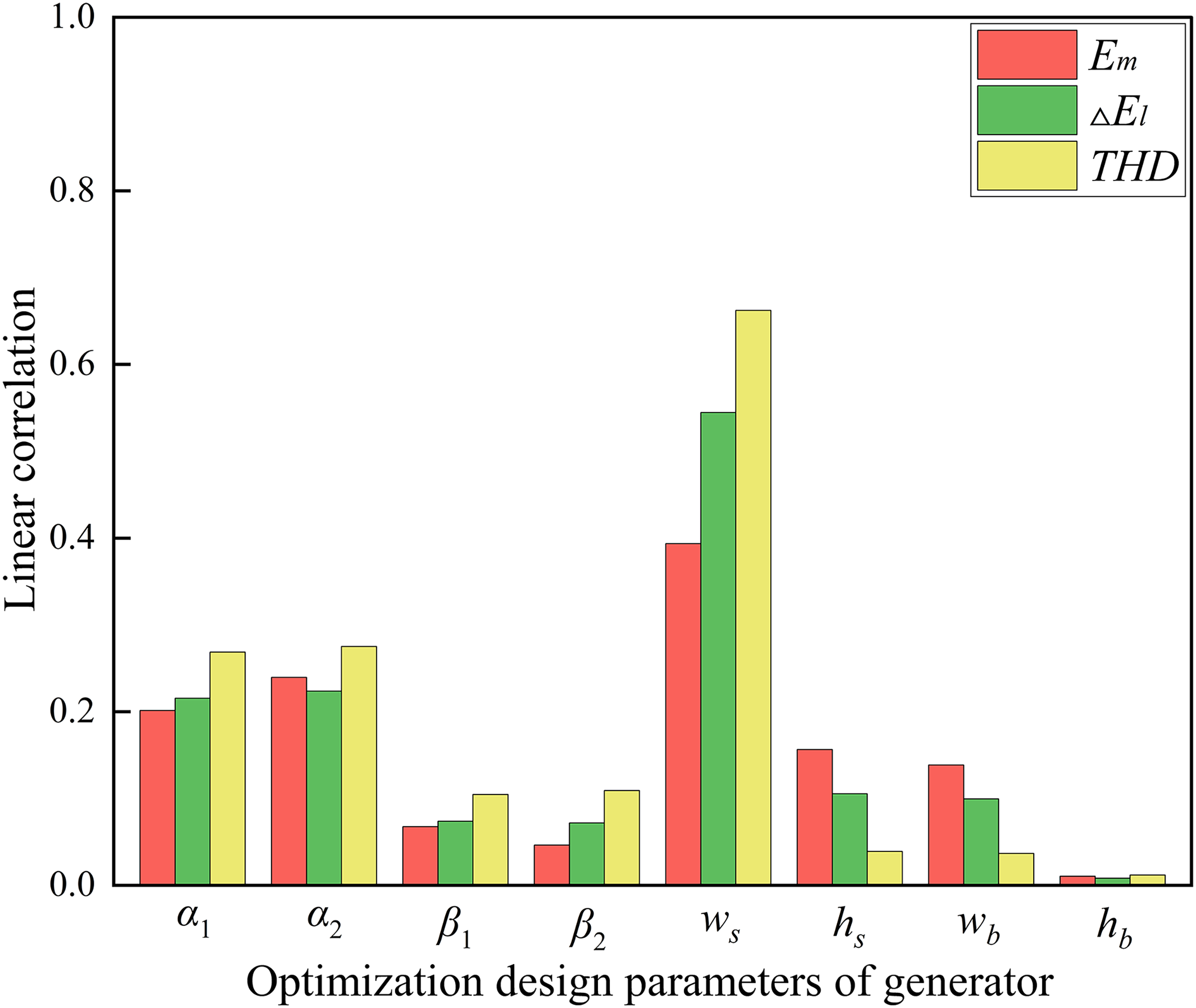
Sensitivity of optimization parameters to optimization objectives.
To validate the sensitivity analysis, actual and predicted values for three response optimization objectives were compared, and a response residual plot was generated, as depicted in Figure 5. The sample points cluster near the black diagonal line and predominantly fall within the red boundary, demonstrating a high reliability of the predicted values in relation to the actual values.

Response residual diagram: (a) Em; (b) △El; (c) THD. THD: total harmonic distortion.
To facilitate the calculation of the fitting curve, this study selects two optimization parameters with higher sensitivity influence on optimization objectives for analysis. By calculating the Residual Sum of Squares (RSS) and the Total Sum of Squares (TSS) of the samples, the equations for RSS and TSS are expressed as follows:

Deviation statistics of optimization objectives.

THD: total harmonic distortion; RSS: Residual Sum of Squares; TSS: Total Sum of Squares.
This paper uses response surface method to investigate the relationships between optimization parameters and optimization objectives, as depicted in Figures 6–8. Figures 6 and 7 are the response surfaces of the pole shoe width ws interacting with the offset angles α1 and α2 of the lower PMs with respect the optimization objectives, respectively. When ws is within a small range, Em, △El, and THD simultaneously reach their peak values on the response surface. After that, as ws increases, Em, △El, and THD all show a trend of first decreasing to a minimum and then increasing. Figure 8 is the response surface of the offset angles α1 and α2 of the lower PMs with respect to the optimization objectives. The influence of α1 and α2 on the optimization objectives depicts a nonlinear relationship. Therefore, the dynamic changes of the optimization objectives are dominated by the interactions among ws, α1, and α2. Analysis of these three optimization parameters can effectively enhance the generator's output characteristics.

Response surface of ws and α1with optimization objectives: (a) effect of ws and α1 on Em; (b) effect of ws and α1 on △El; (c) effect of ws and α1 on THD. THD: total harmonic distortion.

Response surface of ws and α2with optimization objectives: (a) effect of ws and α2 on Em; (b) effect of ws and α2 on △El; (c) effect of ws and α2 on THD. THD: total harmonic distortion.

Response surface of α1 and α2with optimization objectives: (a) effect of α1 and α2 on Em; (b) effect of α1 and α2 on △El; (c) effect of α1 and α2 on THD. THD: total harmonic distortion.
Multi-objective optimization and verification
The optimization objectives of this paper are Em, △El, and THD, which constitute a multi-objective optimization problem. An evolutionary algorithm (EA) is employed to efficiently handle the conflicting nature of these objectives and their complex, nonlinear relationships with the design parameters, without requiring an explicit analytical model. 32 The specific implementation workflow is depicted in Figure 9.

Flowchart of the EA for multi-objective optimization. EA: evolutionary algorithm.
The optimization process commences with the initialization of a design population via LHS, constrained within the value ranges of parameters ws, α1, and α2. Each individual design is evaluated using FEA to compute the three optimization objectives: Em,△El, and THD. The population then enters an evolutionary loop, where it is iteratively refined through genetic operations—selection, crossover, and mutation—until convergence criteria are satisfied. This process yields a Pareto solution set, representing the best-compromised solutions among the competing objectives. This study aims to find the maximum values of Em and △El and the minimum value of THD; therefore, the generator optimization model can be expressed as follows:
Based on this optimization model and the EA process, a three-dimensional Pareto front distribution with 500 sample points is constructed, as depicted in Figure 10. The Pareto front details the trade-off relationships among the optimization objectives Em, △El, and THD. Green points are all sample points, while red points are Pareto front sample points that satisfy constraint conditions. The relatively optimal solution is selected from the red points, and the corresponding data are listed in Table 4.
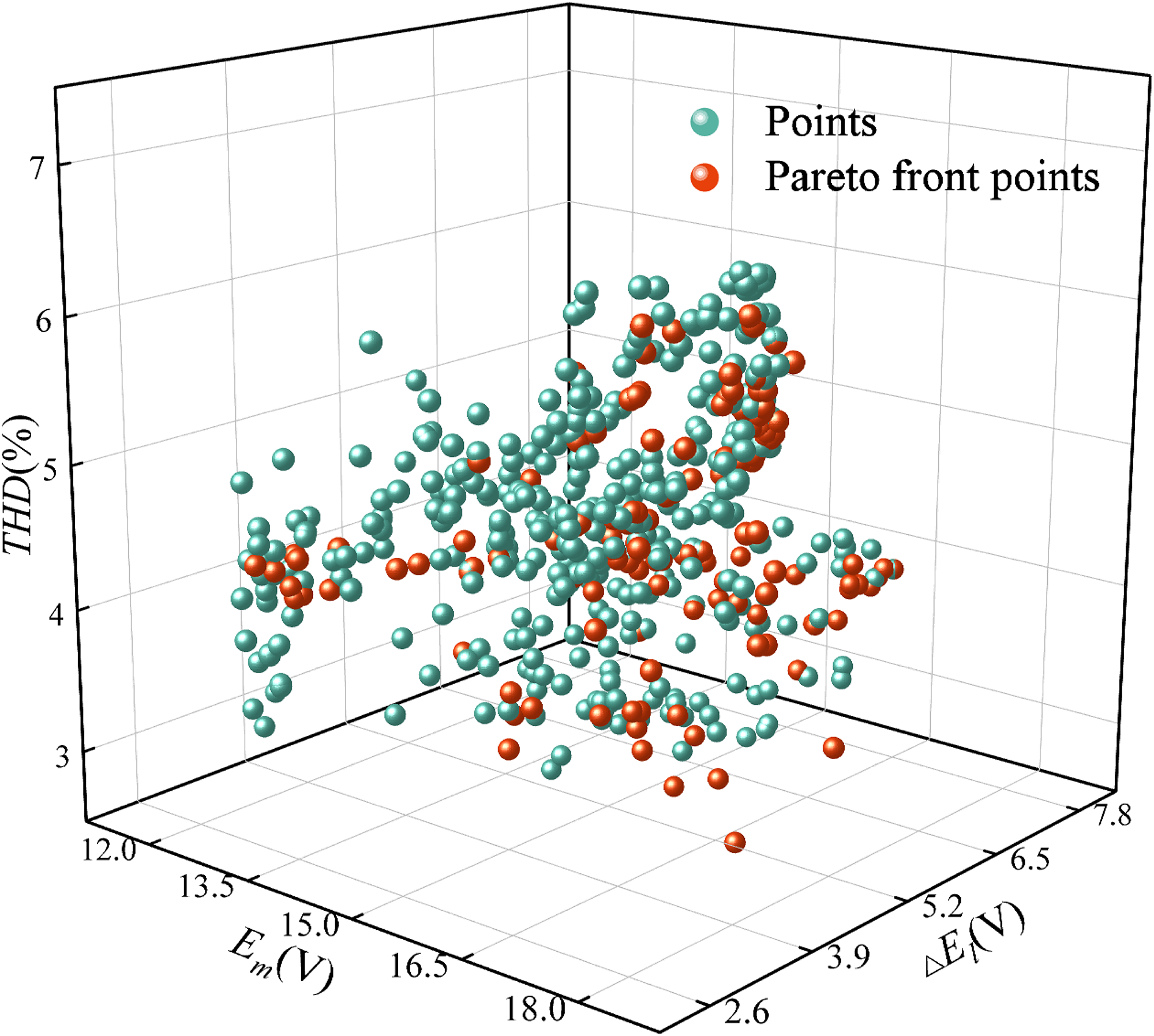
Pareto front distribution.
Relative optimal solution set of Pareto front distribution.

THD: total harmonic distortion.
To identify a set of relatively optimal solution sample points from the Pareto front distribution, a parameter matching coefficient, c, is defined for analysis. In this multi-objective optimization, the amplitude of the Eₘ is considered the primary objective as it directly determines the fundamental power generation capability. The THD, which critically affects the output power quality, forms the secondary focus. Meanwhile, the △El, despite being a key feature of the hybrid excitation structure, is treated as a tertiary consideration since it is inherently a derivative measure of the base Eₘ. A larger value of c indicates better corresponding generator performance.
33
The equation for assigning weights to the three optimization objectives is expressed as follows:

Parameter matching coefficient statistics.
Comparison of generator parameters before and after optimization.

To verify the effectiveness of the optimization design, the HEG both before and after optimization is subjected to FEA, and the changes in Em, △El, and THD are compared, as depicted in Figures 12–14. In Figure 12, the red curve is the optimized Em = 17.77 V, which is increased by 18.7% compared to before optimization. In Figure 13, the difference between blue points on the red curve is the optimized △El = 5.48 V, which is increased by 17.6% compared to before optimization. FFT of the no-load induced electromotive force is performed. The red bars in Figure 14 depict that the fundamental amplitude after optimization is significantly increased, while the amplitudes of other harmonics are reduced. Using Formula (16), the THD is calculated as 3.29%, corresponding to a 38.2% reduction compared to before optimization. In summary, using the interior double-radial asymmetric PM and the optimized salient-pole rotor structural parameters effectively enhances the amplitude and voltage adjustment range of the no-load induced electromotive force and reduces its THD, thereby verifying the effectiveness of the optimization method.

Comparison of the no-load induced electromotive force before and after optimization.

Comparison of the no-load induced electromotive force voltage adjustment range before and after optimization.
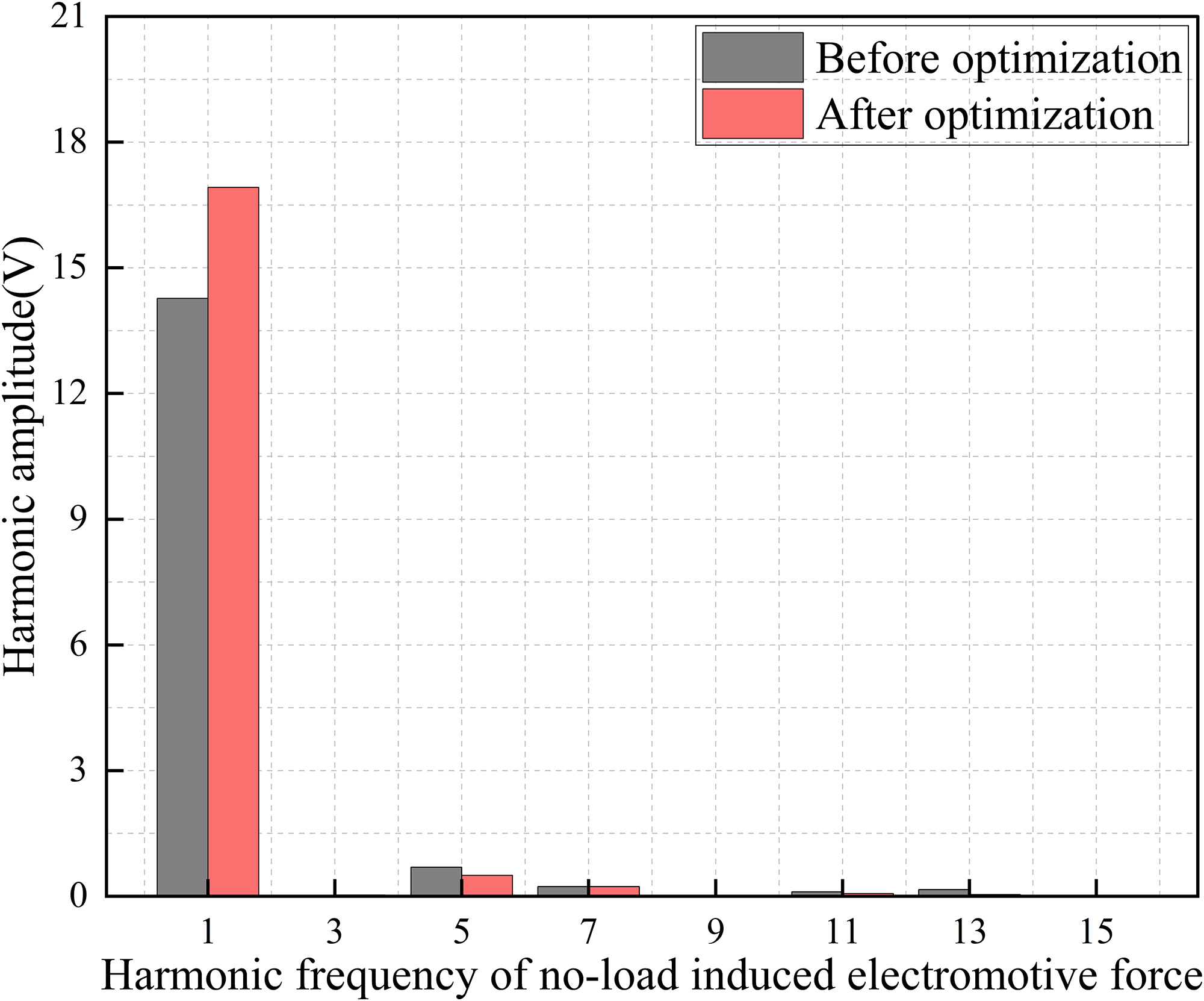
Comparison of harmonics of the no-load induced electromotive force before and after optimization.
Experimental verification
To verify the validity of the FEA, a prototype of a three-phase, 8-pole, 36-slot interior double-radial asymmetric PM, and salient-pole electromagnetic HEG is fabricated, as depicted in Figure 15. Its key component specifications are listed in Table 6.

The diagram of prototype structure: (a) stator; (b) rotor.
Material and key component specifications of the prototype.

The generator comprehensive performance test platform consists of a DC regulated power supply, a generator performance test bench, current transformers, a sliding rheostat, a digital bridge, an oscilloscope, a power analyzer, and a current transformer power supply. The equipment layout of the experimental platform is depicted in Figure 16.
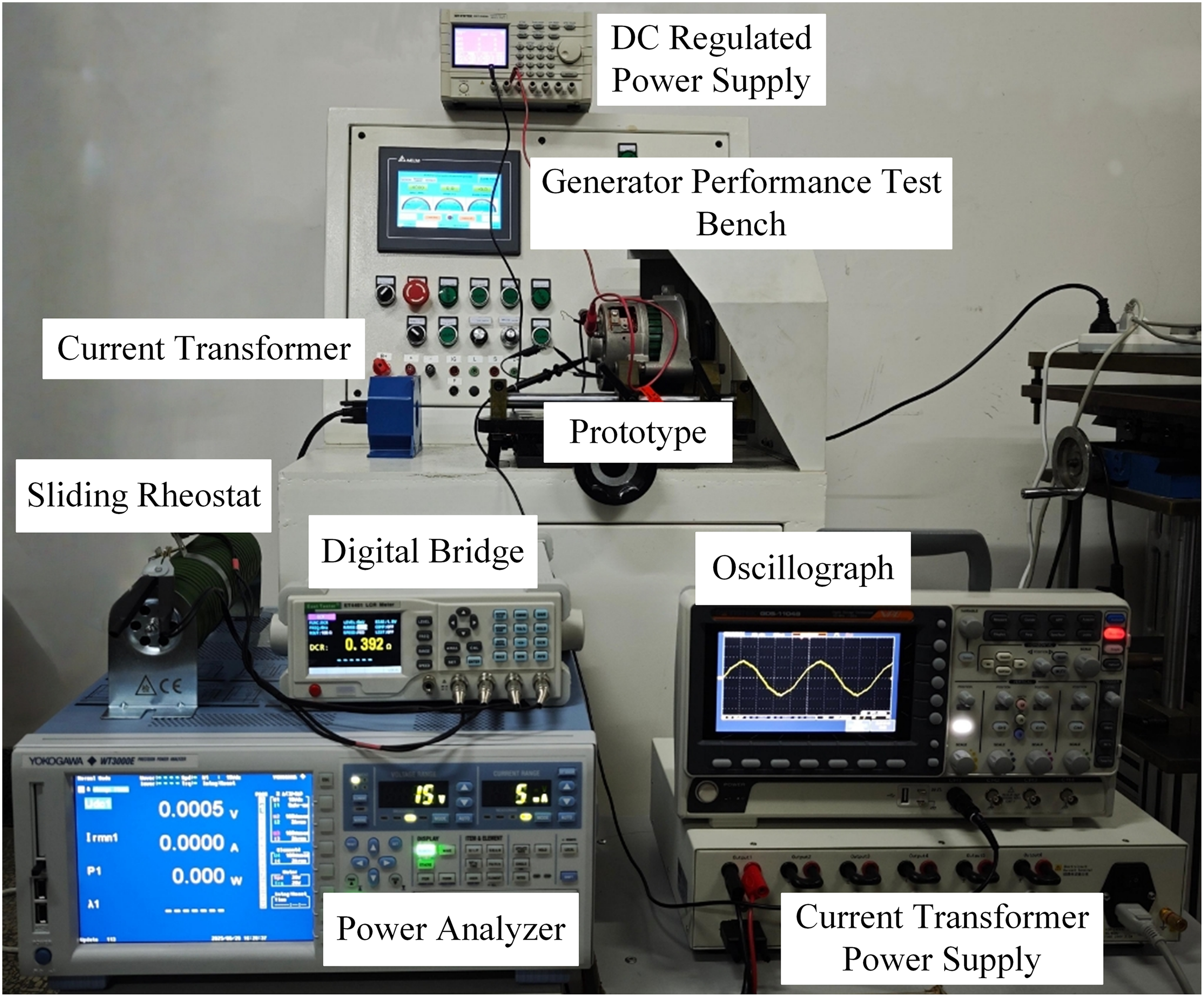
Generator comprehensive performance test platform.
The generator performance test comprises two stages: the no-load test and the load test. During the no-load test, the generator is operated at a specified speed using the motor belt on the test bench to ensure stability. A DC regulated power supply injects positive and negative currents into the generator's excitation windings, facilitating effective coupling of the PMMF and EEMF. An oscilloscope captures the no-load induced electromotive force waveform from the armature windings, measuring its amplitude and voltage adjustment range. The oscilloscope's FFT function decomposes the waveform to determine each harmonic's amplitude, subsequently calculating the THD using the appropriate formula. During the load test, the sliding rheostat's resistance is adjusted under circuit discharge conditions to set the load, with resistance measured by a digital bridge. The generator speed is adjusted using the generator performance test bench, while a DC regulated power supply delivers positive and negative currents to the excitation windings. During wiring, one generator output terminal connects in series with a sliding rheostat via a current transformer, powered by its own supply, while the other terminal connects directly to the rheostat to complete the circuit. The voltage probe of the power analyzer is connected in parallel across the rheostat to measure voltage. The current transformer relays the detected current signal to the power analyzer for synchronous measurement, enabling calculation of the generator's output power.
Based on the generator comprehensive performance test platform, the generator speed is stabilized at the rated speed of 4000 r/min. The amplitude of the no-load induced electromotive force, the voltage adjustment range, and the THD of the prototype are measured, as depicted in Figures 17–19. At the rated speed, the measured results of the prototype are Em = 17.5 V, △El = 5.3 V, and THD = 3.4%, respectively. A slight discrepancy exists between the measured and simulated values, which can be attributed to factors not considered in the simulation, such as the assembly process and generator friction losses. However, the trends of variation are consistent, falling within the acceptable error range.
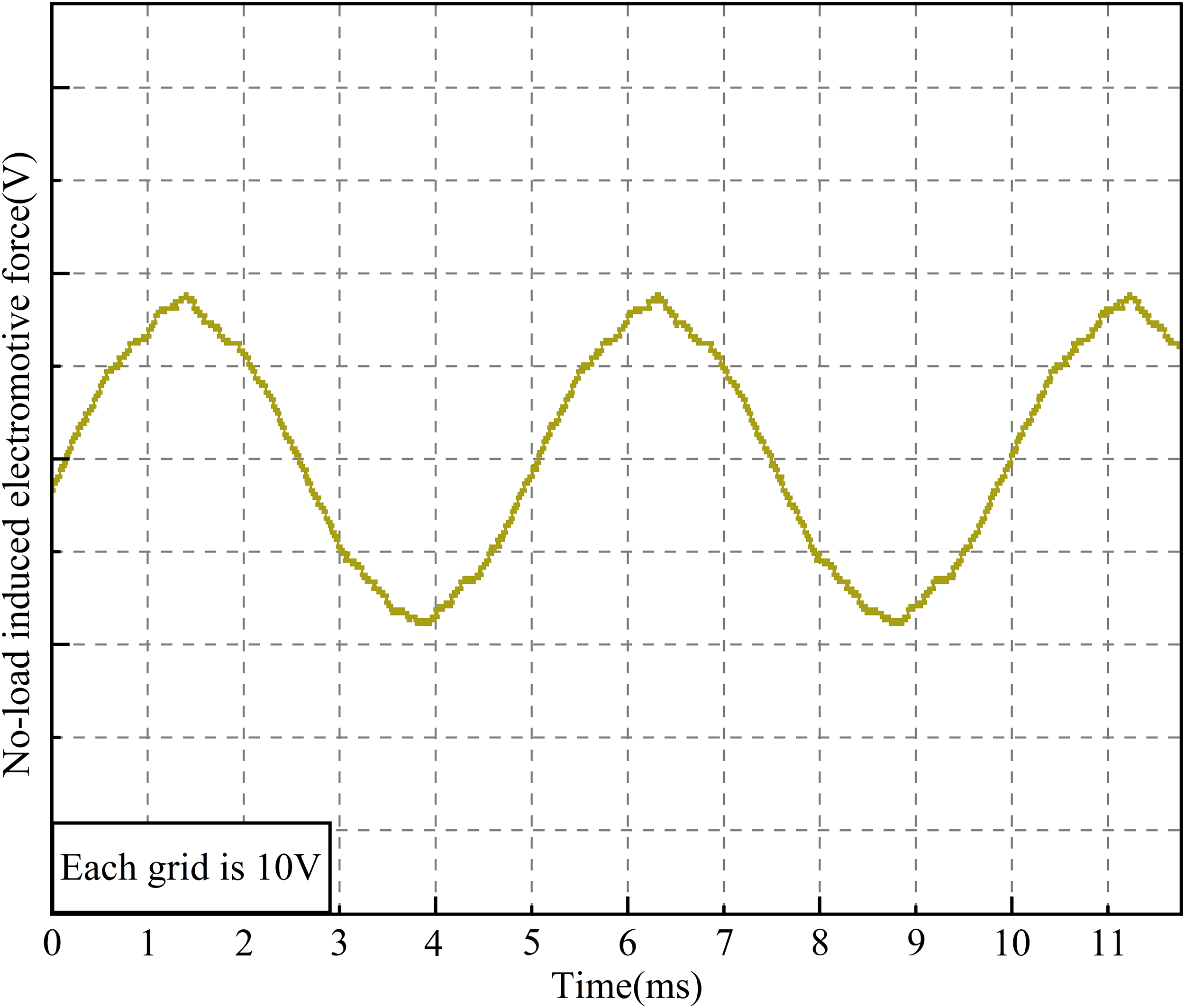
Experimental results of no-load induced electromotive force.

Experimental results of no-load induced electromotive force voltage adjustment range.

Experimental results of no-load induced electromotive force harmonics.
To dynamically match the generator with varying load powers at rated speed, stable output voltage is controlled by adjusting the excitation current, as depicted in Figure 20. Experimental results indicate that with increasing load current, generator output power increases, and the excitation current necessary for maintaining stable voltage rises almost linearly. Specifically, at a load current of 37.1 A and an excitation current of −1.2 A, the generator operates at half-load with an output power of 250 W. When the load current reaches 43.8 A and the excitation current is adjusted to −0.2 A, the generator operates at partial load with an output of 350 W. At a load current of 52.2 A and an excitation current of 1.7 A, the generator operates at rated load with an output power of 500 W.

Adjustment characteristic curve of hybrid excitation generator.
The above test results verify that the interior double-layer asymmetric PM and salient-pole electromagnetic HEG proposed in this study has excellent output characteristics. It satisfies the design requirements, and the effectiveness and validity of the proposed design method are verified through experiments.
Conclusions
This study introduces an interior double-radial asymmetric PM and salient-pole electromagnetic HEG. First, based on the equivalent magnetic circuit method, the effects of the offset angles of the interior double-layer asymmetric PMs and the structural parameters of the salient-pole rotor on generator performance are analyzed. The equations for the three optimization objectives, Em, △El, and THD, are deduced. Second, eight optimization parameters are initially selected for sensitivity analysis, with ws, α1, and α2 identified as the main optimization parameters. The remaining parameters are determined via FEA to obtain their final values. Subsequently, EA is used to construct the Pareto front distribution, and the relatively optimal solution suitable for the optimization model is found through the parameter matching coefficient. Then, Em, △El, and THD are compared before and after optimization. The results indicate that after optimization, Em = 17.77 V, △El = 5.48 V, and THD = 3.29%. Compared with before optimization values, Em and △El increase by 18.7% and 17.6%, respectively, while THD decreases by 38.2%. Finally, a prototype is fabricated based on the optimized parameters for experimental validation. The experimental results are generally consistent with the simulation outcomes, and the deviations fall within an acceptable range, thereby verifying the accuracy of the theoretical analysis and the effectiveness of the optimization design. Therefore, the HEG structure designed in this paper provides a promising solution for achieving high-performance power generation.
It is important to note the limitations and scope of this work. The findings and the optimization approach are specific to the interior double-radial asymmetric series-type HEG structure investigated. The theoretical model's accuracy is contingent upon the initial assumptions of negligible saturation and negligible core loss. Therefore, the proposed methodology is most directly applicable to the design of generators with similar structures and operating within comparable power and speed regimes as our prototype. Extensions beyond these boundaries would require appropriate model refinements and further validation.
Footnotes

Author contribution statement
Conceptualization was done by SM and CL; methodology was done by SM and CL; software was done by CL; validation was done by SM, CL, YW, and QG; formal analysis was done by CZ, HB, SM, and CL; investigation was done by SM, CL, and YW; resources was done by SM; writing—original draft was done by CL; funding acquisition was done by SM. All authors have read and agreed to the published version of the manuscript.
Funding
The authors disclosed receipt of the following financial support for the research, authorship, and/or publication of this article: This work was supported by the Tianjin Education Commission Research Program Project, (grant number 2022KJ122).
Declaration of conflicting interests
The authors declared no potential conflicts of interest with respect to the research, authorship, and/or publication of this article.
Data availability statement
The data presented in this study are available upon request from the corresponding author. The data are not publicly available because they are part of ongoing research.