




Abstract
With the increasing speed of high-speed train, it is more and more difficult to reduce the vibration and noise inside the train. The floor of the train, as a carriage component in direct contact with passengers, is of great significance to improve its vibration and sound isolation performance to ensure the comfort of passengers. In this article, a floor vibration isolator with quasi-zero stiffness is designed based on the dimensional parameters of the traditional floor vibration isolator, and the vibration isolation performance is analyzed by the finite element model of the floor vibration isolator from the static and dynamics aspects, respectively. The load-displacement curves of the floor vibration isolator are obtained through static simulation calculations, and the dynamic analysis of the floor vibration isolator is carried out by simulation methods, which verifies the low-frequency vibration isolation performance of the floor vibration isolator under different working conditions, and the vibration isolator has a good prospect for development.
Introduction
High-speed train has the advantages of large passenger capacity, high safety, high comfort, high operating speed, and so on. However, as the speed of high-speed train increases, the source strength of the sound source outside the carriage is getting louder and louder, and the noise inside the carriage is also increasing. 1 As the main component to reduce the transmission of vibration noise from underneath the vehicle to the vehicle, the floor structure needs to be designed to improve its sound insulation and vibration isolation performance to ensure the comfort of passengers. 2 The traditional vibration isolator between the floor and the aluminum profile in a high-speed train belongs to the linear vibration isolator in passive vibration isolation. Compared with the linear passive vibration isolator, the quasi-zero stiffness vibration isolator has a large stiffness in the non-equilibrium region and a small stiffness near the equilibrium position, which can ensure its high load capacity and good dynamic low frequency vibration isolation performance in the case of small deformation and has the characteristic of “high static and low dynamic.” 3 Therefore, it is of great significance to design a high-speed train floor vibration isolator with nonlinear “high static and low dynamic” stiffness characteristics, and carry out a static and dynamic performance research of this vibration isolator 4 for the vibration and noise reduction of high-speed train.
Domestic and foreign scholars have conducted extensive and thorough research about quasi-zero stiffness vibration isolators. Meng 5 broke through the limitations of low-frequency vibration isolation capacity and space size of vibration isolators, and innovatively designed two kinds of quasi-zero stiffness vibration isolators for vehicle-mounted precision instruments, which were conducive to the improvement of the stability and accuracy of vehicle-mounted precision instruments. Zhu and Niu 6 designed a quasi-zero stiffness vibration isolator by simulation using a spring and a connecting rod mechanism, and verified its vibration isolation performance through tests, which showed that it has vibration isolation effect in the frequency range of 0.2 to 2000 Hz. Zhou 4 designed a quasi-zero stiffness vibration isolator with asymmetric stiffness and damping characteristics, which was helpful to ensure the low-frequency vibration isolation performance of the equipment under the excitation of large displacement amplitude. Yang et al. 7 proposed a new type of high-static and low dynamic stiffness structure based on airbag, and the low-frequency vibration isolation performance of the system under the same loading condition had been greatly improved. Zhang et al. 8 designed a quasi-zero stiffness torsional vibration isolator for variable load conditions, which could adjust the positive and negative stiffness structures in the system synchronously. Margielewicz et al. 9 designed a quasi-zero stiffness vibration isolation system consisting of a main spring and two compensating springs, and evaluated the dynamics of the structure through model tests. Li et al. 10 proposed a negative stiffness mechanism consisting of springs and cylinders, and designed a grounded dynamic damper on the basis of the quasi-zero stiffness isolator to constitute a quasi-zero stiffness isolator with low-frequency and high efficiency. Zhang et al. 11 proposed a design method for the floor damper of high-speed train, which provided a standard for the structural design of floor damper. In order to effectively control the vibration transfer between the aluminum profile and the inner floor, Liu 12 carried out a structural optimization design of the rubber connector, which effectively reduced the stiffness of the connector while satisfying the load in the train. Zhu et al. 13 used finite element method to simulate and analyze the vibration characteristics of high-speed train, and designed a vibration isolation structure based on super elastic rubber materials. Jin 1 designed a quasi-zero stiffness vibration isolator applied to the floor area of a high-speed train, which could improve the low-frequency vibration isolation and sound isolation performance of the floor. Damping parameters have a significant impact on the vibration and sound isolation effect of the floor combination structure of high-speed trains. 14 Miao 15 explored the change rule of damping of rubber floor in the process of use, and established a corresponding neural network model, which could effectively predict the vibration isolation performance of the floor vibration isolation system. Yu et al. 16 explored the impact of two new damping materials on the local vibration isolation of vehicles, and found that the damping pulp floor vibration isolation frequency was wider, and the damping patch was safe. Wang 17 took the honeycomb floor damper of high-speed train as the research object and carried out finite element analysis on it. Liu et al.18–21 devoted to summarize the main research progress of QZS vibration isolation in terms of designs, improvement strategies, and applications, to provide a general overview of the QZS vibration isolation technology for researchers in related fields. The above quasi-zero stiffness isolators form a quasi-zero stiffness structure through the parallel connection of positive and negative stiffness,22–23 thus realizing the design of quasi-zero stiffness structure, but the related structure is more complicated, the conditions of use are more demanding, and the displacement interval of quasi-zero stiffness is shorter, so there are many limitations in engineering applications.
In this article, a quasi-zero stiffness floor vibration isolator with “high static and low dynamic” characteristics is designed for the floor of a high-speed train; then the floor vibration isolator is subjected to static simulation, and the load-displacement curves of the traditional floor vibration isolator and the new floor vibration isolator are obtained; through the finite element simulation software, the dynamics analysis is carried out to verify the performance of the floor vibration isolator under light-load and no-load conditions. Finally, the dynamic analysis of the vibration isolator is carried out by finite element simulation software to verify the low-frequency vibration isolation performance of the vibration isolator under light-load and no-load conditions.
Design of floor vibration isolators for high-speed train
On the basis of the existing quasi-zero stiffness vibration isolators, in order to improve the low-frequency vibration isolation and acoustic isolation performance of high-speed train during no-load and light-load operation, a new type of vibration isolator is designed and applied in the floor mezzanine of high-speed train. The vibration isolator is mainly composed of a trapezoidal structure with quasi-zero stiffness and a rubber block structure with positive stiffness in parallel. The internal assembly is shown in Figure 1, and the cross-section is shown in Figure 2.

Internal assembly of the new vibration isolator.

Cross-section of the new vibration isolator.
The vibration isolation mechanism of the new structure is as follows: the floor of the train is connected with the gland, and the top cover restrains the other degrees of freedom of the gland and the load-bearing joint except for the vertical direction, so as to ensure that the trapezoidal vibration isolation structure will not be overturned. When the train is in no-load and light-load condition, the external perforated trapezoidal vibration isolator is in low stiffness compression state to carry the load alone, and the vibration isolator works near the equilibrium position, with lower natural frequency and higher load, which is conducive to the expansion of the vibration isolation frequency range and realize the low-frequency vibration control. When the train load rises, the trapezoidal rubber is in contact with the rectangular supporting pedestal, and the perforated trapezoidal vibration isolator and the load-bearing rubber block are connected in parallel, and both of them carry the load together to ensure that the floor wood floor sinking amount is not more than 2 mm.
The new floor vibration isolator is designed with reference to the traditional floor vibration isolator, which consists of a perforated rectangular rubber block with L(length)×W(width)×H(height) dimensions of 150 mm × 60 mm × 30 mm and a rectangular aluminum alloy with L × W × H dimensions of 150 mm × 35 mm × 25 mm with a total height of 55 mm. The height of high-speed train floor mezzanine area is limited, so the main limiting parameter of the new vibration isolator is the total height of the vibration isolation device, and the L × W × H dimensions of new vibration isolator is 150 mm × 130 mm × 55 mm. The key component of this design is a trapezoidal quasi-zero stiffness structure consisting of trapezoidal rubber and embedded in the trapezoidal spring steel, which is in the unloaded floor under the effect of gravitational preload has been in the low-stiffness interval and in the train under light-load conditions will move to zero stiffness. It is already in the low-stiffness range under the gravity preload of the unloaded floor, and will be closer to the zero stiffness range under the light-load condition. The trapezoidal spring steel sheet is made of spring steel; the material of trapezoidal rubber is butyl rubber, and its material parameters are selected by hardness; the material of the bearing joint is aluminum alloy. The boundary condition is that the bottom rigid plane is fixed, and a reference point is set on the upper rigid plane to exert a certain amount of displacement. Tradition vibration isolator in floor area is shown in Figure 3. The advantage of this design is a trapezoidal quasi-zero stiffness structure consisting of trapezoidal rubber and embedded in the trapezoidal spring steel, which is in the unloaded floor under the effect of gravitational preload has been in the low-stiffness interval and in the train under light-load conditions will move to zero stiffness. The difference with traditional isolators is that new floor vibration isolator can be closer to the zero stiffness range under the light-load condition in the low stiffness range under the gravity preload of the unloaded floor.

Tradition vibration isolator in floor area.
Design of perforated trapezoidal vibration isolation structures
The quasi-zero stiffness trapezoidal structure is an important part of the new floor vibration isolator as a primary vibration isolator for use under no-load and light-load conditions. The spring steel sheet is embedded in the rubber structure to form a trapezoidal composite structure of spring steel sheet and rubber. The spring steel sheet serves as the main load-bearing object, and the external rubber provides damping for the vibration isolator and suppresses system resonance. With reference to the installation dimensions of the vibration isolator in the floating floor mezzanine of a high-speed train, a trapezoidal spring steel model with a height of 37 mm is established in this section. The original trapezoidal composite structure was improved to enhance the stability of the trapezoidal vibration isolation structure. First, a support pedestal connected to the spring steel is added at the top of the center of the trapezoidal structure, and then the thickness of the spring steel structure at the bottom of the trapezoidal is increased to reduce the deformation of the spring steel at the bottom, which is fixed to the base of the system. The improved trapezoidal vibration isolation structure is shown in Figure 4(a), and its vibration isolation structure at the equilibrium position is shown in Figure 4(b).

Improved perforated trapezoidal vibration isolation structure. (a) New trapezoidal vibration isolation model and (b) new vibration isolation structure.
According to the trapezoidal structure load-displacement curve with the thin wall thickness of spring steel and trapezoidal two waist angle change relationship, through the simulation calculation and repeated optimization of the structural parameters can be obtained, when the bottom spring steel sheet thickness of 0.5 mm, two waist and the top of the spring steel sheet thickness of 0.3 mm and the trapezoidal two waist and the vertical angle of 18°, and the trapezoidal structure load-displacement curve relationship in line with the conditions of the application of the load. The simulation output trapezoidal composite structure load-displacement curve relationship is shown in Figure 5, and the stiffness-displacement curve is shown in Figure 6. The model is nonlinear.

Load-displacement curve of vibration isolator.

Stiffness-displacement curve of vibration isolator.
From Figures 5 and 6, it can be seen that the stiffness of vibration isolator gradually decreases with the increase of displacement, and a curve with stiffness close to zero appears, which is in line with the characteristics of the quasi-zero stiffness vibration isolator. When the system works in the quasi-zero stiffness interval, it has the advantages of large load and small dynamic stiffness, which is conducive to the realization of low-frequency vibration isolation and the expansion of the vibration isolation interval. Moreover, the trapezoidal composite isolator has a larger low-stiffness displacement range than the classical quasi-zero stiffness isolator, which ensures good low-frequency vibration isolation under excitation with large displacement amplitude.
Design of load-bearing rubber blocks
The standard of high-speed train floor sinking amount is assuming that the average mass of each passenger is 60 kg, the number of passengers in the carriage overloaded when the number of passengers is 1.2 times the number of passengers in the full capacity, the carriage changes from empty to overloaded, the sinking displacement of the passenger compartment floor is ≤2 mm. It is known that a vehicle of the high-speed train is full of 90 passengers, and the number of the new type of vibration isolator is 54 sets. The load distribution of the vibration isolator and the parameters of the load-bearing rubber block are determined by finite element simulation, and the load-displacement curve of the load-bearing rubber block is shown in Figure 7. The load-bearing rubber block model is shown in Figure 8.

Load-displacement curve of load-bearing rubber block.

The model of bearing rubber block.
Static analysis of floor vibration isolators
Static simulation calculation of floor vibration isolator
According to the dimensions of the primary trapezoidal composite vibration isolation structure and the secondary rubber block vibration isolation structure, the corresponding assembly parts are established, and the static simulation calculations are carried out in ABAQUS 2020 software.
The load-displacement curves of the primary vibration isolator and the secondary vibration isolator and the assembly are shown in Figure 9, and it can be obtained that: the simulation results of the load-displacement curve of the assembly and the load-displacement curve of the components are consistent, and it can be determined that the constraints loaded in the static simulation of the components are in line with the actual assembly conditions, and the static performance simulation calculations are reliable. The vibration isolator has high-load and low dynamic stiffness and good low-frequency vibration isolation performance within the displacement interval of 1.6 to 2.5 mm. The floor vibration isolator can effectively overcome the shortcomings of poor low-frequency vibration isolation performance of high-speed train under low-load and no-load operation conditions. The static simulation model of perforated trapezoidal structure is established in finite element software, and the density, elastic modulus, and Poisson's ratio of rubber material are defined. The rubber structure is assembled between two two-dimensional rigid planes, the contact property between perforated rubber and rigid plate is defined, and the bottom two-dimensional rigid plate is used as a fixed constraint. In order to facilitate the finite element simulation, the middle part is directly placed between two rigid planes, as shown in the Figure 10, which is the finite element simulation model diagram. Regarding the materials of the parts of the model, the materials of the bearing joint and the rectangular support seat are aluminum alloy; the material of bearing rubber and rubber bearing is chloroprene rubber, and the material parameters need to be selected according to its hardness during simulation. The material of trapezoidal spring steel sheet is spring steel. Finite element simulation assembly is shown in Figure 10.

Load-displacement curves for assembly and key components.
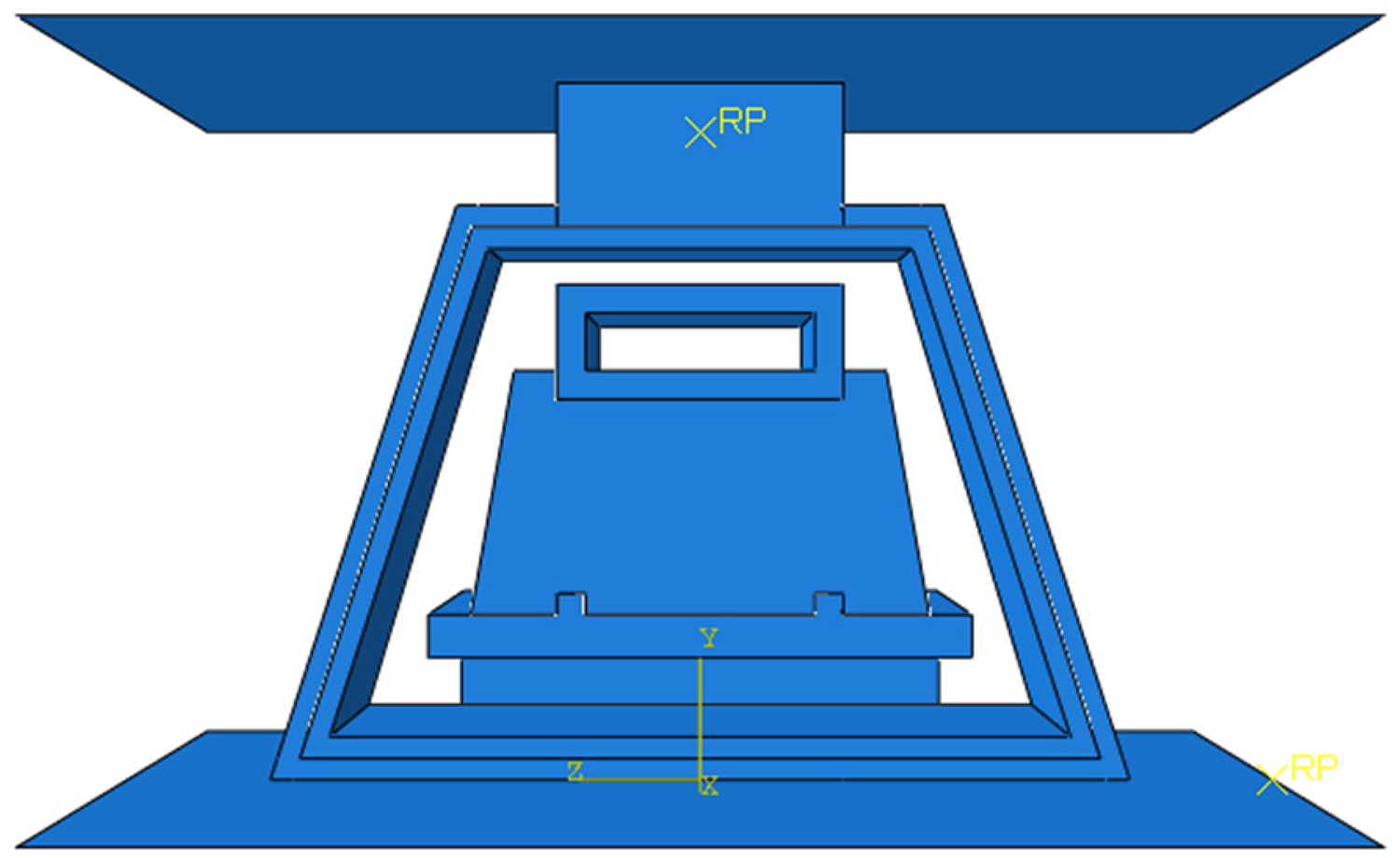
Finite element simulation assembly.
Static stiffness performance analysis of floor vibration isolators
The floor sinking from no load to overload needs to be ≤2 mm, and the stiffness of the quasi-zero stiffness isolator near the equilibrium position is very low, and a larger deformation is often needed when the floor load changes, so the load change of high-speed train is unfavorable to the vibration isolation performance of the quasi-zero stiffness vibration isolator. In order to compare the static stiffness characteristics of the new vibration isolator and the traditional vibration isolator more obviously, a comparative research is carried out from the relationship between the load-displacement curves, when the number of the two types of vibration isolators is the same in each section of the carriage, the comparison of the load-displacement curves of the new vibration isolator and the linear vibration isolator is shown in Figure 11.

Comparison of load-displacement curves of new vibration isolator and linear vibration isolator.
As can be seen from the figure, when the train is in the unloaded condition, the linear vibration isolator is compressed to a position, and the new vibration isolator is compressed to c position. When the train is in the overloaded condition, the linear vibration isolator is compressed to b position, and the new vibration isolator is compressed to d position. It is known that the natural frequency is
Dynamic analysis of floor vibration isolators
Theory analysis of the transfer rate
The purpose of vibration isolation is to reduce the transmission of vibration. In order to further evaluate the vibration isolation performance of vibration isolation devices, lots of researchers have defined the evaluation methods of vibration isolation performance, such as power flow, insertion loss, vibration level drop, and force transmission rate. The force transmission rate, as one of the most commonly used evaluation indexes of vibration isolation effect in analytical analysis and simulation, can provide a theoretical basis for the subsequent dynamics analysis by using the finite element simulation method by exploring the theory of force transmission rate.
From the load-curve fitting analysis of the trapezoidal quasi-zero stiffness isolator above, it can be seen that a Fourier series containing a polynomial at




Simulation analysis of floor vibration isolator dynamics
When the floor vibration isolators are applied to different working conditions of high-speed train, the force transfer rate characteristics of the traditional vibration isolators and the new vibration isolators are compared from four working conditions (no load, light load, half load, and full load). According to the weight of each passenger is 60 kg, the load distribution calculation for a single traditional vibration isolator and new vibration isolator on each carriage is shown in Table 1. When a high-speed train is empty, the sprung mass mainly includes seat mass, floor cloth mass and wooden floor mass, and the total mass is about 3062 kg. Considering that the number of vibration isolators is too small, it is easy to cause local vibration of the floor, and combined with the feasibility of actual installation, it is determined that 54 sets of new vibration isolators will be arranged in the floor area of each carriage. There are 90 passengers at full load and 9 passengers at light load.
Load of two types of vibration isolators under different loading conditions (kg).

The dynamic simulation is based on the static simulation, and the force transmittance T is the ratio of the amplitude of the response force to the amplitude of the excitation force, and the smaller the force transmittance, the better the vibration isolation effect. The frequency-force transmittance curves of the new vibration isolator and the tradition vibration isolator under no-load condition are shown in Figure 12. The vibration isolation effect of the vibration isolator is achieved when the force transfer rate T < 1. Under no-load condition, the traditional vibration isolator has vibration isolation effect in the frequency range of more than 28 Hz, and the new vibration isolator has vibration isolation effect in the frequency range of more than 11 Hz, and the new vibration isolator has low-frequency vibration isolation effect and wider vibration isolation interval which are far more than the traditional vibration isolator.

Transmission rates of forces for two types of vibration isolators under no-load conditions.
The modal analysis of the two types of vibration isolators is performed separately, firstly, the displacement constraints are loaded in the static analysis step and the preload force is loaded to analyze the modal state of the equilibrium state system. The first-order natural frequencies of the two systems are 18.3 and 7.8 Hz, respectively, which are close to the peak frequencies of the transfer rate curves, indicating that the system resonates near this frequency. Further, the dynamics simulations of the tradition vibration isolator and the new vibration isolator are carried out for the light-load, half-load and full-load conditions, respectively, and the force transfer rates of the two vibration isolators for these three conditions are obtained by changing the parameters such as mass point mass, preload load and swept excitation, as shown in Figures 13 to 15. The starting frequencies of the two vibration isolators with vibration isolation effect under these four loading conditions are shown in Table 2.
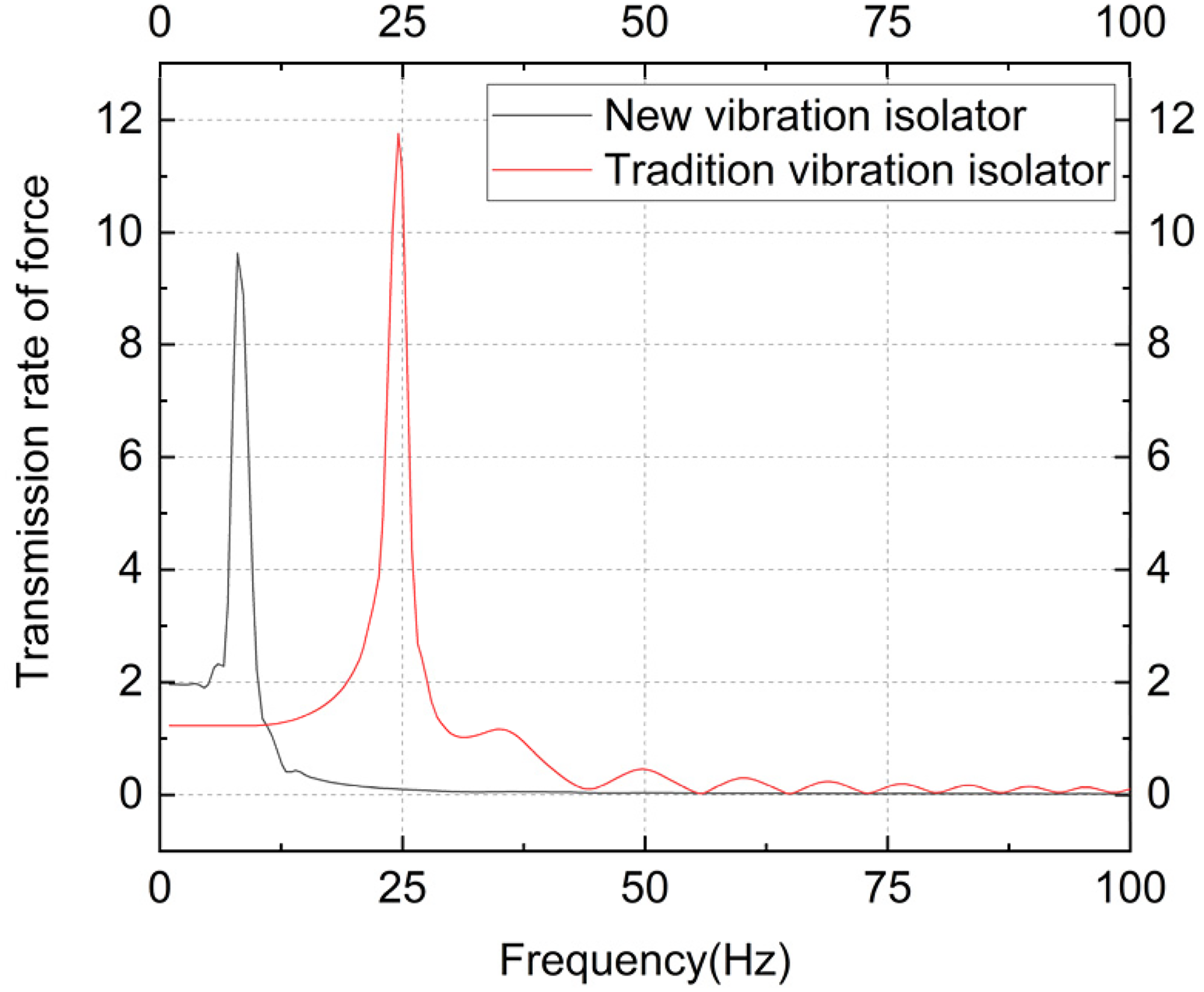
Transmission rate of force under light-load condition.

Transmission rate of force under half-load condition.

Transmission rate of force under full-load condition.
Starting vibration isolation frequencies of two types of vibration isolators under different conditions (Hz).

The vibration isolation performance of the vibration isolator obtained from the load-displacement curve of the vibration isolator in the previous part is verified by the force transmission rate analysis. The new vibration isolator, when the train is under no-load condition and low-load condition, the low-frequency vibration isolation performance is greatly improved, which effectively solves the problems of poor vibration isolation performance and insufficient vibration isolation interval of the traditional vibration isolator in low-load and no-load vibration isolation.
Conclusions
A new type of floor vibration isolator is designed, and the static and dynamic analyses of the vibration isolator are carried out through the simulation method, and the conclusions are as follows:
A new floor vibration isolator is designed, which is still able to ensure the low-frequency vibration isolation level of the floor through the trapezoidal composite structure and the rubber block to undertake the vibration isolation and ensure that the floor wood floor sinking amount is not more than 2 mm. The new vibration isolator has a wider low stiffness displacement interval of 1.6 to 2.5 mm, which is conducive to ensuring its low-frequency vibration isolation performance under the excitation of large displacement amplitude. The new vibration isolation still has good low-frequency vibration isolation level under half-load and full-load conditions. Overall, the new floor vibration isolator can equalize the vibration isolation level under different loading conditions compared with the traditional floor vibration isolator, and has a good development prospect.
Footnotes
Author contributions
SW was involved in conceptualization, methodology, and writing; LS in writing—review and editing; XH in supervision and project administration; HL in investigation, data curation, and validation; and HZ in formal analysis and visualization. All authors have read and agreed to the published version of the manuscript.
Data availability
The datasets used and analyzed during the current study available from the corresponding author on reasonable request.
Declaration of conflicting interests
The authors declared no potential conflicts of interest with respect to the research, authorship, and/or publication of this article.
Ethical statement
This article does not contain any studies with human or animal participants.
Funding
The authors disclosed receipt of the following financial support for the research, authorship, and/ or publication of this article: This work was supported by the Science and Technology Research and Development Program of China State Railway Group Co., Ltd (grant no. L2022Z002).
