



Abstract
In the current economic landscape, the growing importance of innovation and entrepreneurship underscores an urgent need for accurate market trend prediction. Addressing this challenge, our study introduces an innovative entrepreneurial market trend prediction model based on deep learning principles. Through detailed case studies and performance evaluations, this paper demonstrates the model's effectiveness and its potential to enhance decision-making capabilities in a competitive business environment. Accurate market trend prediction is crucial in the fields of innovation and entrepreneurship, and our approach meets this demand. Our model leverages the power of deep learning technology, combining historical market data with diverse market indicators, including sentiment analysis derived from social media, to create an advanced predictive model that surpasses traditional methods. By analyzing data from multiple channels, our model exhibits exceptional accuracy in forecasting future market trends. The case study provides strong evidence of our model's performance and precision, showcasing its significant support for innovators and entrepreneurs navigating complex market trends. Furthermore, this study highlights the vast potential of deep learning technology in the economic sector. We emphasize the importance of developing innovative entrepreneurial market trend prediction models and foresee an increase in project success rates for innovators and entrepreneurs by enhancing decision quality through the adoption of deep learning.
Introduction
In the contemporary economy, the significance of innovation and entrepreneurship continues to grow, underscoring the critical need for precise market trend prediction.1,2 The landscape of business and startups is marked by dynamic shifts and rapid changes, making accurate market trend forecasting a paramount concern. 3 As such, innovation and entrepreneurship practitioners require reliable tools and methods to navigate the ever-evolving market conditions. 4 This research aims to bridge this gap by presenting an advanced predictive model. Accurate market trend prediction is paramount in the realm of innovation and entrepreneurship. It serves as a compass for decision-makers, helping them steer their ventures toward success.5,6 Whether it's identifying emerging trends, understanding customer preferences, or anticipating market disruptions, the ability to foresee market dynamics is a game-changer.7,8 In this context, our research is motivated by the pressing need to provide entrepreneurs and innovators with a robust tool for market trend prediction.
This study leverages deep learning to enhance market trend prediction accuracy by capturing intricate patterns in market data. Incorporating sentiment analysis and other market indicators enriches the model's ability to analyze market dynamics comprehensively, offering a more reliable predictive tool for decision-makers.6,9
In the field of market trend prediction, deep learning, and machine learning models have garnered widespread attention. In recent years, the development of complex neural network architectures has significantly improved the accuracy and robustness of market trend predictions. For example, Transformer models, 13 through self-attention mechanisms, can capture long-span data dependencies, while Graph Neural Networks (GNNs) are advantageous in handling unstructured and graph-structured data, helping to reveal relationships and influences among market participants. 10 Additionally, self-supervised learning techniques, by generating auxiliary tasks, allow models to obtain high-quality representations even in the absence of extensive labeled data. Integrating more data sources, such as social media sentiment analysis, news data, and user behavior data, further enhances the predictive power of the models. Social media sentiment analysis can capture the emotional fluctuations of market participants, while news data and user behavior data provide more comprehensive market dynamic information. In terms of improving the interpretability and usability of deep learning models, incorporating attention mechanisms helps identify and explain important features. Techniques like LIME and SHAP offer both local and global model explanations, aiding users in understanding the model's decision-making process. Below, we will introduce five specific models commonly used in the field and their respective advantages and disadvantages. Firstly, Convolutional Neural Networks (CNNs) serve as excellent tools for image processing and recognition, boasting strong feature extraction capabilities. 11 However, their primary limitation lies in their inapplicability to sequence data, which may restrict their utility in certain market trend prediction tasks. Secondly, Recurrent Neural Networks (RNNs) represent an ideal choice for handling sequence data, as they can consider temporal dependencies. 12 Nonetheless, they come with the challenge of gradient vanishing, making modeling long sequences relatively challenging. 13 Long Short-Term Memory networks (LSTMs) were designed to address the gradient vanishing issue inherent in RNNs. They perform admirably on long sequence data but can be relatively complex and demanding in terms of computational resources compared to some emerging models. Transformer models have achieved significant success in natural language processing, thanks to their parallel computing capabilities and exceptional performance. 14 However, for small datasets, their parameter count can significantly increase, necessitating more data and computational power. Lastly, Generative Adversarial Networks (GANs) excel in generative tasks, capable of producing realistic data. Nevertheless, their training process is relatively unstable, requiring careful hyperparameter tuning.15,16
In addition, time series deep learning models stand out in innovative entrepreneurial market trend prediction for their effectiveness in trend forecasting, risk management, and investment optimization.17,18 They possess the capability to capture temporal dependencies and adapt to long-term market trends, providing invaluable insights to entrepreneurs navigating the ever-changing market landscape. The automation and real-time analytical capabilities of these models empower entrepreneurs to respond promptly to market fluctuations and make data-driven decisions based on the latest market data.19,20 However, it's important to note that they come with certain limitations, including the need for extensive historical data, substantial computational resources, and challenges related to model interpretability. The adoption of time series deep learning models in the field of innovative entrepreneurial market trend prediction offers significant advantages for achieving more accurate and prudent decision-making. Entrepreneurs can leverage these models to optimize strategies, mitigate risks, and maintain a competitive edge in highly dynamic markets.21,22 In addition, multi-modal data fusion models find extensive applications, amalgamating diverse data types such as text, images, and sentiment analysis from social media to offer comprehensive market trend predictions. These models capture market sentiments, visual trends, and integrate traditional market data, providing entrepreneurs with a holistic market insight.23,24 Advantages encompass enhanced market trend predictions, improved risk management, and precise market positioning. However, challenges include managing diverse data, computational resource demands, and model complexity. Entrepreneurs must strike a balance between these advantages and challenges when harnessing the potential of multi-modal data fusion models for practical applications.
The use of GANs in generating market trend data has practical applications.25,26 This approach involves creating diverse market trend data to enhance the performance of trend prediction models and simulating market scenarios. Firstly, GANs can generate diverse sets of market trend data, which can enrich training datasets and improve the accuracy of trend prediction models. The diversity of data aids in capturing the various dynamics and uncertainties of the market, providing entrepreneurs with more reliable predictions. Secondly, GANs can be employed for simulating market scenarios, assisting entrepreneurs in decision analysis and strategy testing without exposure to real market risks. This reduces decision-making risks and instills greater confidence in strategic planning. However, the utilization of GAN-based market trend generation models also comes with certain challenges. Firstly, model training can be complex, demanding substantial data and computational resources. Training and fine-tuning the model can be time- and resource-intensive. Secondly, GAN training processes may exhibit instability, resulting in inconsistent data quality. This may necessitate careful parameter tuning and training techniques to ensure model stability and data consistency. Lastly, generated data may raise privacy concerns, particularly when using actual market data for generation. Furthermore, the model may produce misleading data that could impact decision accuracy.27,28
The motivation behind our research lies in the imperative need to enhance the accuracy and comprehensiveness of market trend predictions. Existing research has largely focused on the use of single data sources, lacking in-depth exploration of integrated analysis from multiple data sources. Additionally, traditional methods face challenges in handling large-scale and high-dimensional data, failing to fully leverage the potential of deep learning technologies. Moreover, existing market trend prediction models have limited forecasting capabilities in complex and dynamic market environments, lacking effective capture of long-term data dependencies. However, we propose a comprehensive deep learning framework integrating key technologies such as GANs, CNNs, and RNNs for processing and analyzing this complex data. This approach uniquely integrates multiple data sources including company names, founding dates, industries, geographic locations, number of employees, and funding information (including funding rounds, amounts, and dates), providing a more comprehensive and in-depth perspective on market dynamics, significantly enhancing prediction accuracy and robustness. Our study provides a more comprehensive market trend prediction model, significantly improving prediction accuracy and robustness. It demonstrates the potential of integrating multiple data sources in market analysis, offering new avenues and methodologies for future research. Furthermore, it emphasizes the effectiveness of deep learning methods in handling market data, providing more reliable tools for decision support systems in practical applications.
Our approach is rooted in a structured application of deep learning theories to advance the field of market trend prediction. Our study aims to: (1) Develop a deep learning framework to predict the future paths of innovative startups; (2) Utilize GANs, CNNs, and RNNs to process complex data like founding dates and funding information; and (3) Validate the framework's accuracy and robustness, focusing on integrating multiple data sources and analyzing time-series data effectively. Therefore, we employ CNNs for robust feature extraction from historical market data, RNNs to model temporal dependencies, and attention mechanisms such as Transformers for integrating diverse data sources effectively. Additionally, GANs are utilized to enhance the model's generative capabilities. This cohesive integration of CNNs, RNNs, Transformers, and GANs not only improves the accuracy and depth of market trend predictions but also contributes significantly to the theoretical foundations of deep learning in economic forecasting and decision support systems for innovation and entrepreneurship.
Materials and methods
Data
Data sources
Crunchbase, acknowledged by over 31 million users worldwide, is a key source of business information, especially noted for its depth and breadth in information about startups and the tech sector.29,30 It collects data primarily through two channels: (1) Investment Firm Contributions: Over 3000 global investment firms regularly update their investment portfolios. This compilation of information from diverse investors forms a rich and dynamic database that reflects the latest trends in the startup ecosystem. (2) User Contributions: About 500,000 executives, entrepreneurs, and investors update company profiles. This crowdsourced method allows Crunchbase to gather extensive information, including details on smaller or emerging companies not typically covered by large investment firms. Moreover, Crunchbase uses artificial intelligence and machine learning to process this data, ensuring accuracy and assisting in sorting, organizing, and analyzing large volumes of information. It also scours the internet and news publications for more data, providing a comprehensive view of the companies in its database.
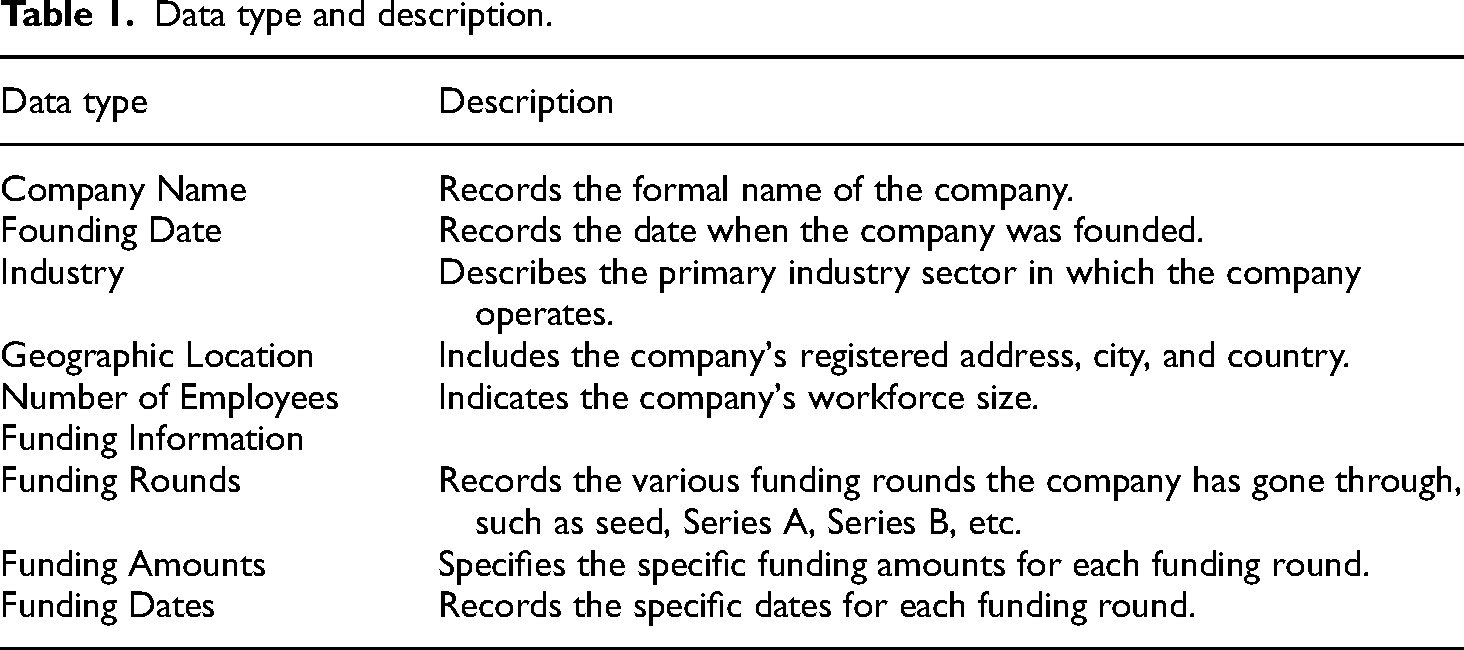
We have collected data on approximately 10,000 startups in the USA, established between 1998 and 2018, from Crunchbase. This dataset is a vital sample for analyzing trends in the U.S. startup landscape over two decades. We chose to study U.S. startup data because the United States is one of the largest and most innovative startup markets globally. The development patterns and success factors of U.S. startups offer significant insights and reference points for other markets. In addition, we chose the 1998 to 2018 timeframe to capture significant economic events like the dot-com bubble and financial crisis, providing insights into startup performance across varied economic conditions. This period offers validated and comprehensive data, crucial for analyzing startups’ evolution from inception to maturity. Limiting our study to data up to 2018 ensures data completeness and accuracy, essential for assessing long-term startup performance and market impact over a minimum five-year observation period. This approach strengthens the reliability and depth of our research findings. These companies are assessed using nine different metrics to analyze their growth patterns, challenges, and success factors during their early years (Table 1).
Data type and description.
Data preparation and preprocessing
In the study of innovation and entrepreneurship market forecasting, thorough data preprocessing and preparation are critical steps. This research involves the collection of key data on startup companies, including but not limited to company names, founding dates, industry categories, geographic locations, number of employees, and detailed financing information such as funding rounds, funding amounts, and funding dates. This information serves not only as the basis for the basic description of the companies but also provides the necessary data foundation for predicting the future status of the companies.
During the preprocessing phase, all company names were standardized to ensure their uniqueness and consistency. Founding dates were converted to a unified format of YYYY-MM-DD, from which derivative indicators such as company age were further extracted. Industry information was categorized and encoded to fit the needs of subsequent machine learning models. Geographic location data were also standardized and converted into numerical codes for quantitative analysis. The number of employees went through data cleaning and normalization to ensure comparability. Financing information underwent a rigorous cleaning and verification process, in which funding rounds were coded, and funding amounts and dates were normalized to extract key time and amount features.
Ultimately, each company was assigned a label based on its current operating status. According to the logic provided, the status and type of financing of the company determined the value of the classification variable
Method
We adopt a deep learning approach to enhance the accuracy and comprehensiveness of market trend predictions. The essence of this method lies in the application of deep learning technologies, including CNNs and RNNs. The integration of these technologies allows us to effectively extract key features from historical market data and process time-series data for more accurate identification and analysis of market trends. Moreover, by amalgamating data from diverse sources, our approach offers a more comprehensive view of the market. We undertake a multifaceted approach to market data analysis, utilizing advanced deep learning techniques for predicting market trends in innovation and entrepreneurship. Our methodology encompasses the following key stages: We commence by gathering multi-source market data, encompassing historical trends, industry reports, and economic indicators. These data are then subjected to rigorous cleaning and standardization processes to ensure consistency and accuracy. To address the issue of class imbalance, particularly in areas with scarce or uneven data, we employ GANs to generate additional data samples. This technique significantly enhances the diversity and balance of our dataset. Our approach utilizes CNNs for extracting features from the data. This step involves a careful selection of key features, which are then processed for further analysis.
For handling time-series data, such as a company's founding date and financing dates, we implement RNNs. These networks are adept at capturing dynamic, time-related information. We construct a deep learning model incorporating CNNs, RNNs, and attention mechanisms. This model is meticulously trained to identify patterns and insights from the data. The outputs of CNNs and RNNs are integrated to form a comprehensive feature set. This set is utilized to train a classification model, which could be logistic regression, support vector machine, or random forest. This model is capable of accurately predicting a company's future status. The trained model is then applied to real-world market trend predictions. Continuous monitoring and iterative optimization based on feedback are integral parts of this stage, ensuring the model's relevance and accuracy over time.
Generative adversarial networks
We incorporate GANs to enhance the predictive accuracy of market trends. GANs, a concept introduced by Ian Goodfellow and colleagues in 2014, consist of two neural networks, the Generator and the Discriminator, which are trained in a competitive setting. The Generator's objective is to create data that mimic the real-world data, starting from random noise and gradually learning to replicate the input dataset's characteristics. Conversely, the Discriminator's role is to differentiate between the actual data from the dataset and the synthetic data produced by the Generator, aiming to accurately classify the real and fake inputs.
This adversarial training process is conceptualized as a minimax game, with the Generator seeking to minimize its ability to be detected by the Discriminator, while the Discriminator aims to maximize its accuracy in identifying real versus generated data. The training can be represented by the function (Table 2).

Definitions of key terms in GANs.

In the context of market trend prediction, GANs play a crucial role in generating synthetic market data, which supplements the training dataset, especially when real-world data are insufficient or incomplete. This approach allows the predictive model to learn from both real and synthetic data, providing a more comprehensive and robust understanding of market trends. Through this adversarial process, both the Generator and Discriminator improve, leading to the creation of highly realistic synthetic data and a Discriminator adept at distinguishing between real and generated datasets. Consequently, this enhances the overall capability of our predictive model, offering more accurate and thorough market trend predictions.
Convolutional neural networks
The application of CNNs is crucial, particularly in extracting key features from market data. 31 Through its convolutional layers, CNNs effectively capture vital information such as patterns of price fluctuations and changes in trading volume. The accurate extraction of these features is significant for a deep understanding of market dynamics and the prediction of future trends. The uniqueness of CNNs lies in their ability to not only reduce data dimensions but also retain essential information, which is particularly important for processing and analyzing large-scale market data.
The convolutional layers in CNNs utilize a series of learnable filters (or convolutional kernels) that slide over the input data to extract local features. Each filter focuses on capturing specific types of features, which in the context of market data analysis might manifest as particular patterns of price movements. The convolution operation can be mathematically expressed as (Table 3):
Definitions of key terms in CNNs.

Following the convolutional layers, CNNs typically include nonlinear activation layers, such as the Rectified Linear Unit (ReLU), enhancing the network's ability to handle complex nonlinear problems. Additionally, the pooling layers in CNNs serve to reduce the spatial size of the feature maps, thereby lowering computational complexity and preventing overfitting while retaining the most important feature information. Finally, the fully connected layers aggregate the features extracted and processed by the preceding layers for the final prediction or classification task. CNNs play a pivotal role in our method for predicting market trends, demonstrating their unique strengths not only in feature extraction but also in reducing data dimensions and preserving key information. Through this approach, CNNs provide a solid foundation for accurate predictions of market trends.
Recurrent neural networks
RNNs play a pivotal role in processing market time series data, such as stock prices and sales figures. 32 The design of RNNs enables them to effectively capture the temporal dependencies present in this data, aiding in the prediction of future market trends.
RNN operates through its recurrent units, which pass information at each time step of the sequence. At time step t, an RNN unit receives two inputs: the current input data
The primary function of RNN in our method is to analyze patterns in the time series data of the market. Its recurrent structure enables the RNN to identify the influence of past events on future occurrences, which is crucial for understanding and predicting market trends. As new data are fed into the model, the RNN's hidden state is continuously updated, allowing the model to dynamically reflect the latest market dynamics. However, RNNs may struggle to learn very long-term dependencies due to issues like vanishing or exploding gradients. To mitigate this, more advanced RNN variants, such as LSTMs or Gated Recurrent Units, can be employed. RNNs play an essential role in our method for market trend prediction. By analyzing historical data and time series patterns, they provide robust support for forecasting future market trends.
Classification algorithms
We used some commonly used classification algorithms in machine learning:
Logistic Regression: Despite its name, logistic regression is used for binary classification. It models the probability that a given input belongs to a particular category. The output is a probability that the given input point belongs to a certain class, which is converted into a binary outcome. Decision Trees: Decision trees are a non-parametric supervised learning method used for classification and regression. A decision tree builds a model that predicts the value of a target variable by learning simple decision rules inferred from the data features. It's like a flowchart where each internal node represents a test on an attribute, each branch represents the outcome of the test, and each leaf node represents a class label. Random Forests: This is an ensemble learning method for classification (and regression) that operates by constructing a multitude of decision trees at training time. For classification tasks, the output of the random forest is the class selected by most trees. It's effective in reducing overfitting by averaging multiple decision trees. Support Vector Machines (SVM): SVMs are a set of supervised learning methods used for classification, regression, and outliers detection. An SVM model is a representation of the examples as points in space, mapped so that the examples of the separate categories are divided by a clear gap that is as wide as possible. New examples are then mapped into that same space and predicted to belong to a category based on which side of the gap they fall on.
Model development
We conduct our operations on a Linux Ubuntu 20.04 LTS operating system. The hardware setup includes an NVIDIA RTX 3080 GPU, equipped with a substantial number of CUDA cores and 8GB of GPU memory, to support the processing of large models and datasets. For the CPU, we have selected a high-performance Intel Core i9 processor. The system is further configured with 32GB of RAM to efficiently handle large datasets and parallel tasks (Figures 1 to 3).

Overview of our framework.

CNN-LSTM model structure.

Loss and accuracy curve of model.
Model building and prediction
In the research of predicting the innovation and entrepreneurship market, a comprehensive deep learning framework has been successfully constructed. This framework integrates GANs, CNNs, and RNNs for processing and analyzing complex datasets. Below are the detailed steps of model construction and prediction (Table 4):
Data Augmentation using GAN: Given the limited number of successful IPO and failure cases in the dataset, GANs have been employed to generate additional samples, significantly improving the class balance of the dataset. During the training process of GANs, the generator successfully produces high-quality synthetic data that are almost indistinguishable from real data. These generated data have been effectively integrated into the original dataset, providing comprehensive data support for model training. Structured Data Processing using CNN: Structured data, including industry classification, number of employees, and financing information, has undergone appropriate preprocessing to transform it into a format suitable for CNNs. CNNs have demonstrated excellent performance in processing this data, successfully learning and extracting key spatial features, which contributes to a deeper understanding of a company's fundamentals. Time Series Data Processing using RNN: For time series data, such as a company's founding date and financing dates, RNNs (especially LSTM) have been used to capture time-related dynamic information. RNNs, with their recurrent structures, effectively remember and utilize historical information, providing robust support for predicting future events. Integration of CNN and RNN Outputs for Prediction: Ultimately, the outputs of CNNs and RNNs are cleverly integrated to form a comprehensive feature set, which is used to train a classification model. The classification model can be logistic regression, support vector machine, or random forest, and it accurately predicts the future status of companies, including operating, M&A, IPO, or closure. The labels of companies are determined based on their current operational status, depending on the company's status and financing type. If a company has been acquired, completed an IPO, or is still operating and has at least completed Series B financing, the corresponding classification variable y is assigned a value of 1. In all other cases, y is assigned a value of 0. This classification method clearly distinguishes the maturity and market performance of companies, enabling the model to accurately predict future development paths.
Information about parameter.

Model evaluation
We chose to use the following model evaluation metrics and their formulas to assess the performance of our model:
Accuracy: Accuracy measures the overall correctness of the model's predictions, calculated as the ratio of correctly predicted samples to the total number of samples in the dataset. The formula is as follows:


Higher accuracy indicates better overall performance.
Precision: Precision quantifies the model's accuracy in predicting positive cases, calculated as the ratio of true positive predictions to the total positive predictions made by the model. The formula is as follows:
Recall (Sensitivity): Recall evaluates the model's ability to correctly identify positive cases, calculated as the ratio of true positive predictions to the total actual positive cases in the dataset. The formula is as follows:
Result
Comparison study results and analysis
In a series of experiments, we compared different model combinations, including GAN + CNN + RNN + Logistic Regression (LR), GAN + CNN + RNN + SVM, and GAN + CNN + RNN + Random Forest (RF). In these experiments, we conducted a detailed measurement of each model's performance and obtained the following results: The GAN + CNN + RNN + LR model exhibited an accuracy of 0.72, precision of 0.80, and recall of 0.82. This model demonstrated high accuracy in predicting positive cases but showed relatively moderate overall performance (Table 5).
Comparison between different models.

The GAN + CNN + RNN + SVM model achieved an accuracy of 0.79, precision of 0.85, and recall of 0.85. This model performed well across various metrics, particularly excelling in recall. The GAN + CNN + RNN + RF model achieved the best performance across all metrics, with an accuracy of 0.87, precision of 0.90, and recall of 0.88. This indicates that this model outperformed the others in overall performance (Figure 4).

Comparison of different models.
From the experimental results, it is evident that the GAN + CNN + RNN + RF model demonstrated excellent performance in terms of accuracy, precision, and recall, establishing it as the top-performing model. This underscores the high feasibility and effectiveness of our deep learning framework in predicting the future development paths of innovative startups (Figure 5).

Comparison of model performance across different metrics.
In this study, we present the loss and accuracy trajectories of a model (GAN + CNN + RNN + RF) trained over 100 epochs. The loss curve indicates a significant performance enhancement in the initial 20 epochs, where the loss decreased from an approximate value of 1.0 to around 0.1. The curve subsequently flattened, suggesting a transition to a phase of marginal improvements.
The accuracy curves demonstrated a rapid ascent in initial training phases, plateauing as training progressed. The training accuracy began at approximately 50% and ascended to nearly 100%, while the validation accuracy followed a similar trajectory but was slightly lower. The parallel extension of both curves at high accuracy levels indicates that the model avoided overfitting and maintained high generalizability across both training and validation datasets. Furthermore, the minimal gap between the training and validation accuracy curves underscores the robustness of the model.
Figure 3 depicts model accuracy, which charts the progression of a machine learning model's accuracy over 100 epochs of training. The x-axis, labeled “Epochs,” extends from 0 to 100, representing the number of training iterations completed. The y-axis measures accuracy, ranging from 0 to roughly 0.8. Two lines are plotted on the graph: the blue line indicates the training accuracy, while the red line denotes validation accuracy. Initially, both lines exhibit a steep incline in accuracy, with the training accuracy particularly sharp in its ascent, leveling off around the 20th epoch. The validation accuracy also increases swiftly at first but plateaus slightly below the training accuracy, suggesting the model is generalizing well but with a slight discrepancy between training and unseen data performance. Training accuracy starts at about 10% and quickly escalates to about 80% by the 20th epoch, subsequently plateauing with minor incremental improvements. Validation accuracy mirrors this pattern but stabilizes at a marginally lower level than the training accuracy, indicating good generalization without significant overfitting. The leveling off of both lines suggests diminishing returns on model performance with additional training, implying the model's learning may be approaching saturation.
Ablation study results and analysis
In the updated ablation study, we examined the performance of the complete model (GAN + CNN + RNN + RF) and its performance after the removal of specific components. The table below provides the detailed performance metrics (Table 6).
Result of ablation study.

The full model exhibited the highest performance, achieving an accuracy of 87%, precision of 90%, and recall of 88%. This indicates that the combined operation of all components in the model yields the most optimal predictive outcomes. Upon the removal of GAN, all performance metrics showed a decline: accuracy dropped to 84%, precision to 81%, and recall to 79%. This change highlights the significant impact of GAN in data generation and enhancement for the model's performance. The performance further declined in the absence of CNN, with accuracy at 80%, precision at 77%, and recall at 75%. This underscores the critical role of CNN in feature extraction and representation learning. The model without RNN showed a slight decline in recall, with accuracy at 83%, precision at 79%, and recall at 80%, highlighting the contribution of RNN in handling time-series data and capturing long-term dependencies. Finally, the model without RF showed a decrease in accuracy to 86%, precision to 85%, and recall to 84%. Although the impact is smaller, it still signifies the indispensable role of RF in integrating features and performing classification decisions.
Conclusion
We aimed to address the prediction of the future development paths of innovative startups, a problem of significant business and strategic importance due to its association with multidimensional information and complex data related to these early-stage companies. To tackle this challenge, we proposed a comprehensive deep learning framework that integrates key technologies such as Generative Adversarial Networks (GANs), Convolutional Neural Networks (CNNs), and Recurrent Neural Networks (RNNs) for the processing and analysis of this complex data.
Our method underwent several critical steps. Firstly, we employed GANs for data augmentation to address the issue of imbalanced data, particularly the scarcity of successful IPO and failure cases in the dataset. This significantly improved class balance in the dataset. Next, we conducted appropriate preprocessing of structured data to make them suitable for CNNs. CNNs successfully learned and extracted crucial spatial features from this data. For time series data, including company founding dates and financing dates, we used RNNs, especially Long Short-Term Memory networks, to capture time-related dynamic information. Finally, we cleverly integrated the outputs of CNNs and RNNs to form a comprehensive feature set, which was used to train a classification model to accurately predict the future development paths of companies. In the experimental phase, we utilized a dataset from Crunchbase, comprising information on approximately 10,000 startups in the USA. We conducted a comprehensive assessment of these companies and employed our proposed deep learning framework for predictions. The experimental results demonstrated the outstanding performance of our model in predicting the future development paths of companies, exhibiting high accuracy and feasibility.
However, we encountered some limitations in our study. Firstly, our data were sourced from the Crunchbase dataset, which primarily focuses on startups in the USA, limiting the generalizability of our findings to other regions and industries. Additionally, while our deep learning framework demonstrated promising predictive performance, its effectiveness may vary with different types of startup data and market dynamics. Recommendations for future research include expanding the scope of data collection to encompass more diverse datasets from global markets and industries. This would enhance the robustness and applicability of predictive models in forecasting startup development paths. Furthermore, exploring the integration of additional advanced machine learning techniques or refining existing methodologies could further improve prediction accuracy. Additionally, conducting in-depth studies on external factors such as economic trends and regulatory changes’ long-term impacts on startup development paths would provide deeper insights.
Our research provides a promising approach to predicting the future development paths of innovative startups. which aligns closely with previous literature on predicting the future development paths of innovative startups. We confirm the effectiveness of our deep learning framework, integrating GANs, CNNs, and RNNs, which represents a novel approach compared to traditional methods. This shift toward deep learning enhances predictive accuracy, particularly through GANs for data augmentation, addressing imbalanced datasets effectively. Future research should focus on scaling and adapting this framework across diverse datasets and industries, exploring its application under different market conditions and regulatory environments. By refining predictive models, we aim to better support strategic planning and investment decisions, offering valuable insights for sustainable growth in entrepreneurial ventures. In conclusion, our study contributes to the application of deep learning in the business domain, with significant practical implications. Future work will continue to refine the model and expand its application to broader domains, better serving society and industrial development.
Our study introduces a deep learning-based predictive framework that effectively forecasts the future development paths of innovative startups. This is crucial for investors and decision-makers when assessing and selecting investment targets. Specifically, our approach aids managers in optimizing investment decisions by accurately predicting a company's future development trajectory, thereby enhancing portfolio optimization and decision-making processes. Furthermore, our findings assist managers in strategic planning. Predicting a company's future market performance and growth trends facilitates the formulation of long-term strategic plans and business development strategies. The application of deep learning frameworks also enhances a company's competitive advantage by analyzing and identifying critical market and technological trends, enabling companies to seize market opportunities and maintain competitiveness. Lastly, our research significantly aids in managing risks and uncertainties. This is particularly critical for startups, where managing risks and uncertainties poses significant challenges. Our predictive model provides more precise forecasts and more effective risk management strategies, enabling managers to better navigate market fluctuations and challenges. In summary, our study not only provides a scientific basis for investment and decision-making but also offers innovative tools and methods for management practice, enhancing strategic execution capabilities and long-term competitiveness of enterprises.
Footnotes
Author contributions
Kongyao Huang designed the main framework and methodology of the study and managed the project. He also participated in data analysis and wrote key sections of the manuscript. Yongjun Zhou was responsible for conducting the experiments and collecting data, as well as participating in data preprocessing and analysis. Xiehua Yu primarily handled software development and technical support, providing necessary tools for data collection and analysis. Xiaohong Su was mainly involved in writing the manuscript, especially interpreting and discussing the results, and was in charge of the final review and revision of the manuscript. All authors have read and approved the final manuscript.
Declaration of conflicting interests
The authors declared no potential conflicts of interest with respect to the research, authorship, and/or publication of this article.
Funding
The authors disclosed receipt of the following financial support for the research, authorship, and/or publication of this article: The 2023 Fujian Young and Middle-aged Teachers’ Education and Scientific Research Project “Research on Innovation and Entrepreneurship Ecosystem Analysis and Decision Support Based on Artificial Intelligence,” The informationization project of the Education Department: Building a platform for sharing regional educational resources; Exploring the path to improve the digital governance capacity of colleges and universities in Quanzhou (grant number JAT231176, JAT 232023).
Data availability statement
The data and materials used in this study are not currently available for public access. Interested parties may request access to the data by contacting the corresponding author.
Consent for publication
All authors of this manuscript have provided their consent for the publication of this research.
