




Abstract
The coloring behavior of laccaic acid, a natural red dye derived from lac insects, has been investigated in this work for the dyeing of silk and viscose fabrics while being heated in MW radiation. The extract was made in an aqueous and acidic media and then used to color fabrics under microwave treatment for up to 10 min. For developing new shades, eco-friendly green bio-mordants and, in comparison, chemical mordants were employed at given conditions. The obtained results revealed that the aqueous extract after 4 min of radiation exposure produced a high color strength (K/S = 17.132) onto silk and the aqueous extract after 6 min of radiation exposure produced better color strength (K/S = 6.542) onto viscose at selected conditions. The fastness ratings evaluation as per ISO standards demonstrates that bio-anchors have provided good ratings under selected irradiation and dyeing conditions. It is concluded that this environmentally friendly technique has improved the natural coloration process of fabrics as well as addition of green mordants has furnished colorfast shades using lac-derived natural anthraquinone dye.
Introduction
Dyes are colored organic substances commonly used in color textiles, cosmetics, wood, paper, and leather. 1 The global attention has been drawn to synthetic dyes because of their attractive, uncommon, and flexible hues. Most synthetic dyes contain hazardous and carcinogenic intermediates that may harm the environment when introduced into the atmosphere.2,3 Due to their high toxicity, non-biodegradable nature, and hazardous effluent, the world is focusing on sustainable products.4,5 Textile industries discharge potentially dangerous chemicals into water reservoirs and the environment, resulting in allergic, toxic, carcinogenic, and severe skin reactions. When synthetic pigments reach lakes, they negatively influence the food chain.6,7
As a consequence, worldwide environmental groups such as the Environmental Protection Agency (EPA), the Food and Agriculture Organizations (FAO), and the Ecological and Toxicological Association of Dyes and Pigments (ETAD) have concentrated on natural products after careful analysis.8,9 People are turning to natural dyes because of the hazards associated with synthetic colors.10,11 Natural dyes are colors derived from insects, plants, and minerals. Mostly these natural colorants are non-toxic, biodegradable, renewable, and less allergenic than synthetic dyes. 12 Most of these dyes also possess antibacterial, antioxidant, antiparasitic, anti-inflammation, anti-hemorrhagic, antiviral, and other biological characteristics. Their ayurvedic and esthetic nature also appeals to people for their use in different fields.13,14
Some of the natural dyes face issues because of their poor yield upon extraction using conventional methods, ease of availability, and low color fastness ratings. 15 Although classic methods are employed to overcome these issues, yet modern ones are the most efficient. Some modern techniques are used for assessing industrial products based on sustainability, green and eco-friendly natures depending upon the nature and mode of the formulation.16–23 Modern techniques include plasma, ultraviolet, microwave, gamma, enzymes, and ultrasonic treatment.24,25 Among these, microwave radiation (MWI) is commonly used to extract colors and modify the fabric surface by enhancing its substantive quality. 26 Microwave radiation has been proven to be highly effective on a commercial scale. 27 It uses mass transfer kinetics, specifically solvent-to-powder interactions, and excellent colorant yields. 28 Through mass transfer kinetics, microwave treatment produces immediate contact of plant material with a solvent, enhancing the colorant yield. 29 For better color sorption, it physically adjusts the fabric surface accordingly. 30 This method adds value to colorant and reduces time, money, labor, and energy.
Mordants are worth mentioning as modules to dye fabric, aiming to achieve a wide range of natural and synthetic fabrications. 31 In natural dyeing, mordants increase color strength and fastness. 32 The mordant type and nature significantly impact the dyed textiles’ color and fastness properties. 33 Some chemical salts are used to enhance shade formation, but Al, Fe, Cr, Co, Ni, Cu, etc., have been commercially used as chemical mordants. In this study, the salts of Al and Fe are used as chemical mordants as these salts form chelates on interaction with dye, and shades with superior fastness are obtained. Bio-mordants are also utilized as they are biodegradable and eco-friendly. Ludhra (L.P.) was used as a bio-mordant as its leaves store alum, a natural aluminum accumulator. 34
There are many natural dyes, but animal-based colorant lac (Kerria lacca) is an excellent reddish-orange natural pigment source. The lac pigment called laccaic acid is obtained from the secretion of lac insects.35,36 It belongs to the family Kerriidae and the phylum Arthropoda. The insects feed on the twigs of many South and Southeast Asian trees, notably those found in India and Thailand. 36 Lac dye is used in the food and cosmetics industries and oil painting and dyeing of silk, wool, and cotton.37,38 Silk is a protein polymer made by spiders, scorpions, flies, and moths, among other creatures. Silk is a natural fabric that contains fibroin, which serves as a functional moiety (amide linkage) for colorant bonding.39–41 Viscose is a fabric produced from cellulose extracted from wood pulp. It has various distinguishing characteristics, such as softness and lightness, superior absorbency, and high drapability, which draw the attention of both customers and producers.42,43 In comparison to other regenerated fabrics, the manufacturing technique is inexpensive. As a result, it is frequently utilized in the apparel sector in items like blouses, dresses, and jackets.
The novelty of this work is that the coloring behavior of lac dye under MWI has been observed for both fabrics of different natures. The irradiation time selection has reduced the dyeing variable, saving energy and cost. Newly introduced bio-mordants, apart from chemicals, have been included for developing dark shades with better fastness. Another important aspect that has been studied that whether MWI can have the potential to change the chemistry of fabric or only can do a physical modification. This step has also been verified. Hence this study is helpful to employ other animal-based as well as plant-based colorants for dyeing surface-modified fabric to get excellent colorfast shades. In contrast, new plant extract can be employed as an alternative to chemical mordants. Thus, this study aimed to explore the coloring behavior of lac dye for viscose and silk, the characterization of fabric through FTIR and SEM, and the introduction of bio-mordant along with green chemical mordants to develop colorfast shades under the influence of microwave radiation.
Materials and methods
Collection of materials
Lac dye (Kerria lacca), as a source of natural crimsons, burgundy reds, and deep purple hues, and the Ludhra (Symplocos racemosa), as a source of polyphenolic anchors, were taken from a local store in Faisalabad, Pakistan. Chemical anchors such as salt of Al (alum) and Fe (green vitrol) were procured from Sigma-Aldrich, USA. Lac dye and bio-mordants such as Ludhra powder (Symplocos racemosa = LP) and Bindi powder (Tribulus terrestris = T.S.) were ground and sieved upto 20-mesh size to get a powder of uniform spot size. Silk (GSM = 34 g/m2) made in China and viscose (42 g/m2) made in Pakistan were splashed with neutral soap at 80 °C for 30 min to sort them ready for dyeing.
Irradiation and extraction process
Fine Kerria lacca powder (1 g/100 mL) was boiled with 100 mL of aqueous and acidic medium for 45 min to isolate the colorants, having a media-to-powder ratio of 100:1. Up to 10 min of high-intensity microwave exposure using domestic Dawlence-based oven to the extracts and fabric were given. By maintaining an extract-to-fabric ratio of 100:1 at 80°C for 45 min, treated (RE) and untreated (NRE) extracts have been used to color-treated (RSF & RVF), non-irradiated fabric (NRSF, NRVF). The details of each experiment sample codes, irradiation of both extract and fabric, or either exact or fabric have been given in Table 1.
Microwave-assisted extraction and dyeing conditions for coloration of silk and viscose fabric from Kerria lacca.
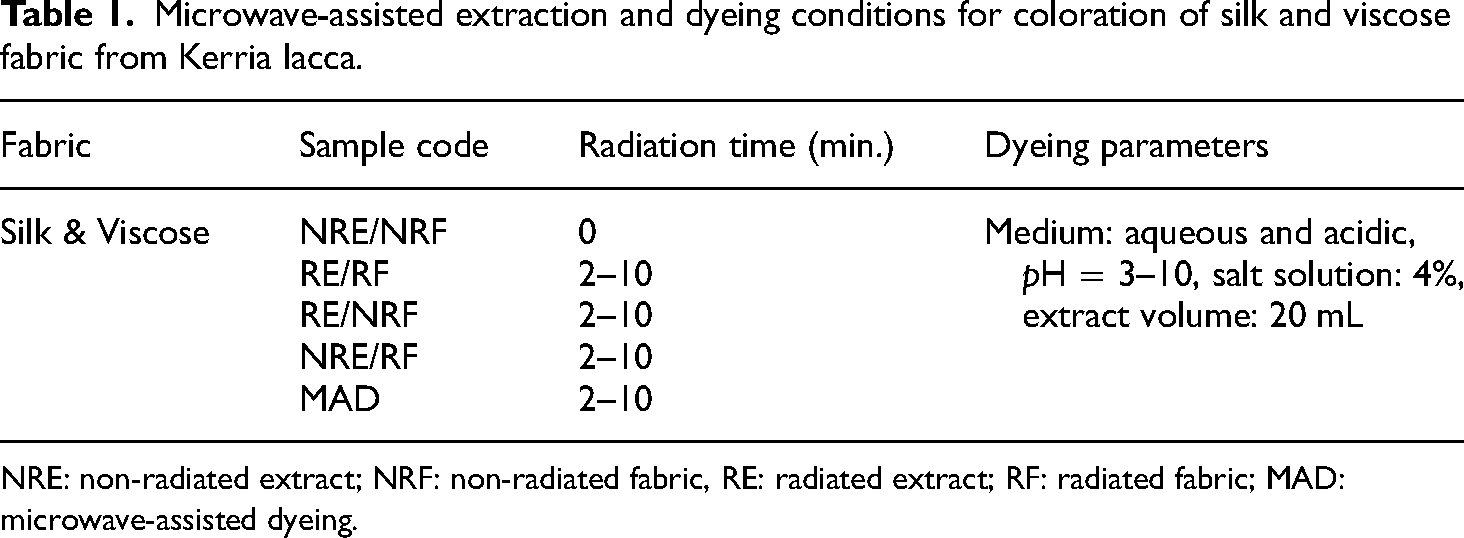
NRE: non-radiated extract; NRF: non-radiated fabric, RE: radiated extract; RF: radiated fabric; MAD: microwave-assisted dyeing.
Optimization of dyeing conditions
Different dyeing parameters, including time and extract pH, were observed. In the first series of experiments, an extract of 3 pH was used for silk dyeing with lac extract after irradiation for the selected time. The same experiment was repeated for silk dyeing with lac extract of 4, 5, and 6 pH, and dyeing was done for 35 min using lac dye extract of 3 pH at 80 °C. The dyeing process was repeated for silk using the optimum extract for 45, 55, and 65 min. Owing to the nature of the fabric, i.e. Viscose, the dyeing of fabric was done with lac extract of 6, 7, 8, and 9 pH, in another series, dyeing time was optimized by dyeing viscose with lac extract of 8 pH for 35, 45, and 55 and 65 min.
Optimization of mordanting conditions
Pre-mordanting and post-mordanting were done at 80 °C for 45 min to increase the color depth and fastness of materials dyed under ideal conditions. Eco-friendly anchors such as Al and Fe salts in various concentrations (0.5–2.5 g/100 mL) have been used before and after dyeing. 44 In comparison, before and after dyeing, the extract obtained from 0.5–2.5 g/100 mL of Ludhra powder (Symplocos racemosa = LP) as bio-mordant was employed at 80 °C for 45 min by considering the mordant-to-fabric ratio of 30:1
Evaluation of fabric and extract
FTIR was used to record the spectra of fabrics for looking at the chemical changes, if any, done by MWI. In contrast, for observing physical changes, a scanning electron microscope was used to scan the images of fabrics before and after microwave exposure. The color strength of all dyed fabrics was measured using Data Color Spectrophotometer (SF 600) using a D65 lamp at 10° observer. The Kubelka Munk equation computed in Data color was used to get color strength (K/S), and the CIE Lab system was employed to study tonal variations in terms of L*, a*, b*, C*, and h. The fastness properties of light, washing, and rubbing for the selected mordanted dyed samples were assessed according to the ISO standard.45–47
Results and discussion
Animal-based colorant containing anthraquinone moiety imparts a reddish-purple shade onto fabric depending upon the medium used. Using an aqueous medium (Figure 1(a) and (b)), the treatment of lac extract and fabric for 4 min before dyeing has given the highest K/S (17.132), and the color coordinates are shown in Table 1. Before M.W. treatment, silk dyeing with aqueous lac extract gave a better yield (K/S = 9.6278). The color depth decreased after raising the microwave treatment time to more than 4 min. On changing media, the acid-based lac extract gave a very low yield of K/S (2.2706) on the silk fabric before irradiation. Before dyeing, by the microwave treatment of lac extract and silk fabric for up to four minutes, a better yield was observed (K/S = 3.4394). The shade representing factor (Table 2) reveals that using the aqueous medium, mostly silk fabric dyed is darker and saturated with a reddish-yellow hue. The optimum fabric dyed with aqueous extract is much darker (L* = 25.7) but less reddish-yellow tone as shown in Table 2. Using acidic extract, the shade is bright reddish-yellow with higher saturation, but the optimum fabric is brighter (L* = 62.32), more reddish (a* = 25.34), and yellow (b* = 33.21) with high saturation and chromaticity in tone. This is because MW treatment can open cell walls with less solvent and time, which adds value to the processing interaction of laccaic acid with solvent through rapid mass transfer kinetics. After extraction, upon dyeing, an excellent yield was observed.

Microwave treatment dyeing of silk fabric by using Kerria lacca extracts in aqueous (a) and acidic (b) media.
Color coordinates of selected fabrics dyed before and after radiation in a suitable medium.
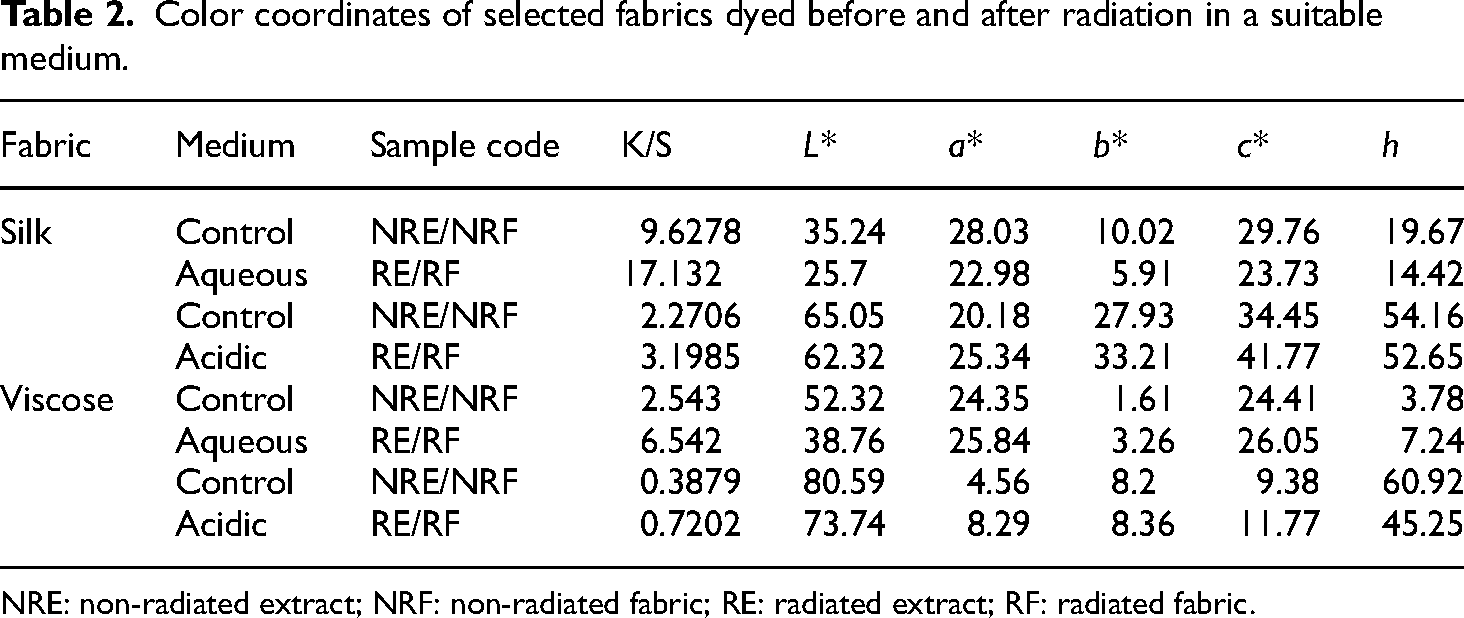
NRE: non-radiated extract; NRF: non-radiated fabric; RE: radiated extract; RF: radiated fabric.
Similarly, surface tuning of fabric through microwave treatment helps improve its sorption and uptake behavior. The nature of the stuff, i.e. cellulose-based fabrics, also plays a role in getting darker or brighter shades of good characteristics. 45 The results given in (Figure 2(a) and (b)) show that using the aqueous medium before irradiation (NRE/NRVF), the dyeing of viscose with laccaic acid has given good color strength (K/S = 2.543) with a darker reddish-yellow hue of low saturation but high chemistry. On giving M.W. treatment for up to 6 min, the utilization of extract for dyeing viscose fabrics has given excellent color yield (K/S = 6.542), with the dark reddish-green appearance of color having high saturation and excellent chemistry and color coordinates shown in Table 1. On moving towards treatment for a long time, the greater heat provided may cause disturbance in the functional behavior of the colorants, resulting in low depth upon application. On changing medium, viscose dyeing with acidic extract has given a low color depth (K/S = 0.3879), and the shade was brighter but less reddish-yellow in tone, with a hue of up to 8 min. After microwave treatment, viscose dyeing with acidic extract has also given a high yield, with a bright reddish-yellow tint of color saturated over it. After irradiating the fabric and extract for up to 6 min, the fabric and aqueous extract have passed high color strength with reddish-yellow hues. This good color strength is due to the rapid action of MW rays on lac extract. These rays rapidly break the boundary of the cell, making possible promising interaction of laccaic acid with solvent and, upon dyeing, give maximum yield, which has been observed by viscose of K/S. Precision from our studies and others reveals that MW rays scratch the fabric's surface, which helps to reduce the colorants to a medium extent. 46 Another good aspect is that these rays cannot change the chemical behavior of functional fabric groups (amido linkage). The spectral images shown in Figure 3(a) and (b) for viscose and Figure 4(a) and (b), for silk reveal that the functional peaks of particular groups have not altered their position. Scanned images of the fabrics (viscose and silk) have been presented in Figure 5(a)–(d), which show that their surface has been physically modified, adding value in the sorption of colorant with good impact.

Microwave treatment dyeing of viscose fabric by using Kerria lacca extracts aqueous (a) and acidic (b).

Spectral interpretation of un-irradiated (a) & irradiated viscose (b).

Spectral interpretation of un-irradiated (a) & irradiated silk (b).

Scanned images of un-irradiated (a) & irradiated viscose (b) and un-irradiated (c) & irradiated silk (d).
The statistical assessment given in Table 3 represents that using the aqueous medium, the treatment of fabric used for dyeing is considered a significant aspect (P = 0.002), whereas using the acidic medium, the M.W. intervals (Exposure time, P = 0.004) and treatment of fabric and extract (sample, P = 0.046) also has given significant results. Similarly, using silk fabric, under aqueous medium M.W. treatment to extract and fabric i.e. the sample is highly significant statistically, whereas using the acidic medium, the same situation has been observed i.e. sample treatment is also highly significant (p = 0.002). Hence overall, statistically (Table 3), the treatment of the fabric and extract both or alone is highly significant to get desired results.
Analysis of variance ANOVA analysis for the impact of MW rays on extraction and fabric treatment.

Dye bath nature is always an important factor because the functional behavior of colorant can be seen promisingly at a particular point, owing to the nature of the fabric. Using silk fabric, the amide functional unit of fabric becomes functional through zeta potential and becomes easily available for interaction with -C = O & -OH of laccaic acid. The yield of colorant is enhanced onto surface-tuned silk fabric. In the case of cellulose, the terminal –OH group is available for bonding with –C = O and –OH of laccaic acid. Still, due to its acidic nature under alkaline conditions, the functional unit of the colorant is lost, and a low yield is observed. Hence, lac dye is comparatively suitable for MW-irradiated silk fabric. 39 Because the protein-based fabrics are dyed at 65 °C for 45 min, the contact levels always add value to the natural dyeing of this kind of fabric. In this study, after the lac extract & fabric experiment, the interaction of colorant with fabric was done between 45 min and 65 min. The results presented in Figures 6(a) and 7(b) show that maximum sorption of colorant onto fabric (cellulose and silk) was achieved for 45 min. However, the sorption behavior was observed more prominently when dyed for 45 min. It can be seen from Figures 6(a) and 7(d) shows that using 30 mL extract of pH 3 for 45 min at 65 °C has given a maximum yield for silk dyeing, whereas 25 mL extract of pH 8 for 45 min at 65 °C has given a maximum yield of viscose dyeing. Hence, M.W. treatment has reduced the contact level, which proves that this treatment is time-effective.

Selection of coloring condition (a) time, (b) temperature, (c) volume, and (d) pH for for silk.

Selection of coloring condition (a) time, (b) temperature, (c) volume, and (d) pH for silk.
The natural dyeing of fabric is complete with the addition of any electrolyte or bio-potent functional molecule. Because poor shade quality is observed, which in turn gives poor fastness, in this study, two sustainable and one new plant-based mordanted Ludhara (Symplocos racemosa) has been utilized. The aluminum salt forms a coordinate covalent complex upon the interaction between the -C = O and -OH groups of laccaic acid and–CONH of silk, and the –OH of viscose. When formed firmly attached to the fabric before and after dyeing, these complexes resist detaching up to a maximum extent.15,31 Similarly, the potent plant molecule of Ludhra (Symplocos racemosa) uses its –OH group to produce additional covalent bonding to give firm color and fast shade. A low amount of salt used cannot provide proper fixation. The above optimum amount may cause aggregates of natural dye complex to adhere to fabric, which causes many difficulties to sorb into voids of fabrics and remain at the surface. During the finishing process, to observe color fastness, many colors are removed, and low color strength is observed.
The result in Figures 8 and 9 shows that 1.5 g/100 mL of Al salt before dyeing has given the dark reddish-yellow hue of high color strength. Similarly, using 2 g/100 mL of Al salt after dyeing shows a bright reddish hue tone of high color strength, but Al has been radiated to get high color strength before dyeing. Using 2 g/100 mL of Fe salt before dyeing, the shade has become bright reddish-yellow, whereas after dyeing, using 1.5 g/100 mL has given a dark reddish-yellow hue. The excellent strength is due to the forming of a metal-dye complex onto the fabric. The low amount does not include a stable complex, whereas, above the optimal amount, the complex formed is gathered as a cluster, which mainly remains on the surface.

Dyeing results of pre (a) and post-mordanted (b) silk using lac extract.

Dyeing results of pre-(a) and post-mordanted (b) viscose using lac extract.
For lac dyeing to get new shades of good characteristics (Table 4), we have employed salt of aluminum and iron. The extracts of plants such as Ludhra (Symplocos racemosa = L.P.) have been employed to make the process greener. After washing, the poorly fixed or unfixed complex clusters are stripped from the fabric, and low strength is formed. Previously, in our studies, the same trend has been seen: too much weight always leads to poor strength. Using plant extract is a recent trend for the mordanting fabric to develop new tints of good to excellent shade fastness. In this study, ludhra has been used as the source of bio-mordant. Before dyeing, 25 mL of 1.5 g/100 mL of extract has given a bright reddish-yellow hue of high strength, whereas 25 mL of 1 g/100 mL of extract after dyeing has given a bright reddish-yellow hue of high strength compared to before dyeing. Similarly, using 1.5 g of Bindi (Tribulus terrestris = T.S) before dyeing and 2 g of Bindi (Tribulus terrestris = T.S) after dyeing showed good color strength. The good strength is due to the formation of extra bonding between –OH and –C = O of laccaic acid and –OH from Symplocos racemose (L.P.) with –CONH of silk. 35 Before and after mordanting with plant extract, this firm interaction between dye and fabric has furnished a new state of high fastness (Table 5). Hence using the selected chemical and bio-mordants, the colorfast shades of viscose and silk dyed with lac-based anthraquinone dye have been obtained under suitable conditions.
Tonal variation and shades of silk and viscose fabrics dyed before and after mordanting at selected conations.
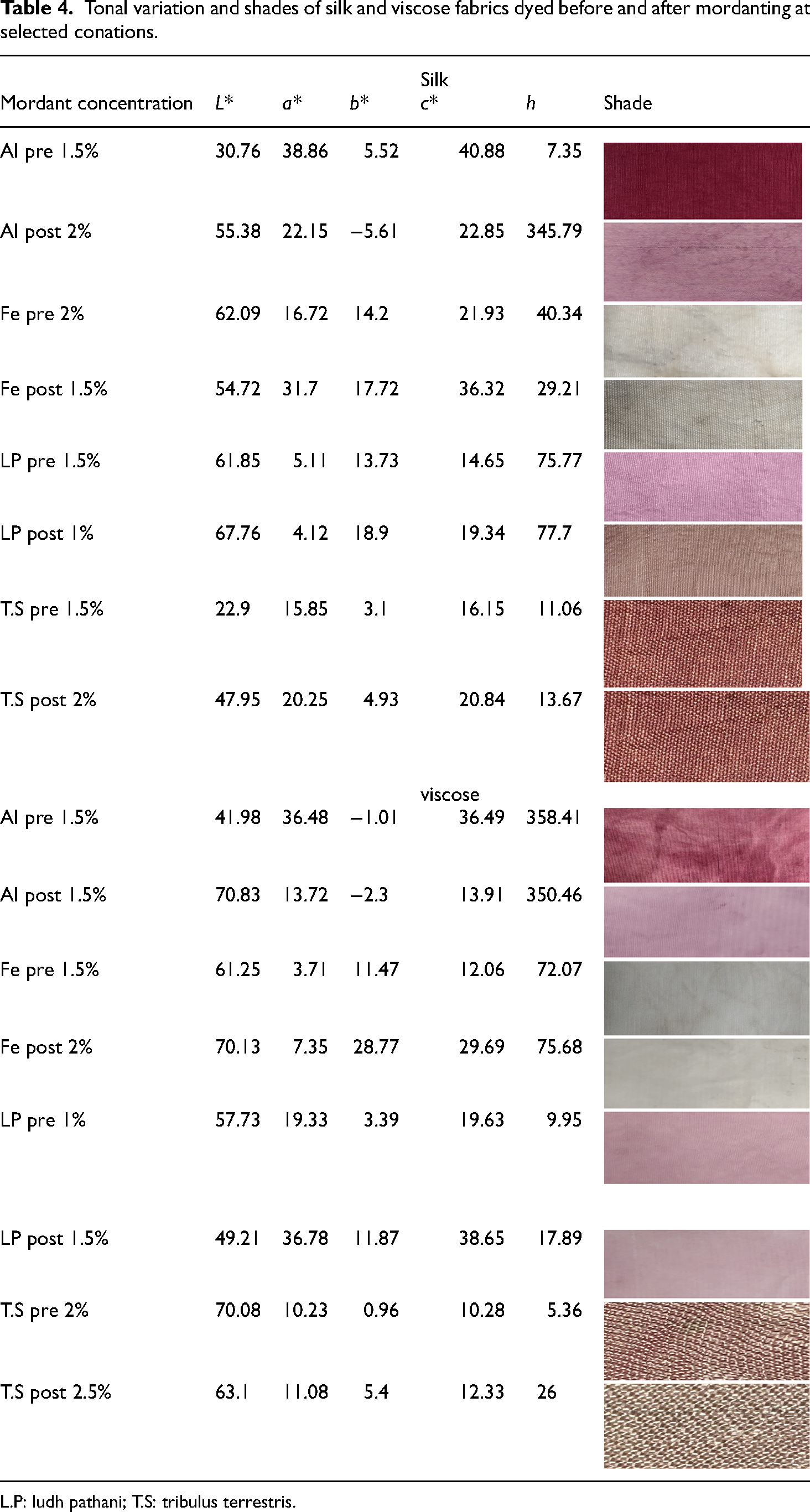
L.P: ludh pathani; T.S: tribulus terrestris.
Fastness grading of silk and viscose fabric dyed with aqueous extract of Kerria lacca before and after mordanting at selected conditions.

WRF: wet rubbing fastness; DRF: dry rubbing fastness; WF: washing fastness; LF: light fastness; LP: Ludh pathani or Ludhra.
Conclusions
The present study focused on the isolation of natural colorants from Kerria lacca. Transforming non-valuable to valuable products is ecologically safe and an income-generating activity for farmers. The above results encourage the utilization of waste material into valuable natural products. Current experimentation is based on exploring the colorant potential of kerria lacca and its utilization for silk and viscose dyeing. The results revealed that 1.0 g/100 mL of aqueous and acidic dye extract, 4.0 g/100 ml of salt solution, 75 °C heating level, and 45 min of dyeing time were optimum. In the shade development process, bio-mordants, compared with chemical ones, are promising, pollution-free, and sustainable. Hence, insect kerria lacca extract has been proven to be a novel eco-friendly colorant source for industrial progress. Thus, plant waste can be utilized as an environmentally friendly source of bio-colorants as an alternative to chemical dyes for natural fabric dyeing.
Footnotes
Author contributions
Mehboob Afzal and Mohsin Javed have done experimental work along with the help of Nimra Amin. Dr Muhammad Usman and Dr Shahid Adeel have supervised the work. Dr Rym Mansour and Dr Fazal-ur-Rehman have analyzed the data, whereas Dr Muhammad Ibrahim and Dr Muhammad Imran have guided in writing the manuscript and provide technical and scientific support also.
Declaration of conflicting interests
The author(s) declared no potential conflicts of interest with respect to the research, authorship, and/or publication of this article.
Funding
The author(s) disclosed receipt of the following financial support for the research, authorship, and/or publication of this article: Authors are grateful to Deanship of Scientific Research at King Khalid University Saudi Arabia for funding this work through project (Project No. RGP-2/579/44).

Author biographies
Muhammad Usman is associate Professor of Chemistry at Government College University Faisalabad Pakistan.
Fazal-ur-Rehman is Professor of Applied Chemistry at Government College University Faisalabad Pakistan.
Mahboob Afzal is Student of Applied Chemistry at Government College University Faisalabad Pakistan.
Mohsin Javed is student of Chemistry at Government College University Faisalabad Pakistan.
Muhammad Ibrahim is Associate Professor of Applied Chemistry at Government College University Faisalabad Pakistan.
Nimra Amin is Student of Applied Chemistry at Government College University Faisalabad Pakistan.
Shahid Adeel is associate Professor of Applied Chemistry at Government College University Faisalabad Pakistan.
Muhammad Imran is from Department of Chemistry, College of Science, King Khalid University, Abha, Saudi Arabia.
Rym Mansour is Assistant Prof. at University of Kairouan, Kairouan, Tunisia.