



Abstract
The world has limited resources and resource depletion has been a serious concern for many years. To ensure that ecological balance is maintained, the United Nations has developed 17 Sustainable Development Goals (SDGs). This study attempts to meet the 12th SDG of “responsible production and consumption” and provide a guideline to manufacturing organizations in Pakistan. Many scholars have examined the role of different technologies on sustainable performance. However, research using eco-innovation (EI), digital transformation (DT), and smart technologies (ST) is still scarce. The current study develops the conceptual model based on the resource-based view (RBV) and technology, organization, and environment (TOE) theories, and using a simple random sampling technique, valid data from 375 professionals in the manufacturing industry is collected to test the relationship between sustainable development strategy (SDS), EI, DT, ST, and sustainable supply chain performance (SSCP). The results indicate strong positive relationships between SDS, EI, DT, ST, and SSCP. Results indicate that even if organizations are executing SDS and EI, without DT and ST, organizations cannot achieve SSCP. Therefore, it is recommended to the managers that they must apply DT and ST to guarantee their pursuit of achieving sustainable performance and contribution toward SDGs.
Keywords
Introduction
The scarcity of natural resources and their increasing demand by manufacturing organizations has strained the consumption of raw materials. According to OECD, 1 by 2060, the demand for raw materials is expected to be 167 gigatons when compared to 90 gigatons today. United Nations 2 drafted 17 Sustainable Development Goals (SDGs) and plans of action emphasizing sustainable development and achieving global sustainable growth. Devising business systems and processes to achieve sustainable growth is the top priority of every country. The 12th SDG, “responsible production and consumption,” stress the significance of designing modern and future-oriented business systems intending to achieve sustainable manufacturing. Manufacturing uses a significant number of resources, which results in a reduction in resources and causes pollution. Other business and technological operations having eminence reliability, lower levels of risk, efficiency-oriented, flexibility, and sustainable growth are also affected by manufacturing. Hence, manufacturing industries are considered the primary cause of resource depletion due to their dynamic demands of these resources and thus are required to adopt modern ways to meet sustainability goals and overcome the challenges. 3 Stakeholders have also increased interest in sustainable strategies to protect the environment from pollution and maintain an ecological balance. 4 Successful transitioning to achieve sustainable growth is dependent upon the economy, political stability, cultural aspects, legal aspects, and the overall social environment of a country requires institutional, technological, and business strategies transformations to enable organizations to develop the capacity to contribute toward achieving sustainable growth as well as meeting the new challenges. Therefore, to achieve sustainable supply chain growth and related SGDs, the inclusive partnership with digitally enhanced stakeholders is vital. 5
Eco-innovation (EI) has gained increasing attention from scholars in business-to-business (B2B) marketing domains. Organizations must redesign their production process and products and adopt modern technologies to pursue sustainable development. 6 It has the potential to influence not only economic prosperity but also organizational outcomes. Plenty of firms have already established clean futuristic technology from future growth perspectives. EI is an innovation that does not hamper the environment, reduces the cost of production, brings efficiency, expands the business market, and involves several parties following the legal considerations to achieve sustainable growth. 7
Digitalization has transformed the ways to communicate with each other. Modern technologies, including smartphones, smart cars, and other gadgets, have revolutionized daily lives and every industry. Digitalization in industries also increases the usage of digital products and services. 8 Digital transformation (DT) fosters agility, real-time transparency, and flexibility and is vital in enhancing customer interactions. Therefore, cost reduction, increased efficiency, optimum utilization of resources, and on-time delivery are crucial to sustainable development.7,9,10 Ellis et al. 11 mentioned that DT refers to a business development model transformation and radical changes in its eco-system by adopting and developing digital competencies such as big data analytics (BDA), machine learning, robotics, the Internet of things, artificial intelligence, and B2B learning networks. Agrawal et al. 12 highlighted that due to its high financial cost and initial operational challenges, DT is risky but still plays a vital role in regulating organizational performance and entails long-term benefits for the organization. Büyüközkan and Göçer 8 found that DT affect the supply chain. Kraus et al. and Alaimo13–15 mentioned that DT transforms the connection between supply chain stakeholders, prepares the organizations to face future challenges, and facilitates the organization to reengineer its business development models. DT equips organizations to embed the devices and enable intelligence into their systems to improve the supply chain performance. The smart devices deployed as a result of DT implementation are smart, programable, communicable, and enhance performance.
Past researchers have made enormous efforts to justify that the investments made by organizations to become digitalized improve the supply chain performance. 16 Harnessing digital technologies and integrating them into corporate strategies could result in sustainable performance, and thus the role of digitalization should further be explored. 17 In another study, scholars 18 highlighted the significance of investment in green technologies and suggested integrating it with sustainability disclosure by the companies and conducting cross-sectional studies. Others have highlighted that such investments have no impact on sustainable organizational performance. Such inconsistent results motivate us to explore further the relationships between DT, smart technologies (ST), and sustainable supply chain performance (SSCP). Further, to the best of our knowledge, there is no empirical study conducted to investigate the effect of EI on DT and SSCP. EI has been coined as the main course to become sustainable. 19 EI encourages the organization to transform technologically and use eco-friendly solutions for toxic reduction, waste management, and enhancing performance. 20
Some scholars
21
had brought to attention that responsible technological innovations acted as one of the key pillars to achieve sustainability and proposed to investigate it through empirical studies. DTs have become an essential part of management due to their analytical and forecasting usability, and empirical research about the potential of these DTs to achieve sustainability could further strengthen the competitive advantages of the organizations.
22
Past literature also examined the mediating role of DT in improving an organization's relationship performance.
23
Moreover, the effect of sustainable development strategy (SDS) DT, ST, and SSCP also need further investigation. Therefore, the current study aims to measure the direct and indirect relationships between the variables empirically and proposes the below given research objectives (ROs): RO 1. To examine the relationships between SDS, EI, DT, ST and SSCP.
RO 2. To find out the possible indirect link of DT and ST with SSCP.
The manufacturing sector involves a lot of human activities which affect the environment directly or indirectly, thus increasing the number of scholars interested in studying the influence of human activities in manufacturing activities. In this regard, the governments, society, and the stakeholders all are concerned about it. 24 Therefore, the current research used the survey methodology to collect data from the SC manufacturing industry. The next section of the current study is about the detailed literature review and development of the hypothesis. In Methodology section, the discussion about research methodology and results are given. Discussion and conclusion section includes detailed discussion about the findings and relating the findings with prior research, at the end, the conclusion of the current study, along with the implications, limitations, and future guidelines, are presented in Limitations and future studies section .
Review of literature
The study uses the resource-based view (RBV) and technology, organization, and environment (TOE) theory to develop the research framework and achieve the SDGs. The proposed research framework examines the relationships between SDS, EI, DT, ST, and SSCP. RBV is known to be a robust and valuable theory in the field of strategic management. According to Barney, 25 RBV revolves around resources, capabilities, and strategic assets. According to RBV, variation in organizational performance outcomes results from its resources of strategic nature, such as core competencies, resources related to absorptive capacity, and capabilities of dynamic nature.
On the other hand, according to Mohtaramzadeh et al., 26 TOE provides a detailed insight into technology adoption and combines the human and machine elements into a single framework. Wong et al. 27 explained that adopting the TOE framework depends upon technology, environment, and organization-related factors because the adoption of different innovations also depends upon different factors related to the culture and context in which they will be adopted. Among the technological aspects are having a competitive advantage, intricacy, suitability, volatility and fragility, facilitating conditions, and performance expectancy. Support from top management and the firm's readiness are factors related to the organization. Finally, pressure from competitors, support from external stakeholders, and government regulation are environmental factors. 27
TOE is concerned with the strategical business programs designed to satisfy the stakeholder's expectations without sacrificing the betterment of the local community or destroying the resources. 4 Hagberg et al. 28 explained DT as using technology and digitalizing every operational activity to meet the business and market requirements to maintain a competitive advantage. According to Crittenden et al. 29 DT increased the choices a business can use in planning, managing, and executing internal and external activities. SSCP can be quantified and measured using the indicator for both sustainability and supply chain performance.30,31 The proposed hypotheses are as follows.
Research model and hypothesis
Relationship between SDS and DT
Business strategies developed to fulfill the needs of its stakeholders without compromising the interests of its stakeholders, local people, and the environment at large are defined as the SDS. 32 On the other hand, the DT of all possible business processes is known as DT. 28 Human resources have been highlighted as a significant factor in Industry 4.0 for the proper implementation of strategies related to sustainability because it can increase the pace of its implementation. 33 Jraisat et al. 34 employed transactions cost economics and identified a triad approach to enhance the agri firm's sustainable performances. Upadhyay 35 considered green supply chain practices as the firm's generic strategy and identified its antecedents. Initiatives to reduce greenhouse gas emissions must be considered from all aspects of the triple bottom line rather than just considering from a single perspective. 36 Creating circular business models could help organizations develop sustainable solutions to reduce the waste of materials and time during production. 37 Though there is not much research investigating the effect of SDS and DT, few scholars like Tsolakis et al. 38 have examined the relationships between BDA and sustainable manufacturing operations.
Similarly, Raut et al. 39 investigated the relationship between BDA and SSC. Raut et al. 40 tested the effects of BDA on sustainable operational practices and Tsolakis et al. 38 examined the food supply chain based on a blockchain-centric approach inr achieving SDSs. Execution and implementation of SDS can be possible after the successful execution of sustainable supply chain practices. Kumar et al. 41 mentioned that small and medium enterprises (SMEs) realize the significance of the strategies like green practices but lack the basic knowledge to integrate them into operational activities. In such case, BDA help manage unstructured data and facilitate effective decision making, enhance sustainable operations, and reuse and reprocess sustainable practices.
Considering green knowledge acquisition as a resource, its impact on green technology innovation was examined and found to increase the environmental performance of the corporations.
42
Kumar et al.
43
found that the outcomes of BDA are enhanced reprocessing of production, efficient use of energy, consumer satisfaction, increase in profits, and optimum utilization of resources. BDA also produces the best estimation and facilitates improving delivery performance, which increases customer satisfaction. Raut et al.
40
highlighted that BDA also enhances customer involvement in feedback, guiding the firm to develop eco-designs and adopt practices of green purchase. According to Tseng et al.,
44
BDA help reduce operational costs by preventing asset breakdown and predicting the required maintenance schedule. DT also supports managing unstructured data by making it understandable, thus improving decision making, accurate forecasting, and improved customer involvement in green initiatives and suppliers. Thus, contributing to the execution of sustainable strategies. Therefore, we conclude that SDS facilitated by DT help to achieve SSCP. Based on the above given arguments, we propose that:
H1. SDS has a positive effect on SSCP. H2. SDS has a positive effect on DT.
Relationship between DT and SSCP
Technologies have become an essential pillar in building the inter and intra-relationships between companies and their stakeholders, and these technologies influence the companies adopting novel business models to achieve sustainability. 21 Modern-era technologies such as BDA, cloud computing, and IoT are part of DT, which enable organizations to understand customer needs better, help firms develop better relationships with customers, generate and share real-time information, and make the supply chain more agile and flexible. Scholars have used the TOE model to investigate the Industry 4.0 adoption in technical education institutions and found that DT in such institutions has improved training and research performance. 45 Calatayud et al. 9 shared that this results in production efficiency, optimum resource utilization, and sustainable growth. There are plenty of studies that have used different variables to examine their effects on sustainable performance. Sharma et al. 46 studied the digitalization of supply chain networks and concluded that it enhanced the firm's performance.
In another study conducted using blockchain technology and its impact on sustainable performance, the findings indicated that the firm's using blockchain technology leverage improvements in sustainable performance.
47
Guptaet al.
48
studied the effects of cloud ERP on sustainable performance and found that cloud enterprise resource planning (ERP) facilitates maximizing the information usage and sharing with others which accelerates the speed of information transactions, ensures the reduction or elimination of information loss, and helps in improving the sustainable performance. Raut et al.
39
tested BDA and the performance of SSC business and concluded that BDA enables an organization to have smart manufacturing and facilitates organizations in enhancing SSC business performance. Ramadan et al.
49
studied the impact of BDAC on sustainable competitive advantage and SCP, and the results showed that BDAC could facilitate firms in developing innovative capabilities and achieving sustainable competitive advantage. Belhadi et al.
50
examined the relationship between Industry 4.0 technologies and SCP and found that Industry 4.0 and DT integration help organizations achieve sustainable performance. Grover et al.
51
conducted a study to check the AI utilization of six factors within an organization and found that AI enhances organizational efficiency, quality, satisfaction level in customers, and employee innovation through empowerment. BDA, IoT, ML, and AI are different digital technologies and reasons for DT that make a responsive, flexible, and agile supply chain, facilitate improved decision making, and increase firm performance. Thus, we propose that
H3. DT has a positive effect on SSCP. H4. DT mediates the relationship between SDS and SSCP.
Relationship between EI, DT, and SSCP
Kem and Pearson 52 defined EI as developing products and services using a new business model for the organization intending to reduce negative environmental impacts. In a circular economy context, identifying effective solutions to overcome resource scarcity ensures resource utilization and economic performance.53,54 Past research on EI practices has associated it with improved performance outcomes.55,56 Aguilera et al. 57 explained that technological EI facilitates saving energy, preventing pollution, and recycling waste, and results in economic and environmental gains for the organization. Research on EI has gained increasing interest from scholars globally, particularly in manufacturing industries. Zhu et al. 58 mentioned that the improvement in organizational performance, along with other factors, still depends on the level of EI practice implementation in the industry. EI stimulates organizations to introduce an innovation culture, adopt modern technologies to perform operations, and ensure that these technologies and innovative ways do not harm nature or society or be a loss of investment to the organization. 56 It can be said that through a high level of EI practices, organizations can achieve enhanced performance objectives. Dangelico and Pujari 59 studied enterprises in Italy and Canada and found that implementing innovation and sustainability in an integrated way gives more benefits. Upadhyay et al. 60 focused on using digital technologies purposely (termed as DIY technologies) and noted that these increased the engagement of the customers and made them more involved in the business. According to Cherrafi et al., 61 innovation in processes interacts more with conventional lean and green approaches and plays a vital role in enhancing performance. Fernando et al. 55 mentioned that when organizations implement EI practices in supply chain management, it should be in tandem with the conventional internal practices of environmental management to gain performance efficiency.
EI are the prime force that drives an organization to deploy green management strategies, and the firm, as a result, makes efforts to provide the necessary support to foster the culture of green innovation.
62
Parida et al.
63
conducted research in heavily polluted enterprises and found that their pursuit of promoting green innovation led them to adopt modern technologies, which enabled them to become integrated and develop the ability for knowledge sharing. At the early stage of organizational development, organizations have low costs and can quickly go for EI and adopt technology to fulfill their sustainable growth objectives. Thus, based on the presented arguments, we propose that
H5. EI has a positive effect on SSCP. H6. EI has a positive effect on DT. H7. DT mediates the relationship between EI and SSCP.
Relationship between DT, ST, and SSCP
DT is concerned with using technology to meet business and market requirements to maintain a competitive advantage. Embedding the smart properties of digital technologies into an organization's tangible and intangible assets has been termed ST 64 Crittenden et al. 29 mentioned that the ability of businesses to manage and perform their external cooperation activities in the digital supply chain had undergone a radical transformation due to DT. DT also reduced the cost of engagement and external collaboration. Digitalization of the supply chain improves customer services by enabling the organization to collect extensive customer-related data through multiple sources and then utilize it to build strong connections with external stakeholders. DT also equips internal and external players with product or service-related expertise, thus improving organizational performance. 65 Scholars have concluded that digitalization has excellent potential to facilitate firms in achieving sustainable performance. 66 González-Rojas et al. 67 found that DT facilitates work-related collaboration for better planning and execution of business processes due to more opportunities for exchanging information and digitalizing everything. Although managing internal activities without face-to-face interaction are challenging and require specific competencies, DT provides choices to overcome such internal challenges. 68 Di Vaio et al. 22 in their research findings shared that DT has long-term effects in creating value and result in sustainable performance.
Using ST to build a solid and collaborative business process is one key goal achieved through DT.
69
Yoo
64
shared that the increasing likelihood of merging different software and software components and discriminating information across the board, infrastructures, and production systems demonstrates the advantages of ST. It indicates that using ST is crucial in exploiting the unlimited opportunities given by DT. Incorporating the internet with ST like smartphones, handheld devices, and gadgets functional support to multiple services are obtained which include management of organizational services, management of collaboration activities with stakeholders, providing timely services to the customers, and services related to research and development. According to Zhu et al.,
70
a digital platform that unites back-end ERP systems with front-end web-based systems across many stakeholders to enable e-business activities illustrates the usage of SR. Furthermore, by effectively managing interaction among the stakeholders and gaining access to the shared key knowledge throughout the organization, ST contribute to effectively managing procurement, production, communication, and customer services (Figure 1). Based on the above discussion, we propose that
H8. DT has a positive effect on ST. H9. ST has a positive effect on SSCP. H10. ST mediates the relationship between DT and SSCP. H11. DT and ST serially mediate the relationship between SDS and SSCP. H12. DT and ST serially mediate the relationship between EI and SSCP.

Research framework.
Figure 1 represents the framework of the current study developed on the basis of proposed relationships.
Methodology
This research has used a structured questionnaire for data collection using the survey methodology. The population was identified from the Security Exchange Commission of Pakistan (SECP) database and the Chamber of Commerce. The list of registered companies was extracted from these databases related to Pakistan's six big cities (Karachi, Islamabad, Lahore, Peshawar, Faisalabad, and Multan). The study has focused on leather, marble, furniture, chemicals, food, logistics, paper, textile, and manufacturers of machinery and equipment companies such as polyvinyl chloride (PVC), electronics, metal, and nonmetal commodities working in six cities of Pakistan. Further, the lists of all these companies were prepared, including the address, contact details and email addresses of each company.
Moreover, to initiate the data collection task, we hired 10 research assistants with bachelor's and master's education. Using simple random sampling, these research assistants started contacting the supply chain management personnel or other relevant persons dealing with the organizations’ activities related to the supply chain. These professionals were contacted personally through email, postal mail, and direct calls by our research assistants. Before the data collection, the participants were initially briefed about the purpose of the research. As a result, 447 organizations agreed to participate and complete the research survey questionnaire.
To maximize efficiency and complete the data collection process quickly, we divided the 10 research assistants into 2 groups (5 members each). One group was responsible for collecting data from large enterprises, whereas the other collected data from SMEs. The research assistants were also responsible for clearly briefing the research purpose of the respondents and handling all their queries when completing the survey questionnaire. Data were collected in two waves. In the first wave, the research assistants collected data on SDS and SSCP constructs. Data about EI, DT, and ST were collected in the second wave. Out of 447, 393 responses were received back, out of which 375 were valid and usable responses, indicating a tremendous response rate of 83.89%. Of these 375 valid responses, 36% were collected from large enterprises, whereas 64% were collected from SMEs. The average age of the respondents was 47.39 years. The average experience of the respondents was 23.39 years. Whereas the average age of the organization was 17.39 years. 82.8% of the respondents were male and 17.2% were female. 7.3% mentioned that they have a diploma related to supply chain, 23.7% had a bachelor's degree, and 69% had a postgraduate degree. Out of 375 usable responses, 2.2% were completed by the director of supply chain management, 2.8% by the vice president of the supply chain, 14.4% by the supply chain project manager, 18.3% by logistics managers, 23.5% by purchase and sourcing manager, 16.5% by supply chain manager, 11.2% by the senior project managers, and 11.1% by the senior managers of the organizations. Table 1 shows the details of the demographic characteristics of the respondents.
Demographic characteristics of the respondents.

Measurements
SDS measures concern the strategic business programs designed to satisfy the stakeholder's expectations without sacrificing the betterment of the local community or destroying the resources. SDS was measured using the well-established scale from previous research,4,71 and it was measured using three items constructed using a 5-point Likert scale. EI measures concern the application of solutions of technological nature that, in the long run, make it possible for material reduction and waste to be avoided and toxic materials to be substituted with non-toxic materials without compromising the sustainable goals. EI was measured using the 10-item scale developed by Geng et al. 72 Each question was measured on a 5-point Likert scale. There were 10 questions, out of which 5 were related to technology, connected with R&D and EI. Three questions were related to management, connected with products, services, and distribution to reduce environmental impact. Lastly, two questions were related to marketing, connected with green marketing through product design, promotion, channels, and marketing policies to bring growth and EI to the firm. However, due to their reflective nature and pilot study results, the study has used them as a unidimensional. Only one question after the data analysis was deleted from EI related explicitly to management EI because one possible reason is that we asked not only about technology but also about product and service for this item.
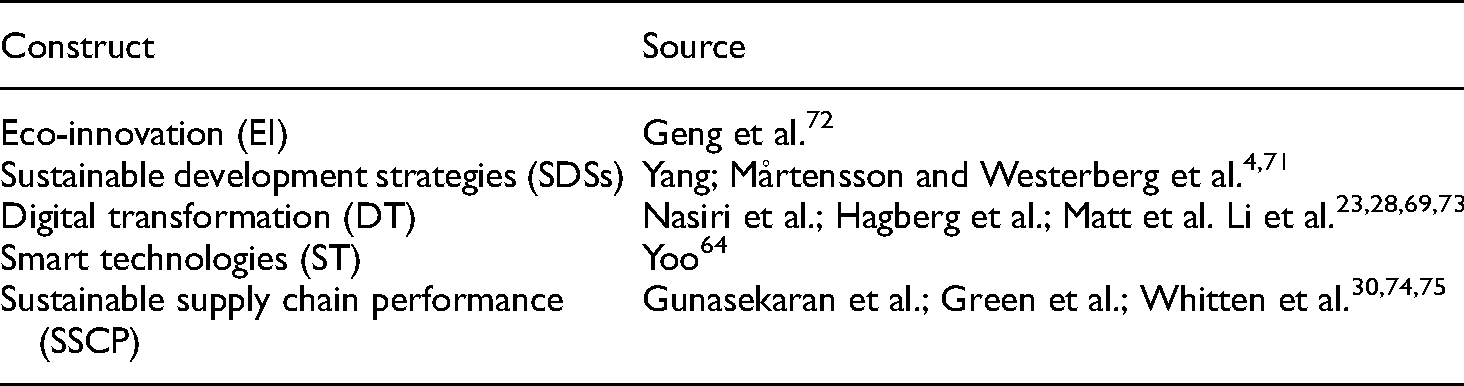
DT measures are concerned about using technology to meet the business and market requirements to maintain a competitive advantage. The eight items scale used in previous research, 23,28,69,73 was adopted to measure the DT using a five pints Likert scale. ST refer to processes, gadgets, or devices replacing physical activities and are aided with digital technologies to get more efficiency and get things done smartly. It consisted of six question items on a 5-point Likert scale and was adopted from the study of Yoo. 64 SSCP measures concern performing business activities without compromising social, economic, or environmental aspects. The constructs of the study and their relevant sources are shown in Table 2.
Constructs and their sources.
Data analysis
We used partial least square structural equation modeling (PLS-SEM) to analyze the proposed research framework using SmartPLS. 74 Using a two-step analysis approach recommended by Hair et al., 75 we first assessed the measurement model and then measured the structural model to test the hypothesis. While estimating the measurement model, we estimated the construct validity and reliability, while in the structural model, we estimated the relationships of each construct with other constructs. We choose PLS-SEM because it gives more concurrent and robust results for the measurement and structural model. 76
Measurement model
Before testing the inner model or structural model for hypothesis testing, first, the outer model or measurement model is tested. It is essential to check that the constructs used in the study are sound and provide adequate theoretical understanding. The assessment of the measurement model is performed by testing the reliability through Cronbach's alpha (α) and composite reliability (CR) and validity through convergent and discriminant validity. Internal consistency among the constructs was tested using Cronbach's alpha (α), and Table 3 indicates that the values range between 0.826 and 0.918 and are above the recommended threshold of 0.7. 77 The CR values are also between 0.896 and 0.934, which are also above the recommended threshold of 0.7. 77 Both of these reliability tests confirm that the constructs are internally consistent. The results are shown in Figure 2.

Measurement model.
Reliability, average variance extracted (AVE), loadings, and outer variance inflation factor (VIF).

When multiple items measure a similar construct, it refers to convergent validity. As per the guidelines of Hair et al., 78 it was tested by examining the factor loadings and the average variance extracted (AVE). The values of all factor loadings were above the 0.708 thresholds and met the criteria for further tests, and AVE values range between 0.543 and 0.743, which are above the recommended criteria of 0.50. 79 The results mentioned in Table 3 ascertain convergent validity.
Discriminant validity was measured using the “Heterotrait-Monotrait ratio (HTMT)” as per the suggestions of Henseler et al. 80 and Fornell and Larcker ration methods. 81 HTMT is considered to show higher performance than Fornell and Larcker ratio criterion. Estimating the discriminant validity using Fornell and Larcker ration method indicated that each construct's correlation values were lesser than the squared root of AVE, indicating no discriminant validity issue. Also shown in Table 4.
Discriminant validity (Fornell-Larker).

Note: ***p < 0.001. Inclined lines rendered in Boldface show the Square Root of the AVE.
We also used the HTMT method to measure the discriminant validity. This ratio shows the intra and inter-correlation of the constructs. 82 As per Franke and Sarstedt, 83 HTMT90 or HTMT85 were fulfilled by the extracted HTMT values, with 0.824 being the highest square root value, above the recommended threshold value. 83 Results gained through this criteria ascertained the discriminant validity. Results are also shown in Table 5.
Heterotrait-monotrait ratio (HTMT).

Notes: HTMT should be lower than 0.90.
Structural model
After estimating the outer model for reliability and validity, next, we estimated the inner model or structural model and analyzed the proposed hypothesis. Results are shown in Figure 3.

Structural model.
Table 6 clearly shows that all the direct hypotheses were accepted. SDS (β = 0.380, t = 8.915, p = 0.000) has a significant positive effect on SSCP, indicating that H1 is accepted. EI (β = 0.251, t = 5.380, p = 0.000) has a significant positive effect on SSCP, indicating that H2 is accepted. SDS (β = 0.392, t = 7.445, p = 0.000) has a positive effect on DT, indicating that H3 is accepted. EI (β = 0.373, t = 5.346, p = 0.000) has a significant positive effect on DT, indicating that H4 is accepted. DT (β = 0.766, t = 24.503, p = 0.000) has a significant positive effect on ST, indicating that H7 is accepted. DT (β = 0.151, t = 3.306, p = 0.000) has a significant positive effect on SSCP, indicating that H8 is accepted. ST (β = 0.208, t = 3.426, p = 0.000) has a significant positive effect on SSCP, indicating that H9 is accepted.
Hypotheses testing (direct).

Using the bootstrapping of 5000 samples, we also estimated the coefficient of determination (R2) to see the explanatory power of the proposed model. The values 0.474, 0.587, and 0.726 of R2 highlight significant effect. 78 Furthermore, the predictive relevance was examined using the Stone-Geisser blindfolding sample reuse method, and the Q values were above “0”. Thus, indicating that our proposed research framework predicted DT (Q2 = 0.31), ST (Q2 = 0.39), and SSCP (Q2 = 043) effectively. Results are shown in Table 7.
Predictive relevance and R-square.

Lastly, we estimated the effect size using the determinant variance of endogenous variables. By examining changes in the R2, the f2 illustrates how a specific exogenous latent variable affects an endogenous latent variable. 84 Following Cohen, 85 we estimated the effect size (f2), and the values 0.031, 0.105, 0.053, and 0.272, respectively, suggest that small, medium, and large effect sizes on SSCP and 1.422 on ST by DT have shown large effect size, whereas, 0.162 and 0.179 on DT affected by EI and SDSs have shown medium effect size, respectively (Table 8).
F-square (effect size).

To estimate the indirect effects, we followed the suggestions of Preacher and Hayes 86 and applied the bootstrapping technique to guarantee that relevant results while estimating the confidence interval (CI) of indirect effects. Figure 4 gives an illustration of the results.

Mediation model.
If the values of the upper limit and lower limit are overlapped with zero, it indicates that there is no mediation. The results of the indirect effects are shown in Table 9. Moreover, the results indicate that H5 stated that DT mediates the relationship between SDS and SSCP, and the values (β = 0.314, t = 4.414, p = 0.000, LCI = 0.184, UCI = 0.378) indicate that DT has a significant indirect impact on SSCP. Thus supporting H5. H6 stated that DT mediates the relationship between EI and SSCP and the results (β = 0.130, t = 2.998, p = 0.001, LCI = 0.069, UCI = 0.211) indicate that DT is mediating the relationship, hence proving H6. H10 stated that ST mediates the relationship between DT and sustainable SSCP. The values of path coefficient β = 0.364, t = 6.218, p = 0.000, LCI = 0.259, UCI = 0.455 highlight a significant and positive relationship. Thus, H10 is accepted. H11 proposed that the relationship between SDSs and SSCP is serially mediated by DT and ST, and the values (β = 0.142, t = 4.565, p = 0.000, LCI = 0.094, UCI = 0.196) highlight that there is serial mediation. Therefore, H11 is accepted. H12 stated that the relationship between EI and SSCP is serially mediated by DT and ST, and the values (β = 0.137, t = 4.763, p = 0.000, LCI = 0.095, UCI = 0.191) highlight that serial mediation exists. Thus, H12 is also accepted.
Mediation hypotheses.

Discussion and conclusion
The study aimed to explain the correlation between a firm's SDS, EI, DT, and ST in achieving SSCP. It also examined the indirect effects of DT and ST, and the findings uncovered a positive relationship between SDS and SSCP. Previous researchers did not study the direct effects of SDS on SSCP but instead used other constructs to explore the relationship, such as human capital, 87 logistics practices, 88 and green policies. 89 When organizations have top management support, develop new products, have relevant information technology-related knowledge and skills, and can adapt to the changing business environment, they work on a SDS.
The direct relationship between EI and SSCP shows a positive effect highlighting the significance of EI for sustainable performance. Results indicate that when the firms have established their R&D institutions, a mechanism to motivate personnel to propagate R&D achievements related to EI. Incentive mechanism to foster EI, pay close attention to the societal, economic, and environmental challenges and stimulate innovation, innovate their production, logistics, and distribution network, ensuring reduction of environmental impact then they can achieve SSCP. These findings match with Geng et al., 72 who also found that when SMMEs execute EI policies at the lower levels of the organization, it positively contributes to achieving performance outcomes.
There is a scarcity of research on the relationship between SSD and DT. We empirically tested the relationship, and the results indicated a significant positive effect of SDS on DT. Under the dynamic and uncertain business environment, this relationship paves the way to successfully implement and execute the SDS. These findings are similar to Nayal et al., 90 who discovered that digital technologies assist management with effective decision making consumer involvement in feedback, resulting in sustainable practices and improved performance. Similarly, Raut et al. 39 investigated the relationship between BDA and SSC and found a significant and positive relationship, and Raut et al. 40 tested the effects of BDA on sustainable operational practices and found a positive relationship.
The results of H4 indicate a positive relationship between EI and DT. EI is an excellent source of creating awareness, offers plenty of possibilities to co-create solutions, and enhances the opportunities to adopt state-of-the-art technologies for manufacturing. When firms introduce new products and services, deploy information technology systems, improve their production, logistics, and distribution systems, and digitalize their operations, they create robust networking with various partners and other businesses. Our findings match the results of Janahi et al., 91 who unveiled that EI in manufacturing strategies motivates the organization to develop reactive and preventive measures to adopt the technologies to achieve higher efficiency.
The results of H7 showed that DT has a positive relationship with ST When organizations are investing in digitalizing their operational activities and processes, installing equipment to collect large datasets, and integrating their supply chain with modern technologies, all these efforts create opportunities to use other gadgets and devices to improve their performance. In other words, to redesign the business in the modern digital world, it is a dire need to rethink the digital technologies and smart devices in use for improved efficiency. The previous research 24 supported these findings and suggested that the organization's DT enhances its capabilities to use ST, resulting in improved relationship performance.
The results of H8 indicated a positive relationship between DT and SSCP. The findings align with past research, 39 which suggested that BDA positively impacts SC performance. Abundant literature has explored the relationship of artificial intelligence, 50 additive manufacturing, 92 and BDA 93 with sustainable performance. The current study examined the relationship between DT and SSCP, and the positive relationship signifies the ability of the organizations to have real-time information management and knowledge sharing, optimum utilization of available information for optimum resource utilization, real-time production based on demand, and predicting uncertainties to minimize/avoid the risks. The findings of H9 suggested a positive relationship between ST and SSCP. The results are aligned with the findings where the ST result in better relationship performance outcomes. 23
We also examined the indirect relationship, and H5 stated that DT mediates the relationship between SDS and SSCP. Our findings justify H5 because the SDS application cannot only result in SSCP, and DT fully mediates the relationship between SDS and SSCP. It is because DT enables the organization to develop strong capabilities of information sharing, improve decision-making, and results in SSCP. Similarly, H6 mentioned that DT mediates the relationship between EI and SSCP, and the results shown in Table 9 show that partial mediation exists. These results show similar findings with past research, 91 which showed that the eco-design, a firm's decision-making behavior, industrial trends, green knowledge, and innovation incentives tend to guide organizations to deploy technology and improve performance outcomes. H10 was tested to check the mediation role of ST in the relationship between DT and SSCP, and the results clearly show that ST fully mediates the relationship, which means that when the organization couples the DT with ST, the overall performance of the organization increases. It is aligned with the previous research where the scholars found that when organizations build a robust collaboration system, 23 combine ST with software, 69 for a collaborative working environment, it facilitates stakeholder interaction.
H11 was tested to examine the serial mediation of DT and ST between the relationship of SDS and SSCP. The results discovered that the application of SDS cannot only result in SSCP. The firms must make efforts to transform their operational activities and system through modern technologies embedded with smart gadgets and programs, and only then the sustainable goal can be achieved. Furthermore, in H12, we tested the serial mediation of DT and ST in the relationship between EI and SSCP. It also highlights that firms fostering the innovation culture, developing mechanisms to promote innovation, and understanding the significance of EI take initiatives to transform technologically by bringing digital technology into their organization, using AI and machine learning for better decision-making, and automating their organization. Only such organizations build a capacity to use devices that can be programmed, respond to changing environments by storing and recording all information, and then use these ST to make guided decisions for achieving sustainability goals.
Theoretical contribution
This empirical study contributes to the literature in multiple ways. Our study attempts to create a synergic effect between SDS, EI, DT, ST, and SSCP. It substantially contributes to SSCP literature and provides guidelines for the organization to achieve sustainable growth and SDGs. First, the current study used the RBV and TOE models to explain the relationships between the studied variable, enhancing the literature on both theories. Second, the firms that adopt EI get benefits in their environmental performance. However, it has been a key in modern operations management, 94 human resource management, 95 marketing, 96 and other fields to enhance the business's overall performance.
Nevertheless, only scarce literature is available to conceptualize EI and its impact on SSCP. The previous studies have focused on BDA, AI, machine learning, IoT, and IT capabilities, whereas the current study focuses on DT and ST and provides a holistic view of SSCP. The empirical findings also provide evidence of a significant mediating role of DT and ST in achieving SSCP. Our findings suggest that organizations in underdeveloped countries must understand the importance of DT and ST to combat the uncertainties of the business environment and to play their part in contributing to the SDGs through sustainable performance. Therefore, our study contributes significantly to the literature on sustainable performance.
Managerial implications
This study's empirical evidence helps organizational management understand that developing sustainable strategies and becoming EI-oriented requires them to adopt digital technologies for improved sustainable performance. The findings also recommend that the management embrace DT to enhance transparency, communication, efficiency, and coordination among the parties through the implementation of SDS. The mediation results indicate that DT makes organization flexible, create synergy, foster a culture of innovative products and services, and firms cannot achieve it without transforming digitally and using modern ST to enhance their efficiency.
Our study recommends a strong link between the implementation of SDS, DT, and ST playing a vital role in achieving sustainability. Thus, the management of organizations must invest in technology to create more and more opportunities to cope with modern challenges and create value for the supply chain. This study also guides managers in developing strategies and standard mechanisms to promote and implement EI policies to achieve sustainable performance. The study also provides guidelines that EI can be maximized if organizations transform digitally and use ST more often. Managers must develop strategies to adopt and utilize digital technology to increase the organizational capability of information sharing, knowledge management, connectivity, analytical intelligence, and human-machine interaction to enhance the transformation from physical to digital and smart in pursuit of contributing to SDGs.
The study's findings guide the management that executing the SDS requires organizations to adopt EI at all levels of the supply chain. These EI become a source of motivation to deploy ST to share information across the supply chain and facilitate decision-making, develop synergic relationships among the supply chain members and help each other achieve sustainable performance. Implementation of DT across the supply chain requires a certain level of collaboration from all members, and ST become a source to develop the capability of collaboration and implement the firms’ strategies more effectively to increase the firm's performance.
Limitations and future studies
This study has several limitations. First, studies have unveiled three subdimensions of SDS 97 : economic development, social consciousness, and environmental protection. In this study, we used the unidimensional scale to measure the SDS. Future studies should measure the SDS using these three dimensions as a higher-order construct. Second, EI was measured using a 10-item scale. The current study has revealed that technology, management, and marketing innovations create the construct of EI 72 and significantly effects DT and SSCP. It is recommended to test the results using all three dimensions of EI separately to get a better insight into an EI role on SSCP. Third, this study has not considered culture, organizational ambidexterity, and trust issues. Future studies can replicate this model in different cultural settings and include organizational ambidexterity as a moderator. 98
Footnotes
Declaration of conflicting interests
The author(s) declared no potential conflicts of interest with respect to the research, authorship, and/or publication of this article.
Funding
The author(s) disclosed receipt of the following financial support for the research, authorship, and/or publication of this article: This work was supported by the Open Foundation of Guangdong Provincial Key Laboratory of Public Finance and Taxation with Big Data Application (No. KF202207); and National Natural Science Foundation of China (No. 72250410375) .

Author Biographies
Syed Abdul Rehman Khan is a senior scholar in the field of supply chain management and his research mainly focuses on green practices and technological revolution in supply chain management.
Zeeshan Ahmad is a senior scholar and affiliated with Air University in Pakistan.
Adnan Ahmed Sheikh is an associate professor in the field of management and affiliated with Air University in Pakistan.
Zhang Yu is a research scholar in the field of logistics and supply chain management.