



Abstract
In this study, the multi-objective optimal design of the Hinge Sleeve of Cubic (HSC) was achieved by combining the central composite design (CCD), Kriging and multi-objective genetic algorithm (MOGA) approaches. Firstly, the model of the HSC was established and the appropriate design variables were selected. The mass, the maximum deformation and the maximum equivalent stress of the HSC were taken as the optimization objectives. After comparative analysis of the parameters, the parameter with the greatest influence on the optimization objectives was selected as the geometric constraint. Subsequently, according to the results of the experimental design, the Kriging model was used to establish the response surface optimization model of the objective function. And finally the best optimization results were obtained by using MOGA. The experimental results show that the optimization strategy is reliable and the mass of the optimized model is reduced by 24.84%, which achieves the lightweight design of the HSC while meeting the actual production requirements, saves the design cost and improves the material utilization.
Introduction
Under the policy of “Made in China 2025,” synthetic diamond has become a key new material for national development. Diamond has a wide range of applications as precision machining tools, window materials for infrared spectroscopy, and heat sinks for laser equipment.1–3 As the world's largest producer of synthetic diamonds, accounting for more than 95% of the world's synthetic diamond production, synthetic diamond production in 2020 will be 20.7 billion carats, an increase of 5.1 billion carats from 2015.
The Hinge Sleeve of Cubic (HSC) is the most important equipment for synthesizing diamond materials, and its development has contributed to the development of artificial diamond industry. 4 The HSC is the main load-bearing part of the hydraulic press, which works under high pressure and variable load for a long time, and the reaction force of the piston and hydraulic oil moves outward to transfer the load to the lugs. As each HSC restrains the movement of the lugs through the shaft pins, it leads to large tensile stress on them, which deforms the lugs and easily causes their structural failure and damage, thus affecting the quality of the synthetic superhard material in the press.5,6 Currently, some scholars use the traditional empirical and analogical methods to simplify HSC, which will lead to large errors in the results, resulting in its bulky structure, large size, and high processing cost.7,8 In addition, it is of interest to study HSC under high-temperature and high-pressure synthesis conditions as the synthesis cavity of HSC continues to expand, which directly affects the performance and consumption of large volume cubes in diamond single crystal synthesis equipment.
More research has been conducted in the area of optimal design of diamond single crystal synthesis equipment. Shuguang Wang and others optimized the design of the bottom arc and lug width by targeting the part volume and the stress value at the higher stress. 9 Weimin Meng and Jiewei Yang et al. used finite element (FEM) analysis method to conclude that double chamfered top hammer is better than the current top hammer by ANSYS FEM. 10 Dongchen Qin et al. established the finite element mechanical model and structural optimization design model of the top hammer of the HSC, and prepared the structural optimization design program (ODPST) for the top hammer by using the ANSYS Parametric Design Language (APDL), and obtained accurate and reliable design parameters. 11 Qiang Wang and Dongmei Cai used the HSC carbide top hammer as the object, carried out a three-dimensional (3D) finite element thermal coupling analysis using ANSYS, analyzed the stress distribution inside the top hammer under working condition, elucidated the damage mechanism of the top hammer and put forward the idea of structural parameter optimization. 12 In summary, the current research mainly focuses on the optimized design of the structure of the equipment. So, the optimized design of the structural parameters of the HSC is a research hotspot in the future.
Multi-objective optimization
In this article, the mass, total deformation and equivalent force of HSC are taken as the optimization objectives, and the corresponding lightweight multi-objective structural optimization scheme is proposed on the basis of the original model stress. The response surface optimization method has the advantages of fast computational speed and high accuracy, and has been widely used in the structural optimization design of various mechanical parts. Therefore, the response surface method is used to optimize the structure design of the HSC. The optimization flow is shown in Figure 1.

Optimization design flow chart.
The specific steps are as follows. In the first step, the HSC is parametrically modeled in SOLIDWORKS, and its finite element model is built in ANSYS and statically analyzed. In the second step, design of experiment (DOE) is performed in the response surface optimization module to obtain the initial sample points. In the third step, the simulation data calculation is performed to establish the optimization system. In the fourth step, the multi-objective genetic algorithm (MOGA) algorithm is used to obtain the optimal solution set and verify the rationality of the selected optimization parameters.
The design exploration module in the workbench is driven to investigate variations in input parameters(L1, L2, L3, L4, L5, and R) and subsequently analyze and store the data, providing a method for rapid design optimization, which is widely used in practical engineering analysis. Depending on the experimental conditions, this module includes various parameters to be analyzed and designed during the analysis, which facilitates the optimization of designs such as analysis.13,14
The Kriging method is to reasonably select each randomly sampled point within the sample interval when conducting the experimental design, and experimentally derive the response values of the sample points to provide raw data for establishing the response surface. There are various methods of experimental design, such as Central Composite Design (CCD), Optimal Space-Filling Design, Box-Behnken Design, Sparse Grid Initialization, Latin Hypercube Sampling Design, etc. And CCD is the most commonly used second-order design in response surfaces. 15 This is followed by establishing the response surface, which is essentially a complex function with input parameters representing the output parameters, solving for a certain amount of known experimental data to obtain an approximate solution, and thus an approximate relationship for all experimental parameters. This reduces the workload and at the same time obtains a higher accuracy parameter relationship. Among other things, the energy efficiency of the Kriging method is based on the capability of its internal error estimator. Specifically, it improves the quality of the response surface by generating refinement points and adding them to the response surface regions that need the most improvement. In additionally, it evaluates the relative error of prediction across the parameter space during updating of the response surface. Design Explorer uses the relative error of prediction rather than the error of prediction because this allows the same value to be used for all output parameters, even if the parameters have different ranges of variation. While providing improved response quality and fitting higher-order variations of the output parameters, the Kriging method provides refinement for continuous input parameters (includes those with manufactured value).
The Kriging is defined as follows:

where y(x) is the unknown function of the optimization objective; f(x) a polynomial function of “x” and E[f(x)] = f(x),

The “k” is the number of design variables, k = 4, and β is the coefficient to be determined for each equation. Z(x) is a random function that obeys a Gaussian normal distribution when its mean is zero and has non-zero covariance,


Based on the unbiasedness of Z(x) and the estimated minimum variance yields the relevant parameter “


Structure and finite element analysis
Main structure and parameterization
In this article, the model of the HSC is established in SOLIDWORKS according to the design requirements, and its structure is designed as shown in Figure 2.
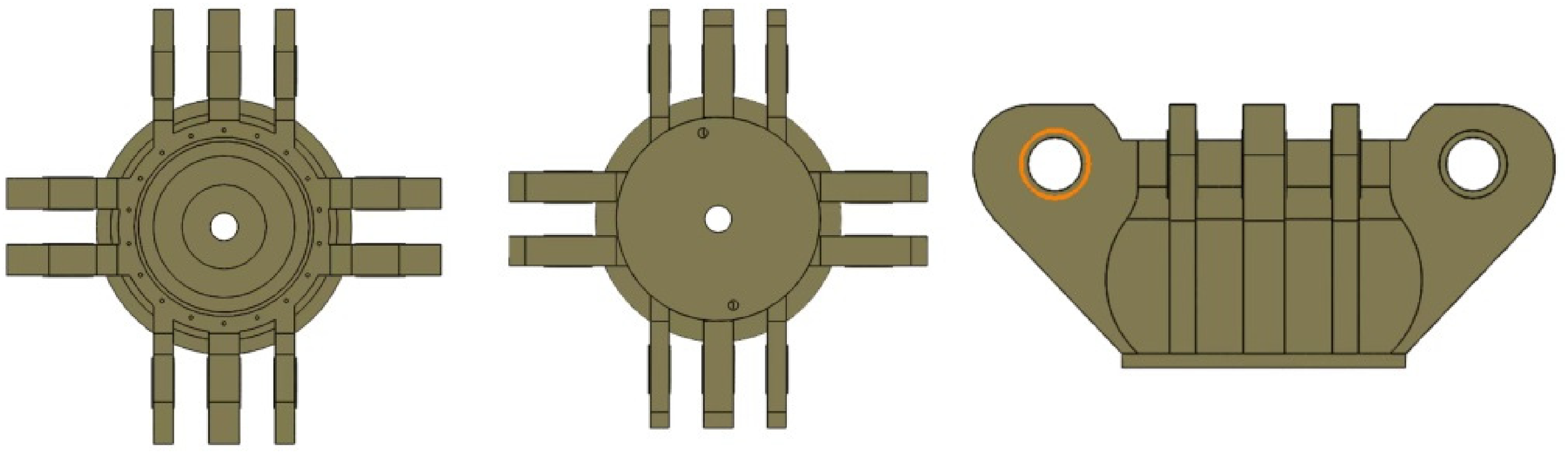
Original structure.
The structure of the model was optimized and parameterized, as shown in Figure 3. After determining the main structural form according to the production requirements, SOLIDWORKS is associated with ANSYS Workbench and the model file is accurately imported into ANSYS Workbench, which keeps the model accurate while ensuring the real-time nature of the related analysis.
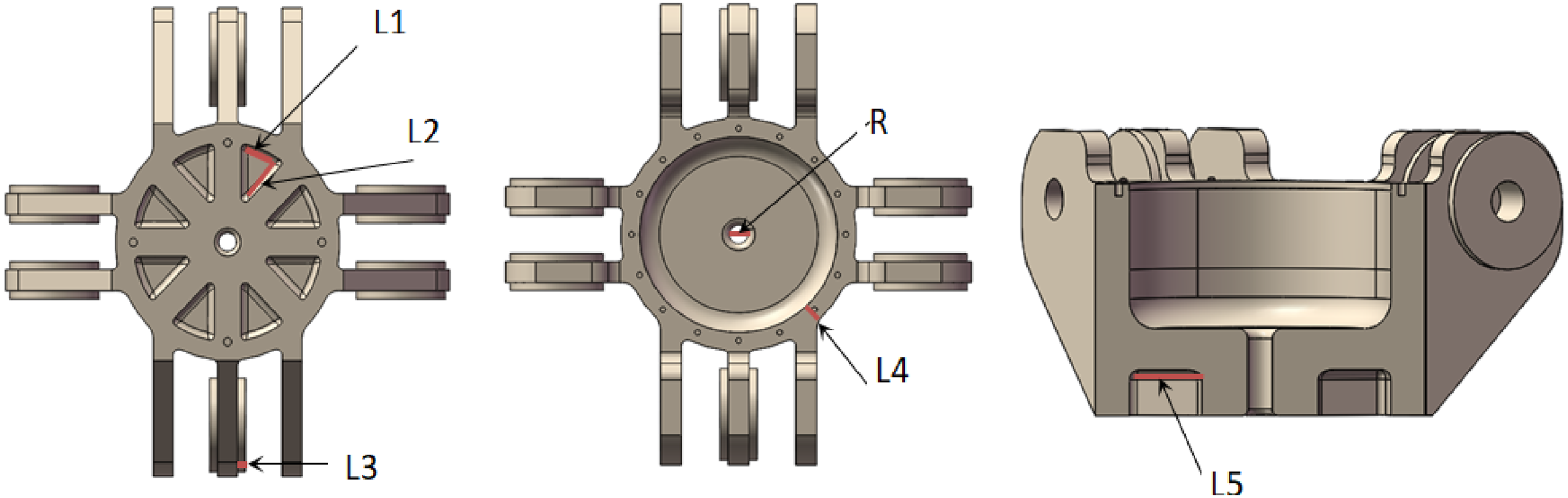
Optimized main structure and design parameters.
In order to reduce the weight of the HSC while ensuring its performance in all aspects, this article selects the length of the triangle bottom edge of the cylinder L1, the waist length of this triangle L2, ear tab excision thickness L3, the radius of the oil inlet hole R, the cylinder wall thickness L4, and the bottom cut thickness L5 for parameterization definition. In SOLIDWORKS, through the global variable parameterization window, add the prefix “DS_” according to the parameter setting identifier of ANSYS Workbench, and the parameter settings and optimized design range are shown in Table 1.
Parameter settings and optimization range.

Finite element model
The material of the HSC is selected as 42CrMo, and the mechanical properties of this material, as shown in Table 2. The meshing of the HSC is mainly refined by using the tetrahedron dominated meshing method (Tetrahedrons), setting the cell size to 5 mm, the mesh quality defined as high, and the mesh size at the rounded corners set to 3 mm. The finite element model of the HSC is shown in Figure 4. The model has 32614 cells and 57721 nodes.
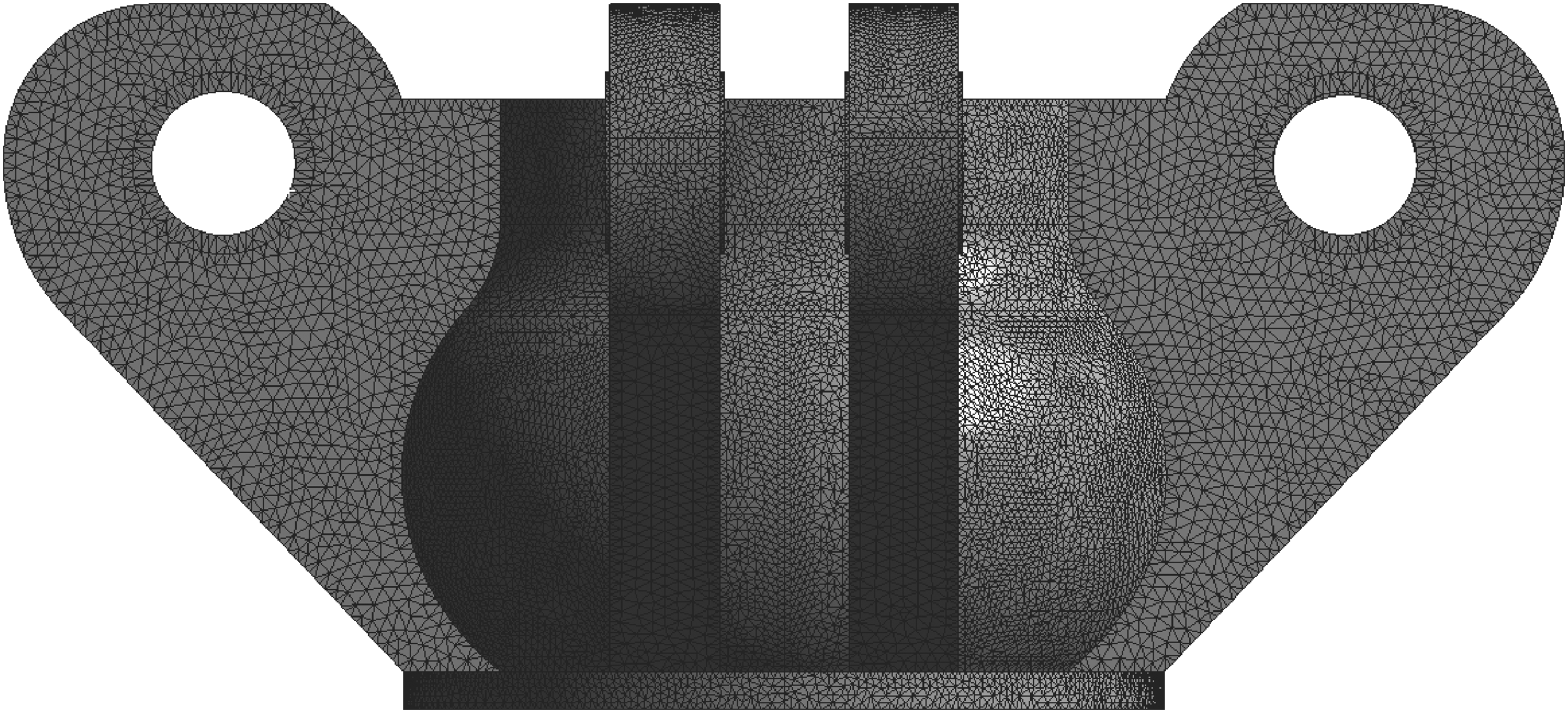
Overall finite element model.
Material parameters of hinge beam.

Analysis of simulation results
The deformation and stress clouds were obtained by calculating the static analysis of the original model of this hinged beam, as shown in Figure 5.

Deformation clouds, stress clouds, stress local enlargements of the original model.
As can be seen from Figure 5, the maximum deformation is 0.79754 mm, which is located near the inlet hole, and its maximum stress is 848.82 MPa, which is located at the edge of the pin hole on the bump. This value is slightly larger than the allowable stress value of 42CrMo, 805.39 MPa, so the bump fastener in the original model is prone to fracture in actual production.
Optimized design
Design variables and objective function
In ANSYS Workbench, the optimization target is used as the output parameter, and the maximum stress is an important reference for the optimized design in the case of a hinge beam subjected to 100 MPa pressure. According to the load-bearing characteristics of the HSC, the overall light weight should be ensured as much as possible under the premise of ensuring its static stiffness to meet the safety production.
The theoretical model of the optimized design of the HSC is as follows:
After the parameters are set, the data analysis type selects CCD. Generate 25 groups of design points, set the constraints in the set mathematical model, and carry out the calculation. The results of the calculations are shown in Table 3.
Calculation results of optimized design points.

The maximum deformation, the maximum equivalent force and the mass of the hinge beam are selected as the optimization objectives. The length of the triangle bottom edge of the cylinder L1, the waist length L2 of this triangle, the lug tab excision thickness L3, the radius of the oil inlet hole R, the cylinder wall thickness L4, and the bottom excision thickness L5 are used as the objective functions to constrain the structure. Meanwhile, in order to reduce the computation, the above parameters are customized in Parameter Set in Workbench with related parameters (L2 = 2L1, L3 = L5) to simplify multiple design variables to four and obtain the preferred solution for the optimized design. That is, the mass of the optimized the HSC is minimized while ensuring the strength and stiffness of the HSC.
Sensitivity analysis of design variables
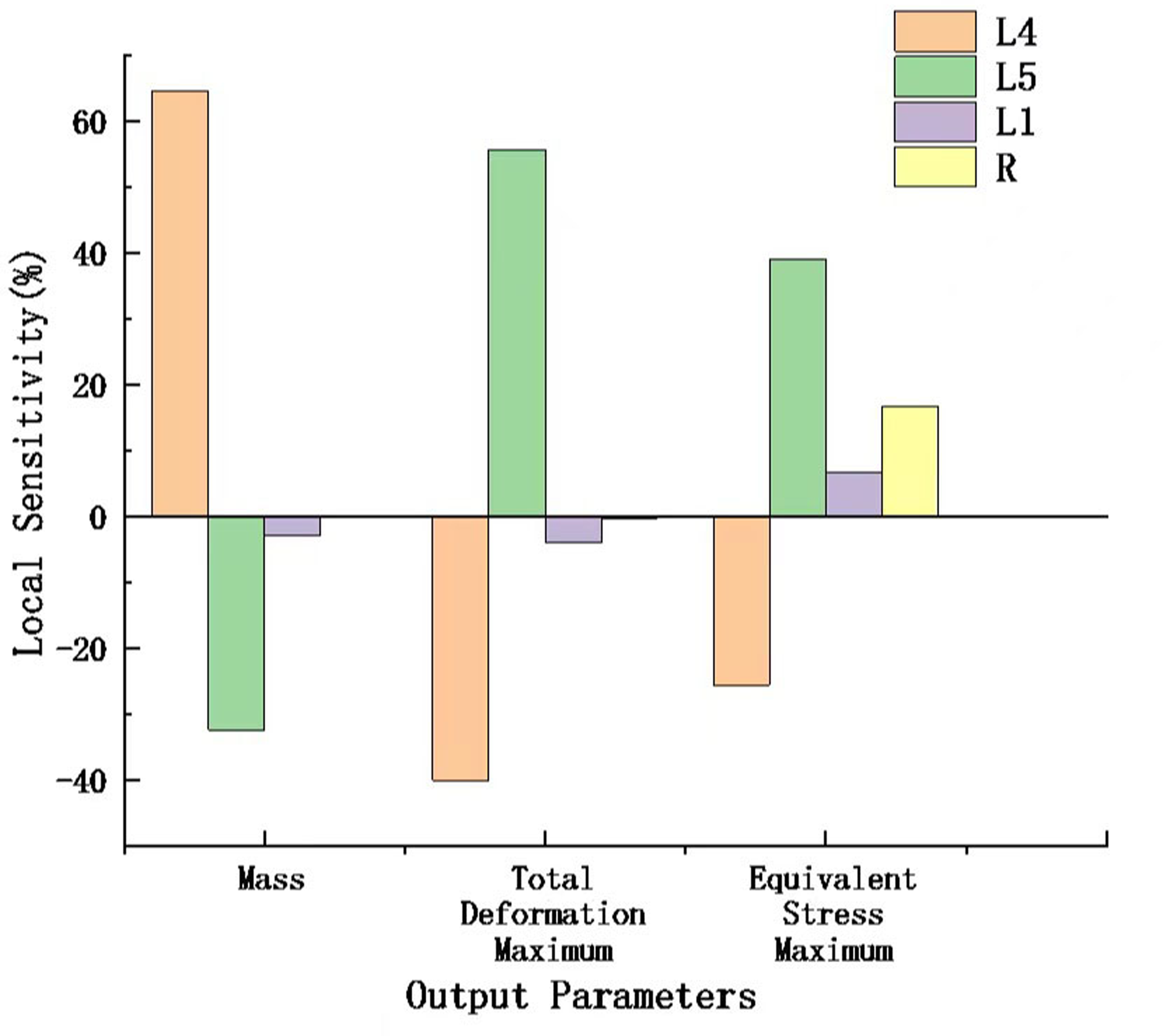
In the established response surface, the sensitivity analysis of the HSC design parameters can be expressed by equation (10).
Sensitivity analysis chart.
As shown in Figure 6, when considering each parameter individually, L4 has a positive effect on the mass, and L5, L1, and R have a negative effect on the mass, where L1 and R have a small effect on the mass in the established response surface, and the sensitivity of the selected parameter L4 > L5 > L1 > R. L5 has a positive effect on the maximum deformation, and L4, L1, and R have a negative effect, and the sensitivity of the selected parameter Sensitivity L5 > 45 > L1 > R. L4 has a negative effect on the maximum equivalent stress, L5, L1, and R have a positive effect, and the sensitivity of the selected parameter L5 > L4 > R > L1.
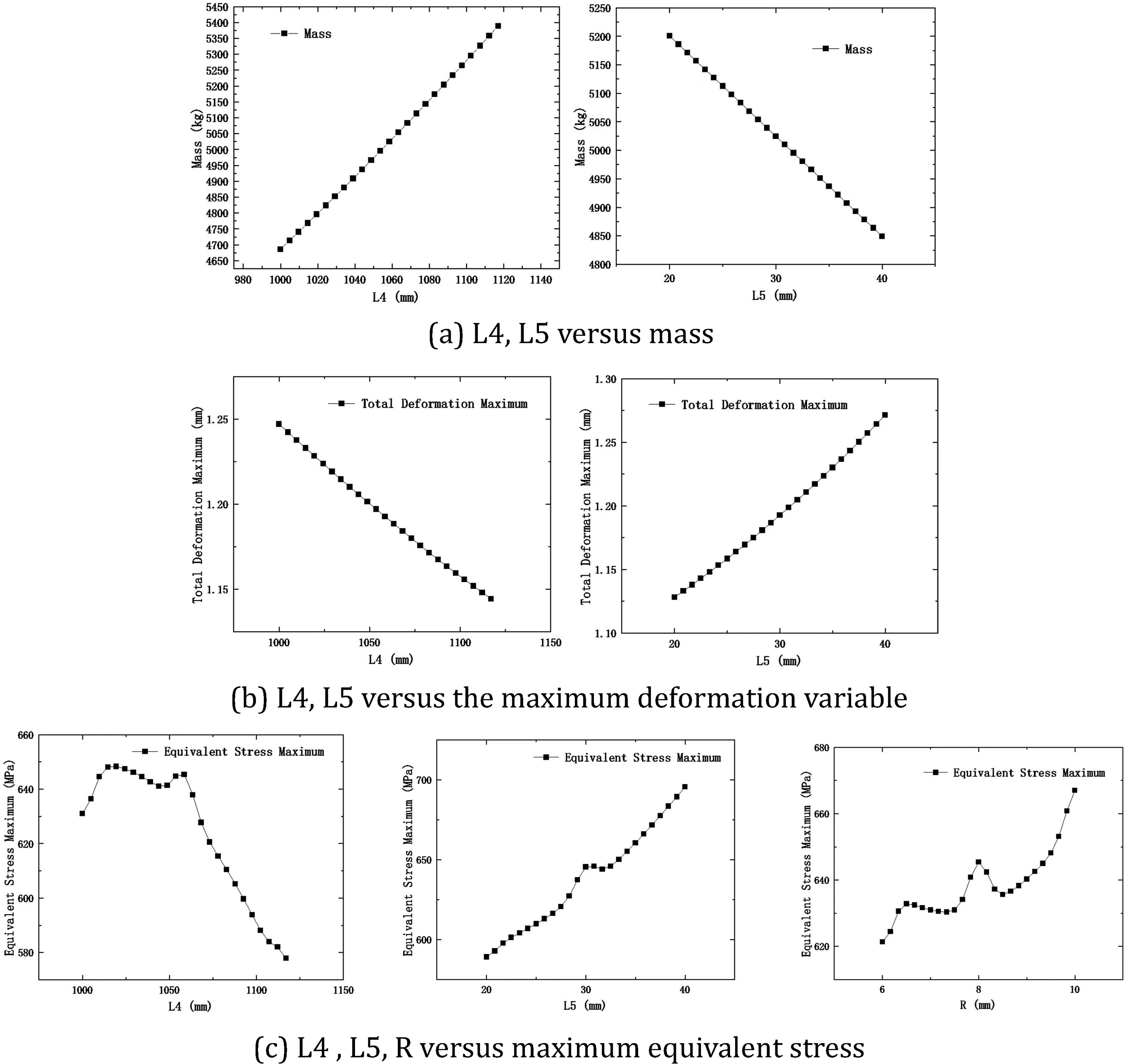
According to the calculated results, the influence of each optimized parameter on the mass, maximum stress, and maximum deformation of the HSC in the established response surface is shown in Figure 7. The analysis shows that the mass increases with the increase of the parameter L4 (cylinder wall thickness) and decreases with the increase of L5 (bottom cut thickness and ear tab cut thickness). The maximum deformation decreases with the increase of the parameter L4 (wall thickness of the cylinder) and increases with the increase of L5 (thickness of the bottom cutout and the thickness of the lug cutout). The maximum equivalent stress fluctuates with the increase of the parameter L4 (cylinder wall thickness), which reaches the maximum value at L4 = 1017 mm and then decreases with the increase of the wall thickness. The maximum equivalent stress fluctuates with R (radius of the oil inlet hole), showing a decreasing condition when R = 6.5∼7.5 and R = 8∼8.5, and increases with R in the rest of the range.
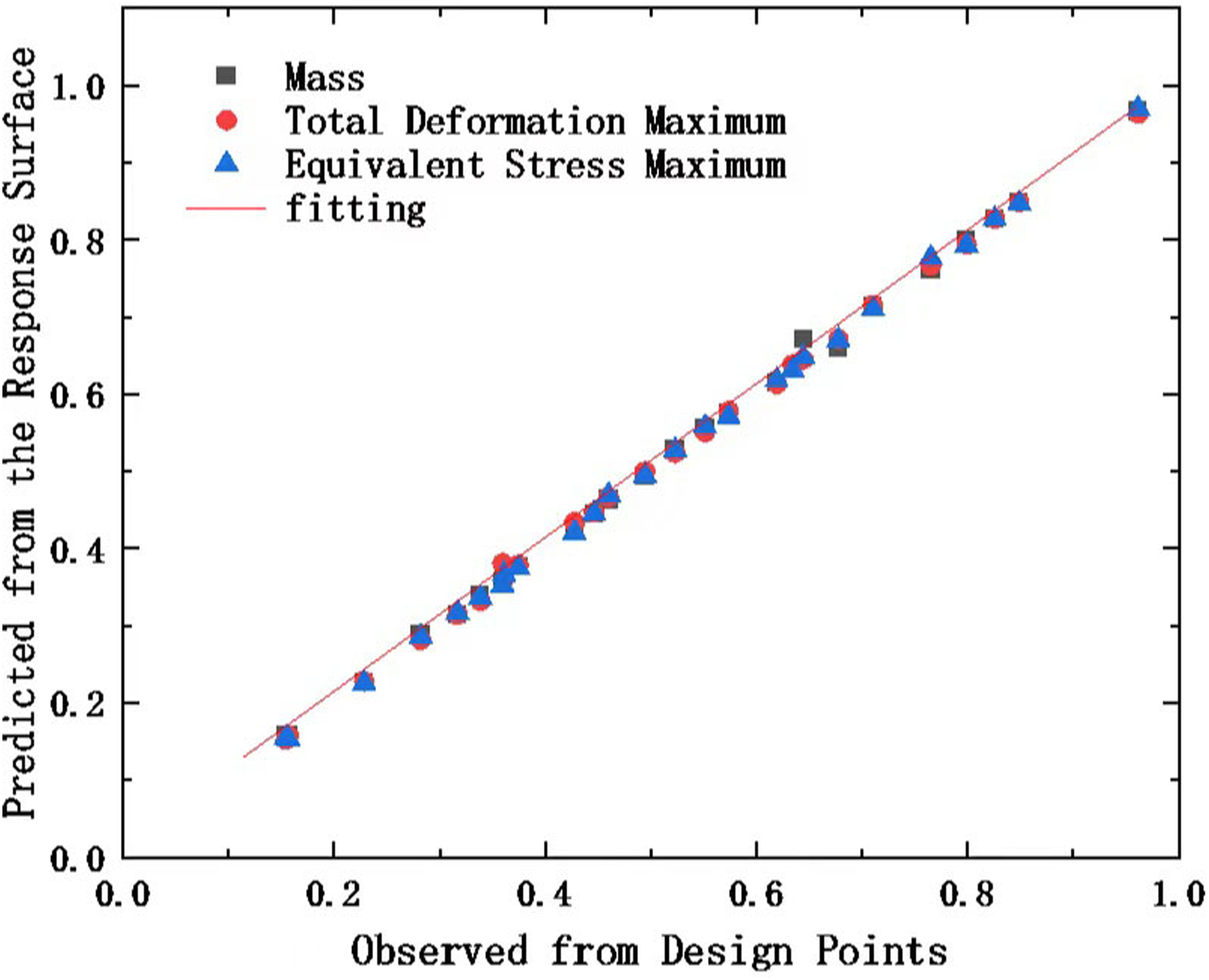
Response surface goodness-of-fit analysis.
Combined with Figures 6 and 8, it can be seen that L4 (cylinder wall thickness) and L5 (bottom removal thickness and ear tab removal thickness) have a greater influence on weight, maximum total deformation, and maximum stress than the other two parameters, and R (oil inlet hole radius) has a certain influence on the maximum equivalent stress of the HSC, and there is a positive correlation. This shows that the values of L4 (cylinder wall thickness), L5 (bottom removal thickness and ear tab removal thickness) and R (radius of oil inlet hole) directly affect the stress concentration of the HSC and need to be considered in the optimization process.
Relationship between individual parameters and optimization objectives.
Response surface analysis
The optimization algorithm in this study uses the Kriging method in response surface systems. This is an exact multidimensional interpolation that incorporates a polynomial model similar to the standard response surface. It provides a “global” model of the design space, while also adding local deviations for interpolating DOE points. To model the simulation of f(x) in equation (1):



From the above analysis, it can be seen that the response surface model is an approximate alternative model, so the goodness of fit of the response surface must be evaluated. Figure 7 shows the goodness-of-fit analysis of the established response surface. It can be seen that the mass, maximum total deformation, and maximum equivalent stress are all distributed near the established response surface, indicating that the quality of the established response surface meets the requirements.
The response surface contour cloud plots of each output parameter were obtained by fitting the above experimental design as shown in Figures 9 to 11. It can be visualized from the cloud diagram that the response surface cloud diagram of mass and total form variables is almost a plane and the relationship between them is similar. The response value increases or decreases almost linearly with the change of input. The warping of the response surface of the equivalent stress is relatively high, which indicates the high influence of the quadratic term in the response of the equivalent stress.

Contour cloud of hinge beam mass response surface with different parameters.

Cloud plot of total deformation response surface with different parameters.

Contour cloud of equivalent stress response surface of the Hinge Sleeve of Cubic with different parameters.
Validation of optimization results
Optimization results
After establishing the Kriging model and considering it as an objective function, MOGA can be applied to find the Pareto optimal solution. The MOGA algorithm is a hybrid variant algorithm that supports various types of input parameters and is a fast nondominated ranking method. 17 The parameters are set for the MOGA algorithm as shown in Table 4.
MOGA parameters.

MOGA: multi-objective genetic algorithm.
In order to obtain the desired Pareto optimal solution, the response surface boundary conditions are set during the optimization process according to equation (5). The Pareto optimal solution is obtained by multiple iterations as shown in Figure 12, and the color of the squares in the figure indicates the superiority of the optimization results, with blue being the optimal solution and red being the inferior solution.

Pareto optimal solution.
The above is the effect of a single design variable on the output results. Taking the four state variables of the HSC as the optimization objectives, and ensuring that its strength and stiffness meet the design requirements while ensuring that its mass is minimized, three groups of candidate point solutions are obtained after calculation. Three sets of candidate optimized design points were obtained by fitting the design points to the system runs. The data were rounded to obtain three sets of data, that is, A, B, and C, and the model was re-systematically analyzed. The results are shown in Table 5.
Comparison of optimization results of parameter variables.

From Table 5, it can be seen that the masses of the three groups are less different, among which group A is the lightest; group B has the smallest total deformation and equivalent force. Group B was selected as the final optimization result from the viewpoint of reliability and material utilization. Compared with the pre-optimization, the total deformation is increased by 29.732%, the equivalent stress is increased by 16.70%, and the mass is reduced by 24.84%.under the condition of ensuring the strength and stiffness of the HSC.
Result verification
When the ANSYS calculation is completed, the dimensions are rounded and imported into Workbench for the second analysis and calculation, with all settings remaining the same as before the optimization. The optimized results are shown in Figure 13. As can be seen from the figure, the actual maximum deformation is 1.135 mm and the maximum equivalent force is 707.1 MPa, which are increased by 29.732% and 16.70%, respectively, compared with the pre-optimization period. The mass is 4928.6 kg, which is reduced by 24.84%. The deformation value at the bottom inlet hole of the hinge beam cylinder increases slightly. The maximum stress in the original model is at the edge of the pin hole on the lug, but after optimization, the stress at the edge of the pin hole of the hinge beam is reduced to a large extent and is much smaller than the allowable yield strength. The effectiveness of the proposed scheme was verified in actual production (as shown in Figure 14). The design of the HSC is mitigated and the utilization of materials is improved while ensuring safety.

Deformation and stress cloud after optimization.

Application of the design method.
Conclusion
In this study, a response surface optimization model based on Kriging model was developed and the following results were obtained using MOGA for multi-objective optimization of the HSC. The actual maximum deformation after optimization is 1.135 mm and the maximum equivalent stress is 707.1 MPa, which are increased by 29.732% and 16.70%, respectively, with respect to the pre-optimization period. The mass is effectively reduced by 24.84%. The maximum stress in the original model is at the edge of the pin hole on the lug. After optimization, to a large extent, the stresses at the edges of the pin holes of the HSC are reduced and are much less than the allowable yield strength. Finally, the HSC is designed to be lightweight, reduce fabrication cost and improve material utilization while maintaining strength.
The influence of design variables on the objective function was fitted using response surface model, and the local sensitivity of the objective function to the design variables was investigated to verify the reliability of the optimization results. Compared with the traditional method, the optimized the HSC comes with excellent performance, and the effectiveness of the optimization strategy is verified through practical production.
Footnotes
Declaration of conflicting interests
The authors declared no potential conflicts of interest with respect to the research, authorship, and/or publication of this article.
Funding
The authors disclosed receipt of the following financial support for the research, authorship, and/or publication of this article: This work is supported by the Guangxi Higher Education Undergraduate Teaching Reform Project (2016JGB236), Research and Practice on the Reform of Independent Investigative Cooperative Learning Teaching Methodology for Automation Majors under the Proposed Simulation Experimental Platform, enterprise cooperation project with Jiangsu a new material science and technology limited company (20210320), the Second Batch of Industry-University Cooperation Collaborative Education Project (201802302102), Ministry of Education, China.

Author biographies
Xuan Sun is an associate professor at Guilin University of Technology. His research directions are electromechanical control, test analysis, and data processing.
Ting Liu is a graduate student of Guilin University of Technology. Her research directions are wind vibration response analysis and mechanical design.
Jiguang Jia is a graduate student of Guilin University of Technology. His research direction is machine vision.
Zhihui Chen is an engineer, working at Guangxi Special Equipment Inspection and Research Institute, Nanning, China, and his research area is nondestructive testing and electromechanical engineering.
Jing Shang is a graduate student of Guilin University of Technology. Her research directions are in robotic arms and machine design.