



Abstract
The purpose of this research is to evaluate the colouring performance of Amba Haldi–based natural extracted yellowish colour for the dyeing of wool fabric using ultrasonic (US) treatments. Before and after the US treatment, the colourant was separated in aqueous and acidic solutions for up to 60 min. Scanning electron microscopy and Fourier-transform infrared spectroscopy were used to investigate the surface morphology and chemical changes in the cloth before and after radiation. On the wool fabric that was ultrasonically treated at 75°C for 45 min, an acidic extract of Amba Haldi powder after US treatment for 20 min showed good colour depth (K/S). Acacia extract (2%), pomegranate extract (1.5%) and pistachio extract (1%), when used as pre-biomordants, were shown to have excellent colour strength. Acacia (1.5%) extract, pomegranate (2%) extract and pistachio (1.5%) extract were also used as post-biomordants. As pre-chemical mordants, Al salts (1%), Fe salts (1.5%) and tannic acid salts (2%), whereas Al salts (2%), Fe salts (1%) and tannic acid salts (2%), have produced successful results as post-chemical mordants. Overall, it was discovered that pomegranate extract (2%), used as a post-bio-mordant, and salt of Fe (1.5%), used as a post-chemical mordant, both exhibit exceptional colour strength. Ultrasonic treatment, a procedure that is harmless for the environment, has only served to increase the colour strength of dye on wool fabric, and the addition of bio-mordants has made the process more sustainable.
Introduction
Dyes are colourful organic substances commonly used to colour fabrics, papers, cosmetics, wood and leather. 1 Most synthetic dyes are thought to contain intermediates that are toxic and carcinogenic, and when employed, these effluents are released into the environment and contaminate the environment; non-biodegradable moieties in effluents impair aquatic bodies, disrupt photosynthesis and cause severe allergic, toxic, carcinogenic and severe skin responses in humans and animals.2,3 Hence, their disturbance in the ecosystem causes global warming and unnatural seasonal change, destroying global beauty. 4 Their preserves in the water system produce low photosynthesis, killing aquaculture and causing many fatal and carcinogenic diseases.5,6 When synthetic dyes are mixed with soil, the effluent destroys the soil pH and bacterial activity, destroying the agro-land. 7 These colours also harm the entire food chain when they enter water streams. Different global protection associations have spread awareness and moved towards green ecological products. Among these ecological products, bio dyes have a special place worldwide. Previously, these colourants were also used to dye body parts, caves, etc. 8
These dyes are widely used in anti-oxidant, anti-fungal, anti-bacterial finishing, U.V protection and other industries since they are non-toxic, environmentally friendly and easy to degrade.9,10 These dyes are organic macromolecules with a broad ability to bind (intermolecular force or hydrogen bond) with natural fibres. Natural dyes have risen in popularity as potential alternatives to synthetic dyes due to their biodegradability, low toxicity and low occurrence of allergic reactions. 11 Therefore, we have also extracted natural colour from gardenia yellow, 12 tulsi leaves, 13 Butea monosperma plants, 14 Alkanna tinctoria roots, 15 Rheum Emodi plants, 16 Coral Jasmine flower 17 and neem leaves extractions. 18 These bio-colours do not pollute the environment or cause wastewater problems because their effluents and residues, when mixed with agri-land, become their part and enrich the soil. 19 Hence, the reproduction of bio-colours in fields is proceeding around the globe. Again, there is the revival of cultural heritage, and the return to the classic art wave is on the way.20,21
Mordants are used in regular bio-colouring to develop further various colour attributes and fastness properties. 22 Two kinds of mordants are being used, that is, chemical and bio-mordants. Bio-metals present in salts from dye complex onto fabric by reacting coordinate covalent bond. In contrast, bio-mordants utilise the hydroxyl (-OH) groups predominantly from their phenolics to create additional hydrogen bonding with the fabric, resulting in an expanded range of colours. 23 Plant phenolics, anthraquinone, flavonoids, etc., are becoming increasingly popular for use in the bio-colouring process to achieve a wide range of vibrant and colourfast hues.17,24
As for as low yield is concerned, although conventional methods are being employed, these processes have many flows on energy, time, solvent, etc. 25 But some modern methods have proved that their mode of action is rapid, lean and yield-enhancing without harming their ability to show functional behaviour. 15 These methods utilise less solvent, energy and time and retain the actual product's identity. Among such methods, ultrasonic (US) rays have a novel mode of action. 26 These rays have mechanical effects which transfer the energy by a special mechanism called acoustic cavitation. 27 The insolvent bubbles have so much energy that when collapsing with plant boundary, they evolve active bio isolate (colourant) through powder solvent interaction by consuming less energy, solvent and time. 28 Thus, it is a sustainable, levelling source of isolation that modifies the extraction process to give a high yield and can upgrade the fibre surface to motivate its sorption behaviour. For the current study, our researchers have inspected the colouring behaviour of Amba Haldi (Curcuma aromatica) for bio-treated wool fabric (Figure 1). Amba haldi, also called wild turmeric, is a member of the Zingiberaceae family and is well-known as a healing power worldwide. 29 Physiochemical analysis of Amba Haldi shows that it contains many bioactive, but curcumin structures are responsible for delivering yellow gamutes onto fabric such as cotton wool, silk and nylon.

Structure of curcumin (a), Amba Haldi plant powder (b) and the structure of wool (c).
Wool is a natural animal fibre obtained from the fur of sheep, camels, etc., after processing. 30 In this fibre structure, keratin is the main element, a mode of polypeptide chain through amido linkage. 31 This amido linkage is responsible for attaching to the other substrate through a covalent or ionic bond. 32 Therefore, the aims and objectives of the research is to the colouration of wool fabric using naturally extracted dyes form Amba Haldi (Curcuma aromatica). Here, provided the optimistic effects of US rays for yield and plant phenolics for fastness, the current study was improved the extraction of Curcuminoids from Amba Haldi (Curcuma aromatica). Then, the physicochemical characteristics of wool fabric were examined using scanning electron microscopy (SEM) and Fourier-transform infrared spectroscopy (FTIR) before and after irradiation. The wool fabric was then dyed with naturally extracted dyes from Amba Haldi, and the level of mordanting for achieving a uniform shade was assessed. The fastness ratings of the dyed shade were determined according to ISO standards. The results indicate that the naturally extracted dyes from Amba Haldi have the potential to replace synthetic dyes in the textile industry for dyeing wool fabric, offering an environmentally friendly alternative.
Materials and methods
Collection of materials
The plant pigments used in this study, namely Amba Haldi (Curcuma aromatica), pomegranate rinds (Punica granatum), pistachios (Pistacia vera) and acacia bark powder (Acacia nilotica), were obtained from a reputable herbal store in Faisalabad, Pakistan. The collected plant materials were carefully processed and preserved to serve as a source of polyphenolic compounds for developing shades. In addition, sustainable salts of aluminium (Al), iron (Fe) and tannic acid (TA) were purchased from a chemical store in Faisalabad, Pakistan, to isolate natural dyes and bio-mordants. The Amba Haldi was finely ground and sieved through a 20-mesh size screen to obtain a powder with a consistent particle size. For the bio-dyeing and mordanting process, wool fabric weighing 375 g/m2 was prepared by washing it with a neutral soap at a temperature of 80 °C for a duration of 30 min.
Irradiation and extraction process
With a liquor-to-powder ratio of 25:1, fine haldi powder split into 4 g was boiled for 45 min with 100 mL of aqueous and acidic medium. With the aid of a Rohs-based commercial US bath, the extracted plant materials and the fabric samples were exposed to US waves for a duration of up to 60 min (at a frequency of 50 Hz and power of 120 W). To perform the dyeing process, a fixed extract-to-fabric ratio of 25:1 was maintained, and the temperature was set at 80°C for a period of 45 min. Both the treated extracts (referred to as NRE) and the untreated extracts were used to dye both the treated fabric (referred to as RWF) and the untreated fabric (referred to as NRWF). A visual representation of the complete experimental procedure can be found in Figure 2.

Extraction, mordanting and dyeing scheme of the work.
Optimisation of dyeing conditions
Many dyeing parameters were statistically optimised using response surface methods, including temperature, dyeing time, pH and extract volume (RSM). In a series of 32 tests using a statistical model, dyeing was done at a temperature range from 65–85°C for 35–65 min using 35–65 mL of extracts of 3–7 pH and 0.5–2/100 mL of salt as an exhausting agent. The experiments are described in detail in Table 1.
Response surface regression: k/s versus ph, volume, time, temperature and salt.

Optimisation of mordanting conditions
To enhance the colour intensity and colourfastness of the dyed fabric, both pre-mordanting and post-mordanting processes were conducted at a temperature of 80°C for 45 min. Eco-friendly electrolytes including aluminium (Al), iron (Fe) and TA were utilised as mordants. These mordants were applied before and after dyeing, following specific conditions, at concentrations ranging from 0.5 g/100 mL to 2.5 g/100 mL. 33 The mordant-to-fabric ratio of 25:1 was maintained during the treatment. Furthermore, extracts from natural sources including pomegranate rinds (Punica granatum), pistachios (Pistacia vera) and acacia bark powder (Acacia nilotica) were employed as bio-mordants. The dyeing process with these bio-mordants was carried out at a temperature of 80°C for 45 min.
Assessment of fabric and extractions
Scanning electron microscopy was employed to investigate the surface morphology of both the irradiated and unirradiated textiles. 34 This technique allowed for a detailed examination of the physical characteristics of the textile samples at a microstructural level. Additionally, FTIR analysis was utilised to observe any changes in the characteristic peaks corresponding to the functional units of wool. 35 This analysis provided insights into the alterations or modifications that occurred in the chemical composition of the wool fabrics. Finally, the coloured materials were examined using a Colori spectrophotometer in the Lch Lab system (CS-410, China). ISO standard techniques for light, washing and rubbing were observed on a greyscale for various rating fastness features.36,37
Results and analysis
Isolation of natural compounds by the conventional process is not appreciated because the type of dyeing process takes a lot of solvents, time and energy. Sometimes on many days, the constant energy supplied may cause degradation of actual production. 38 The addition of sustainable tools such as US rays has solved the problem by its unique mode of action, that is, energy transfer via acoustic cavitation. 39 The bubbling produced by this process is continuous, a sort of energy that ruptures its cell wall when it strikes the boundary and allows the plant moiety (Curcuminoids) to interact wall with solvent. 40 Thus this mass transfer kinetics in a sustainable way, when employed during dyeing, shows good yield onto fabric. 41 Fabric dyeing in an acidic medium produced good results. As a consequence, the findings in Figure 3(b) show that irradiating extract for 20 min in an acidic solution gave high results (K/S = 25.681) onto irradiated wool beyond the ideal duration (US = 20 min); other plant by-products are also evolved, and during dyeing affect the K/S value. The dyeing of fabric in an aqueous medium given in Figure 3(a) showed excellent results (K/S = 15.139) onto irradiated wool (US = 60 min), and the colour coordinates are shown in Table 2. According to our previous studies,14,42 it was observed that these rays modify fabric surfaces physically without having a chemical nature. Thus, it is another advantage of US rays that are only isolated; the colourant is a suitable medium and improves fabric uptake ability without any loss. The statistical analysis given in Table 3 shows that using an aqueous medium, the choice of sample code is significant (p = 0.000) but radiation imparted on the process is not (p = 0.430). But using acidic extract, irradiation of fabric and extract (p = 0.000) and variation in treatment, that is, RE, NRE, RFRF and NRF are highly significant (p = 0.000). Hence, statistically, the results shown in Table 3 are highly significant and per our expectations. To summarise the result, it is proposed that extract and cloth be ultrasonically treated for up to 20 min to get promising outcomes.

Ultrasonic-assisted dyeing of wool fabric using Amba Haldi aqueous (a) and acidic (b) extract.
Coordinates in a suitable medium certain wool fabric that has been coloured before and after radiation.

Control: without radiation; NRE: non-irradiated extract; NRWF: non-irradiated wool fabric; RE: Irradiated extract; RWF: Irradiated wool fabric.
Statistical analysis for irradiation of extract and fabric in aqueous and acidic media.

Physically, the changes in fibre surface help to enhance its colouring behaviour. This is because of the smooth fibre surface, and the colourant molecules are sorbed in cluster form. But after irradiation, the surface is peeled, the scratched surface holds colourant molecules firmly, and upon assessment in spectra flash CS-410 high yield in terms of K/S was observed. 43 Scanned images presented in Figure 4(a) and Figure 4(b) revealed the fact. Results in Figure 5(a) and Figure 5(b) demonstrated the typical peak of amide linkage in proteinaceous fabric (wool) does not change after US treatment for up to 60 min. The amide (-NH) stretching peak at 1718cm−1, the hydroxyl (-OH) stretching peak at 3373 cm−1 and the carboxyl (R-COOH) stretching peak at 1100 cm−1 were not modified by US treatment for up to 60 min, according to FTIR spectral pictures taken from irradiated and unirradiated wool fabric. In wool fabric, the presence of a distinct peak corresponding to the amide linkage in the FTIR analysis indicated that the irradiation did not alter the chemical composition of the material. This observation holds significant advantages for the textile processing industry. The ATR-FTIR spectral images presented in Figure 6(a) and Figure 6(b) depict the results of the Amba Haldi extract. Before irradiation, the spectral analysis indicated the presence of specific peaks in the FTIR results. These included a peak at approximately 3500 cm−1, corresponding to the stretching of the phenol group (-OH), as well as peaks at 1599 cm−1 (indicating aromatic C = C stretching) and 1501 cm−1 (representing C = O stretching). Notably, following irradiation, the spectral peaks exhibited no significant changes and remained consistent with the pre-irradiation spectrum. Hence, US rays, like MW rays, also modify the fabric's surface without altering its chemistry, which is one of the enormous advantages of using them widely in textiles.

Scanning electron microscopy (SEM) micrograph of the wool fabric (a) un-irradiated and (b) irradiated.

Fourier-transform infrared spectroscopy (FTIR) spectra of wool fabric (a) un-irradiated and (b) irradiated.

Fourier-transform infrared spectroscopy (FTIR) spectra of Amba Haldi extract before (a) and after (b) ultrasonic treatment.
In the dyeing of wool, both parameters have a key role. In this study, after US radiation, a series of 32 experiments under a central composite design was planned and implemented using various rays of time, temperature, pH, salt and extract volume. The results have shown that the model selected for data analysis was linear and fits. Similarly, the role of extract volume, pH and salt were highly significant (p = 0.000). But the role of the contact variable is significant at 5% of a level. Hence, each parameter has a key role in wool dyeing with Amba Haldi extract. In two-way interaction, extract pH's role, time and temperature are highly significant (p = 0.00) (Table 1).
Similarly, the role of extract volume with salt, time and temperature is also significant (p = 0.00), and contact variable, that is, dyeing time and temperature, has also shown significant results along with salt and volume. Overall, the involvement of their variable following US treatment of both extract and fabric produced good outcomes. The results reveal that 45 mL of extract of 5 pH has 1.5/100 mL of salt after US treatment for up to 20 min and has given the highest yield (K/S = 25.600) onto irradiated wool when employed for 45 min at 75°C shown in Figure 3(b). It was seen that the US rays have also reduced dyeing levels to get promising results.
Mordanting is the art of introducing new shades of good to excellent fastness. Usually, Cu, Cr, Co, Fe, Sn, etc., salts are used, but toxicity is the main issue informing of their effluents after processing. 44 To make the process eco-friendly, in a different study, salt of Al, Fe and TA has been used to develop colourfastness shades of high strength. 45 The data shown in Figure 7(a) and Figure 8(a) revealed that 25 mL of 1 g/100 mL of Al-salt before dyeing and 25 mL of 2 g/100 mL of Al-salt after dyeing has shown maximum yield. Similarly, 25 mL of 1.5 g/100 mL of Fe (FeSO4) before dyeing and 25 mL of 1 g/100 mL of Fe after dyeing furnished darker shades. Its 2 g/100 mL before and after dyeing on TA has yielded good results. Comparatively, 25 mL from 1 g/100 mL of Al-salt before dyeing and 25 mL of Fe-salt from 1 g/100 mL after dyeing have shown excellent shade strength. The good shade of high strength is due to the formation of the coordinate covalent bond by metal ion (Fe2+/Al3+) with amido unit of wool and -OH from Amba Haldi using TA, interacts with –OH of haldi-based colourant (curcuma) and amido side of wool keratin by H-bonding. This special type of interaction either gives bright or dark shade depending upon the nature of the metal, fabric and colourant used. The shade coordinates given in Table 4 revealed that the tones of mordanted fabrics have varied from brighter to darker in appearance and the trends have been shifted from greenish-yellow to a reddish-yellow hue. The values of a* and b* in the CIELAB colour space represent a colour's chromaticity coordinates. The a* axis represents the green-red axis in colour space. On this axis, negative values indicate greenness, while positive values indicate redness. The blue-yellow axis is represented by the b* axis, where negative values suggest blueness and positive ones suggest yellowness. 46 Therefore, most shades look brighter with a reddish-yellow tint, but before dyeing, by applying a concentration of 1 g/100 mL of aluminium (Al)-salt, a brighter shade (L* = 73.47) with a reddish-yellow hue (a* = 0.50; b* = 58.02) was achieved. Following the dyeing process, the application of 1 g/100 mL of iron (Fe)-salt resulted in the development of a darker tint (L* = 60.31) with a reddish-yellow hue (a* = 4.11; b* = 49.34).
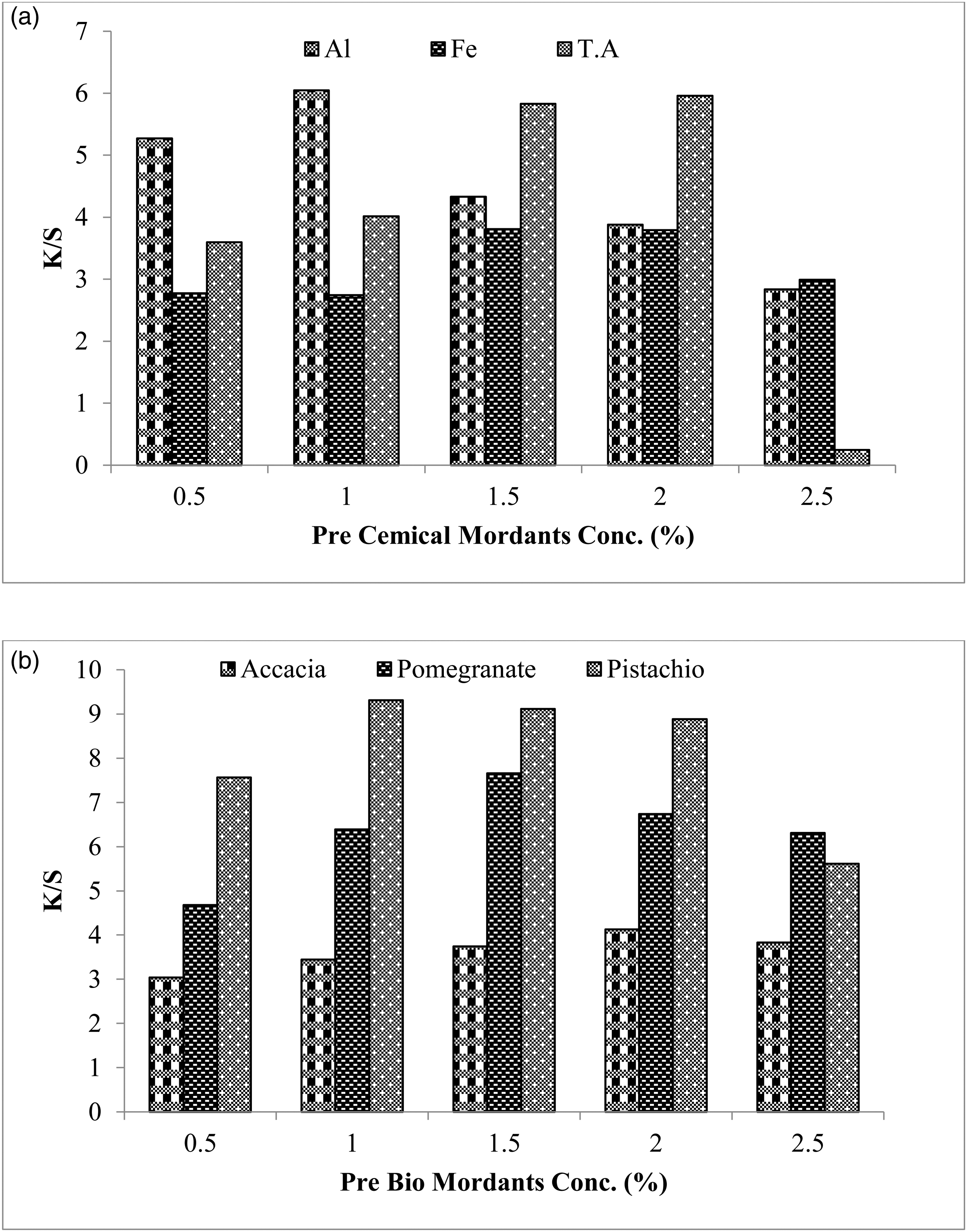
Pre-chemical (a) and bio-treatment (b) of wool for dyeing with Amba Haldi extract.

Post-chemical (a) and bio-treatment (b) of wool for dyeing with Amba Haldi extract.
Optimum condition of mordanting colour coordinates and shades.

Plant-based molecules have functional characteristics which not only impart their biological activities but also develop now colourfast shades. It can be noted that plants used as the source of bio-mordants are themselves natural colourants. Hence, it should be considered as over bio-dyeing of the fabric when new shades are introduced, and the colourfastness rating is improved. Here, in this study, it has been found that 25 mL of extract taken from 2 g/100 mL of acacia, 25 mL of 1.5 g/100 mL of pomegranate and 25 mL of 1 g/100 mL of pistachio hull powder have given good strength to the spectra flash data shown in Figure 7(b) and Figure 8(b). The shade coordinates shown in Table 4, the tonal variations revealed that before dyeing, their application has given bright yellow to red greenish-yellow shades. Similarly, after dyeing, it can be seen that 25 mL from 1.5 g/100 mL of acacia extract, 25 mL from 2 g/100 mL of pomegranate and 25 mL from 1.5/100 mL of pistachio extract have given a high yield. Tonal variation also shows that most shades are brighter, with reddish-yellow to yellowish-green tones. In terms of the colour development, prior to dyeing, a solution of 25 mL from a concentration of 1 g/100 mL of pistachio extract produced a brighter shade (L* = 74.32) with a reddish-yellow tone (a* = 1.21; b* = 65.31). Following the dyeing process, the application of 2 g/100 mL of pomegranate extract resulted in the development of a brighter shade (L* = 66.98) with a greenish-yellow hue (a* = -0.35; b* = 63.39). The potential mechanism underlying the wool dyeing process with Amba Haldi natural dyes is illustrated in Figure 9.

Possible attachment of metallic mordant (a) and plant molecule (b) with wool fabric and Amba Haldi colourant.
Discussion
The colour fastness properties of the optimally dyed and mordanted wool fabrics were evaluated using ISO standard. Using Amba Haldi extract for 45 min at 80°C increased the colour rating and fastness qualities, as demonstrated in Table 5. Ratings show how quickly shades have become increase fastness as a result of mordanting. The enhanced dyeability observed in the fabric can be attributed to the strong bonding formed between the fabric and the colouring component under US radiation. This phenomenon promotes the migration of the colourant towards the fabric's surface, resulting in closer proximity between the dye and the fabric. As a result, the dyeability is improved, leading to a more efficient and effective dyeing process. When multiple studies, including rubbing, exposure to light, and washing, were employed, bio-mordants enhanced the wool fabric's colouration and fastness. 47 This is because of a stable dye complex and strong H-bonding, which worked better than a similar chemical mordant. 48 US treatment improved the colour grading and fastness of Amba Haldi, a natural dye for wool fabric dyeing. As a result, bio-mordanting has been recognised as a cutting-edge technique for producing shades and making cloth dyes more sustainable and environmentally beneficial.
Fastness grading of wool fabric dyed with acidic extract of Amba Haldi before and after mordanting at selected conditions.

L.F: light fastness; W.F: washing fastness; DRF: dry rubbing fastness; WRF: wet rubbing fastness.
Although the study showed excellent results for the dyeing of wool fabric using naturally extracted dyes from Amba Haldi using US treatment and bio-mordants, it has some limitations for industrial applications. The investigation was carried out under certain experimental circumstances, such as specified solvent, time and temperature parameters. The applicability or scalability of the suggested strategy may be constrained by the fact that these circumstances might not accurately reflect actual industrial or commercial situations. Although the study places a strong emphasis on environmental sustainability and pollution prevention, it is crucial to consider the cost-effectiveness and viability of applying the suggested strategy on a larger scale. The applicability and adoption of the approach in industrial settings may be influenced by variables such as equipment costs, energy usage and process optimisation.
Conclusion
Due to their unique mode of operation and decreased energy, time, solvent and cost consumption, sustainable isolation instruments like US rays explored the universe of natural goods for the worldwide community. The suggestions show that curcumin is isolated from Amba Haldi powder using the US treatment on an acidified medium. Natural yellow dye produced better effects after 20 min on wool fabric that had been irradiated. It was proved that acidic Amba Haldi extract has been subjected to a 20 min US treatment, shown ultrasonically treated for 45 min at 75°C on wool fabric. Using environmentally friendly chemicals and bio-mordants has been demonstrated to be effective in new hues with their high fastness and superb tint firmness features. As a result, the value of natural and sustainable colourant extraction from plants for ecological fabric dyeing may thus be increased by US radiation. This is followed by a pollution-free mordanting process to create new colours with high colourfastness.
Footnotes
Authors contribution
The whole experiments have been conducted by M.Phil student, Aamir Ali. Dr Noman Habib has supervised the whole work, where Dr Shahid Adeel and Shahid Rehman Khan have guided scientifically for smooth running of the work. Dr Muhammad Abdul Qayyum and Mr Rony Mia have analysed the data.
Consent to participate and publish
We give consent to publish our work of M.Phil studies and is jointly contributed by the all authors.
Declaration of conflicting interests
The author(s) declared no potential conflicts of interest with respect to the research, authorship, and/or publication of this article.
Ethical approval
We approve that this manuscript is a part of the M.Phil studies.
Funding
The author(s) received no financial support for the research, authorship, and/or publication of this article.

Author biographies
Noman Habib is currently working as an Assistant Professor of Botany at Government College University, Faisalabad, Pakistan.
Shahid Adeel is an Associate Professor of Applied Chemistry at Government College University, Faisalabad, Pakistan.
Aamir Ali is an MPhil student of Botany at the Department of Botany, Government College University, Faisalabad, Pakistan.
Rony Mia is currently working as a Lecturer in the Textile Engineering department at the National Institute of Textile Engineering & Research (a constituent institute of the University of Dhaka, Dhaka, Bangladesh).
Shahid Rehman Khan is a Senior Scientific Officer at the Applied Chemistry Research Centre (Leather Section) at PCSIR Laboratories Complex, Ferozepur Road, Lahore, Pakistan.
Muhammad Abdul Qayyum is an Assistant Professor of Chemistry in the Department of Chemistry, Division of Science and Technology at the University of Education Lahore, Lahore, Pakistan.