




Abstract
The study of boundary layer flows over an irregularly shaped needle with small horizontal and vertical dimensions is popular among academics because it seems to have a lot of uses in fields as different as bioinformatics, medicine, engineering, and aerodynamics. With nanoparticle aggregation, magnetohydrodynamics, and viscous dissipation all playing a role in the flow and heat transmission of an axisymmetric
Introduction
Nanoliquids are used to manage the process of heat transfer in a variety of practical applications, including heat pumps, cooling systems, biochemical mechanisms, and digital equipment. This is possible owing to the higher thermal efficiency of nanoliquids. Nanofluids are defined as liquids created by the uniform dispersion of metal or metal-based microscopic particles at the nanoscale. 1 According to the findings of both experimental and numerical investigations,2,3 the dynamics of the host fluid are significantly impacted by the nanomaterials that are included inside the host fluid. Researchers in the contemporary day are very interesting since nanofluids may be used in such a broad variety of scientific and technological applications. The temperature of the host fluid increased as a result of the presence of a mixture of nano-sized particles within the fluid. This happened because the small particles were good at moving heat around, which can speed up the rate of heat transfer. 4 The small solid particles’ varying forms have an effect on the dynamics of the host fluid, as well as a significant impact on the temperature of the host fluid. The many particles that may be found inside of nanofluid flows have been the subject of investigation by the scientific community on all three fronts (numerically, analytically, and empirically). 5 In recent years, a number of scientists have studied the different properties of nanoparticles in order to improve the thermal properties of the host fluid.6–10 They have used a wide range of approaches, geometries, and methods to do this. Mixing minute solid particles with the base fluids can improve the thermal properties of a number of fluids.11,12
Aggregates are a term used to describe the ways in which particles or molecules come together to create extended structures. Colloidal science and engineering place a large emphasis on the aggregation mechanism, which is a process that cannot be reversed. The concepts of aggregation and agglomeration, on the other hand, are not quite the same. The process of assembling molecules in a specific sequence with strong bonding is referred to as aggregation, while the process of building molecules in a pattern that is only weakly attached and may be disrupted by mechanical force is referred to as agglomeration. Using fractal geometry, one may determine the nature of this aggregation structure. There is a lot of controversy surrounding the idea of increasing nanoliquids’ thermal conductivity. Recent research indicates that the aggregation of nanocomposite particles plays a significant role in the thermal performance of nanofluids. According to Keblinski et al., 13 as related to Brownian movement of the particles, major upgrade factors include the size of the particles, nanoparticle aggregation, and the liquid–molecule interface. Wang et al. 14 showed evidence that the aggregation kinematics was a good way to create thermal conductivity. The research carried out by Cai and colleagues 15 shows that fractal theory is capable of providing an accurate description of nanoparticles and their aggregation. See the work of Mackolil and Mahanthesh, and others16–20 for recent publications of many different works that make an effort in this area.
Because magnetohydrodynamic (MHD) flow phenomena are so important, they have gotten a lot of attention because they are used in many engineering and industrial fields, such as fusion reactors, optical fiber, crystal growth, and stretching plastic sheets. Lorentz forces result from the interaction between magnetic fields and electrical currents. Consequently, MHD describes the behavior of a conductor's magnetic field and fluid. Research should be conducted to determine the impacts of MHD flow on industrial and technological sectors. As a result of the fields of magnetism and electrically conducting fluids, the cooling rate has a significant impact on the final product. In Carreau nanoliquid, Sandeep and Ashwinkumar 21 investigated both the nanoparticle shape and the MHD stagnation point flow. A quantitative study of Sutter by fluid flow confined at a stagnation point with an inclined magnetic field and thermal radiation impacts has been published by Sabir et al. 22 In Sarada et al., 23 nonlinearities and temperature spikes influence nanofluid flow and heat transfer in non-Newtonian MHD through sheets that are stretched thin.
Due to its significant practical value, researchers have paid close attention to the investigation of the behavior of the thermal energy transfer through boundary layers toward a thin needle. The first numerical results for a thin needle were subjected to boundary layer flow computation and explanation by Lee.
24
When the needle disappeared, he observed that displacement thickness and drag per unit length gradually decreased until they reached zero. A flow and a heat source for transmission over a thin needle in a variety of liquids were then investigated. As part of one of these studies, Grosan and Pop
25
examined the flow of fluid properties and the transfer of heat properties when a thin needle was immersed in nanofluids. In the study, it was found that nanoparticle volume or size significantly influenced heat transmission and the characteristics of flow. In addition, Tiwari, Das, and Buongiorno models were used to investigate the effect of MHD nanofluid flow by means of a thin needle that moves rapidly with frictional heating (see Sulochana et al.
26
). Krishna et al.
27
has developed this idea further by investigating the boundary layer and heat transfer properties of
Since viscous dissipation has so many applications in industry, a growing number of academics are beginning to focus their attention on studying its influence. Some examples of these applications include the development of electric ovens, the manufacture of paper, and the growth of crystals. When Pal et al. 32 studied the MHD flow of nanoliquid in a heated sheet with viscous dissipation, they found that the heat transfer gradient decreased with the existence of the Eckert number. Hsiao 33 used numerical analysis to study the MHD and Ohmic dissipative flow of Maxwell liquid on a stretched sheet when thermal radiation was present. The results of their research showed that when the Eckert number goes up, the mass transfer gradient gets stronger. Butt and colleagues 34 investigated the effect that viscous dissipation and MHD flow of viscous liquids with entropy production had on a viscous liquid as it flowed through a cylinder implanted in a porous medium. They found that increasing the Eckert number resulted in an increase in the thickness of the thermal boundary layer. Alshehri and Shah 35 performed a computational study to investigate the issue of the viscous dissipative flow of a hybrid nanoliquid accompanied by radiation. As the Eckert number was increased, they found that there was an improvement in the nanoliquid thermal field. In their research on Sisko nanoliquids suspended with gold nanoparticles, Tang et al. 36 showed that increasing the Eckert number causes a rise in the temperature of the liquid being studied. The effects of viscous dissipation and joule heating, along with other physical properties, across a permeable stretched sheet were investigated by Rafique et al. 37
According to a study of the relevant published research, which shows that nanoparticle aggregation is a factor, the flow and heat transmission around tiny needles moving in parallel streams of nanofluid have not received any attention. Because of this, the focus of the current research is on the transport phenomena of titanium dioxide nanoparticle aggregates in ethylene glycol-based fluids when an externally applied magnetic field and viscous dissipation are present. The process of aggregation can make it possible for nanoparticles to have much better thermal conductivity. In addition, nanoparticles provide a variety of challenges that must be overcome. One of the hardest things for engineers to figure out is how the interactions between molecules in a system, like the aggregation kinetics, affect the thermophysical properties of the fluid. Aggregation kinetics, which is something that is spoken about in the research literature, has an effect on heat transfer, the temperature that is created, and thermal conductivity. Based on the results of previous studies, we decided to look into how the kinetics of aggregation affect thin needles moving in parallel streams of nanofluid while Lorentz force and viscous dissipation are acting on them. The main goal of this paper is to find out what role the grouping together of nanoparticles might play in making the thermal conductivity of the host fluid better. The shooting with RK-IV, a well-known computational strategy, is used in order to solve the environment of MATHEMATICA. When the effect of nanoparticle aggregation is considered, it becomes clear that the temperature function improves, even though aggregation might sometimes result in a decrease in velocity. This is the case even if the velocity can sometimes increase. So, this shows how important and influential aggregates are, as well as how useful they are as a theoretical tool that could be used in the future in the industrial and technical fields. Through the use of RK-IV, solutions have been found for the many distinct forms of boundary layer flow that are responsible for a variety of fluid-related issues. This method provided a quick, accurate, and quick solution to the fluid concerns.
Description of the problem
When an asymmetric MHD flow of ethylene glycol-based fluids is studied, the effects of nanoparticle aggregation and viscous dissipation on the boundary layers are taken into account. An axisymmetric flow is a type of flow in two dimensions that can be recognized by symmetrical streamlines around an axis or along a line of symmetry along a needle surface. An illustration of the current study is shown in Figure 1. The needle wall is thought to be set at a constant temperature





Coordinate system and physical configuration.
In this case, u and v components of velocity along
Base fluid


When the fractal structure of aggregates is taken into consideration, the updated nanoparticle volume fraction
For the purpose of simplifying equations (1) to (4), dimensionless quantities are introduced (see
38
):





Other important factors to consider include Prandtl number 



Method of solution with code validation
While trying to find a solution for a set of nonlinear partial differential equations (8–9) with linked boundary conditions (10), one encounters a great deal of difficulty. A numerical technique is recommended above any other method for solving these problems. It is possible to arrive at a numerical solution for the transformed system of equations (8) and (9) by using a shooting technique in conjunction with a Runge-Kutta structure of the 4th order and boundary conditions (10). The shooting method turns boundary value problems into a set of nonlinear first-order ordinary differential equations with known initial conditions that can be solved numerically. In order to find a numerical solution that is accurate to the fifth decimal place and has 



Code validation
A comparison of the results shear stress values
Shear stress comparison values for various values of e when

Results and discussion
The intension of this research is to determine the significance of shear stress, heat transfer, nanoparticles aggregation effect, viscous dissipation, and magnetic parameters on slender needle for
The influence of nanoparticle volume fraction

Velocity profile

Temperature profile
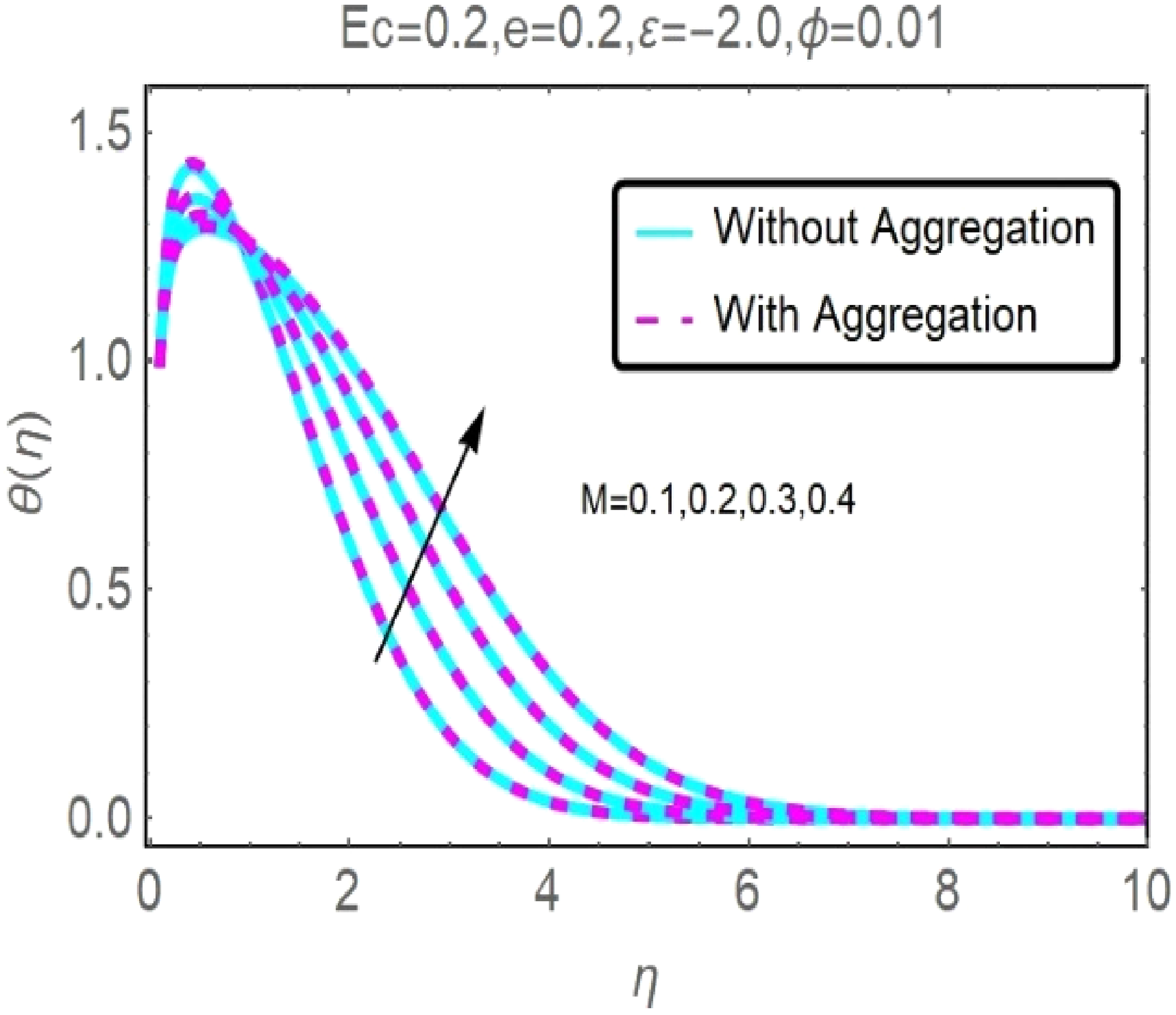
The influence of magnetic parameter M is displayed in Figures 4 and 5 for the velocity and temperature profiles. As the value of the magnetic parameter is increased, there is a corresponding drop in the velocity profile, but there is an increase in the temperature profile. According to Figure 4, the flow of liquid decreases when the magnetic field M is increased. When magnetic fields are introduced into a flow system, a Lorentz force is produced that acts in opposition to the velocity of the flow system; thus, the velocity of the flow system decreases as the magnetic parameters are increased

Velocity profile
Temperature profile
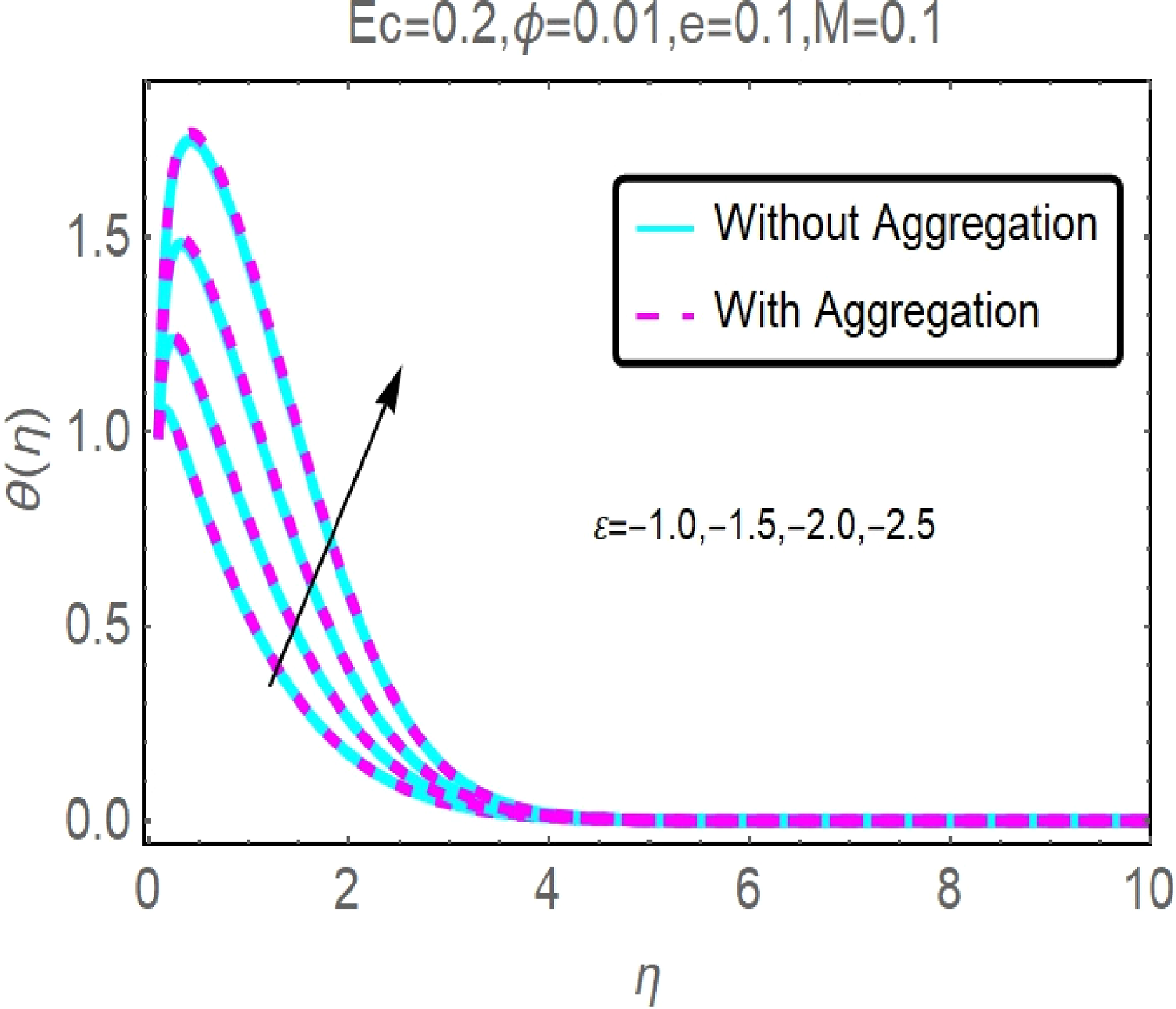
Figures 6 and 7 illustrate the effect that the velocity ratio parameter

Velocity profile
Temperature profile
A look at impact of needle thickness parameter e on velocity and temperature profile is shown in Figures 8 and 9. As the values of e increases, velocity profile decreases and temperature profile increases. As can be seen in Figure 8, the velocity distributions have a downward trend when thicker needles are considered. This decrease is affected when the thickness of the momentum boundary layer at the needle surface goes up more. As the thickness of the needle increases, so does the thickness of the thermal boundary layer. This makes it possible for heat to move from the needle wall into the fluid around it (see Figure 9). Figure 9 shows that an increase in the thickness of the thermal boundary layer has a big effect on the dispersion of temperatures throughout the flow.

Velocity profile

Temperature profile
The significance of Eckert's number

Temperature profile
Figures 11 and 12 show how the volume percentage of nanoparticles and their velocity ratio influence the amount of friction experienced by the skin and the Nusselt number. The addition of nanoparticles into the base fluid would result in an increase in the force of drag. This would be caused by interactions between suspended particles in the flow. As a result, there will be a decrease in the coefficient of friction on the wall. When the model is evaluated without considering aggregation, the skin friction coefficient is much higher. Because of the narrow surface of the needle and the thin wall of the titania-aggregated nanofluid, there is a tiny area for suspended particles to collide, which results in a reduced skin coefficient of friction. The rate of heat transmission quickens with the incorporation of nanoparticles into the system. The higher the temperature, the more intense the intermolecular forces become, which may help explain this phenomenon. In addition to this, the temperatures must be very high in order to disrupt the bonds that hold the nanoparticle molecules together. Figure 12 illustrates that an increase in the rate of heat transfer takes place when more nanoparticles are placed in the flow. In addition, the rate of heat transmission is greater for needles with thinner walls as well as titania nanoparticles with thinner walls. Heat may be physically transported more readily through a thin wall than through a thick wall. Because the thickness of the thermal boundary layer is reduced, the model without aggregation has a greater heat transfer rate than a model with a lower density. This is because the face of the wall that is exposed to the fluid is reduced, which in turn reduces the face of the wall that is exposed to the fluid.

Skin friction of

Nusselt number of
Figures 13 and 14 show how the needle thickness e and the velocity ratio parameter
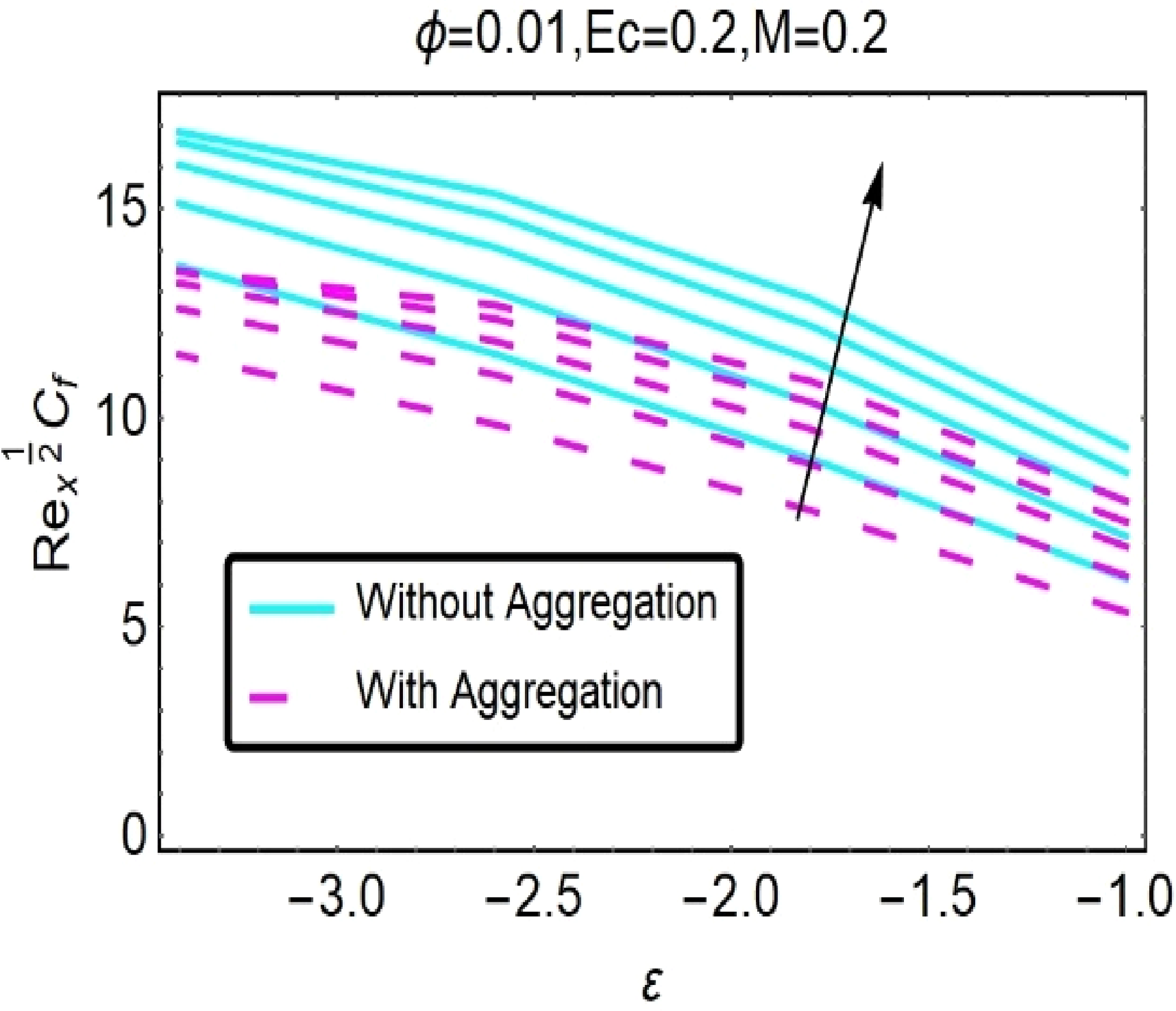
Skin friction of e against
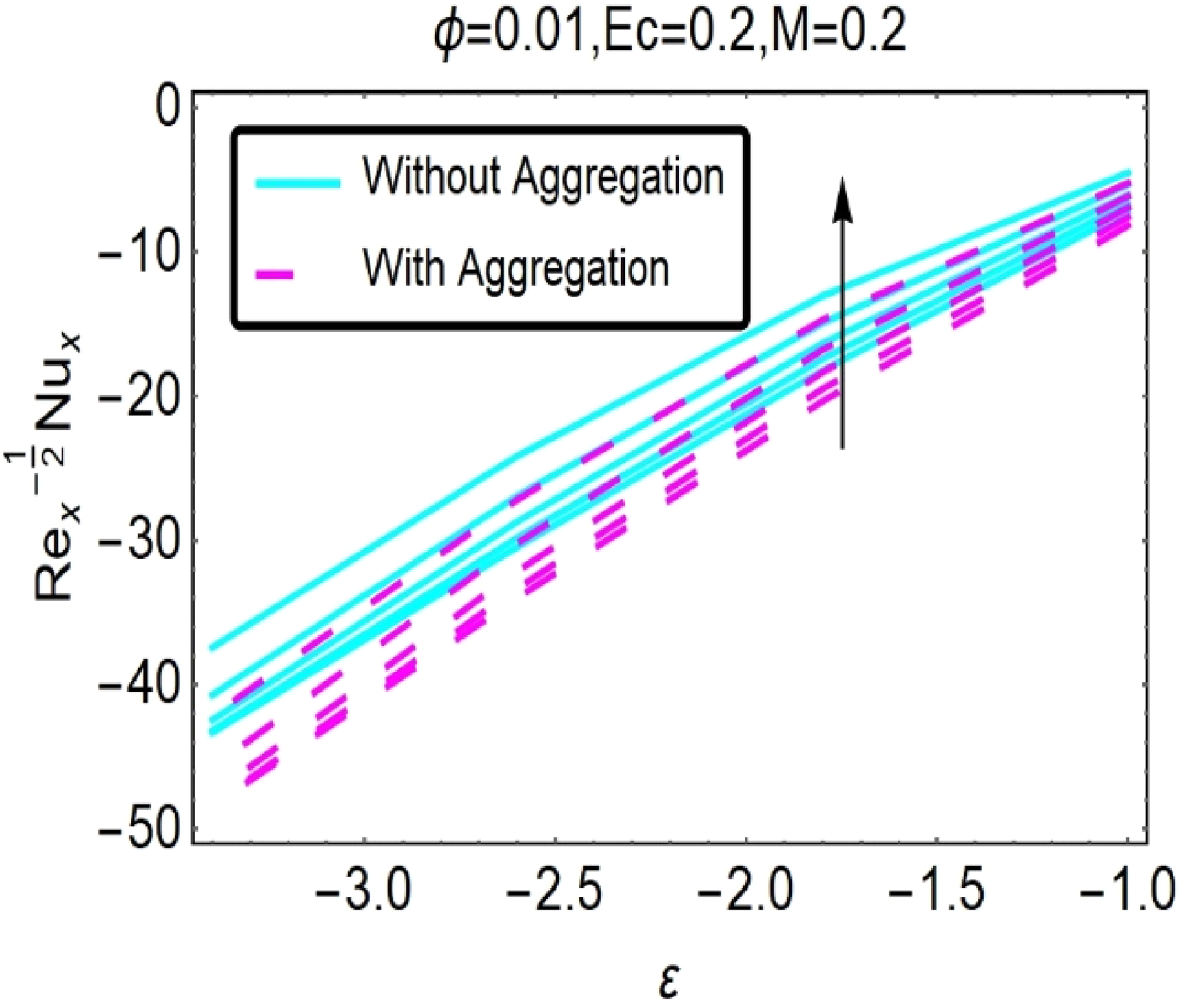
Nusselt number of e against
Figures 15 and 16 show the variations in the skin friction coefficient and the heat transfer coefficient that occur for various values of the parameter

Skin friction of M against

Nusselt number of M against
The influence of
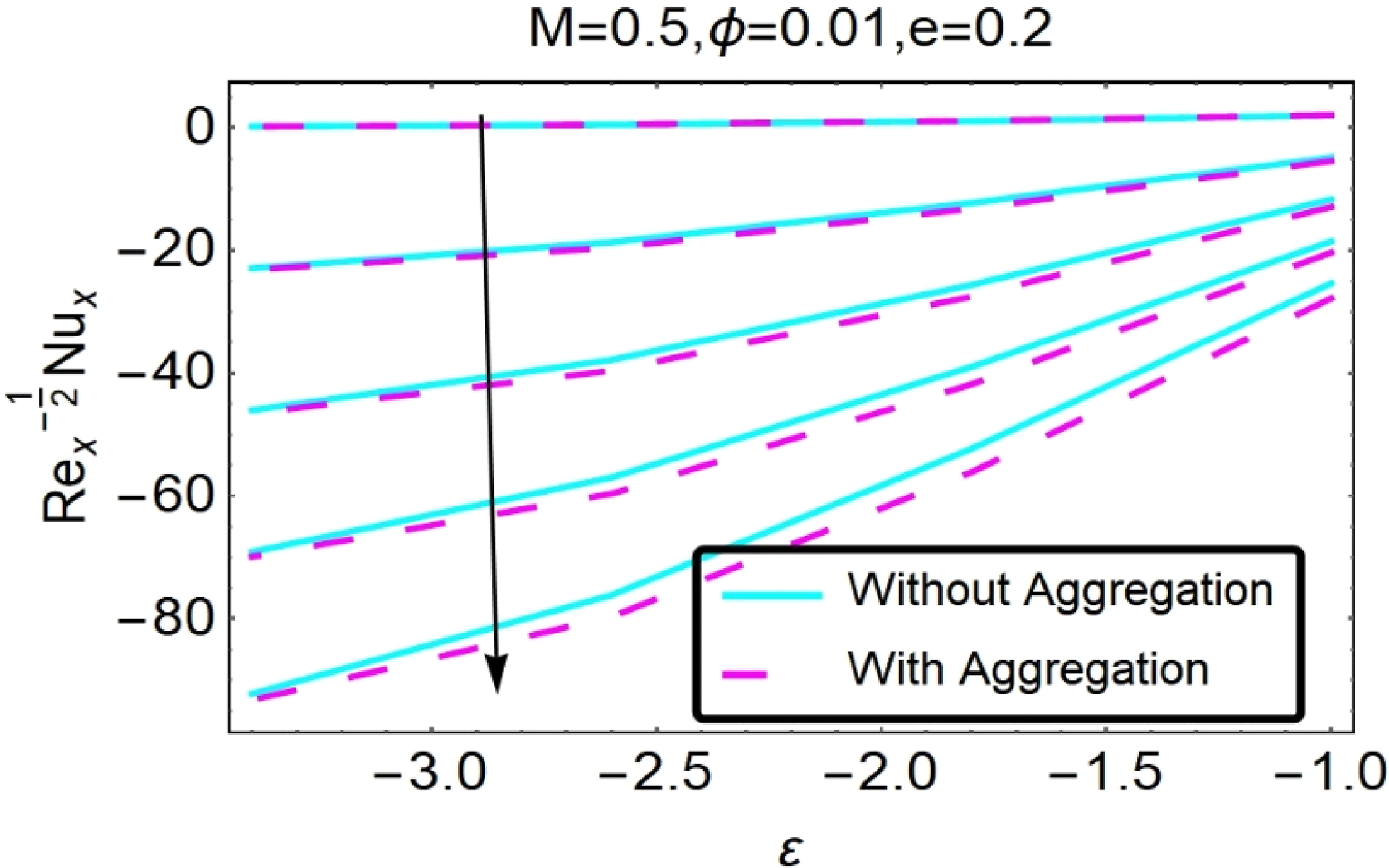
Nusselt number of
Conclusion
Using nanoparticles that contain
Titania nanoparticles and thin needle walls have been shown to increase the drag forces between the needle surface and fluid particles in a nanofluid made of ethylene glycol. This phenomenon is suitable for certain applications requiring substantial frictional forces because it has the effect of slowing down the moving surface. The current model has a high rate of heat transfer, which results in a surface that cools down very quickly. This is an additional benefit of the model. Possessing this quality is necessary to carry out the necessary cooling activities.
Footnotes
Author contributions
All authors contributed equally to this manuscript.
Data availability
Data will be available on demand from Z.M.
Declaration of conflicting interests
The author(s) declared no potential conflicts of interest with respect to the research, authorship, and/or publication of this article.
Funding
The author(s) received no financial support for the research, authorship, and/or publication of this article.

Author biographies
Bilal Ali a PhD student in School of Mathematics and Statistics, Central South University Changsha, 410083, China. His research focus on applied Mathematics, neural network, computational fluid mechanics.
Sidra Jubair a PhD student in School of Mathematical Sciences, Dalian University of Science & Technology, Dalian, China and working as lecturer mathematics at Department of Mathematics and Statistics, Women University Swabi, KPK, Pakistan. Her area of research is applied mathematics.
Dowlath Fathima is currently working as an assistant professor in College of Science and Theoretical Studies, Department of Basic Sciences at Saudi Electronic University, Saudi Arabia. She received a PhD from B S Abdur Rahman University in 2014. Her research interests span both Computer Science and Mathematics. Much of her work has been on Operations Research and Inventory control, mainly through the application of statistics and functional analysis, fractional calculus. Few of other works involves Differential equation, Mathematical modelling and its application. To her credit, she has many published articles in journals and conferences.
Afroza Akhter is pursuing her PhD in VIT Bhopal-India since 2021 in Mathematics using applications. She has received her Master's (MSc) in Mathematics from University of Kashmir. She is author/coauthor of many papers published both in national and international journals. She has also presented many papers in some international conferences.
Khadija Rafique a PhD student at department of mathematics and Statistics, Hazara University Mansehra, Pakistan. Her area of research is applied mathematics, difference equation, fluid mechanics.
Zafar Mahmood is currently working lecturer mathematics. He received a PhD degree from Hazara University Mansehra, Pakistan. His research works involves Differential equation, Mathematical modelling and its application, computational fluid mechanics. To his credit, he has many published articles in journals.