



Abstract
The resource utilization of building waste in urban sustainable environment governance is significant, in view of the status of construction waste recycling; this article built a reverse logistics planning model in urban building waste from the perspective of a closed supply chain by means of a hybrid nonlinear programming model. Combining the simulated annealing algorithm with memory function and the genetic algorithm with global convergence performance, a new genetic simulated annealing algorithm is presented to optimize the model. The empirical study was then made for the system to verify the feasibility of the model. The proposed new planning method and its detailed steps can provide a meaningful reference value for resource utilization of building waste in urban sustainable environment governance.
Introduction
With the rapid growth of the economy and the continuous expansion of the construction scale, building waste has become an urgent problem to be solved in environmental management and urban management. In 2017, the cumulative output of building waste in China exceeded 29 billion tons, increasing by 19.04% compared with 24 billion tons in 2016 (China Statistical Yearbook—2017). The massive accumulation of building waste has seriously affected people's lives, which has aroused the widespread concern of scholars. The research on building waste in China began in the 1980s. In the 1990s, the concept of construction waste recycling was recognized by the government, experts, and scholars several years later. Firstly, this article analyzed the research status of construction waste recycling in urban sustainable environment governance at home and abroad, starting from the transportation network in construction waste recycling to construct a reverse logistics network of building waste in urban sustainable environmental governance, forming a closed supply chain utilization model. The intelligent model combining genetic algorithms and a simulated annealing algorithm was selected, and the concrete case is simulated and analyzed to verify the feasibility of the model. It has reference significance for improving the efficiency of construction waste recycling in urban sustainable environment governance.
Literature review
There are many references studying the resource utilization problems of building waste in urban sustainable environment governance, which are classified and analyzed as follows.
(1) Regarding the policy and economic research on the resource utilization of building waste in urban sustainable environment governance, Esin et al. provided suggestions regarding the prevention/reduction of waste generated due to modifications done for various purposes in residences in Turkey. 1 Couto et al. discussed strategies and actions that should be implemented in Portugal to improve waste construction management by impelling the deconstruction process. 2 Ortiz et al. compared three different situations of current waste management from a case study in Catalonia (Spain). 3 Osmani evaluated the driving factors and changing pressure of minimization of building waste in Britain, and discussed the source evaluation of building waste. 4 Ling et al. investigated the barriers that are faced in implementing waste management and the extent to which waste management practices are adopted. 5 Waste minimization strategies and the relative importance of benefits of material waste recognition were examined using a survey of construction companies operating in Chongqing city China; The results showed that a remarkable proportion of respondent companies have specific policies for minimizing building waste. 6 Tam et al. used four private construction projects as cases to prove that the use of prefabricated projects can effectively reduce building waste in Hong Kong. 7 Gao et al. looked at the development status of China's construction waste recycling industry from the perspective of the industrial chain, and thought that its development was mainly controlled by market logic and government regulation. 8 Hassan et al. analyzed causes of waste generated in malaysian housing construction sites. 9 Zhang et al., 10 taking building materials as a starting point, proved that the recycling of building waste is a key factor for the synchronous development of China's economic environment. Xu et al. discussed the macro-policy and micro-individual factors affecting the classification of municipal wastes in China. 11 Li focused on the advanced experience of garbage disposal in Tokyo, New York, London, and other cities, and also summarized the shortcomings in the garbage disposal process in developed countries. 12 Schamne et al. analyzed the potential application of the precepts of solid waste reverse logistics to the civil construction sector in curitiba. 13 Zhu studied the principle of domestic garbage classification and treatment under the mode of environmental co-governance. 14 Al-Ghouti incorporated both municipal solid waste bottom ash (MSW-BA) and municipal solid waste fly ash (MSW-FA); and discusses their physicochemical characterizations, leaching mechanisms, and pre-treatment methods. 15 Santhana provides a state of the art review of the current technologies existing for the recovery of precious metals from industrial waste streams to analyze the sustainability. 16 These documents focus on the policy and economic planning of building waste utilization in urban sustainable environment governance, and generally do not involve optimization methods and models, “closed supply chain,” “reverse logistics,” and so on.
(2) Regarding the research on the planning model and method of building waste decision-making in urban sustainable environment governance, Kia et al. introduced the current situation of construction and demolition waste treatment system in Tehran and identified the potential problems about the environment, human beings, and economy by the fuzzy analytic hierarchy process model. 17 Liu et al. used the entropy weight method and fuzzy comprehensive evaluation method to construct the risk-sharing model of building waste treatment projects under PPP mode. 18 Zhang et al., 19 based on analyzing the respective costs and benefits of the government and residents under different strategies, built an evolutionary game model of residents’ garbage classification behavior and government charging behavior with the help of evolutionary game theory. Cui et al. applied the GK model of the Environmental Kuznets Curve (EKC) and analyzed the EKC curve of municipal solid waste and economic growth by panel data from 1997 to 2005. 20 Huang used the inventory method and scenario method to calculate the carbon emission inventory and future carbon emission reduction potential of Hubei Province, considered that the reduction of fossil energy consumption in high energy-consuming industries and the low-carbon treatment of garbage are the key points of carbon emission reduction in the future. 21 Naftal et al. analyzed the generation, storage, collection, and transportation of construction domestic wastes in a medium-sized city in Kenya, Jixi City. 22 Although these documents were related to the optimization methods and models of construction waste recycling in urban sustainable environment governance, the emphasis is not on intelligent optimization such as simulated annealing algorithm or genetic algorithm, nor on “closed supply chain” and “reverse logistics.”
Through reading a large number of references, it is found that most of the existing research are based on developed countries or regions, and more experts and scholars focused on the research of policies and the economy. Few people studied the recycling of building waste in urban sustainable environment governance from the perspective of intelligent optimization of transportation routes of building waste in urban sustainable environment governance. In this article, the building waste produced in some construction stages is studied, and a reverse logistics network of building waste is constructed by establishing a nonlinear stochastic programming model. The simulated annealing algorithm with memory function and genetic algorithms with global convergence performance are introduced to optimize the model and get the optimal solution. A new genetic simulated annealing algorithm is constructed to optimize the reverse logistics network of building waste in urban sustainable environment governance. Because the article combines “closed supply chain,” “building waste,” “reverse logistics,” “simulated annealing algorithm,” and “genetic algorithm,” it has certain innovation.
Methods
For building waste generated by the projects under construction, there is a reasonable range of construction waste classification process is planned at the project site to judge whether the building waste can be reused. If possible, transport the reusable building waste to the construction waste recycling treatment center (referred to as the treatment center) for product regeneration; otherwise, sends the abandoned building waste to the disposal site for proper treatment. To reduce possible congestion, transport the recycled products manufactured by the reuse of building waste to various suppliers, and transport the building waste generated in the manufacturing process of the recycled products to the consumptive yard for treatment. The supplier will transport the building materials to the required projects under construction, as shown in Figure 1.
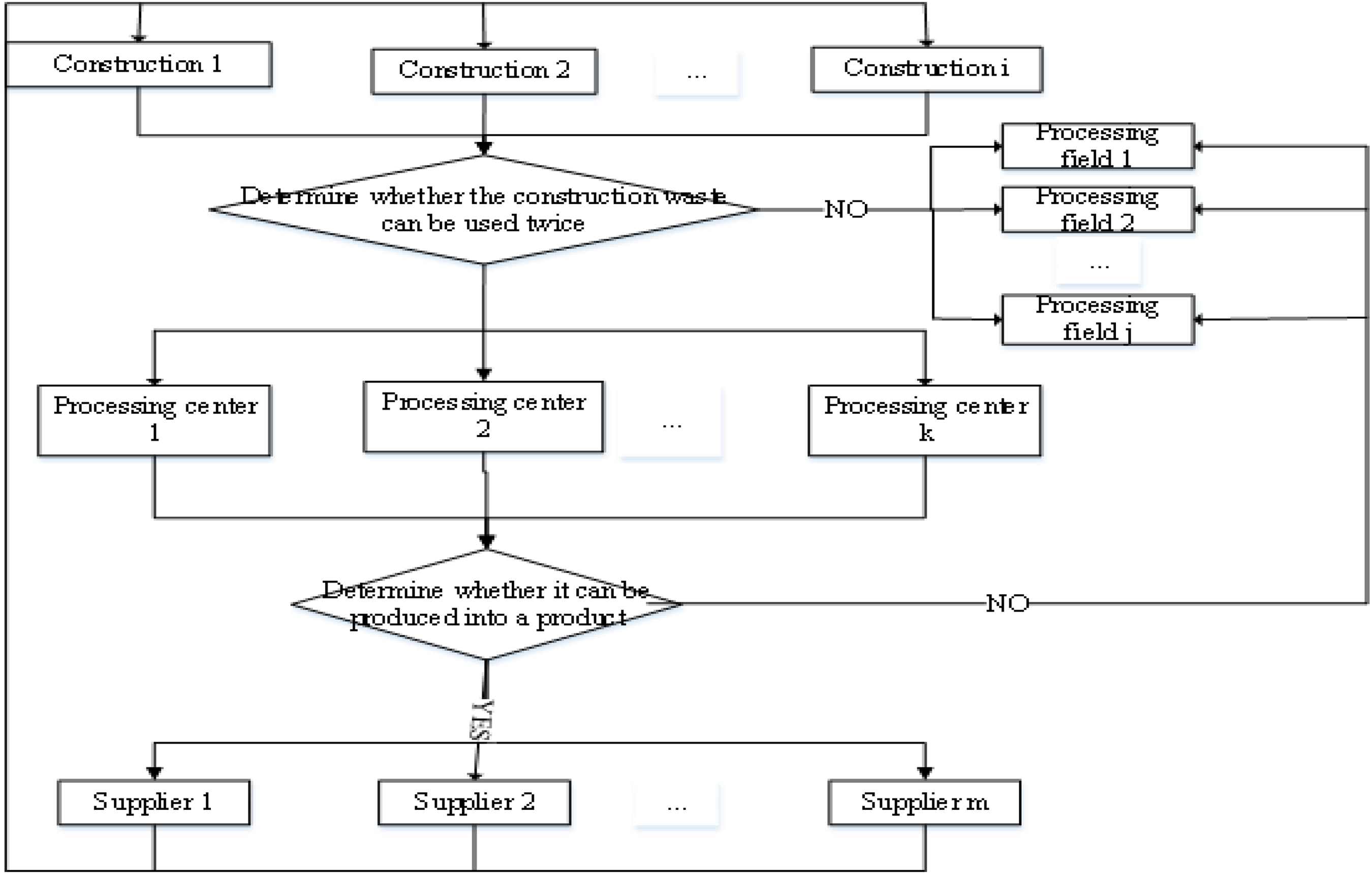
The reverse logistics network of building waste.
The optimal object is the optimal costs, which include transportation costs, operation costs, and inventory costs.


The main factors table affecting the transportation costs of building waste.

By equation (2)
Operating costs include the operating costs of the concession yard and the operating costs of the processing center.

Wi—consume yard operating costs;
W j—processing center operating costs;
wj—the cost of operating the unit in the field;
wk—processing center operating costs;
h1—consumer field operational status; and
h2—processing center operating status.
(3) Calculating inventory costs
The inventory cost in the planning model includes the inventory cost incurred during the construction waste collection process at the project under construction, the inventory cost of the recycled product in the processing center, and the inventory cost of the building waste generated during the production process of the recycled product. Therefore,
vi(t)—unit inventory cost of building waste in the project under construction;
vk1(t)—processing unit inventory cost of recycled products;
vk2(t)—processing of unit cost of building waste generated in the production process of recycled products at the center;
n—the number of construction waste dumping days at the project under construction;
l1—days of storage of recycled products at the processing center;
l2—the number of days of construction waste inventory generated during the processing of recycled products in the center;
a—the amount of building waste produced each day at the project site under construction;
b—the daily production of recycled products at the processing center; and
e—dispose of the amount of building waste disposed at the center every day due to the production of recycled products.
From equation (1), the objective function C results are as follows:
The constraint conditions of the above planning model mainly include six parts:
The amount of building waste that is being transported to the consignment yard under construction projects is not greater than the maximum disposal capacity of the concession yard. The amount of building waste delivered to the processing center site for the project under construction is not greater than the maximum demand of the processing center. The amount of recycled products shipped from the processing center to the supplier is not greater than the maximum demand of the supplier. The amount of building waste transported by the processing center to the consignment yard is not greater than the demand of the processing center. The number of recycled products delivered by the supplier to the project under construction is not greater than the maximum demand of the project. All building waste on the project under construction is cleared.
The article adopts a combination of simulated annealing algorithm and genetic algorithm to obtain the optimal solution of the presented planning model.



The Simulated Annealing (SA) algorithm originated in the early 1980s, it is a stochastic optimization algorithm and is mainly used to solve a large range of combinatorial optimization problems. The algorithm mainly deals with solving optimization problems. 23 For the similarity of the physical system annealing, the Metropolis algorithm was used. 24 At the same time, the process of reasonably controlling the temperature decrease achieves the goal of simulated annealing, so as to achieve the goal of solving the global optimization problem. SA algorithm has been used by a large number of experts and scholars to solve the continuous optimization problem in recent years.25–29
SA algorithm has good local search ability, and good solution effect when seeking a globally optimal solution. However, in many cases of solving the global optimal solution, it can not be well used, so that the application of SA algorithm is affected by a certain degree of limitations.
Genetic algorithms have better global search ability and can obtain the global optimal solution very well. However, once the data increase, the global search ability of the genetic algorithm will be limited.
From the above analysis, we can see that the combination of the genetic algorithm and SA algorithm can make up for the shortcomings of both sides to maximize the global search ability of the genetic algorithm and the local search ability of the SA algorithm.
The specific operation flow is shown as follows.
From the above-presented planning model, the analysis is carried out to obtain the optimal solution. The optimal node for the transportation cost in the logistics network is obtained, and the roadmap where the lowest cost is located is determined. Through this model, it can help top management decision-makers to select the optimal node of the construction waste reverse logistics network and determine the final transportation path, and achieve the lowest cost target.
Case analyses
A company has six projects under construction in city A. There are six construction waste disposal sites in the city, four construction waste recycling centers, and five related building materials companies. In total, there are 40 projects in the city in 2017. The output of building waste is about 60 million tons. The transportation of building waste is handled by a professional company. The headquarters of the company shall be responsible for the national call for the recycling of building waste, and decided to use the six projects in City A as a pilot project for the recycling of building waste. Assuming all projects under construction are carried out at the same time, the number of different transport vehicles is selected, resulting in different transport limit values. The lowest cost is obtained from the model, and the number of vehicles at the lowest cost. Specific related known data are shown in Table 2.
The project-specific information.

The building waste of the projects under construction can be calculated. Some calculated results are shown in Tables 3–4.
Construction waste production and transportation volume of projects under construction.

Unit: tons
Selection of transport vehicles.

The specific results are shown as follows. Different limit values are generated for different number of transport vehicles, and the lowest costs are shown in Table 5.
The minimum costs for different limit values.

The different cost changes under different limit values are shown in Figure 2.

The lowest cost comparison curve diagram for different limit values.
According to the comparison of the above graphical curve changes, the lowest cost is the number of vehicles is 10, the cost of the project transport limit is 70 tons, and the specific value is 375,424.72 yuan. The specific results are shown in Figure 3.

Maximum-valued iteration curve of genetic-simulated annealing algorithm.
The continuous decrease of the curve indicates that the algorithm is effective. When the curve is flat at the end, the algorithm converges. That is, when the number of transport vehicles is limited to 10, the transport limit is 70 tons. The optimized iterative curve in the model is shown in the figure. The following matrix shows the result of the last iteration.
The distribution instruction matrix for construction projects to transit sites (limit value = 70)

The delivery instruction matrix for a construction project to the processing center (limit value = 70)

The delivery instruction matrix of the processing center to the accommodation site (limit value = 70)

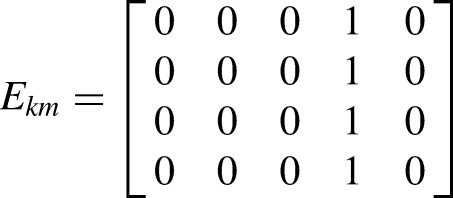

The supplier's delivery indication matrix to the project under construction (limit value = 70)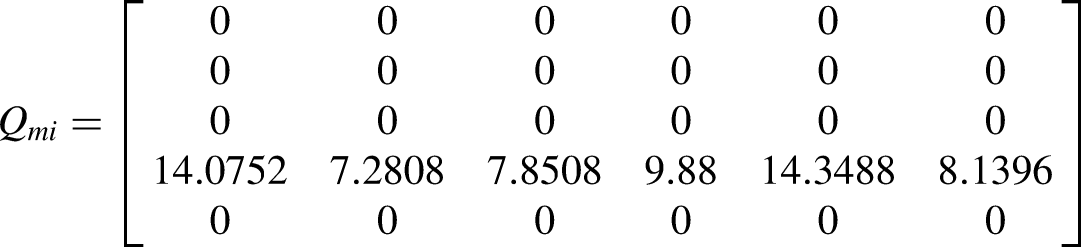
Results and discussion
Where, 14.0752 represents that during the last shipment, supplier 4 delivered 14.0752 tons of recycled products to Project 1 under construction. This article made system analysis and calculation of reverse logistics networks about building construction waste by combining specific cases. Specifically, the company's projects under construction in City A are analyzed, and all known data is input into programs to get the cost required for the inverse logistics of the construction waste in all vehicles and the specific choice objects and the number of delivery during the last delivery. Comparing all cost results, the number of vehicles under the minimum cost is the best solution.
The presented planning design model and detailed steps in this article can provide some empirical references for the further reduction of the cost of construction waste resources.
The research objects of this article are housing construction projects, and the construction waste generated in the construction project is only a single type of construction waste, excluding the construction waste generated by the demolition project. In real life, the direction of building waste is not just housing construction projects, natural disasters such as highways, bridges, earthquakes, mudslides, and other natural disasters will also produce a large number of construction waste. In the inverse logistics network of construction waste, the interests of all parties involved did not conduct a detailed analysis in this article. The cost factors in this paper mainly consider transportation costs, operating costs, and inventory costs. There is no specific analysis of cost items of each cost. In future work, it is necessary to explore the problems not involved in this article, and provide certain reference significance for the development of the resource utilization of subsequent construction waste.
Conclusions
The number choice of transportation vehicles has a greater impact on the optimal cost of construction waste. Moreover, the change in the impact cost is not a linear increase or a linear distribution. In this article, 20 changes from 5 to 100 vehicles were selected. The genetic SA program is used to calculate the lowest cost in each case. Comparing the 20 results, it can be concluded that the cost of the construction waste network is the lowest when there are 10 vehicles for transportation. The accelerating development of construction waste is imminent, and only when the cost is reduced. It is not always a long-term solution to blindly use government coercive measures without adjusting from the market point of view. From the perspective of a closed supply chain, this article improves the utilization efficiency of building waste in urban sustainable environment governance.
The accelerating development of building waste is imminent, and only when the cost is reduced will the enterprise have the willingness to voluntarily implement the relevant provisions of resource recycling of building waste. It is not always a long-term solution to blindly use government coercive measures without adjusting from the market point of view. From the perspective of a closed supply chain, this article improves the efficiency of the utilization of building waste resources in urban sustainable environment governance, presented a planning model and detailed steps can provide some empirical references for the further reduction of the cost of building waste.
Footnotes
Data availability statement
Not applicable.
Authors’ contribution
The work was done by BAI Xiaoping and HU Meiyan and supervised by BAI Xiaoping. All authors conceived the idea. HU Meiyan helped analyze the data and drafted the manuscript. All authors read and approved the final manuscript.
Declaration of conflicting interests
The author(s) declared no potential conflicts of interest with respect to the research, authorship, and/or publication of this article.
Funding
This work was supported in part by the National Natural Science Foundation of China (NSFC, grant number 51774228).
Author biographies
Bai Xiaoping is currently an associate professor of Xi’an University of Architecture & Technology, Xi’an, PRC. His research interests include system engineering, etc. His articles have appeared in Frontiers of Structural and Civil Engineering (SCIE), Kybernetes (SCIE), Discrete Dynamics in Nature and Society (SCIE), Scientific World Journal (SCIE), Applied Mathematics & Information Sciences (SCIE), Journal of Asian Architecture and Building Engineering (AHCI/SCIE), Sage Open (SSCI), Tsinghua Science and Technology, etc.
Hu Meiyan is Master in Xi’an University of Architecture & Technology, Xi’an, PRC. Her research interests include system engineering, etc.