



Abstract
Applications
The nanofluids and their upgraded version (ternary and tetra nanofluids) have a very rich thermal mechanism and convinced engineers and industrialist because of their dominant characteristics. These broadly use in chemical, applied thermal, mechanical engineering, and biotechnology. Particularly, heat transfer over a cylindrical surface is important in automobiles and heavy machinery.
Purpose and Methodology
Keeping in front the heat transfer applications, a model for Tetra-Composite Nanofluid [(Al2O3-CuO-TiO2-Ag)/water]tetra is developed over a vertically oriented cylinder in this study. The existing traditional model was modified with innovative effects of nonlinear thermal radiations, magnetic field, absorber surface of the cylinder, and effective thermophysical characteristics of tetra nanofluid. Then, a new heat transfer model was achieved successfully after performing some mathematical operations.
Major Findings
The mathematical analysis was performed via RK and determined the results graphically. The study gives suitable parametric ranges for high thermal efficiency and fluid movement. Applied magnetics forces were observed excellent to control the fluid motion, whereas curvature and buoyancy forces favor the motion. Thermal mechanism in Tetra nanofluid is dominant over ternary nanoliquid and nonlinear thermal radiations increased the heat transfer rate.
Introduction
Investigation of heat transfer over a cylindrical surface under certain physical scenarios such as slip effects, permeable surface, and convective heat condition is important and frequently occur in hydraulic devices and automobiles. Thus, researchers turned to inspect such flows under different physical conditions. Therefore, viscose flow and heat transfer model over a porous nonuniform radial cylinder were studied in Ali et al. 1 and graphically discussed the skin friction coefficient, velocity, temperature, and Nusselt number for different values of parameters. In the continuation, Chamkha et al. 2 performed research work on convective boundary layer flow over a vertical cylinder and analyzed Sherwood number and Nusselt number. Mixed convection flow over a rotating cylinder of Maxwell nanofluid with the presence of Joule heating and heat source/sink impact was analyzed by Saeed et al. 3 Later on, Nadeem et al. 4 investigated the hybrid nanofluid flow toward stagnation point over a moving cylinder and discussed Xue and Yamada-Ota models for hybrid nanofluid. The 3D Newtonian nanofluid flow over a stretching cylinder was examined in Basir et al. 5 with the impact of thermal slips and hydrodynamic. Basically, this study was conducted about the manufacturing process of nano-biopolymer. Another interesting study considering the impact of heat flux, natural convection flow of copper/water (Cu-H2O) nanofluid was examined by Sadia et al. 6 and discussed the surface heat transfer and shear stress against different parametric ranges.
The properties of magnetohydrodynamics (MHD) viscous flow in the presence of joule heating and viscous dissipation were interpreted in Ullah et al. 7 The main purpose of this study was to analyzed the behavior of entropy optimization rate via graphical representation. Further, thermal characteristics of non-Newtonian MHD Casson nanofluid over a stretching cylinder with the effects of melting heat transfer were examined by Kumar et al. 8 who observed that when the value of melting parameter increases the velocity also increases but the temperature is decreasing function. Ibrahim et al. 9 discussed the behavior of activation energy of Williamson nanofluid on mixed convective heat and mass transfer over a stretching cylinder with absorption or generation of heat inside the fluid. It is noticed that with the increase in porous parameter the temperature and concentration also increases, whereas the dimensionless velocity decreases across a circular cylinder was numerically investigated by Waqar et al. 10 Imad et al. 11 explored the MHD Carreau nanofluid flow with joule heating and convective boundary conditions. Transient heat transfer in hybrid nanofluid flow toward stagnation point with the impact of thermal radiation, Joule dissipation, and heat generation over a convectively heated and moving cylinder was reported by Kumbhakar et al. 12 The self-propelled motion of gyrotactic swimming microorganisms of MHD nanoliquid flow over a convectively heating cylinder analyzed by Arif et al. 13 A mixed convective MHD nanofluid and heat transfer with chemical reaction and magnetic field over a cylinder oriented in inclined with the angle of inclination with horizontal introduced by Mondal et al. 14 Tanmoy et al. 15 described the boundary layer MHD, Casson and Williamson nanofluid flow with the influence of linear order chemical reaction in the presence of thermal radiations and graphically interpreted the comparison of mass and heat transform accomplishment between Casson and Williamson nanofluids. 16
Recently, Mackolil et al. 17 conducted thermal analysis under heat source effects and Williamson nanoliquid taken as working fluid. The dominant effects of imposed thermal radiations were investigated and concluded that this phenomenon is better to improve heat transfer in nanoliquids. Another, study relevant to heat transfer under surface convection and Buongiorno model was inspected by Gireesha et al. 18 The model was handled through RK19,20 technique and then examined the results via graphs for different parametric ranges. Further, thermal enhancement is observed due to the induction of dissipation effects, Biot and thermal radiation effects. In near past, Gul et al., 21 Li et al., 22 and Murtaza et al. 23 organized comprehensive investigations of nanofluids heat transfer under multiple physical aspects. They analyzed that nanofluids are reliable for heat transfer applications and thus increases their demand in industries. Further, the most relevant studies for hybrid nanoliquids with multiple nanoparticles concentration factor and physical aspects were performed by different researchers (see Refs.24–27) and concluded that these fluids are very effective for thermal enhancement. Some more relevant and effective studies of nanofluids for a variety of nanoparticles and host liquids under convective heat condition, combined convection and their influence on temperature enhancement are reported in Refs.28–31
From the open literature, it is inspected that the studies for stagnation point flow (SPF) have been reported by taking common or simple nanofluids which lost the novelty of enhanced heat transfer for advanced tetra nanofluids. It is fact that the analysis of nanofluids with hybrid nanoparticles 32 attained huge attention from the researchers because of their promising heat transfer applications and limited studies reported in this regard. These motivational aspects turned our attention toward this significant research gap. Therefore, the current model developed which deals with the detailed analysis of enhanced heat transfer for advanced tetra nanofluid over a vertically oriented cylinder which is important for loaders, excavators, and hydraulics. The model is modified with innovative effects of nonlinear thermal radiations, magnetic field, combined convection, and enhanced thermophysical characteristics of tetra nanofluid. All these new insights contribute potentially in the study of tetra nanofluids for its heat transfer characteristics.
Tetra nanofluid model formulation
Statement of the model
The study of nontransient heat transfer in SPF of tetra nanofluid is considered. The cylinder is taken as working geometry and it is assumed that the cylinder surface is absorber, thermal radiations and magnetic field applied through the surface. Further, the flow is time independent (steady), and the flow is streamed lines. The dispersion of nanoparticles in base solvent is uniform and no-slip exits between them. The ternary and tetra nanofluids toward a stagnation point over a vertically permeable cylinder are configured in Figure 1 so that, x-axis is taken along with vertical direction. The impacts of nonlinear thermal radiations and magnetic fields were considered to upgrade the study. The temperature


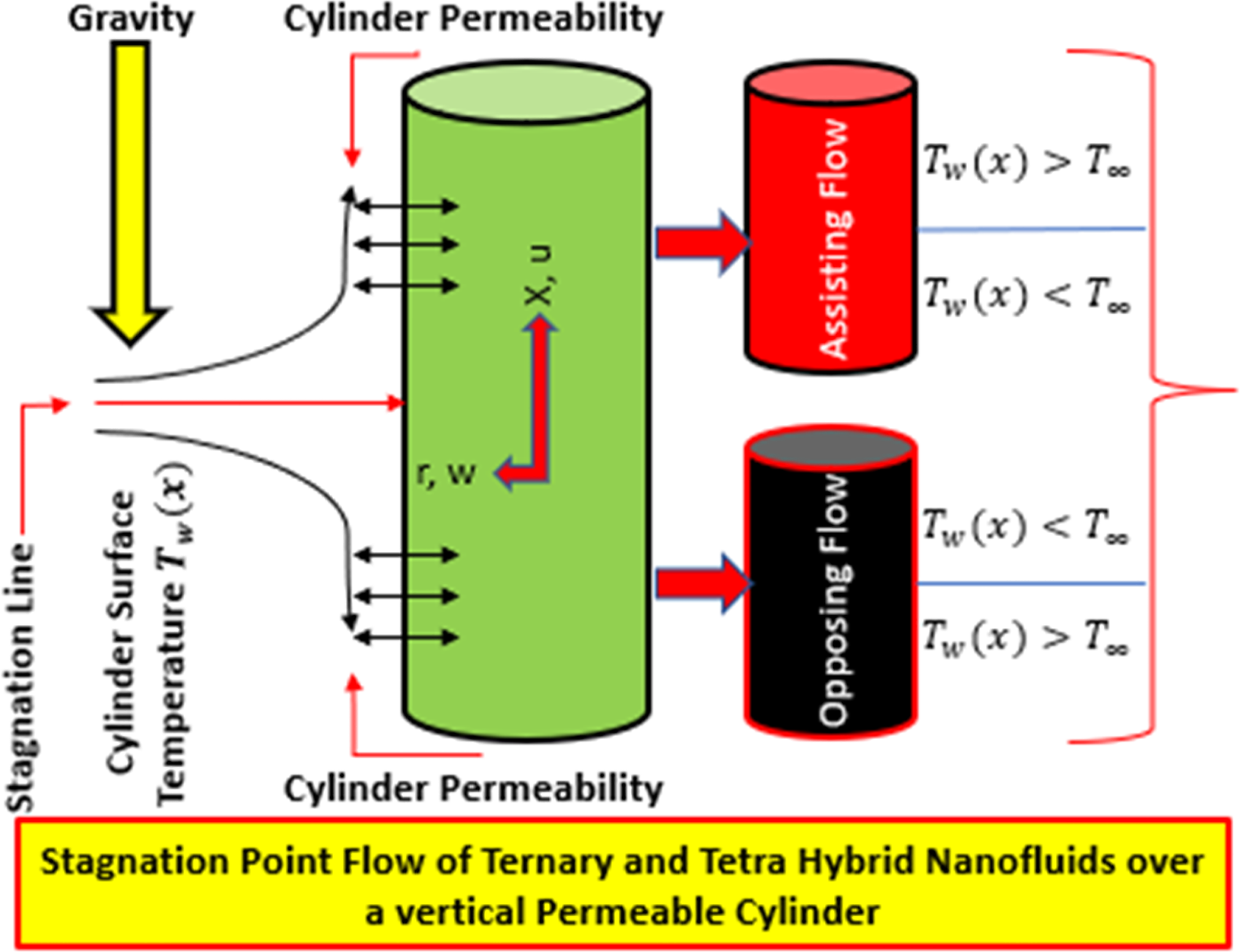
Ternary and tetra hybrid nanofluids flow along vertically placed cylinder.
The similarity expressions developed in the following way:


Tetra hybrid nanofluid models
Thermophysical characteristics of tetra nanofluid that was used to modify the model are given in Table 1. These are updated dynamic viscosity, thermal and electrical conductivities, and heat capacity comprising the tetra composites properties.
Advanced tetra hybrid models.

Tetra hybrid heat transfer model
Using the above models as well as similarity transformations in equations (2) and (3), we obtained the following new heat transport model:

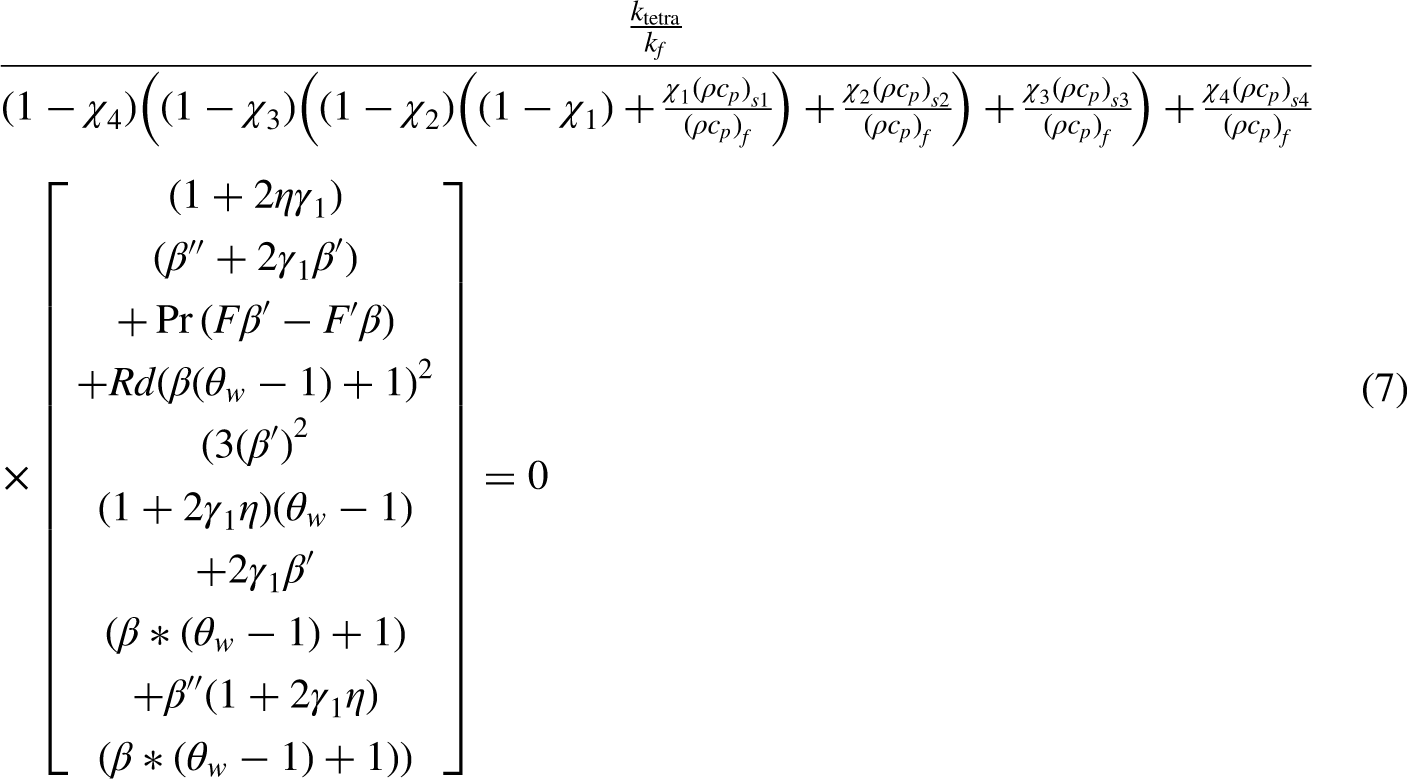
Additionally,

Skin friction and Nusselt number
For the specific model, the engineering quantities (skin friction coefficient and Nusselt number) are formulated in the following expressions:
After mathematical calculation and insertion of the models, the following expressions were achieved:

Mathematical investigation
First, the tetra nanofluid model containing nonlinearities in the velocity and energy models equations is reduced into a joint system of differential equations comprising only the first-order nonlinear ordinary differential equations. For this step, feasible transformation for adopted. The acquired model is then treated through numerical means and implemented RK technique (see Refs. 33–35) successfully. The complete detailed implementation process of RK method36,37 is described in the below flow diagram (see Figure 2).

Flowchart of implementation of mathematical techniques.
Discussion of the results
The velocity profile
This subsection organized to investigate the physical behavior of the velocity for [(Al2O3-CuO-TiO2-Ag)/water] against multiple values. The fluid motion against the curvature number (

The velocity
Figure 3(b) deals with the actual variations in the velocity under combined convection effects (
As the velocity of fluid affect by various factors including the impact of physical parameters, fluid characteristics, and appropriate geometry. Therefore, the velocity simulation under varying effects of magnetic field is illustrated in Figure 3(c). As, under stronger magnetic field, the resistive Lorentz forces increase which has dissipative property, so it resists the fluid particles motion over the cylinder surface. Similarly, almost negligible fluid motion is noticed in Figure 3(d) for both cases.
The temperature profile
Figure 4(a) to (d) furnished to analyze the comparative heat transmission in ternary and tera nanofluids influenced by the parameters

The temperature
The mixed convection is a combined version of natural and forced convection act together for thermal transmission. Therefore, Figure 5(a) to (b) portrayed to inspect the temperature of ternary as well as tetra nanofluids under these important physical parameters. It is seen that by magnifying

The temperature
Skin friction and Nusselt number
The skin friction and Nusselt number trends for ternary [(Al2O3-CuO-TiO2)/water] and tetra [(Al2O3-CuO-TiO2-Ag)/water] nanofluids are portrayed in Figure 6(a) to (d) against the parameters
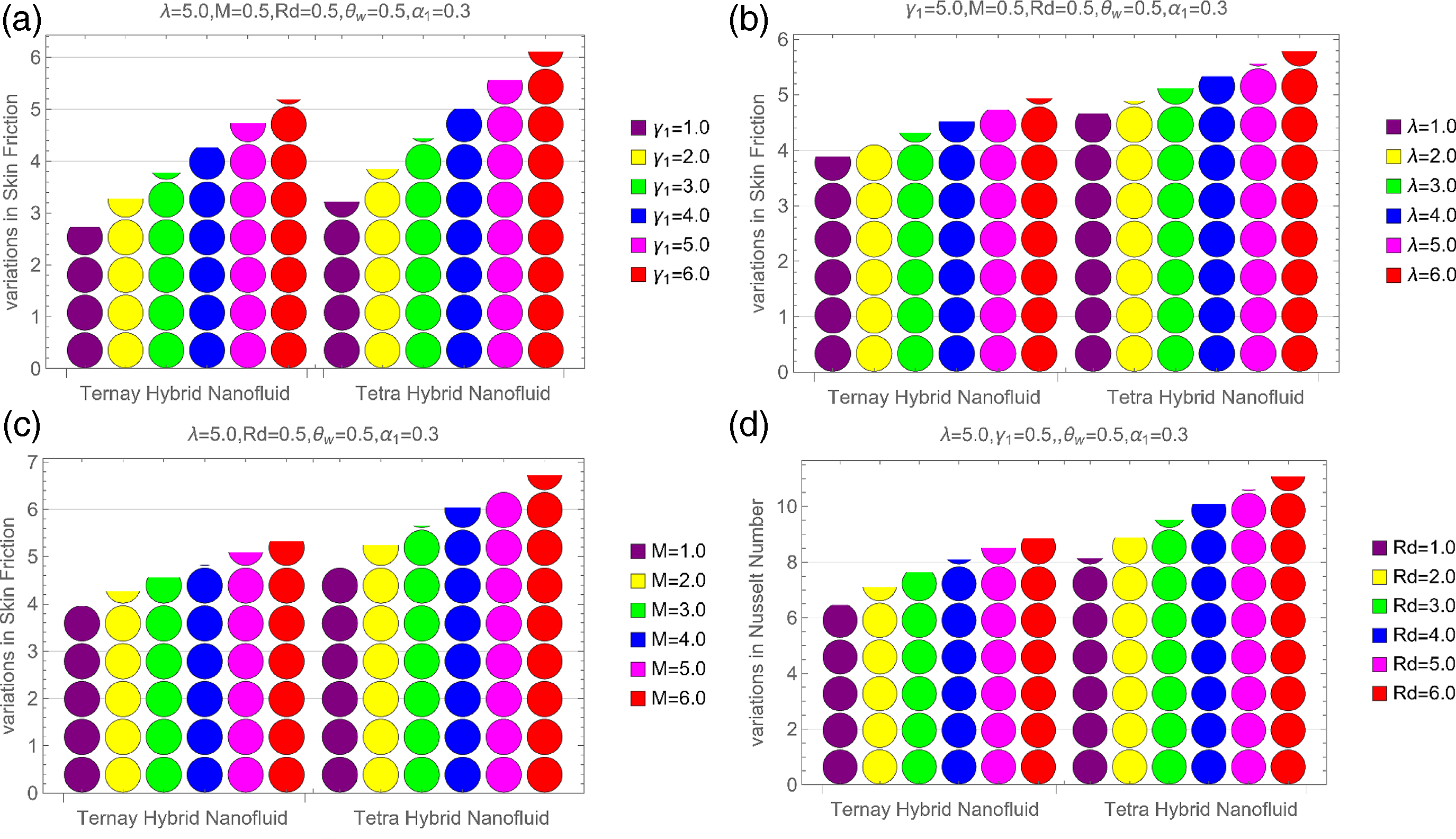
Skin friction comparison for ternary and tetra hybrid nanofluids for various values of parameters (a)
Solid particles concentration and thermophysical attributes
A comparative analysis of thermal and electrical conductivities for Nano to tetra hybrid nanofluids is provided in Figures 7 and 8, respectively. It is concluded that for tetra hybrid nanofluid the value of thermal as well as electrical conductivities is higher than that of ternary nanofluid which is important for thermal enhancement in advanced tetra nanofluid.

Comparative analysis of thermal conductivity for nano to tetra hybrid nanofluids.

Comparative analysis of electrical conductivity for nano to tetra hybrid nanofluids.
As we know that tetra hybrid nanofluids are homogeneous mixture of particles of four different metals. So, the dynamic viscosity of tetra nanofluid [(Al2O3-CuO-TiO2-Ag)/water] is greater as compared to other nanofluids which are configured in Figure 9. Similar behavior of density is interpreted in Figure 10, which shows that the density is growing up rapidly for tetra hybrid nanofluid.

Comparative analysis of dynamic viscosity for nano to tetra hybrid nanofluids.
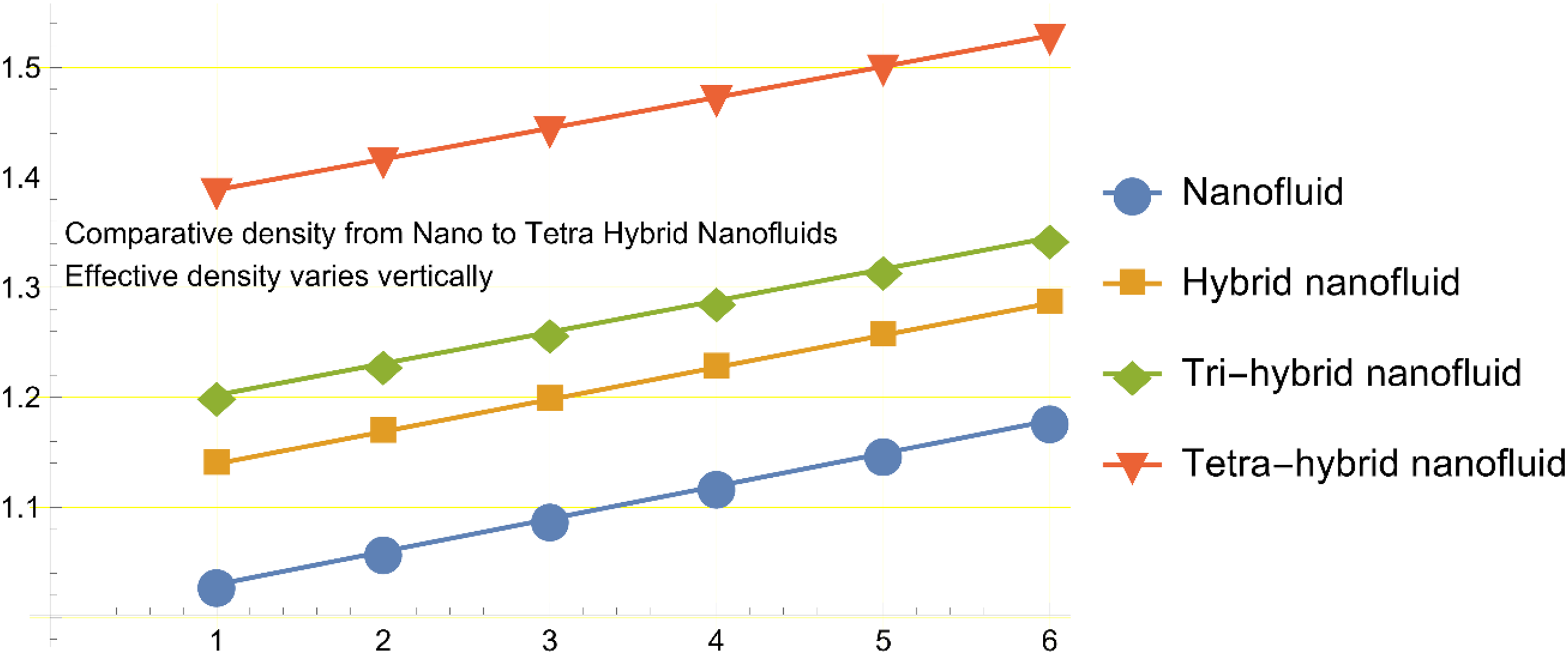
Comparative analysis of density for nano to tetra hybrid nanofluids.
Figure 11 portrays the changes in the thermal expansion coefficient for different nanofluid generations. The results highlight that the thermal expansion coefficient improved by enhancing the volumetric fraction and % in the model.

Comparative analysis of thermal expansion for nano to tetra hybrid nanofluids.
Study and code validation
In this subsection, the results of the model are compared with reported data of Dinarvand et al. 38 These results under certain assumptions are organized in Figure 12 and examined that the current study and code are valid and in better agreement with existing scientific data. To meet the physical nanofluid model of Dinarvand et al., 38 the current model is restricted to the absence of nonlinear thermal radiations and fraction factor as elucidated in Figure 12 and found a good agreement between them.
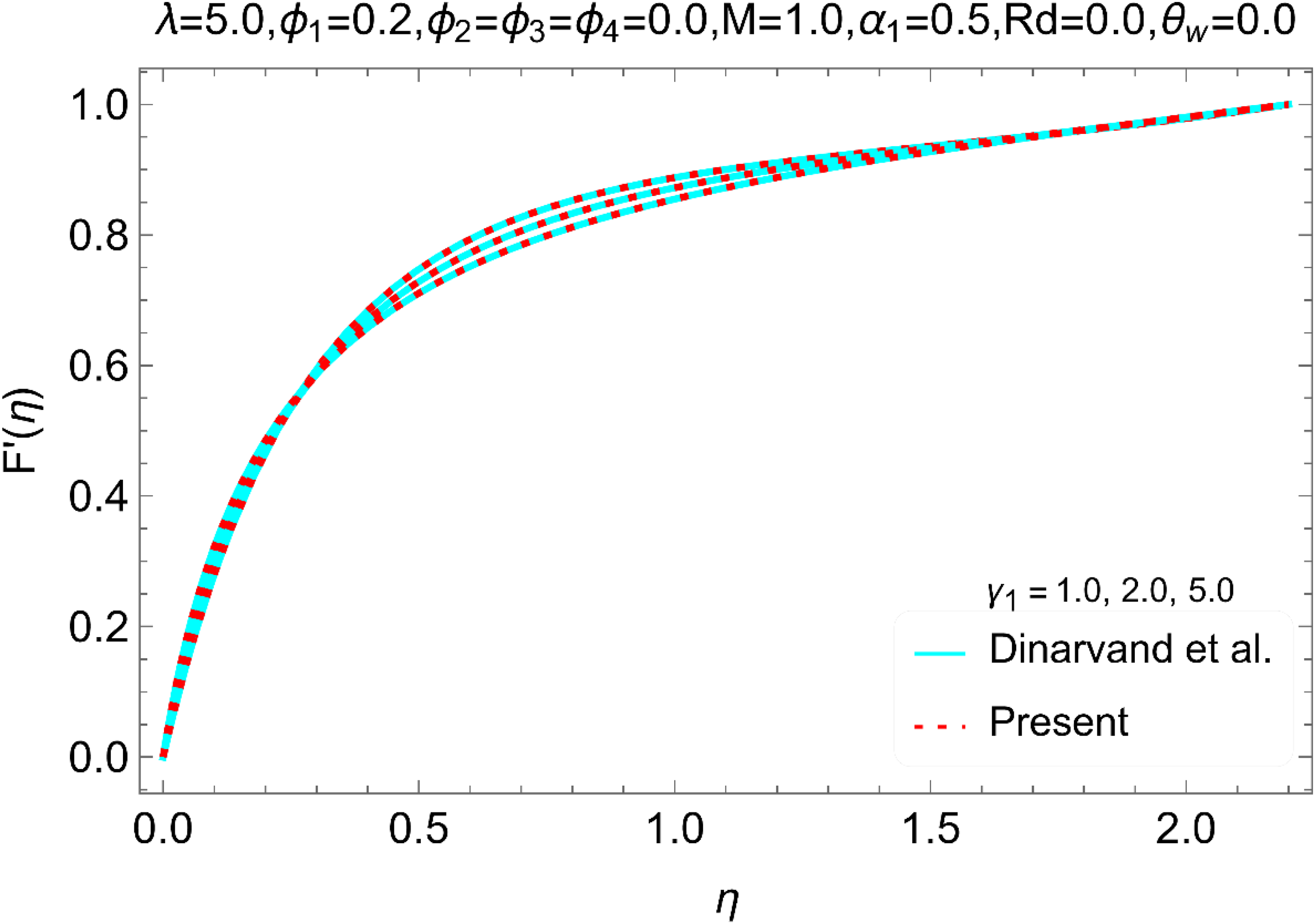
Study and code validity with already existing data in the literature.
Conclusions
The study deals with enhanced heat transfer in a new class of tetra nanofluid which is not examined in the literature so far. The heat transfer analysis over a cylinder is very important from hydraulic machinery manufacturing. Therefore, a model is obtained for SPF over a cylinder by adding innovative effects of nonlinear thermal radiations, absorber surface of cylinder, magnetic field, and new tetra thermophysical characteristics. The proper model formulation was done, analyzed through numerical technique, and concluded with the following outcomes:
By enlarging the cylinder curvature The nonlinear thermal radiations Tetra composite thermal conductivity Tetra nanofluid can be suggested as better for industrial applications where a huge amount of heat transfer is required.
Footnotes
Acknowledgements
The authors extend their appreciation to the Deanship of Scientific Research at King Khalid University for funding this work through research groups program under grant number RGP. 1/342/43.
Declaration of conflicting interests
The author(s) declared no potential conflicts of interest with respect to the research, authorship, and/or publication of this article.
Funding
The author(s) received no financial support for the research, authorship, and/or publication of this article.
