



Abstract
Synthetic cilia-regulated transports through micro and nanofluidic devices guarantee an efficient delivery of drugs and other biological substances. Entropy analysis of cilia stimulated transport of thermally radiated hybrid nanofluid through an electroosmotic pump is conducted in this study. Joint effects of applied Lorentz force and Ohmic heating on the intended stream are also studied. Metachronal arrangements of cilia field coating channel inner side, are liable to generate current in the fluid. After using the lubrication and the Debye-Huckel estimations, numerical solutions of the envisioned problem are obtained. For pressure rise per metachronal wavelength, the pressure gradient is numerically integrated. The analysis reveals that high electric potential results in reducing the heat transfer effects in the flow system. The enhancement of flow is noticed near the channel surface for higher electroosmotic parameters. The irreversibility in the channel decreases when the Helmholtz-Smoluchowski velocity is applied in the opposite direction of the flow and thus produces the fluid friction irreversibility.
Keywords
Introduction
Motile cilia facilitated transports perform important part in the movement of cell itself or vicinity material past over cell body. Cilia comprise of tiny hair like attachments covering the cell that beat periodically and get the path in biofluids. They operate like oars, smashing backward and forward strikes in coordination, and create a synchronized arrangement of traveling waves along the surface namely metachronal waves. Therefore, an intensification in fluid stream is associated with greater force applied on fluid during effective stroke. Motile cilia have diverse uses in biology and bioengineering disciplines. For instance, in respiratory tract cilia are liable for cleaning the airways by removing mucus and other particles (see Knowles and Boucher 1 ), in gastrointestinal system cilia drive food to its end (see Kindblom et al. 2 ), in female reproductive tract they transport egg through oviducts (see Wijayagunawardane and Miyamoto 3 and Ashraf et al. 4 ), and ductuli efferentes mingle sperms in male testis to stop them from assembling and clogging the tubules Lehti and Sironen. 5 Lately, synthetic cilia-based microscale electromechanical appliances such as sensors, lab-on-a-chip, and actuators have earned attentions of researchers. These microfluidic devices prompted by electric and magnetic field have extensive uses in hemodialysis, drug delivery and microfluidic mixing, etc. Recognizing the significance of ciliary flows in biology and bioengineering disciplines, some findings have been reported for the attentive readers (Farooq, 6 Saleem and Munawar, 7 and Farooq et al. 8 ).
An electroosmotic flow evolves in retort of application of electric field on fluid. This motion is related with electric double layer (keeping the net charge density) grows at solid-liquid interface. Models of some modern electronic apparatus in microfluidic and nanofluidic applications are electroosmotic fluid pumps, liquid drug delivery, microelectronic chip cooling, DNA testing, lab-on-a-chip devices and microfabricated fluid devices, etc. In this respect, the innovative attempt was presented by Burgreen and Nakache. 9 Yang and Li 10 considered electric double layer effect on pressure pumping flow through a rectangular microchannel and established that the electric double layer at the liquid-solid interface has tendency to deviate the flow features. Chaube et al. 11 examined the influence of electric double layer on micropolar fluid and highlighted the usage of this model in lab-on-chip appliances and micro peristaltic pumps. A mathematical study dealing with slip effect in the electroosmotic pumping of Prandtl fluid in ciliated channel was conducted by Munawar. 12 A sufficient decrease in the fluid velocity in the center of channel was shown by the author as the Helmholtz–Smoluchowski velocity and the electro-osmosis effects increase. Jayavel et al. 13 studied the electroosmotic peristaltic motion of nanoparticles mixed with hyperbolic fluid and concluded that skin friction at the channel is an escalating function of electroosmotic parameter. Xu et al. 14 scrutinized the electroosmosis powered flow across a microchannel with its upper stretching wall. Some recent investigations with the idea of combined electric and magnetic fields in peristaltic flows through microchannels are mentioned in Tripathi et al., 15 Akram et al. 16 .
Mono nanofluids are composed by scattering nano-sized solid particles like copper, aluminum, titanium, gold, copper oxide separately in base fluid such as water, blood, ethylene glycol, and oil. The base fluid (having low thermal conductivity) gets advanced heat transfer characteristics with high thermal conductivity when combine with nano-scale bits. To achieve super high thermal conductivity, hybrid nature nanofluids are introduced in various channels and ducts (see Elnaqeeb et al., 17 Shah et al., 18 and Abdelsalam et al. 19 ). According to Song et al., 20 a hybrid nanofluid is a liquid that has been homogeneously mixed with two distinct forms of nanoparticles and supports in increasing the thermo-migration of nanoparticles and thus corresponds to a significant growth in heat exchange. Novel uses of hybrid nanofluids are found in fuel batteries, heat transmission in microelectronics, assortment powered engine, engine cooling, refrigerator, chiller, healing, and pharmaceutical processes and in boiler shaft gas temperature drop, etc. An interesting study toward microfluidics and nanofluidics was contributed by Chakraborty and Panigrahi, 21 remarking impact of electric field intensity on nanofluid flow. Common effect of magnetic field, thermal radiations, and Joule heating on hybrid nanofluid flow in a rotating system between two parallel surfaces was examined by Chamkha et al. 22 Munawar et al. 23 discussed the performance of Ag-MgO/water hybrid nanofluid in an inclined square enclosure under magnetic field effect and showed that adding 2% hybrid nanoparticles in the base fluid results in 18.3% increase in the heat transfer rate. A recent contribution on blood-gold Carreau nanofluid and dusty fluid was presented by Koriko et al. 24 who suggested a continuous increment of buoyancy is to enhance the velocities of both fluids.
In many biological systems under chemical reactions, another interesting trend is decline in free energy. For example, chemical reactions in result of metabolic process in various living beings activates free energy and thus consequence in significant amount of entropy production. Some antientropic activities contain flow of different substances, such as, blood flow, urination, perspiration, muscle contractions and biosynthesis, etc. Due to these imperative uses of thermodynamics in bioengineering, many researcher (Mehmood et al., 25 Munawar et al., 26 and Munawar and Saleem 27 ) have been enticed to this arena of research and considered the entropy phenomenon in several biofluid flows. A well familiar contribution in this area of research is given by Bejan. 28 Moreover, Bejan 29 explored entropy generation in four different heat transfer situations. In biological systems, Saleem and Munawar 30 explored the entropy phenomenon in non-Newtonian fluid flow through a wavy ciliated surface under gravity effects. An inspiring attempt revealing the exergy analysis Cu-water nanofluid in tube was presented by Akbar and Butt. 31 Lately, a bio-magnetic fluid flow with thermodynamic features was analyzed by Munawar and Saleem. 32
In the current work, the main objective is to analyze the entropic aspects in an electroosmotic transport of thermally radiated nano-Carreau fluid lining with carpet of motile cilia. This model delivers a deep insight that synthetic cilia-actuated electroosmotic pumps can be future modern microfluidic devices in industry and physiology to facilitate an efficient supply of drugs and other biological materials. The entropy is supposed to be produced by the combined effects of radiative heat transfer and Ohmic heating in addition to heat transfer and viscous irreversibilities. The whole flow model is formed in wave frame under practical assumptions of lubrication and Debye-Huckel linearization. The pressure-rise expression is numerically obtained by integrating pressure gradient. Numerical solutions of important thermodynamic characteristics are plotted for different influential parameters.
Mathematical modeling
Consider a two-dimensional pumping transport of hybrid nature nanofluid, prepared by mixing copper and copper-oxide nano bites in the base fluid, in a channel with interior walls covered with cilia mat. The base fluid is assumed to be blood and is modeled by Williamson fluid. The flow in the ciliated channel is stimulated by transverse magnetic field and axially applied electric field. Moreover, the coordinated wave (metachronal traveling wave) progressing with uniform velocity c along the wall is presumed to be a key factor for generating current in the fluid. These periodic waves are stimulated by effective and recovery knocks of cilia field. The flow configuration is framed in a Cartesian coordinate system keeping horizontal axis

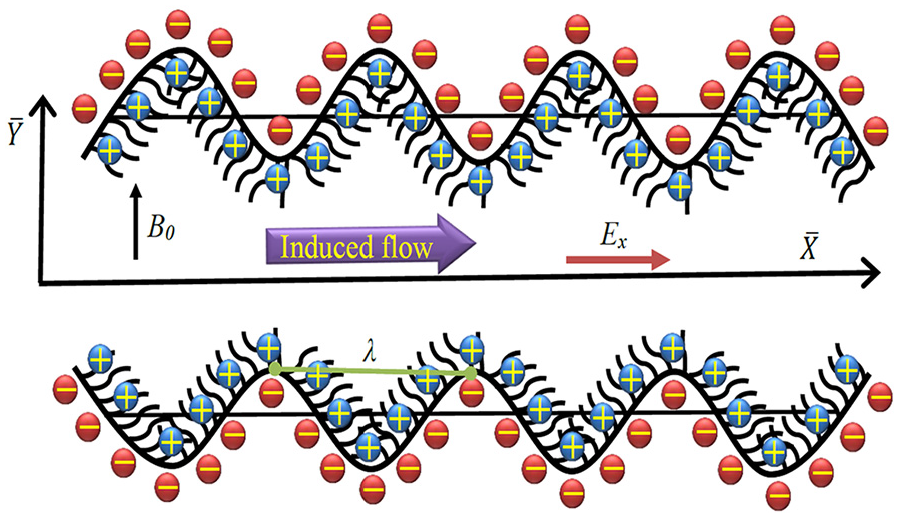
Schematic diagram and the physical configuration.
The headway of cilia follows elliptic shaped wave motion and are horizontally located at

in which a denotes the channel mean height, H the channel’s half width, α the eccentricity of cilia, λ the wavelength, ε the cilia height, t the time, and X0 is the location of the fluid particle.
The velocity components at the channel boundary (Siddiqui et al. 34 ) can be obtained by differentiating equations (1) and (2) with respect to variable t to get:


The governing equations of proposed flow problem in the fixed frame are noted as:


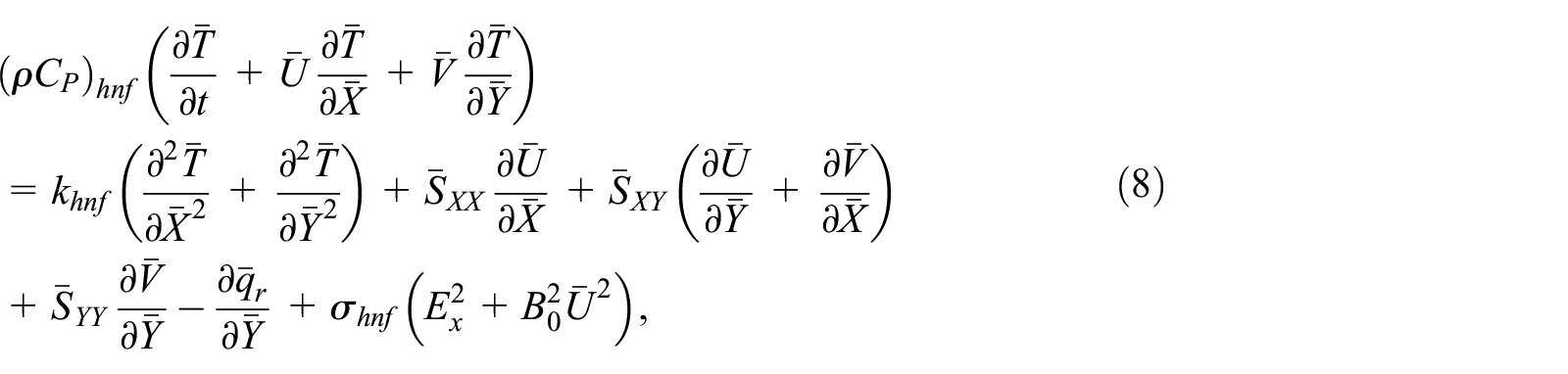
where
The extra stress for the Williamson fluid Gireesha et al. 35 is expressed as:

with

From equation (10), the component of stress tensor SXX, SXY, and SYY
The default volume fraction of solid nanoparticles, assumed in the current study, is 6% of the base fluid (Williamson fluid). The mathematical equations representing the attributes of hybrid nanofluid (Cu-CuO/blood) are listed as (Ghadikolaei et al. 36 ):




where

where m defines the structure of nanoparticles. Particularly, a value of m = 3.7 corresponds to brick shape, m = 4.9 relates to cylindrical shape, and m = 5.7 is used for platelets shape solid particles. For the current analysis, the brick shaped nanoparticles (m = 3.7) are assumed.
Using Type I model for hybrid nanofluids as remarked by Shah et al. 18

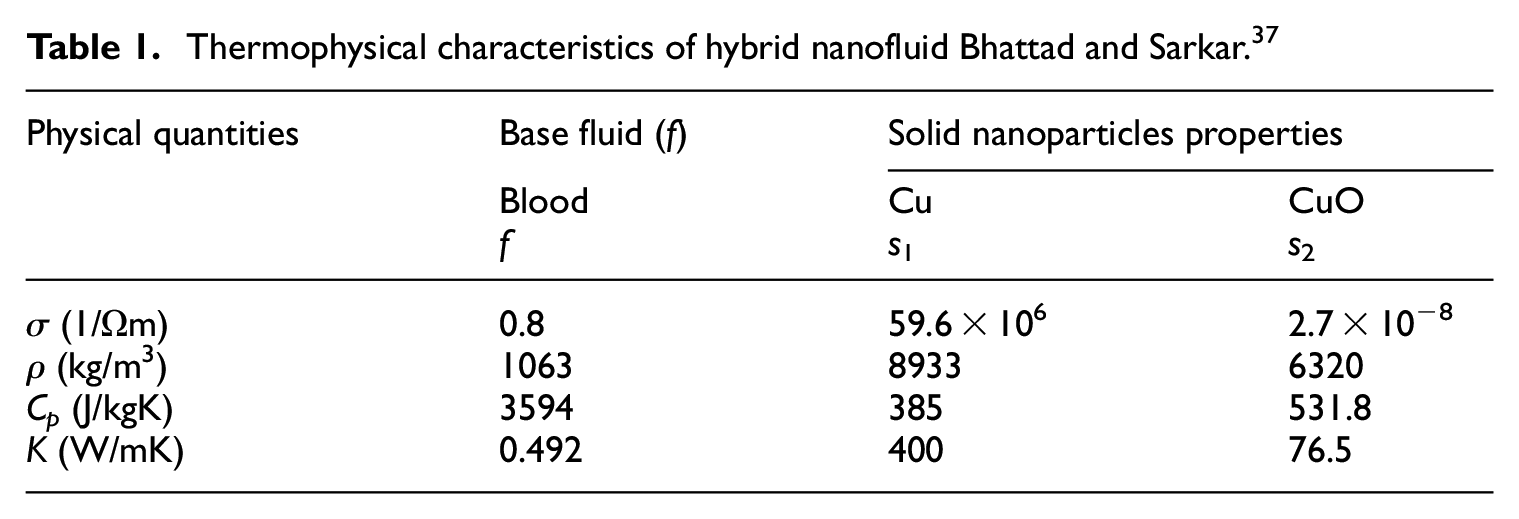
where ρ, μ, (ρCP), (ρβ), σ, and k are the density, viscosity, heat capacity, thermal expansion coefficient, electrical conductivity, and thermal conductivity. The subscripts 1 and 2 correspond to the Cu and CuO nanoparticles, hnf is for hybrid nanofluid mixture, while f is assigned to the base fluid. Table 1 presents the numerical values of these characteristics. Also, ϕ (=ϕ1 + ϕ2) is the total volume fraction of nanoparticles with ϕ1 and ϕ2 represent volume fraction of Copper and Copper Oxide nanoparticles in base fluid.
Thermophysical characteristics of hybrid nanofluid Bhattad and Sarkar. 37
The radiation is assumed as one of the heat transfer methods in fluid flows. The radiative heat flux in the

where σ* and K* are Stefan-Boltzmann constant and absorption coefficient of nanofluid, respectively. The temperature differences in the fluid flow are supposed to be adequately small. Hence, the Taylor’s series of T4 can be expanded about the temperature difference. Neglecting the second and higher order terms, one gets,

The analysis is converted into wave frame by introducing the following transformations:

The electric potential present in ciliated channel is characterized by the Poisson-Boltzmann equation as (see the detail of electroosmotic analysis in Lin and Chen 39 ):

where

in which
By assuming the symmetricity of electrolytes, the net charge density may be computed as:

where kb, Tave, and no are the Boltzmann constant, local absolute temperature, and the average concentration of electrolytes. Assuming the wall zeta potential (≤25 mV) to be appropriately small thus, the Debye-Hückel supposition gives:

Utilizing equations (21) and (23) in equation (20), the potential function for electric double layer is found by the equation:

Also establishing the following non-dimensional terms as:
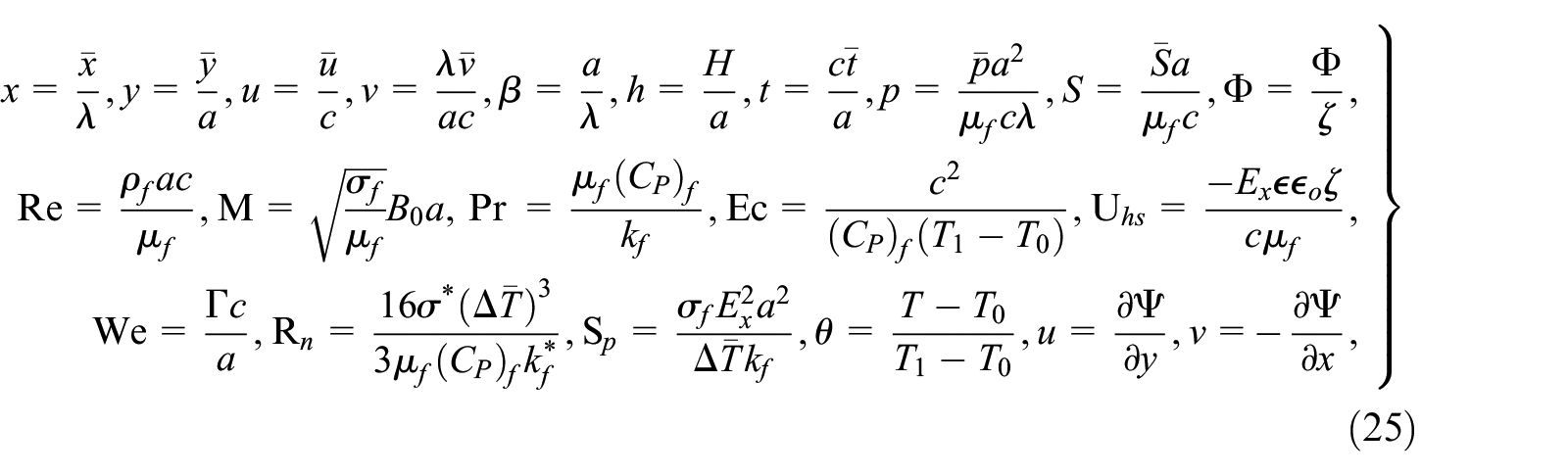
where (u, v) is the dimensionless velocity vector along the coordinates (x, y), β the wave number, p the normalized pressure, Rn the thermal radiation number for base fluid, Uhs the Helmholtz-Smoluchowski velocity, Sp signifying joule heating for the base fluid, θ the dimensionless temperature field, and Re, M, Pr, Ec are the Reynolds, Hartmann, Prandtl, and Eckert numbers, respectively.
Normalizing equations (5)–(8) with the help of equations (19) and (25) and the using the assumption of long wavelength and inertia effect negligible, one gets the following set of equations:


Cross differentiating equations (26) and (27) leads us to the following equation:

with

where




and
The resulting nondimensional boundary conditions are listed as:


Integrating the pressure gradient, one gets the pressure-rise per wavelength given by

The non-dimensional mean flow rates for fixed (Q) and wave (F) frames are interrelated as:

The numerical solution of the coupled fourth order linear differential equations (28)–(30) with boundary data (31)–(32) are obtained using the numerical package “NDSolve” with the shooting method provided by symbolic computational software Mathematica. The current is problem is also solved analytically by perturbation method. The detail of the method is explained by (Munawar and Saleem 27 ) and is suppressed here to avoid repetition. A comparison table is produced for the values of second derivative of stream function Ψ at channel boundary by varying parameter M (See Table 2). The table shows an acceptable match between analytical and numerical results which builds confidence on the solution reported in this document.
Comparison of analytical and numerical methods when Q = 2, α = ε = 0.2, β = x = 0.5, We = 0.01, Uhs = 1 are fixed.

Entropy analysis
In cilia supported transport the primary sources of entropy production are radiated heat transfer, fluid friction, and Joule heating in the nano-Carreau fluid. Consequently, the entropy expression is stated as (Ijaz et al. 40 and Saleem 41 ):

Normalizing equation (35) by assuming lubrication approximations and using equation (25), one gets the expression for total entropy generation number:

where τ = ΔT/T0 represents the temperature difference number (supposed to be τ = 1). The first term in equation (36) represents the radiation irreversibility caused by radiative heat flux and the second term is the fluid friction irreversibility and the third term reveals irreversibility due to Joule heating. The Bejan number is described as (Sohail et al., 42 Farooq et al., 43 and Rashad et al. 44 ):
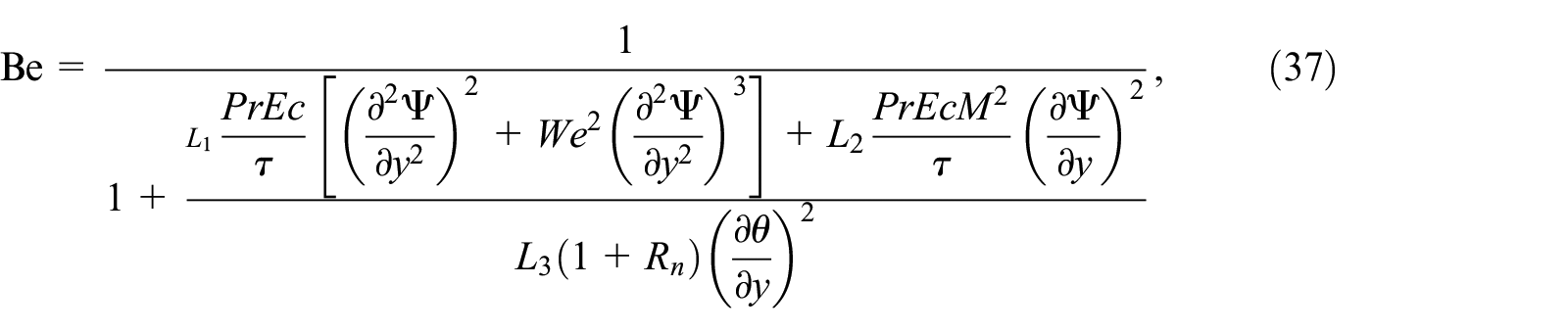
The Bejan number Be fluctuates between 0 and 1 and describes the tradeoff between heat transfer irreversibility and other irreversibilities.
Analysis of results and discussion
In this section, the graphical results for various important flow and heat transfer characteristics are discussed and analyzed to develop understanding about the physical aspects of the flow problem. The rheological aspects of hybrid nature nanofluid are examined by taking the disperse of copper (Cu) and copper oxide (CuO) nanosized bits at the proportion of 50% in base fluid (Williamson fluid). Different graphs of dynamically and thermodynamically important features are plotted against relevant parameters in Figures 2 to 8. Some parameters are kept fixed at their default values, like, downstream variable x considered to be 0.5, the Prandtl number is fixed at 1, the Eckert number at 0.05, the cilia length ε at 0.2, and the nanoparticle concentration ϕ is taken to be 4%.

Pressure gradient for variation (a) in M (b) in K (c) in cilia length and (d) in α when We = 0.01, α = 0.2, β = 0.1, M = 1, Uhs = 2, K = 0.8.
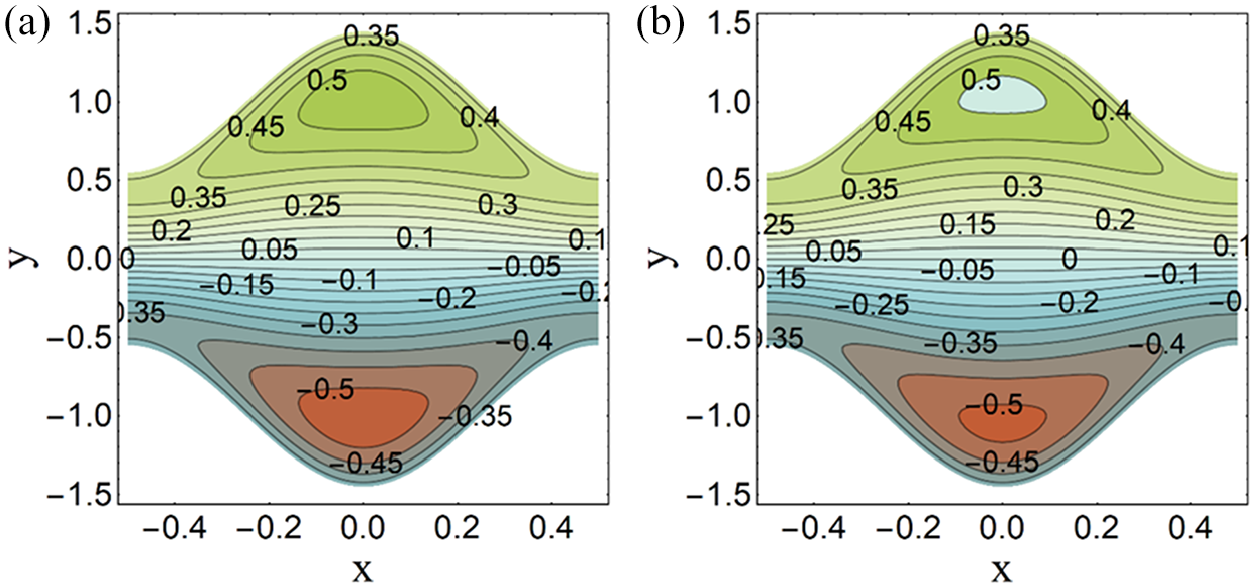
Streamlines for variation in M when We = 0.01, α = 0.2, β = 0.1, K = 0.8, Uhs = 2: (a) M = 1.0 and (b) M = 1.5.

Effect of M on: (a) velocity, (b) temperature, (c) entropy number, and (d) Bejan number at fixed We = 0.01, α = 0.2, β = 0.1, K = 0.8, Uhs = 2, Sp = 1, Rn = 2.
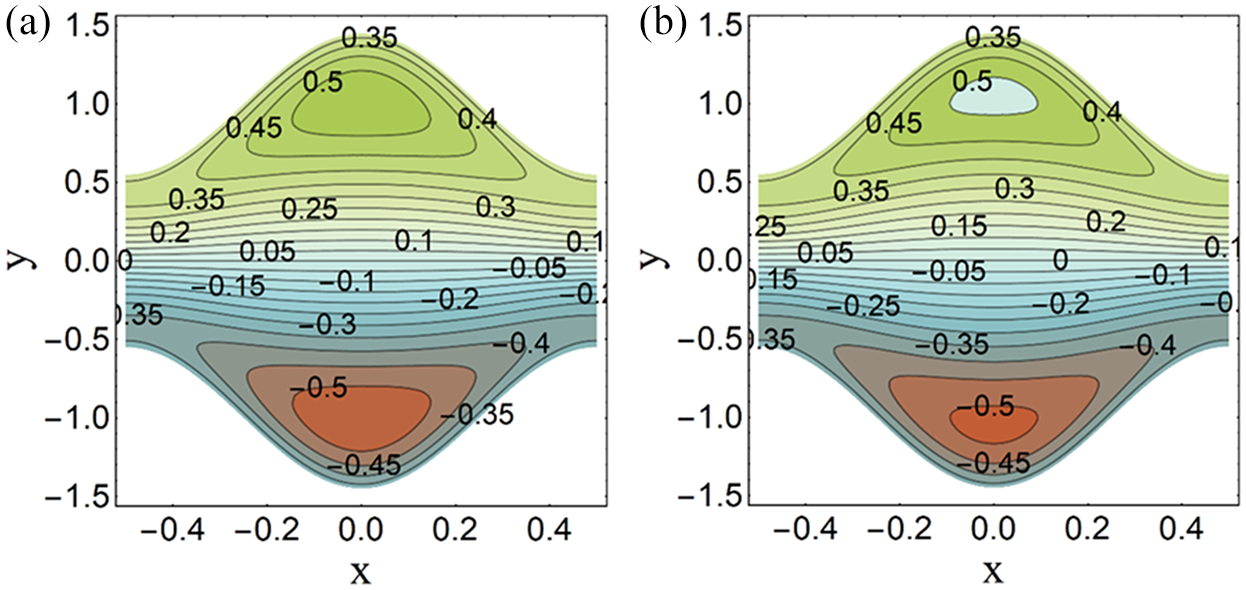
Streamlines for variation in K when We = 0.01, α = 0.2, β = 0.1, M = 1, Uhs = 2: (a) K = 0.0 and (b) K = 2.0.
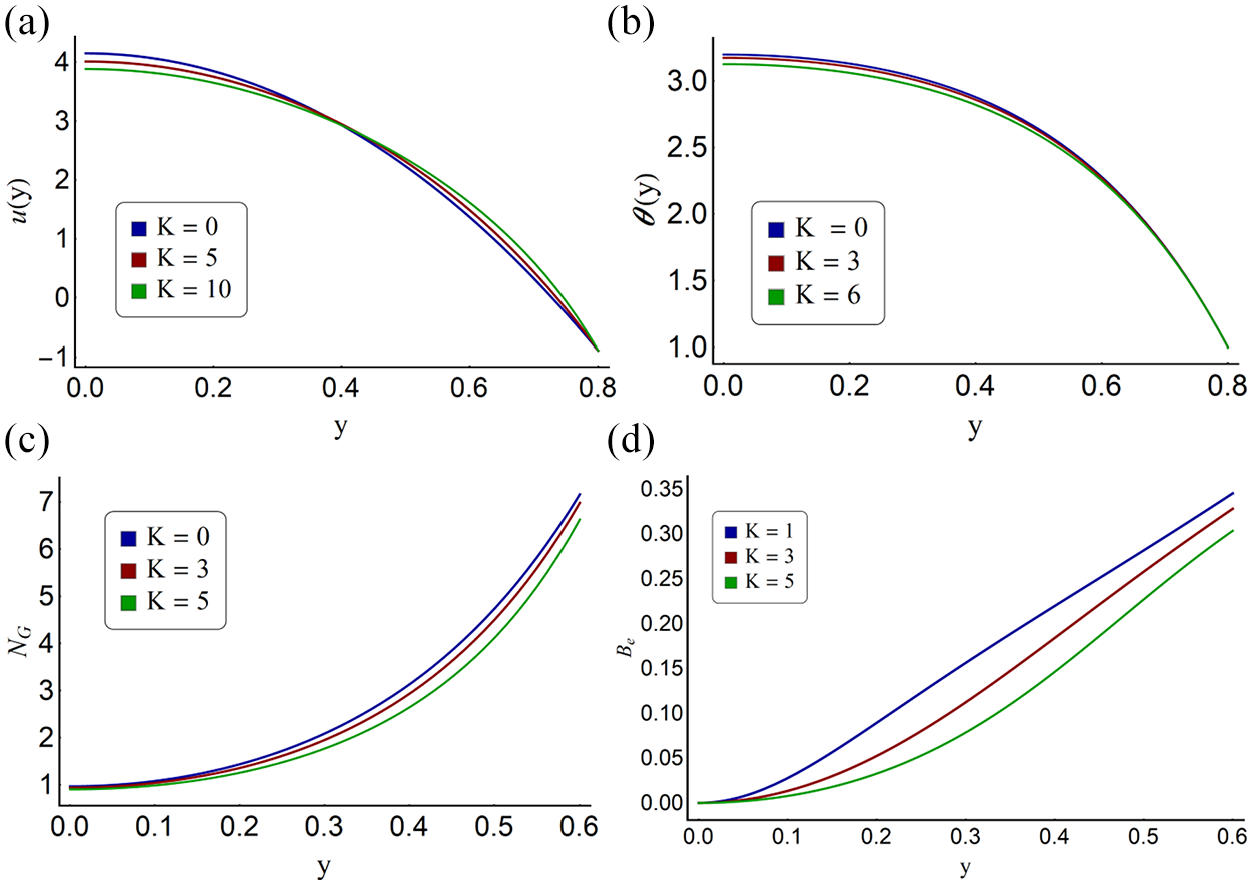
Effect of K on: (a) velocity, (b) temperature, (c) entropy number, and (d) Bejan number at fixed We = 0.01, α = 0.2, β = 0.1, M = 1, Uhs = 2, Sp = 1, Rn = 2.

(a) The velocity, (b) the temperature, (c) entropy number, and (d) Bejan number for varying Uhs at fixed We = 0.01, α = 0.2, β = 0.1, M = 1, K = 0.8, Sp = 1, Rn = 2.
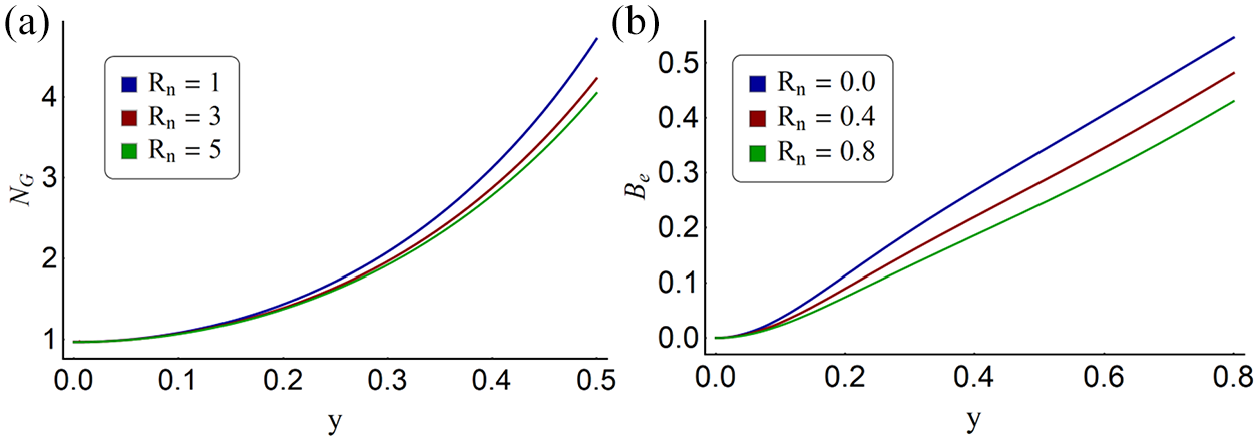
(a) The entropy number and (b) Bejan number for varying Rn at fixed We = 0.01, α = 0.2, β = 0.1, M = 1, K = 0.8, Sp = 1, Uhs = 2.
Pressure gradient profile
The pressure gradient is the rate at which the pressure changes occur with respect to distance. The pressure gradient in the ciliated channel is plotted against axial distance x in Figure 2 to see its behavior for variation in the parameters M, K, ε, and α in downstream. Figure 2(a) indicates that a considerable drop in the pressure gradient is associated with large values of M in the narrow and wider parts of the ciliated channel. Figure 2(b) reveals that higher value of K (implies small Debye length) improves the pressure gradient throughout the channel region. This vowing impression of the parameters is more significant in the core channel part. Figure 2(c) illustrates that long appendages (covered channel surface) interact more deeply than shorter ones. Therefore, an increase in ε results in an augmentation in pressure gradient in the middle of channel, but an inflected trend is observed near the channel boundaries. The pressure gradient is lifted with an increase in α in the wider channel part and presented reverse behavior close to channel middle area (See Figure 2(d)).
Effects of the Hartmann number
When electric current is induced by motion of conducting fluid under a magnetic field, a magnetic force, called Lorentz force, acts on the fluid and modify its motion. The Hartmann number appears in the flow dimensional analysis and represents the magnetic force to the viscous force. The effect of Hartmann number on the flow and thermal characteristics are presented in Figures 3 and 4. A remarkable trend in cilia supported pumping streams is trapping which is bunch of internally rotating fluid steams surrounded by the laminar flow of cilia stimulated metachronal waves. At the exalted stream and sizeable occlusions, streamlines take the fluid bolus and drive forward by the rhythmic waves. Figure 3 illustrates that the enclosed bolus shrinks down for increasing values of Hartmann number (M) which signifies the reduction in flow rate. Figure 4(a) shows that an elevated value of magnetic field parameter (M) slows the fluid velocity in the environs of the channel center and enhances it in the vicinity of the channel wall. Also, this rise (in Hartmann number) acquires a more flatten form of velocity profile near the channel center. This decreasing behavior of M on fluid stream is due to electromotive force which is associated with magnetic force. This stimulated force has the capability to resist the fluid flow in channel deep region. But in a wavy channel, to keep a constant flow rate, an utterly inverse state can be noticed near the channel boundaries. The fluid temperature exhibits an increasing behavior as M increases and this increase is more prominent in the center of channel (see Figure 4(b)). The total entropy number is portrayed in Figure 4(c) for small values of Hartmann number M. The figure indicates that the entropy in the channel increases as M increases. This behavior of entropy is due to significant increase in convection as magnetic force becomes strong. Figure 4(d) demonstrates the same fact where Bejan number is sketched and shows substantial increase in heat transfer irreversibility. The figure further describes that in the middle portion of channel fluid friction irreversibility dominates and near the channel surface heat transfer irreversibilities dominate.
Effects of electroosmosis parameter
The impact of electroosmotic parameter (K) on flow and thermal attributes can be seen through Figures 5 and 6. The streamlines pattern for variation in K is depicted in Figure 5. The figure shows a substantial decrease in the bolus size indicating a rapid decline in the flow rate. It is further observed from the figure that the high values of K augment the fluid stream near the surface and hinder in the locality of channel center. This behavior is obvious because an increase in Debye thickness results a weak electric double layer and thus a bulk of fluid flow arises. In Figure 6(a) the velocity profile is plotted at varying K. The figure shows a similar pattern of velocity profile as observed for the Hartmann number in Figure 4(a) but with less variation in the velocity. On the other side the temperature profile decreases as K increases (see Figure 6(b)) and results in a decreasing convection. Figure 6(c), shows that electric field has antagonistic association with entropy generation in the channel. A more comprehensive view of this behavior is shown in Figure 6(d) where Bejan number is plotted against the parameter K. The figure shows that the entropy in the channel is controlled by the frictional effects in fluid. This conduct of entropy is due to the decrease in Debye length which increases the electrons density and thus suppresses the heat transfer effects in the fluid.
The Helmholtz-Smoluchowski velocity effects
The variational effects of electrokinetic phenomenon the Helmholtz-Smoluchowski velocity Uhs on the flow and thermal characteristics are discussed in Figure 7. It is the streaming potential produces by charged wall under pressure gradient. Its positive value indicates the presence of high electric potential at higher pressure end in the channel. It is noticed from the figure that induction of Uhs velocity in the flow direction supports the fluid velocity. The same strength of electric field, when applied in the opposite course of motion causes deceleration in fluid velocity especially in the center part. The temperature profile decreases when Uhs is applied in the flow direction and increases for opposite direction of Uhs and thus supports the heat transfer rate in the channel (see Figure 7(b) for instance). The entropy generation number increases for positive Uhs while it decreases for negative Uhs velocity. Figure 7(d) indicates that heat transfer irreversibility significantly rises near the boundary as the Uhs velocity is applied in the opposite direction while fluid friction irreversibility becomes dominant when Uhs is applied in the parallel direction of the flow. This indicates that high electric potential results in reducing the heat transfer effects in the flow.
Effects of the thermal radiation number
Thermal radiation is emission of energy transfer from any heated body in the form of electromagnetic waves. Figure 8 demonstrates the impact of radiation parameter Rn on the entropy number and the Bejan number. From Figure 8(a) it is revealed that overall entropy in the ciliated channel is lowered when the radiation parameter is elevated. However, this decreasing effect becomes lessened as higher value of Rn (=5) is considered. The Bejan number profile in Figure 8(b) shows that fluid friction irreversibility dominates the flow regime for higher values of Rn. This conduct is depicted as the conduction at the surface becomes weakened as Rn increases which decreases the thermal contact.
Conclusions
A theoretical analysis of entropy production in ciliated channel loaded with thermally radiated hybrid nanofluid is conducted in this study. The effects of magnetic field, electric field, and Joule heating are also incorporated. The flow in the wavy channel is stimulated due to metachronal waves motile cilia and electroosmosis. After applying Debye-Huckel, long wavelength and low Reynolds number estimations, the shooting method is applied to calculate the numerical solutions of the proposed problem. The study reveals the following remarks:
The elevated values of Hartmann number and electroosmotic parameter strengthen the fluid motion in the vicinity of the channel surface and obstruct near the central channel part.
The fluid friction irreversibility dominates the flow regime as the electroosmotic parameter increases. A high electric potential result in reducing the heat transfer effect in the channel.
The total entropy inside the channel can be reduced by taking a high electro-kinetically thermally radiated fluid flow.
The higher values of Helmholtz-Smoluchowski velocity and radiation parameter moderate the entropy in the ciliated pump.
Thin electric double layer and extended cilia enhance pressure gradient in the deep channel part. However, the magnetic field hinders pressure gradient throughout the channel.
Footnotes
Appendix
Declaration of conflicting interests
The author(s) declared no potential conflicts of interest with respect to the research, authorship, and/or publication of this article.
Funding
The authors disclosed receipt of the following financial support for the research, authorship, and/or publication of this article: This research is supported by the Deanship of Research Development, Prince Mohammad Bin Fahd University Al-Khobar.
