




Abstract
This study explores the effects of the thermal stress, rotation, and magnetic fields on the propagation of surface waves in a symmetric five-layered inhomogeneous elastic plate. The harmonic wave solution was adopted to reduce the given partial differential equations to their corresponding ordinary differential equations, which were later solved using a classical method. The Mathematica software was also employed for the numerical simulations. The dispersion relations associated with both the symmetric and antisymmetric modes have been determined and analyzed with regard to the aforementioned external effects and rotation. The variations in thermal stress positively affect the wave propagation in the plate even for relatively smaller values of the temperature variation. Also, the same trend is observed in the case of the magnetic field, but for higher values. Finally, for the rotation, it was found that the angular velocity must reach at least 104 before a significant change is observed; which in fact differs from the situations of half-plane reflection and single-layered.
Introduction
Propagation of elastic waves in various structures has been extensively examined in the past decades due to its frequent occurrence in nature and encounters in different phenomena of science and engineering applications. In particular, fields like the geology, modern aerospace, earthquakes, plasma physics and automotive industries to mention a few have long acknowledged the presence and dynamicity of wave propagation phenomena.1–4 Moreover, several studies in favour of the present topic have long been established with regard to the influence of certain external forces that significantly alter the propagation of waves in different bodies. For instance, the effect of magnetic field forces on the propagation of waves in elastic bodies was studied in Chadwick 5 and Kaliski and Petykiewicz, 6 while the thermal stress effects on the propagation of waves in an initially stressed anisotropic plate and double-layered nano-plates were presented by Selim 7 and Wang et al., 8 respectively. Furthermore, the propagation and reflection of surface waves in the presence of rotation have been analysed in a layer resting on thermo-diffusive elastic half-plane in Kumar and Chawla 9 and in an elastic stress free-surface half-space with thermal relaxation,10,11 respectively. The influence of an initial stress on the vibration of conducting medium amidst gravitational field forces was analysed by El-Naggar et al. 12 and initially stressed multilayered piezoelectric composite bodies were examined in Qian et al., 13 while the propagation of surface elastic waves under thermal relaxation and voids presence was studied by Abo-Dahab et al. 14 In addition, several investigations of the wave propagation in bodies and elastic media comprise the presence of viscous damping by Leissa and Qatu 15 and the presence of material and structural discontinuities.16,17 Furthermore, the propagation and dispersion of waves in multilayered and composite structures were equally examined in the literature.18–19 Such structures include sandwich plates, layered laminates, composite rods, photovoltaic panels and beams to mention a few. For example, the harmonic wave assessment in an elastic sandwich plate was examined by Lee and Chang, 20 and the dispersion of waves in an inhomogeneous elastic three-layered plate was considered Naumenko and Eremeyev. 21 In addition, more relevant studies with regard to the layered media include the wave propagation in layered photovoltaic panels and laminated glass, 22 buckling and bending analysis of vibrating composite and sandwich beams by Sayyad and Ghugal, 23 the determination of lowest motion modes of elastic beams with alternating components by Sahin et al., 24 a layer-wise finite element analysis for composite plates by Belarbi et al. 25 and for sandwich five-layered composites by Shishehsaz et al. 26 More, the influence of certain forces on the propagation of waves in multilayered media was investigated including the propagation of waves in an inhomogeneous magneto-electro-hollow cylinder and on elastic plates by Zhu and Shi 27 and Jiangong et al., 28 respectively, and the determination of an analytic solution to a Love wave problem in a double-layered media underlying an inhomogeneous half-space layer by Mandi et al., 29 to mention a few; see also previous studies30–35 and the references therein for more notable related works.
However, we explore in this article the influence of the thermal stress, magnetic field and rotational effects on the propagation of surface waves in an inhomogeneous symmetric five-layered plate. The plate which is presumed to be of isotropic alternating materials is prescribed with perfect interfaces and traction-free outer faces. Similarly, the expected related displacements and stresses will be determined in each layer of the plate in relation to both the symmetric and antisymmetric cases. Also, the determination of the dispersion relations and their analysis will be carried out, in addition to the determination of the respective cut-off frequencies. Moreover, this article goes as follows: in section “Governing equations,” the governing equations of motion in the presence of external forces and rotation are supplied. Section “Formulation of the problem” gives the formulation of the aiming problem. Section “The exact solution” presents the exact solutions to the problem, and section “The Dispersion relation” determined and analysed the dispersion relation, while section “Lowest cut-off frequency” determined the cut-off frequencies. The numerical results are given in section “Numerical results and interpretation,” with the conclusion in the final section.
Governing equations
We consider an isotropic homogeneous elastic medium in the presence of magnetic fields, thermal stress and rotation. The governing equations then take the following forms:7–12
1. The strain–displacement relation

2. The stress–strain relation given by

3. The equation of motion with magnetic force

where
4. The rotational acceleration

where
Furthermore, the linearized Maxwell equations for the electromagnetic field in a conducting medium take the forms

of which the magnetic field force takes the following form 34

where
In addition, the thermal stress which was recently considered by Selim 7 and Wang et al. 8 takes the form

where

equation (7) becomes

Formulation of the problem
We consider in this section a magneto-rotator-five-layered plate made of isotropic inhomogeneous alternating layers as shown in Figure 1. The plate consists of the inner core layer of thickness of

A symmetric magneto-rotator-five-layered elastic plate.
Consider the Cartesian coordinates system

The anti-plane shear motion 21 in the above symmetric plate under consideration is governed by the following equations of motions from equations (1)–(10)

for


where
Furthermore, we also define the following interfacial conditions of displacements and stresses


and the following traction-free conditions

However, we determine in the subsequent section the related displacements and stresses in the respective layered of the plate by utilizing the prescribed interfacial and traction-free boundary conditions. Similarly, we will set modalities for determining the aimed dispersion relations for onward analysis.
The exact solution
This section determines the exact solution of the formulated problem analytically using the normal mode method. By this, respective displacements and shear stresses will be determined in each layer of the symmetric plate under consideration.
Thus, equation (11) through equations (12) and (13) becomes the following

where

Therefore, to determine the surface wave propagation in the plate, equation (17) via the normal mode method admits the following solution form

where

where

Thus, we obtain the respective solutions in the symmetric five-layered plate as follows

where
Symmetric solution
For the symmetric solution for
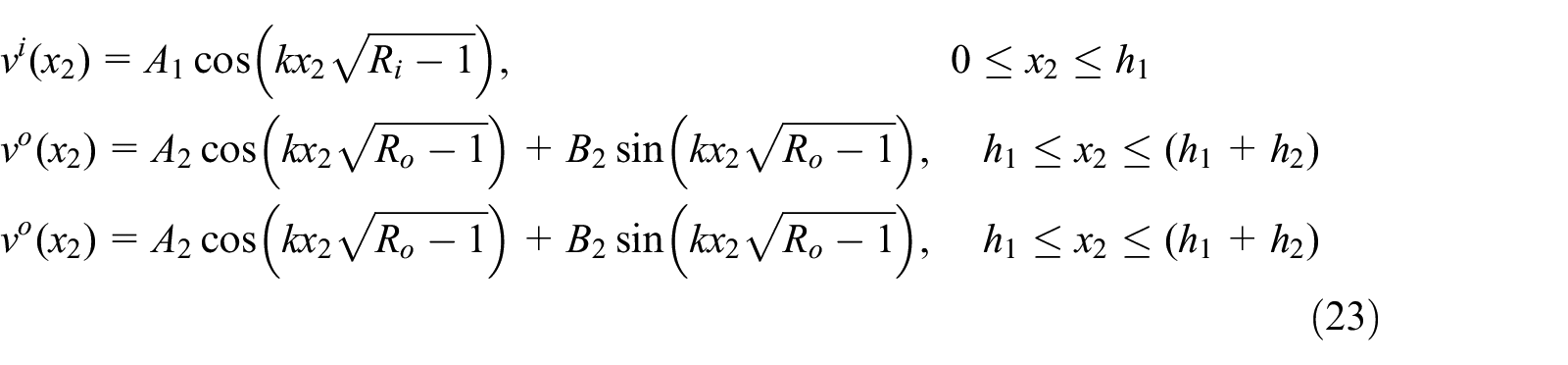
However, we determine below the complete exact displacements and stresses (in the absence of the exponential factor

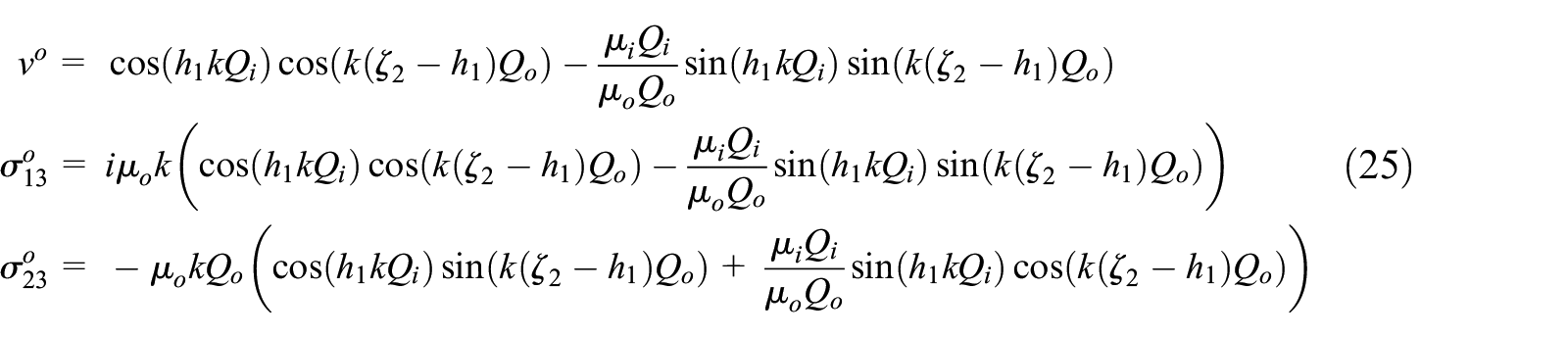
and

where

and within the ranges below

where

Antisymmetric solution
The antisymmetric solution for
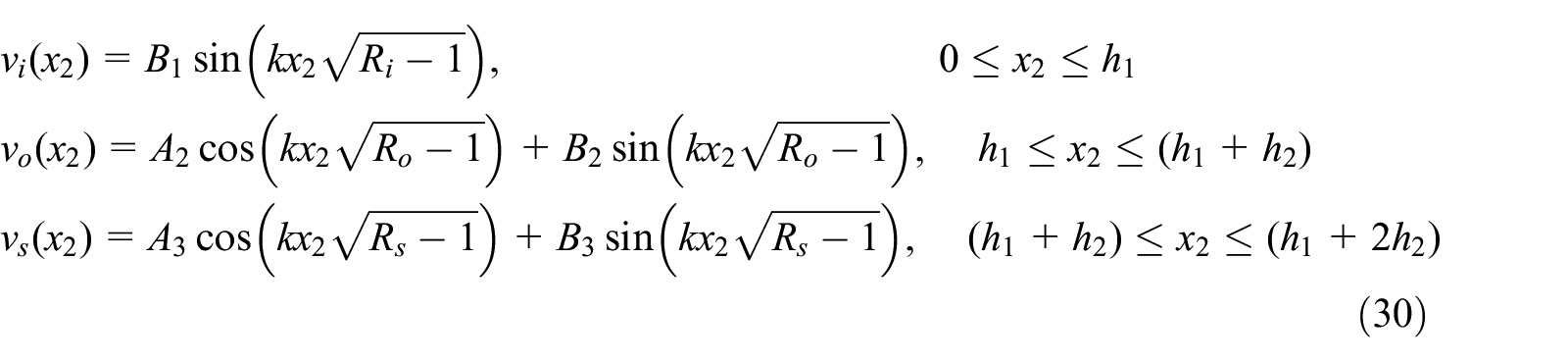
Also, in the same passion, we determine exact displacements and stresses in the respective layers as follows

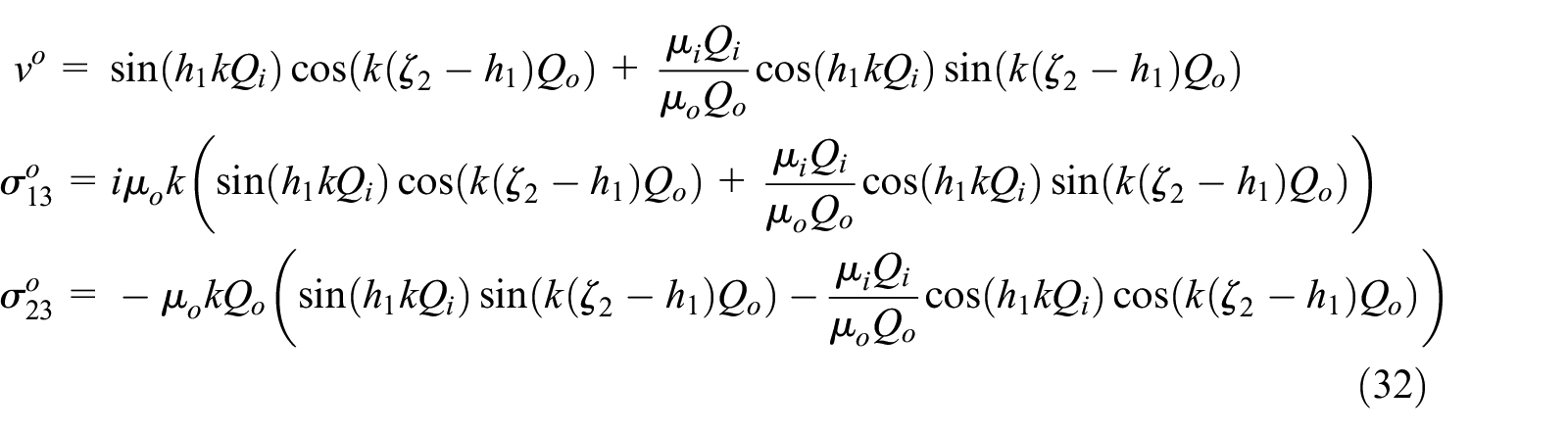
and

with

where
The dispersion relation
This section determines the generalized dispersion relation for the formulated problem corresponding to both the symmetric and antisymmetric solutions modes presented earlier.
Symmetric dispersion relation
Here, the dispersion relation of the formulated problem associated with the symmetric solution modes is presented.
In doing so, the symmetric modes via the use of the continuity and boundary conditions prescribed in equations (14)–(16) and the solutions obtained equation (22) yield a 5 × 5 dispersion matrix of which

where
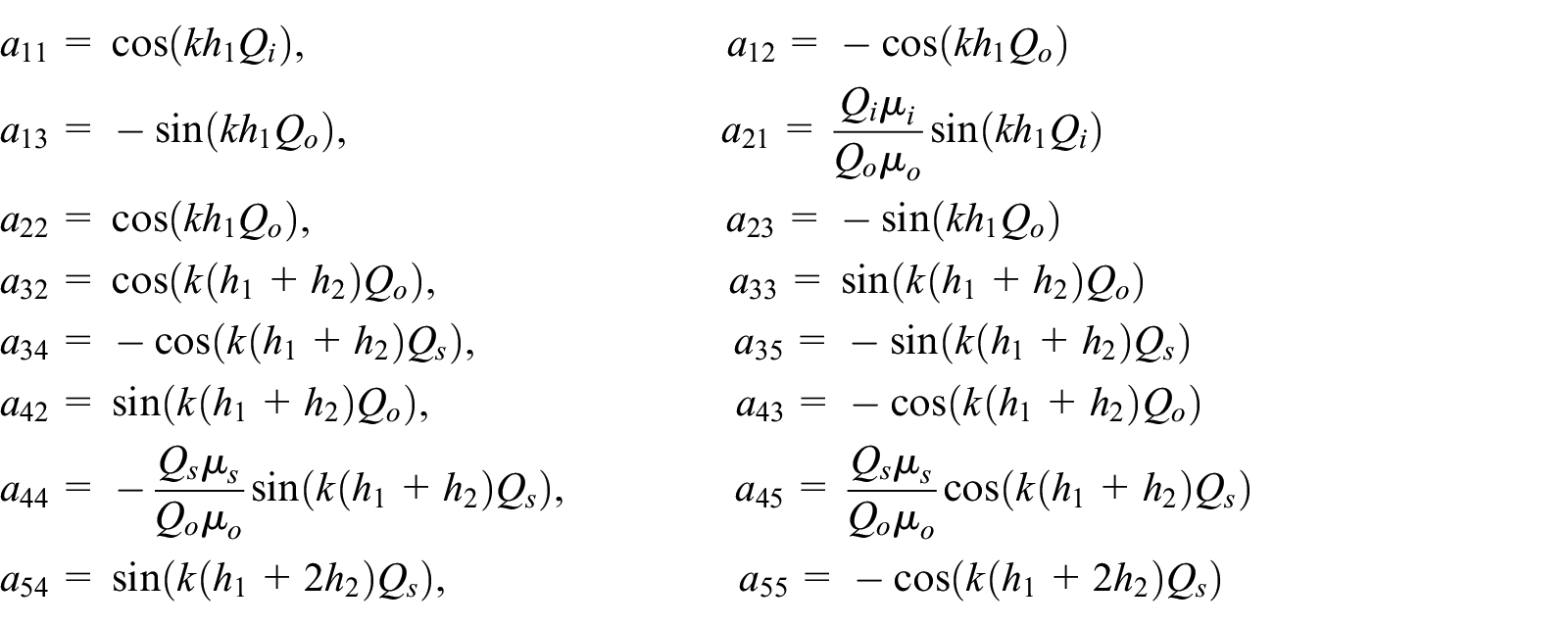
with
Thus, the dispersion relation corresponding to the symmetric modes is obtained (equation (35)) as follows

Special case
However, a very special case of the obtained dispersion relation for symmetric modes given above will be when all these external quantities are absent, that it, when the rotation

where

Antisymmetric dispersion relation
Proceeding as above, the dispersion relation for the antisymmetric modes gave a 5 × 5 dispersion matrix of which

with the following entries

where
Accordingly, the antisymmetric dispersion relation is obtained from equation (39) as follows

Special case
Also, a special case of the obtained dispersion relation for antisymmetric modes given above will be in the absence of the rotation, magnetic field, and the temperature variation; that is, when

where
Lowest cut-off frequency
This section determines the cut-off frequencies associated with both the symmetric and antisymmetric dispersion relations obtained in the previous section. However, to determine the lowest cut-off frequency, we recall from equation (19) that

where
Thus, with this relation defined in equation (42),

Also, from equation (29) via equation (43), we get

where

for
Therefore, the Cut-off frequency for the symmetric modes is obtained from the symmetric dispersion relation given in equation (36) with the help of relations equations (42)–(45) and by setting

Also, for the antisymmetric modes, we get the corresponding Cut-off frequency from the antisymmetric dispersion relation given in equation (40) as follows

together with the predicted single cut-off frequency as

It is worth noting here that the antisymmetric modes are known to possess global low-frequency regime whenever
Numerical results and interpretation
This section attempts to present the obtained results numerically by considering some physical data of interest together with a possible interpretation of the simulated results. In doing so, the derived dispersion relations for the symmetric and antisymmetric solution modes will be simulated to assess the effects of the rotation, magnetic field and temperature variation associated with the thermal stress. We start off by choosing the following thickness values of the inner core layer, outer core layer and skin layer as follows:

Also, for the copper material, we obtain the following data33,37

for

for

Variation of the symmetric dispersion relation given in equation (36) with respect to the rotation with variation in magnetic field.

Variation of the symmetric dispersion relation given in equation (36) with respect to the magnetic field with variation in rotation.
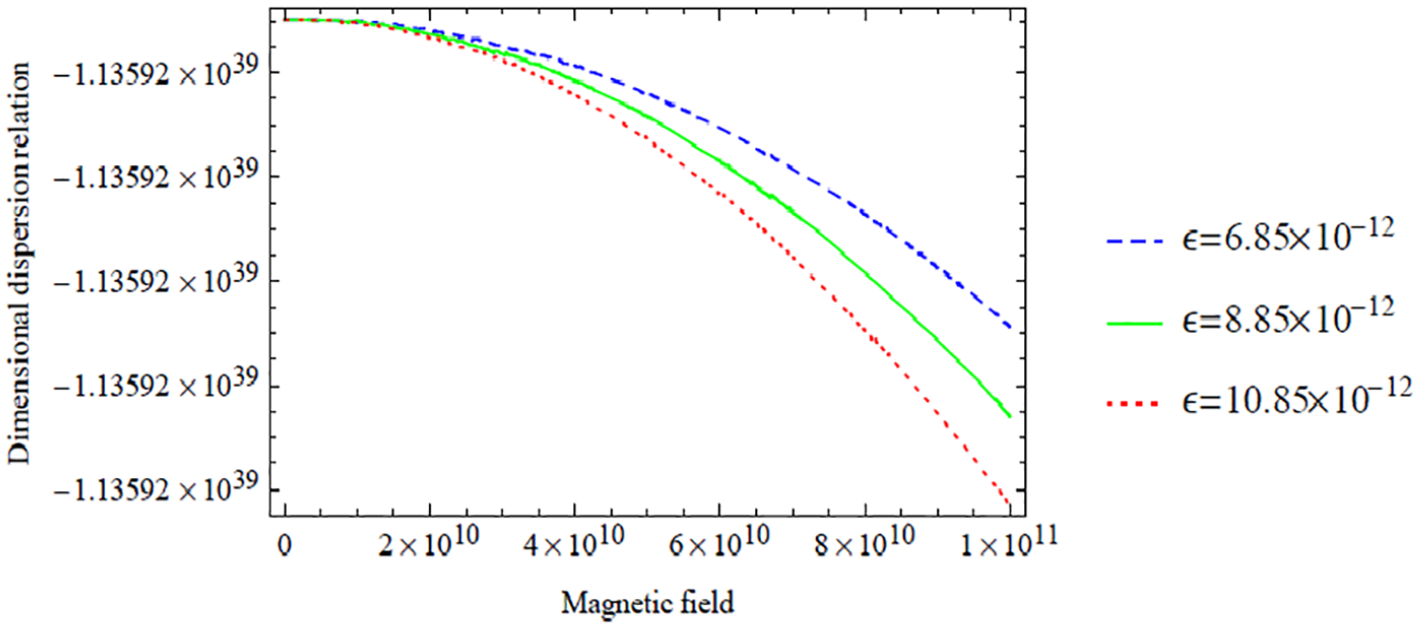
Variation of the symmetric dispersion relation given in equation (36) with respect to the magnetic field with variation in electric field.

Variation of the symmetric dispersion relation given in equation (36) with respect to the magnetic field with temperature variation.

Variation of the symmetric dispersion relation given in equation (36) with respect to the rotation with temperature variation.

Variation of the antisymmetric dispersion relation given in equation (40) with respect to the rotation with variation in magnetic field.

Variation of the antisymmetric dispersion relation given in equation (40) with respect to the magnetic field with variation in rotation.

Variation of the antisymmetric dispersion relation given in equation (40) with respect to the magnetic field with variation in electric field.

Variation of the antisymmetric dispersion relation given in equation (40) with respect to the magnetic field with temperature variation.
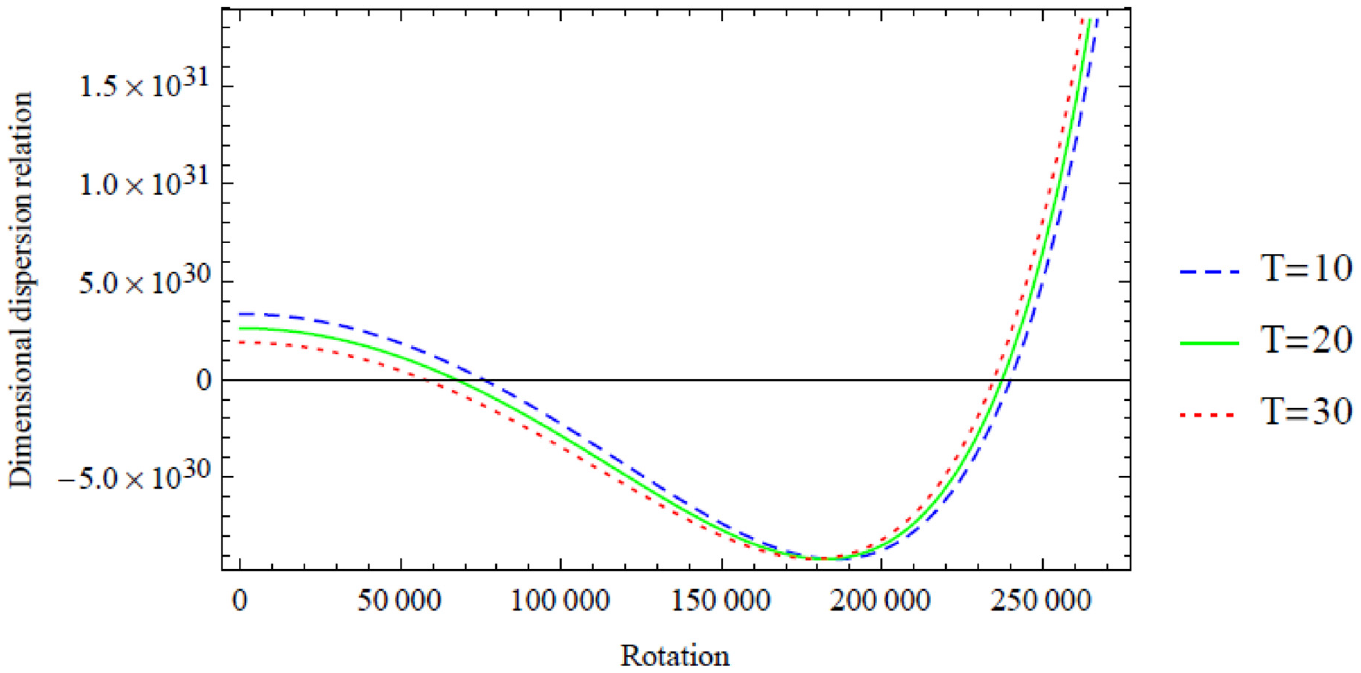
Variation of the antisymmetric dispersion relation given in equation (40) with respect to the rotation with temperature variation.
Figure 2 displays the variation of the dimensional symmetric dispersion relation given in equation (36) with respect to the rotation with variation in magnetic field, with temperature variation fixed at
Figure 3 depicts the variation of the dimensional symmetric dispersion relation given in equation (36) with respect to the magnetic field with variation in rotation
Figure 4 shows the variation of the dimensional symmetric dispersion relation given in equation (36) with respect to the magnetic field with variation in electric field
Figure 5 showcases the variation of the dimensional symmetric dispersion relation given in equation (36) with respect to the magnetic field, with temperature variation at fixed rotation
In Figure 6, the variation of the dimensional symmetric dispersion relation given in equation (36) with respect to the rotation with temperature variation, at fixed a magnetic field
However, a similar interpretation of the dimensional symmetric dispersion relation graphs shown in Figures 2–6 can also be drawn on the dimensional antisymmetric dispersion relation graphs shown in Figures 7–11. Nevertheless, it is worth noting here that the dispersion relation associated with the antisymmetric modes supports the long-wave low-frequency propagation, which leads to the possession of the global low-frequency regime; whereas the symmetric modes do not support that, see Prikazchikov et al. 21 and Sergushova 36 for more and some asymptotic approximations of the dispersion relation in the absence of external forces.
Conclusion
In conclusion, this article explored the influence of the thermal stress on the propagation of surface waves in an inhomogeneous symmetric five-layered plate assumed to be in a rotating frame of reference in the presence of a magnetic field force. The layers of the plate are further presumed to be of alternating material constituents comprising densities and stiffnesses with suitable perfect interfacial conditions and traction-free boundaries on the outer faces. Furthermore, the respective displacements and stresses have been determined in each homogeneous layer. Besides, the resulting dispersion relations in both the symmetric and antisymmetric modes cases have been determined and analysed with emphasis on the variations on the magnetic field, rotation, electric field and temperature variation.
For the sake of the numerical simulation, a five-layered plate composed of alternating copper–aluminium layers is considered and analysed in regard to symmetric and antisymmetric fundamental mode cases of the dispersion relations when
Footnotes
Declaration of conflicting interests
The author(s) declared no potential conflicts of interest with respect to the research, authorship and/or publication of this article.
Funding
The author(s) received no financial support for the research, authorship and/or publication of this article.
