



Abstract
Fluid flow chronologically is widely recognized due to its various uses in turbines, the framework of spinning magnet stars, gyromagnetic generators, and chemical engineers observing the progression of petroleum through the aquifer, and blood vessels in the respiratory alveolar plate. Tropical cyclones, pools of water, and storms all exhibit rotational movement. The current investigation aims to analyse the micro polar fluid flow between two infinite vertical discs enclosing Hall impact, varying thermal conductivity, heat flux as well as anomalous heat generation. The implication of a chemical change combined with chemical potential improves mass propagation. Suitable similarity conversions are used to convert the defined problems into conventional differential equations (ODEs). Furthermore, by introducing new variables the ODEs are transformed into nonlinear coupled ODEs and then solved numerically by the RK 4th order along with the shooting technique. The velocity profiles decrease as suction parameter increases. The temperature field exhibits a rising behaviour for the increasing values of thermophoresis, Brownian and radiations parameters while the concentration field shows a decreasing behaviour. Shear stress at the upper wall increases when the rotation variable and suction variable are augmented. Heat transmission escalations at the bottom wall when Prandtl number and radiation factor are enhanced. The novelty of the present work is to examine the Buongionro model in the presence of a heat source and chemical reaction inside the Darcian porous rotating channel, which has not been investigated yet. In some limiting cases, a comparison of the on-going study with existing literature is also included to justify the contemplated problem.
Keywords
Introduction
These days, researchers are very interested in applications of nanofluid and heat transfer enhancement techniques. According to empirical findings, the substantial properties of heat flow, mass transfer, and density during the flow are present in working fluids in a variety of technical and medical disciplines. Although different base liquids can transfer heat with a similar amount of efficiency, these liquids are often not ideal for thermal transport applications because of their low thermal ability. This problem can be resolved by using certain nanoparticle additions to increase the heat efficiency of such conventional approaches. The most effective way to improve heat transportation, which is employed in a variety of engineering products and air-conditioning systems, is to suspend ordinary fluids with nanosize particles. This idea allows for the replacement of convectional fluids with lower heat efficiency with nanofluids that can transfer more heat to surfaces. Nano fluids are typically more stable in terms of heat and momentum transmission than regular fluids. Different metals, including nitrides, oxides, borides, gold, steel, silver, and copper, can be used cautiously to improve such nanomaterials.
The study of boundary-layer flow towards a stretching surface was first introduced by Anderson 1 has become a significant and exciting subject for research investigations because of its wide industrial application such as cooling capacity polymer, heat exchange properties such as thermal performance, wire coating-layer, liquids diffusivity, and chemical production sectors. Sakiadis2,3 examined the boundary layer flow over flat sheet for laminar and turbulent flow. Further, Crane 4 expanded the problem to analyse the varying extending sheet velocity and closed form analytically solutions was obtained for Navier–Stokes system using two dimensional flow. These initial assistances have been of excessive significance in wire performance and elastic fabrication industries. The temperature dissemination of the melting fluid has been deliberated, 5 where the outcomes are reflected very imperative in the development of conserving polymer sheets extracted through the die. Wang 6 amended the fluid dynamic problem outside the stretched tube, which is required for the manufacturing environment of wire and fibers pulling. Ishak 7 recently expanded the study of Wang to investigating melting heat rate over a permeable surface. Keeping the applications of the stretching sheet, many researchers analysed the fluid flow and heat transfer over the stretching sheet under various conditions. For this goal, the nanoparticles were introduced in the base fluid to improve the heat transfer characteristics such as viscosity, thermal efficiency, and diffusivity in the fluid.
It is witnessed that chemical processes have significant influence on heat transfer in various branches of science and nanotechnology like solar collectors, nuclear reactor safety, metallurgy and chemical engineering.8–10 Nadeem et al. 11 considered the consequence of chemical performance for blood flow consuming Walter's B model over a tapering artery. Hayat et al. 12 scrutinized the chemical processes for Maxwell fluid. Using the BLF, Abdul et al. 13 inspected the chemical processes over stretchable sheet filled with nanofluid. The homogeneous and heterogeneous chemical processes over the permeable stretching surface were studied by Kameswaran et al. 14 Uddin et al. 15 numerical investigated the MHD convective BLF with slip effect over stretching porous plate with chemical processes. The analytical solution was obtained for free convective flow (FCF) over a horizontal surface filled with nanofluid. 16 Most recently, Srinivas et al. 17 considered the viscoelastic fluid over stretching pipe with chemical processes. Similarly, the MHD FCBLF with chemical reaction of NF through a vertical surface was explored by Uddin et al. 18 Patil et al. 19 investigated the magnetized chemically hybrid nanofluid with thermal over stretched with Ohmic heating and dissipation effect. Shamshuddin et al. 20 studied the thermal exploration of ethylene glycol nanofluid movement with viscosity effect over a permeable cylindrical annulus. Shamshuddin et al. 21 explored the thermo-solutal and chemical reaction impacts on magnetized nanofluid movement along a vertical stretching sensor surface. Patil et al. 22 examined the Powell Eyring nanoliquid movement over a porous elongated surface with inclined magnetic field and chemical reaction.
In the present study, we investigate the nanofluid flow over the parallel plate horizontally in the presence of chemical reaction, Hall current, and linear radiant energy. The characteristics of fluid dynamic is also examined with variable thermal and heat generation and absorption. The model partial differential equations are altered to ordinary differential equation by similarity variables. The ODEs are transformed into first order ODEs through new variables and then solve numerically. The novelty of the present work is that no one analyses the influence of chemical reaction using the ferrofluid in two parallel horizontal plates in the presence of hall current. So, in limiting case, the present work is validated to the published work. The influence of involving parameters is explained through graphs and tables on the flow characteristics. For the validation the present work is compared to the published work reported by Dutt et al. 5 and good analogous is found.
Mathematical formulation
Incompressible nanofluid is examined over the two parallel porous horizontal plates in the presence of chemical reaction and hall current. The plate is spinning with the velocity
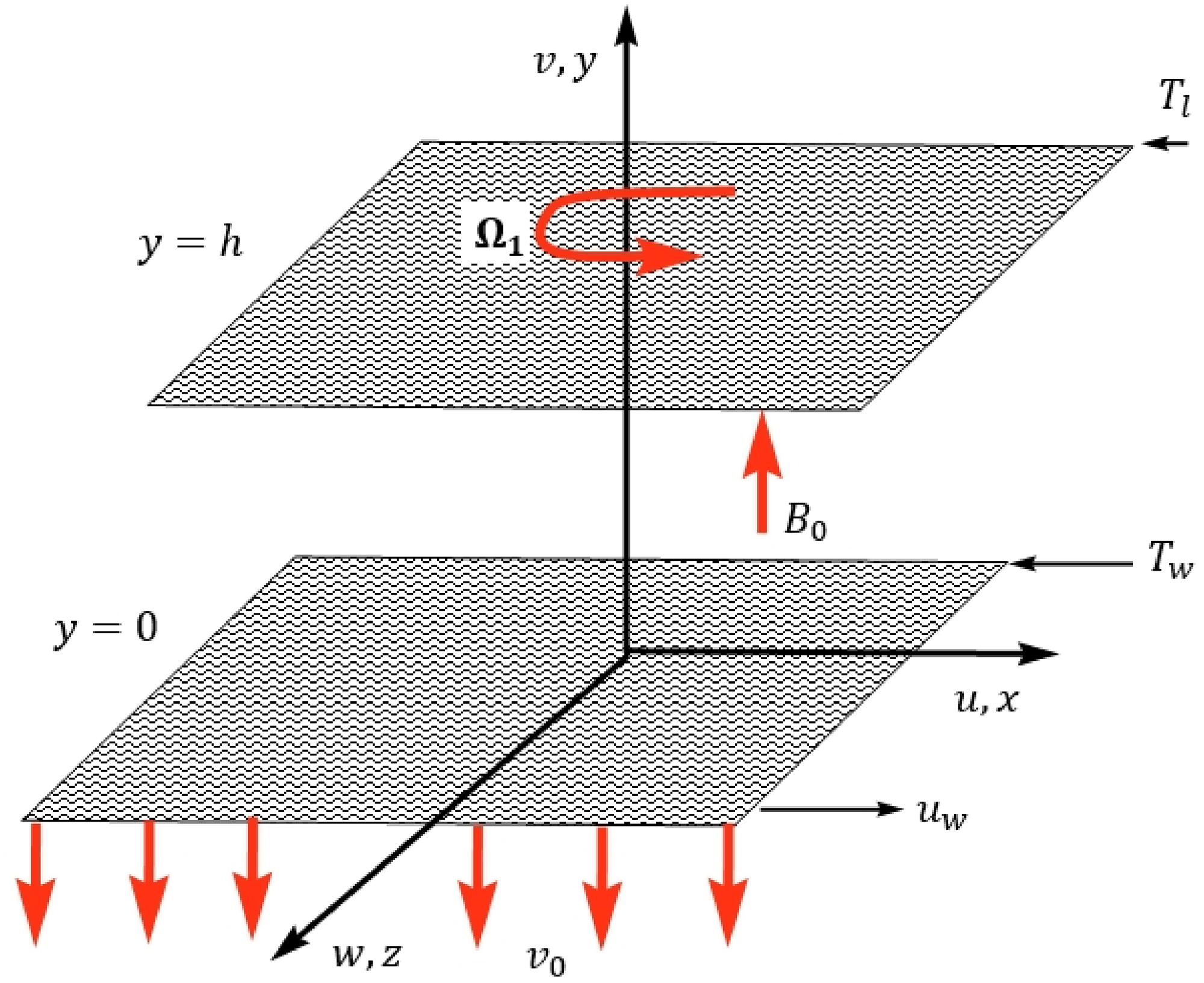
Flow geometry of the model.

Flow chart for the numerical scheme.
The basic flow equations of nanofluid are2,3,18:






With boundary conditions4,5,18



The varying thermal conductivity given in equation (5) is explored as4,8:


By using Eq. (11) the Eq. (1) satisfy automatically and Eqs. (2-4, 6, 7, and 10) yield the system




Lower plate:





Numerical procedure
Due to higher nonlinear equations of velocity, temperature and concentration profiles, the exact solution is impossible. For this purpose the numerical solution has been obtained for the flow characteristics. For the PDEs are converted to ODEs by transformation variables. ODEs are then converted to first order ODEs through new variables and then solved numerically by applying RK4 method wit step size
Results and discussion
In this section we will investigate the influence of physical parameters on velocity, temperature, and concentration profiles graphically and tabular form. Equations (12)-(15) show visually the characteristics of the velocities

(a) Influence of K on

(a) Influence of a on
The movement of the liquid is resisted by the Coriolis force, which acts in a revolving channel transverse to the velocity profiles and the spinning axis. There is a dual impression for

(a) Influence of
The Reynolds number

(a) Influence of

(a) Influence of m on
As m rises, the fluid's velocity
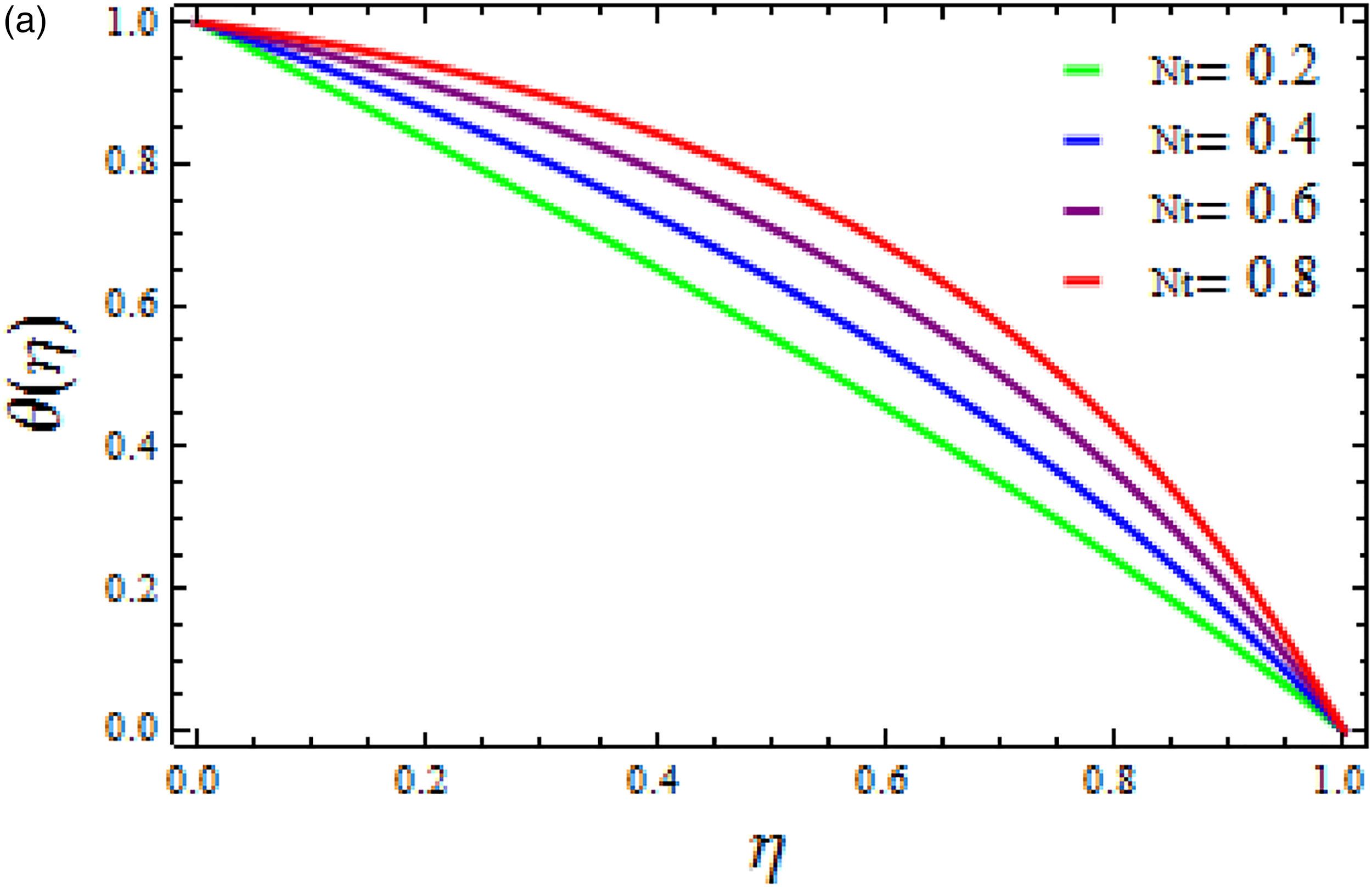
(a) Impact of

(b) Impact of

(a) Impact of
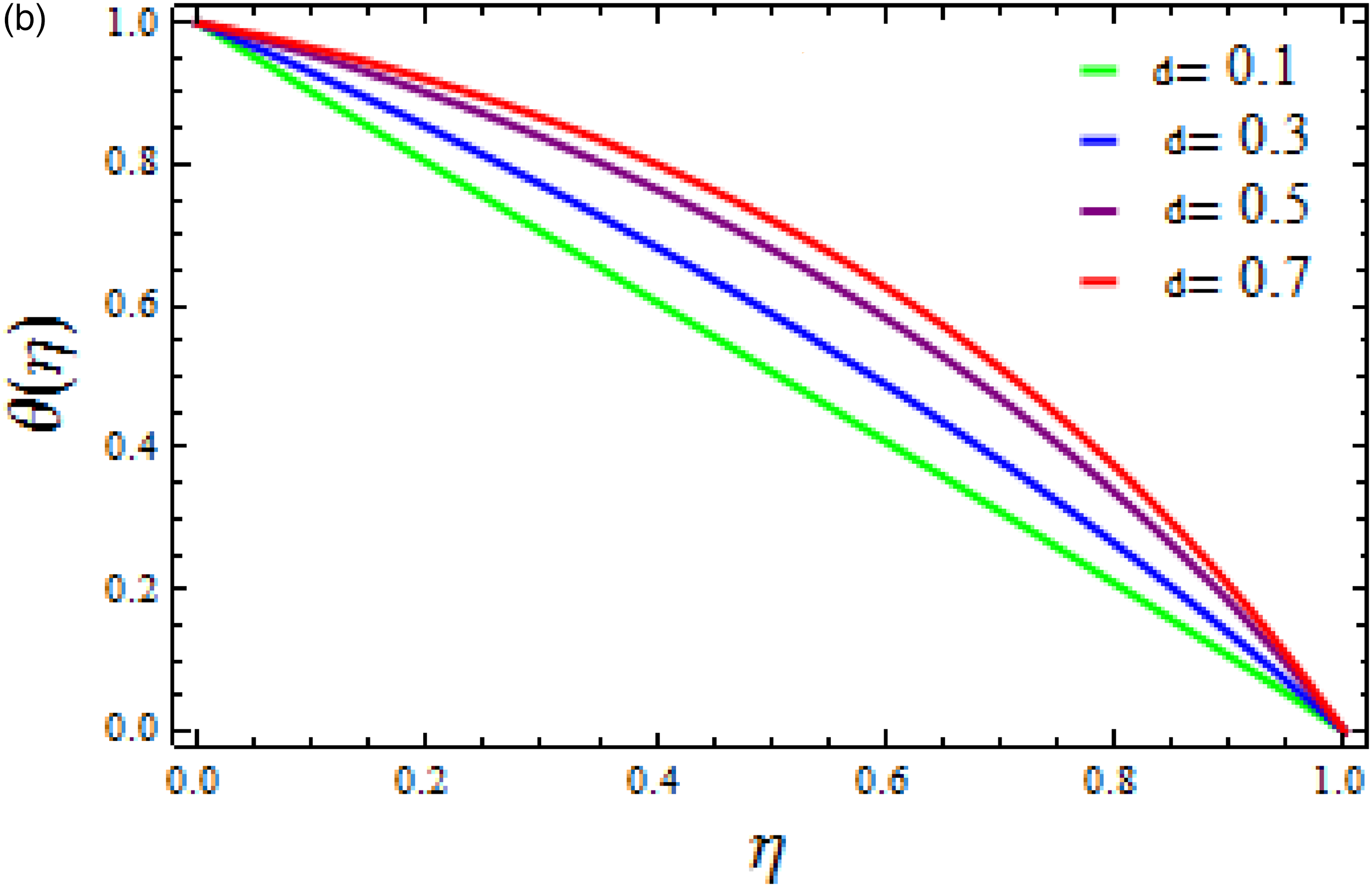
(b) impact of d on
Figures 12(a)-12(b) and 13(a)-13(b) demonstrate the presentation of variable heat source/ sink on

(a) Impact of

(a) Influence of

(a) Influence of

(b) influence of
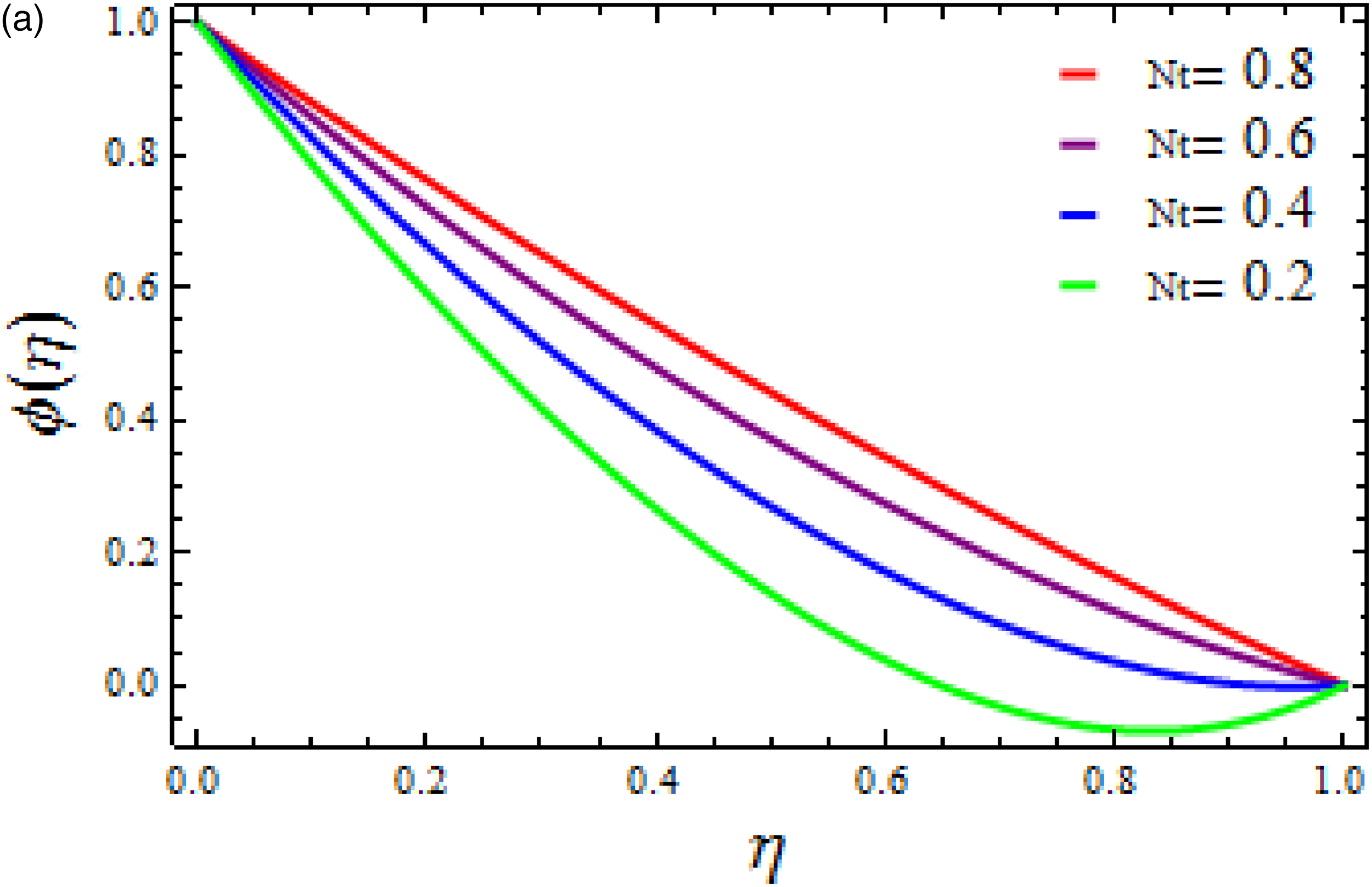
(a) Influence of

(b) influence of

(a) Influence of E on

(b) influence of a on
The impact of

(a) influence of

Impact of
Numerical values for friction drag coefficient at both wall.

Numerical values for heat transfer rate.

Numerical values for mass transfer rate.

Validation of the present work with published work for temperature and concentration profiles.

Conclusions
The current investigation aims to analyse the micro polar fluid flow between two infinite vertical discs enclosing Hall impact, varying thermal conductivity, heat flux as well as anomalous heat generation. The implication of a chemical change combined with chemical potential improves mass propagation. Suitable similarity conversions are used to convert the defined problems into conventional differential equations (ODEs). Furthermore, by introducing new variables the ODEs are transformed into nonlinear coupled ODEs and then solved numerically by the RK4 approach along with the shooting technique. The novelty of the present work is to examine the Buongionro model in the presence of a heat source and chemical reaction inside the Darcian porous rotating channel, which has not been investigated yet. In some limiting cases, a comparison of the on-going study with existing literature is also included to justify the contemplated problem.
The results of the current investigation are given below:
The velocity profiles decrease as K increases. The temperature field exhibits a rising behaviour for the increasing values of N
t
, N
b
and d, and Rd. For N (b) and N t, the concentration field shows a decreasing behaviour. The concentration field diminishes as S
c
and δ are enhanced. Shear stress at the upper wall increases when the rotation variable and suction variable are augmented. Heat transmission escalations at the bottom wall when Pr, Rd, and d are amplified.
The current investigation can be enhanced to include Hall current as well as Ion slip effects along with any viscoelastic non-Newtonian model. The Non-Newtonian models have wide range of applications in the fluid realm. Additionally, simple thermal radiation can be replaced with nonlinear thermal radiation, and a gyrotactic microorganism's effect can be added.
Footnotes
Declaration of conflicting interests
The authors declared no potential conflicts of interest with respect to the research, authorship, and/or publication of this article.
Funding
The authors received no financial support for the research, authorship, and/or publication of this article.

Data availability statement
The data presented in this study are available upon request from the corresponding authors.
Author biographies
Zeeshan is working as an Assistant Professor in Mathematics, Department of Mathematics and Statistics, Bacha Khan University Charsadda, Pakistan. He did his PhD from Abdul Wali Khan University Mardan. He received his MPhil and Master degree in mathematics from Quaid-i-Azam University Islamabad. He has published more than 80 papers in JCR journals.
Muhammad Shoaib Khan is working as an Assistant Professor in Mathematics, Department of Mathematics and Statistics, Bacha Khan University Charsadda, Pakistan. He did his PhD from Peshawar University. He received his MPhil and Master degree in mathematics from COMSATS University Islamabad and Bacha Khan University Charsadda. He has published more than 80 papers in JCR journals.
Ilyas Khan received his PhD degree in applied mathematics from the Universiti Teknologi Malaysia(UTM) in 2012 and Post Doctorate in 2013 from the same university. He received several distinctions such as senior visiting research fellow and visiting researcher. He has over 15 years of academic experience in different reputed institutions of the world. He is currently working as an Associate Professor in the Department of Mathematics, College of Science, at Majmaah University, Saudi Arabia. He has received twice distinguish researcher award from Majmaah University. According to AD-Scientific Index 2022, He has received first place as a best scientist at Majmaah University and 3rd place as a best scientist in Saudi Arabia.
Syed M. Eldin is working as an Associate Professor at Center of Research, Faculty of Engineering, University of Malakand, Chakdara, Pakistan.
Hira is working as a Lecturer in the department of biotechnology and microbiology at Bacha Khan University Charsadda, KP, Pakistan.