




Abstract
The consequences of double-diffusivity convection on the peristaltic transport of Sisko nanofluids in the non-uniform inclined channel and induced magnetic field are discussed in this article. The mathematical modeling of Sisko nanofluids with induced magnetic field and double-diffusivity convection is given. To simplify PDEs that are highly nonlinear in nature, the low but finite Reynolds number, and long wavelength estimation are used. The Numerical solution is calculated for the non-linear PDEs. The exact solution of concentration, temperature and nanoparticle are obtained. The effect of various physical parameters of flow quantities is shown in numerical and graphical data. The outcomes show that as the thermophoresis and Dufour parameters are raised, the profiles of temperature, concentration, and nanoparticle fraction all significantly increase.
Keywords
Introduction
Researchers have been particularly interested in studying peristaltic flow of Newtonian and non-Newtonian fluids to apply it in multiple domains and to peristaltic medical engineering problems too.1–7 Like Mekheimer and Abd elmaboud 8 explained that the phenomenon is helpful to remove unwanted tissues such as cancer cells that can be destroyed through bioheat. In addition, peristaltic blood flow 9 describe the phenomena of hyperthermia, in which the tissue is heated to 42°C–45°C, which will be destroyed. In addition to this, peristaltic flow is mostly found in ureter function, transportation of semi-solid food through intestine, passing of ova via fallopian tubes, transportation of seminal fluid into the cervix, bile motion along bile duct, motion of cilia, blood flow in arteries and veins, and urine excretion. In addition, mathematicians, biologists, and physicists became more interested in the problems of flow magnetohydrodynamics (MHD). Magnetohydrodynamics (MHD) works by the electromagnetic force of a magnetic field. These types of magneto-fluids include liquids, plasma, electrolytes, and salt water. Magnetohydrodynamics (MHD) also works on magnetic resonance imaging, hyperthermia, imaging resonance imaging, reducing bleeding during surgery, or the proliferation of cancer cells and the growth of magnetic tracers. 10 In addition, the pump, hemodynamics, glandular ducts, bile duct, and intestinal tract are just a few applications of peristaltic flow with magnetic effects. Mekheimer 11 described the effect created by the magnetic field on the (destructive) movement of the couple’s pressure on the limited channels and discussed arithmetic results. Bhatti et al. 12 described blended impact of the magnetic force and slip conditions for peristaltic hemodynamics (“blood flow”) along a separate medium that is also consulted with pump signals and exact solutions for velocity distribution. Both Bhatti and Zeeshan 13 analyzed the impact of slip and endoscope on peristaltic flow of fluid-shaped suspensions using the annulus (Some problems related to peristaltic flow and magnetic force impacts are listed in index).14–18
Currently, researchers are showing great interest in nanofluid flow as it has many applications in science, biomechanics, chemical, and nuclear industries. These liquids can be used in many engineering problems. 19 Nanofluids mean the inclusion of a small number of nanometer particles that are said to be <100 nm in basic liquids such as oil, water, biofluids, ethylene, and lubricants. The name was first introduced by Choi 20 ; supplemented small nanoparticles to the base liquid to enhance thermal conductivity. Eastmann et al. 21 introduced heat transfer of copper nanoparticles of ethylene glycol nanofluid. Since then, the emergence of nanofluid development of the mathematical model by showing the features of Brownian diffusion. Sheikholeslami et al. 22 examined the impact of viscosity dependent on time on free transfer of magnetohydrodynamic nanofluid transmission. Since then, several researchers have contributed to the latest developments in nanofluids.23–28 The content of nanofluid transport with peristaltic is rarely found in literature, although there are applications imperative for medical engineering programs. A study carried out by Akbar et al., 29 has elevated the peristaltic flow of nanofluid to a separating tube, which combines the temperature using a homotopy perturbation method. Many important results of peristaltic transport of nanofluids flow can be found in Hayat et al., 30 Ramesh and Prakash, 31 Riaz et al., 32 Abumandour et al., 33 Mekheimer et al., 34 and Ellahi et al. 35
Double diffusion of volatility of the separated liquid resting its size is determined by two different substances at different values. Stern 36 confirmed that this arrangement is unstable or weed compaction rises to the ground. The double-diffusive convection used is called an essential element, and in many cases, it is a process of mixing at sea, where warm water and salt are often found above cold and fresh. In this case, the fast diffuser (temperature T) stabilizes, and the slow diffuser (salt S) relaxes, resulting in a double-sided salt of convection, which is the focus of our discussion. In addition to the use of oceanographic, dual-constructed convection is affected by heat and transport of various other geophysical and astrophysical fluid systems, from the magnetic melt 37 to the inner planets and stars.38–41 Complete studies on double diffusion and its applications are listed in Alolaiyan et al., 42 Bég and Tripathi, 43 Akram et al., 44 Akram and Afzal 45 as well. The aim of the present study is to describe the influence of double diffusion on magnetic induction and peristaltic flow of Sisko nanofluids in an inclined non-uniform channel. In section 2 basic governing equations are defined. In section 3, mathematical formulations of Sisko fluid for two dimensional and directional flows of nanofluids under double-diffusivity convection is presented. The solution of proposed problem is discussed in section 4 whereas the graphical representation of obtained results is elaborated in section 5.
Basic governing equations
The basic equations of hydromagnetic Sisko nanofluid are given as follows:
(a) Maxwell’s equation


From equations (1)–(3), the induction equation can then be attained as

(b) Continuity equation is

(c) Naiver–Stoke equation is defined as


For Sisko fluid, the stress tensor


(d) The thermal energy, solute concentration, and nanoparticle fraction



In the equations above,
Mathematical formulation
In this problem, the incompressible hydro-magnetic flow of a non-uniform channel of an electrically conducting Sisko nanofluid is considered. The X—axis is drawn along the propagation of wave and its Y—axis is orthogonal. It is also assumed that the channel is slanted at an angle of

Geometry of the problem.
The geometrical shape of the deformations of wall is depicted as

where
and
The velocity field for current problem is










where



In fixed frames

Defining dimensionless quantities



Where
The dimensionless form of equation (12) is

where
Using equations (20) and (21), equation (13) is automatically satisfied and equations (14)–(19) in wave frame (after bars dropping) becomes





where



Now utilizing long wavelength and low but finite estimation of the Reynolds number, the equations (23)–(29) becomes




where

Removing pressure from equations (30) and (31) yields


The boundary conditions for the proposed problem in wave frame are defined as follows:
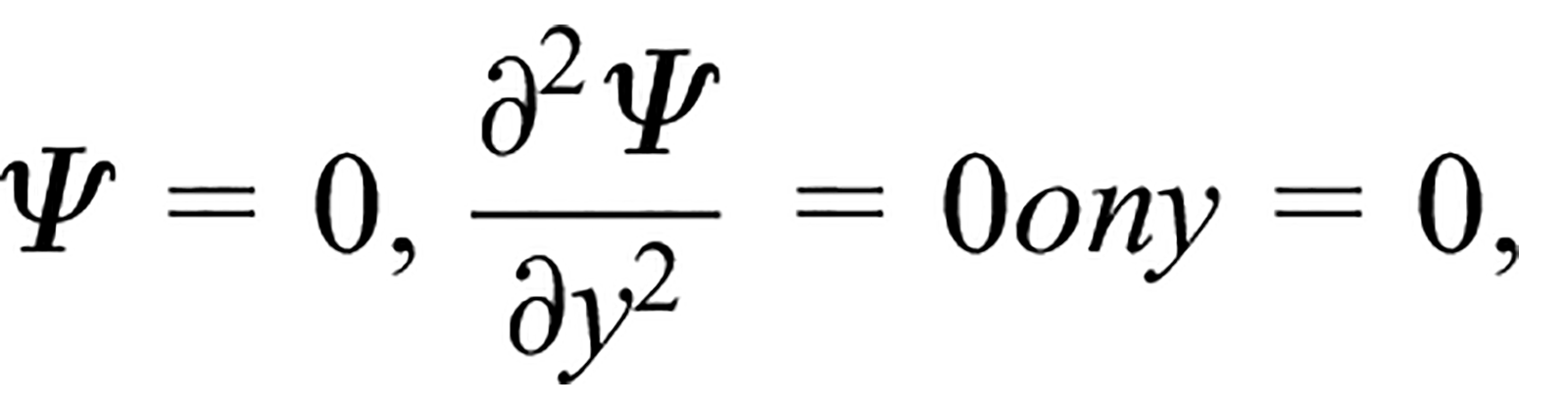




Here,
Solution methodology
Exact solution
The exact solution of temperature, volume fraction of the nanoparticle and concentration of solutal (species) that fulfills the boundary conditions (



where

Numerical solution
The exact solutions of equations (30), (35), and (38) is difficult due to non-linearity nature of partial differential equations. Numerical solution of the non-linear equations are calculated using Mathematica software. Thus, by numerical approximation to solutions, graphical illustration is achieved.
Graphical evaluation
In this part, the graphical results of the existing problems are thoroughly discussed. To address the highly non-linear equations, numerical solution is computed, and graphical illustration is shown to see impact of concentration, temperature, nanoparticle fraction, pressure gradient, pressure rise, magnetic force function and velocity of numerous interesting physical parameters. To observe the graphical behavior of thermophoresis

Effect of

Effect of

Effect of

Effect of

Effect of

Effect of

Effect of

Effect of

Effect of

Effect of

Effect of
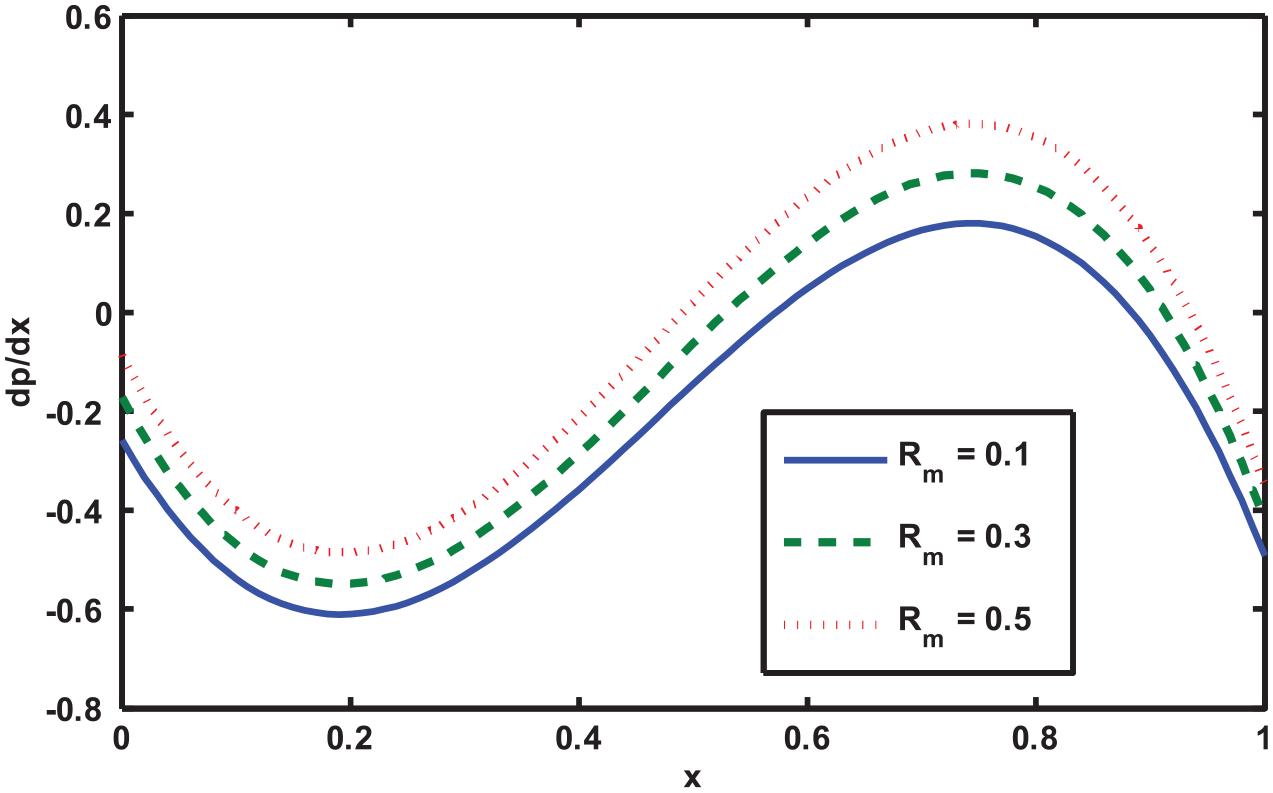
Effect of
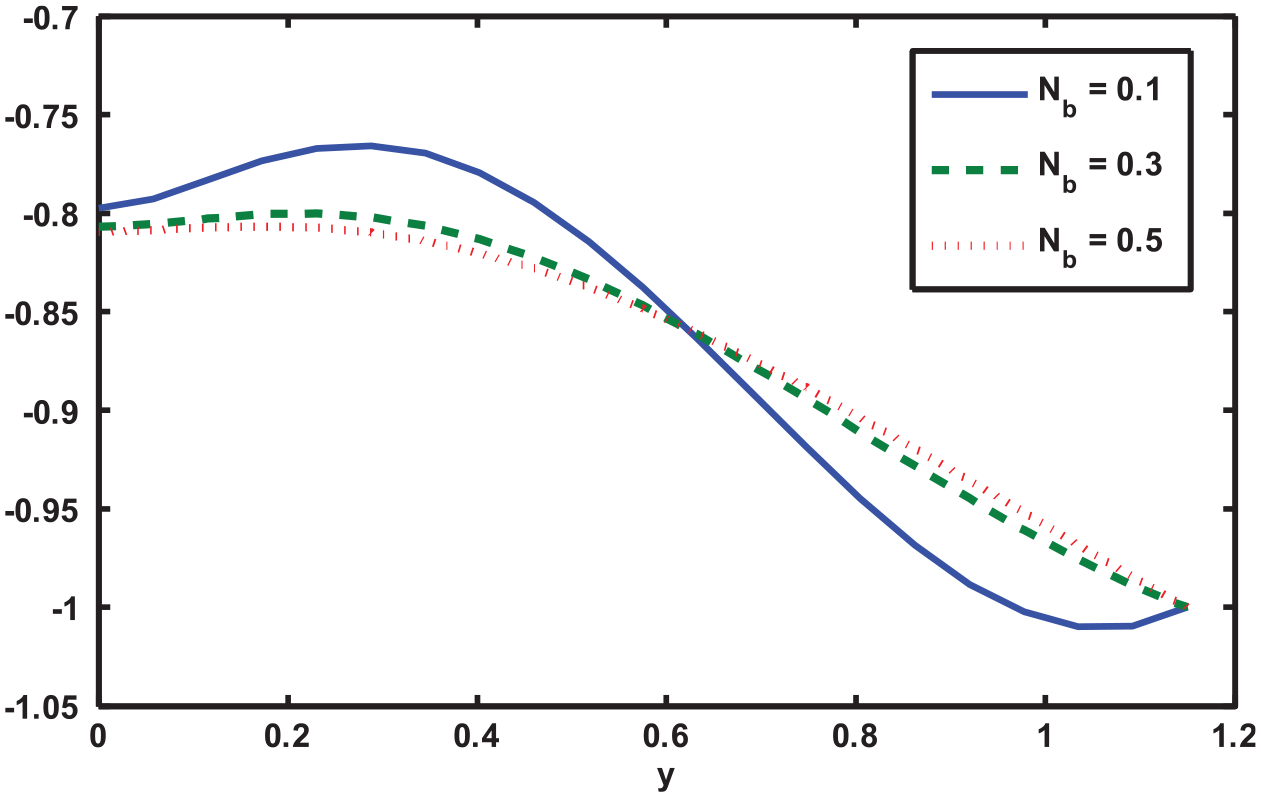
Effect of
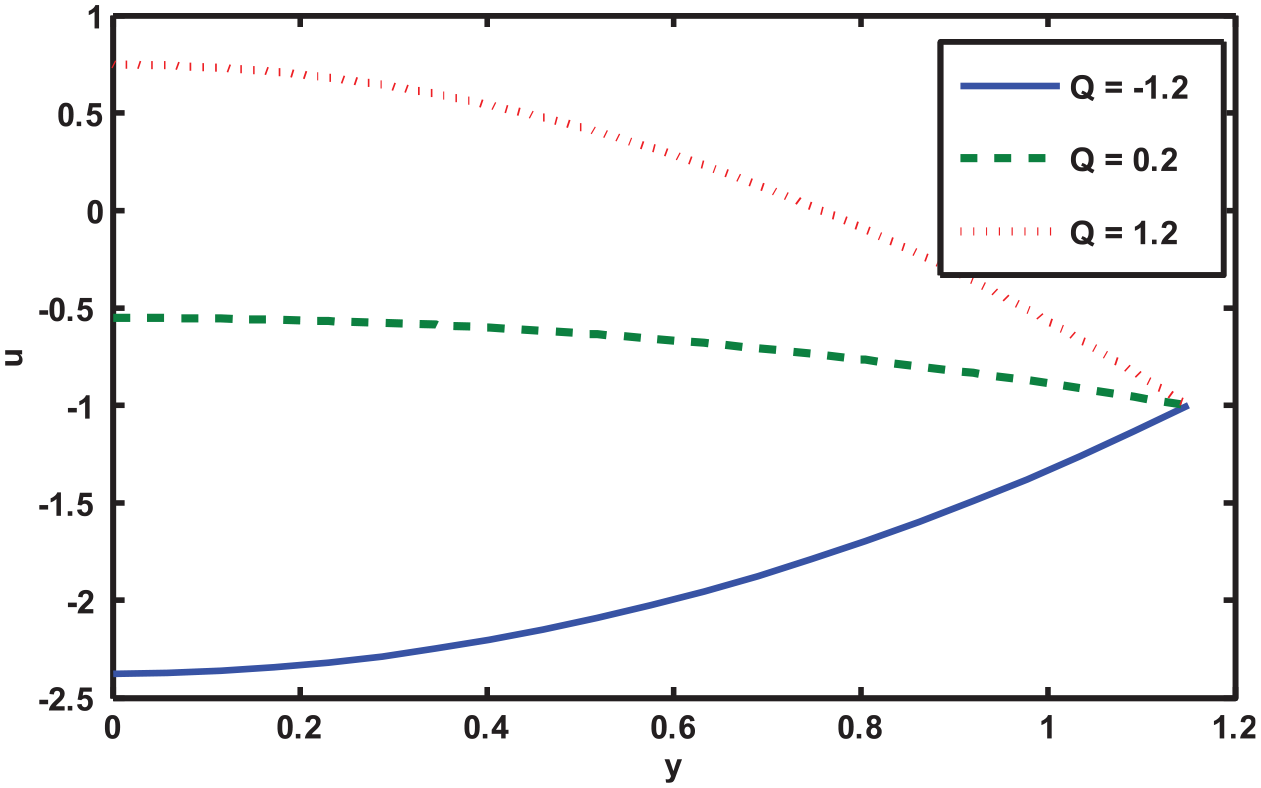
Effect of

Effect of

Effect of
An interesting phenomenon is trapping which occurs in peristaltic supported flows. It is defined as the formation of internally moving fluid mass besieged by the streamlines of peristaltic waves. At the exalted flow rates and significant occlusions, streamlines catch the fluid mass bolus and push it ahead along with peristaltic waves. Figures 18 to 20 describes that the trapped bolus size decreases for high values of
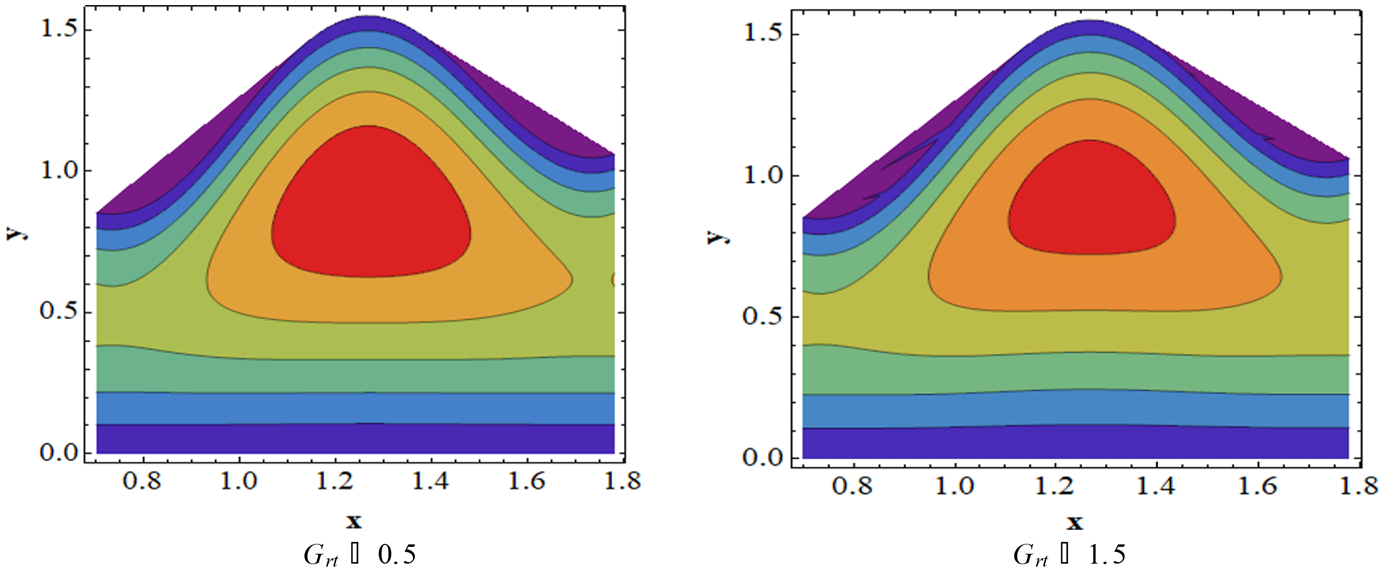
Streamlines for various

Streamlines for various

Streamlines for various
Concluding remarks
This section addresses the final remarks on the present issue. The impact of double-diffusivity convection on peristaltic flow of Sisko nanofluids in inclined non-uniform channel in the presence of induced magnetic field is discussed. Mathematical modeling of Sisko nanofluids with induced magnetic field and double-diffusivity convection are described in detail. For the problem under consideration, exact and numerical solutions are presented. The main findings are as follows.
The temperature profile, magnitude value of concentration profile, and magnitude value of nanoparticle fraction significantly rise as the thermophoresis and Dufour parameters are increased.
Increasing non-Newtonian parameter
Increasing non-uniform parameter
By increasing
The pressure gradient increases by increasing non-Newtonian parameter
By increasing
The trapped bolus size reduces when higher values of
Footnotes
Declaration of conflicting interests
The author(s) declared no potential conflicts of interest with respect to the research, authorship, and/or publication of this article.
Funding
The author(s) received no financial support for the research, authorship, and/or publication of this article.
