



Abstract
Objective:
Body image is defined as the perception of one's own body. While positive body image has a positive impact on quality of life, self-dissatisfaction may lead to depression, anxiety and low self-esteem. Body image might be quantified and evaluated: relevant instruments include the Body Shape Questionnaire (BSQ) and the Functionality Appreciation Scale (FAS).
This study was designed to translate and evaluate the psychometric properties of the Polish versions of these instruments.
Methods:
Translation (both forward and backward) from the original English versions of the questionnaires met international standards. Internal consistency and test-retest reliability are reported from 89 participants for the BSQ and 103 for the FAS. The participants also completed the Polish versions of the Body Image Quality of Life Inventory (BIQLI) and the Body Appreciation Scale-2 (BAS-2) to explore convergent validity.
Results:
Both, Polish versions of the BSQ and the FAS demonstrated good internal consistency and reproducibility. Convergent validity revealed a moderate relationship between the BSQ and the BIQLI scores, and a strong one between the FAS and the BAS-2 scores.
Conclusion:
Polish versions of both BSQ and FAS questionnaires showed sufficiently strong psychometric properties to support their use in clinical and research work with Polish speaking patients.
Keywords
Introduction
Body image is a multidimensional construct, consisting of perceptions of the individual's body and attitudes toward the self, mostly concerning physical appearance. Body image in general can be separated into two aspects: body dissatisfaction, often conceptualized as poor body image or negative body image, with damaging impacts on life generally; versus positive body image, with positive life impact. 1 Negative body image includes body dissatisfaction, body preoccupation and body shame. There are certain cognitive and behavioural functions associated with negative body image, including eating behaviours, sexual behaviours and emotional stability, and body image may also directly influence the quality of life and self-esteem.2,3 Body dissatisfaction has negative impacts such as depression, anxiety and poor self-esteem. Research on body image has traditionally focused on negative body image, however, this has been changing with increased interest in positive body image. Positive body image can be defined as accepting, holding favourable opinions toward, and respecting the body. 1
Body image nowadays is one of the most important parts of self-being. Social media, particularly in Europe and Northern America has created a ‘body aware’ population.
Body image is generally considered a stable trait but amenable to change in relation to interventions, rather than as a situational variable. It can be measured and it is relevant to quantify the effects of body image on various self-experiences and life contexts.2,4 Body image consists of at least two axes: the attitudinal axis – evaluation of satisfaction with the appearance, and the self-perception axis – cognitive-behavioural emphasis on individual appearance.3,4
There are several instruments for the assessment of body image, among them the Body Shape Questionnaire (BSQ), assessing negative body image, developed by Cooper et al. in 1987, mostly concentrated on excessive concern about the body shape typical of eating disorders;5,6 and the Functionality Appreciation Scale (FAS), measuring positive body image, developed by Alleva et al. in 2017, evaluating body functionality, defined as a multifaceted feature, including not only aspects such as internal processes and physical abilities, but also creativity, bodily senses, ability to communicate with others, and self-care.7,8 The BSQ and the FAS original versions are in English, but not only both are widely used in various languages to evaluate body satisfaction, but also both can be used free of charge. These factors led us to choose these measures for translation.
Although a few tools measuring body image are available in the Polish language, e.g., the Body Appreciation Scale-2 (BAS-2), 9 the Body Image Quality of Life Inventory (BIQLI; both used for the convergent validity in our work), 10 the Multidimensional Body-Self
Relations Questionnaire (MBSRQ), 11 the Body Esteem Scale (BES), 12 the Appearance Appreciation Index (AAI), 13 the Cosmetic Procedures Screening Questionnaire (COPS; the last two validated lately by our team), 14 we chose to translate and conduct preliminary psychometric exploration of the BSQ and the FAS to expand the diversity of the body image assessment tools, deliver possibilities for the measurement of both negative and positive body image and equal the means accessible worldwide. This paper reports these translations and preliminary psychometric explorations.
Materials and methods
The BSQ is a self-reported measurement of the body shape concerns typical of bulimia nervosa and anorexia nervosa. The questionnaire has 34 items scored from 0 to 6 points (least and most impaired respectively) with the sum of the questions giving a range from 0 to 204. The higher score indicates greater impairment with a cut-off point from the original UK studies of 80 suggesting mild concern with shape. The questionnaire was designed for women but can be used for men with slight wording changes following the author's guidelines. 6
The FAS was developed to reflect recognition of body functionality: respecting, appreciating and honouring the body for its capability, and improving the awareness of body usefulness. It contains 7 questions scored from 0 points (no appreciation) to 5 points (maximal appreciation) and the score is the average of the item scores: range 0–5 points with higher scores indicating greater appreciation of body functionality. The questionnaire was designed for both men and women. 7
The project was approved by the Bioethical Committee of the Medical University of Wroclaw - KB number 325/2020. The study was conducted following the principles of Good Clinical Practice and the principles of the Helsinki Declaration of the World Medical Association.
Translation and preliminary validation process
The translations of both BSQ and FAS questionnaires followed an established international standard 15 involving permissions to translate from copyright holders. Following this, the original English versions of both questionnaires were each translated into the Polish language by two independent translators. Then the translated versions of both the BSQ and the FAS were compared by bilingual experts in the field and final, unified versions were created. Next, other independent translators, who were not familiar with the original versions of BSQ or FAS questionnaires, performed reverse translations from Polish to English. The reverse translations were sent to the copyright holders of the original versions of the BSQ and the FAS, who advised about changes to create the final Polish versions. For the BSQ a teleconference ran through all items, for the FAS online correspondence was sufficient.
After the translation process, the psychometric exploration was performed. We recruited participants via social media i.e., Facebook, Messenger and Instagram using posts inviting completion of a Google Forms survey. The only motivation invited was to contribute to knowledge, no other incentive was offered. The participants were asked to complete the questionnaires twice with a 3–6-day interval (which is considered sufficiently long to prevent the individuals from remembering previous answers) to ascertain test-retest reliability. 16 No participants had undergone aesthetic procedures during this interval.
The BSQ was initially completed by 137 participants and a second completion by 89 participants (64.96%), whereas the FAS was primarily completed by 153 participants and secondarily by 103 (67.32%). No reminders were given for the second completion.
The forms described the study and obtained informed consent and the participants were asked to complete the questionnaires, whether they were understandable and how long completion took.
To examine convergent validity respondents completing the BSQ also completed the Polish version of BIQLI (the Body Image Quality of Life Inventory) 17 and those undertaking the FAS filled in the Polish version of BAS-2 (the Body Appreciation Scale-2). 3 The BIQLI addresses 19 contexts or life realms where body image has a significant role. Responses rate body image from highly negative to highly positive impact on a 7-point bipolar scale (–3 to + 3). The quality of life-related to body image is calculated as a mean of the 19 life spheres of the questionnaire. The BAS-2 consists of 10 items each answered on a 6-point (0–5) scale and scored as the mean of the items scores where higher scores indicate body appreciation. These scoring rules predict a negative correlation between the BSQ and BIQLI and a positive correlation between the FAS and BAS-2, as found in previous papers on body image.1,7
For the BSQ the sample consisted of 89 women, aged between 22–57 years old (mean, 36.18 with standard deviation [SD] 9.13) and that of the FAS involved a sample of 22 men (36.1 ± 8.89) and 81 women aged between 22–57 years old (35.03 ± 8.69). All participants were identified as white and employed, the majority had high socioeconomic status (73.03% and 68.93% for BSQ and FAS validation sub-studies respectively), the lowest education level was high school diploma (4.49% and 5.83%) and the highest postgraduate degree (11.23% and 6.79%). These samples were consistent with those of the original papers on the BSQ and the FAS in the terms of population scope, age and gender.5,7
Statistical analysis
The statistical analysis was performed using Statistica 13 (Dell, Inc., Tulsa, USA) software. The internal consistency of the questionnaire was evaluated with the Cronbach α coefficient, where a value of at least 0.7 is often labelled “sufficient” questionnaire internal consistency and values above 0.9 labelled “very good”. 18 The intraclass correlation coefficient (ICC) assesses general linear agreement between scores, therefore it was used to assess the questionnaire reproducibility (test-retest reliability). An ICC of at least 0.7 has been deemed adequate. 19 In addition, Spearman correlation coefficients are reported as scores were not Gaussian in distribution. The Spearman coefficient also does not assume linearity, only measuring rank correlation.
Scores from the first and second completions were compared with the Wilcoxon test to detect central location shift with p-value ≤0.05 considered statistically significant. The Holm-Bonferroni correction for multiple comparisons was used to minimize the risk of spuriously statistically significant findings arising from the number of tests (number of tests used for this correction: 34 and 7 for the BSQ and the FAS, respectively).
Results
There were no comments on problems understanding the questions and completion took between three and five minutes for the BSQ and one to two minutes for the FAS. The overall average scores obtained for the BSQ and the FAS were 79.60 ± 33.47 (range, 34–177) and 4.38 ± 0.61 (range, 2.29–5), respectively. Cronbach's α for the BSQ was 0.97 (95% parametric CI: 0.96 to 0.98) and 0.88 for the FAS (95% CI: 0.84 to 0.91). The ICC for test-retest reliability was 0.95 (95% CI: 0.93 to 0.96) for the BSQ and 0.85 for the FAS (95% CI: 0.80 to 0.89). Similarly, highly statistically significant and strong positive Spearman correlations were found (BSQ RS = 0.94, p < 0.001, 95% CI: 0.91 to 0.96; FAS RS = 0.86, p < 0.001, 95% CI: 0.81 to 0.90).
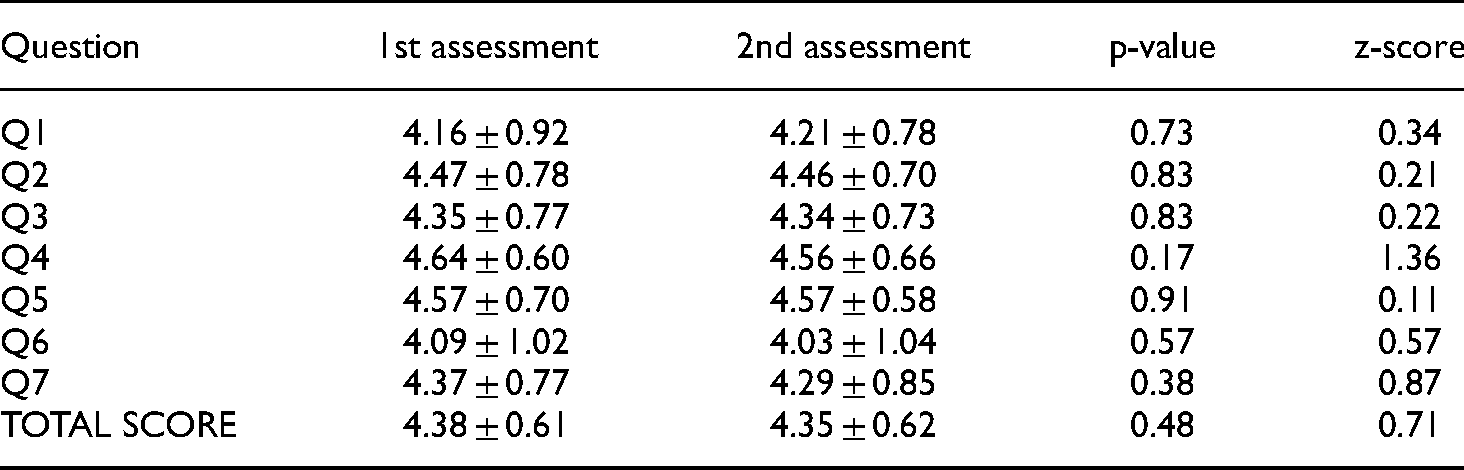
No statistically significant mean changes with repeat completion were found for the total score nor any particular question (on day 0 and day 3–6) for either questionnaire (Tables 1 and 2).
Reproducibility of results of the Functionality Appreciation Scale (FAS).
Reproducibility of results of the Body Shape Questionnaire (BSQ).
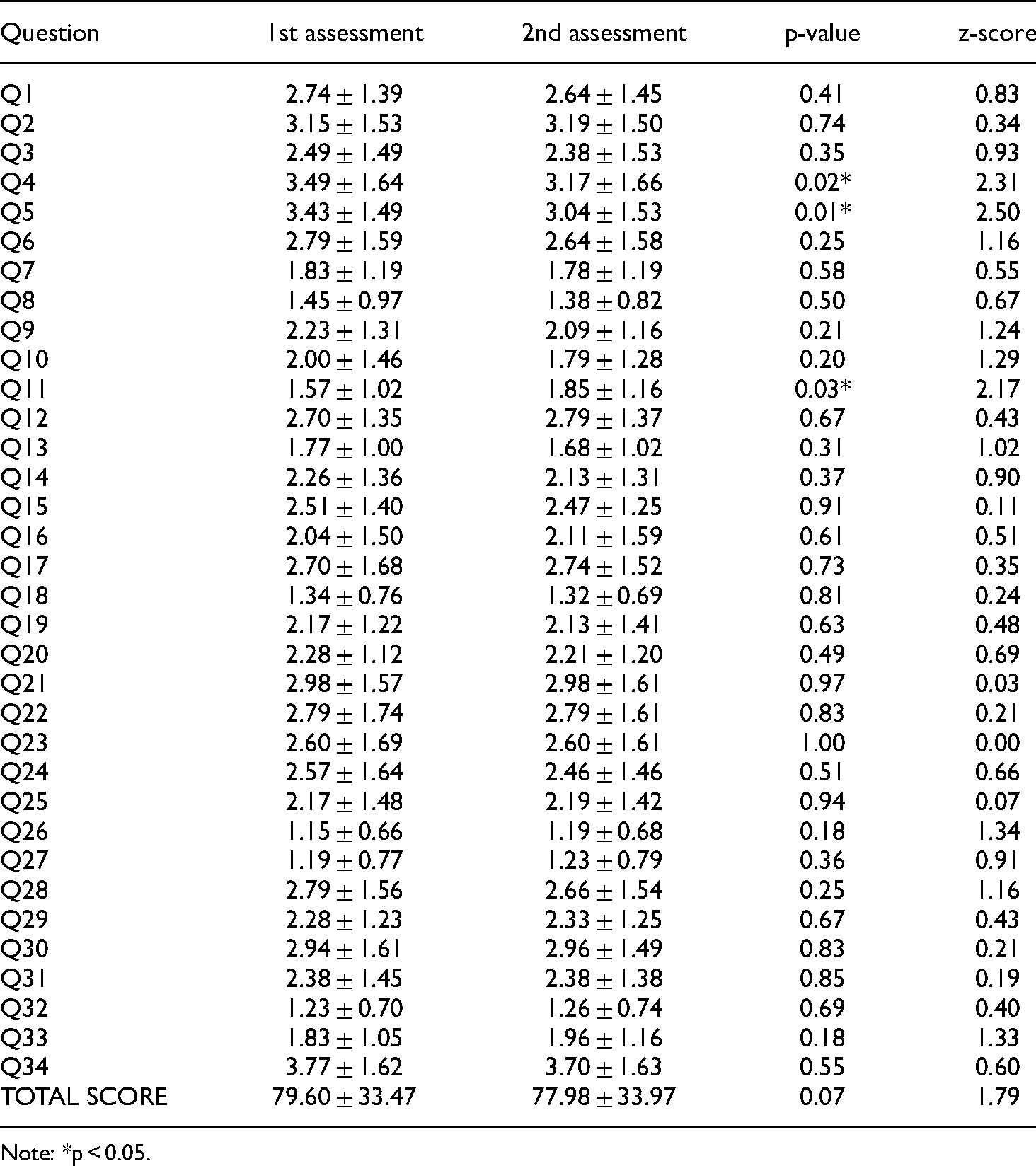
Note: *p < 0.05.
The convergent validity procedure revealed that the BSQ correlated moderately negatively with the BIQLI (RS = -0.30, p = 0.01 95% CI: −0.48 to −0.10), indicating that higher scores on the BSQ were associated with a lower body image quality of life. The convergent validity of the FAS and the BAS-2 was stronger (RS = 0.73, p < 0.001, 95% CI: 0.62 to 0.81) (Figure 1 & 2).

The correlation between total scores of the Body Shape Questionnaire (BSQ) and the Body Image Quality of Life Inventory (BIQLI).

The correlation between total scores of the Functionality Appreciation Scale (FAS) and the Body Appreciation Scale-2 (BAS-2).
Discussion
Research on body image has significantly expanded over the past years resulting in the creation of multiple instruments to assess body image; similarly, as body image is multidimensional, numerous measures exist to rate its various components such as perceptual, evaluative, affective, cognitive and behavioural aspects.4,20 Among these instruments, the BSQ and the FAS have proved useful for a primary evaluation of body image disturbances with the BSQ addressing the body shape preoccupations typical for bulimia nervosa and anorexia nervosa5,6 while the FAS reflects body functionality appreciation. 7
The aims of this report were to document that a thorough translation process was used and to report basic psychometric properties for the Polish version of the BSQ and the FAS in non-clinical samples, as such information is necessary before translated questionnaires are used in clinical practice. Evaluation of the Polish version of the BSQ revealed very good internal consistency and test-retest reliability. It was not possible to compare these results with those from the 1987 original paper as no such statistical analysis was reported there. 5 However, our results were similar to those obtained in other validation works conducted on general populations by: Taylor in 1987, 21 Probst et al. in 2008, 22 Conti et al. in 2009 23 (overall average score 81.5 ± 28.4, Cronbach α coefficient 0.97 for work by Taylor; Cronbach α coefficient 0.97, ICC 0.88 for work by Probst et al.; overall average score 73.9 ± 34.6, Cronbach α coefficient 0.96, ICC 0.91 for work by Conti et al.; compared to overall average score 79.60 ± 33.47, Cronbach α coefficient 0.97 and ICC 0.95 for our data).
Compared to the original version of the FAS questionnaire (conducted on the general population), the translated Polish language version showed a similar, overall average score (4.18 ± 0.63 in the original paper [s.3] vs. 4.38 ± 0.61 here), good test-retest reliability measured with ICC (0.81 in original paper vs. 0.85 in translated one) and internal consistency (Cronbach α coefficient 0.86 in original paper vs. 0.88 in these data). 7
In addition to these very encouraging reliability findings, both questionnaires showed statistically significant convergent validity relationships with other accepted measures of body image (the BSQ correlated moderately, negatively with the BIQLI and the FAS correlated strongly with the BAS-2).
Of course, this study has limitations. Firstly, it was conducted 100% online due to pandemic restrictions which, with the fact that it is an unfunded project, restricted sample size and clarity about the sampling frame. Moreover, the sample is a general population sample, not a clinical sample. The test-retest follow-up period used is shorter than what has been employed for some other psychometric evaluations, but a 3 to 6 days interval is considered sufficiently long, as no statistical differences are observed between such an interval and longer periods. 10 What is more, the questionnaires were designed originally for UK/U.S. populations with some political and cultural differences from the Polish population. However, given how little funding there is for psychometric explorations, and that the BSQ and the FAS are still used currently in many different countries, we decided that there was more than enough justification to proceed with this work for Poland/Polish.
These findings support these Polish versions of the BSQ and the FAS for clinical and research purposes, though these findings should be treated as preliminary but providing a solid foundation to expand research on body image. Future studies, with funding, should involve help-seeking samples, larger samples and more complex designs including more test-retest completions over wider intervals to explore longer-term stability and exploration of sensitivity to change across interventions in help-seeking samples.
To conclude, the preliminary results of the present study demonstrated promising psychometric results of the BSQ and the FAS questionnaires in samples of Polish-speaking individuals. These translated instruments would appear to be suitable for the evaluation of body shape distress in Polish speakers for research or clinical purposes.
Footnotes
Acknowledgements
Advice given by Jessica Alleva from Department of Clinical Psychological Science of Maastricht University in the Netherlands has been a great help in creating the Polish version of FAS.
Declaration of conflicting interests
The author(s) declared no potential conflicts of interest with respect to the research, authorship, and/or publication of this article.
The Polish versions of the BSQ and the FAS are available on request (e-mail: ida.yurtsever@gmail.com).
Funding
The author(s) disclosed receipt of the following financial support for the research, authorship, and/or publication of this article: Publication was funded by Wroclaw Medical University research grants number SUBZ.C260.22.056.

Author biographies
Ida Yurtsever works as dermatologist at prestigious private clinics in both Warsaw and Wroclaw, Poland. She is an expert specially in Aesthetic Dermatology field. She obtained her medical degree from the Warsaw Medical University in 2013 and completed her specialization in Dermatology and Venereology at Hospital of Ministry of Interior in Warsaw in 2019. She is a postgraduate of Aesthetic Medicine School at Warsaw Medical University. She continues to publish articles in multiple peer-reviewed dermatology journals. She is a member of the Polish Dermatology Society and the European Academy of Dermatology and Venereology. As a member of Polish Aesthetic Medicine and Antiaging Society, she continually participates in numerous national and international aesthetic dermatology congresses. Currently, she works on her PhD thesis.
Łukasz Matusiak is a full professor of the Department of Dermatology, Venereology and Allergology of Wroclaw Medical University in Poland. He is a founding member of the EHSF (European Hidradenitis Suppurativa Foundation e.V.) and a member of the Polish Dermatological Society and the European Academy of Dermatology and Venereology. As an author and co-author, he has published nearly 200 scientific publications with total Impact Factor of more than 450. His index “h” is 28. He has participated in many national and international scientific conferences, where he has given more than 150 lectures. His main fields of interests include hidradenitis suppurativa, dermatological surgery, psychodermatology, and immunology of inflammatory skin diseases.
Marta Szepietowska is a medical student of Wroclaw Medical University in Poland. Within the Erasmus Plus program she completed one year of her studies at the Faculty of Medicine of Malaga University, Spain. She is an active member of Student Research Group of the Experimental Dermatology of the Department of Dermatology, Venereology and Allergology. She is an author and co-author of more than 20 scientific publications with a total Impact Factor of more than 40. She was awarded for her research activities with the scholarship by the Polish Ministry of Health.
Chris Evans holds visiting chairs at the University of the Americas (UDLA) in Quito, Ecuador and at the University of Roehampton, London UK. He worked as a medical psychotherapist from 1984 to 1996 with qualifications in analytic/psychodynamic therapy from the Royal College of Psychiatrists, Group Analysis from the IGA, London and Family Systemic Therapy from the Tavistock Clinic and University of East London. He worked clinically from community to forensic high security. Since stopping clinical work he works as an independent researcher with wide interests but particular expertise in psychometrics and routine change measurement, see https://www.psyctc.org/psyctc/ and as maintaining the CORE (Clinical Outcomes in Routine Evaluation) system (https://www.coresystemtrust.org.uk/).
Jacek C Szepietowski is a full professor and chairman of the Department of Dermatology, Venereology and Allergology of Wroclaw Medical University in Poland. He is an Immediate Past President of the European Society for Dermatology and Psychiatry and Past Present of International Forum for the Study of Itch. He is a board member of numerous international scientific societies and a Honorary President of Polish Dermatological Society. Currently he serves as a Chairmen of the Education Committee of International Society of Dermatology. He obtained degree of doctor honoris cause from International Caucasus University in Tbilisi, Georgia. He is an author and co-author of more than 700 scientific publication with total Impact Factor of more than 1500. His index “h” is 58. His mail fields of interests include itch, psychodermatology and inflammatory skin diseases, including hidradenitis suppurativa.