



Abstract
To improve the conical pick cutting performance by per cutting to the free surface. The cutting performance of rock and rock plate breaking are investigated by theoretical and experimental methods. Analyzed the fracture position of the rock plate with constrained one side by the pick to study the effect of rock properties and the rock plate structural parameters on cutting force. The results indicated that the rock plate fracture is mainly from the constrained side and center of the rock plate. The cutting force of the conical pick is significantly affected by the rock plate structural parameters and the constraint sides of the rock plate number. The cutting force increases obviously with the increase of plate thickness, cutting point depth, and the rock uniaxial compressive strength. However, the influence of rock plate constrains sides number is opposite. It provides a basis for improving the cutting performance of pick and predicting the rock plate fracture.
Introduction
Roadheader is common equipment in roadway excavation, and pick the primary rock breaking tool of roadheader. In hard rock cutting, there is a problem of severe wear, which causes the production cost to increase. The research on the rock breaking mechanism of the pick is of great significance for optimizing the cutting parameters and improving the conical pick cutting performance.
Aiming at the rock breaking mechanism of pick, many scholars, at home and abroad, have done a lot of research in theory, experiment, and numerical methods. Yasar et al. 1 pointed out that the mechanical model of rock breaking by pick should include ductile-brittle transition by comparing the experimental and theoretical results of cutting force. Wang et al. 2 studied the specific cutting energy consumption of cutting sandstone with a pick with the fracture mechanics. Li et al. 3 found that the rock damage is mainly a plastic failure, and the rock fracture is a predominantly brittle failure. Wang et al. 4 studied the relationship between the surrounding rock pressure and the cutting force of pick by using the test bench and pointed out that hard rock's machinability and brittleness index under high confining pressure is related to the strength parameters and brittleness index of rock materials. Yasar et al. 5 obtained that the maximum cutting force and the average force ratio is 2.45. Liu et al. 6 studied the separation of rock fragments in the hard rock cutting process with the cutting test bench. Bilgin et al. 7 and Balic et al. 8 applied the linear cutting machine to study the main factors affecting the rock breaking performance and pointed out that the uniaxial compressive strength, tensile strength, static and dynamic elastic modulus of rock are the main factors affecting the rock breaking performance of the cutting tool.
In the aspect of numerical simulation, Gao et al. 9 established a theoretical model of rock breaking with the conical pick to forecast the maximum cutting force, and built a rock cutting fracture model based on the maximum tensile stress criterion. The comparison between the model and models of Evan10,11 and Nishimatsu 12 shows that the prediction model is more reliable and accurate. Li et al. 13 pointed out that the peak cutting force occurred in the crack stage rather than the fragment separation stage. The peak cutting force is positively correlated with the fracture toughness and cutting depth of rock with the fracture mechanics. Menezes et al.14,15 applied the secondary developed finite element constitutive model to simulate and analyze cutting tool breaking rock progress and simulated the debris separation. Zhao et al. 16 simulated the drum breaking coal process and found that traction speed is an essential factor affecting the cutting force of the drum and the stress of the pick. Li et al. 17 used PCF(2D) to investigate the influence of rock brittleness on rock fracture morphology and the cutting performance. Li et al. 18 researched the rock cutting with a conical pick with confining pressure based DEM, and the results show that the cutting force with confining pressure is more significant than that without confining pressure. Wan et al. 29 studied the falling crushing process of coal based on LS-DYNA. Zeng et al. 19 studied the cutting performance of conical pick in the rock cutting process. Lu et al.20–24 proposed a combined cutting method of saw blade-pick and studied the cutting force of rock under different conditions. Wang et al.25,26 researched the effects of the cutting parameters of diamond sawblades on cutting rock and investigated the relationship between cutting force and cutting parameters of the conical pick in the rock cutting process.
To reduce pick wear and to improve rock breaking efficiency, a rock breaking method of the per-cutting free surface has been proposed. Firstly, the rock's free surfaces are cut by the diamond sawblades to form the rock plate, which can reduce the strength of the rock and then break the rock plate with the pick. The experimental study on the breaking characteristics of the conical pick cutting rock plate with one side constrained and three sides free is conducted. Firstly, the bending state of the rock plate with one fixed side and three free sides under the cutting with the conical pick. Based on the reciprocal theory of work to solve bending of rock plate, and predict the rock plate fracture position. In order to study the cutting force and breaking shape of the free rock plate with fixed one side and three sides broken by pick, the cutting and breaking test of the rock plate was carried out by using the test bench.
Theoretical research of pick cutting rock plate
The diamond sawblades cut rock to form a rock plate, which can increase the surface number of rock and reduce the rock strength, as shown in Figure 1. In the process of diamond sawblades cutting rock, due to the vibration of diamond sawblade and rock geological conditions, the constraints of the rock plates are different, such as: rock plate with three constrained edges, rock plate with two adjacent constrained edges and rock plate with one constrained edge, as shown in Figure 2. In order to analyze the conical pick cutting rock conveniently, the rock plate formed by diamond sawblades cutting simplifies into a rectangular rock plate. Therefore, the rock plate with one constrained edge is simplified as the rectangular rock plate with one constrained edge and three free edges.

The diamond sawblades cutting rock.

Three kinds of constrained condition of rock plate: (a) three constrained edges (b) two adjacent constrained edges (c) one constrained edge.
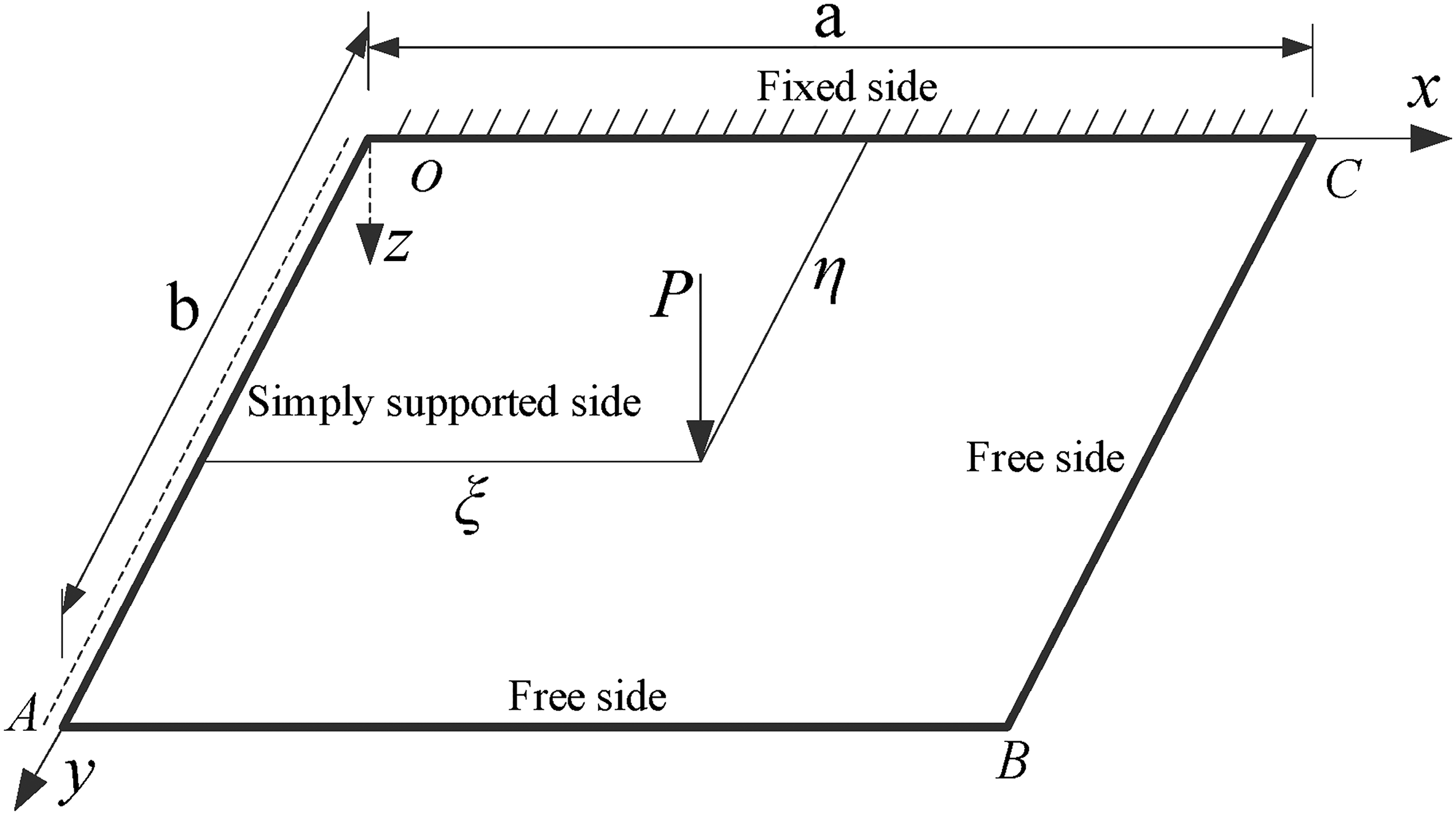
The boundary conditions of rock plate.
The boundary condition of the rock plate with one side constrains
There are three kinds of boundary conditions of the rock plate: fixed, simply supported, and free. The rock plate with one side fixed and three free sides are shown in Figure 1, OC edge is fixed, OA, AB, BC edges are free, according to Fu et al. investigation.27,28
(1) The fixed edge
The deflection and rotation angle on the fixed edge y = 0 is zero, and the boundary condition as follows:

(2) Simply-supported edge
The bending moment and deflection on the simply supported edge x = 0 are zero, the boundary condition is as follows:

(3) Free edge
For x = a free edge, the bending moment and distributed shear force are zero. The boundary condition is as follows:

when the corner is free, the static condition is as follows:

Solution of bending function of rock plate
According to the reciprocal theory of work, 28 in elastic space, the sum of work done by the first group of external forces and bending moments on the corresponding displacement of the second group of forces is equal to the sum of work done by the second group of forces and bending moments on the corresponding displacement of the first force group. The reciprocal theorem of work defines two force systems: the basic and practical bending systems. The rock plate basic bending system is the rock plate simply bending supported on four sides under concentrated load, which has a particularity, plotted as Figure 4 (a). The existing system of rock plate bending is the rock plate bending under arbitrary conditions and general stress conditions, as shown in Figure 4 (b). The current system is based on the primary system.

Solving system of bending rock plate.
Based on the reciprocal theory of work, the basic system is shown in Figure 4 (a) is transformed into the existing system, presented in Figure 4 (b), define the coordinate of the action point of force P is the (


The rock plate deflection surface equation is force function, torque, and bending moment. For the actual systems with different boundary conditions and loads, assume the bending moment on the boundary and the deflection caused by deformation. The deformation characteristics of the rock plate are obtained by satisfying different boundary conditions and then getting the normal stress and other internal force of the rock plate. It can be noted by equation (7) that the rock plate bending in the existing system is necessary ω(ξ, η). In order to solve the problem, we need to solve the primary system by solving the ω1(ξ, η) firstly. According to the introduction of the reciprocal theorem of work in reference, 28 the basic system is a fixed, known system. The boundary value of the fundamental solution has been given by the differential equilibrium equation of thin plate bending and the reciprocal theorem of work. Therefore, in solving the boundary, the ω(ξ, η) is a known quantity, which only solves the actual system boundary torque and deflection.
Bending analysis of rock plate confined by one side
The rock plate with one unilateral constraint is a rock plate with one fixed and three free edges. The mechanical model is shown in Figure 5, where OC is the fixed edge and OA, AB and BC are the free edges.

The mechanical model of a rock plate with one edge constraint under concentrated load.
To solve the equilibrium differential equation, the fixed edge of OC is equivalent to the supported edge with bending moment. And the assumptions are as follow:


Bending and moment of fixed rock plate boundary when P acts on the midpoint of y = 0 free edge.
Set up the rock plate cutting with pick testing bed
The rock plate crushing test bench is built to carry out the experimental research, which mainly includes a hydraulic power system, the rock plate cutting rock mechanism, and the signal acquisition system, which are plotted in Figure 7. The hydraulic power system is composed of the pump station, the hydraulic system control unit, and the oil cylinder, which is used to provide power for the cutting structure. The cutting mechanism of the rock plate is composed of the clamp, pick and guide rail, which is used for cutting and crushing rock plates. The signal acquisition system is composed of a static torque sensor, signal acquisition instrument, transmitter, and the computer used to collect the voltage signal of the static torque sensor. The voltage signal of the static torque sensor is proportional to the torque so that the torque can be obtained from the voltage signal, and then the cutting force can be obtained.
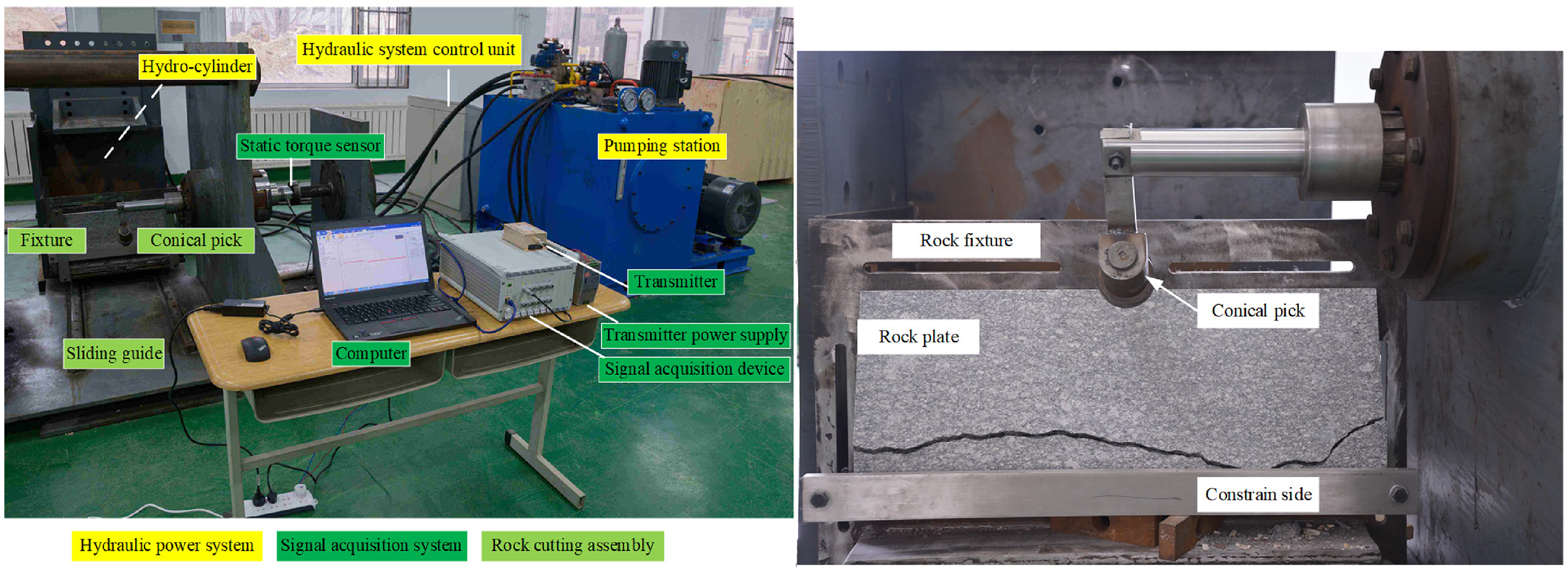
Rock plate crushing experimental bench.
The fracture randomness of two adjacent and three edges constrained rock plates will form one edge constrained rock plate in the process of cutting fracture. Compared with the former two constraint conditions, the rock plate lacks the fixed action of both sides, and its fracture morphology and cutting force will change significantly. The influence of rock properties, cutting depth of rock, the thickness, the width, and the height of the rock plate on breaking shape and cutting force is studied by experiment.
The cutting force curve of conical pick in the cutting progress with the experimental method, is shown in Figure 8. The cutting force curve of conical pick cutting rock is divided into three stages, (a) no-load stage of conical pick, (b) conical pick cutting rock plate stage, (c) the stage after rock plate broke. The rock fixture moves to the conical pick, the signal of static torque sensor maintains 0 value and slight fluctuations, as shown in Figure 8 (a); the cutting force curve of conical pick contacts and breaks rock plate is shown in Figure 8 (b); the conical pick continues to move without load of conical pick, as shown in Figure 8 (c).

The cutting force curve of conical pick in cutting rock process.
Results and discussion
Influence of rock properties on pick cutting performance
The pick cuts granite, marble, sandstone-1, sandstone-2 with a height of 200 mm, a width of 500 mm, and a thickness of 20 mm. The parameters of four kinds of rocks’ mechanical properties are shown in Table 1. The cutting result of sandstone-1 and granite plate constrained by one edge are presented in Figure 9. It can appear from the figure that the integrity of the rock plate fracture is good. The sandstone-1 shows an overall fracture under the cutting with the pick, as presented in Figure 9 The rock plate breaks at the fixed boundary at the bottom, and the broken part accounts for a large proportion of the whole rock plate. The rock plate that has not been cut is confined by one side. As shown in Figure 9 (b), the overall fracture of granite is equal in size and also occurs at the fixed boundary at the bottom. Because when the fixed boundary does not constrain the rock plate on both sides, the force exerted by the pick on the rock plate will produce a large bending moment and internal force on the fixed edge. Therefore, the rock plate is more likely to break from the edge with fixed.

The cutting results of the rock plate with different properties.
The mechanical properties of rock.

The four kinds of rocks cutting force change with times is shown in Figure 10. It can be seen that the peak cutting force of sandstone-2 with the largest compressive strength is the largest, and that of the marble with the minor compressive strength is the smallest The cutting force rapidly declines to zero after reaching the peak cutting force according to the characteristics. There is no cutting force fluctuation after the peak cutting force, and it rapidly drops to zero.
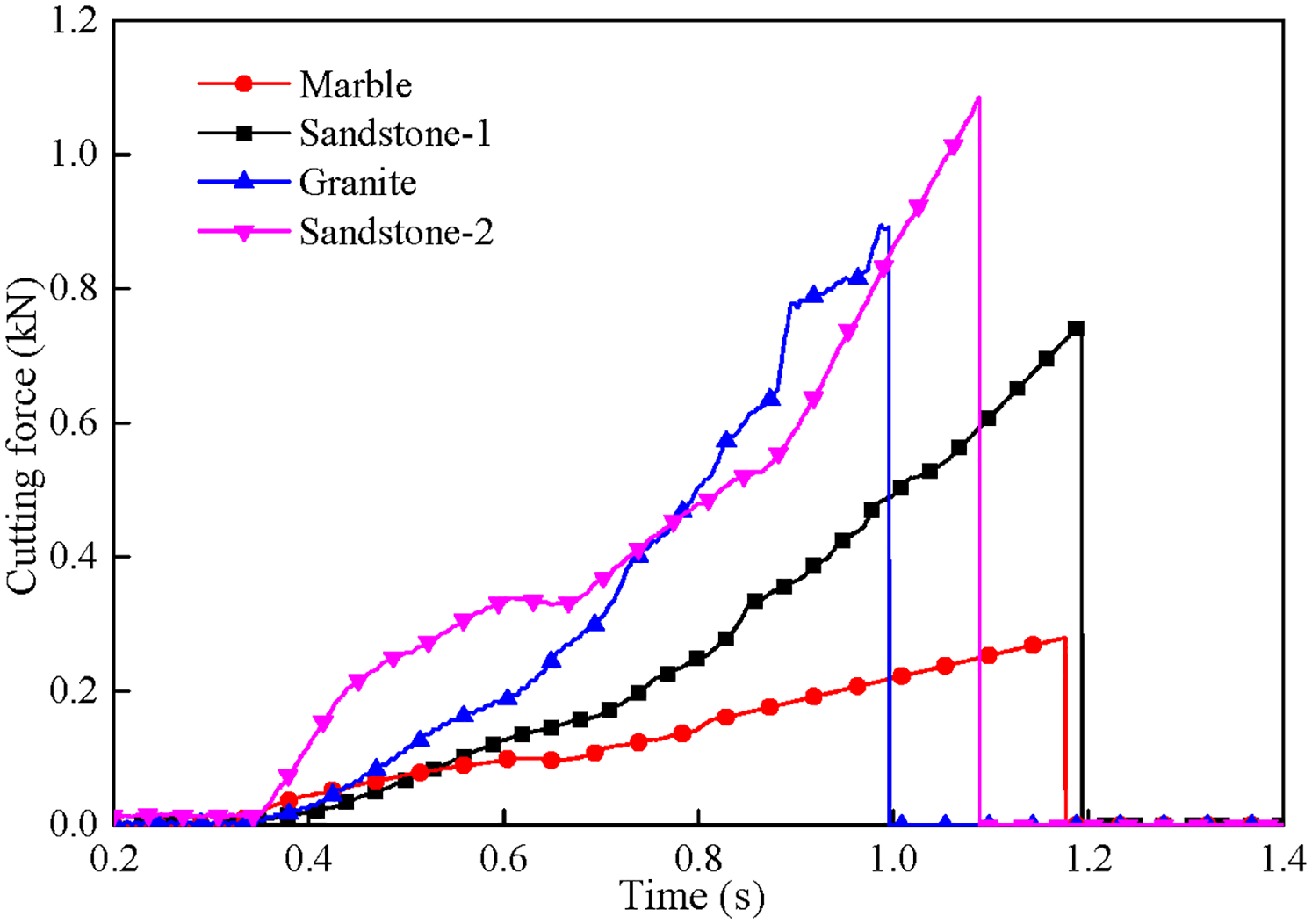
Variation in cutting force with time.
The peak cutting force with rock compressive strength variation and the fitting curve between them are shown in Figure 11. The peak cutting force of marble is 0.286 kN, that of sandstone 1 is 0.549 kN, that of the granite is 0.899 kN, and that of sandstone is 1.135 kN. According to the fitting curve of Figure 11, it appears that the peak cutting force rise with the proctor hardness increasing. There is a linear correlation between the proctor strength and the peak cutting force.
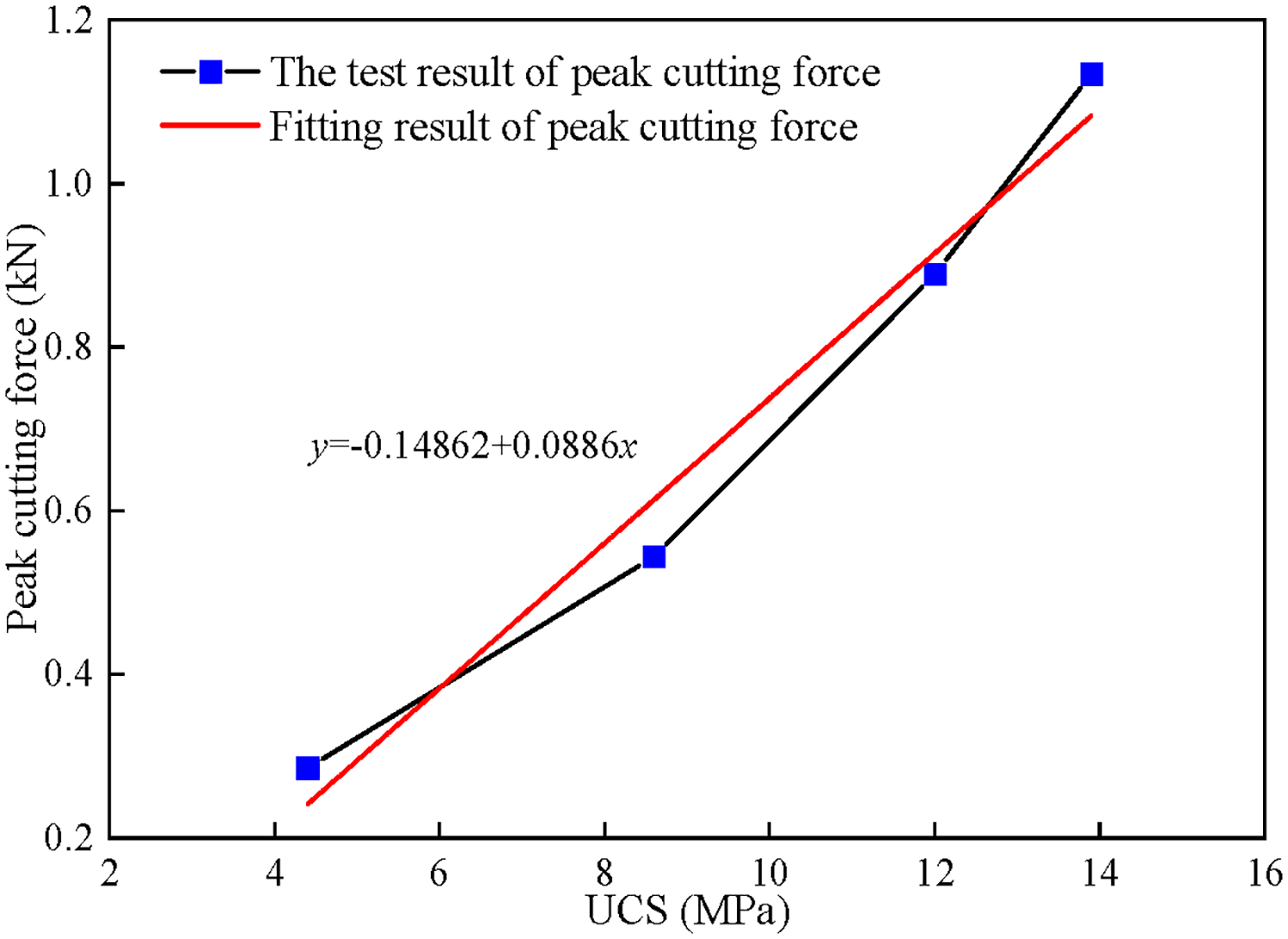
Variation in peak cutting force with UCS.
Influence of the rock plate thickness on conical pick cutting performance
The rock plate fracture with a height of 200 mm, a width of 500 mm, the thickness of 16, 20, 26, and 30 mm were cut by conical pick to research the influence thickness on pick cutting performance. The conical pick cutting rock plate results with the thickness of 16 and 26 mm are presented in Figure 12. As a result of picking a cutting rock plate with a thickness of 16 mm, and the rock plate breaks laterally near the edge fixed. When the rock plate thickness is 26 mm, a crack is parallel to the edge fixed and a vertical crack in the middle of the rock plate.
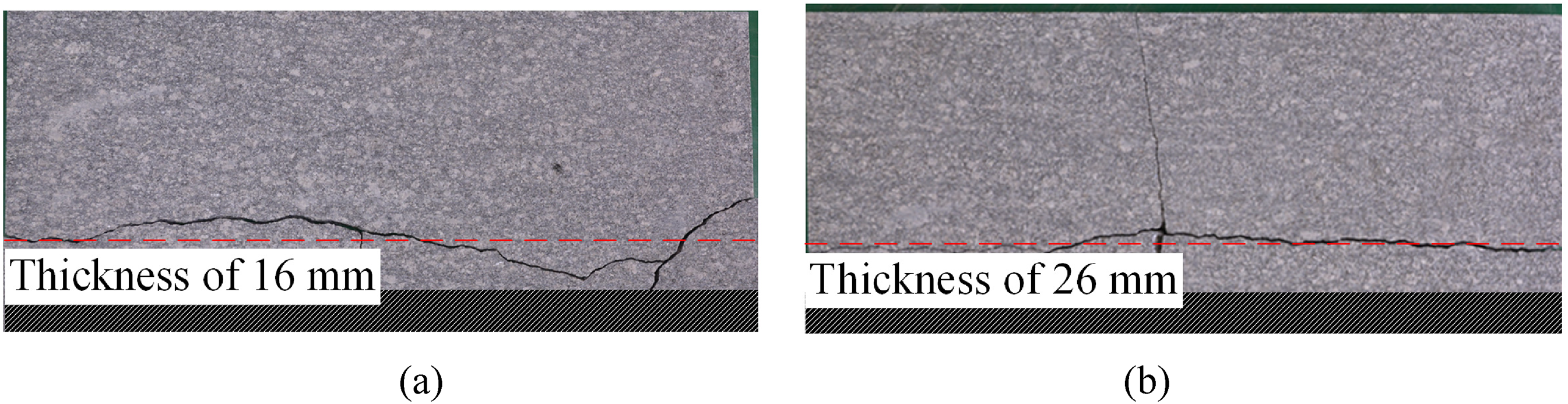
The conical pick cutting rock plate results with various thickness.
The cutting force of pick cutting rock plate change with various thicknesses is shown in Figure 13

Variation in cutting force with time.
The peak cutting force variation with thickness and the fitting curve is presented in Figure 14. The peak cutting force increase with the increasing rock plate thickness. The difference of cutting force between rock plates with thicknesses of 16 mm and 20 mm is 0.381 kN, while that between rock plates with thicknesses of 26 mm and 30 mm is 0.611 kN. The greater the thickness greater the variation range of cutting force is. The fitting formula shows an exponential positive correlation between the rock plate thickness and the peak cutting force.

Variation in peak cutting force with the thickness.
Influence of rock plate width on the conical pick cutting performance
The rock plate fracture results with a height of 200 mm and a thickness of 20 mm at the width of 200 mm, and 300 mm are plotted in Figure 15. When the width is 200 mm, the fracture of the rock plate is divided into two parts, and the width is 300 mm, the whole fracture of the rock plate. Through comparison, it is found that the granite in Figure 15(a) breaks along the fixed boundary into parts, and the granite with 300 mm breaks along the fixed edge as a while, as shown in Figure 15(b). It can be concluded that for the unilaterally fixed rock plate, when the height is 200 mm, and the width of the rock plate is different, the most likely fracture is two parts along the fixed edge or one part along the fixed edge.

The cutting results with different rock plate width.
The change curve of cutting force with time is plotted in Figure 16. While the rock plate width of 200 mm, the cutting force of 0.604 kN, while the width of 300 mm, the cutting force is 0.857 kN, and the peak cutting force is smaller than others when the width is 200 mm. However, the peak cutting force has little difference when the width is 300 mm, 400 mm, and 500 mm.

Variation in cutting force with time.
The variation of peak cutting force with the rock plate width and the fitting curve between them are presented in Figure 17. The peak cutting force first increases and then tends to be stable with the increases of the width of the rock plate, and in the area where the peak cutting force increases, the increase range is not large. It indicated that the influence of the rock plate width on cutting force has a certain rule in the 200 mm to 500 mm field, but the peak cutting force changing value is not big. There is an exponential positive correlation between the peak cutting force and the rock plate width, as shown in Figure 17.
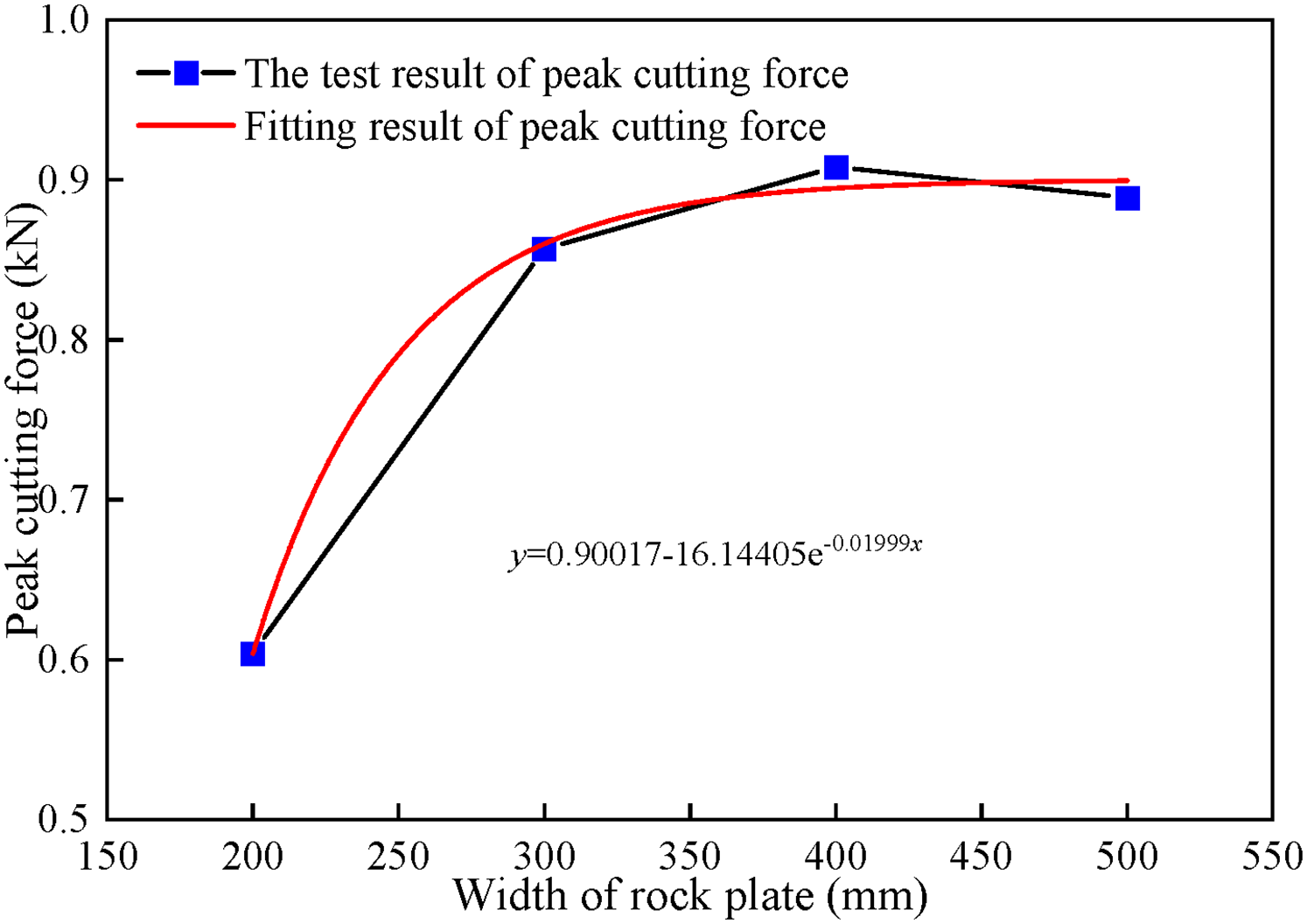
Variation in peak cutting force with cutting depth.
Influence of rock plate height on conical pick cutting performance
The cutting results of the rock plate with a width of 500 mm and a thickness of 20 mm, and the height of 120 mm, and 160 mm are shown in Figure 18. Compared with the results of rock plate height of 200 mm, the cutting result is different. When the height of the rock plate is small, the number of blocks formed by the rock plate breaking is more, and the location and result of the fracture are similar to those of the two adjacent edges constrained rock plate. The fracture is along the lower fixed boundary on one side of the cutting position, and on the other side, the fracture degree is small. Because several parts of the rock plate can't be broken, the rock plate with a smaller height needs to be cut many times, so for the rock plate with one side constraint. It is more conducive to improve the cutting effectively when the rock plate height is larger.

The cutting results with different rock plate height.
The change of cutting force with time and statistics of peak cutting force under different rock plate heights are shown in Figure 19. The variation of peak cutting force with height and the fitting relationship between them are shown in Figure 20. The peak cutting force decreases with the increase of rock plate. When the height is 200 mm, the peak cutting is the smallest, 0.889 kN, and the peak cutting force is 2.953 kN with the rock plate height of 80 mm. There is a negative linear correlation between the rock plate height and the peak cutting force.

Variation in cutting force with time.

Variation in peak cutting force with height.
Influence of cutting point depth on pick cutting performance
The cutting results of the granite plate with the width of 500 mm, the thickness of 20 mm, and the height of 200 mm under different cutting depths are shown in Figure 21. It is evident that when the cutting depth is 4 mm and 36 mm, respectively, the cutting results are the same, and they are all fractures along the lower fixed boundary, which indicates that the cutting depth of pick has little effect on the fracture morphology of the strained rock plate on one side.

The cutting results of a rock plate with the different cutting depths.

Variation in cutting force with time.
The variation of cutting force with time under various cutting depth is shown in. The cutting depth of pick has a significant influence on peak cutting force. The peak cutting force is 0.565 with a cutting depth of 4 mm, while the cutting depth is reaching 45 mm, the cutting force is 1.578 kN. The peak cutting fore changing rule with time is shown in Figure 23. According to experimental results, it is evident that the peak cutting force increases with the increase of cutting depth, and there is a positive linear correlation between the peak cutting force and pick cutting depth.

Variation in peak cutting force with cutting depth.
Influence of constrains condition on plate cutting performance
According to the investigation of Lu et al.21,23 and the investigation of the paper, the cutting process of rock plate under three side constraints, two adjacent side constraints, and one side constraint are studied. The cutting force is different with different cutting conditions for the same kind of rock plate. With the same cutting parameters in the experiment, the cutting force of three different constraint rock plates is shown in Figure 24. It is indicated that the peak cutting force of rock plate with three edges is the largest, and the peak cutting force of one edge constraint is the smallest Therefore, it is concluded that the number of edge constraints greatly influences the cutting force of pick.
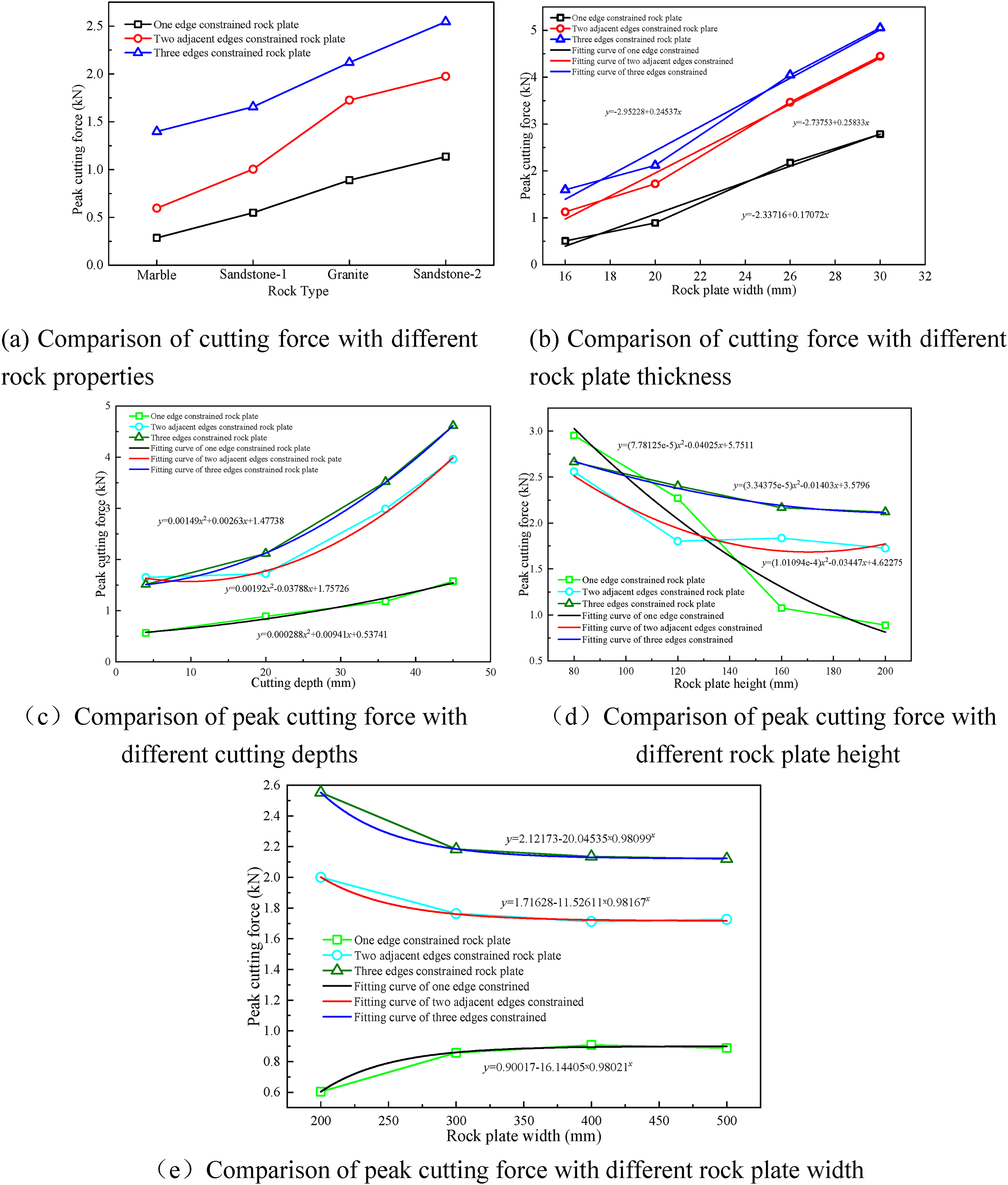
The comparison of peak cutting force between three different constraint conditions.
Conclusion
Based on the theory and the experiment, the crushing performance of rock plates with one edge constraint by the pick is studied, and the influence of the structural parameters of the rock plate on the cutting force and rock crushing is analyzed. The results are as follow:
(1) Based on the theory of the thin plate fracture, the fracture of a rock plate with one edge constraint is analyzed. It is concluded that the maximum stress of the fixed edge and the rock plate's the free edge in the first fracture.
(2) The pick cutting force of pick increases with the increase of uniaxial compressive strength of rock, the thickness of rock plate, and pick cutting depth. The cutting force first increases and then tends to be stable with the increase of rock plate width. The cutting force of pick decreases with the rise of rock plate height.
(3) The cutting force of one edge constraint is smaller than that of the other two kinds of constraint models.
Footnotes
Acknowledgments
This work was supported by the Shandong Provincial Key Research and Development Project (2019SDZY01), the Natural Science Foundation of Shandong Province (Grant No. ZR2019BEE069) and the National Natural Science Foundation of China (Grant No.51974170).
Conflicts of interest
There are no conflicts of interest regarding the publication of this paper.
Data availability
The data used to support the findings of this study are included in the article.
Declaration of conflicting interests
The author(s) declared no potential conflicts of interest with respect to the research, authorship, and/or publication of this article.
Funding
The author(s) disclosed receipt of the following financial support for the research, authorship, and/or publication of this article: This work was supported by the Shandong Provincial Key Research and Development Project (grant number 2019SDZY01, ZR2019BEE069) and the National Natural Science Foundation of China (Grand Number 51974170).
