




Abstract
Lancet needle is a typical medical treatment device. Its tip consists of two lancet planes and one bevel plane. When the lancet needle is inserted into soft organ tissue, the insertion force may influence the needle cutting direction and treatment effect and increase the pain. One of the main factors affecting this insertion force is the geometry of the needle tip. Based on the research on the shape and processing method of the conventional lancet needle, a new lancet needle tip geometry was obtained by adjusting the relative position of the grinding wheel to the needle. A mathematical model of this new lancet needle was established. The relationship between processing parameters and needle shape was analyzed, and the needle insertion force was predicted. Compared with the conventional lancet needle, the new lancet needle is sharper, and the insertion force on the cutting edge is smaller. However, this change in the grinding position of the needle lancet plane has a great influence on the shape of needle tip near the intersection of the bevel plane and the lancet plane. Some special second bevel angle and rotated angle will cause a large change in the specific force at the intersection place, which is not conducive to reducing the insertion force.
Introduction
Medical needles are widely used in medical treatment for injection or blood sampling purposes.1–3 When the needle is inserted into a human organ, an insertion force is generated between the needle and the organ tissue. This force may influence the needle inserting direction3–5 or increase pain.5–10 Therefore, it is important to reduce or minimize it for achieving better medical treatment. The sharpness of the needle tip is closely related to the insertion force. Li et al. 11 polished the needle using the magnetic abrasive finishing technique and then measured the axial force—including tip cutting force, inner friction force, and outer friction force—during insertion of a hollow needle into a tissue-mimicking sample. The results showed that unpolished needles had a tip cutting force 22% higher than polished needles. Needle insertion in soft tissue is essentially similar to a knife cutting. The insertion force greatly depends on the needle tip’s cutting-edge geometry.12–23 On the basis of the geometry of the needle tip and its fabrication method, two parameters—inclination angle and rake angle—are used to develop the mathematical models of needle.12,14–18 Many studies have been conducted about the insertion force of needle.21–31 Moore et al. 20 developed a predictive force model based on the inclination angle and the rake angle of a needle’s cutting edge to predict the insertion force and studied a novel needle cutting-edge geometry for end-cut biopsy and curved needle tips based on rake and inclination angles.13–15 The rake angle is the angle of the rake face with respect to the perpendicular to the cut surface. It is believed that a larger inclination angle will lead to a lower cutting force and a larger rake angle will lead to a sharper needle edge.10,14,15,17,21
Currently, there exists a wide variety of needle tip geometries. Lancet needle usually has complicated cutting edges,16,18,24 which are generated by the intersection of the needle tube surface and the bevel plane or the needle tube and lancet plane. A rake angle together with the inclination angle and edge radius properly describes the cutting edge.17,24 Studies have been conducted to investigate the effects of needle tip geometry on the insertion force and needle sharpness.12–18,25–31 Chebolu et al. 25 investigated the relationship between the insertion forces and the cutting-edge geometry and proposed two novel needles. Wang et al. 24 described the fabrication procedure of the conventional lancet needle and developed a mathematical model to calculate the inclination and rake angles along the cutting edge of this needle.
In this article, after gaining an in-depth understanding of the definition of lancet needle geometry and the relationship between needle fabrication parameters and insertion force, based on the studies of the conventional lancet needle, a new lancet needle tip geometry was proposed in order to achieve a smaller insertion force. The fabrication parameters of this new lancet needle were described and its mathematical models were developed to calculate the inclination and rake angles along the cutting edges. The shape of this new lancet needle was studied. The specific forces on the cutting edge were calculated. The insertion force is the sum of the specific force in the cutting edge and leading edge. The insertion force of the new lancet needle was studied, and it is found that the insertion force produced by this new lancet needle during insertion into tissue is lower than that produced by the conventional lancet needle with the same fabrication parameters.
Needle geometry
There are three main parameters in processing a lancet needle—bevel angle, second bevel angle, and rotated angle. The conventional lancet needle,
24
as shown in Figure 1, is fabricated in four steps. In step 1, the needle tube is grinded along a bevel angle δ. Point P is the highest point of the intersection line of the first grinding plane and the needle tube outer surface. In step 2, the grinding plane rotates to a secondary bevel angle

Conventional lancet needle tip grinding procedure.
In this article, we fabricate the needle tip geometry by changing the third and the fourth grinding plane positions. As shown in Figure 2, in step 1, the needle tube is grinded along a bevel angle δ, as described in Figure 1. In step 2, point P is moved along the Z direction l distance to point C and grinding needle tube along the second bevel by angle
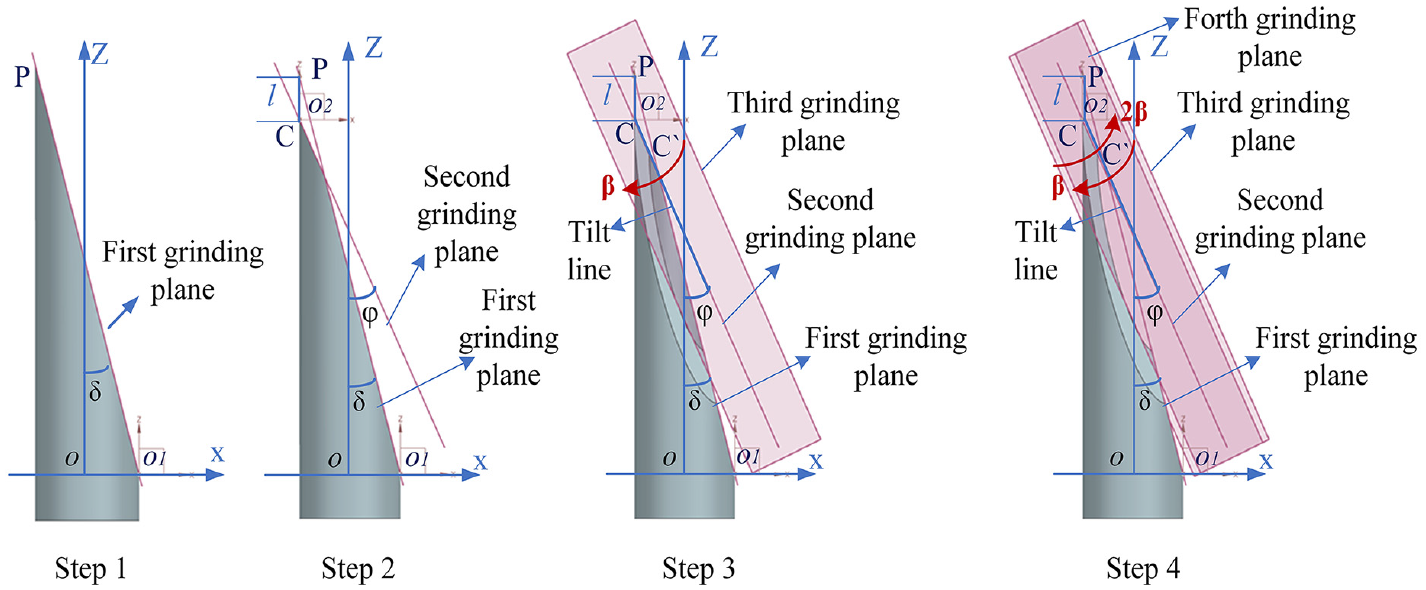
New lancet needle tip grinding procedure.
Mathematical model and parameter analysis of new lancet needle
Mathematical model
The parameter γ marks the angular position of a point on the cutting edge in the xy-plane measured from the x-axis, as shown in Figure 3(a). The inclination angle λ is defined as the angle between the tangent to the cutting edge and the plane perpendicular to the cutting direction, as shown in Figure 3(a). 20 The rake angle α is defined as the angle between the plane perpendicular to the cutting direction and the plane of the needle tip face surface measured in the plane with normal vector that tangent to the cutting edge. Vector a is the intersection line of plane Pn and Pr, and vector b is the intersection line of plane Pn and Ar. Pr is the plane at the cutting point and parallel to the xy-plane. Ar is the face plane of the needle tip surface. Pn is a plane with a normal vector s, vector tangent to the cutting edge. 14

New lancet needle: (a) definition of inclination angle λ and (b) definition of rake angle α.
As mentioned by Han et al., 12 the parametric equation of the first grinding plane with a needle of radius r is given by



For the second grinding plane, its parametric equation can be given by


From the parametric equation of the first and the second grinding planes, the normal vector of the first plane at a point on the cutting edge is
According to the principle of graphic transformation, the normal vector



Therefore

Then, the parametric equation of the third grinding plane is given by


The tangent vector at a point on the lancet plane cutting edge can be expressed as

As shown in Figure 3(b), vectors a and b are defined using the cross-products of the normal vectors s and

The inclination angle and rake angle along the cutting edge of the new lancet needle are given below:
In Section 2 (lancet plane)


In Section 1 (bevel plane)


As shown in Figure 4, line EF is the intersection of the lancet plane and the bevel plane or the intersection of the third grinding plane and the second grinding plane. Line PB (the intersection of the first grinding plane and the xz-plane) and line CD (the intersection of the second grinding plane and the xz-plane) cross at point D.

New lancet needle geometry: (a) left view and (b) top view.
The function of line PB is
The function of line CD is
Therefore, the coordinate of point D is


The direction

Then, the slope m of the intersection of the first grinding plane

Since line FE passes through point D, the function of line FE in Figure 4(b) can be expressed as
The intersection point E in the xy-plane is given by

Therefore


For the conventional lancet needle, the inclination angle λ and the rake angle α for cutting edge in Section 1 and Section 2, respectively, are 11
In Section 1


In Section 2


Parameters analysis
The shape and size of the new lancet needle are determined by parameters used to fabricate it. The change in the inclination angle and the rake angle on the cutting edge reflects the effect of fabrication parameters on the size and shape of the needle tip. In this part, the relationship between needle mathematical model, needle shape, size, and fabrication parameters will be discussed. The inclination angle curve and the rake angle curve of cutting edge of the new lancet needle and the conventional lancet needle will be drawn based on the derived equations.
Offset distance l
Figure 5 shows the needles fabricated with different offset distance l. The needle tip geometry is composed of two kinds of plane: bevel plane and lancet planes. With the decrease of l, the needle tip length and the bevel plane length increase and the length of leading edge CC′ decreases. A small portion of the bevel plane appears besides point C′ when l is smaller than 0.9785 mm. Distance l significantly affects the size of the needle tip geometry but slightly affects the shape of the lancet plane.
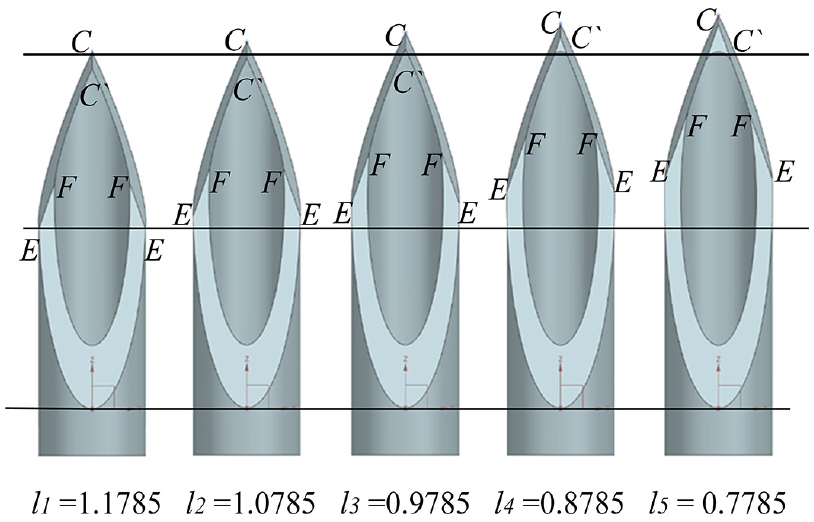
New lancet needles fabricated with different offset distance
Bevel angle
The

The tip geometry, rake angle, and inclination angle for needles produced with different bevel angles:
Second bevel angle
Figure 7(a) shows the new lancet needles with various

Needles produced with different second bevel angles:
Rotated angle β
Figure 8(a) shows the new lancet needles grinded with various β. The position of point E on the new lancet needle shows that β does not affect the whole length of the needle tip and leading line CC′ but affects the position of transition line EF. When β changes, the shape of the new lancet needle changes significantly. When β = 45°, 55°, and 65°, the angle γ = 82°, 69°, and 56°. The influence of β on the inflection point on the curve of the rake angle and the inclination angle of the new lancet is greater than that of the conventional lancet needle, as shown in Figure 8. In Section 1, β does not affect the rake angle and the inclination angle for both kinds of needles. In Section 2, when having the same β, the inclination angle of the new lancet needle is greater than the inclination angle of the conventional lancet needle and the rake angle of new lancet needle is obviously larger than the rake angle of the conventional lancet needle. For the new lancet needles, when β increases, the lancet plane of the needle becomes larger and more of the needle tube is grinded away. The inclination angle near the transition point changes drastically. Therefore, even if most of the points on the new lancet needle cutting edge have a larger inclination angle and the needle is sharper near the needle tip point, it is not sharper near the intersection of the bevel and the lancet plane. The inclination angle is small near line EF in Section 2. In short, for the new lancet needle, even a larger β will result in a larger inclination angle and rake angle in Section 2, but it will also result in a very small or negative inclination angle near the transition line. As shown in Figure 8(B), for conventional lancet needle, the position of line EF on different needles is different, but the angle γ of the inflection point on the inclination curve and the rake curve of different needles only have a small change.

Needles produced with different rotated angles:
Specific force
It has already been demonstrated that the inclination angle and the rake angle can significantly affect the insertion force.12–16 As shown in Figure 3, when needle moves along the cutting direction, after tip point C is inserted into organ tissue, the leading edge CC′ and cutting edge curve CE cut open the tissue, then the cutting curve edge FF of the bevel plane in Section 1 will cut into the tissue 16 and the needle tube gets inserted. The size of the wound on the inserted tissue surface is determined by the needle tube size, needle tip shape, and the angle between needle cutting direction and inserted tissue surface. The insertion force consists of two parts: the first is the friction between needle tube outer surface and organ tissue, and the second, more important, is the cutting force of needle tip.17–20 In Section 2, the cutting edge is curve CE. In Section 1, the cutting edge is curve FF (the intersection of needle inner tube and first grinding plane). Moore et al. 20 proposed a model in equation (31) with inclination angle and rake angle as parameters to predict the specific force of every point on the cutting edge of the needle along the inserting direction based on experiment result

When the needle cuts open organ tissue, the organ tissue will only contact with the lancet cutting edge or contact with both the cutting edge CE of the lancet plane and the cutting edge FF of the bevel plane, which will be determined by the inserting angle (the angle between the needle centerline and cutting direction) and tissue property. Therefore, the insertion force is the sum of the specific force in cutting edge and the leading edge in equation (32)

where FN is the insertion force, FC is the force in the cutting edge, and FL is the force in the leading edge.
Figure 9 shows the predicted specific force when various needles are inserted into the tissue. As stated above, l can affect the length of the entire needle tip and the length of leading line CC′, but it does not affect the inclination angle and the rake angle for both kinds of needles. Therefore, the specific force curves of needles with different l almost overlap. f at different points on the cutting edge of the new lancet needle is smaller than f at different points on the cutting edge of the conventional lancet needle. For the new lancet needle, the force received at each point on the cutting edge of lancet plane has little change. But for the conventional lancet needle, the difference of the force received at each point on the cutting edge of lancet plane is significant.

Specific force of different needle insertion into tissue. (I) New lancet needles and (II) conventional lancet needles. (a) the specific force of new lancet needles(δ = 15°, φ = 45°, β = 55°) with different l; (b) the specific force of new lancet needles(l = 0.9785, φ = 45°, β = 55° ) with different δ; (c) the specific force of new lancet needles(l = 0.9785, δ =15°, β = 55°) with different φ; (d) the specific force of new lancet needles(l = 0.9785, δ =15°, φ =45°,) with different β; (e) the specific force of conventional lancet needles(δ = 15°, φ = 45°, β = 55°) with different l; (f) the specific force of conventional lancet needles(l = 0.9785, φ =45°, β =55°) with different δ; (g)the specific force of conventional lancet needles(l = 0.9785, δ =15°, β = 55°) with different φ; (h)the specific force of conventional lancet needles(l = 0.9785, δ =15°, φ =45°) with different β.
For the new lancet needle, the bevel angle determines the shape and size of needle bevel plane but has less effect on the inclination and rake angles. As shown in Figure 9(b) and (f),
The second bevel angle
The rotated angle
Conclusion
As a medical device, the insertion force of needle into organ tissue is an important factor affecting the accuracy of needle treatment. Based on the research on the shape and processing method of conventional lancet needle, a new lancet needle tip geometry was obtained by changing the third and fourth grinding plane positions. The mathematical model of this new lancet needle was established. The relationship between processing parameters and needle shape and size was analyzed and the needle insertion force was predicted. Based on the above research, the following conclusions can be drawn:
Compared with the conventional lancet needle, the new lancet needle is sharper, and the insertion force on the cutting edge of the lancet plane is smaller.
Offset distance l can affect the length of needle tip but cannot affect the insertion force on the cutting edge in the bevel plane and the lancet plane.
Bevel angle affects the inclination and the rake angle of the cutting edge on the needle bevel plane and does not affect these angles of the cutting edge on the lancet plane. A larger bevel angle will lead to a larger bevel plane.
The second bevel angle and the rotated angle can dramatically affect the shape of new lancet needle. A smaller second bevel angle and a larger rotated angle lead to a larger inclination angle and the needle is sharper.
The new lancet needle may have a smaller special force on the cutting edge than the conventional lancet needle grinded with same parameters.
In addition, the shape and size of the needle tip affect not only the puncture force but also the soft tissue cutting profile. 32 Punctures with small puncture resistance, little influence on the cutting profile, or better cutting profile are important for the puncture treatment of sensitive organs. This will be the focus of our next research.
Footnotes
Declaration of conflicting interests
The author(s) declared no potential conflicts of interest with respect to the research, authorship, and/or publication of this article.
Funding
The author(s) disclosed receipt of the following financial support for the research, authorship, and/or publication of this article: This research work was sponsored by the National Natural Science Foundation of China (50875108) and China Postdoctoral Science Foundation (801114202418).
