




Abstract
The conical pick is the most crucial tool of roadheader for breaking rock, establishing the conical pick cutting rock and conical pick fatigue life numerical simulation models to investigate the influence of cutting parameters on rock damage, average peak cutting force, specific cutting energy and the conical pick fatigue life. The research results indicate that the width and depth of rock damage increase with increasing cutting depth and cutting speed. The average peak cutting force and the specific cutting energy have the same changing tendency. The changing trend of conical pick fatigue life and conical pick stress is opposite relationship. The optimum cutting angle of the conical pick cutting rock is 45°. Applying the research results for guiding the optimization of the cutting parameters reduces the specific cutting energy and stress and improves the conical pick fatigue life.
Introduction
The conical pick is the primary tool for roadheader breaking rock. Many scholars at home and abroad have done a lot of investigations on conical pick and rock breaking. In 2017, Li et al. 1 simulated the influence of confining pressure on rock breaking pressure with conical pick by discrete element method (DEM) and analyzed the rock breaking process, cutting force, and specific cutting energy with various confining pressure conditions for four kinds of rocks. In 2011, Rojek et al. 2 applied the discrete element method(DEM) to research the multiple material fractural fracture. In 2019, Wang et al. 3 pointed out that rock breaking performance of the conical pick is affected by the confining pressure, and he has proved that fragility under biaxial confining pressure in different from that under uniaxial confining pressure through the experimental and regression analysis. The rock is more fragile under uniaxial confining pressure, while the rock is more fragile when the confining pressure stress is released. In 2018, Jiang and Meng 4 studied the influence of different water jet rock breaking cutting heads on the specific energy consumption, comparing the influence of water jet on rock breaking performance to determine the best parameters of water jet assisted rock breaking. In 2018, Liu et al. 5 established conical pick cutting rock numerical simulation model with discrete element method of conical pick cutting rock, studies the influence of traction speed, angular velocity, and installation angle of conical pick on the cutting performance. In 2019, Wan et al. 6 proposed a method to judge the cutting performance of conical drum pick based on random load and the numerical simulation results show that the influence of the number of conical picks, the installation angle and the cutting position on the cutting performance of the drum decreases gradually.
Yasar and Yilmaz 7 conducted cutting experiments on six different rock samples by using rock vertical cutting machine to research the changes of cutting force and specific cutting energy consumption with the increase of cutting depth and ratio of cutting line spacing to cutting depth, in 2019. And in 2019, Fan et al. 8 used the three-dimensional finite element model based on the smooth edge to simulate the rock breaking process with the conical pick. In 2019, Wang and Su 9 conducted the indentation test of rock broken by conical pick based on rock fracture mechanics, and investigated the influencing factors of rock broken with conical pick combined with Evan's rock breaking theory. In 2017, Li et al. 10 proposed a theoretical prodected model about peak cutting force with the fracture mechanics. In 2018, Su 11 predicted the rock cuttingability with the numerical simulation and the theoretical methods based the analyzing the peak cutting force. In 2020, Zou et al. 12 researched the debris separation phenomenon in the process of rock fragmentation based on PFC(2D), and pointed out that the cutting depth and the cutting angle have obvious influence on the average cutting force. In 2020, Jeong et al. 13 applied the smoothed particle hydrodynamics (SPH) method to simulate the rock breaking process. The strength model of Drucker-Prager (DP) was used to simulate rock brittle behavior, which confirmed the feasibility of this method. In 2019, Zhou et al.14,15 studied the influence of conical pick cone angle, cutting angle, and cutting speed on dust of rock breaking, which indicated that the increasing conical pick cone angle and cutting angle is beneficial to reduce the dust generation. Dewangan et al.16,17 researched the wear of four kinds of conical picks with SEM and found that mixed wear of rock, plastic strain, chemical degradation and conical pick fracture are the main forms of wear, in 2015 and 2016. In 2017, Kim et al. 18 researched the influence of cutting angle on conical pick temperature, conical pick wear and conical pick rock breaking performance. In 2017, Liu et al. 19 pointed the influence of conical pick types, structure and working angle on conical pick wear. Liu et al. 20 investigated the influence of rock strain on the wear of conical pick. In 2019, Fan et al. 21 studied the conical pick wear in the process of rock breaking by using the conical pick rotary cutting test bench by analysis of the wear of alloy head of different materials. In 2020, Su and Akkaş 22 pointed out that the composition of rocks or minerals affecting the conical pick wear.
The numerical simulation model of rock cutting with the conical pick is established to investigate the influence of cutting depth, cutting angle and cutting speed on the cutting performance of conical pick in the process of rock cutting. The feasibility of numerical simulation is verified by uniaxial compressive test And investigated the cutting parameters on fatigue life of conical pick based on the investigation of conical pick cutting performance cutting rock. The results provide the basis for optimizing cutting parameters and predict conical pick fatigue life.
Methods
Rock material has complex properties and belongs to heterogeneous quasi-brittle material. Evan
23
proposed a mechanical model conical pick breaking rock. The breaking cutting force of rock increases linearly with the rise of rock tensile strength, decreases with increasing uniaxial compressive strength of rock, and increases exponentially with the increasing cutting depth and cutting angle, the theoretical model as shown in (1). Evan verified the theoretical model with experiments, and the results indicated that the theoretical results agree with experiments.

Roxborough and Liu
24
studied the influence of friction between rock and conical pick on cutting force based on Evan's conical pick cutting rock theory and put forward the modified formula of theory, shown as (2)

Goktan,
25
in 1997, pointed that the smaller the sharp angle of conical pick, the smaller the contact area with the rock in the process of conical pick cutting rock, which causes the reduction of conical pick cutting force. However, Evan and Roxborough's theory model has not considered the influence of the taper angle of the conical pick on cutting force. Goktan took the conical pick taper angle as the main point of the model optimization and established the mechanical model of peak shear force of conical pick breaking rock considering both the taper angle and friction coefficient, as shown in formula (3)



Yasar
28
proposed a similar empirical, theoretical model based on the shortcomings of previous research. The theoretical model can predict the average cutting force and peak cutting force of single conical pick and multi conical picks by introducing various coefficients, the theoretical model shown as formula (6)


Established and validated numerical simulation model
Established conical pick cutting rock numerical simulation model
In investigating the interaction effect between conical pick and rock, the lower part of the conical pick is removed. Only the top of the conical pick is retained, owing to the conical pick handle's deformation less in the process of conical pick cutting rock. Establishing the 3D model of conical pick cutting rock with SolidWorks, which is imported into ANSYS/LS-DYNA to build the numerical simulation model of conical pick cutting rock. The element is defined as Shell 163 and 3D Solid_164 and set Shell 163 by Element Type for Real Constants Option. The material types of conical pick and rock have been defined as PLASTIC_KINEMATIC and RHT. The main parameters of conical pick and rock are shown as Tables 1 and 2. In order to improve the quality of mesh generation, the conical pick is symmetrically divided to get 1/4 conical pick, and then the cutting surface of 1/4 pick plane is divided into several small planes and glue together. The meshing face is rotated around the conical pick axis to generate the conical pick finite element model, the shell element used for surface mesh generation is deleted. The rock model is meshed with SOLID_164 and the size of the elements is defined as 0.001 m, the conical pick cutting rock numerical simulation model is shown in Figure 1. The workstation using 40 calculation cores to solve the numerical simulation model of conical pick cutting rock.

The conical pick cutting rock numerical simulation model.
The key parameters of rock material.

The key parameters of conical pick material.

Verification and modify
In order to verify the accuracy and feasibility of the numerical simulation model of rock cutting with the conical pick, the model was tested by the uniaxial compression experiment. The standard rock sample of

The uniaxial compression test-bed and uniaxial compression numerical simulation model.
The results of uniaxial compression test and the numerical simulation are shown in Figures 3 and 4. Compared with the results of uniaxial compression test, the numerical simulation model could be verified. It is obvious that the number and shape of rock cracks are basically consistent with the numerical simulation results. There is a main crack breakthrough from top left to bottom and connecting with a crack from top right to the bottom, as plotted in Figure 3. The stress-strain curve of uniaxial compression test and numerical is shown as Figure 4. The numerical uniaxial compression stress-strain curve fluctuates obviously, which is caused by some rock model elements failure. The peak stress of the trial is 120.20 MPa, the peak stress of numerical simulation results is 114.31 MPa, the error rate is 4.9% which is less than 5%. Therefore, it is feasible to study the mechanical behavior of cutting rock with conical pick by numerical simulation method.

The results of uniaxial compression test and numerical simulation: (1) The result of uniaxial compression experiment, (2) The result of uniaxial compression numerical simulation.

The stress-stain curve of uniaxial compression test and numerical simulation.
Established fatigue life model of conical pick
The fatigue life model of conical pick is established by ANSYS/Workbench. Imported the SolidWorks model of conical pick to ANSYS/Workbench to establish numerical simulation model with Static Structural and Geometry function. Defined the material of conical pick is Cr-Mo steel SAE4142 with nCode Designlife of Workbench, and the S-N curve of Cr-Mo steel SAE4142 is shown in Figure 5. In the process of conical pick cutting rock, only the conical pick tip cuts rock. The cutting force area near the conical pick tip needs to be defined specially. The force area is separated from the whole conical pick by projection function with the help of a cylinder, as shown in Figure 6.

Material S-N curve.

The force area of projection function.
In order to improve the speed of the solution and reduce the number of mesh, the mesh of the cutter is subdivided locally to ensure the accuracy of numerical simulation. The mesh of the section without cutting force is relatively rough, and the mesh of the cutting tip area is relatively compact. Added the constraints to the conical pick body to keep the conical pick relative position in the global coordinate system with the action of cutting force, as shown in Figure 7. According to the X/Y/Z cutting force of the conical pick obtained by numerical simulation conical pick cutting rock, the form of force component of cutting force is loaded to the force area of the conical pick.
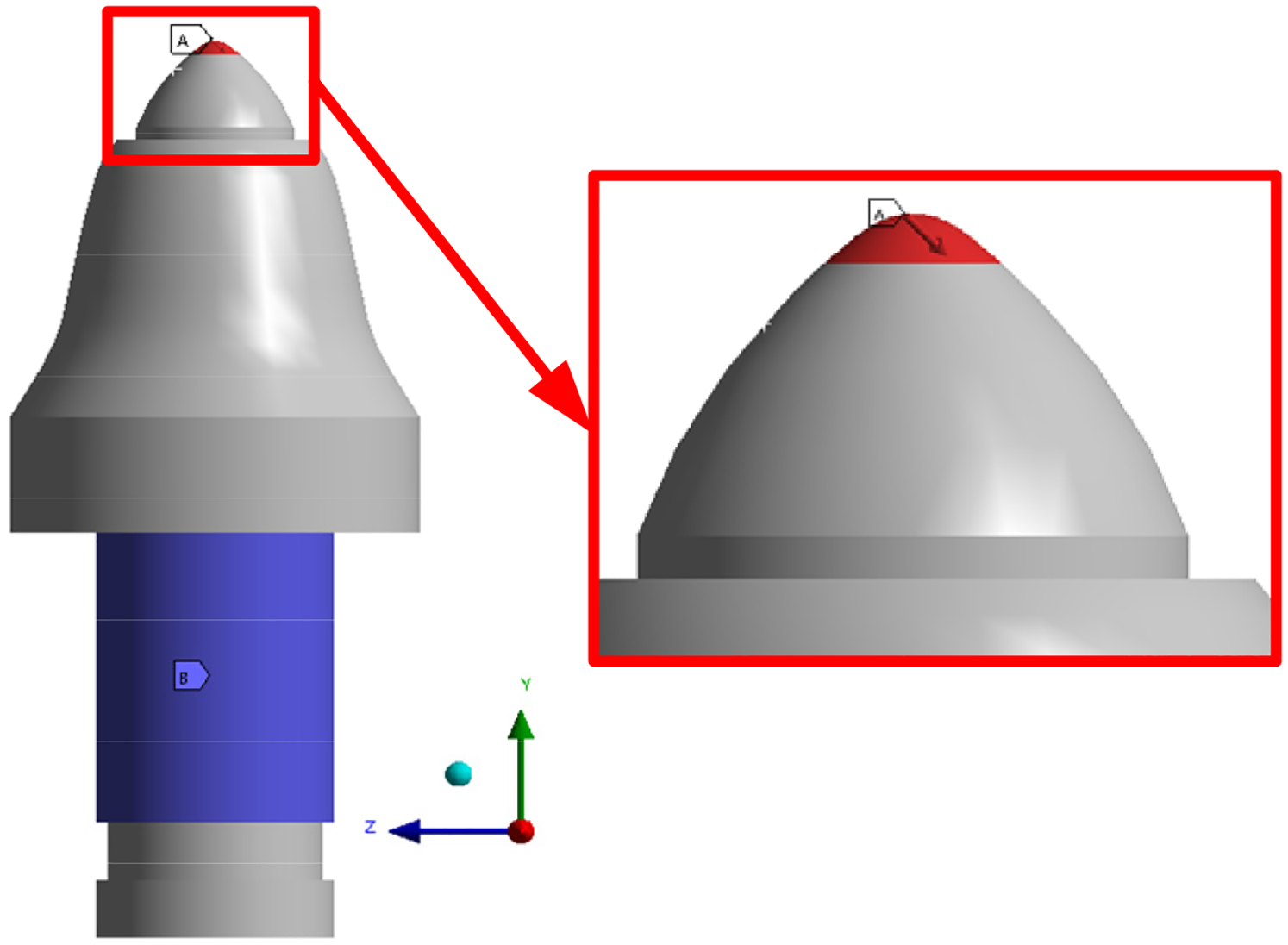
The numerical simulation of conical pick fatigue life.
Modified and verified the fatigue life model
According to the numerical simulation model of conical pick fatigue life, imported the cutting force component into the conical pick fatigue life model to simulate the conical pick fatigue life. The result of conical pick fatigue life is shown in Figure 8(1). Comparing the numerical simulation result and the worn conical pick in actual position, it is evident that the wear area is similar, as presented in Figure 8. Therefore, the numerical simulation model of conical pick fatigue life is accurate.

The conical pick wear in actual working condition.
Results and discussion
The process of rock cutting with conical pick
The conical pick cutting rock with a cutting depth of 0.010 m, cutting speed of 1 m/s and the cutting angle of 30° is shown in Figures 9 and 10. The force curve of conical pick cutting rock is shown in Figure 9, when the conical pick contact rock, the cutting force of conical pick increases steadily and reaches a relatively stable value, and the fluctuates in a relatively stable range.

The cutting force curve of conical pick cutting rock.

The damage cloud of rock in the process of conical pick cutting rock.
In order to accurately investigate the rock breaking process with conical pick, the conical pick is hidden to show the rock damage and failure, as shown in Figure 10. When the conical pick contacts the rock, the contact position of rock between the conical pick and rock is depressed inward with the extrusion of the conical pick, and the damage occurs above the contact point, as shown in Figure 10(1). The conical pick continues to cut along the negative direction of z-axis, the rock elements contacting with the conical pick tip is deleted, causing the extrusion failure. The rock above the contacting position between conical pick and rock expands due to the extrusion between the conical pick and rock, and the rock above the contacting point appears damaged. The damage area increasing, as shown in Figure 10(2). When the cutting distance of conical pick is 0.05 m, the contacting rock elements between conical pick tip and rock are broken in a large range. The rock elements above the contact position are damage and fail, as shown in Figure 10(3). When the cutting distance of conical pick is 0.08 m, the rock damage area increases and the rock breaking volumes increase. The continuous crushing occurs above the contact point between the conical pick and rock, and the upper surface of rock presents obvious tensile failure, as shown in Figure 10(4). The conical pick cutting rock with constant cutting speed, the rock appears obvious radial shape rock cracks. There are obvious damage areas around the groove formed by the conical pick, and obvious radial cracks on the rock upper and left surface, as shown in Figure 10(4), (5), and (6).
In the process of conical pick cutting rock, the stress relationship between the conical pick and rock is close to the rock fracture and conical pick wear. It is significant that combination rock stress and conical pick stress for studying rock fracture. The stress nephogram of conical pick and rock during rock cutting is plotted in Figure 11. At the contacting point between conical pick and rock, the stress nephogram of the rock contacting point presents a circular distribution, as shown in Figure 11(1), the stress nephogram on the conical pick presents an elliptical, circular distribution, which is closely related to the shape of the conical pick. When the cutting distance of the conical pick increases to 0.006 m, the stress nephogram of the conical pick and rock rises obviously. At the same time, the rock contact area between conical pick and rock increases obviously. Owing to the compression of conical pick on rock, the upper surface of the rock expands upward, and the stress nephogram appears on the rock upper surface, as shown in Figure 11(2). While the cutting distance of conical pick reaching 0.012 m, the stress nephogram of the conical pick increases obviously, and the arc of the conical pick contacts with the rock. There are two obvious action points of conical pick appearing. The stress nephogram on the left surface and upper surface of the rock connects, and the stress nephogram increases. Several rock elements at the contacting area between conical pick and rock are deleted, owing to rock elements failure, as shown in Figure 11(3). The conical pick continues to cut rock along the z-axis, the rock stress cloud area enlarges and the rock appears rock broken. The rock stress nephogram shows the radial distribution. The stress concentration position of the conical pick stress cloud is prominent corresponding to that of rock, as shown in Figure 11(4), (5) and (6). While the conical pick cutting rock stably, the stress concentration obvious on both sides of the conical pick tip and the front of the conical pick, so the front end of the conical pick is easy to be wear in the process of cutting rock, which is consistent with the actual wear condition of the conical pick.

The stress cloud of conical pick and rock in the process of conical pick cutting rock.
The influence of cutting parameters on conical pick cutting performance
The influence of conical pick cutting angle on conical pick cutting performance
The conical pick cuts rock with cutting angles of 30°,45°,60° and 75°, cutting speed of 2 m/s, and the cutting depth of 0.01 m to research the influence of cutting angle on cutting performance. The numerical simulation results are plotted in Figures 12 and 13. The conical pick cutting rock with same cutting speed and depth, while the cutting angle being 30°, the width and depth of the rock damage area are 0.055 m and 0.024 m, respectively. And the damage area of the cutting groove edge is continuous. The front section of the cutting groove is in a sharp angle state, and the cutting groove bottom is relatively flat, as shown in Figure 12(1). While the cutting angle reaching 75°, the rock damage area of the cutting groove width is 0.033 m, the damage area of rock cutting groove depth is 0.017 m, and the sharp angle of the front section groove decreases, as shown in Figure 12(4). With the increase of cutting angle, the damage area width of the cutting groove declines, and the rock damage area decreases. There are radioactive cracks around the cutting groove, as shown in Figure 12.
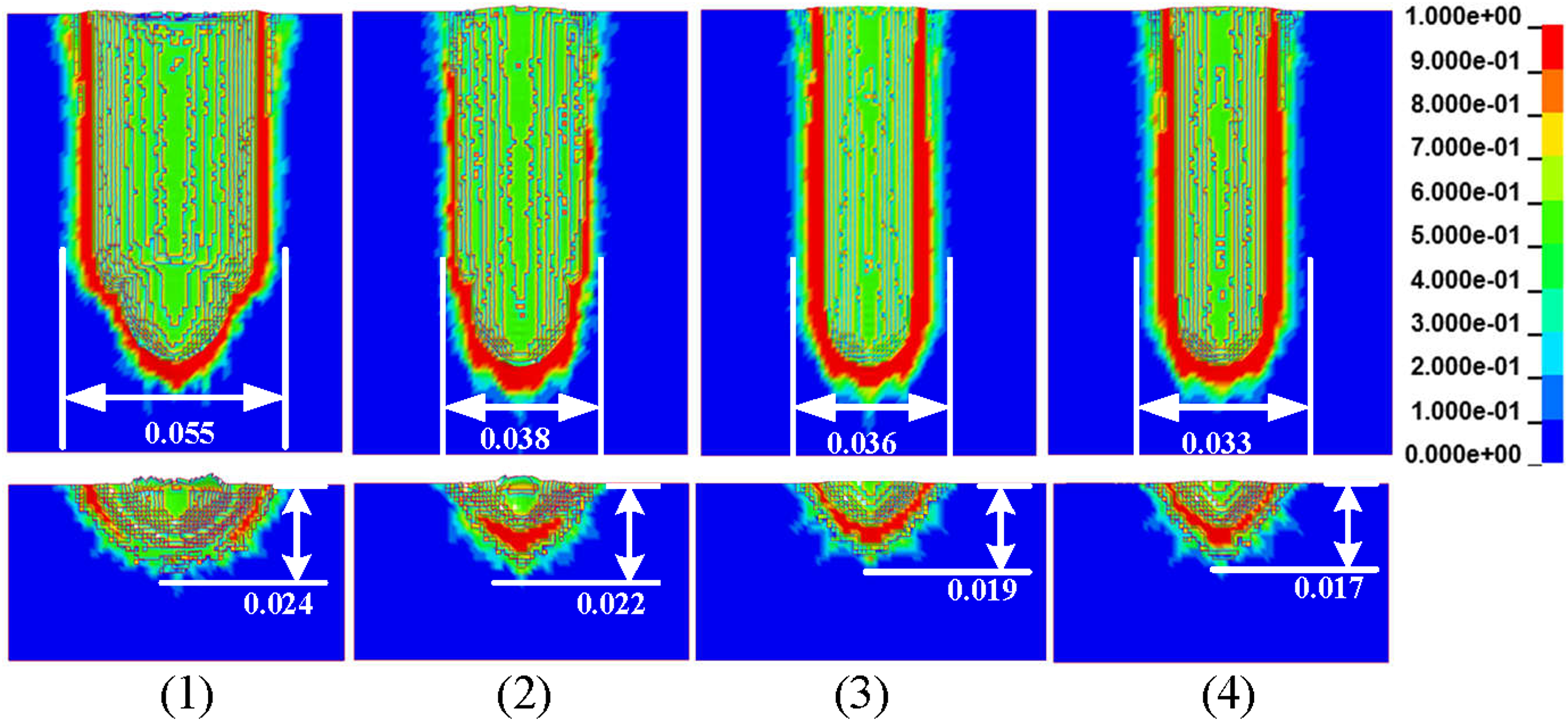
The damage nephogram of rock cutting by conical pick with various cutting angle: (1) The cutting angle of 30°, (2) The cutting angle of 45°, (3) The cutting angle of 60°, (4) The cutting angle of 75°.

The stress nephogram of conical pick with various cutting angles: (1) The cutting angle of 30°, (2) The cutting angle of 45°, (3) The cutting angle of 60°, (4) The cutting angle of 75°.
The conical pick stress cloud in the process of conical pick cutting rock, as shown in Figure 13. There are two stress concentration areas appear between the conical pick tip and the upper arc surface of the conical pick, and there is stress concentration areas at the joint of the conical pick tip, when the conical pick cutting angle is 30°and 45°, as shown in Figure 13(1) and (2). The cutting angle of the conical pick continues to increase. When the cutting angle reaches 60°, the stress concentration point on the upper arc surface of the conical pick tip disappears, shown as Figure 13(3). With the increase of cutting angle, the stress concentration area of the conical pick decreases, and the stress concentration area of the conical pick body declines. The stress concentration is at the conical pick tip edge, which is basically consistent with the actual situation of the conical pick tip wear in the actual, shown in Figure 13.
The cutting force curve of conical pick cutting rock with various cutting angles is shown in Figure 14. The cutting force of conical pick with stable conical pick first decreases and then shows. The cutting angle of the conical pick with the cutting angle of 45°, the average peak cutting force is 14.94 kN, while the cutting angle of 30°, the average peak cutting force is 24.65 kN.

The cutting force curve of conical pick cutting rock with various cutting angle.
The average peak cutting force with different cutting angles is shown in Table 3. It indicated that the cutting force first decreases and then increases, and the average cutting force is 24.65 kN with a cutting angle of 30°. The curve fitting is made between the average peak cutting force and the cutting angle of the conical pick, as plotted in Figure 15. It is a quadratic relationship between the average peak cutting force and cutting angle, and the minimum average peak cutting force appears between 45° and 60°, and the fitting equation is Fac = 0.01762 × 2−1.89784x + 65.45181, and the R2 is 0.96595, the error is 0.03699, which is less than 0.05. Therefore, the fitting equation is accurate and reliable.

The fitting curve of average peak cutting force and cutting angle.
The average peak cutting force of conical pick with various cutting angle.

The specific cutting energy consumption is closely related to cutting angle. With the same cutting distance, the volume of rock material removed by the conical pick decreases with the increase of cutting angle. And the specific cutting energy consumption with various cutting angles is shown in Table 4. The curve fitting of cutting specific energy consumption with various cutting angle is plotted in Figure 16, and the fitting equation is SE = 76 × 2−6533.2x + 169,540.2, R2 = 0.97156, F is 165 and the error is 0.047 which is less than 0.005, therefore, the fitting curve is accurate. The results show that the minimum specific energy consumption of the conical pick cutting rock appears at the cutting angle between 45° and 60°.

The relationship curve between specific cutting energy with cutting angle.
The specific cutting energy consumption with different cutting angle.

The influence of conical pick cutting depth on conical pick cutting performance
The conical pick cuts rock with cutting speed of 2 m/s, cutting angle of 45°, and cutting depths of 0.002, 0.004, 0.006, 0.008 and 0.010 m to investigate the influence of cutting depth on cutting performance. The rock damage is influenced by the cutting depth obviously. While the cutting depth of 0.002 m, the damage depth and damage width is 0.13 m and 0.029 m, respectively, as plotted in Figure 17(1). The damage width and depth increase with the increasing cutting depth. Therefore, when the cutting depth reaches 0.010 m, the rock damage width increases to 0.042 m and the rock damage depth increases to 0.026 m, as plotted in Figure 17(5). With the cutting depth increasing, the rock damage width and depth on both sides of the cutting groove decrease. The damage area of rock increases with the increase of cutting depth.

The rock damage cloud with various cutting depths: (1) The cutting depth of 0.002 m, (2) The cutting depth of 0.004 m, (3) The cutting depth of 0.006 m, (4) The cutting depth of 0.008 m, (5) The cutting depth of 0.010 m.
The stress of conical pick is closely related to the cutting depth, and the stress area of the conical pick increases with the increase of cutting depth. The stress of conical pick is mainly concentrated in the position of the conical pick tip, as shown in Figure 18. With the increase of cutting depth, the stress area of the conical pick tip increases, and the peak stress of conical pick increases. However, when the cutting depth of the conical pick is 0.010 m, there is a new stress concentration point appearing on the arc surface of the conical pick. Which is indicated that the increase of the cutting depth of conical pick, the wear area and the wear degree of conical pick increase. When the cutting depth increases, the conical pick body will appear obvious wear.

The conical pick stress cloud with various cutting depths: (1) The cutting depth of 0.002 m, (2) The cutting depth of 0.004 m, (3) The cutting depth of 0.006 m, (4) The cutting depth of 0.008 m, (5) The cutting depth of 0.010 m.
The cutting force curve of conical pick cutting rock with a cutting speed of 2 m/s, cutting angle of 45°, cutting depth of 0.002, 0.004, 0.006, 0.008 and 0.010 m is shown in Figure 19. The cutting force increases with cutting depth increasing, and the increase rate obviously. The fluctuation of cutting force curve is positively correlated with cutting depth and increases with the increase of cutting depth. The cutting force increases with the increasing cutting distance, and the growth rate of cutting force is the same with different cutting depth at the beginning stage when the cutting distance reaching a certain distance, the cutting force curve reaches the stable value, it fluctuates around in the stable value, as shown in Figure 19.

The cutting force curve of conical pick with different cutting depths.
The average peak cutting force of conical pick is shown in Table 5, the average peak cutting force of conical pick increases with the increase of cutting depth. The curve of average peak cutting force and cutting depth is obtained by fitting the curve of average peak cutting force and cutting depth, as shown in Figure 20. The fitting curve function of average peak cutting force and cutting depth is Fac = 0.03398 × 2 + 1.41995x−0.45758, R2 is 0.98995, the F value is 582.14 and error is 0.0017,which is less than 0.05. Therefore, it is considered that the fitting curve function is accurate.

The relationship between average peak cutting force and cutting depth.
The average peak cutting force of conical pick cutting rock with various cutting depth.

The cutting depth of conical pick has a significant impact on the specific cutting energy consumption. The specific cutting energy consumption with various cutting depths is shown in Table 6 and Figure 21. The specific cutting energy consumption increases with the increase of cutting depth. Fit the results of specific cutting energy consumption and cutting depth, as shown in Figure 21. The fitting curve function is SE = −109 × 2 + 3349x + 5798.536, the R2 is 0.98836, the F value is 1620.858 and the error is 6.1657 × 10⁻⁴ which is less than 0.05. Therefore, the fitting equation of specific cutting energy consumption and cutting depth is reliable. In a certain range of cutting speed and cutting angle, the cutting specific energy consumption increases with the increase of cutting depth, and the growth rate of cutting specific energy consumption slows down.

The relationship between specific cutting energy and cutting depth.
The specific cutting energy with various cutting depth.

The influence of conical pick cutting speed on conical pick cutting performance
The conical pick cuts rock with cutting angle of 45°, cutting depth of 0.010 m and the cutting speed of 1, 2, 3 and 4 m/s to investigate the influence of cutting speed on conical pick cutting performance. The rock damage cloud with various cutting speeds is shown in Figure 22. According to Figure 22, it is obvious that the width and depth of rock damage area increase with the increase of cutting speed. While the cutting speed of 1 m/s, the width and depth of rock damage is 0.039 m and 0.018 m, respectively. And while the cutting speed of 4 m/s, the width and depth of rock damage is 0.044 m and 0.023 m, respectively. With the increase of cutting speed, the rock damage area width on both sides of the cutting groove increases, the rock damage depth at the cutting groove bottom increases. The damage range at the rock cutting groove bottom radiated outward, and the damage extension length on the upper surface of the rock is closely related to the cutting speed.

The rock damage cloud with various cutting speed: (1) The cutting speed of 1 m/s, (2) The cutting speed of 2 m/s, (3) The cutting speed of 3 m/s, (4) The cutting speed of 4 m/s.
The conical pick stress cloud with various cutting speeds is significantly different, as plotted in Figure 23. At the same cutting angle and cutting depth, with the increase of cutting speed, the stress of rock increases obviously, and the concentrated stress of conical pick increases obviously. And the stress area of the conical pick increases obviously with the growth of cutting speed, the stress nephogram of the conical pick and extends downward from the conical pick tip, and the stress distribution area of conical pick tip is larger.

The conical pick stress cloud with different cutting speed.
Combined with the stress nephogram of conical pick and rock damage nephogram, as shown in Figures 22 and 23. It is significant that the rock damage cloud and conical pick stress are corresponding relationship. The cutting speed is a positive influence of cutting speed on rock damage and rock stress. The stress area and stress value of the bottom surface of conical pick increase with the increase of cutting speed, which causes the rock damage depth at the bottom of the rock cutting groove. Meanwhile, the interaction force between the rock and conical pick tip increases sharply, resulting in the increase of stress range and the conical pick peak stress. The cutting force of conical pick with various cutting speeds is shown in Figure 24. In the rising stage of cutting force, the cutting force curves of different cutting speeds are basically similar. When the cutting force curve is basically stable, it can be seen that the cutting force of the conical pick increases with increasing cutting speed. And the fluctuation range of the cutting force curve increases with the increase of cutting speed. The fluctuation range of the conical pick cutting force curve is positively correlated with the cutting speed.

The cutting force curve of conical pick with various cutting speed.
The average peak cutting force of conical pick with various cutting speeds is shown in Table 7. The average peak cutting force is positively correlated with cutting speed. When the cutting speed is 1 m/s, the average peak cutting force of conical pick cutting rock is 8.44 kN. However, while the cutting speed reaching 4 m/s, the average peak cutting force is 16.19 kN. It is indicated that the average peak cutting force is sensitive to cutting speed and increases rapidly with the increasing cutting speed. Fitting the average peak cutting force of conical pick and cutting speed is shown in Figure 25, the fitting equation is Fac = 0.705 × 2−1.231x + 9.6, R2 value is 0.96824, F value is 178.429 and the error is 0.042 less than 0.05. Therefore, the fitting equation between average peak cutting force and cutting speed is accurate and reliable.
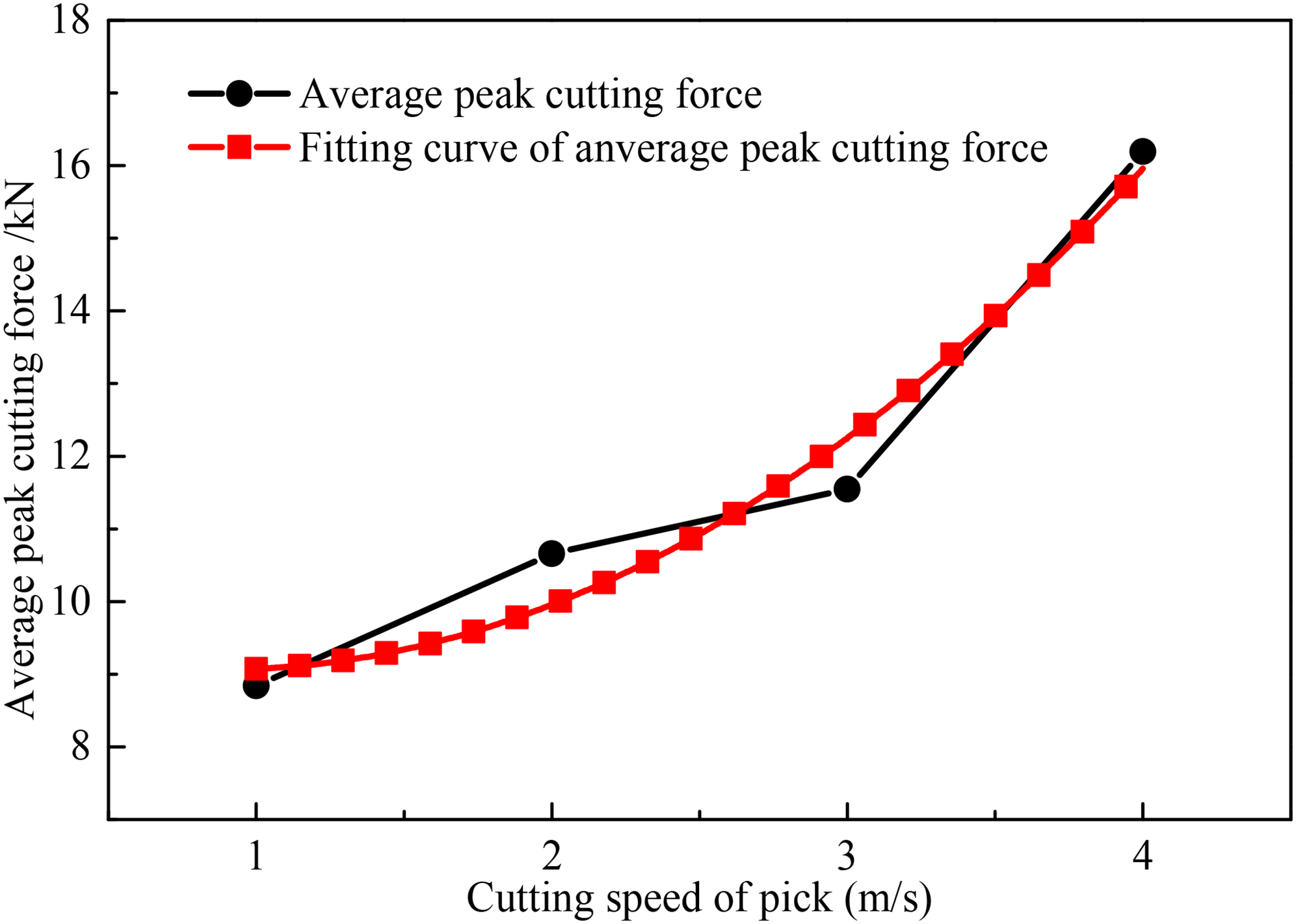
The relationship between average peak cutting force and cutting speed.
The average peak cutting force of conical pick with various cutting speed.

The specific cutting energy consumption of conical pick is an important index to evaluate the cutting performance. The specific cutting energy consumption with different cutting speeds is plotted in Table 8. The specific cutting energy consumption is closely related to the cutting speed of the conical pick. The specific cutting energy consumption increases with increasing the cutting speed. Fitting the specific cutting energy consumption with cutting speed is plotted in Figure 26. The relation equation between specific cutting energy and cutting speed is SE = 837.41 × 2 + 4253.536x + 4662.52475, R2 is 98.51, F value is 984.831 and the error is 0.022, which is less than 0.05, therefore, the relation equation between specific cutting energy consumption and cutting speed is reliable.

The relationship between specific cutting energy consumption and cutting speed.
The specific cutting energy consumption with different cutting speed.

The influence of cutting parameters on conical pick fatigue life
The influence of cutting angle on conical pick fatigue life
The cutting angle of the conical pick affected the conical pick fatigue life greatly. The numerical simulation results of conical pick cutting rock with cutting depth of 0.010 m, cutting speed of 2 m/s and the cutting angle of 30°, 45°, 60° and 75° are imported into the numerical simulation model of conical pick fatigue life to investigate the influence of cutting angle on the conical pick fatigue life. The results of numerical simulation on conical pick fatigue life are plotted in Figure 27. According to Figure 27, the fatigue life of conical pick is related to the cutting angle. It can be seen from the fatigue life cloud, the conical pick fatigue life first decreases and then increases with the increasing cutting angle. And the fatigue life range first decreases and then increases, and the minimum value of conical pick fatigue life first increases and then decreases. And with the increase of cutting angle, the fatigue life nephogram of conical pick expands from the joint of the conical pick.

The fatigue life of conical pick with different cutting angles: (1) The cutting angle of 30°, (2) The cutting angle of 45°, (3) The cutting angle of 60°, (4) The cutting angle of 75°.
The minimum value of conical pick fatigue life cutting rock with different cutting angles is shown in Table 9 and Figure 28. The minimum value of conical pick fatigue life first increases and then declines with increasing cutting angle. When the cutting angle of the conical pick is 45°, the minimum fatigue life of the conical pick reaches the maximum value of 7.38 × 10⁷. However, the increasing cutting angle causes the minimum fatigue life of conical pick to decrease. When the cutting angle increases to 75°, the minimum fatigue life of the conical pick is 3.79 × 10³, which shows that the cutting angle of the conical pick has a great influence on the conical pick fatigue life.

The relationship between conical pick fatigue life and cutting angle.
Fatigue life of conical pick with various cutting angle.

The curve equation is obtained by curve fitting the conical pick minimum fatigue life and cutting angle is
The influence of cutting depth on conical pick fatigue life
The numerical simulation results of conical pick cutting rock with a cutting speed of 2 m/s, cutting angle of 45° and the cutting depth of 0.002, 0.004, 0.006, 0.008 and 0.010 m were imported into the fatigue life numerical simulation model to study the influence of cutting depth on conical pick fatigue life, and the results of fatigue life numerical simulation are shown in Figure 29, Table 10 and Figure 30. The range of conical pick fatigue life nephogram is closely related to the cutting depth, and the conical pick fatigue life range expands with the increase of cutting depth. According to the numerical simulation results, with the increase of cutting depth, the minimum conical pick fatigue life decreases obviously, and the conical pick fatigue life range expands obviously.

The conical pick fatigue life with various cutting depths: (1) The cutting depth of 0.002 m, (2) The cutting depth of 0.004 m, (3) The cutting depth of 0.006 m, (4) The cutting depth of 0.008 m, (5) The cutting depth of 0.010 m.

The relationship between conical pick fatigue life and cutting depth.
The minimum value of conical pick fatigue life with various cutting depth.

The minimum conical pick fatigue life is significantly affected by the cutting depth. When the cutting depth is 0.002 m, the minimum fatigue life of conical pick is 8.63 × 10¹⁰. When the cutting depth reaches 0.010 m, the minimum conical pick fatigue life is 7.98 × 10⁴. The fatigue life and cutting depth of the conical pick were fitted, and the fitting results curve was obtained, as shown in Figure 30. The fitting curve equation is
The influence of cutting speed on conical pick fatigue life
The results of numerical simulation results of conical pick cutting rock with cutting depth of 0.010 m, cutting angle of 60°, and cutting speed of 1, 2, 3 and 4 m/s are imported into the fatigue life numerical simulation model to investigate the influence of cutting speed on conical pick fatigue life. The fatigue life numerical simulation results are plotted in Figure 31, Table 11 and Figure 32. The fatigue life nephogram area increases with increasing cutting speed. When the cutting speed reaches 4 m/s, the conical pick fatigue life gradually expands from the conical pick tip and conical pick body, as shown in Figure 31.

The conical pick fatigue life with various cutting speed.

The relationship between conical pick fatigue life and cutting speed.
The minimum conical pick fatigue life with various cutting speed.

When the cutting speed is 1 m/s, the minimum fatigue life of the conical pick is 3.68 × 10⁸. When the cutting speed reaches 4 m/s, the fatigue life of the conical pick decreases to 7.85 × 10³. The fatigue life of the conical pick is significantly affected by the cutting speed. The curve fitting between the minimum conical pick fatigue life and the cutting speed is shown in Figure 32. The fitting curve equation is
Conclusion
The numerical simulation model of conical pick cutting rock with different cutting parameters is established to study the influence of cutting parameters on conical pick cutting performance and fatigue life. Several conclusions are being obtained as the following:
With the increase of cutting angle of conical pick, the width and depth of rock damage and the conical pick stress decrease, the average peak cutting force and specific cutting energy first decreases and then increases. However, the conical pick fatigue life first increases and then decreases with increasing cutting angle. The optimum cutting angle of the conical pick is the 45°. With the increase of cutting depth increases, the width and depth of rock damage and the conical pick stress increases, the average peak cutting force and specific cutting energy increases. But, the conical pick fatigue life declines with increasing cutting depth. The increasing cutting speed causes the width and depth of rock damage and conical pick stress increasing, and the average peak cutting force and the specific cutting energy increasing, however, the conical pick fatigue life decreasing.
Footnotes
Acknowledgments
This work was supported by the projects of the Shandong Provincial Key Research and Development Project (2019SDZY01) and the Natural Science Foundation of Shandong Province (Grant No. ZR2019BEE069).
Declaration of conflicting interests
The author(s) declared no potential conflicts of interest with respect to the research, authorship, and/or publication of this article.
Data availability
The data used to support the findings of this study are included within the article.
