




Abstract
Taking the fractured tight reservoir of the Fengcheng Formation in Mahu Depression as the research object, the RFPA software, a numerical simulation platform of real fracture process, was used to study the fracture propagation laws in fractured tight reservoirs during the fracturing process. On this basis, the influences of different factors on the fracture propagation laws in the fractured tight reservoirs were investigated, the influences of various factors on fracture propagation were quantitatively analyzed by the gray correlation method, and then the fractability calculation model for evaluating the fracturing effects was obtained by the analytic hierarchy process method. The results show that when the fracture angle is less than 70°, the natural fracture controls the hydraulic fracture propagation direction, whereas when the fracture angle is greater than 70°, the maximum horizontal principal stress controls the hydraulic fracture propagation direction. With the increase of the fracture angle, the hydraulic fracturing area firstly decreases and then increases, whereas with the increase of the fracture density, the hydraulic fracturing area gradually increases. The hydraulic fracturing area increases as the fracture compressive strength, tensile strength and elastic modulus reduction factor increase, whereas the hydraulic fracturing area decreases as the fracture Poisson's ratio reduction factor increases. Based on the gray correlation method, the ranking of the fracturing effect is clarified as fracture density > horizontal stress difference > fracture angle > elastic modulus > compressive strength > tensile strength > Poisson's ratio. Using the analytic hierarchy process, a model for calculating the reservoir fractability index is established, and has a good positive correlation with the dimensionless fracturing area.
Introduction
With the gradual increase of China's oil dependence on foreign countries, which has exceeded 73%, the energy security in China is becoming more and more severe, and then the importance of the exploration and development of unconventional energy sources is slightly prominent. The exploration and development of unconventional energy sources such as tight oil and shale oil has risen to the national strategy due to the large amount of resources in China. 1 In recent years, with the gradual improvement of oil and gas exploration and development technology, tight oil and shale oil resources have been discovered in the Permian of Junggar Basin, Permian of Santang Lake Basin, Paleocene and Neoproterozoic of Qaidam Basin, Triassic of Ordos Basin, Paleocene of Bohai Bay, Cretaceous of Songliao Basin, etc., and their exploration and development has made a big breakthrough, the exploration and development of these areas has been increasing year by year. 2
Tight reservoirs are characterized by poor permeability, no natural production capacity or natural production capacity below the lower limit of industrial oil flow in a single well, and the implementation of efficient fracturing is a key technology to achieve their efficient development.3,4 A large number of natural fractures are in tight reservoirs, and numerous studies have shown that natural fractures have an important impact on hydraulic fracture. Many scholars have studied the effects of natural fractures on the propagation pattern and fracture morphology of hydraulic fractures mainly by means of experiments and numerical simulations. Zhou et al.5,6 Cheng et al. 7 and Zhang et al. 8 studied the effects of main stress difference and natural fractures on the fracture morphology of horizontal wells by means of true triaxial hydraulic fracture experiments and acoustic emission monitoring, respectively. However, these studies did not elaborate the relationship and sensitivity between the influencing factors. Weng et al. 9 Shi et al. 10 Zhao et al. 11 Zhang et al. 12 Li et al. 13 Wang et al. 14 investigated the effects of structural characteristics, In-situ stress difference, and natural fractures on the fracture propagation pattern and fracture morphology during the hydraulic fracture by extended finite elements, phase field model based on probability distribution function and phase field variables, FLAC-PFC, RFPA, and other numerical simulations. These studies illustrate that research scholars have carried out a lot of research works on the hydraulic fracture propagation laws in reservoirs and its influencing factors, and achieved remarkable results, revealing the influence of natural fractures, laminar structure, and In-situ stress difference on the hydraulic fracture propagation law of reservoirs. However, these studies mainly analyzed the natural fractures on the fracture morphology and fracture propagation pattern, but did not quantitatively analyze the influence degree of different factors on the fracturing effects of the fractured tight reservoir. Therefore, it is necessary to study the fracture propagation laws in the fractured tight reservoirs during the fracturing process, quantitatively analyze the influences of various factors on the fracture propagation laws, and establish the fractability evaluation model of fractured reservoirs.
Therefore, the tight reservoirs of Fengcheng Formation in Mahu Depression as the research object in this paper, a two-dimensional borehole numerical simulation model is constructed using the real fracture process numerical simulation platform RFPA software, which can be used to investigate the fracture propagation laws in the fractured tight reservoirs during the fracturing process. On this basis, the effects of fracture density, fracture angle and rock mechanical properties as well as the horizontal principal stress difference on the fracture propagation laws in the fractured tight reservoirs are investigated, and the influences of different factors on the fracturing effect in the fractured tight reservoirs are quantitatively analyzed using the gray correlation method, so as to build a fractability evaluation model of the fractured tight reservoir integrating various factors. It provides a theoretical basis for efficient fracturing in the fractured tight reservoirs in the study area.
Numerical simulation model and parameters
A two-dimensional borehole hydraulic fracturing model is established by using the real fracture process analysis software (RFPA) (the schematic diagram is shown in Figure 1), so as to carry out the influences of different mechanical parameters on the fracture propagation laws in the fractured tight reservoirs. The software (RFPA) introduces the non-uniform parameter m of rock material, and assumes that the mechanical parameters of meso element obey Weibull statistical distribution function, which fully reflects the non-uniform characteristics of rock:


Schematic diagram of hydraulic fracturing model for two dimensional borehole.
The software simulates the progressive failure process of quasi brittle materials (such as rock) under increasing static load. The main governing equations are as follows:
Equilibrium equation:



According to the existing research results, the distribution range of the uniaxial compressive strength in the study area is 121∼199 MPa, the distribution range of the tensile strength is 10∼17 MPa, the elastic modulus ranges from 30 GPa to 55 GPa, the Poisson's ratio is between 0.19 and 0.30, the formation pressure distribution range is 61∼73 MPa, the maximum horizontal main stress is between 91 and 107 MPa, the minimum horizontal main stress ranges from 83 to 93 MPa, and the distribution range of the horizontal stress difference is 6∼12 MPa. At the same time, the fractures in the study area can be divided into semi filled fractures and filled fractures, in which the density of semi filled fractures is 0∼26 lines/m, and the density of filled fractures is 0∼8 lines/m. Referring to the physical test values of rock mechanics parameters of rock samples in the study area, the meso rock mechanics parameters in the model are calibrated through the results of macro mechanics experiment and numerical experiment, as shown in Table 1. The mechanical parameters of fractures are treated by the same proportion reduction method, such as the ratio of compressive strength, tensile strength and elastic modulus of matrix to fracture is 0.5, and the Poisson's ratio of fracture to matrix is 0.5. These parameters are referred to as compressive strength reduction factor, tensile strength reduction factor, elastic modulus reduction factor and Poisson's ratio reduction factor.
The meso-parameters of rock mechanics in the simulation.

The two-dimensional borehole hydraulic fracturing model without structural surface heterogeneity is constructed by using the RFPA-2D flow software platform. The size of the model is 1500 mm × 1500 mm, and the number of units of the model is 300 × 300 = 90,000. In the simulation well, the pressure is simulated by applying water head to simulate the fracturing process. The effective stress method is used for loading (the maximum and minimum horizontal principal stress minus pore pressure). The pressure loading mode is step-by-step mode, and the single step increment is 1.0 MPa. The pressure in the borewell is gradually increased to simulate the increasing process of wellbore pressure until the formation is pressed open to form fractures and extend. In order to analyze and describe the formation and propagation laws of fractures, the Hoek-Brown criterion is used as the rock failure criterion in the simulation process, the effects of horizontal principal stress difference, fracture angle, fracture density, compressive strength, tensile strength, elastic modulus, Poisson's ratio and other factors on fracture propagation are mainly simulated. The fracture angle is defined as the angle between the fracture and the maximum horizontal principal stress.
In order to quantitatively analyze the influence of various factors on the fracture, considering the need for comparability of the results of different simulation schemes, the simulation result diagram under the same injection pressure is selected, and the image processing of the simulation result diagram (Figure 2(a)) is carried out by using ImageJ software. The processing results are shown in Figure 2(c), so as to extract the fracture morphology of the model. On this basis, the fracture characteristic parameters of the simulation results are calculated, and the dimensionless fracture length and dimensionless fracturing area are defined. The former describes the propagation distance of the fracture and the latter describes the fracturing transformation area. The calculation formulas are as follows:

Extraction of compressive fracture characteristic parameters. (a) Simulation result, (b) Color code, (c) Binary graph.
In order to study the propagation laws of hydraulic fractures in the fractured tight reservoir, a fractured tight reservoir model is established. The horizontal stress difference is 10 MPa and the fracture density is 20 lines/m. The rock mechanical characteristic parameters of matrix and fractures are shown in Table 1. The initial pressure applied in the wellbore is 0 MPa and the increased pressure in the wellbore is 1 MPa each time. As shown in Figure 3, it is the result of the gradual propagation of hydraulic fractures under the corresponding borehole pressure in the fractured tight reservoir.

Propagation law of hydraulic fractures in fractured reservoirs. (a) 40 MPa, (b) 45 MPa, (c) 50 MPa, (d) 55 MPa, (e) 60 MPa.
It can be seen from Figure 3 that in the initial stage, the hydraulic fracture starts and extends along the direction of the maximum horizontal effective principal stress. When the hydraulic fracture meets the natural fracture, the hydraulic fracture can turn and no longer develop in the direction of the maximum horizontal effective principal stress, but continue to extend in the direction of natural fracture. With the increasing injection pressure in the wellbore, other natural fractures in the fractured tight reservoir are also opened with the progress of fracturing, which improves the complexity of reservoir reconstruction. The research results of Liu et al. 16 Liang et al. 17 Zhao et al. 18 also show that the existence of gravel structure, natural fracture or bedding structure is the basis for the formation of complex fracture morphology or fracture network around the well.
Comparing the fracture propagation laws of unstructured reservoir and fractured reservoir during the fracturing process, for unstructured reservoir, except for no natural fracture, other simulation parameters are consistent with fractured reservoir. As shown in Figure 4, it is the propagation laws of hydraulic fractures in reservoirs without structural planes. As shown in Figure 4, in the initial stage, the hydraulic fracture starts and extends along the direction of the maximum horizontal effective principal stress. With the gradual increase of pressure in the wellbore, a main fracture along the direction of the maximum horizontal effective principal stress is formed in the reservoir without structural plane. Although there are some secondary fractures on both sides of the main fracture, the development degree of secondary fractures is low. There is no complex fracture network in fracturing transformation in reservoir without structural plane. This is similar to the research results of Zhao et al. 18 indicating that the hydraulic fractures in heterogeneous strata without structural plane mainly extend along the direction of maximum horizontal principal stress.

Propagation law of hydraulic fractures in reservoir without structural plane. (a) 40 MPa, (b) 45 MPa, (c) 50 MPa, (d) 55 MPa, (e) 60 MPa.
Results
Effect of fracture angle
In order to study the influence of fracture angle on the effect of reservoir fracturing, a model with fracture angle distribution range of 0° to 90° and interval of 10° is established. In the model, the fracture density is 20 lines/m, the fracture rock mechanical property reduction coefficient is 0.5, and the horizontal principal stress difference is 10 MPa. The simulation results of fracture propagation under partial fracture angle based on numerical simulation are shown in Figure 5, and the statistical dimensionless fracturing area is shown in Figure 6.
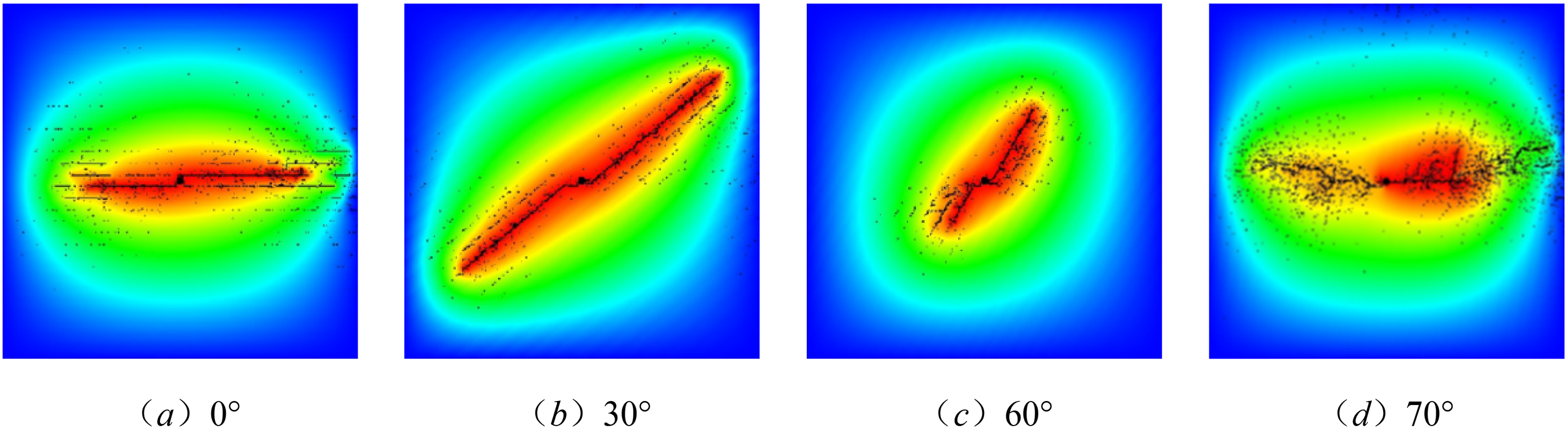
Effect of fracture angle on fracture propagation law. (a) 0°, (b) 30°, (c) 60°, (d) 70°.

Variation of dimensionless fracturing area under different fracture angles.
It can be seen from Figure 5 that the fracture angle has a significant effect on the fracture propagation mode in the process of reservoir fracturing. When the fracture angle is less than 70° and with the increase of the bottom hole pressure, tensile stress regions are formed on the left and right sides of the maximum horizontal principal stress direction of the wellbore. Under the action of the tensile stress, the borehole wall begins to crack. When the hydraulic fracture encounters the natural fracture, under the action of the tensile stress, the hydraulic fractures extend along both sides of many natural fractures, and the propagation distance of different natural fractures is different. Dense fractures form an elliptical fracturing area along the direction of natural fractures, and natural fractures play a major role in controlling the propagation of hydraulic fractures. However, when the fracture angle is greater than 70° and with the increase of the bottom hole pressure, when the hydraulic fracture encounters the natural fracture, the hydraulic fracture deflects under the action of the tensile stress. The hydraulic fracture passes through several natural fractures, and its propagation direction is similar to the direction of the maximum horizontal principal stress. The dense fractures form an elliptical fracturing region along the direction of the maximum horizontal principal stress. At this time, the maximum horizontal principal stress plays a major role in controlling the propagation of hydraulic fractures.
It can be seen from Figure 6 that with the increase of the fracture angle, the dimensionless fracturing area first decreases and then increases. This is mainly because that the normal stress on the natural fracture surface changes with the change of the fracture angle. With the increase of the fracture angle, the normal stress first increases and then decreases, resulting in the change of the borehole pressure required for formation fracturing, that is, the borehole pressure required for formation fracturing first increases and then decreases. And under the same borehole pressure, the dimensionless fracturing area decreases and then increases.
Effect of fracture density
In order to study the influence of fracture density on the effect of reservoir fracturing, the models with fracture density of 0, 8, 12, 16 and 20 lines/m are established. In the model, the fracture angle is 20° and the reduction factor of fracture rock mechanical properties is 0.5. The horizontal principal stress difference is 10 MPa. The simulation results of fracture propagation under partial fracture density based on numerical simulation are shown in Figure 7, and the statistical dimensionless fracturing area is shown in Figure 8.

Effect of the fracture density on fracture propagation law. (a) 0 line/m, (b) 8 lines/m, (c) 16 lines/m, (d) 20 lines/m.

Variation of dimensionless fracturing area under different fracture densities.
It can be seen from Figure 7 a that the matrix hydraulic fracturing obtains the dense fracture network around the well, the long axis direction of the elliptical fracturing area is consistent with the direction of the maximum horizontal principal stress, and the fracture development is dense, while the fracture development degree in the longitudinal aspect is low. At the same time, it can be seen from Figure 7 that with the increase of the borehole pressure, the tensile stress area is formed on the left and right sides of the maximum horizontal principal stress direction of the well, under the action of the tensile stress, the borehole wall begins to crack. When the hydraulic fracture encounters the natural fracture, the hydraulic fracture extends along both sides of the natural fracture under the action of tensile stress. With the increase of the fracture density, under the action of tensile stress, the more fractures are generated along the direction of natural fractures, the larger the elliptical fracturing area is. In addition, it can be seen from Figure 8 that with the increase of fracture density, the dimensionless fracturing area increases gradually. This is because that with the increase of the fracture density, there are more weak structures in the formation, the more fractures can be generated under the action of the borehole pressure, and the more intensive fractures are formed, resulting in the larger fracturing region, that is, the larger dimensionless fracturing area.
Effect of horizontal principal stress difference
In order to study the influence of horizontal principal stress difference on reservoir fracturing effect, different horizontal principal stress difference models are established. The horizontal principal stress difference includes 0, 5, 10, 15 and 20 MPa. In the model, the fracture angle is 20°, the fracture density is 20 lines/m, and the fracture rock mechanical property reduction coefficient is 0.5. The simulation results of fracture propagation under partial horizontal principal stress difference based on numerical simulation are shown in Figure 9, and the statistical dimensionless fracturing area is shown in Figure 10.

Effect of the horizontal principal stress difference on fracture propagation law. (a) 5 MPa, (b) 10 MPa, (c) 15 MPa, (d) 20 MPa.

Variation of dimensionless fracturing area under different horizontal principal stress difference.
It can be seen from Figure 9 that with the increase of the borehole pressure, the tensile stress area is formed on both sides of the maximum horizontal principal stress direction of the well, and the wellbore begins to crack under the tensile stress. When the hydraulic fracture intersects with the natural fracture, the hydraulic fracture extends along both sides of the natural fracture under the tensile stress. And decreasing with the horizontal principal stress difference, under the action of tensile stress, the more fractures are generated along the direction of natural fractures, the larger the elliptical fracturing area is. In addition, it can be seen from Figure 10 that with the increase of horizontal principal stress difference, the dimensionless fracturing area gradually decreases. This is mainly because that with the increase of the horizontal principal stress difference, the normal stress on the natural fracture surface increases gradually, and the natural fracture is more difficult to open. Under the same borehole pressure, the more fractures are generated, the denser the fractures are formed, and the larger the fracturing area is, that is, the larger the dimensionless fracturing area is.
Effect of compressive strength
In order to study the influence of compressive strength on the effect of reservoir fracturing, the fracture compressive strength reduction coefficient models are established, which are 0.3, 0.4, 0.5, 0.6 and 0.7, respectively. In the model, the fracture angle is 20°, the fracture density is 20 lines/m, the horizontal principal stress difference is 10 MPa, and the fracture rock mechanical property reduction coefficient is 0.5. The simulation results of fracture propagation under partial horizontal principal stress difference based on numerical simulation are shown in Figure 11, and the statistical dimensionless fracturing area is shown in Figure 12.
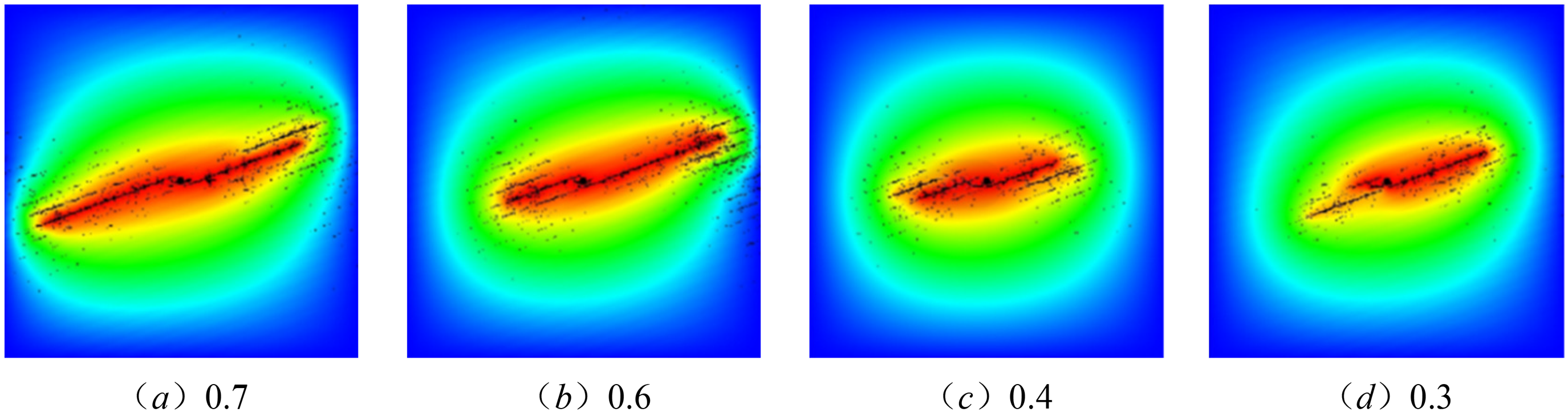
Effect of the compressive strength on fracture propagation law. (a) 0.7, (b) 0.6, (c) 0.4, (d) 0.3.

Variation of dimensionless fracturing area under different compressive strength.
It can be seen from Figure 11 that with the increase of liquid column pressure in the well, the tensile stress area is formed on both sides of the maximum horizontal principal stress direction of the well, and the wellbore begins to crack under the tensile stress. When the hydraulic fracture encounters with the natural fracture, the hydraulic fracture extends along both sides of the natural fracture under the tensile stress. And with the increase of fracture compressive strength reduction coefficient, under the action of tensile stress, the propagation distance of hydraulic fractures along the direction of natural fractures increases, and the number of fractures excited increases, and the area of elliptical fractures increases. In addition, it can be seen from Figure 12 that with the increase of the reduction factor of fracture compressive strength, the dimensionless fracturing area increases gradually. This is mainly because that the lower the reduction factor of fracture compressive strength or the higher the fracture compressive strength, the higher the borehole pressure is required for formation fracturing to cause formation damage, and the higher the borehole pressure is required for formation fracturing. Under the same borehole pressure, the smaller the propagation distance of hydraulic fracture along the natural fracture direction, the smaller the fracturing area, that is, the smaller the fracturing area is.
Effect of tensile strength
In order to study the influence of tensile strength on the effect of reservoir fracturing, the fracture tensile strength reduction coefficient models are established, which are 0.3, 0.4, 0.5, 0.6 and 0.7, respectively. In the model, the fracture angle is 20°, the fracture density is 20 lines/m, the horizontal principal stress difference is 10 MPa, and the fracture rock mechanical property reduction coefficient is 0.5. The simulation results of fracture propagation under partial horizontal principal stress difference based on numerical simulation are shown in Figure 13, and the statistical dimensionless fracturing area is shown in Figure 14.

Effect of the tensile strength on fracture propagation law. (a) 0.7, (b) 0.6, (c) 0.4, (d) 0.3.

Variation of dimensionless fracturing area under different tensile strength.
It can be seen from Figure 13 that with the increase of the borehole pressure, the tensile stress area is formed on both sides of the maximum horizontal principal stress direction of the well, and the wellbore begins to crack under the tensile stress. When the hydraulic fracture intersects with the natural fracture, the hydraulic fracture extends along both sides of the natural fracture under the tensile stress. And with the increase of the fracture tensile strength reduction coefficient, under the action of tensile stress, the propagation distance of hydraulic fractures along the direction of natural fractures increases, and the number of fractures excited increases, and the area of elliptical fractures increases. In addition, it can be seen from Figure 14 that with the increase of the reduction factor of the fracture tensile strength, the dimensionless fracturing area increases gradually. This is mainly because that the lower the reduction factor of fracture tensile strength or the higher the fracture tensile strength, the higher the borehole pressure is required for the formation fracturing, and the higher the borehole pressure is required for the formation fracturing. Under the same borehole pressure, the smaller the propagation distance of hydraulic fracture along the natural fracture direction, the smaller the fracturing region, that is, the smaller the dimensionless fracturing area is.
Effect of elastic modulus
In order to study the influence of elastic modulus on the effect of reservoir fracturing, the fracture elastic modulus reduction coefficients are 0.3, 0.4, 0.5, 0.6 and 0.7, respectively. In the model, the fracture angle is 20°, the fracture density is 20 lines/m, the horizontal principal stress difference is 10 MPa, and the fracture rock mechanical property reduction coefficient is 0.5. The simulation results of fracture propagation under partial horizontal principal stress difference based on numerical simulation are shown in Figure 15, and the statistical dimensionless fracturing area is shown in Figure 16.

Effect of the elastic modulus on fracture propagation law. (a) 0.7, (b) 0.6, (c) 0.4, (d) 0.3.

Variation of dimensionless fracturing area under different elastic modulus.
It can be seen from Figure 15 that with the increase of the borehole pressure, the tensile stress area is formed on both sides of the maximum horizontal principal stress direction of the well, and the wellbore begins to crack under the tensile stress. When the hydraulic fracture intersects with the natural fracture, the hydraulic fracture extends along both sides of the natural fracture under the tensile stress. And with the increase of the fracture elastic modulus reduction coefficient, under the action of tensile stress, the propagation distance of hydraulic fractures along the direction of natural fractures increases, and the number of fractures excited increases, and the area of elliptical fractures increases. In addition, it can be seen from Figure 16 that with the increase of fracture elastic modulus reduction coefficient, the dimensionless fracturing area increases gradually. This is mainly because that with the decrease of the fracture elastic modulus reduction coefficient or the increase of fracture elastic modulus, the stiffness of the formation increases, that is, the formation strength increases, and the formation needs higher borehole pressure to cause the formation to form fractures, which requires higher borehole pressure. Under the same borehole pressure, the propagation distance of hydraulic fractures along the direction of natural fractures is smaller. And the smaller the fracturing area is, that is, the smaller the dimensionless fracturing area is.
Effect of Poisson's ratio
In order to study the effect of Poisson's ratio on reservoir fracturing, the fracture Poisson's ratio reduction coefficients are 0.3, 0.4, 0.5, 0.6 and 0.7, respectively. In the model, the fracture angle is 20°, the fracture density is 20 lines/m, the horizontal principal stress difference is 10 MPa, and the fracture rock mechanics property reduction coefficient is 0.5. The simulation results of fracture propagation under partial horizontal principal stress difference based on numerical simulation are shown in Figure 17, and the statistical dimensionless fracturing area is shown in Figure 18.
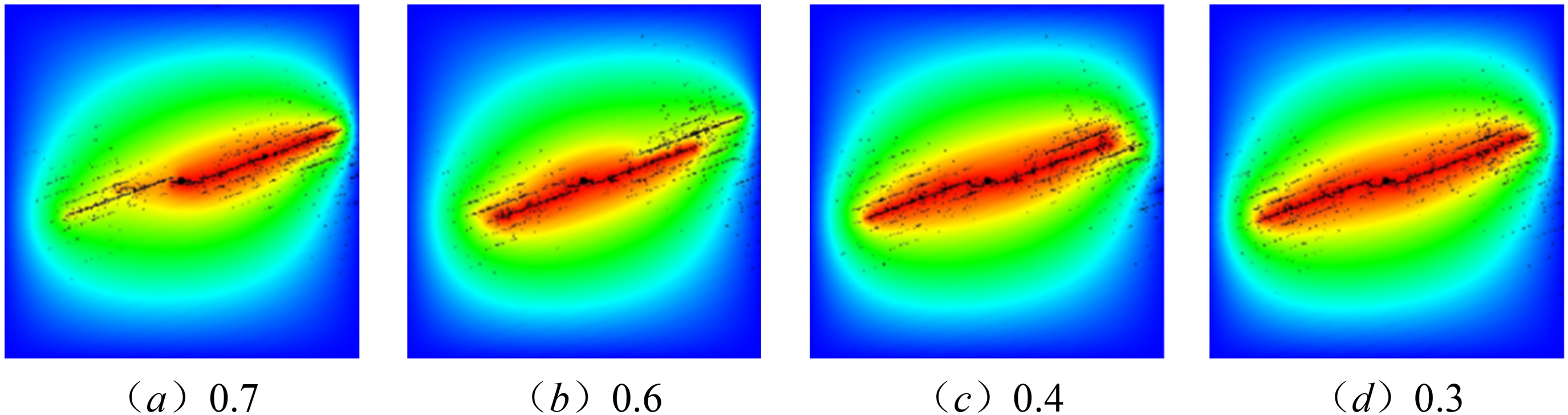
Effect of Poisson's ratio on fracture propagation. (a) 0.7, (b) 0.6, (c) 0.4, (d) 0.3.

Variation of dimensionless fracturing area under different Poisson's ratio.
It can be seen from Figure 17 that with the increase of the borehole pressure, the tensile stress area is formed on both sides of the maximum horizontal principal stress direction of the well, and the wellbore begins to crack under the tensile stress. When the hydraulic fracture encounters the natural fracture, the hydraulic fracture extends along both sides of the natural fracture under the tensile stress. And with the Poisson's ratio reduction coefficient of the fracture increases, under the action of tensile stress, the propagation distance of hydraulic fractures along the direction of natural fractures decreases, and the number of fractures excited decreases, and the area of elliptical fractures decreases. In addition, it can be seen from Figure 18 that the dimensionless fracturing area decreases gradually with the increase of the fracture Poisson's ratio reduction coefficient. This is mainly because that with the decrease of the fracture Poisson's ratio reduction coefficient or the increase of the fracture Poisson's ratio, the formation has good ductility, and under the same borehole pressure, the propagation distance of hydraulic fractures along the direction of natural fractures increases, resulting in the increase of the fracturing area, that is, the increase of the dimensionless fracturing area.
Fracturing evaluation
Based on the results of numerical simulation, although the influence of horizontal principal stress difference, compressive strength, tensile strength, elastic modulus and Poisson's ratio on the propagation law of compressive fracture is analyzed quantitatively, the influence of each factor on the fracture is only analyzed qualitatively, but the influence degree of each factor needs further quantitative research. Zeng et al. 19 and Gao et al. 20 have quantitatively studied the sensitivity of different factors by using the gray correlation method, so as to determine the main controlling factors, which shows that the grey correlation method is an effective method to analyze the influence degree of various factors. The grey correlation method can solve the grey correlation degree of each influencing factor in the unknown nonlinear problem, reflect the importance of each influencing factor to the objective function, and avoid the subjectivity of determining the index weight of each factor by human experience. Therefore, based on the numerical simulation results, the gray correlation method is used to analyze the influence of horizontal principal stress difference, compressive strength, tensile strength, elastic modulus and Poisson's ratio on the fracturing effect. In the numerical simulation, the dimensionless fracturing area of fracturing effect is used as the evaluation index.
The extreme value transformation method (Equation (8)) is used to normalize the fracturing area of each factor and dimensionless pressure. Taking the dimensionless fracture length after normalization treatment as the reference sequence and the factors after normalization treatment as the comparison sequence, the correlation degree between each factor and dimensionless fracture length is calculated (Equation (9)). The similarity degree between each factor and dimensionless fracture surface product is evaluated by displacement difference. The smaller the displacement difference is, the closer the correlation degree is to 1, the closer the shape of the two is. On the contrary, the lower the similarity between them.

The average value of correlation coefficient can quantitatively reflect the correlation degree of each factor. Therefore, the correlation coefficient of each factor is averaged. The calculation formulas are as follows:
Based on the results of numerical simulation, the calculation results of correlation degree of each factor are shown in Table 2. The influence degree of each factor on fracturing effect can be determined according to the correlation degree. It can be seen from Table 2 that there are obvious differences in the correlation degree of each factor. According to the relative size of its value, the order of influence degree of each factor can be determined. So, the order of influence degree of each factor on fracturing effect is as follows: fracture density > horizontal stress difference > fracture angle > elastic modulus > compressive strength > tensile strength > Poisson's ratio.
Correlation degree and order of each factor and dimensionless fracturing area.

In the numerical simulation, the definition of fracture angle is the angle between fracture and horizontal principal stress, which is difficult to obtain in practice. In order to simplify the research, based on the study of the influence degree of various factors on fracturing effect, considering the influence of fracture density, horizontal stress difference, elastic modulus and compressive strength, the weight coefficient of each factor is determined by analytic hierarchy process, so as to evaluate the fracturing ability of reservoir. The basic idea of analytic hierarchy process is to hierarchize the problem to be analyzed, decompose the problem into different constituent factors according to the nature of the problem and the overall goal to be achieved, then obtain the importance of each factor through pairwise comparison, establish a judgment matrix, and calculate the weight coefficient of each factor to the goal.21,22 According to the principle of analytic hierarchy process, the factors affecting fracturing effect are normalized in positive or negative direction,21,23 so that all factors become positive parameters, that is, the larger the normalized factor is, the larger the dimensionless fracturing area is. On this basis, the weight of each factor is measured by pairwise comparison of the considered factors, and the weights of each factor are determined by quoting the numbers 1∼9 and the corresponding reciprocal to scale,21,23 and the judgment matrix is constructed. The judgment matrix of the reservoir fractability index constructed is shown in Table 3. On this basis, the weight vector of each factor is calculated by using the eigenvector method of analytic hierarchy process, that is, the weight coefficient of each factor. The weight coefficients of crack density, horizontal stress difference, elastic modulus and compressive strength are 0.4236, 0.227, 0.227 and 0.1223, respectively.
Judgment matrix of the reservoir fractability index.

Based on the analytic hierarchy process (AHP), a calculation model of the reservoir fractability index was established, which comprehensively considered the effects of fracture density, horizontal stress difference, elastic modulus and uniaxial compressive strength:
According to the established calculation model of the reservoir fractability index, based on the data of numerical simulation results, the relationship between the calculated fractability index and dimensionless fracturing area is shown in Figure 19. It can also be found from Figure 19 that there is a good positive correlation between the fractability index and the dimensionless fracturing area, that is, the larger the fractability index is, the larger the dimensionless fracturing area is, and the larger the fracturing area is. This shows that the weight coefficient constructed has a certain reliability, or the reservoir fractability index considering the effects of fracture density, horizontal stress difference, elastic modulus and compressive strength has a certain reliability.

Relationship between fractability index and dimensionless fracturing area.
Conclusion
In this paper, the effects of fracture density, fracture angle and rock mechanical properties as well as the horizontal principal stress difference on the fracture propagation patterns in the fractured tight reservoirs are investigated, and the effects of different factors on the fracturing effect in the fractured tight reservoirs are quantitatively analyzed. The following conclusions can be made:
When the fracture angle is less than 70°, the natural fracture controls the propagation direction of hydraulic fracture; When the fracture angle is greater than 70°, the maximum horizontal principal stress controls the propagation direction of hydraulic fracture; With the increase of fracture angle, the hydraulic fracture reconstruction area decreases and then increases, while with the increase of fracture density, the hydraulic fracturing area gradually increases. With the increase of the ratio between compressive strength, tensile strength and elastic modulus of fracture and matrix, the hydraulic fracturing area decreases, whereas with the increase of the ratio between Poisson's ratio of fracture and matrix, the hydraulic fracturing area increases. The weight coefficients of fracture density, horizontal stress difference, elastic modulus, compressive strength are determined by using the grey correlation method and analytic hierarchy process method, and then the calculation model of the reservoir fractability index is constructed, which has a good positive correlation with dimensionless fracturing area.
Footnotes
Acknowledgements
This research is supported by the Major National Science and Technology Project (Grant No. 2017ZX05001-004), and the Young Scientific and Technological Innovation Team of Rock Physics in Unconventional Strata of Southwest Petroleum University (No. 2018CXTD13).
Declaration of conflicting interests
The author(s) declared no potential conflicts of interest with respect to the research, authorship, and/or publication of this article.
Funding
The author(s) disclosed receipt of the following financial support for the research, authorship, and/or publication of this article: This research received a grant from the Major National Science and Technology Project, grant number 2017ZX05001-004 and the Young Scientific and Technological Innovation Team of Rock Physics in Unconventional Strata of Southwest Petroleum University (No. 2018CXTD13).
