



Abstract
This study aimed to identify the relationships between the keywords of research on metabolic syndrome in cancer survivors and the entire knowledge research structure, through topic extraction from a macro perspective. From six electronic databases, 918 studies published between 1996 and 2019 were identified and reviewed, and 365 were included. Keyword network analysis and topic modeling were applied to examine the studies. In keyword network analysis, “obesity,” “treatment,” “breast cancer,” “body mass index,” and “prostate cancer” were the major keywords, whereas “obesity” and “breast” were the dominant keywords and ranked high in frequency, degree centrality, and betweenness centrality. In topic modeling, five clustered topics emerged, namely metabolic syndrome component, post CTX(chemotherapy) sequence, prostate-specific antigen-sensitive plot, lifestyle formation, and insulin fluctuation. Topic 2, post CTX sequence, showed the highest salience in earlier studies, but this has decreased over time, and the themes of the studies have also broadened. This study may provide critical basic data for determining the changing trends of research on metabolic syndrome in cancer survivors and for predicting the direction of future research through the visualization of the effects and interactions between the major keywords in research on metabolic syndrome in cancer survivors.
Introduction
Since cancer survival rates have been improving steadily, the population of cancer survivors (i.e. individuals living with and beyond cancer) has also increased. The number of cancer survivors in 2026 in the US is expected to be 20.3 million (including nearly 10 million males and 10.3 million females). 1 In 2015, 32% of Koreans were cancer survivors who were receiving or living after cancer treatment. 2
Cancer survivors have a higher incidence of complications than the general population without a history of cancer. 3 In particular, cardiovascular diseases have been reported as one of the most common complications. 4 Furthermore, cardiovascular diseases and cancer possess various similarities and experience possible interactions. 5 Metabolic syndrome, one of the most important predictors of cardiovascular disease, has attracted much attention not only among the general population but also in cancer survivors. 6 Metabolic syndrome in cancer survivors is an increasingly important issue because of its potential cardiovascular-disease-related burden, and it remains the most common comorbidity in this population. 4
Studies have raised the awareness of the severity of problems caused by metabolic syndrome among cancer survivors. However, most previous studies were either prevalence-related7–11 or those on related factors using predictive factor analyses,12–18 followed by intervention studies.19–21 As great efforts have been made to understand the burden of metabolic syndrome in cancer survivors, it is necessary to analyze the trends in this accumulated research to provide guidance for future research.
Thus, existing meta-analyses and systematic reviews regarding cancer survivors with metabolic syndrome are limited. One meta-analysis including nine cross-sectional studies found that adult cancer survivors with hematologic malignancies were at an increased risk of metabolic syndrome. 6 Another meta-analysis that included 12 articles evaluated the prevalence and risk factors of metabolic syndrome in childhood leukemia survivors. 22
Although meta-analyses and systematic reviews regarding metabolic syndrome in cancer survivors were conducted as a comprehensive method of analyzing previous studies,6, 23 these research designs have some limitations. First, it is difficult to accommodate the entire research data when using existing individual studies. 6 Moreover, owing to the small number of studies, inconsistency in methodological approaches affects the meta-analysis; hence, the findings are often too broad, incomparable, and research-oriented. 24 Conversely, systematic reviews allow researchers to identify trends in research; however, it takes a long time and effort to analyze the required data, and such reviews rely heavily on the expertise, experience, and insight of experts to perform the analysis.25,26 Although researchers can examine the knowledge structure in this way, it is often difficult to know the context in which the concepts and topics are handled and what relationships exist. 27
Social network analysis is a powerful way of ensuring that the entire research area is covered, as this approach analyzes accumulated data regarding a specific research topic from the time of the first few studies on the topic to the present. 28 Social network analysis represents each object that constitutes a social phenomenon as a node and identifies the relationships between the most important nodes by visualizing the link between the objects as a network. 29 These network-based reviews have sufficient benefit as a complement to traditional analysis methods. 30 As such, social network analysis has the strength to provide information that may improve our understanding of complex relationships and offers better insights into where and how to intervene to improve outcomes. 31
The present study aimed to apply the social network analysis method to identify the relationships between the keywords of previous studies on metabolic syndrome in cancer survivors, while simultaneously examining the entire knowledge framework of research on this topic from a macro perspective.
Materials and methods
Search strategy and data collection
In this study, we searched six electronic academic databases, namely PubMed, EMBASE, Cochrane, CINAHL, SCOPUS, and Web of Science. Studies involving cancer survivors were included. Various terms were chosen to filter the publication title, abstract, and keywords. The following terms were used in combination: (metabolic syndrome OR syndrome X) AND (cancer survivors OR patient with cancer OR cancer patient). For example, in Pubmed actual search query was as follows: (“metabolic syndrome”[mesh] OR “metabolic syndrome” OR “syndrome X”) AND (“cancer survivor”[mesh] OR “cancer survivor” OR “patient with cancer” OR “cancer patient”).
As a result of the search, 918 studies, published from 1996 to February 2019, were found. Out of the papers identified, duplicates (251); duplicate search results were identified using the bibliographic management program. All papers that met the exclusion criteria were deleted. A total of 365 studies were selected in the final analyses. A matrix containing serial numbers, authors, titles, author keywords, and abstracts of all articles was created using Microsoft Office Excel.
Analysis
Data refinement, keyword network analysis and visualization, and topic modeling analysis were conducted on the collected abstracts using the program NetMiner 4.4 (Cyram Co. Ltd, Seoul, 2018).
First, only nouns were extracted from the collected abstracts. Subsequently, for the refinement process, a dictionary containing thesaurus, defined words, and an exception list was created by examining the keywords previously obtained. This was performed through collaboration with a team consisting of a professor from the department of nursing and two nurses specialized in oncology. First, a thesaurus was developed by gathering words that had similar meanings but were written differently and choosing a representative term. For example, “metabolic syndrome” was chosen as the representative term for “Metabolic Syndrome,” “Metabolic syndrome,” “MetS,” “Mets,” “MS,” “syndrome X,” “MetSyn,” “MSY,” and “Syndrome X.” Second, defined words were established for cases when two or more morphemes needed to be combined into one. For instance, the term “androgen deprivation therapy” was established so that it could be extracted as one word instead of being separated into “androgen,” “deprivation,” and “therapy.” Third, morphemes that needed to be excluded from the analysis were summarized into an exception list. For example, research- and statistics-related terms such as “study,” “methods,” “result,” “odds,” and “SD” as well as units such as “mmHg” and “mg/dL” were excluded. Finally, metabolic syndrome, cancer, survivors, patient, and cancer survivors, used to search for previous studies, were also excluded.
The targets were keywords with a frequency of appearance above a certain standard. 32 Overall, 999 keywords were extracted from 365 abstracts and refined. To primarily determine the keywords associated with metabolic syndrome in cancer survivors, a keyword frequency analysis was conducted. The frequency ranged from 1 to 349, with a frequency of 1 for 118 keywords, 10 or less for 743 keywords, and 20 or less for 840 keywords. The researchers reviewed the distribution of keywords according to frequency; considering the control possibility and manageability of the results interpretation, 256 keywords with a frequency of 11 or higher were analyzed.
In this study, a keyword network analysis was used to determine the core keywords that are central to studies on metabolic syndrome in cancer survivors, employing a microscopic perspective to understand the structural relationship between the keywords. Furthermore, macroscopic research trends were examined through subtopic analysis using topic modeling in metabolic syndrome research.
Using Netminer version 4.4 (Cyram), the keyword network analysis was conducted by setting both window size and link frequency threshold at 3, using the link distance between two words in accordance with a method by Paranyushkin. 33 Window size was set at 3 because we decided that the significant connection between structures could not be obtained by analyzing only the links between adjacent words. The link frequency threshold was set at 3 because the relationship intensity between the words was determined as significant when they appeared at least three times or more. For reference, when only the relationships between words with a link frequency of 3 or more were extracted in the analysis of the link distribution for each link frequency threshold, the rate of relationships between words that were eliminated was 44.7% of the total. The probability of coincidental appearance was considered for up to a link frequency threshold of 2. Finally, a total of 218 keywords and 534 links between words were analyzed.
To determine the keywords associated with metabolic syndrome research in cancer survivors, term frequency-inverse document frequency (TF-IDF), degree centrality, and betweenness centrality were analyzed. TF-IDF is a value that takes into account the frequency and rarity of each keyword. TF-IDF was set at ≥ 0.1, and all words in the document with weak importance were eliminated. A replication analysis was conducted among the 365 articles and 256 words in this study; furthermore, 25 keywords that appeared in 10 or more documents with the highest TF-IDF mean values were presented in order to determine the keywords of metabolic syndrome research in cancer survivors.
Keywords with high degree centrality also had a high level of links, as they were connected to several other keywords and were strongly influential as a network hub. Keywords with high betweenness centrality are mediators between other keywords and are crucial because they play a role as a bridge in expanding topics from one to another. 34 Furthermore, the top 25 keywords of each centrality index were identified in this study.
To determine the core keywords of metabolic syndrome research, we assessed the keywords with high specificity that were selected from those extracted by the TF-IDF standard among the keywords selected using the four criteria (frequency, TF-IDF, degree centrality, and betweenness centrality); the top three core keywords were extracted. The extraction occurred from the alignment made up of three criteria (frequency, degree centrality, and betweenness centrality). In addition, visualizing the relationships between the top three core keywords and the adjacent keywords and drawing the lines with different levels of thickness according to the link frequency threshold allowed for a structural understanding of the links between the keywords.
For topic modeling analysis, the latent Dirichlet allocation (LDA) methodology was used. LDA is a probability model describing which topics exist in each given document. 35 It also calculates the probability of each document and word being included in a specific topic and that of each word obtained from the entire document being included in a specific topic. 36 In other words, topic modeling analysis assumes that each article is a collection of arbitrary issues and probabilistically presents the importance of issues and words comprising each article. 37 In this study, core issues were identified in the collected abstracts and labeled, and changes in issues over time were examined. Setting a proper number of topics is critical, as the results of topic modeling can vary according to the number of previously set topics and proper methods for searching the number of topics studied. 36 Based on a study reporting that a proper number of topics depend on good categorization as determined by researchers, 38 several topics were determined to be well-categorized from the replication analysis in this study. Consequently, using topic modeling by applying the Gibbs sampling method for the LDA analysis, 39 five topics were extracted in this study, with the topic modeling parameters set as α = 0.1 and β = 0.01 according to Zhao et al. 39 The search period for 2019 and the abstracts of articles published until February 2019 were excluded from this study, as these could have affected the trend in topics. The trend in topics was reported as a relative percentage for each year.
Ethical considerations
This study was conducted after receiving an exemption from review by the Institutional Review Board of the author's university (IRB No. 1041078-201902-HRSB-055-01).
Results
According to the results from the frequency and TF-IDF analyses using the 256 keywords that appeared 11 times or more in the 365 articles, the 10 highest ranking keywords in frequency were, sequentially, “obesity” (n = 349), “treatment” (n = 333), “breast cancer” (n = 311), “body mass index” (n = 266), “prevalence” (n = 262), “female” (n = 227), “prostate cancer” (n = 184), “exercise” (n = 177), “acute lymphoblastic leukemia” (n = 170), and “follow-up” (158).
The top 10 words with the highest TF-IDF mean values obtained from more than 10 documents were as follows: “testicular cancer survivors” (1), “metformin” (0.92), “C-reactive protein” (0.85), “polymorphism” (0.85), “behavior” (0.84), “response” (0.833), “hematopoietic stem cell transplantation” (0.830), “gastric neoplasm” (0.830), “body weight” (0.83), and “definition” (0.83).
According to the results from the keyword network analysis, there were 218 keywords, 534 links, an average degree of 2.45, and density of 0.023. The analysis of the degree of centrality showed that the mean degree centrality was 0.023, and the network degree centralization index was 17.7%. The degree centralities of the keywords were, sequentially, “treatment” (0.198), “obesity” (0.184), “body mass index” (0.143), “breast cancer” (0.120), “serum” (0.092), “insulin” (0.092), “glucose” (0.088), “high-density lipoprotein (HDL) cholesterol” (0.088), “prevalence” (0.083), and “insulin resistance” (0.083).
The analysis of the betweenness centrality showed that the mean betweenness centrality was 0.01, and the network betweenness centralization index was 28.8%. The betweenness centralities of the keywords were, in order, “obesity” (0.298), “treatment” (0.214), “body mass index” (0.116), “breast cancer” (0.103), “colorectal cancer” (0.076), “serum” (0.064), “prostate cancer” (0.064), “physical activity” (0.052), “insulin” (0.047), and “diabetes mellitus (DM)” (0.043; Table 1).
Core keywords of research on cancer survivor metabolic syndrome.

DM: diabetes mellitus; HDL: high-density lipoprotein; TF-IDF: term frequency-inverse document frequency.
To determine the core keywords of metabolic syndrome research, results from the frequency, TF-IDF, degree centrality, and betweenness centrality analyses were examined. Taking into account that the keywords selected by the TF-IDF standard had high specificity, the highest-ranking keywords in frequency, degree centrality, and betweenness centrality mostly coincided and were therefore identified as core keywords that were emphasized as the most frequently occurring in metabolic syndrome research. However, with “acute lymphoblastic leukemia,” its frequency ranked high, but its rankings for degree centrality and betweenness centrality were relatively low. This suggests a relatively weak link with other keywords in terms of significant association or betweenness in metabolic syndrome research. In contrast, the frequency of “insulin” or “insulin resistance” ranked low, but its ranking in degree centrality was relatively high, which suggests that there were studies focusing on “insulin” that were highly linked to other keywords.
The top three core keywords extracted from the alignments by degree centrality, betweenness centrality, and frequency were “obesity,” “treatment,” and “breast cancer.” These core keywords not only had high frequency but also high degree centrality and betweenness centrality with other keywords. Hence, they were determined as core keywords that were predominantly discussed in studies associated with metabolic syndrome in cancer survivors.
Therefore, the core keywords were analyzed, and their relationships with adjacent keywords were examined (Figure 1). For the first core keyword “obesity,” its five highest ranking adjacent keywords in the link frequency threshold were “hypertension” (30), “insulin resistance” (28), “dyslipidemia” (22), “prevalence” (20), and “DM” (18). In Figure 1, the meaning of the numbers indicates the degree of connection between keywords.

(a) Core keyword network (obesity), (b) core keyword network (treatment), (c) core keyword network (breast cancer).
This indicates that studies on metabolic syndrome in cancer survivors focused on diseases associated with obesity. For the second core keyword, “treatment,” its five highest ranking adjacent keywords in the link frequency threshold were “breast cancer” (14), “prostate cancer” (12), “diagnosis” (12), “chemotherapy” (11), and “acute lymphoblastic leukemia” (9). This suggests that studies closely associated with cancer types were the main focus regarding treatment. For the last core keyword “breast cancer,” its five highest ranking adjacent keywords in the link frequency threshold were “female” (51), “stage” (15), “treatment” (14), “prognosis” (11), and “diagnosis” (9). This suggests that studies on metabolic syndrome in cancer survivors focused on diagnosis and treatment for women with breast cancer.
Regarding the topic modeling analysis results, the topic–keyword map is represented in Table 2. Metabolic syndrome among cancer survivors was clustered into five topics (Table 2). Topic 1 comprised keywords that represent the concept of “metabolic syndrome component,” including the top 10 keywords as follows: “prevalence,” “breast cancer survivors,” “HDL cholesterol,” “blood pressure,” “triglyceride,” “component,” “total cholesterol,” “female,” “waist circumference,” and “serum.” Topic 2 comprised keywords that represent the concept of “post CTX sequence,” including the top 10 keywords as follows: “treatment,” “acute lymphoblastic leukemia,” “childhood,” “childhood cancer survivors,” “adult,” “obesity,” “cardiovascular disease,” “prevalence,” “chemotherapy,” and “risk factors.” Topic 3 comprised keywords that represent the concept of “prostate-specific antigen-sensitive plot,” including the top 10 keywords as follows: “prostate cancer,” “exercise,” “androgen deprivation therapy,” “treatment,” “obesity,” “male,” “prostate,” “response,” “survivorship,” and “care.” Topic 4 comprised keywords that represent the concept of “lifestyle formation,” including the top 10 keywords as follows: “colorectal cancer,” “hypertension,” “DM,” “obesity,” “stage,” “gene,” “survivorship,” “complication,” “gastric neoplasm,” and “diet.” Finally, topic 5 comprised keywords that represent the concept of “insulin fluctuation,” including the following top 10 keywords: “breast cancer,” “body mass index,” “female,” “obesity,” “insulin,” “insulin resistance,” “glucose,” “treatment,” “weight,” “and “physical activity.”
Top 10 keywords for each topic.
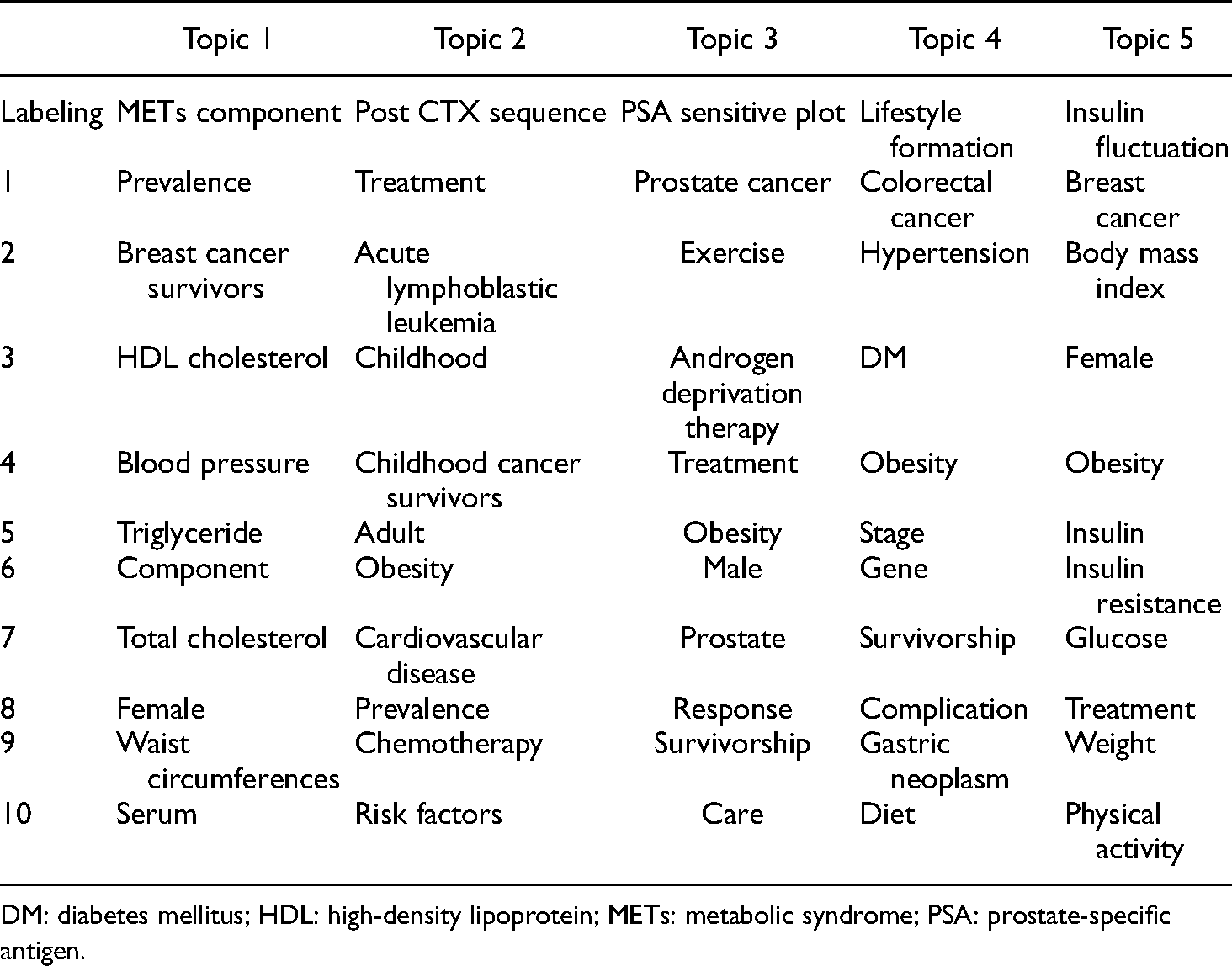
DM: diabetes mellitus; HDL: high-density lipoprotein; METs: metabolic syndrome; PSA: prostate-specific antigen.
In addition, among a total of 365 articles, the number of articles assigned to each topic was highest for Topic 2 (32.1%), followed by Topics 5 (23.3%), 3, (18.1%), 4, (14.2%), and 1 (12.3%; Table 3).
Number of previous studies for each topic.

The relative trend of topics over time is shown in Figure 2. Topic 4 appeared in 2009 and has been showing a constant level of distribution at approximately 15%. Topics 2 and 5 showed a gradual decrease over time. Topic 2 accounted for the highest percentage of the entire research on metabolic syndrome in cancer survivors but recently started showing a decreasing tendency. Topic 1 has been showing a constant level of distribution at approximately 10% since 2012. Topic 3 first appeared in 2005 and has shown an increasing trend over the past four years. With the tendency toward a wider scope of approaches in metabolic syndrome in cancer survivors, a gradual tendency toward even distribution was seen for the five topics. Furthermore, Topic 3 has been gaining more attention than Topics 2 and 5 in metabolic syndrome research in cancer survivors over time (Figure 2).

Annual trend in topic.
Discussion
This study examined the whole knowledge structure of research on metabolic syndrome in cancer survivors by extracting topics and keywords from relevant studies and visualizing the relationships between keywords in the network, thereby providing a macro perspective for the research trends.
According to the analysis, the core keywords that not only had a high frequency but also a high degree centrality and betweenness centrality in metabolic syndrome research were “obesity,” “treatment,” and “breast cancer.” High degree centrality meant that the keywords had a strong correlation with the central network, and the keywords with high betweenness centrality allow us to understand the effects of the keyword on trends and formation of the entire network by linking various keywords. Hence, the keywords “obesity,” “treatment,” and “breast cancer” can help us understand the research trends regarding metabolic syndrome in cancer survivors and how to choose research topics in the future. In addition, studies reporting that metabolic syndrome was aggravated by obesity, sedentary lifestyle, and the use of chemotherapy in patients with breast cancer support our results.19,40,41
According to the topic modeling analysis results, topics related to metabolic syndrome in cancer survivors were clustered into five topics. Topic 1 described the concept of “metabolic syndrome component” by including 10 top keywords (“prevalence,” “breast cancer survivors,” “HDL cholesterol,” “blood pressure,” “triglyceride,” “component,” “total cholesterol,” “female,” “waist circumference,” and “serum”). Previous studies referred to cardiovascular risk factors such as central obesity, hyperglycemia, hypertension, high triglyceride level, and low serum cholesterol and HDL cholesterol levels as metabolic syndrome,4,42,43 and these results are likely to be because of the strong association between metabolic syndrome and breast cancer, which is common in females.19,20,44
Topic 2 included the following 10 top keywords: “treatment,” “acute lymphoblastic leukemia,” “childhood,” “childhood cancer survivors,” “adult,” “obesity,” “cardiovascular disease,” “prevalence,” “chemotherapy,” and “risk factors.” It denotes a concept of “post CTX sequence,” which describes outcomes and side effects occurring after acute lymphoblastic leukemia chemotherapy. Acute lymphoblastic leukemia mainly occurs during childhood, but the five-year survival rate has improved by more than 90% because of advanced treatments.12–15 However, it is known that childhood cancer survivors tend to develop at least one chronic disease in their 20s and are at high risk of premature death. 22 As survivors who undergo chemotherapy have a high prevalence of obesity and are at high risk of metabolic syndrome as well as cardiovascular diseases, evidence-based intervention strategies that meet specific requirements of childhood are needed for the changes in survivors’ treatments, preventing obesity, and alleviating metabolic syndrome.10,45 Through further studies including “post CTX sequence” concepts, customized interventions for survivors should be implemented in order to monitor survivors’ metabolic status and improve their diet and physical activities. Furthermore, long-term large-scale studies with survivors are needed.
The 10 top keywords in Topic 3 included “prostate cancer,” “exercise,” “androgen deprivation therapy,” “treatment,” “obesity,” “male,” “prostate,” “response,” “survivorship,” and “care.” This topic was termed “prostate-specific antigen-sensitive plot,” indicating that the trend in prostate-specific antigen sensitivity is a critical factor in prostate cancer treatment and the follow-up of its survivorship. The association between metabolic syndrome and prostate cancer, a major disease in males, is already widely known. It was also reported that androgen deprivation therapy, a main treatment for prostate cancer, induces obesity by reducing insulin sensitivity and increasing serum triglycerides and fat. 46 Topic 3 is a concept emphasizing the importance of preventing prostate cancer recurrence by using the prostate-specific antigen plot for survivorship and managing metabolic syndrome through diet and exercise.
Topic 4, “lifestyle formation,” included the following top 10 keywords: “colorectal cancer,” “hypertension,” “DM,” “obesity,” “stage,” “gene,” “survivorship,” “complication,” “gastric neoplasm,” and “diet.” These address the management of the factors influencing metabolic syndrome and lifestyle forming as an important concept to increase the survival of colorectal cancer patients and reduce the prevalence of colorectal cancer and gastric neoplasm. Several studies have shown that colorectal cancer and gastric neoplasm are also associated with metabolic syndrome, similar to other cancer types.13,14,23,47 Epidemiological study results from countries with a high incidence of colorectal cancer showed that lifestyle factors increase the risk of colorectal cancer. 47 Obesity, hypertension, DM, and high triglycerides level increase the prevalence of not only cardiovascular disease but also chronic diseases and various types of cancer, including gastric and colorectal cancer; this finding can help raise awareness of the risk of metabolic syndrome. 48 To manage metabolic syndrome that can occur as a complication after cancer prevention and treatment, avoiding sedentary living and improving lifestyle through diet and exercise along with lifestyle formation at the local community level will be of utmost importance.
Topic 5, “insulin fluctuation,” included the following top 10 keywords: “breast cancer,” “body mass index,” “female,” “obesity,” “insulin,” “insulin resistance,” “glucose,” “treatment,” “weight,” and “physical activity.” This is because insulin fluctuation is associated with the management of metabolic syndrome in survivors of breast cancer, a major disease in women. Metabolic syndrome is associated with the recurrence of cardiovascular disease, type 2 diabetes, and cancer, and occurs more frequently in breast cancer survivors.19,20 Therefore, the management of diabetes and obesity in breast cancer survivors using insulin resistance and glucose indices is the most crucial aspect for preventing metabolic syndrome.
According to the relative trends of each topic over time, Topics 4 (“lifestyle formation”) and 1 (“metabolic syndrome component”) showed consistent levels of distribution at approximately 10%. However, Topics 2 (“post CTX sequence”) and 5 (“insulin fluctuation”) showed decreasing trends over time, whereas Topic 3 (“prostate-specific antigen-sensitive plot”) showed a decreasing trend during the past four years since its appearance in 2005. The subsequent increasing trend of Topic 3 may possibly be because of the fact that prostate cancer is one of the diseases with the highest survival rate following early treatment. The early diagnosis of prostate cancer can lead to more than 90% full recovery because of the advancement in surgical techniques and the development of medical equipment for cancer treatment. 49 Metabolic syndrome care for extending life expectancy and increasing quality of life has emerged as the most important element in prostate cancer, which mainly occurs in older age. Furthermore, the distribution of the five topics in recent studies on metabolic syndrome in cancer survivors is likely to be because of studies exploring alternative approaches to maintaining high quality of life during the survival period rather than chemotherapy, which frequently leads to complications when viewed from various angles. Therefore, future studies on metabolic syndrome in cancer survivors with diversified perspectives are required; these should not only focus on the treatment of metabolic-syndrome-related diseases but also on lifestyle-related diseases, the improvement of the quality of life, and the identification of alternative approaches to preventing metabolic syndrome.
Finally, our study had a limitation in that it lacked a qualitative analysis to explain the quantitative and visual representation of the entire structure of the network connections. An extensive length of time and labor force will be required for the required amount of data to be collected and interpreted, as this heavily relies on the knowledge, experience, and insight of experts. However, because of the crucial need to increase the survival rate of patients with cancer through the management of metabolic syndrome, our study could provide important basic data for determining research trends and predicting future research directions.
Footnotes
Declaration of conflicting interests
The author(s) declared no potential conflicts of interest with respect to the research, authorship, and/or publication of this article.
Funding
This study was supported by the National Research Foundation of Korea (NRF) funding (Grant No. 2018R1A1A1A05018386).
