




Abstract
Singularity is one of the important features in invariant structures in several physical phenomena reflected often in the associated invariant differential equations. The classification problem for singular differential invariants in (1+3)-dimensional space associated with Lie algebras of dimension 4 is investigated. The formulation of singular invariants for a Lie algebra of dimension
Keywords
Introduction
Lie group theory is an interesting area of research in which differential equations (DEs) are analysed on the basis of their corresponding invariant structure. This theory was initiated towards the end of the 19th century by the great Norwegian mathematician Sophus Lie (1842–1899). The concept of differential invariants appeared in Lie,1,2 further considered by Tressé and many researchers. Consequently, the theory of differential invariants became a prominent part of Lie theory. Symmetries of the underlying DEs are obtained in terms of their generators and then the corresponding Lie algebra is obtained. The invariants associated with the admitted Lie algebras are deduced and they are utilized for the analysis of the underlying DEs, inter alia, integration and classification.3–11,13,14,12,15,16 Most of the focus in the literature, is related to regular differential invariants of the corresponding Lie algebras of the DEs under study. Singularity of the differential invariant structure associated with the Lie algebra of the underlying DEs is rather limited and often overlooked. This demands a deeper insight on the problem of singularity in the differential invariant structure of the Lie algebras under consideration.
In 1999, the notion and concept of singular invariants has been described in terms of solution manifold in the work of Ibragimov. 17 In the case of a system of ordinary DEs (ODEs), the classical direct approach of successive reduction of order, once the symmetry algebra is known, is not applicable.3,18 Thus, many researchers decided to consider the classification of systems of ODEs via their symmetries. In this regard, Popovych et al. 19 studied the realizations of finite-dimensional Lie algebras and presented an updated classification in their work. By utilising 19 and employing differential invariants, Gaponova and Nesterenko 7 classified a system of two second-order ODEs admitting Lie algebras of dimensions not greater than four in their work. Moreover, by utilizing the concept of singular invariants given in the work of Ibragimov, 17 they also investigated the singular invariants for these systems of ODEs. However, the integration and other diverse features of several analysis of these underlying classified invariant systems have not been discussed in the work of Gaponova and Nesterenko. 7 Ayub and colleagues investigated the same problem. They not only developed a new type of invariant construction but classified a system of two second-order ODEs possessing Lie algebras of dimensions 3 and 4 via regular invariants in their work.3,4 In addition, they also presented an integration strategy on the basis of their classification. By means of the new invariant scheme of construction, they classified singular invariant systems of two second-order ODEs admitting Lie algebras of dimension 4 in Ayub et al. 20 Moreover, this invariant classification leads to the promulgation of integrability procedure as well as various other properties of classified invariant systems viz., conditional singularity, weak uncoupling, weak linearization, and partial uncoupling, partial linearization.
Systems of three second-order ODEs occur in many physical applications, viz. mechanics of particles, fluid mechanics, small oscillations, neural oscillations (brain wave), charged particles possessing magnetic field effects etc. Thus, the area of research related to a system of three second-order ODEs has an indispensable role in the applied sciences. Limited investigations have been performed on a system of three second-order ODEs, see e.g.11,13,14,12 Recently, by using the same approach as developed in, 3 Zahida et al. 12 constructed a basis of second-order differential invariants in (1+3)-dimensional space admitting Lie algebras of dimension three. They also formulated systems of three second-order ODEs possessing three-dimensional Lie algebras for these underlying invariants. However, there still remain various unexplored features for a system of three second-order ODEs with respect to their symmetry algebra analysis.
Here our main interest is in singularity in differential invariant structures associated with a system of three second-order ODEs having Lie algebras of dimension
Notation
The subsequent notations are invoked for the underlying Lie algebra with allied realizations as well as corresponding invariant structure. In the sequel,
Singular differential invariants and equations
Singular invariants and invariant equations
Singularity in physical systems has a key role in their analysis and often is reflected in the form of DEs in their mathematical modelling. Sometimes this singularity appears hidden in the underling physical systems and apparently not recognized at first glance in the arising DEs of the mathematical model.
We focus on a system of three second-order ODEs in the general form
A differential function 
If the rank of the coefficient matrix of vector fields on the solution manifold is less than the rank of the coefficient matrix on the generic manifold, then singularity occurs in the invariant structure of the associated underlying vector fields. This singularity has a significant role in the construction of the corresponding system of invariant DEs, which further affects their integrability. Here we investigate such type of singularity for the system (1) which admits a four-dimensional Lie algebra.
We employ the same technique discussed in literary works3,4,20,12 We extend this to a system of three second-order ODEs given in the form (1) having Lie algebra of dimension
Let us investigate the case of the first realization of 


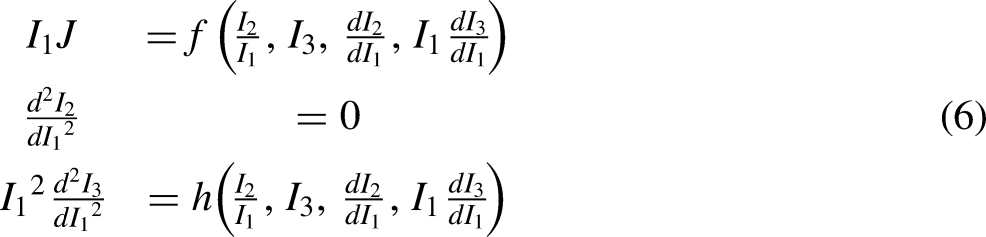

By utilizing the realizations of Lie algebras of dimension
The singularity structure and corresponding invariants for four-dimensional Lie algebras in (1+3)-dimensional space can be categorized into different types and this is discussed in the next section.
Types of singular invariant equations
Singularity in physical systems may arise in different situations with various physical constraints as a result of which there are different types. So it is natural that diverse types of singularity would be reflected in the DEs associated with the mathematical modelling of these physical systems. There are some physical systems in which singularity depends on some constraints in the form of conditions and known as the conditional singularity.
If we look at the conditional singularity from a mathematical point of view in the case of a system of three second-order ODEs having Lie algebras of dimension
For the case of a system of three second-order ODEs possessing the Lie algebra 


In a similar manner as performed for the case of conditional singularity, on the basis of other properties of the underlying physical systems such as weak uncoupling, weak linearity, partially uncoupling and partial linearity, singularity in differential invariants of these investigated systems from an algebraic point of view can be classified. This classification can be utilized in order to investigate the singularity analysis of the underlying physical systems as an inverse problem.
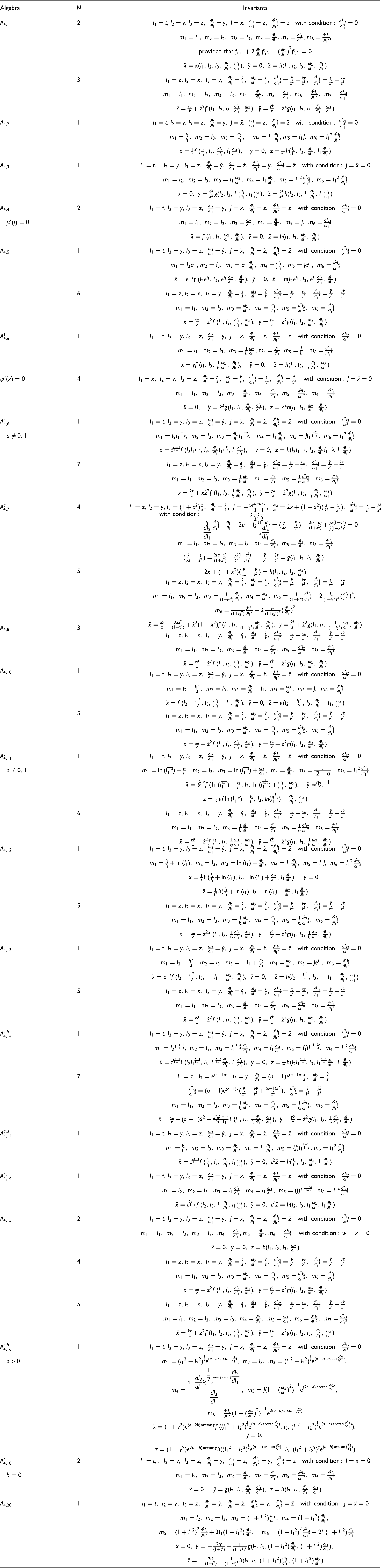
We classify singularity in differential invariants and the associated canonical forms, mentioned in Table 1, on the basis of weak uncoupling, partially uncoupling, weak linearity and partially linearity in 1+3-dimensional space for Lie algebras of dimension
In the light of the above observations, we proceed to the following definitions which are extensions of what appears in the work of Ayub et al. 3
A system of three second-order ODEs is said to be
weakly uncoupled if one of its equations possesses an uncoupled the scalar second-order equation in one of the dependent variables; partially uncoupled if two of its equations consist of uncoupled scalar second-order equations in their own right in two of their dependent variables.
In a similar manner, we can define the linearity of a system of three second-order ODEs in terms of weakly linear and partially linear as follows.
A system of three second-order ODEs is said to be
weakly linear if one of its equations constitute a scalar linear second-order equation; partially linear if two of its equations embody scalar linear second-order equations.
Furthermore, we also define weakly linearizable and partially linearizable systems of three second-order ODEs as below.
A system of three second-order ODEs is said to be
weakly linearizable by point transformation if it can be transformed via an invertible transformation to a weakly linear form; partially linearizable via point transformation if it can be transformed by an invertible transformation to a partially linear form.
On the basis of the above definitions, the classification results associated with canonical forms presented in Table 1 can be summarized as follows.
A system of three second-order ODEs given in terms of singular invariant equations is said to be weakly uncoupled and weakly linearizable by point transformation if and only if it possesses one of the following Lie algebras
A system of three second-order ODEs represented in terms of singular invariant equations is said to be partially uncoupled and partially linearizable via point transformation if and only if it possesses the Lie algebra
A system of three second-order ODEs written in terms of singular invariant equations can be reduced to asystem of two second-order ODEs by point transformation if and only if it admits one of the following Lie algebras
The set of following realizations in 1+3-dimensional space associated with four-dimensional Lie algebras, viz.
In a similar manner for conditional singularity for differential invariants in 1+3-dimensional space for a Lie algebra of dimension
‘A system of three second-order ODEs represented in terms of conditional singular invariant equations by point transformation if and only if it admits the Lie algebra
‘A system of three second-order ODEs represented in terms of conditional singular invariant equations is said to be conditional weakly uncoupled and conditional weakly linearizable by point transformation if and only if it possesses the Lie algebra
The proofs of these propositions follow directly from Table 1.
Integration
Lie point symmetries are utilized for various types of analyses of DEs. One of the important features is the reduction and integrability of the underlying DEs. Especially, in the case of a system of DEs, a reduction procedure in the classical manner is not effective. 18 Therefore, for integrability of a system of DEs, the canonical form approach is of much benefit. This is equally applicable in both cases, i.e. for regular and singular invariant system of equations. Here, we consider the singular invariant system of equations. The singular differential invariant structure and construction of canonical forms is described in the “Singular invariants and invariant equations” section. In addition, categorization of the classified forms as stated in Table 1 has been investigated in detail in the “Types of singular invariant equations” section-(2.1).
We visit some cases from Table 1 and perform the integrability analysis of the underlying singular invariant equations for peculiar values of
Category A
Those cases of canonical forms are analysed for which
Let us consider a particular class of a Lie algebra from Category A viz., 
Here we look at the following two cases.
Trivial case When
The system (12) has a solution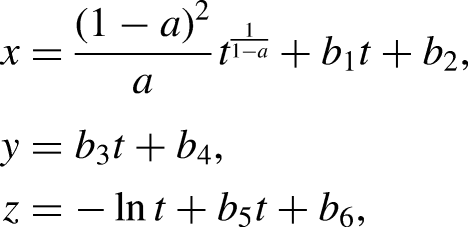
If we take the value of 

In both Cases (a) and (b) of the studied Lie algebra
Proceeding in like manner for all Lie algebras in Category A, as mentioned in Table 1, we deduce that the integrability of these corresponding invariant systems depends on a scalar second-order ODE associated with this investigated invariant system.
Category B
In this category, those cases of canonical forms are analysed in which
Consider the Lie algebra taken from Category B viz., 
Like the previous Category A, we study the following two cases for this underlying class Trivial case When
In particular, if we take 
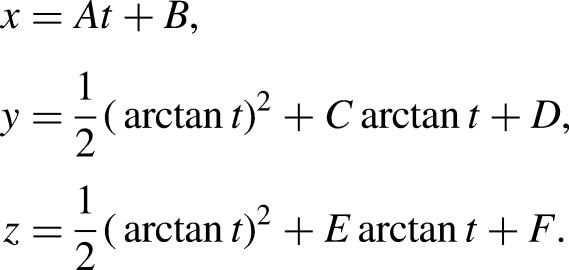
Extending this analysis to all the Lie algebras appearing in Category B, in Table 1, we determine that the integrability of these corresponding invariant systems having the underlying Lie algebras, depends on a system of two scalar second-order ODEs associated with their invariant systems.
Category C
Those cases of canonical forms are analysed here in which both
Consider the Lie algebra 
The above relations are as shown in Table 1 and we determine

In the light of the above discussions, integrability analysis here can be summarized as follows.
If a system of three second-order ODEs when represented in terms of singular invariant equations possess a four-dimensional solvable symmetry Lie algebra, then its general solution by quadrature exists in the following two cases.
Case (1). If the admitting Lie algebra is
Case (2). If the admitting Lie algebra possesses a Lie subalgebra
The proofs of these results follow directly from Table 1. The Case 1 is analysed in Categories A and C and Case 2 is discussed in Category B.
Applications
In many physical systems such as vibratory and oscillatory systems, the energy in the form of the intensity of vibrations or oscillations is gradually dissipated by friction and other resistances with time; these are known as damped. In mathematical modelling, they play a crucial role in the mathematical study of mechanics of the system of interacting as well as non-interacting particles. Singularity in the invariant structure of such types of physical systems is a peculiar hidden structure which is closely related to various aspects of analysis including damping and integrability. In the current study, we investigate the classification of singularity in invariant structure for a four-dimensional Lie algebra and have presented the results in the form of a table.
In addition, one of the interesting properties related to a solution of DEs is the notion of blow-up of the corresponding solution in finite time. Here we briefly mention this aspect.
The blow-up of a solution of the underlying DE in finite time indicates the phenomenon that the corresponding solution tends to infinity in a finite time. The study concerning the blow-up phenomenon is evoked by fruitful mathematical structures of the investigated equation. In addition, the blow-up mechanisms have special meaning emphasizing physical and biological significances in applications. Mathematically, let

If the DE is autonomous, the independent variable, time
In this section, we present two physical examples from mechanics to illustrate our main results.

The system (21) admits the symmetry Lie algebra of vector fields


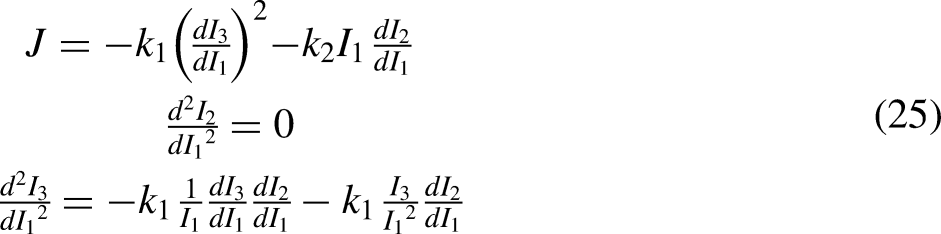
From the second equation of the system (25), we arrive at

By using the values of (27) in the first equation of the system (25) and performing some manipulations, we obtain
By utilizing invariants in Table 1 and employing invertible transformation (23), reverting to the original variables after dropping the bars, (26), (27) and (28) become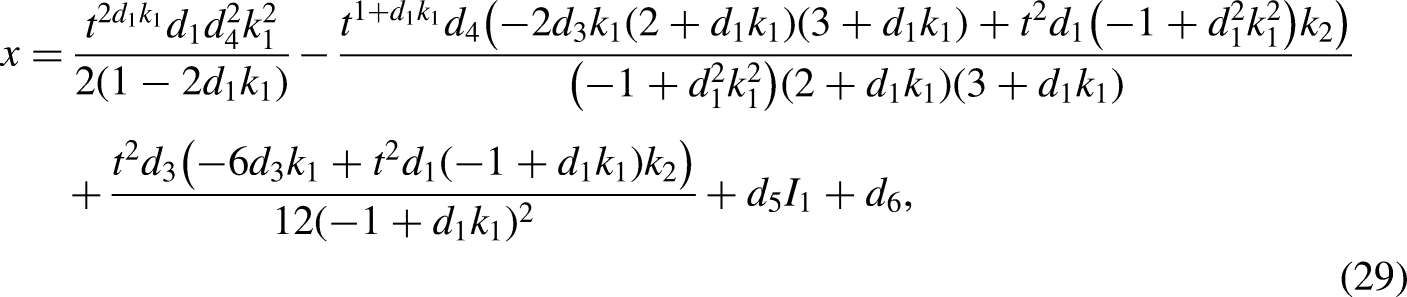


Thus (29)–(31) provide the solution of our system (21).
We now briefly comment on the blow-up of the solution above. By careful observation, the solution, viz., (29)–(31) of the system (21), results in the blow-up of the solution in time

The system (32) possesses the Lie algebra spanned by the following symmetry vectors




Conclusion
We gave a description of the classification problem of singularity in differential invariant structures in
We have obtained
In some cases due to singular invariant structure, these classified canonical forms do not lead to a complete system of three second-order ODEs in
Furthermore, on the basis of categorization of singular invariant equations for a system of three second-order ODEs possessing Lie algebras of dimension
This classification reveals many features of singularity in differential invariants and related invariant systems of equations. This work will have significance for the classification and integrability of a system of three second-order ODEs possessing Lie algebras of dimension
By employing mathematical modelling of physical systems, this classification of singularity in differential invariants in
Remarks on Table 1
Footnotes
Acknowledgments
We appreciate the useful remarks of the reviewers and are thankful to them for such guidance by which the paper has been significantly improved.
Declaration of conflicting interests
The authors declared no potential conflicts of interest with respect to the research, authorship, and/or publication of this article.
Funding
The authors received no financial support for the research, authorship, and/or publication of this article.
