



Abstract

Keywords
The term biodiversity, a shortened form for biological diversity, was coined in the 1980s.1,2 It refers to the variety and richness of life on Earth at all levels of organization, spanning from the genetic level to the species and ecological levels. Universally recognized as an irreplaceable asset to humankind, biodiversity stands as a cornerstone of paramount importance, intricately woven into the fabric of both present and future generations. In the late 1980s, as the alarming rate of species extinction caused by human activities became evident, the United Nations Environment Programme initiated efforts that led to the creation of the Convention on Biological Diversity (CBD), which took effect in 1993.
The CBD defines biological diversity as “the variability among living organisms from all sources including, inter alia, terrestrial, marine and other aquatic ecosystems and the ecological complexes of which they are part; this includes diversity within species, between species and of ecosystems” (Text of the Convention, Article 2, p. 4). Building upon this definition, the Intergovernmental Science-Policy Platform on Biodiversity and Ecosystem Services (IPBES), which was established in 2012, defines biodiversity as “the variability among living organisms from all sources including terrestrial, marine and other aquatic ecosystems and the ecological complexes of which they are a part. This includes variation in genetic, phenotypic, phylogenetic, and functional attributes, as well as changes in abundance and distribution over time and space within and among species, biological communities and ecosystems” (IPBES Glossary). Accordingly, the IPBES definition underscores the emphasis on living elements, aiming to adhere to the essence of the CBD definition while aligning more closely with contemporary ecological theory. 2
Until today, biodiversity loss and its impacts on humanity remain critical global issues.3–6 Addressing these pressing concerns requires urgent actions and effective governance to facilitate coordinated efforts across various sectors of society, emphasizing that biodiversity conservation is a shared global concern. However, efforts toward biodiversity conservation have, for the most part, been siloed and independent.7,8
The nexus approach, which emerged in the early 1980s, has evolved into a versatile tool for integrating systems, a platform for engaging stakeholders, and a method for exploring development pathways that consider the drivers and impacts of social and environmental changes, including climate change.9,10 This approach acknowledges the interdependencies between sectors/systems, providing a promising framework for biodiversity conservation.
The importance of the nexus approach is increasingly recognized in the field of biodiversity conservation. Recent studies have shown a specific focus on “biodiversity” and “ecosystems” as nexus components. 10 In 2018, the European Commission's Joint Research Centre, in partnership with the UNESCO-Intergovernmental Hydrological Programme, initiated a project centered on the water-energy-food-ecosystems nexus. 11 Currently, the IPBES is conducting a global nexus assessment that focuses on biodiversity, water, food and health (https://www.ipbes.net/nexus). As biodiversity conservation policies become rich and diverse, 12 the need for effective coordination across sectors has increased, underscoring the critical need for a nexus approach to biodiversity conservation.
This Letter identifies some key interrelated considerations for implementing the nexus approach in biodiversity conservation research and practice. These considerations encompass nexus thinking, policy mainstreaming, stakeholder engagement, database improvement, and financial support (Figure 1).
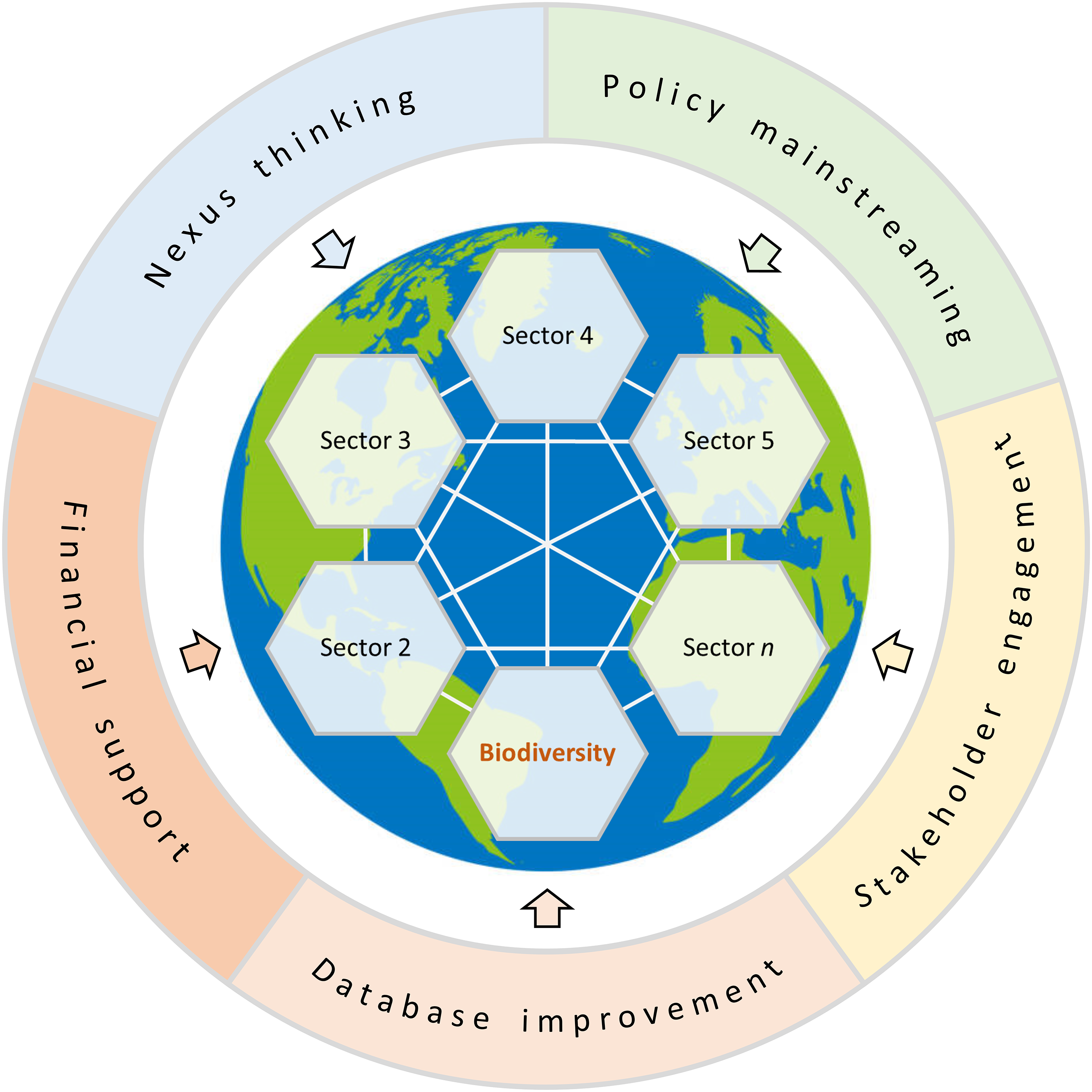
Conceptual framework showing (i) biodiversity as one of the key nexus components and (ii) some key interrelated considerations for implementing the nexus approach in biodiversity conservation research and practice. Note that nexus components can be resource sectors, systems, or specific social-ecological issues.10 Earth image credit: Elico-Gaia.
In conclusion, the nexus approach provides a promising framework for orchestrating research and development plans aimed at effectively addressing the intricate and interrelated challenges confronting our planet. It holds the potential to address the root causes of biodiversity loss, including land/sea use change, direct exploitation of natural resources, pollution, climate change, and the proliferation of invasive alien species. 6 Moreover, the nexus approach advocates for sustainable development.10,13 Its seamless integration and successful implementation within biodiversity conservation research and practice demand an overarching, integrated, and interdisciplinary perspective. This perspective should encompass elements such as nexus thinking, the integration of policies, engagement of stakeholders, continual enhancement of databases, and the provision of financial support. This holistic and integrated approach has the potential to be useful in achieving a future where both humans and nature thrive in harmonious coexistence.
Footnotes
Declaration of conflicting interests
The author declared no potential conflict of interest with respect to the research, authorship, and/or publication of this article.
Funding
The author disclosed receipt of the following financial support for the research, authorship, and/or publication of this article: This work was supported by the Japan Society for the Promotion of Science (JSPS) through its Grants-in-Aid for Scientific Research (KAKENHI) Program: Grant-in-Aid for Scientific Research (C), Number 22K01038 (Principal Investigator: Ronald C. Estoque). The views expressed in this paper are of the author and do not necessarily reflect the position of his institution and the funder.

Author biography
Ronald C. Estoque is a Senior Researcher at the Center for Biodiversity and Climate Change, Forestry and Forest Products Research Institute (FFPRI), Japan. He is a forester and geoenvironmental scientist by training. His research interests are at the interface of nature and society and include sustainability, land use/land cover change, forest cover change, ecosystem services, urbanization, quality of life, climate change mitigation, vulnerability, risk and adaptation, and the nexus approach. He applies various tools and techniques, including GIS, remote sensing, and social-ecological approaches. He was a contributing author (CA) to the Intergovernmental Panel on Climate Change's (IPCC) sixth assessment report (AR6) (WG II, Chapter 10). Currently, he serves as a review editor (RE) for the Intergovernmental Science-Policy Platform for Biodiversity and Ecosystem Services' (IPBES) nexus assessment (Chapter 2), a section Editor-in-Chief for Sustainability (section: Sustainable Forestry), a subject editor for Ecosystem Health and Sustainability, associate editor for Frontiers in Forests and Global Change, and a member of the editorial board for Science of the Total Environment, Remote Sensing, and Ecological Civilization.