In this paper, a mathematical model of Love-type wave propagation in a heterogeneous transversely isotropic elastic layer subjected to initial stress and rotation of the resting on a rigid foundation. Frequency equation of Love-type wave is obtained in closed form. The material constants and initial stress have been taken as space dependent and arbitrary functions of depth in the respective media.
Objectives:
The dispersion equation is determined to study the effect of different types of parameters such as inhomogeneity, initial stress, rotation, wave number, the phase velocity on the Love-type wave propagation.
Methods:
The analytical solution has been obtained, we have used the separation of variables, method and the numerical solution using the bisection method implemented in MATLAB.
Results:
We present a general dispersion relation to describe the impacts as the propagation of Love-type waves in the structures. Numerical results analyzing the dispersion equation are discussed and presented graphically. Moreover, the obtained dispersion relation is found in well agreement with the classical case in isotropic and transversely isotropic layer resting on a rigid foundation. Finally, some graphical presentations have been made to assess the effects of various parameters in the plane wave propagation in elastic media of different nature.
A theoretical problem based on seismology is being studied in this piece of work. It considers two characteristic media (dissimilar) to analyze the propagation of seismic waves. Explosions or Earthquakes are responsible for the generation of two types of seismic waves namely body wave and surface wave which as the name suggest propagate within and along the surface, respectively. Surface seismic waves are categorized into Love-type waves and A.E.H. Love is to be credited for shedding light on the existence of these waves in 1911. The paper considers a composite structure made of dual but different media in order to describe the propagation of these Love-type waves in the current model of Earth (Figure 1). It can greatly assist in the examination of distinctiveness and behavior of Love-type waves in the internal side of the earth. The fundamental concepts of elastic materials and seismic waves are very well explained in the books of Love,1 Ewing et al.2 Biot,3 Gubbins,4 Ding et al.5 and Dey and Mukherjee,6 and so on. Wang and Zhang7 considered a “transversely isotropic fluid-saturated porous layered half-space” to investigate how Love waves propagate in such a medium. Similarly, a “pre-stressed Voigt-type viscoelastic orthotropic functionally graded layer over a porous half-space” was considered by Pandit et al.8 to study how the love waves propagate in such a medium. The study on propagation of love waves was extended by Kakar and Kakar9 by considering their movement in a “Voigt-type viscoelastic heterogeneous layer overlying heterogeneous viscoelastic half-space.” A transversely isotropic layer was considered by Chattopadhyay10 to study the strong SH motion which was supposed to be lying on an elastic material (isotropic) owing to a momentary point source. Recently, Singh et al.11 utilized an “initially stressed magnetoelastic transversely isotropic medium” to better understand how the shear wave propagation impacts a “semi-infinite smooth moving punch.” Acharya et al.12 considered a conducting medium to contemplate the impact of magnetic fields and transverse isotropy on the interface waves. Ahmad and Khan13 also considered an unbounded medium emitting transversely isotropic characteristics to study how the propagation of wave plane is affected by rotational effects while the medium is revolving around its axis. Baljeet14 is to be credited for pointing out how the propagation of plane waves takes place in the case of a “dual-temperature, rotating, and thermoelastic transversely isotropic solid half-space.” In the case of an isotropically layered structure, the dispersion equations for the propagation of various types of seismic surface waves were established by Kundu et al.,15 Zhu et al.,16 and Kakar.17 Several factors may cause the inside pressure of the Earth to vary such as gravitational pull, atmospheric pressure, overburden and process manufacturing, slow creep process, and so on (Dey and De18). Thus, it has been considered that the Earth is stressed initially. On a theoretical level, several researchers and authors have considered the pre-stressed media to understand the propagation of seismic surface waves. The dispersion relation was developed by Dhua and Chattopadhyay,19 Kundu et al.,20 and Chattaraj et al.21 so that the propagation of surface waves in different sorts of pre-stressed media could be better understood. The pre-stressed media through which the seismic surface waves propagate has a significant impact on their propagation. Dey and Addy22 discussed how the initially stressed medium influences elastic waves.
Sketch of the physical situation of the problem.
In this paper, we aim to study the propagation of Love-type wave in an initially stressed heterogeneous transversely isotropic layer in effect of rigid foundation. The study of the effect of rigid foundation layers on propagation of elastic wave has always been of great concern to civil engineers and seismologists. Analytical treatment has been done to find the dispersion relation from where the real part of the expression will give the dispersion relation of phase velocity. It is found that the heterogeneity and initial stress have a significant favoring effect on the phase velocity of Love-type wave when the layer has rigid base. Deduced result is found in well agreement with the established standard results existing in the literature. All graphs are plotted by using MATLAB software. The graphical results of this problem are discussed in numerical results and discussion section.
Formulation of the problem
Let us consider a heterogeneous initially stress and transversely isotropic rotating layers of a finite thickness H with rigid surface at y = H. We choose a coordinate system in such a way that, y-axis is directed vertically downwards and the -axis is assumed in the direction of the propagation of Love-type wave as shown in Figure 1.
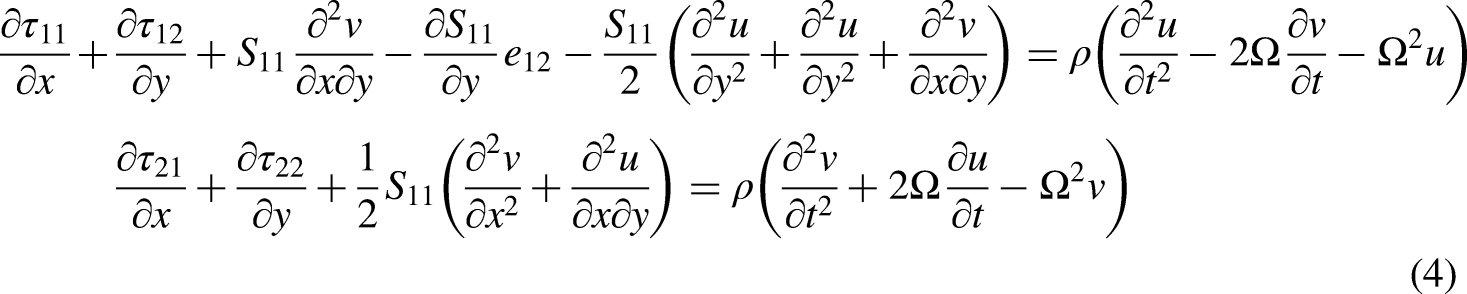
The displacement equation of motion in the rotating frame has two additional terms: the Centripetal acceleration → due to the time-varying motion only and the Coriolis acceleration 2 due to moving reference frame. We restrict our analysis to plane. Thus, all the quantities in the medium are independent of the variable For the propagation of Love-type waves in a transversely isotropic elastic layer under initial stress and rotation , the governing equations given by Biot2 are
where is the stress tensor, is the initial stress, e is the dilatation, t is the time, is the density of the medium, is the displacement vector, is the angular velocity, is the strain tensor, and is the rotational component defined by
For propagation of Love-type wave in -direction, it is assumed that
The heterogeneity in the layer is taken as follows.
We characterize the elastic constants , and the density ρ of non-homogeneous material, as follows:
in which , and represent the values of , and in the homogeneous case, respectively, represents the non-homogeneous parametric and are elastic constants for the transversely isotropic layer.
In view of equations (2) and (3), equation (1) leads to
where are the stress components, is the initial stress, are the factors of displacement in the layer along x and y directions, respectively.
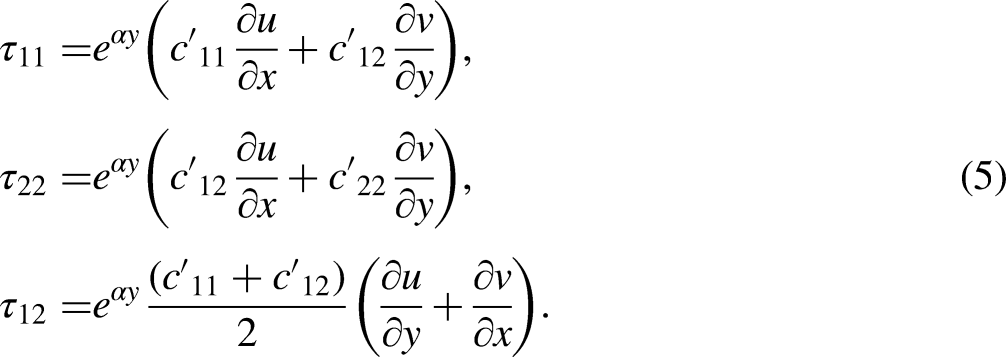
The stress–displacement relations for the transversely isotropic non-homogeneous layer given by Biot2 are
Substituting equation (5) into equation (4), we get
where .
Solution of the problem
To solve equations (6) and (7) analytically in the form of the harmonic travelling waves in the positive direction of the x-axis with velocity c, we call the solution of the form:
where is the angular frequency, is the wave number in the x-direction, and are the amplitudes of the functions.
Now using equation (8) in equations (6) and (7), we obtain
Now substituting
So, P(y) will be
Using (11) and (12) in equations (9) and (10), we get
By substituting equation (8) into equations (11) and (12), we obtain
Boundary conditions
The stress-free case at the free surface of the upper layer provides suitable boundary conditions as:
At the lower boundary layer (fixed surface) the displacement components vanish,
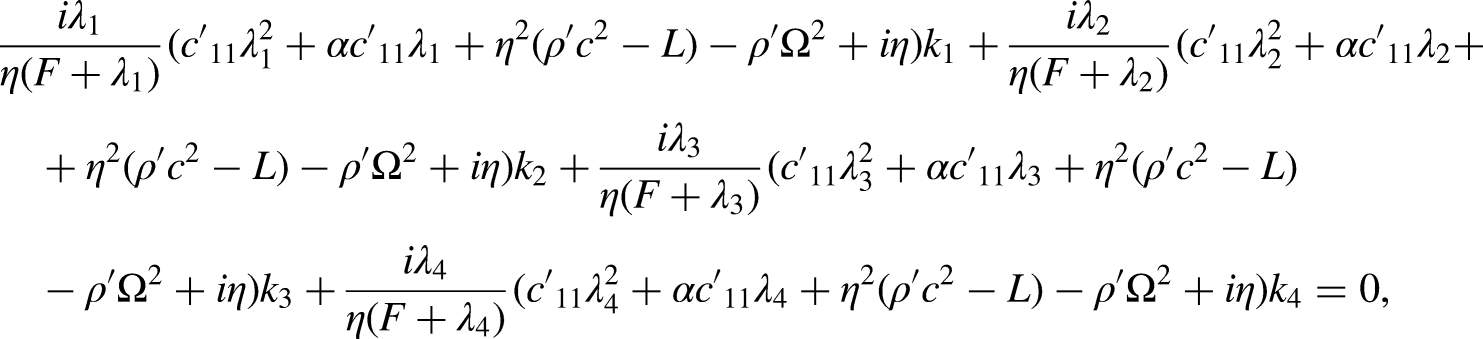
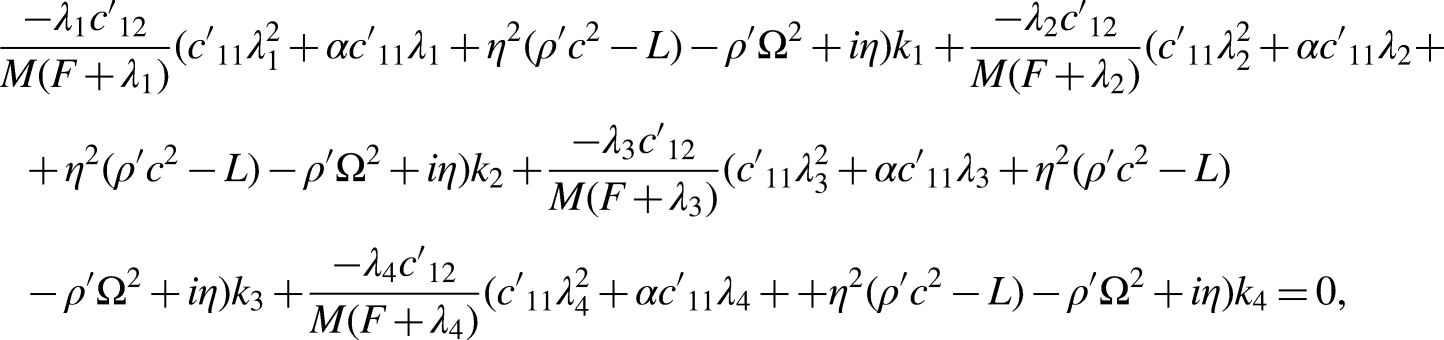
By substituting equations (15a) and (15b) into equation (5) and equations (13) and (14), we get
To eliminate the arbitrary constants , and from equation (16), we have the following determinant:
Equation (17) is the required equation of the Love-type wave in a heterogeneous transversely isotropic elastic layer resting over a heterogeneous a rigid foundation. This dispersion equation being a function of phase velocity, angular velocity, wave number, initial stress, rotation, and heterogeneous parameter associated with the rigidity and density of inhomogeneous layer, reveals the fact that Love-type wave propagation is greatly influenced by above-stated parameters. However, under the condition when vanish of inhomogeneity rotation , and initial stress , equation (17) gives the dispersion equation of Love-type wave in homogeneous transversely isotropic layer resting on rigid base obtained by Gubbins4 and in similar fashion for isotropic materials with the vanishing of inhomogeneity rotation , and initial stress , equation (17) gives the dispersion equation of Love-type wave in homogeneous isotropic layer resting on a rigid base obtained by Singh et al.11
The expressions of coefficients are given in Appendix.
The numerical procedure
Here, the phase velocity of the problem is obtained by numerically solving the frequency equations. Because these equations are an implicit functional relation of and , we proceed to find the variation of frequency equation with wave number . We utilized MATLAB program to analyze the roots of the above equations versus different values of rotation, initial stress, heterogeneous parameters, and layer thickness. Moreover, we have adopted the following iterative procedure for numerical computations. For a fixed value of , we investigated the detrimental equations for various values of the unknown quantity, starting with the initial value near zero and adding each time a fixed, but small increment that unknown quantity until the signs of determinant value are changed. Then, the bisection method is employed to locate the correct root to a chosen number of decimal places. With this root as the initial value, the procedure is repeated to find the next root, and so forth.
Numerical results and discussion
To illustrate the effect of inhomogeneity wave number thickness rotation , and initial stress of the Love-type wave, graphical interpretation of phase velocity, we use the dispersion equation (17) along with the following numerical values of various densities and elastic constant as suggested by Payton,4 cobalt material has been taken for transversely isotropic materials as
The above data are in good agreement of Love-type waves. By using above numerical data, we have shown the impacts of heterogeneous parameters rotation initial stress , and thickness H on the propagation of Love-type wave in the following figures (Figures 2–9). All graphs have been plotted for the phase velocity with respect to the wave number on the Love-type wave propagation. The phase velocity curves in all figures follow same decreasing trend with respect to the The variations are shown in Figures 2–9, respectively.
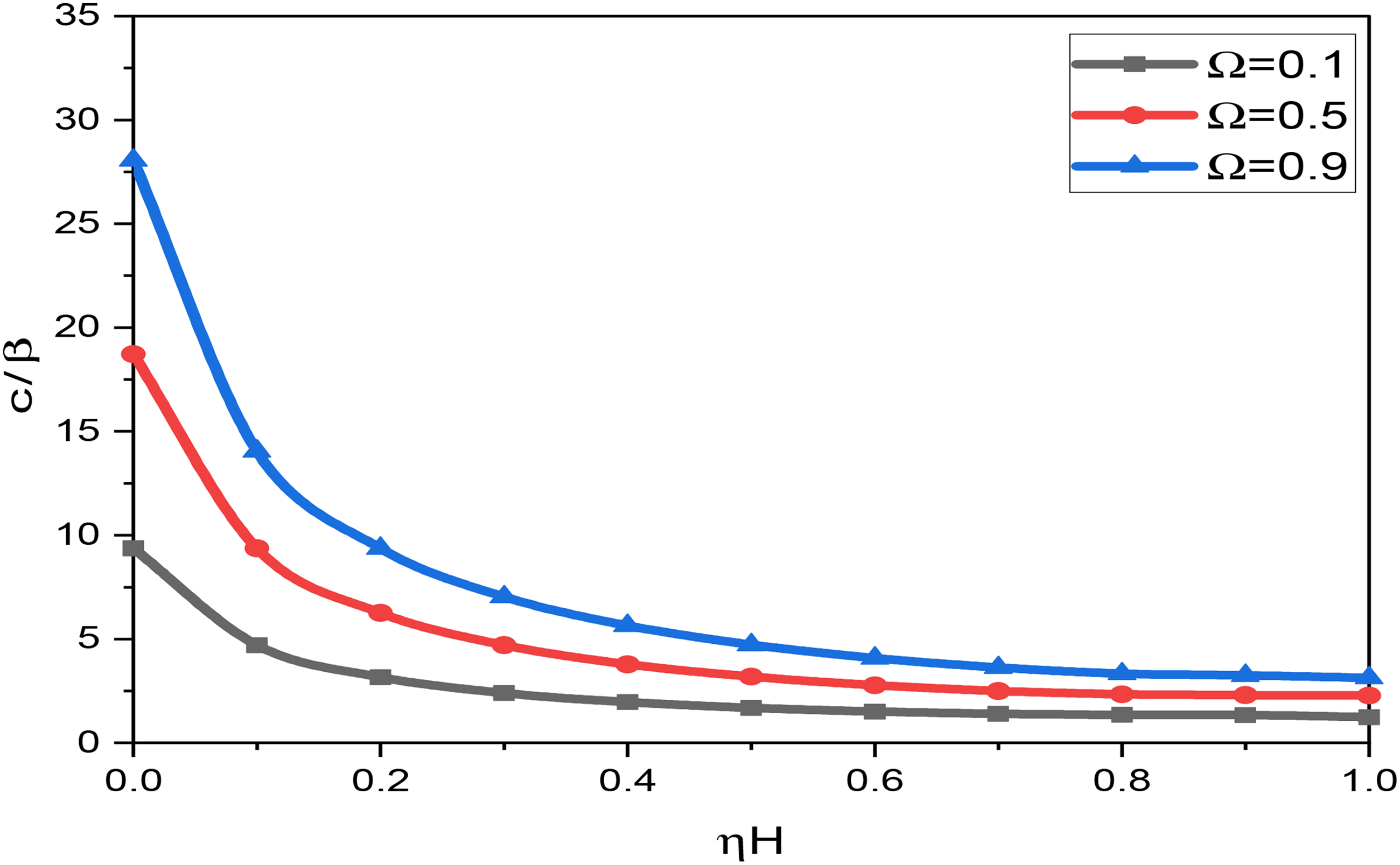
Love -type wave under the effect of rotation Ω against non-dimensional wave number .
Love-type wave under the effect of layer thickness H against non-dimensional wave number.
Figure 2 signifies the effect of rotation on the propagation of Love-type waves in a transversely isotropic layer. In the particular value of initial stress with the variation of the rotation, phase velocity decreases rapidly after some time with increases in wave number The phase velocity of the Love-type wave seems to increase with the increase in the magnitudes of rotation parameter. The figure concludes that the phase velocity of the Love-type wave increases with the increase in the rotation parameter at the interface of the layer. It has also been revealed from the figure that as the value of increases, the phase velocity of Love-type waves increases for and decreases for .
Figure 3 depicts the effect of initial stress on the propagation of Love-type waves in a transversely isotropic layer. For the particular value of rotation with the variation of initial stress. It is obvious that the phase velocity decreases with increasing of initial stress through the wave number while it decreases with increasing of wave number Moreover, it is remarked from Figure 3 that the influence of initial stress on the dispersion curves is substantial for the considered range of the wave number. The dispersion curves shift upwards as the magnitude of initial stress rises, clearly depicting the fact that the traversal of Love-type waves becomes faster with the increment in initial stress present in the layer.
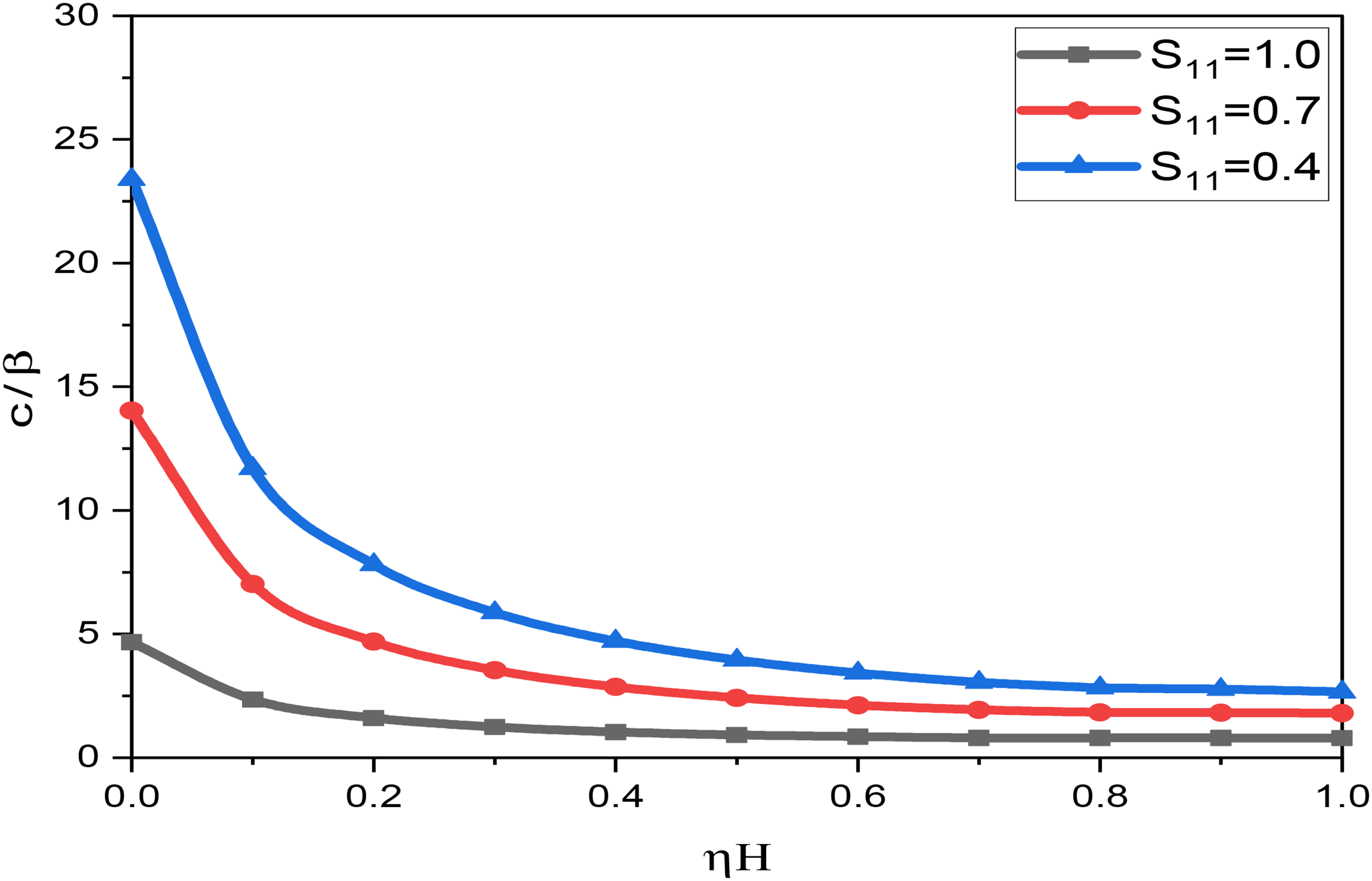
Love -type wave under the effect of initial stress S11 against non-dimensional wave number .
Figure 4 pertain to phase velocity with respect to wave number of Love-type waves for different values of layer thickness H. It is observed that the phase velocity decreases with the increase of layer thickness, while it decreases with increasing of wave number It can be easily marked that the dispersion curve is more sensitive to the lower magnitude of thickness compared with the higher the magnitude of thickness. Moreover, a remarkable difference in the upper bounds of the phase velocity of the Love-type wave is marked at the lower layer for the lower magnitude of thickness, whereas the difference is negligible for the higher magnitude of thickness. The phase velocity of Love surface wave is uniformly decreased with the increment of thickness.
Love-type wave under the effect of layer thickness H against non-dimensional wave number .
Figure 5 displays the variations of non-dimensional phase velocity of the Love-type wave with respect to wave number of different values of rational number of inhomogeneity . It is observed that the phase velocity increases with increasing of rational number of inhomogeneity, while it decreases with increasing of wave number . The figure also suggests that has a very significant effect on the phase velocity in the lower layer as compared to the higher layer.
Love-type wave under the effect of factor α against non-dimensional wave number .
Figure 6 shows the variations of non-dimensional frequency w of Love-type waves with respect to the wave number for different values of rotation . It is observed that the non-dimensional frequency decreases with increasing of rotation, while it decreases with increasing of wave number . It can be noticed from the plot that the non-dimensional frequency for angular velocity has large values in comparison to the values of angular velocity
The frequency w under the effect of rotation Ω against non-dimensional wave number .
Figure 7 shows the variations of phase velocity of Love-type waves with respect to the wave number for different values of rotation without heterogeneity effect . It is noticed that the value of phase velocity at is greater than the value of phase velocity at as well it decreases with increasing of wave number . It has been followed from this figure that, rotation has increased effect on the phase velocity of Love-type waves.
Love-type wave under the effect of rotation Ω against non-dimensional wave number .
Figure 8 shows the variations of phase velocity of Love-type waves with respect to the wave number for different values of initial stress without heterogeneity effect . It is noticed that the value of phase velocity at is less than the value of phase velocity at as well it decreases with increasing of wave number . It has been followed from this figure that, initial stress has increased effect on the phase velocity of Love-type waves.
Love-type wave under the effect of initial stress S11 against non-dimensional wave number .
Figure 9 shows the variations of phase velocity of Love-type waves with respect to the wave number for different values of thickness of the layer H without heterogeneity effect . It is noticed that the phase velocity decreases with increasing of thickness, while it decreases with increasing of wave number . It has been followed from this figure that, thickness has increased effect on the phase velocity of Love-type waves.
Special case: without heterogeneity effect
In this case, the dispersion equation from equation (16) for is neglected of Rayleigh-type wave in a homogeneous transversely isotropic layer resting on a rigid base.
Conclusion
In the present study, we have conducted a theoretical analysis with some numerical examples of parameters to understand the effect of rotation, the initial stresses, heterogeneities, and thickness on the propagation of Love-type waves through a mathematical model. The study reveals that the presence of rotation, heterogeneities in both media and initial stress present in the layer affect the propagation of Love-type waves significantly. From the overall study, we have the following conclusions:
The rotation, initial stress, heterogeneity parameter, and thickness have proportional impacts on the phase velocity of Love-type waves.
The rotation has a significant favoring effect on the phase velocity of Love-type wave when the layer has rigid base.
The heterogeneity parameter affects considerably phase velocity. It is found that for fixed initial stress phase velocity increases with an increase in the heterogeneity parameter with respect to wave number.
The phase velocities of Love-type wave increase in the case when the heterogeneity parameter is fixed with an increase in the value of the initial stress parameter irrespective of the fact that anisotropy is present in the layer in effect of rigid foundation.
The initial stress and rotation parameter have inverse impacts on the phase velocity of Love-type waves.
The layer thickness parameters significantly influence the variations of the Love-type wave.
The above conclusion indicates that the heterogeneities, rotation, initial stresses, and thickness of the proposed Earth model have a remarkable effect on the Love-type surface wave propagation. Also, we have shown the validation of this problem by comparison of the standard wave equation of Love.1 Hence, the results of the present theoretical study may be helpful to seismologists in the analysis of Earth's interior, and to know the cause and assessment of damage due to earthquakes. Also, the results can be used for the practical application of seismic waves in the heterogeneous layered earth structure.
Footnotes
Acknowledgment
Taif University Researchers Supporting Project number (TURSP-2020/164), Taif University, Taif, Saudi Arabia.
Declaration of conflicting interests
The authors declared no potential conflicts of interest with respect to the research, authorship, and/or publication of this article.
Funding
The authors received no financial support for the research, authorship and/or publication of this article.
ORCID iDs
Nahed Sayed Hussein
Abdelmooty Mohamed Abd-Alla
Author biographies
Fatimah Salem Bayones is a professor of applied mathematics in thermoelasticity theory at Taif University. She received a PhD degree from university of UQU in the Saudi Arabia in 2010. Her main areas of scientific interest were wave propagation in elasticity, thermoelasticity, and viscoelasticity. Many research articles have been published in reputed international journals of mathematical and engineering sciences.
Nahed Sayed Hussein is now an associative professor at Mathematics Department, Faculty of Science, Cairo University. She got both master and PhD from Cairo University. She has been teaching for 30 years. She supervised many master researches. She honored of uniqueness in research by all universities she had been taught at, as Cairo and Taif.
Abdelmooty Mohamed Abd-Alla is currently a professor in applied mathematics (continuum mechanics). He was born in Egypt-Assuit in 1956. Now he is working as professor of mathematics, in Faculty of Science, Sohag University, Egypt. His research interests include theory of elasticity, vibration, thermoelasticity, and fluid mechanics.
Amnah Mohammad Alharbi is an assistant professor of applied mathematics in thermoelasticity theory at Taif University. He received a PhD degree from University of East Angelia in the UK in 2014. His main areas of scientific interest were wave propagation in elasticity, thermoelasticity, and viscoelasticity. Many research articles have been published in reputed international journals of mathematical and engineering sciences.
Appendix
References
1.
LoveAEH. Mathematical theory of elasticity. UK: Cambridge University Press, 1920.
2.
EwingWMJardetzkyWSPressF. Elastic waves in layered media. New York: McGraw-Hill, 1957.
3.
BiotMA. Mechanics of incremental deformations. New York: Wiley, 1965.
4.
GubbinsD. Seismology and plate tectonics. Cambridge: Cambridge University Press, 1990.
5.
DingHChenWZhangL. Elasticity of transversely isotropic materials. Springer Science & Business Media, 2006.
6.
DeySMukherjeeSP. Love waves in granular medium over a half-space under gravity. J Acoust Soc Am1982; 72: 1626–1630.
7.
WangYSZhangZM. Propagation of love waves in a transversely isotropic fluid-saturated porous layered halfs-pace. J Acoust Soc Am1998; 103: 695–701.
8.
PanditDKKunduSGuptaS. Propagation of love waves in a prestressed Voigt-type viscoelastic orthotropic functionally graded layer over a porous half-space. Acta Mech2017; 228: 871–880.
9.
KakarRKakarS. Love wave in a Voigt-type viscoelastic heterogeneous layer overlying heterogeneous viscoelastic half-space. Int J Geomech2016; 17: 06016009.
10.
ChattopadhyayA. On the strong SH motion in a transversely isotropic layer lying over an isotropic elastic material due to a momentary point source. Indian J Pure Appl Math1978; 9: 886–892.
11.
SinghAKKumariNChattopadhyayA,et al.Smooth moving punch in an initially stressed transversely isotropic magnetoelastic medium due to shear wave. Mech Adv Mater Struct2015; 23: 774–783.
12.
AcharyaDPRoyISenguptaS. Effect of magnetic field and initial stress on the propagation of interface waves in transversely isotropic perfectly conducting media. Acta Mech2009; 202: 35–45.
13.
AhmadFKhanA. Effect of rotation on wave propagation in a transversely isotropic medium. Math Probl Eng2001; 7: 147–154.
14.
SinghB. Wave propagation in a rotating transversely isotropic two-temperature generalized thermoelastic medium without dissipation. Int J Thermophys2016; 37: 1–13.
15.
KunduSGuptaSMannaS. SH-type waves dispersion in an isotropic medium sandwiched between an initially stressed orthotropic and heterogeneous semi-infinite media. Meccanica2014; 49: 749–758.
16.
ZhuHZhangLHanJ,et al.Love wave in an isotropic homogeneous elastic half-space with a functionally graded cap layer. Appl Math Comput2014; 231: 93–99.
17.
KakarR. Dispersion of love wave in an isotropic layer sandwiched between orthotropic and prestressed inhomogeneous half-spaces. Latin Am J Solids Struct2015; 12: 1934–1949.
18.
DeySDePK. Propagation of channel wave in an incompressible anisotropic initially stressed plate of finite thickness. Tamkang J Sci Eng2010; 13: 127–134.
19.
DhuaSChattopadhyayA. Torsional wave in an initially stressed layer lying between two inhomogeneous media. Meccanica2015; 50: 1775–1789.
20.
KunduSMannaSGuptaS. Love wave dispersion in pre-stressed homogeneous medium over a porous half-space with irregular boundary surfaces. Int J Solids Struct2014; 51: 3689–3697.
21.
ChattarajRSamalSKMahantiN. Dispersion of love wave propagating in irregular anisotropic porous stratum under initial stress. Int J Geomech2013; 13: 402–408.
22.
DeySAddySK. Love waves under initial stresses. Acta Geophys Pol1978; 26: 47–54.