




Abstract
The pipeline length exerts great influence on flame propagation characteristics, Realizable
Introduction
A lot of inflammable and explosive gases will be produced in chemical industry and petrochemical industry. If they leak and mix with the air, or if the concentration of combustible gas in the tail gas collection system reaches the explosion limit, they can cause the combustible gas cloud to explode. 1 The accident hazard mainly depends on the constraint condition of explosion area, the length of confined space and the discharge of explosion pressure. In order to reduce the accident rate and accident consequences, it is necessary to have an accurate understanding of the cause and development of the accident. Although extensive studies have been conducted on premixed flame propagation in tubes including close-ended and open-ended containers, researches were mainly focused on flame propagation dynamics, 2 damage to the surrounding environment caused by the blast wave, flow field distribution and other issues. With the development of laser experimental technology, high-speed photography technology and schlieren technology, premixed flame propagation in closed tubes has become a research focus in the field of combustion. The first photographs of premixed flames propagating through pipes were published by Ellis in 1928, 3 revealing that when the flame spread to the end of the pipe, the flame shape suddenly changed into sag inward, and the inversed flame front will maintain this shape and continue to spread. 4 This peculiar flame shape was named tulip flame in 1959.5,6 Besides, it was found that premixed flames in open-ended pipes can also exhibit such similar phenomenon.7,8 So far, many quite different mechanisms have been involved to explain the formation of tulip flame.2,9,10 The factors affecting the tulip flame include pressure wave, speed gradient of flame front, Taylor-Markstein instability, 11 Darrieus-Lansau12,13 and other factors. Gieras et al. 14 have investigated the influence of methane concentration and the initial temperature of the mixture (the temperature ranged from 293 K to 473 K) on explosion pressure and pressure rising rate. 15 The results showed that the increase of the initial temperature enlarged explosion limit range. Wang et al. 16 found that when the methane concentration is slightly higher than the equivalence ratio, the flame propagates fastest by laboratory experiments of different concentrations of gas-air premixed gas in opened square glass tubes. The causes of the tulip flame was revealed by Shen 17 based on the study of the combustion characteristics of propane and hydrogen with a high-speed schlieren system. And the influence of equivalence ratio, pressure and temperature on the laminar flame was investigated.
With the development of fluid mechanics theory and finite element analysis software, numerical simulation has been gradually applied to reveal gas explosion phenomenon. 4 With the use of Fluent 16.0 software, Makhviladze et al.18–20 studied the changes of flame surface shape and the characteristics of flame structure when the premixed flame propagated in a closed combustion vessel. It was found that the flame shape gradually formed a tulip shape due to unstable flame surface and unevenly distributed flow field. Marra and Continillo 21 carried out a study on flame propagation dynamics with finite-rate model to mainly observe the interaction between the flame front and the vortex. Patel et al. 22 studied the deflagration process of the premixed flame in a semi-hermetic vessel with the improved full surface density (FSD) combustion model, and the simulated results including flame structure, flame speed and pressure have been proved to be more accurate in comparison with the experimental results.
Although some results have been obtained through the study of the combustible gas explosion mechanism, most of those studies mainly focus on the initial concentration, ignition energy, mixed gas properties, etc., except the environmental factors. The previous studies generally focused on the characteristics of propane combustion and detonation in pipes of a certain structure size, but few systematic researches were carried out on the combustion and detonation law of propane premix gas in open and closed pipes of different sizes. Therefore, in order to resolve these problems, detailed numerical simulation is conducted to explore the influence of pipe length on the flame propagation characteristics and to reveal the flame acceleration process of the explosion flame in the open-ended and close-ended pipes.
Numerical model
The whole process of gas combustion and explosion can be described by the basic equations of fluid mechanics which involves mass equation, momentum equation and energy equation as follows.



Where, ρ and p are fluid density and fluid pressure, respectively; u is the flow rate of the mixed gas;
The diffusion speed of planar and circular jets can be more accurately simulated by Realizable


Among these formulas,
Where, C1, C2 and C1ε are all constants;
In this study, based on the assumption that the mixed gas is evenly distributed and fully mixed previous to reaction, the Zimont model is used to simulate the deflagration process of the premixed flame based on the C equation. Because the flame front is very thin, the unburned gas becomes combustion products through chemical reaction when the flame front moves, therefore, the flow field is divided into burned area and unburned area by the flame layer. The flame propagation speed is affected by both the laminar flame speed and the turbulent vortex.
C is a scalar and is used to characterize the progress of the reaction, which is expressed as follows.

Where, n is the number of products; Yi is the mass fraction of component i, and Yi,eq is the mass fraction of component i at full combustion. According to this definition, if C is equal to 0, it represents the reaction hasn’t started yet, while C = 1 represents full combustion. In the process of reaction, the value of c is between 0 and 1.
The C equation after filtering is expressed as follows:

Where,

Where, A is a constant and its empirical value is 0.5;
Materials and methods
Experimental device
The experimental device is composed of a pipe system, a gas distribution system, a test system (including a pressure sensor and a flame sensor) and an auxiliary facility (Figure 1). The experimental data is obtained from Zhou et al. 24 The thickness of pipe wall is 5 mm and the outer diameter is 135 mm. The type of the pipe is 316 seamless stainless steel with 12 m long, which can withstand a maximum pressure of 6 MPa. The end of the pipe is equipped with an automatic pressure relief safety valve to ensure the safety of the experiment. The flanges are used to connect pipes, which are sealed with a PTFE gasket to ensure the overall airtightness of the pipe. The concentration of propane-air mixture is equivalent ratio (ER)1, and the initial temperature of the pipe is about 25°C. The ignition device is the EPT-6 ignition energy test bench, and the experimental ignition energy is 1 J. The experimental gas was prepared in advance in the distribution tank and left for 12 h to make it fully diffused and uniform. Before each experiment, the pipeline was vacuumed and premixed gas was slowly injected into the experimental pipeline for a short period of standing. Synchronously, the experimental data was collected, the igniter was charged. After the experiment, the pipes were ventilated for 15 min. The length of the pipe is 6 m, 7.5 m, 9 m, 10.5 m, and 12 m, respectively. The pipe diameter is 0.125 m and the ratio of length to diameter (L/D) is larger than 45. The above parameters, ignition mode selection and sensor arrangement are all the same as the parameter setting, model selection and sensor arrangement in the numerical simulation. The detail arrangement and the ignition position of each sensor is shown in Table 1.

Experiment system used in this study, which includes the experimental pipe, igniter, premix gas tank, compressor, methane gas cylinders, visual windows, data logger and monitor.
Experimental pipe sensor layout, including photoelectric position sensor from F1 to F10 and pressure location from P13 to P16.

Parameters setting
A physical model corresponding to the experimental system is established. The ignition position is at the bottom which is labeled with red box (Figure 1) is 0.25 m away from the left closed end. The pipe is 12 m long with the diameter of 0.125 m. The quadrilateral mesh is used to divide the calculation model, then the independence of the mesh is verified and analyzed. When the mesh size of the cell area is 2 cm, the error between the experimental and the simulation results is the smallest. When the grid size is reduced to 1 cm, it has little effect on the simulation results, but the calculation time greatly increases. Considering the accuracy of the calculation results and the calculation time cost, a 2 cm × 2 cm grid system is used for numerical simulation in this paper. In the simulation process, the heat conduction and heat radiation of the pipe wall are not considered. The boundary conditions are adiabatic and non-slip rigid walls, that is, that is, both the tangential speed and the normal speed relative to the solid wall surface are zero. The propane-air is evenly mixed in the pipe, and it is kept under normal temperature and pressure. The propane-air physical parameters and initial conditions in the model are shown in Table 2.
Physical parameters of propane-air in the model.

Model validation
The Realizable

Flame speed distribution along the pipe axis. The black line represents the flame speed calculated with Realizable
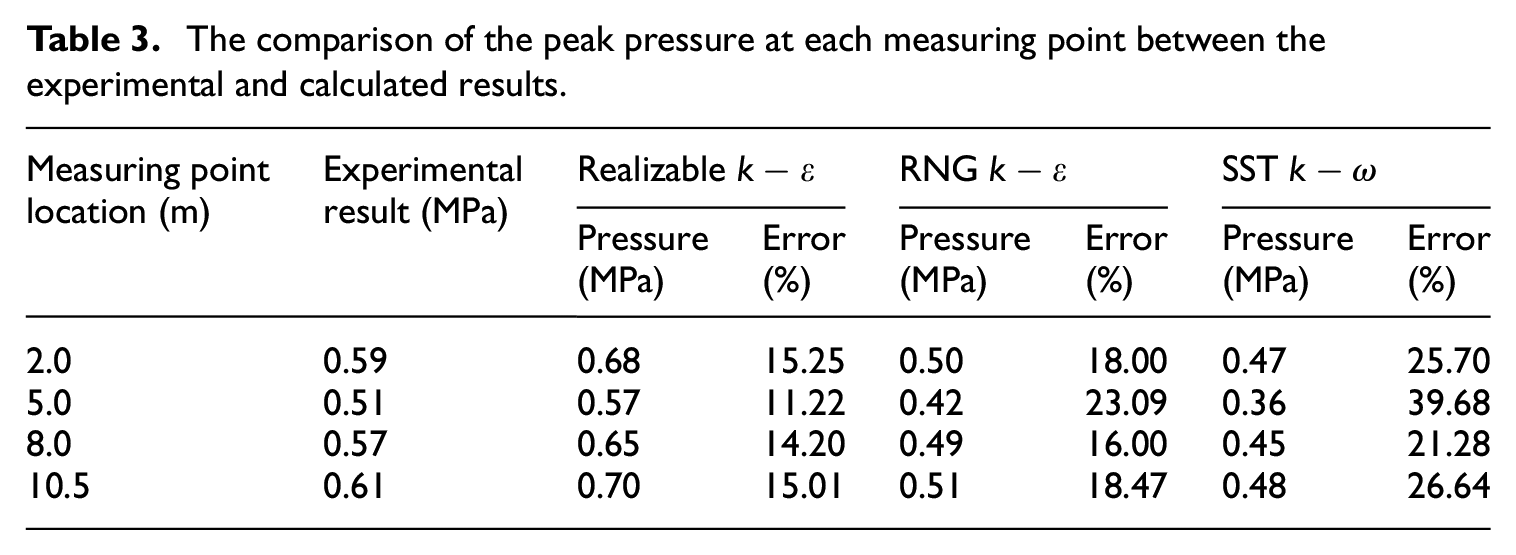
The comparison between the experimental peak pressures and the calculated peak pressures at each measuring point of the pipe was shown in Figure 3. It can be seen that the maximum peak pressure was located at the measuring point at the end of the pipe. Because there was no energy loss in the simulated pipe, the calculated peak pressure with Realizable
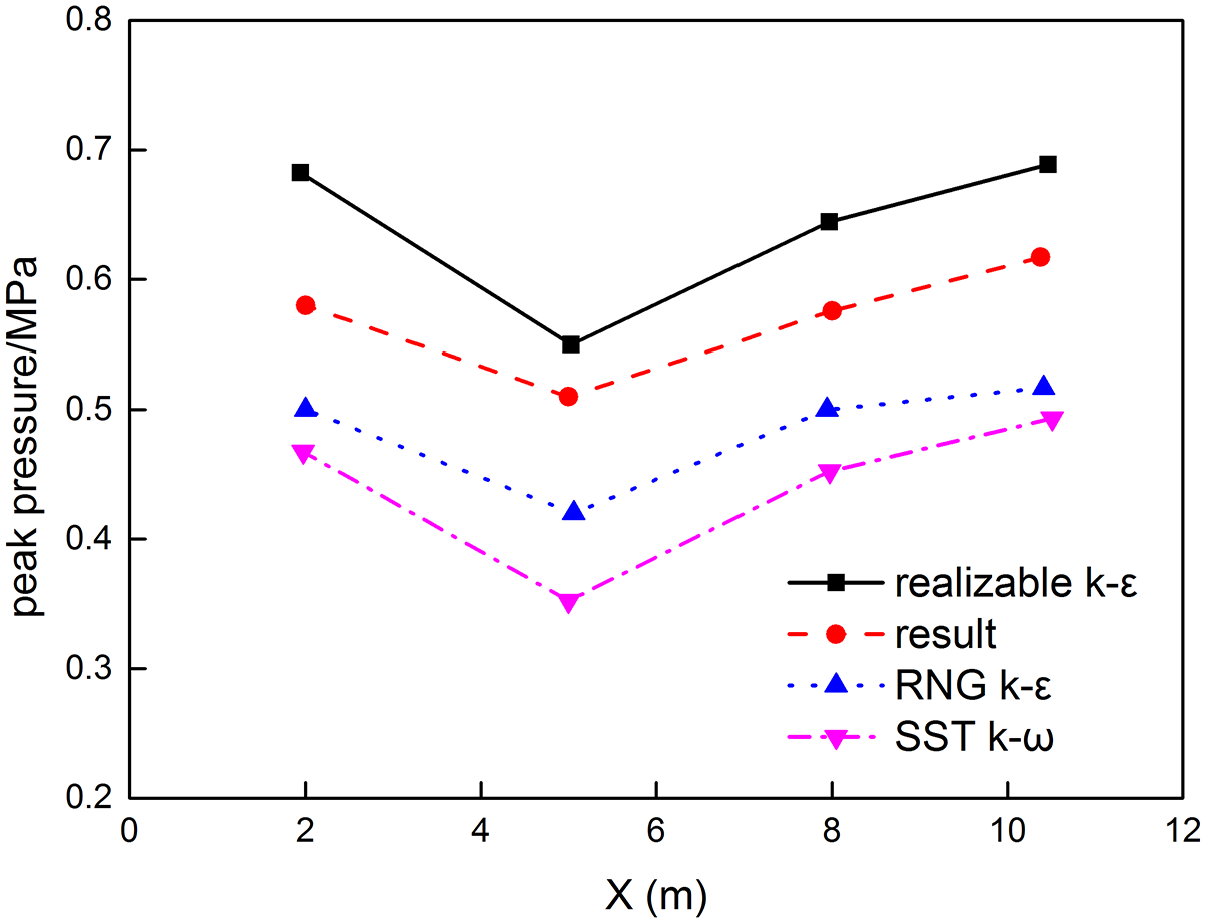
The black line represents the peak pressure calculated with Realizable
The comparison of the peak pressure at each measuring point between the experimental and calculated results.
Results and discussion
The pipe length has great influence on flame propagation process by changing flame structure, flame propagation speed and explosion pressure, so this section focuses on the characteristics of changes on flame structure, flame propagation speed and explosion pressure in close-ended and open-ended pipes of different length.
The influence of pipe length on the variation of flame structure
The variation of flame structure in close-ended pipe
In order to study the variation of the flame structure, five pipes with different length are chosen. According to different pipe length, five time periods are selected, and the variation of flame structure is shown in Figure 4. It can be seen that the flame gradually forms a tulip flame structure with inward.2,10,29,30 In order to make the flame structure more clearly displayed, all figures of Figure 4 are output based on the flame propagation distance, rather than the full pipe length. The progression of the flame front is irregular with inversions of the direction of progression of the flame. 4 When the pipe length is 6 m, it takes about 30ms to appear the first tulip flame, its position is roughly 2.9 m away from the ignition end, but the tulip flame is not obvious and there is no pronounced distorted tulip flame. A typical tulip flame with little distorted characteristics is formed at the time of 40 ms in the 7.5 m long pipe. As for the 9 m long pipe, the tulip flame appears at the time of 47 ms, and the flame surface is located 3.5 m away from the ignition end. Under the condition of the pipe with 12 m long, the tulip flame is formed at the time of 60 ms, which locates 4.0 m away from the ignition end.

The variation of flame structure under different pipe length in close-ended pipes. The whole pipe length is 6 m, 7.5 m, 9 m, 10.5 m, and 12 m, respectively.
In the close-ended pipe, when the gas passes through the flame front from the unburned side to the burned side, an expansion occurs and a flame flow is generated. However, as the combustion progresses, the generated flow varies from region to region. There are probably three regions, the first one is the region far from the flame front, where the dominated gas is unburned gas. The unburned gas is moving in a positive and one-dimensional direction. The second region is also some distance from the flame front. What’s different from the first region is that the burned gas is dominated in this region. The third region is closest to the flame front, the gas in this region includes both burned and unburned gas. An interaction occurs between the flame front and the flow field induced by combustion, which controls the unstable propagation of the flame and further promotes the formation of tulip flame or distorted tulip flame. 31 Therefore, the pipe length has a large influence on when and where the tulip flame first appears.
The variation of flame structure in open-ended pipe
Figure 5 shows the effect of pipe length on the propagation of the flame front in open-ended pipe. It can be seen that the variation process of flame structure is basically the same under different pipe length. The flame propagates to the pipe end in a hemisphere shape, then forms a planar flame, which gradually evolves into a tulip flame. After the tulip flame spreads a certain distance, the flame front surface is restored to a curved surface structure. In order to make the flame structure more clearly displayed, all figures of Figure 5 are output based on the flame propagation distance, rather than the full pipe length. When the pipe length is 6 m, the flame structure presents a hemispherical shape between 25 ms and 40 ms, and then changes to a planar structure at 45 ms, which lasts for about 2 ms. The tulip flame first appears at the time of 48 ms, which is located about 5.5 m away from the ignition end. As for the pipe of 7.5 m long, a hemispherical flame structure appears at the time of 25 ms which goes on nearly 30 ms. At the location of 5.6 m away from the ignition end, the flame structure displays a planar shape until it forms an obvious tulip flame at 60 ms. Under the condition of 9 m long pipe, the tulip flame is formed at 75 ms, which is involved from the planar structure at 73 ms. When the pipe length increases to 10.5 m, the tulip flame appears at 93 ms and locates at 6.9 m from the ignition end. A more typical and obvious tulip flame is formed when the pipe is 12 m long, which lasts for about 1.4 ms and disappears at the distance of 8.4 m from the ignition end. From the above analysis, the conclusion can be drawn that the longer the pipe, the later the tulip flame structure appears. However, the general regulation of flame structure variation is from hemispherical to planar to tulip in five open-ended pipes of different length.

The variation of flame structure under different pipe length in open-ended pipes. The whole pipe length is 6 m, 7.5 m, 9 m, 10.5 m, and 12 m, respectively.
In the process of the flame propagation, the flame propagation speed will occur uninterrupted jump in the direction perpendicular to the flame surface. The flame propagation velocity is different at the edge as well as the center of the pipe. When the flame passes from unburned area to the burned area, the fresh gas is simply compressed by the burnt gas accompanied with different flame propagation velocity in the pipe. As the flame front moves forward through the unburned gas mixture, the flame is no longer stable due to the thermo-diffusion instabilities and flame stretch, leading to flame wrinkling with a greater total flame surface area. 32 When the flame front is deformed, the flow field will also change its direction accordingly, which further leading to the generation of vortex in the area near the flame front. Besides, the vortex can also cause reverse flow behind the flame front during the formation of a tulip flame. 33 The reverse flow causes the backward propagation of the original cusp. With the development of the original cusp, the classical tulip flame is formed. After the classical tulip flame is completely formed, the reverse flow begins to appear in the far-field unburned gas with the disappearance of the positive flow at about 48 ms in 6 m long pipe, 60 ms in 7.5 m long pipe, 75 ms in 9 m long pipe, 93 ms in 10.5 m long pipe, and 110 ms in 12 m long pipe, respectively.
Comparison of the variation of flame structure under the open-ended and close-ended pipes
The time and the location of the tulip flames first appear is different under different pipe length. The location, the time and the propagation distance of the tulip flame in the open-ended and close-ended pipes are shown in Tables 4 and 5.
Tulip flame characteristics in open-ended pipes.

Tulip flame characteristics in close-ended pipes.

According to Tables 4 and 5, the position where the tulip flame appears is delayed with the pipe length increasing under both operating conditions, and so does the corresponding time when the tulip flames appeared. From the above analysis, we can see that the reflected wave has a promoting effect on the formation of the tulip flame. For the close-ended pipes, the shorter the pipe, the faster the pressure wave reaches the pipe end to generate reflected wave, so that the earlier the reflected wave disturbs the flame. In the case of these five pipe lengths, the tulip flame appears at the time between 30 ms and 60 ms, and the location is between 2.9 m and 4.0 m away from the ignition end. Depending on how far the tulip flame propagates under these five pipe lengths, there is no much difference, however, the main difference is the time and the position of the tulip flame first appears.
As for the open-ended pipes, there is no reflected wave in the pipe. Through the comparison between these five pipes with different length, the position of the tulip flame first appears is greatly delayed as the pipe length increases. The longer the pipe is, the farther the tulip flame propagates. Combined with the formation of tulip flame, vortex of different scales is also formed behind the flame,26,27 which increases the turbulence intensity in the flow field and causes laminar flow transforming to turbulent flow. Therefore, the longer distance the tulip flame propagates in the open-ended pipe, the larger the turbulent kinetic energy is, and eventually the flame speed is accelerated.
The influence of pipe length on the variation characteristic of flame propagation speed
The variation characteristic of flame propagation speed in close-ended pipe
Figure 6 shows the flame propagation speed at various measurement points on the pipe axis under different pipe length in close-ended pipes. It can be seen that the flame propagation is relatively slow at initial stage of ignition, and the flame propagation speed under five pipes of different length is basically the same. However, when the flame propagates to a distance between 2 m and 4 m away from the coordinate axis, the flame speed under each operating condition shows an obvious downward trend indicating that the flame structure evolves into the tulip flame as the flame front propagates to this distance. The reason is that the propagation of the flame front is blocked during the formation of the tulip flame, so a lower flame propagation speed forms. When the tulip flame passes the distance, it becomes a curved surface flame structure. Meanwhile, the area of the flame surface increases, heat accumulates and the flame accelerates until the speed reaches a maximum value.

Flame propagation speed in close-ended pipe at different pipe length. The pipe length is 6 m, 7.5 m, 9 m, 10.5 m, and 12 m, respectively.
Because the two ends of the pipe wall are closed, a reflected wave is formed when the pressure wave propagates to the end of the pipe, then it begins to propagate toward the ignition end. During the process of the reflected wave propagating to the ignition end of the pipe, the reflected wave is reflected back and thus produces concurrent wake speed. As a result, the propagation of the flame front is promoted and the flame speed rises. With the flame front propagating to the pipe end, a reverse wake speed is generated when the reflected wave meets the flame front, so the propagation of the flame front is inhibited, and even causes the flame propagation speed to drop. Therefore, the flame propagation speed generally presents rise and then fall. The process is closely related to the reflection process of pressure waves in the pipe. The longer the pipe is, the more the pressure wave reflections are, thus the more energy loss of the reflected wave will be. Therefore, the oscillation amplitude of the flame propagation speed tends to decrease with the increase of pipe length. For example, when the pipe is 6 m long, two peaks appear in the flame propagation, however, as for the pipe of 12 m long, the rise and fall amplitudes are small after the flame propagation speed reaches the peak. The maximum flame propagation speed of the five different pipe length is all located at the midpoint of the pipe axis, indicating that the flame is the most vigorous when the flame travels approximately in the five pipes of different length.
Table 6 shows the maximum flame propagation speed in the five different long pipes. It can be clearly seen that the maximum flame propagation speed is proportional to the pipe length. During the combustion reaction, the continuous accumulation of energy and the gradual increase of turbulence intensity lead to the acceleration of the flame. Therefore, the longer the pipe is, the more space the flame has to accelerate, and the larger the flame propagation speed is.
Physical parameters of propane-air in the model.

The variation characteristic of flame propagation speed in open-ended pipe
Figure 7 shows the variation process of flame propagation speed along the pipe axis in five open-ended pipes of different lengths. It can be seen that the flame propagation speeds are basically the same under those five conditions. At the initial stage of ignition, there are few products, so both the material expansion rate and the flame rise rate are low. With pipe length increasing, the flame burns more fully and the flame rate reaches its peak near the end of the pipe.

Flame propagation speed at different pipe lengths in open-ended pipe. The pipe length is 6 m, 7.5 m, 9 m, 10.5 m, and 12 m, respectively.
Comparison of the variation characteristic of flame propagation speed in open-ended and close-ended pipes
The relationship between the pipe length and the maximum flame propagation speed in the open-ended and close-ended pipe is shown in Figure 8. It can be seen that the maximum flame propagation speed increases with pipe length increasing under both operating conditions. The increase of pipe length provides space for the development of flame propagation, and it has a certain incentive effect on flame propagation. Petchenko et al. and Akkerman et al.28,29 hold that the acoustic oscillations produce an effective acceleration field at the flame front leading to a strong Rayleigh-Taylor instability during every second half period of the oscillations. It can be seen from Figure 8 that the flame propagation speed continues to increase obviously in the open-ended pipe, while, in the close-ended pipe, the flame speed accelerates slowly in the second half of the pipe. The reason is that the flame propagation velocity is affected by the reflection of shock wave and the combustion of unburned gas in the close-ended pipe. In the close-ended pipe, both ends of the pipe wall are closed, when the pressure wave propagates to the end of the pipe, it forms a reflection wave which starts to propagate towards the ignition end. Once the reflection wave meets the flame front, it will produce a reverse wake speed, thus inhibiting the spread of the flame front. When the reflection wave propagates to the ignition end of the pipe, it will reflect back, which will produce the same wake speed and promote the spread of the flame front. At the initial stage of ignition, the flame front is far away from the end of the pipe, so it is less affected by the deceleration of reflected wave in the propagation process. The flame propagation speed continues to increase depending on the combustion of unburned gas and the acceleration effect of the reflected wave. With the propagation of flame, the distance between the flame front and the end of the pipe is shortened. Meanwhile, the pressure in the pipe continues to rise, and the deceleration effect of the reflected wave at the end is enhanced. Therefore, the flame propagation is greatly inhibited. However, as for the open-ended pipe, the whole acceleration process of flame in the pipe only depends on the combustion reaction of unburned gas, so the flame propagation speed can keep rising continuously in the whole process. In general, the maximum flame propagation velocity in the open-ended pipe is higher than that in the close-ended pipe.

Corresponding relationship between pipe length and maximum flame propagation speed under open-ended and close-ended pipes.
The influence of pipe length on the variation of flow field in pipes
Figure 9 shows the change of the flow field during the formation of the tulip flame in open-ended and close-ended pipes with the same length of 9 m. In the close-ended pipe, a compression wave is formed due to the rapid expansion of combustion products under high temperature condition. Because the pipe end is closed, the compression wave generates counter-current and then becomes a reflected wave. The Figure 9 shows that the reverse flow of the mixed gas is very obvious before the formation of the tulip flame. The reverse flow inhibits the propagation of the flame front. According to the above analysis, the occurrence of tulip flame is almost simultaneous with the inhibition of the flame propagation. The reappearance of the reverse flow in the burnt gas behind the primary tulip cusp at the time of 50 ms, indicating that the velocity of the flow induced by the pressure wave decreases. The reverse flow reappears both in the unburned and burnt regions at about 51 ms. After the initial formation of the tulip flame, a small-scale symmetric vortex is generated on both sides of the pipe wall due to the countercurrent flow and the limitation of the pipe wall surface on airflow, which makes the flame near the pipe wall unstable. Therefore, the flame propagating speed near the wall increases. An obvious tulip flame is formed until the countercurrent flow fills the whole combustion area. After the formation of the tulip flame, the vortex gradually collapses and then gradually disappears because of energy attenuation. At this time, the unburnt gas near the flame tip begins to flow forward, which weakens the countercurrent strength. However, because the central area of the tulip flame still maintains a reverse flow, the flame depth gradually decreases. Therefore, the tulip shape will become more pronounced, as shown at the time of 52 ms in Figure 9. The important factors for the deformation and instability of the flame front to form the tulip flame structure are the baroclinic effect produced by the pressure wave and the vorticity produced by the Mach rod effect. 4 It can be seen that the main cause of tulip flame formation in the close-ended pipe is the reflection wave at the end of the pipe. The closer the flame is to the end of the pipe, the greater the influence of the reflection wave on the disturbance of the flame front, and the easier the tulip flame will be produced. Therefore, with the increase of pipe length, the flame is further away from the pipe end after ignition, so further diffusion is needed to produce tulip flame. This also explains why the position of tulip flame in the close-ended pipe in Section 4.1 is delayed due to the change of pipe length.

The process of flow field change in open-ended and close-ended pipes.
In the open-ended pipe, the pressure near the open end is released, so there is no countercurrent before the formation of the tulip flame. When the tulip flame is formed, the airflow in the field still points to the unburned gas, so it can be seen that the tulip flame structure still forms without the interference of the reflected wave on the flame front. Before the formation of the tulip flame, the flame changes from the fingertip shape to the planar shape. The tulip flame initially formed at 73 ms, meanwhile, turbulence occurs simultaneously on both sides of the pipe wall, which accelerates the flame near the pipe wall. With the gradual energy loss of turbulence, the airflow behind the flame surface gradually changes into countercurrent. Besides, the countercurrent causes a speed gradient in flame layers in longitudinal distribution along the pipe, so the flame speed of each part is different. Affected by these mechanisms, the tulip flame structure evolved further and formed a typical tulip flame structure at 75 ms. The countercurrent only appears in the burned region and the flow direction in the unburned region is positive. The appearance time and position of the tulip flame in the open-ended pipe are greatly delayed, which also implies that the reflected wave can promote the formation of the tulip flame. For the open pipe, the turbulence in the pipe caused by the pipe end opening is the important reason of tulip flame formation. The closer to the pipe end, the higher the intensity of turbulent kinetic energy in the pipe, which promotes the formation of tulip flame. Therefore, for the long pipe, the position of tulip flame formation will be delayed. This also explains that the position of tulip flame in the open pipe in Section 4.1 is delayed due to the change of pipe length.
Under both the open-ended and close-ended pipes, although the formation mechanism of the tulip flame is significantly different, turbulence can be observed in both conditions. The difference is that the turbulence is formed after countercurrent in close-ended pipes, however, the turbulence is formed spontaneously in the flame propagation process in open-ended pipes.
From the above research results, the increase of pipe length is conducive to the development of flame, and the flame has a stronger development advantage in the open space. Therefore, once a fire breaks out, the most important measure is to cut off the development of the flame as early as possible so that there is not enough space for the flame to develop, which can effectively reduce economic and social losses.
Conclusion
In this paper, Realizable model, RNG model and SST model were respectively used to quantitatively analyze the influence of pipe length on flame propagation characteristics of propane-air explosion flame. The main conclusions were obtained as follows.
The pipe length has a great influence on flame propagation speed. Compared with the close-ended pipes, the influence of the pipe length on the maximum flame propagation velocity is obviously greater in the open-ended pipes. The self-acceleration mechanism of the flame is different in these two types of pipes. In the close-ended pipe, the flame propagation speed continues to increase depending on the combustion of unburned gas and the acceleration effect of the reflected wave at the initial ignition stage. As the distance between the front of flame and the end of the pipe decreases, the flame propagation is inhibited under the influence of the increasing pressure in the pipe. For the open-ended pipe, the whole acceleration process of flame only depends on the combustion reaction of unburned gas, so the flame propagation speed can keep rising continuously in the whole process. In general, the maximum flame propagation velocity in the open pipe is higher than that in the closed pipe.
Through the comparison between the experimental and simulation results, it shows that the countercurrent near the flame front in the burned region plays a vital role in the formation of the tulip flame. The interaction between the countercurrent and the flame front generates some vortices in the burned region behind the tulip flame front, resulting in different flame propagation velocities and thus producing a certain effect on the flame structure.
The tulip flame formation mechanism is different in the open-ended and close-ended pipes. The position where the tulip flame first appears in both pipes is delayed as the pipe length increases. In the close-ended pipes, the reflection wave at the pipe end is the main cause of tulip flame formation. Besides, the reflection-induced countercurrent promotes the formation of tulip flame. In the open-ended pipes, the turbulence in the pipe caused by the opening at the pipe end is the main cause of tulip flame formation. And the turbulence is formed spontaneously in the flame propagation process.
Footnotes
Declaration of conflicting interests
The author(s) declared no potential conflicts of interest with respect to the research, authorship, and/or publication of this article.
Funding
The author(s) disclosed receipt of the following financial support for the research, authorship, and/or publication of this article: This study was funded by National Key R&D Program of China (No.2017YFC0805100), the National Natural Science Foundation of China (No. 51204026), Scientific Research Project “Fire Risk Analysis of Petrochemical Enterprises” of Fire Department of Ministry of Public Security (No. 2016JSYJD04), Tianjin Science and Technology Project (No. 2016ZXCXSF0080), Major projects supported by the Natural Science Research of Jiangsu Higher Education Institutions (No. 17KJA440001), Jiangsu Government Scholarship for Overseas Studies (No. JS-2018-155).
