This study investigates optical solitons in magneto-optic waveguides while preserving the generalized anti-cubic structure of nonlinear self-phase modulation. A novel -model expansion technique is proposed, and its application in magneto-optic waveguides is explored. The approach provides an accurate and efficient method to solve wave propagation problems in magneto-optic media, enabling improved modeling of light behavior by incorporating the combined effects of electric and magnetic fields within a unified framework. To address the challenges arising from the nonlinear magneto-optic effects on waveguide characteristics, the method yields precise dispersion relations, field distributions, and transmission properties. This technique facilitates the design of magneto-optic waveguides with tailored characteristics for next-generation photonic systems. By offering a reliable and accurate modeling framework, the approach contributes to the development of more precise and efficient magneto-optic devices, advancing photonic integration, communication, and sensing technologies.
It is commonly known that complex processes in a variety of scientific domains, including physics, biology, chemistry, mechanics, and others, are described by nonlinear partial differential equations (NLPDEs). One can gain a better understanding of these events by studying the exact solution of NLPDEs, which are mathematical models of the phenomena.1,2 Many efficient techniques to obtain precise solutions of NLPDEs have been proposed in the last few decades, including the inverse scattering method,1 the tanh function method,3,4 the Hirota bilinear transform method,5 the truncated Painleve expansion method,6 the Backlund transform method,7 the exp-function method,8–10 the methods for expanding Jacobi elliptic functions,11–13 the generalized Riccati equation,14–16 the sub-ODE (ordinary differential equation) method,17,18 the extended auxiliary equation method,17,19 the soliton ansatz method20,21 and others are listed. Magneto-optic waveguides, which use magnetic fields to control light propagation, are crucial parts of contemporary photonic and optoelectronic technologies.
The nonlinear Schrödinger equation (NLSE) for magneto-optic waveguide have been examined analytically by numerous scholars. Numerous authors addressed this model utilizing a wide range of integration strategies. One of the fastest-growing subfields of nonlinear fiber optics study is optical solitons.22 Metamaterials and couplers are two examples of optical devices that exhibit the dynamics of these soliton molecules. An other type of fabric that sends data bits over continents is optical couplers. There are various kinds of optical couplers, including multiple-core and twin-core couplers.23 To solve this kind of NLSE, they employed a variety of approaches. In 2012, Chen24 explained the evolution of a complex wave in a medium where dispersion and nonlinearity interact the NLSE. It estimate phenomena like optical soliton, pulse propagation and modulaton in nonlinear systems like magneto-optic waveguide. In 2012, Agrawal25 described the propagation of slowly changing optical pulse envelops in nonlinear media that was the initially developed standard form of NLSE. The equation includes consideration of Kerr-type nonlinearity and second-order dispersion, these two aspects are essential in optical waveguide and fiber.
The idea of Russell’s in 1844 “great wave of translation” gave rise to the soliton, a powerful, enduring wave with a de Broglie wavelength that find uses in physics, telecommunications, mathematical physics, and among other domains.26 In 2017, Haider27 analyzed another method that was very helpful for waveguides with weak guidance was perturbation theory. It makes possible to estimate magneto-optic effects and modal properties without having to solve the entire wave equation. Faraday rotation in thin-film waveguides was examined by using the perturbation theory.28 Non-reciprocal devices like optical circulators and isolators, which are crucial for avoiding back reflections in laser systems and optical networks, depend on magneto-optic waveguides. In 2017, Bi et al.,29 worked on chip magneto-optic isolator that was the use of garnet materials. In 2019, Wang et al.30 by using magnetic field that detect the changes in light propagation is the sensing application that magneto-optic waveguides were also used. In practical applications of magneto-optic waveguides needs to reduce optical losses, integrate with photonic platform and enhance magneto-optic waveguides. The NLSE supports both dark and bright solutions for optical solution of magneto-optic waveguide with anticubic law nonlinearity. Innovation in optical soliton is extensive. In 2020, Rezazadeh et al.31 and in 2014, Zhou et al.32 explained the effects of nonlinearity and dispersion on solutions for NLSE using the ansatz approach. Since 1972, due to their high GHz frequency range tunability and versatility the grain film optical waveguides have get the popularity. For the creation of dynamic devices like intensifiers and channel waveguides, the research on nonlinear magneto-optical interaction is important. In conjunction with an artificially produced magnetic field, magneto-optic waveguides improve data transport and lessen soliton mess. The experimental realization of solitons in anti-cubic nonlinear magneto-optic waveguides still faces many obstacles despite the tremendous advancements made, future work should concentrate on creating materials with low optical losses and strong anti-cubic nonlinearity, as well as investigating novel material systems like two-dimensional materials and topological insulators. Rabie et al.33 constructed the new soliton solutions for a concatenation model using modified extended tanh-function method. Mathanaranjan et al.34 explored the chirped optical solitons for the nonlinear Schrödinger equation using the new extended auxiliary equation method.
Several recent works have applied advanced analytical techniques to nonlinear differential equations. For example, the study by Hashemi35 employed the variable-coefficient third-degree generalized Abel equation method to obtain exact solutions of complex nonlinear wave models. Such auxiliary-equation approaches provide useful tools for handling higher-order nonlinearities. In continuation of these developments, the present study adopts the -model expansion method within the generalized anti-cubic (GAC) model framework, offering an alternative and efficient way to derive exact optical wave solutions in magneto-optic waveguides.
In integrated optical systems, these waveguides are essential components that are commonly utilized in sensors, modulators, and isolators.36–38 NLPDEs resulting from the interaction between electromagnetic fields and the waveguide medium control the propagation of light in magneto-optic waveguides. Analytical solutions to these equations are difficult, particularly when higher-order nonlinearities are included. The offers a sophisticated mathematical framework for investigating solutions to these kinds of nonlinear systems.39–41 In order to describe more complicated physical phenomena including multi-stable states, domain walls, and soliton solutions, the technique uses a sixth-order polynomial potential in the field equations. It offers a precise analytical method for comprehending the soliton production, in the context of magneto-optic waveguides.42–46 The use of the approach47–51 soliton solutions for magneto-optic waveguide equations is presented in this article. The resulting solutions offer a better understanding of the waveguides’ nonlinear dynamics and practical photonics implications by shedding light on their physical behavior under various operating situations. This article’s goal is to use the so-called novel -model expansion approach of the resonant NLSE for the first time.
The following linked NLSE controls the propagation of optical pulses in nonlinear optical magneto-optic materials with GAC law of nonlinearity.31,51,52
and
Here, the nonlinearity parameter represents the GAC, where . The system reduces to the coupled NLSE with anti-cubic law when . The self-phase modulation is indicated by the coefficients and for while the cross-phase modulation parameters are indicated by the coefficients and for . On the other side, the inter-modal dispersions and the self-steepening coefficients are denoted by the coefficients and for , respectively.
When analyzing magneto-optic waveguide the -model expansion technique suggest in this study shows much higher accuracy and convergence efficiency compared to the previously published method and results. Prior research which relied on the expansion of the -model and traditional coupled-mode approach,53,54 only produced accurate results under mild nonlinear settings. When strong nonlinear and magneto-optic waveguide interactions were taken into account, the accuracy of the results drastically decreased. By incorporating higher-order nonlinear elements, the -model expansion created in this study can more precisely represent multistable behaviors, field distributions, and propagation constant even in strongly nonlinear regimes. The resulting results show faster convergence with fewer computational steps and better agreement with full wave numerical simulations and experimental observations published in the literature.55,56
Higher effectiveness is shown for the suggested -model expansion approach47,48 when compared to other methods, including the -model and classical coupled-mode approach. It provides more accurate descriptions of magneto-optic waveguide propagation properties, especially when there are strong nonlinear and magneto-optic interactions. Higher-order terms allow the model to effectively represent complicated behavior that lower-order models are unable to such multistability and nonlinear mode coupling. Additionally, the approach maintains the numerical stability across a significantly wider range of parameters while exhibiting faster convergence with fewer computational steps. Consequently, the suggested approach offers a more accurate and effective analytical tool for researching magneto-optic waveguide phenomena.
The motivation behind this research arises from the increasing importance of soliton-based communication systems and the demand for precise mathematical soliton structures in nonlinear media.
The motivation of this study is to investigate optical wave propagation in magneto-optic waveguides under GAC nonlinearity, which is not well explored in existing literature. The -model expansion method is used to obtain new exact wave solutions, helping to better understand how magneto-optic effects influence the behavior and propagation of nonlinear optical waves. Recent improvement in exact solution methods and analytical technique has signigicantly expanded the toolbox for extracting soliton solutions and treating nonlinear partial differential equations that are pertinent to optical and magneto-optic waveguides. Furthermore, a number of researchers demonstrate how well -model expansion approach work to produce new families of hyperbolic, elliptic, and singular solitons.57–59 These analytical methods have also been expanded for models of linked nonlinear Schrödinger types and magneto-optic systems, producing explicit forms of solitons that are directly applicable to modeling the magneto-optic waveguide phenomena. Applications of higher-order expansions such as -model to substantially nonlinear regimes is justified by more general reviews and analytical investigations that highlight the improved convergence insights that contemporary expansion methods offer.60,61
This work introduces a novel GAC for magneto-optic optical waveguides by using -model expansion approach, deriving new solitary wave solutions that have not been reported before. The combined anti-cubic and -model expansion approach nonlinearities reveal new propagation dynamics and tunability via external magnetic fields. The -model expansion is used to derive a higher-order effective potential, offering a new mathematical framework for nonlinear magneto-optic wave propagation. Graphical analysis reveals new stability regions controlled by magnetization and anti-cubic strength, enabling tunable soliton engineering. The GAC term produces novel solitary wave profiles not observed in cubic–quintic systems, revealing new propagation dynamics in magneto-optic media.
The remaining part of this article is organized as follows. In the “Introduction” section, the introduction and mathematical model are presented. The “An explanation of the new expansion strategy for the model” section describes the applied method and the “Solving equation and its various Jacobi elliptic function-based solutions” section describes the derivation of solutions. In the “Graphical discussion” section, the graphical analysis and discussion are provided. Finally, the “Conclusion” section concludes the article with key findings.
An explanation of the new expansion strategy for the model
Assume that the form of a NLPDE is taken as follows:
where is an unknown function, the highest-order derivatives and nonlinear terms are involved in the polynomial , and its partial derivatives. The following is a description of the primary steps of the employed method. We take the wave transformation , . To reduce equation (3) to the subsequent nonlinear ODE, where is a nonzero constant
where , is a polynomial, and its derivatives are , , and so forth.
We presume that the new formal solution to equation (4) exists as follows:
where , are constants to be found later, while satisfies the well-known auxiliary nonlinear ODE as follows:
where is a real constant (i = 0, 2, 4, 6). By balancing the highest-order derivatives with the highest nonlinear terms in equation (4), we may find the positive integer N in equation (5). The answer to equation (7) is well known.
where ) is the Jacobian elliptic equation solution and
and are variables that will be ascertained later, whereas and are provided by the following equations:
under the situation of constraint
It is commonly known that the following Jacobi elliptic solutions exist for equation (9).
In this Table 1, , , , , , ,, , and are the Jacobi elliptic functions with the modulus . These functions degenerate into hyperbolic functions, when as follows:
shows the Jacobi elliptic functions.
Sr. No.
1
2
3
4
5
6
7
8
9
10
11
or
12
13
14
, , , , ,, , , , , and into trigonometric functions, when , as follows:
, , ,, , , , , , .
Equations (8) and (9) can be substituted into equation (5) to obtain the Jacobi elliptic function solutions of equation (3).
Solving equation and its various Jacobi elliptic function-based solutions
In this part, we apply the novel -model expansion method to solve equations (1) and (2). To achieve this, we presume that the formal solution to equations (1) and (2) exists.
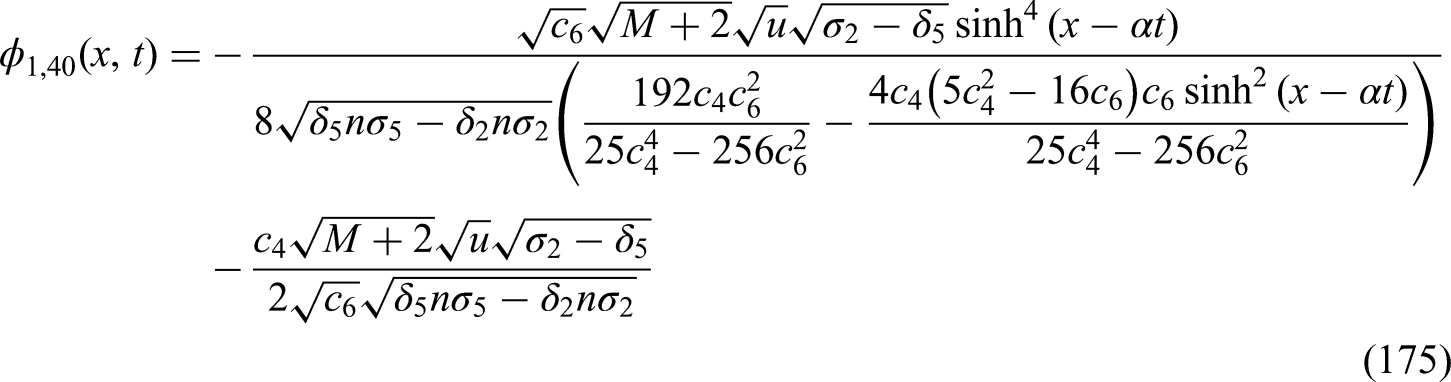
where , and . Where , , and are constants and and is a real function. After dividing the imaginary and real components of equations (1) and (2) and substituting equations (13) and (14) into it, then the imaginary componentes are as follows:
where and . To balance equations (22) and (23), we take the transformation. Assume the transformation as follows:
when and are the new functions of . When we enter equations (24) and (25) into equations (22) and (23), we obtain as follows:
and
Consider the formal solution to equations (26) and (27) exists.
is obtained by balancing and with and in equations (26) and (27). Thus
where and and , , , , , and are constants that will be found later. When equations (6), (7), (30), and (31) are substituted into equations (26) and (27), and the coefficients of the same powers are obtained through Mathematica, then we have the result , , , , , , , , and .
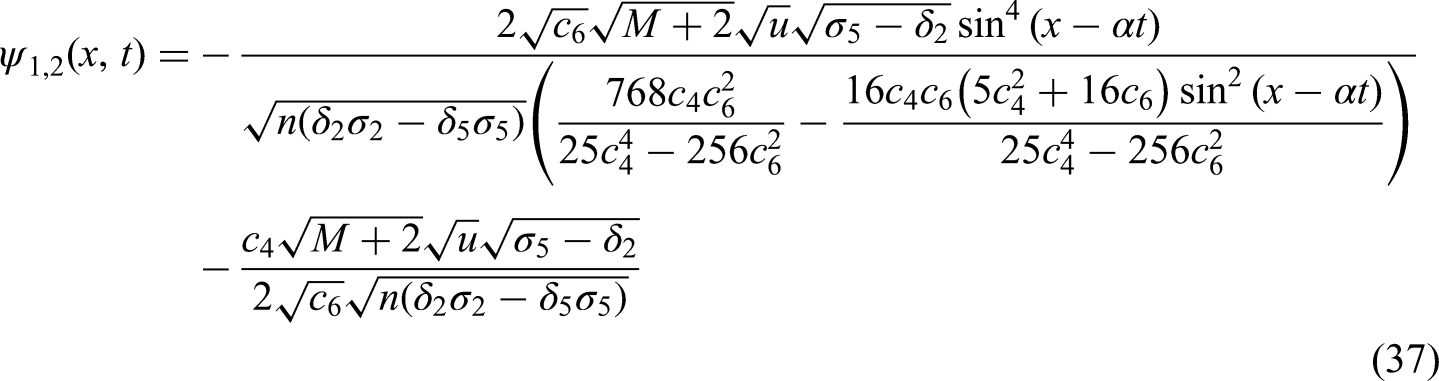
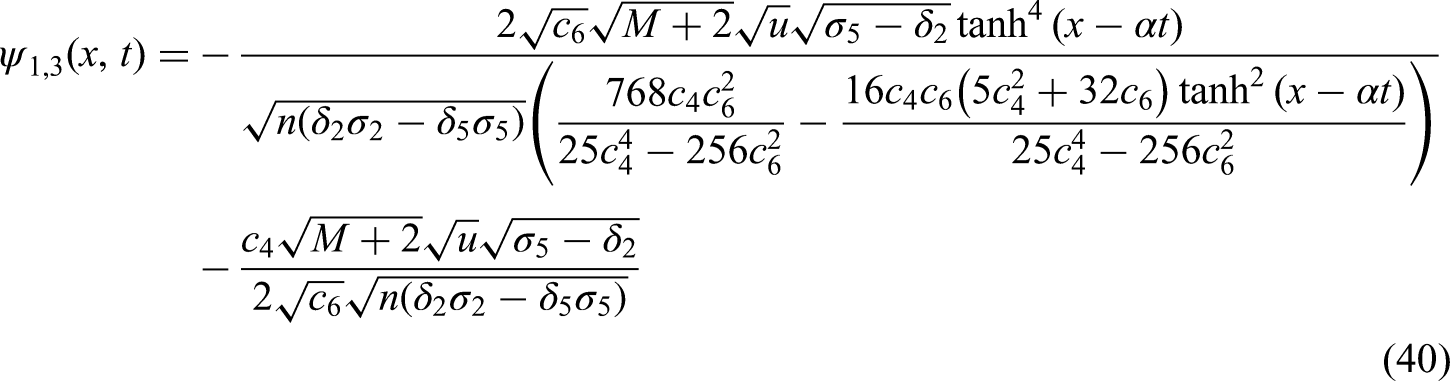
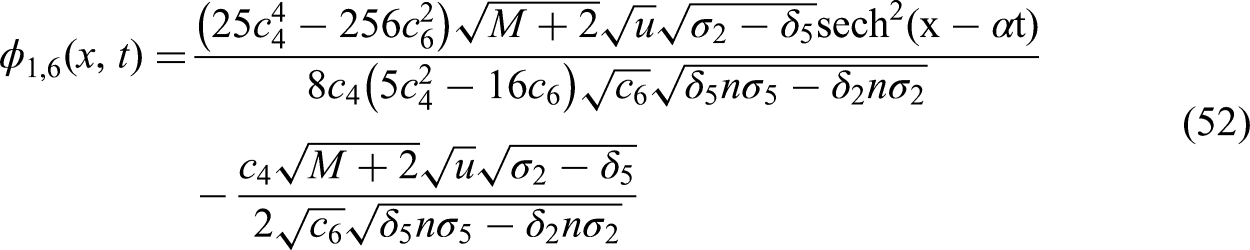
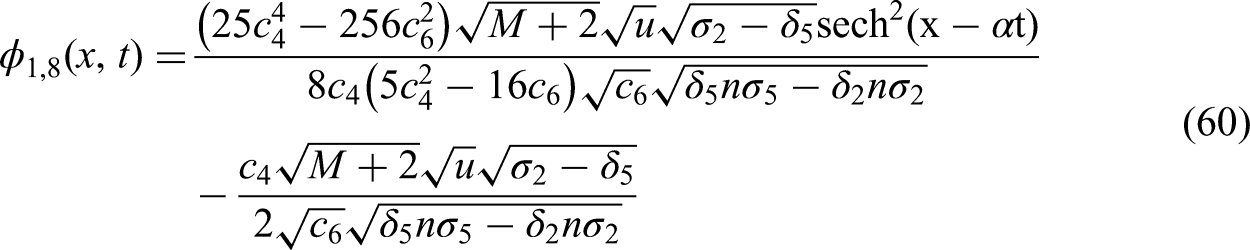
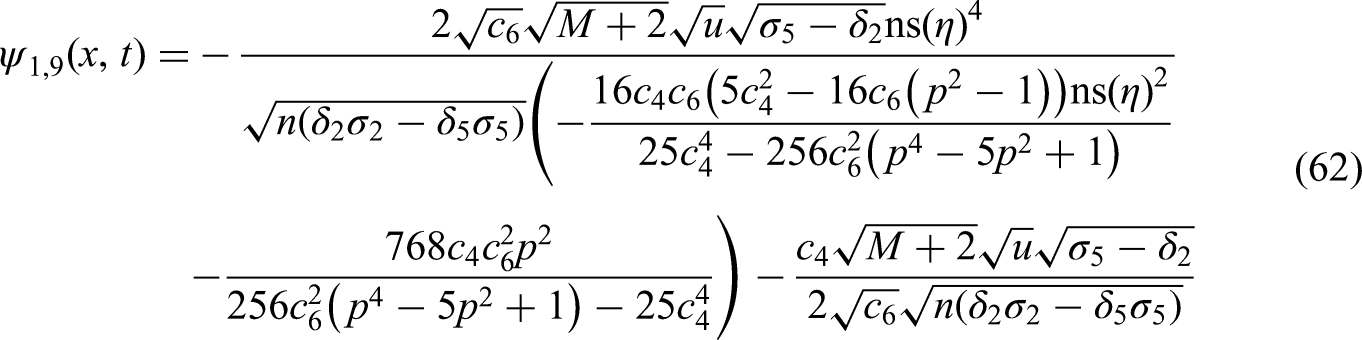
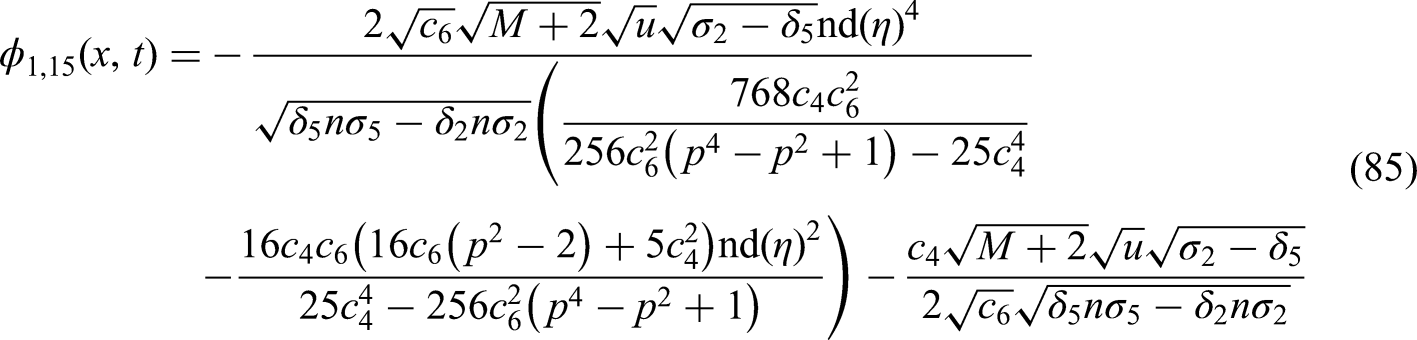
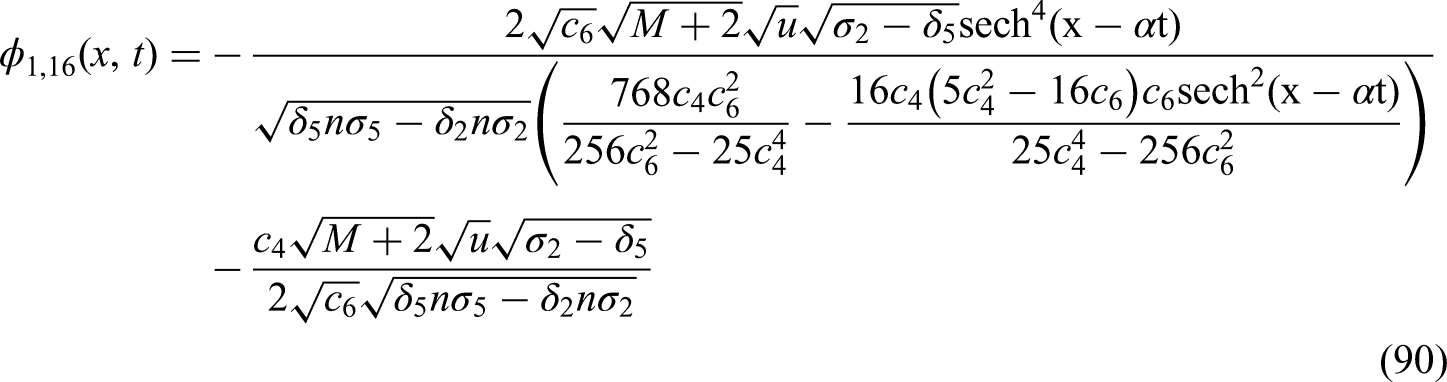
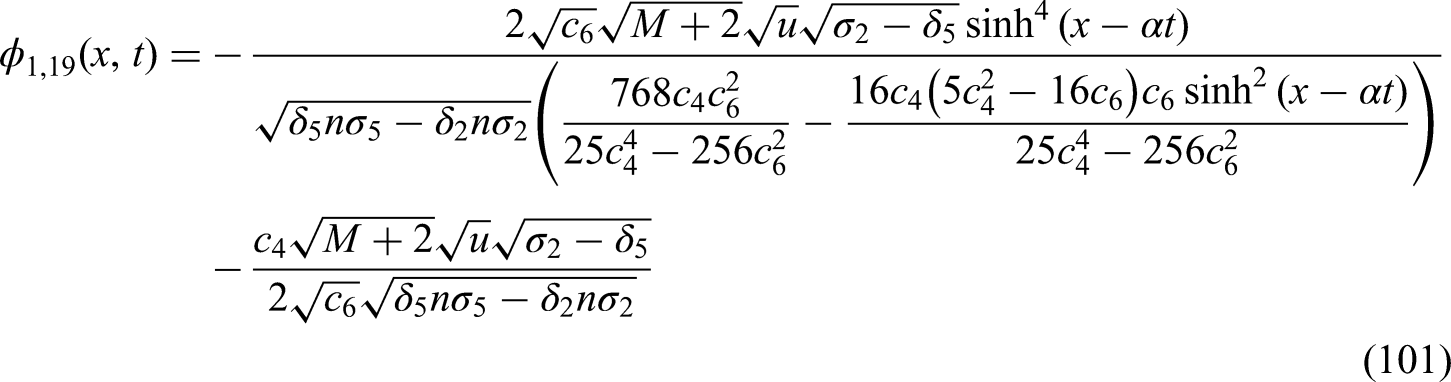
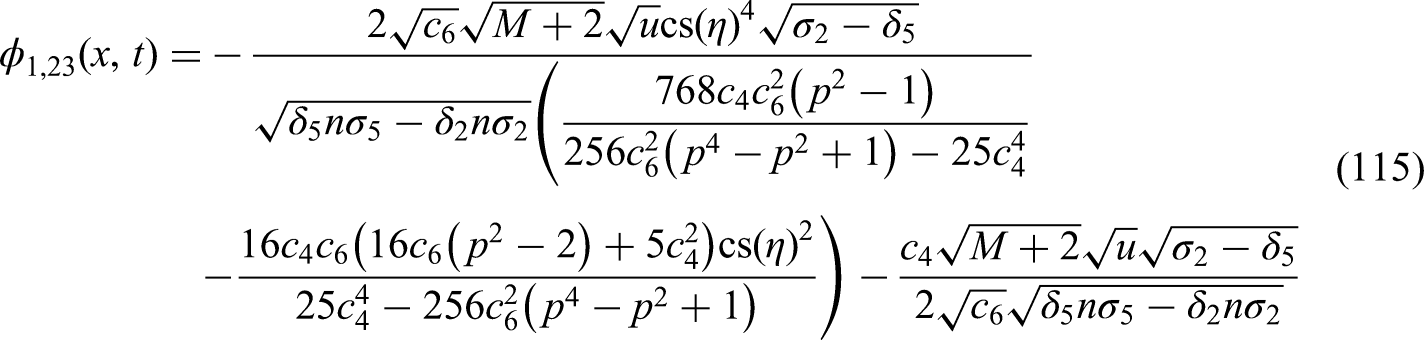
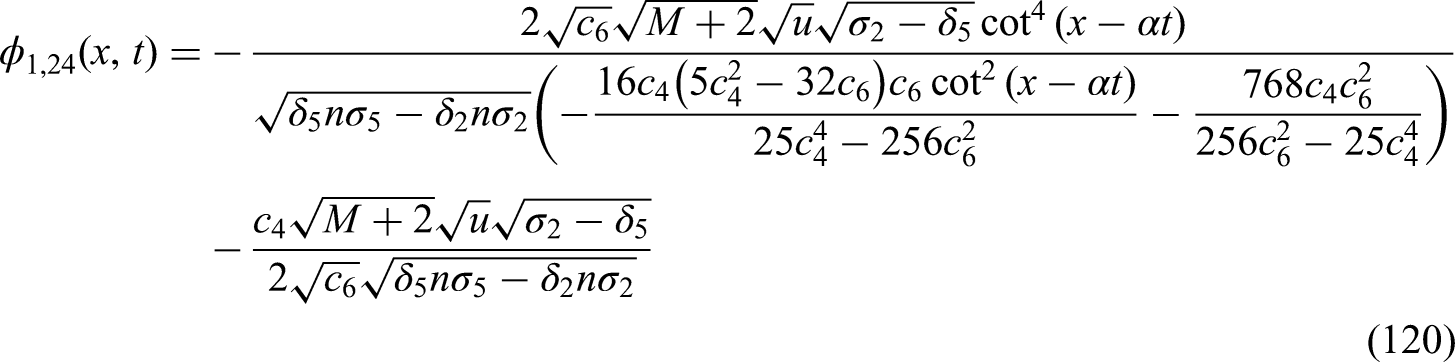
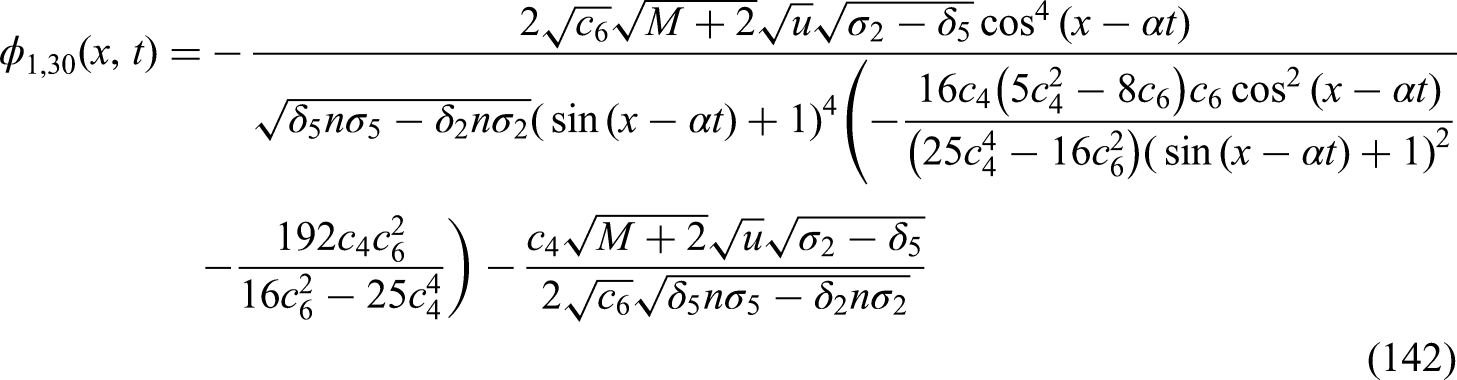
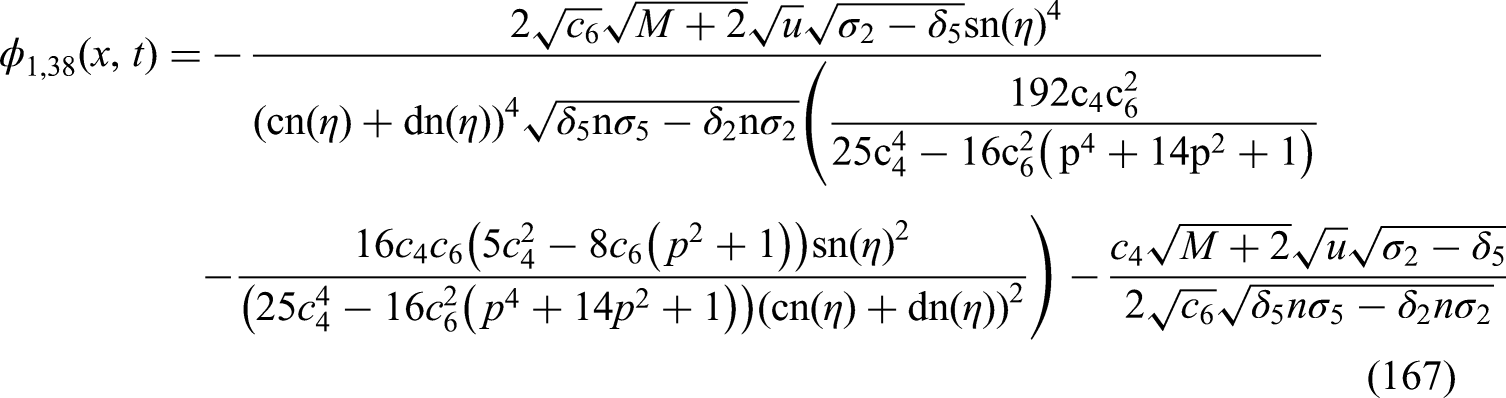
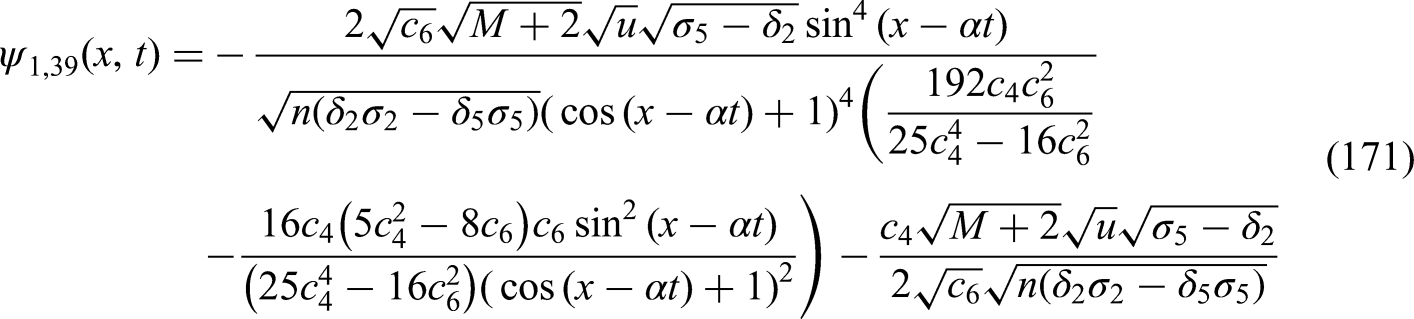
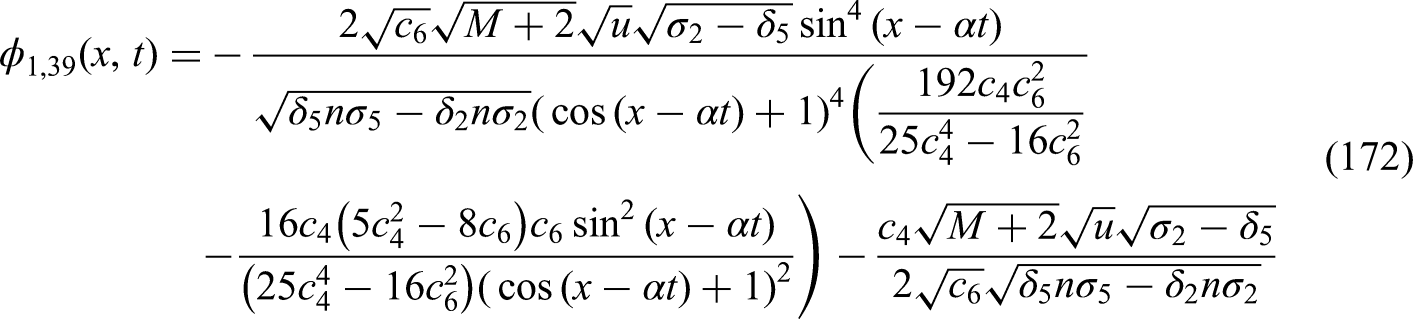
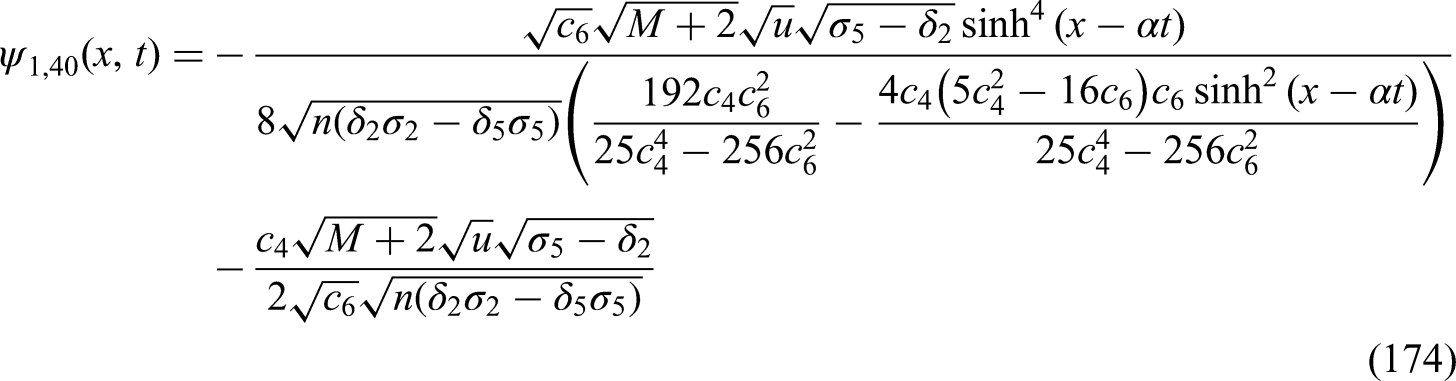
The following several new exact solutions to equations (1) and (2) are now available:
Case : If , , , then and we have the Jacobi elliptic function solution
and
Here and are auxiliary constants introduced in the expansion method. These constants arise during the balancing procedure and are used to simplify the analytic form of the Jacobi elliptic function solutions, where and are as follows:
and
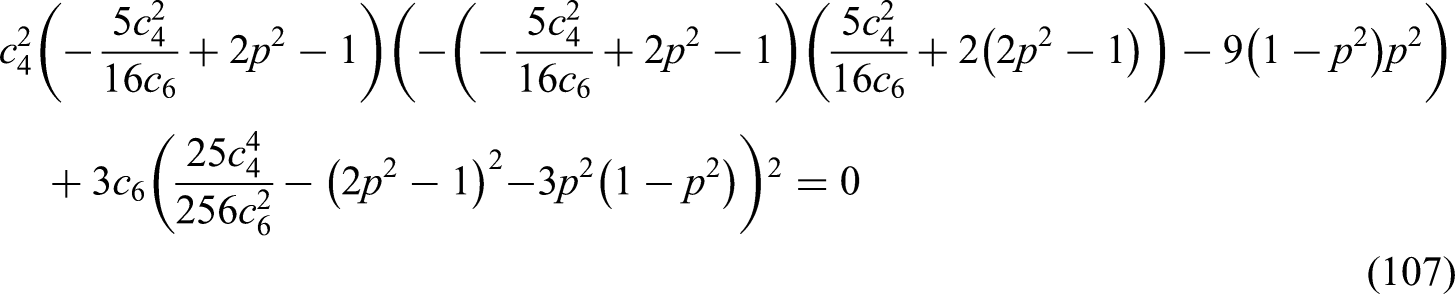
under the situation of constraint
if , then we have periodic wave solution
and
under the situation of constraint
if , then we have periodic wave solution
under the situation of constraint
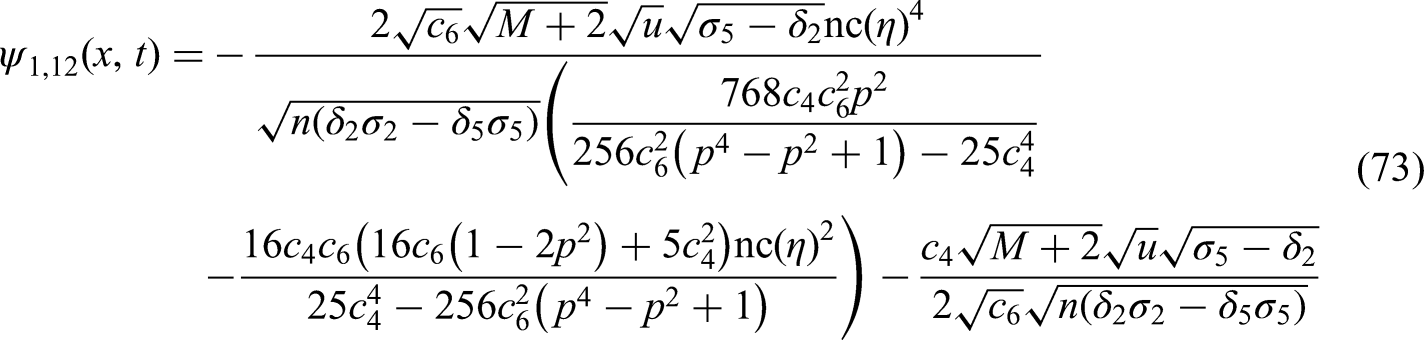
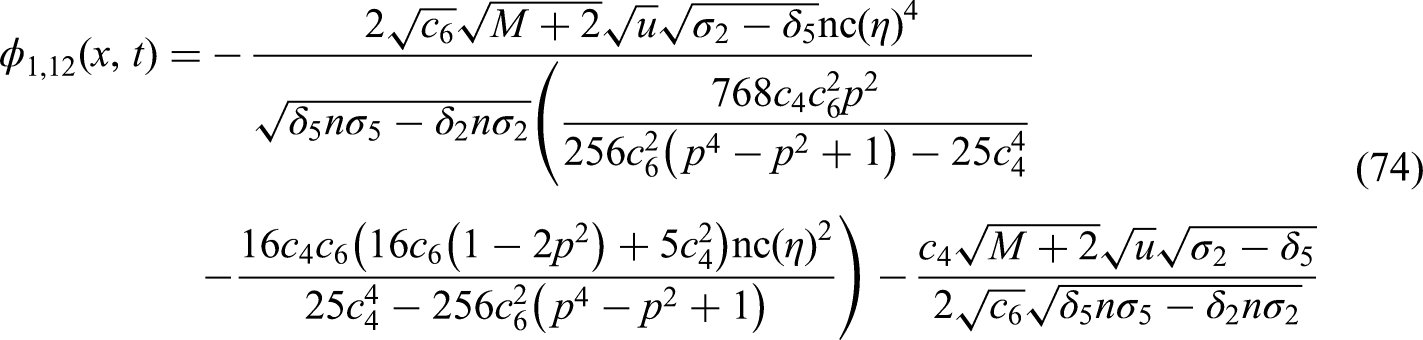
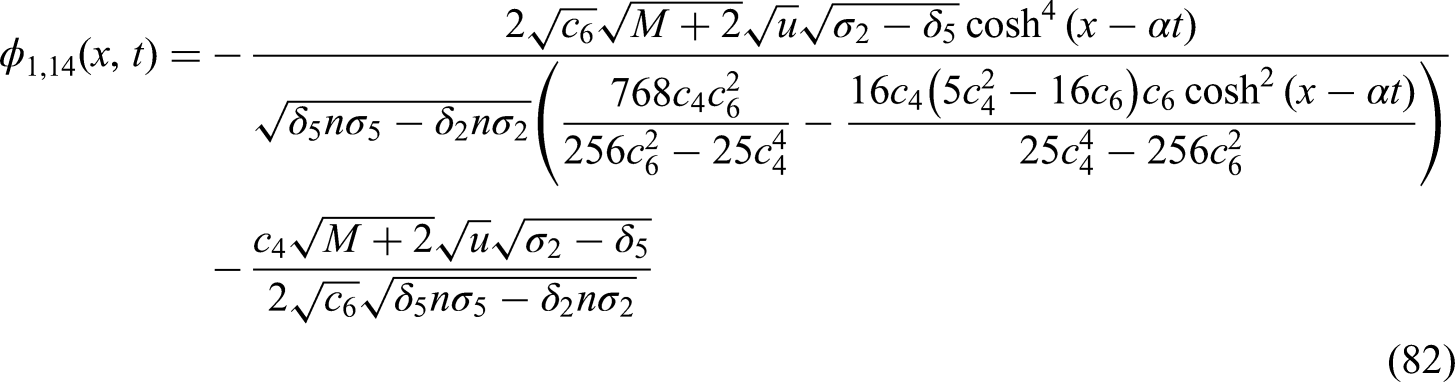
Case : If , , then and we have the Jacobi elliptic function solution
where and are as follows:
and
under the situation of constraint
if , then we have periodic wave solution
and
under the situation of constraint
if , then we have periodic wave solution
under the situation of constraint
Case : If , , then and we have the Jacobi elliptic function solution
where and are as follows:
and
under the situation of constraint
if , then we have periodic wave solution
under the situation of constraint
Case : If , , then and we have the Jacobi elliptic function solution
where and are as follows:
and
under the situation of constraint
if , then we have periodic wave solution
and
under the situation of constraint
if , then we have periodic wave solution
under the situation of constraint
Case : If , , then and we have the Jacobi elliptic function solution
where and are as follows:
and
under the situation of constraint
if , then we have periodic wave solution
and
under the situation of constraint
if , then we have periodic wave solution
under the situation of constraint
Case : If , , then and we have the Jacobi elliptic function solution
where and are as follows:
and
under the situation of constraint
if , then we have periodic wave solution
under the situation of constraint
Case : If , , then and we have the Jacobi elliptic function solution
where and are as follows:
and
under the situation of constraint
if , then we have periodic wave solution
under the situation of constraint
if , then we have periodic wave solution
under the situation of constraint
Case : If , , then and we have the Jacobi elliptic function solution
where and are as follows:
and
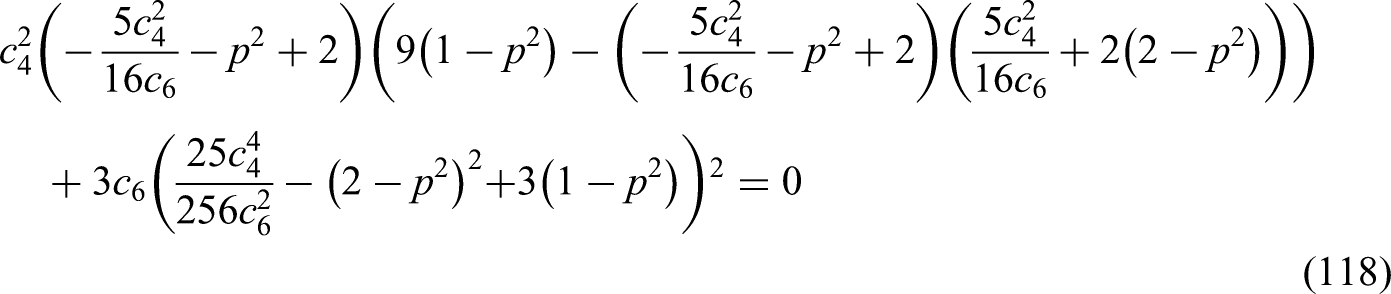
under the situation of constraint
if , then we have periodic wave solution
under the situation of constraint
if , then we have periodic wave solution
under the situation of constraint
Case : If , , then and we have the Jacobi elliptic function solution
where and are as follows:
and
under the situation of constraint
if , then we have periodic wave solution
under the situation of constraint
if , then we have periodic wave solution
under the situation of constraint
Case : If , , then and we have the Jacobi elliptic function solution
where and are as follows:
and
under the situation of constraint
if , then we have periodic wave solution
under the situation of constraint
if , then we have periodic wave solution
under the situation of constraint
Case : If , , then then and we have the Jacobi elliptic function solution
where and are as follows:
and
under the situation of constraint
if , then we have periodic wave solution
under the situation of constraint
if , then we have periodic wave solution
under the situation of constraint
Case : If , , then and we have the Jacobi elliptic function solution
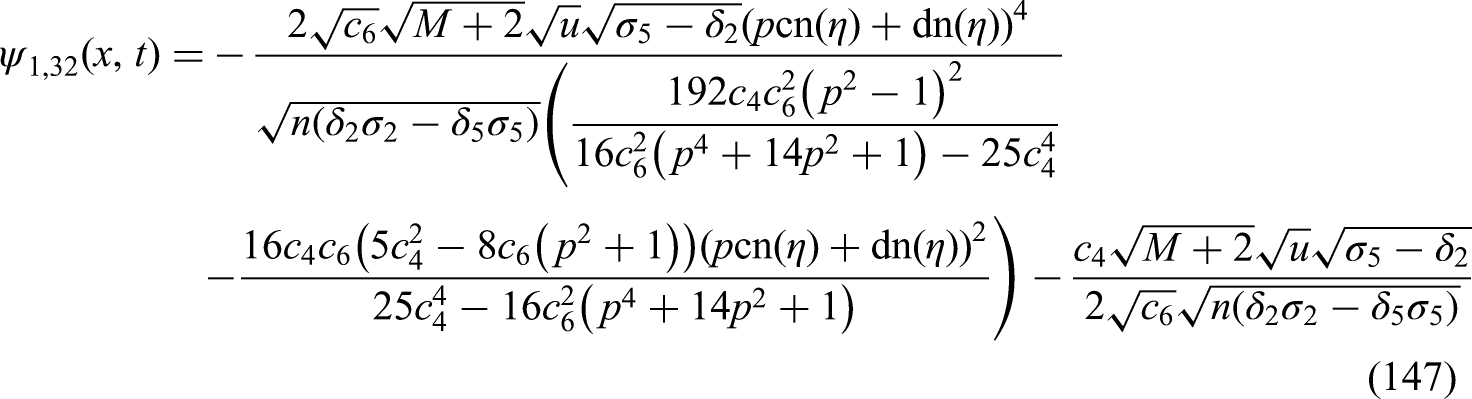
where and are as follows:
and
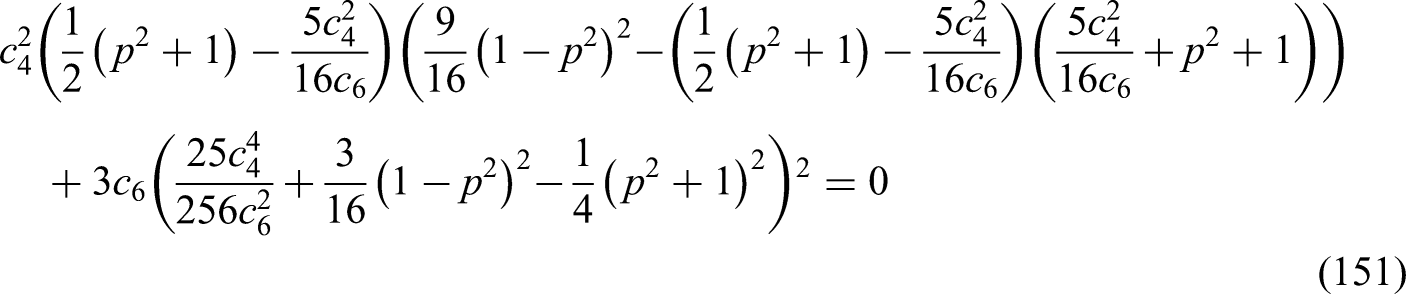
under the situation of constraint
if , then we have periodic wave solution
under the situation of constraint
Case : If , , then and we have the Jacobi elliptic function solution
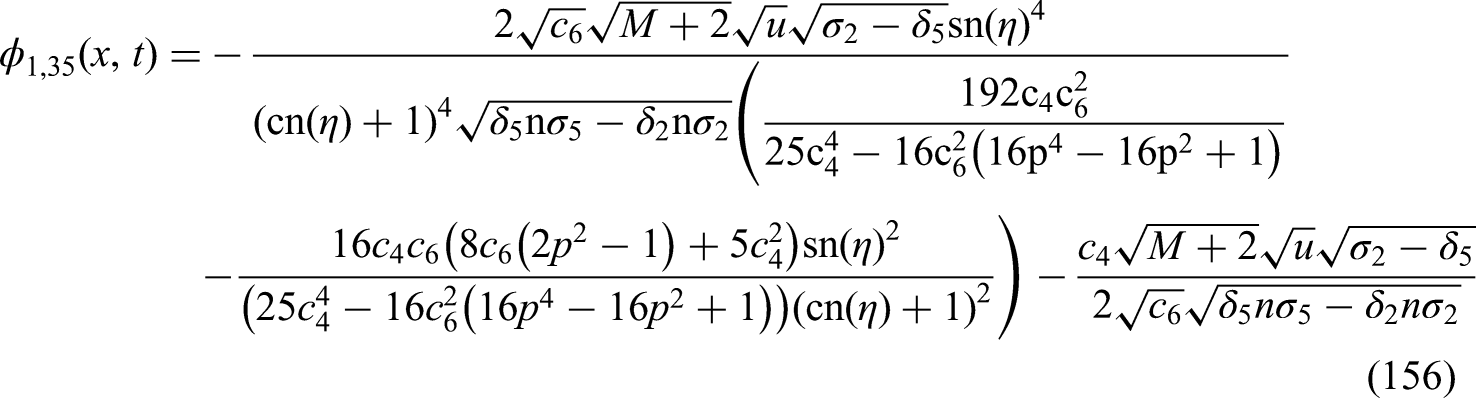
where and are as follows:
and
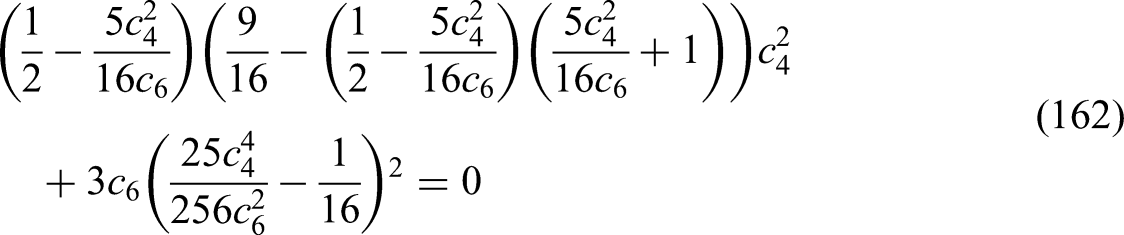
under the situation of constraint
if , then we have periodic wave solution
under the situation of constraint
if , then we have periodic wave solution
under the situation of constraint
Case : If , , then and we have the Jacobi elliptic function solution
where and are as follows:
and
under the situation of constraint
if , then we have periodic wave solution
under the situation of constraint
if , then we have periodic wave solution
under the situation of constraint
Graphical discussion
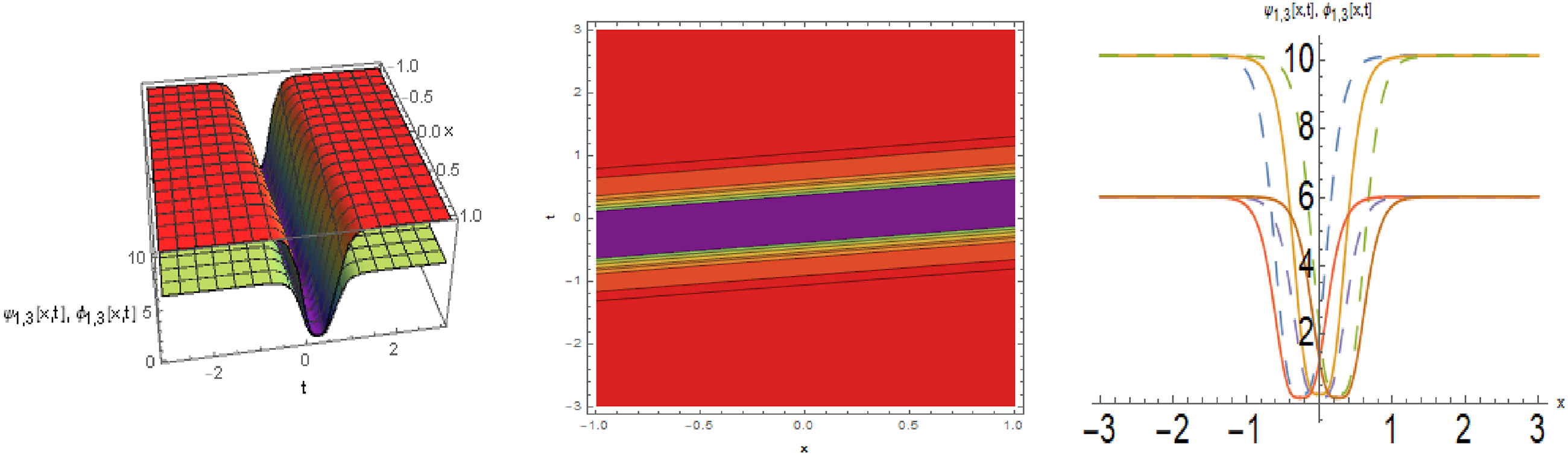
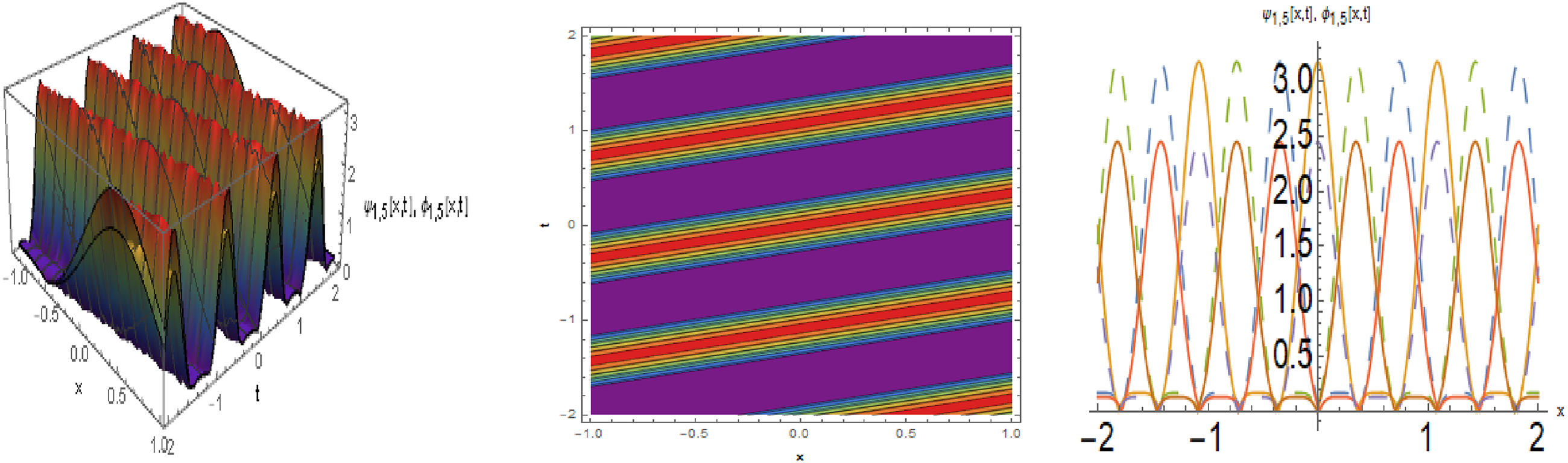
In this section, we use contour charts and 3D to demonstrate a few solutions. All of the graphs are created using Mathematica. The approach is an effective tool for magneto-optic waveguide modeling since it provides robust answers to a variety of soliton topologies and is used to generate accurate solutions for NLPDEs. In this section, we display the 3D and contour graphs of some of our responses to show their physical relevance. The magneto-optic waveguide model offers lumps, solitons, kink waves, periodic-wave solutions, and combinations in addition to other wave solutions in exponential, trigonometric, and hyperbolic functions. The magneto-optic waveguide model is a temporal derivative of second order. Negative time values are plotted to show the pre-evolution (initial) state of the wave and to present a complete symmetric picture of the solution over the entire time domain. The solution and that yields the solitary wave solution in the form of 3D, line and contour graphs are depicted in Figure 1 by selecting the parameters, such as , , , , , , , , , , and . The solution and that yields the dark soliton in the form of 3D, line and contour graphs are depicted in Figure 2 by selecting the parameters, such as , , , , , , , , , , and . The solution and that provides a single wave solution in 3D, line and contour graphs are depicted in Figure 3 by selecting the parameters, such as , , , , , , , , , , and . The solution and that yields a bright solution is also depicted in Figure 4 by selecting the parameters, such as , , , , , , , , , , and . The solution and that yields a solitary wave solution is also depicted in Figure 5 by selecting the parameters, such as , , , , , , , , , , and . The solution and that yields a solitary wave solution is also depicted in Figure 6 by selecting the parameters, such as , , , , , , , , , , and . The findings made in this article, which apply contour charts and 3D graphs, provide important information on how nonlinear waves can be used in magneto-optic waveguides, and the implications directly relate to practical use. The solitons, kink wave modeling, periodic-wave solutions, and hybrid waveforms modeling proves how these phenomena can be exploited in optical communication systems. An example is solitons, which preserve their shape and energy throughout long distances, and, therefore, solitons are the best in transmitting data across long distances without losing its strength. Kink waves and dark solitons, which are a sudden jumps and a localized depression, can be applied to optical switching and signal modulation. Changing different parameters (strength of magnetic field and waveguide characteristics) demonstrated in the graphs indicates the effect of these factors on the propagation of waves. The use of this work is essential in the development of optical equipment, such as modulators, isolators, and sensors, which depends on the accurate light control, the future of telecommunications and optical computing, and other magneto-optic systems. The stability of the obtained solutions under small perturbations is a critical aspect of their physical applicability, especially for real-world systems like optical communication devices or sensors. In nonlinear wave systems, such as the ones described in this study, it is essential to assess whether the solitons, kink waves, or other solutions remain robust when subjected to small disturbances, as this determines their feasibility for practical use. For example, in the case of solitons, their inherent stability against small perturbations is one of the key features that makes them attractive for optical applications like data transmission. However, this stability must be carefully examined, particularly for complex solutions like kink or dark solitons, which may exhibit different stability characteristics depending on the specific parameters of the waveguide and the strength of external fields.
Physical representation for and by selecting the parameters such as .
Physical representation for and by selecting the parameters such as .
Physical representation for and by selecting the parameters such as .
Physical representation for and by selecting the parameters such as .
Physical representation for and by selecting the parameters such as .
Physical representation for and by selecting the parameters such as .
Conclusion
This work preserves the GAC form of the nonlinear self-phase modulation structure while recovering optical solitons in magneto-optic waveguides. A novel -model expansion method is presented, and its application in magneto-optic waveguides is explored. As an advanced extension of traditional perturbation techniques, the method provides a precise and efficient approach for solving wave propagation problems in magneto-optic media. Comparing the proposed -model expansion strategy to existing approaches, such as the model and the standard coupled-mode approach, reveals that it is more effective. In particular, in the presence of strong nonlinear and magneto-optic interactions, it offers a more precise description of magneto-optic waveguide propagation characteristics. In practical applications, magneto-optic waveguides require reduced optical losses, integration with photonic platforms, and enhanced performance. By integrating the effects of electric and magnetic fields into a unified framework, this method enables more accurate simulation of light behavior in magneto-optic waveguides. The study provides exact solutions for dispersion relations, field distributions, and transmission characteristics, addressing the challenges posed by nonlinear magneto-optic effects on waveguide performance. Comprehensive numerical simulations validate the effectiveness of the -model expansion method, demonstrating its capability to predict field intensities and propagation constants over a wide range of parameters. This approach facilitates the design of magneto-optic waveguides with tailored properties for next-generation photonic devices. By providing a more accurate and reliable modeling framework, the approach promotes photonic integration, communication, and sensing technologies, leading to the development of more efficient magneto-optic devices. Furthermore, the method exhibits faster convergence in some computational steps while maintaining numerical stability over a larger range of parameters. Thus, the proposed method provides a more precise and efficient analytical tool for studying magneto-optic waveguide phenomena.
Footnotes
ORCID iD
Baboucarr Ceesay
Author contributions
MZB: writing original draft and investigation; MWY: methodology and investigation; NA: supervision and investigation; KA: writing the original draft and methodology; and BC: review and editing the article. All authors have accepted responsibility for the entire content of this manuscript and approved its submission.
Funding
The authors received no financial support for the research, authorship, and/or publication of this article.
Declaration of conflicting interests
The authors declared no potential conflicts of interest with respect to the research, authorship, and/or publication of this article.
Data availability statement
Data sharing is not applicable to this article as no data sets were generated or analyzed during the current study.
References
1.
AblowitzMJClarksonPA. Solitons, nonlinear evolution equations and inverse scattering, vol. 149. London: Cambridge University Press, 1991.
2.
WazwazAM. The extended tanh method for abundant solitary wave solutions of nonlinear wave equations. Appl Math Comput2007; 187: 1131–1142.
3.
ZayedEMAbdelazizMAM. Exact solutions for the nonlinear Schrödinger equation with variable coefficients using the generalized extended tanh-function, the sine–cosine and the exp-function methods. Appl Math Comput2011; 218: 2259–2268.
4.
ZayedEMAbdelazizMA. The tanh function method using a generalized wave transformation for nonlinear equations. Int J Nonlinear Sci Numer Simul2010; 11: 595–602.
5.
HirotaR. Exact solution of the Korteweg–de Vries equation for multiple collisions of solitons. Phys Rev Lett1971; 27: 1192.
6.
KudryashovNA. On types of nonlinear nonintegrable equations with exact solutions. Phys Lett A1991; 155: 269–275.
7.
CullenJJ. Part I: Lie-Backlund theory and linerization of differential equations. Part II: Monte Carlo simulations of 1-D quantum spin models. Athens, Georgia: University of Georgia, 1982.
8.
YusufogluE. New solitonary solutions for the MBBM equations using Exp-function method. Phys Lett A2008; 372: 442–446.
9.
DehghanMManafian HerisJSaadatmandiA. Application of the Exp-function method for solving a partial differential equation arising in biology and population genetics. Int J Numer Methods Heat Fluid Flow2011; 21: 736–753.
10.
ManafianJ. On the complex structures of the Biswas-Milovic equation for power, parabolic and dual parabolic law nonlinearities. Eur Phys J Plus2015; 130: 255.
11.
ChenYWangQ. Extended Jacobi elliptic function rational expansion method and abundant families of Jacobi elliptic function solutions to (1+1)-dimensional dispersive long wave equation. Chaos Solitons Fractals2005; 24: 745–757.
12.
LiuSFuZLiuS, et al.Jacobi elliptic function expansion method and periodic wave solutions of nonlinear wave equations. Phys Lett A2001; 289: 69–74.
13.
ZayedEMAl-NowehyAG. Exact solutions for the perturbed nonlinear Schrödinger equation with power law nonlinearity and Hamiltonian perturbed terms. Optik2017; 139: 123–144.
14.
LiBChenY. Nonlinear partial differential equations solved by projective Riccati equations Ansatz. Zeitschrift Für Naturforschung A2003; 58: 511–519.
15.
LiBChenY. On exact solutions of the nonlinear Schrödinger equations in optical fiber. Chaos Solitons Fractals2004; 21: 241–247.
16.
ZayedEMAl-NowehyAG. Solitons and other solutions to the nonlinear Bogoyavlenskii equations using the generalized Riccati equation mapping method. Opt Quantum Electron2017; 49: 1–23.
17.
ZayedEMAl-NowehyAG. New extended auxiliary equation method for finding many new Jacobi elliptic function solutions of three nonlinear Schrödinger equations. Waves Random Complex Media2017; 27: 420–439.
18.
XuGQ. Extended auxiliary equation method and its applications to three generalized NLS equations. Abstr Appl Anal2014; 2014: 541370.
19.
ZayedEMEAlurrfiKAE. Extended auxiliary equation method and its applications for finding the exact solutions for a class of nonlinear Schrödinger-type equations. Appl Math Comput2016; 289: 111–131.
20.
TrikiHKaraAHBiswasA, et al.Optical solitons and conservation laws with anti-cubic nonlinearity. Optik2016; 127: 12056–12062.
21.
ZayedEMEAl-NowehyAG. Exact solutions and optical soliton solutions for the (2+1)-dimensional hyperbolic nonlinear Schrödinger equation. Optik2016; 127: 4970–4983.
22.
GhayadMSBadraNMAhmedHM, et al.Derivation of optical solitons and other solutions for nonlinear Schrödinger equation using modified extended direct algebraic method. Alexandria Eng J2023; 64: 801–811.
23.
RabieWBAhmedHM. Cubic-quartic optical solitons and other solutions for twin-core couplers with polynomial law of nonlinearity using the extended F-expansion method. Optik2022; 253: 168575.
24.
ChenM. Applications of nonlinear Schrödinger equation in magneto-optic waveguides. J Opt2012; 14: 055201.
25.
AgrawalGP. Nonlinear fiber optics. In: Nonlinear Science at the Dawn of the 21st Century. Berlin, Heidelberg: Springer Berlin Heidelberg, pp.195–211, 2000.
26.
YounasURenJ. Investigation of exact soliton solutions in magneto-optic waveguides and its stability analysis. Results Phys2021; 21: 103816.
27.
HaiderT. A review of magneto-optic effects and its application. Int J Electromagn Appl2017; 7: 17–24.
28.
DahlgrenPHermanRMChangWSC. Faraday rotation in thin-film waveguides using perturbation theory. Opt Express2008; 16: 7215–7222.
29.
BiLHuJJiangP, et al.On-chip optical isolation in monolithically integrated non-reciprocal optical resonators. Nat Photonics2011; 5: 758–762.
30.
WangZZhangYZhangX, et al.Magneto-optic waveguide sensors based on ferromagnetic garnet films for magnetic field detection. Opt Lett2019; 44: 3729–3732.
31.
RezazadehHAbazariRKhaterMM, et al.New optical solitons of conformable resonant nonlinear Schrödinger’s equation. Open Phys2020; 18: 761–769.
32.
ZhouQZhuQLiuY, et al.Dark solitons with anti-cubic nonlinearity under high-order dispersion effects. Opt Commun2014; 321: 193–198.
33.
RabieWBAhmedHMDarwishA, et al.Construction of new solitons and other wave solutions for a concatenation model using modified extended tanh-function method. Alexandria Eng J2023; 74: 445–451.
34.
MathanaranjanTHashemiMSRezazadehH, et al.Chirped optical solitons and stability analysis of the nonlinear Schrödinger equation with nonlinear chromatic dispersion. Commun Theor Phys2023; 75: 085005.
35.
HashemiMS. A variable coefficient third degree generalized Abel equation method for solving stochastic Schrödinger–Hirota model. Chaos Solitons Fractals2024; 180: 114606.
36.
LinQPainterOJAgrawalGP. Nonlinear optical phenomena in silicon waveguides: modeling and applications. Opt Express2007; 15: 16604–16644.
ZayedEMAl-NowehyAGArnousAH, et al.Investigating the generalized Kudryashov’s equation in magneto-optic waveguide through the use of a couple integration techniques. J Opt2024; 54: 2156–2172.
39.
AliASeadawyARLuD. Soliton solutions of the nonlinear Schrödinger equation with the dual power law nonlinearity and resonant nonlinear Schrödinger equation and their modulation instability analysis. Optik2017; 145: 79–88.
40.
ShahzadTBaberMZSulaimanTA, et al.Extraction of optical solitons for nonlinear Biswas–Milovic equation in magneto-optic waveguide. Opt Quantum Electron2024; 56: 64.
41.
DtschHBahlmannNZhuromskyyO, et al.Applications of magneto-optical waveguides in integrated optics. J Opt Soc Amer B2005; 22: 240–253.
42.
EkiciMZhouQSonmezogluA, et al.Solitons in magneto-optic waveguides by extended trial function scheme. Superlattices Microstruct2017; 107: 197–218.
43.
BiswasAArnousAHEkiciM, et al.Optical soliton perturbation in magneto-optic waveguides. J Nonlinear Opt Phys Mater2018; 27: 1850005.
44.
ZayedEMAlngarMEShohibRM. Optical solitons in magneto-optic waveguides for perturbed NLSE with Kerr law nonlinearity and spatio-temporal dispersion having multiplicative noise via Itô calculus. Optik2023; 276: 170682.
45.
ZayedEMAl-NowehyAG. The -model expansion method for solving the nonlinear conformable time-fractional Schrödinger equation with fourth-order dispersion and parabolic law nonlinearity. Opt Quantum Electron2018; 50: 164.
46.
SindiCTManafianJ. Soliton solutions of the quantum Zakharov-Kuznetsov equation which arises in quantum magneto-plasmas. Eur Phys J Plus2017; 132: 1–23.
47.
ManafianJ. Optical soliton solutions for Schrödinger type nonlinear evolution equations by the tan ()-expansion method. Optik2016; 127: 4222–4245.
48.
FengZ. On explicit exact solutions for the Lienard equation and its applications. Phys Lett A2002; 293: 50–56.
49.
ZayedEMAlngarMEEl-HorbatyMM, et al.Solitons in magneto-optic waveguides with generalized anti-cubic nonlinearity. Optik2020; 223: 165456.
50.
ZayedEMAlngarMEShohibRM. Dispersive optical solitons in magneto-optic waveguides for perturbed stochastic NLSE with generalized anti-cubic law nonlinearity and spatio-temporal dispersion having multiplicative white noise. Optik2022; 271: 170131.
51.
BiswasAKaraAHEkiciM, et al.Conservation laws for solitons in magneto-optic waveguides with anti-cubic and generalized anti-cubic nonlinearities. Regul Chaotic Dyn2021; 26: 456–461.
52.
WuQChenLWuZ, et al.Design and demonstration of a flexibly cascaded N-ring-cavity ultrafast soliton all-fiber laser based on circulators. Opt Laser Technol2022; 152: 108181.
53.
JiangW. Microwave-optics quantum frequency conversion and optically heralded microwave photons. California: Stanford University, 2022.
WangXZhaoWZhangH, et al.Magnetic-optic effect-based topological state: realization and application. Front Mater2022; 8: 816877.
56.
AhmedSRiazM. Modeling of nonlinear magneto-optic waveguides using improved coupled-mode analysis. Opt Commun2023; 523: 128752.
57.
IsahMYokusA. Application of the newly -model expansion approach to the nonlinear reaction-diffusion equation. Open J Math Sci (OMS)2022; 6: 269–280.
58.
TipuGHFaridiWARizkD, et al.The optical exact soliton solutions of Shynaray-IIA equation with F6-model expansion approach. Opt Quantum Electron2024; 56: 226.
59.
MadaniYAMohamedKSYasinS, et al.Exploring novel solitary wave phenomena in Klein–Gordon equation using model expansion method. Sci Rep2025; 15: 1834.
60.
El-ShamyOEl-BarkoukyRAhmedHM, et al.Extraction of solitons in magneto-optic waveguides for coupled NLSEs with Kudryashov’s law of nonlinearity via modified extended direct algebraic method. Ain Shams Eng J2024; 15: 102477.
61.
Vivas-CortezMNageenMAbbasM, et al.Investigation of analytical soliton solutions to the non-linear Klein–Gordon model using efficient techniques. Symmetry2024; 16: 1085.