




Abstract
A mathematical model is presented to analyse the flow characteristics and heat transfer aspects of a heated Newtonian viscous fluid with single wall carbon nanotubes inside a vertical duct having elliptic cross section and sinusoidally fluctuating walls. Exact mathematical computations are performed to get temperature, velocity and pressure gradient expressions. A polynomial solution technique is utilized to obtain these mathematical solutions. Finally, these computational results are presented graphically and different characteristics of peristaltic flow phenomenon are examined in detail through these graphs. The velocity declines as the volume fraction of carbon nanotubes increases in the base fluid. Since the velocity of fluid is dependent on its temperature in this study case and temperature decreases with increasing volumetric fraction of carbon nanotubes. Thus velocity also declines for increasing volumetric fraction of nanoparticles.
Introduction
Peristalsis is the study of transportation of fluid inside ducts having sinusoidally deformable walls. The applications of this peristaltic flow phenomenon include many physiological flow problems (i.e. movement of food inside digestive system, urine transport to bladder and blood circulation in small blood vessels etc). Moreover, there are plenty of engineering applications like transportation of noxious and corrosive fluids, aggressive chemicals and slurries. 1 Many researchers have been interpreting the peristaltic flow problems for different geometries (tubes, rectangular duct, asymmetric channels etc) due to their variety of applications. Pozrikidis 2 had provided a theoretical investigation for two-dimensional flow in channels having sinusoidally deformable walls. Yin and Fung 3 had analysed the peristaltic flow of a viscous Newtonian fluid inside cylindrical tubes. Srinivas and Kothandapani 4 had studied the combined effect of peristalsis and heat transfer inside an asymmetric geometry. Nadeem and Akram 5 had presented a mathematical investigation to study the peristaltic flow inside a duct having rectangular cross section. Further, some recent research articles that present the study of peristaltic flow inside different geometries is provided.6–9 Moreover, a huge literature is available on study of peristaltic flow inside rectangular ducts, cylindrical and asymmetric channels. Recently, the analysis of fluid transport along with heat transfer inside ducts having elliptic cross-section and sinusoidally deformable walls has gained the interest of researchers. These elliptic duct peristaltic flow problems also have many applications in the field like the peristaltic flow problems for rectangular and circular ducts.
When compared to a circular duct, the elliptic duct is more practical to use if a better cooling effect is required for heat exchanger and the design has space as an important factor. The reason behind this advantage is that if an elliptic duct and a circular duct both have equal cross sectional area then the elliptic duct has a longer circumferential length as compared to circular duct. 10 The flow of heated Newtonian fluid inside a geometry with elliptic cross section was mathematically interpreted by Richardson. 11 Abdel-Wahed et al. 12 had presented the experimental analysis for heated and fully developed laminar fluid flow inside an elliptic duct. Some recent researches that include the flow in elliptic ducts with heat transfer are Sakalis et al., 13 Shariat et al., 14 and Ragueb and Mansouri. 15
Some fluids have low thermal conductivity and it restricts the analysis of heat transfer in many engineering problems. This issue can be resolved by adding a specific quantity of nano-sized particles in the base fluid. Since the addition of these nanoparticles play an important role to enhance thermal conductivity. 16 Thus, the analysis of fluid transport with nanoparticles has its role in different geometries used for fluid flow problems. Akbar et al. 17 had mathematically examined the peristaltic flow of nanofluids inside a vertical cylindrical duct. The fluid transport with single wall carbon nanotubes inside a curved cylindrical channel is mathematically modelled by Shahzadi et al. 18 Akbar 19 had provided the mathematical computations for the flow of carbon nanotubes across an asymmetrical channel. Ellahi et al. 20 had interpreted mathematically the peristaltic flow of nanofluid inside a duct with rectangular cross section. Some researchers have also studied the nanofluid flow inside ducts having elliptic cross section.21,22 Further, some of the recent researches that interpret the nanofluid flow with distinct applications of practical importance are referred as Ellahi et al., 23 Maskeen et al., 24 and Zeeshan et al.25,26
All this literature review has revealed that the peristaltic flow of nanoparticles across a duct having elliptic cross section is not computed mathematically yet. We have mathematically computed the peristaltic flow of a heated Newtonian viscous fluid with single wall carbon nanotubes across a vertical duct having elliptic cross-section. In this study, water is considered as base fluid. The heat transfer analysis is explained by considering the constant heat absorption for base fluid. Exact mathematical computations are done to obtain velocity as well as temperature profile solutions. We have added some graphical results to explain the flow behaviour with heat transfer in detail. Further, different aspects of peristaltic flow are discussed with these graphical results. Streamlines depict the side view of this vertical elliptic duct peristaltic flow problem.
Mathematical model
The peristaltic flow of a heated Newtonian viscous fluid inside a vertical elliptical duct is mathematically interpreted. The Cartesian coordinates

Geometrical model of the problem. 27
The geometry of deformable walls is provided by the following sinusoidal equations

The mathematical equations governing the flow of this incompressible, Newtonian fluid are provided as 27





The dimensional form of the relevant boundary conditions is given as

The two frames of reference (i.e. fixed frame and moving frame) are mathematically related by the following equations

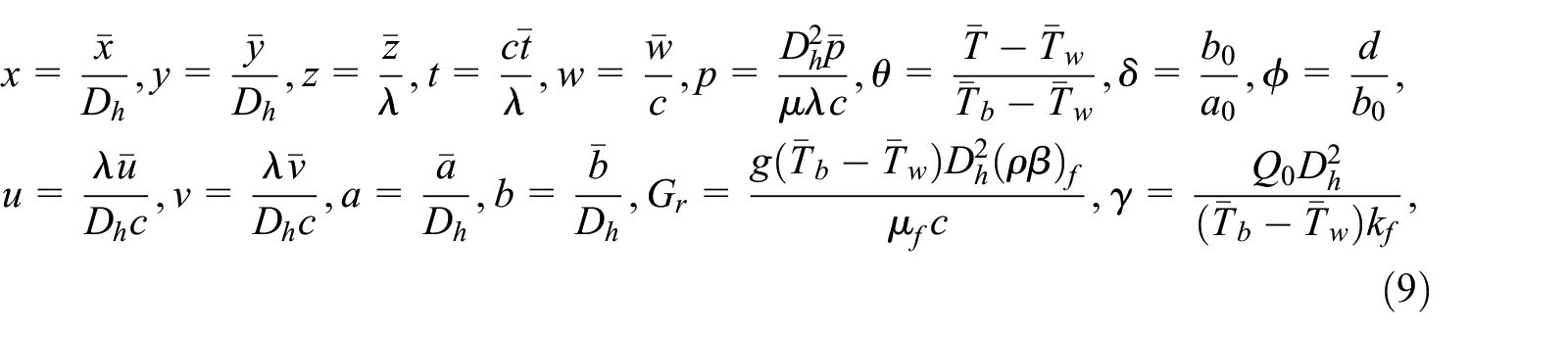
The useful dimensionless variables are provided by
The hydraulic diameter of ellipse is written as

The eccentricity of ellipse is
Table 1 and 2 represents the numerical values and experimental formulas for thermo physical features of hybrid nanofluid respectively.

The equations (3)–(6) are obtained in their non-dimensional form after using equations (8) and (9), then final simplified form of non-dimensional equations is obtained by applying lubrication theory, (i.e. λ


With non-dimensional boundary conditions


Where
Thermo-physical properties of base fluid and CNT referred as Akbar et al. 29

Carbon nanotube model referred as Nadeem. 30

Exact solution
Assume a polynomial form solution of temperature equation (15) given as

By using equation (18) in equation (15) and comparing coefficients of


Now by using equation (18) in the relevant boundary condition for temperature given in equation (17) and by comparing coefficients of



By solving equations (i)–(vi), we get values of constants

Now utilizing values of these constants in equation (18), we get an exact solution for temperature profile that satisfies both equation and boundary conditions exactly and is given as

The same procedure that is used to obtain temperature solution is used again to get an exact solution for velocity profile that satisfies both the momentum equation (14) and boundary condition given in equation (16). The exact solution for

The mathematical result for dimensionless flow rate

The mathematical result of pressure gradient is evaluated from equation (22) as follows

The pressure rise expression over a single wavelength is calculated by

Result and discussion
This segment provides a graphical assessment of the mathematical results that are obtained in the previous section. We have plotted some 2-dimensional as well as 3-dimensional graphs for both velocity and temperature profiles. The velocity of fluid is plotted for increasing value of different parameter as displayed in Figures 2 to 5. All these velocity graphs reveal that the velocity gains its highest value in the centre of elliptic duct and it declines toward the walls of duct. Also, an axial symmetry flow behaviour is revealed by these velocity graphs. Thus, we can conclude that the peristaltic flow in this vertical elliptic duct is an axially symmetric flow. Figure 2(a) gives a 2-dimensional graphical result of velocity for incrementing value of

(a) Velocity for

(a) Velocity for

(a) Velocity for
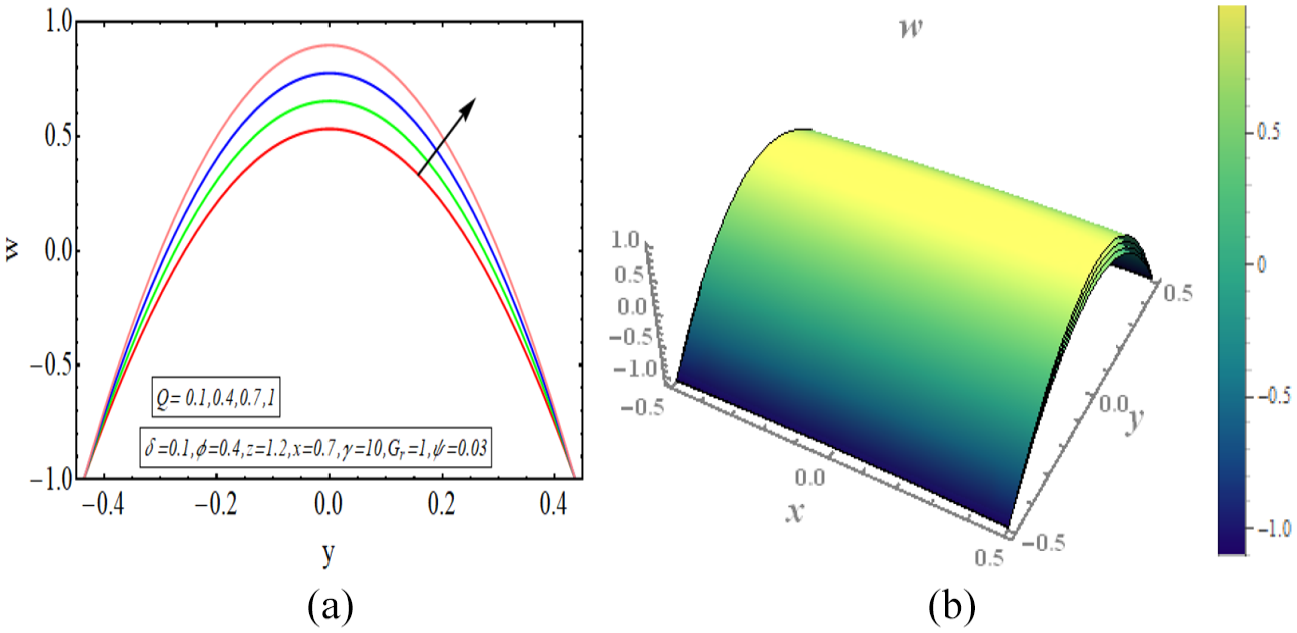
(a) Velocity for

(a) Temperature for

(a) Temperature for

(a) Pressure gradient for

(a) Pressure rise for

(a) Streamline for
Conclusions
The flow of a heated Newtonian viscous fluid with single wall carbon nanotubes inside a vertical elliptical duct with sinusoidally deformable walls is mathematically interpreted. The main advantage of using carbon nanotubes in the base fluid is enhancement in the thermal conductivity. The major findings that appear in this work are given below
The peristaltic flow in this vertical elliptic duct is an axially symmetric flow.
An increment in the values of
An axially symmetric behaviour is seen in these temperature graphs.
The temperature of fluid decreases with increasing the volume fraction of carbon nanotubes in the base fluid. The high value of thermal conductivity of carbon nanotubes is the main reason behind quick decline in the temperature of fluid.
The trapping slightly increases in size with increasing values of flow rate
Footnotes
Appendix
Declaration of conflicting interests
The author(s) declared no potential conflicts of interest with respect to the research, authorship, and/or publication of this article.
Funding
The author(s) disclosed receipt of the following financial support for the research, authorship, and/or publication of this article: The author Salman Saleem extend their appreciation to the Deanship of Scientific Research at King Khalid University for funding this work through research groups program under Grant No. RGP.2/38/42
