



Abstract
In this study, “peristaltic transport of hybrid nanofluid” inside a rectangular duct is examined. Water (base fluid) is used with two types of nanoparticles, namely, single-walled carbon nanotube (SWCNT) and multi-walled carbon nanotube (MWCNT). The viscous dissipation effect comes out as the prime heat generation source as compared to the conduction of molecules. After using some suitable dimensionless quantities, we obtained the nonlinear partial differential equations in a coupled form which are then solved exactly by the Eigenfunction expansion method. Velocity distribution, pressure gradient, and pressure rise phenomena are also discussed graphically through effective physical parameters. The heat transfer rate is high for the phase flow (single-walled carbon nanotube/water) model as compared to the hybrid (single-walled carbon nanotube + multi-walled carbon nanotube/water) model due to the enhanced thermal conductivity of the hybrid model.
Introduction
Peristalsis, a progressive wave-like muscular contraction moves the ingested food or fluid through the epithelial duct to the abdomen. Also, the sinusoidal movement of the walls of any channel is the evolution of the peristaltic flow. Today, peristaltic fluid flow has gained a lot of importance on account of its numerous applications in engineering, mathematics (applied), and in the physiological world. John Floyer 1 discussed the various applications of peristaltic motion into the human body such as the movement of chyle, blood, and so on, and described the old art of feeling pulse and its improvement using pulse watch. In the human body, the transportation of distinct fluids between different parts follows the principle of peristaltic pumping. The anatomical processes such as the motion of urine across the urinary system, the transit of mushy fluid (chyme) through the small bowel and via esophageal tube, the transformation of masticated food are some examples of peristaltic transport. A detailed study of biofluids to diagnose different types of diseases in humans helps doctors and surgeons. Engineers have invented pumps that have physiological and industrial applications. Dr Michael DeBakey (a heart surgeon) matured the peristaltic pump in 1932. The working of these pumps depends on the precept of peristalsis. In addition, many different kinds of biomedical equipment like heart-lung machines, and so on have a remarkable role in peristaltic flow. Jaffrin and Shapiro 2 discussed peristaltic pumping with practical examples of roller pumps, finger pumps, and so on and Weinberg et al. 3 gave an experimental study of peristaltic pumping with thorough reflux, mean flow and trapping analysis, and so on. For new researchers, a lot of research work is easily available. Latham, 4 who acquainted the idea of peristalsis, is regarded as the pioneer that highlights the fluid transportation within a peristaltic pump. Shapiro et al., 5 Fung and Yih 6 were the first who by the use of mobile and immobile frame analysis explained the facet of basic “fluid mechanics,” respectively, and mathematically modeled peristaltic transport. They dealt with the “peristaltic flow of viscous fluid.” Jaffrin and Shapiro 2 discussed the fluid flow because of peristaltic pumping in the direction of the tube's length that covers the prime vasomotion applications as well. For a large value of wavelength and relatively with a lower value of Reynolds number, the two-dimensional peristaltic flow was studied by Pozrikidis. 7 The reflux and trapping phenomena of peristaltic flow had been discussed thoroughly by Takabatake et al. 8 Also, they explained the engineering and physiological applications of peristaltic flow. Chalubinski et al. 9 and the studies of De Vries et al. 10 divulged that the motion of fluid inside the uterus is because of peristalsis. Nakanishi and Kawaguti 11 scrutinized a two-dimensional (2D) model of “peristaltic flow of a viscous fluid” in a conduit having contentiously moving waves with shrinking walls numerically. An explanation for explicit (exact) results of Navier-Stokes equations of blood glide inside fiber membranes which can be used for a synthetic kidney has been given by Tsangaris and Vlachakis. 12 Erdogan 13 investigated the results of sidewalls on the flow around the axes in a rectangular duct having the property of suction and injection. Some recent advancement in the field of peristalsis is provided.14–17
The particles having a diameter between 1 and 100 nanometers (nm) is called a nanoparticle. Nanoparticles are used in the manufacturing of cosmetics, electronics, clothes, crack-resistant paints, self-cleansing home windows, agriculture, stain-repellent fabrics, foods, scratch-proof eyeglasses, and ceramic coatings for solar cells. A fluid containing nanoparticles is called a nanofluid. Heat exchangers, ventilation systems, coolant machines, refrigeration, automotive industry, and so on are the foremost applications of nanofluid. 18 These fluids are a new class of heat transfer fluids. Tripathi and Bég 19 discussed a nanofluid flow in a 2D horizontal channel, where the effect of gravity was ignored. It is an application of drug transportation in which a curved conduit transmits nano-particles in blood. He also gave an exact solution to the governing problem based on previous work. Ghasemi et al. 20 gave two effectual methods known as the “least square method” and the “Galerkin method” to solve such certain types of fluids in the field of bioengineering.
Few researches have been done on heat transfer analysis in industrial and engineering problems and it is because of the “low thermal conductivity” of a fluid, however by intensifying the captivation of nanoparticles in the fluid this dilemma can now be figured out. Because more the concentration of nanoparticles, more will be the thermal conductivity. Nadeem and Shahzadi 21 discussed the heat transfer inside a curved-shaped structure for a “two-phase nanofluid flow.” In a triangular duct, numerical discussion about flow and heat transfer of nanofluids was given by Ahmed et al. 22 A review on the hybrid nanofluids was given by Sarkar et al. 23 Ellahi et al. 24 investigated the transportation and the effects of porosity of Jeffrey fluid under the influence of partial slip through a rectangular duct. Saleem et al. 25 explained the physical characteristics of the “peristaltic flow of hybrid nanofluid (Cu-Ag/blood)” inside an arched duct with a ciliated wall. Saleem et al. 26 presented the microphysical study of “peristaltic flow of single-walled carbon nanotube (SWCNT) and multi-walled carbon nanotube (MWCNT) carbon nanotubes” within a catheterized duct with a blood clot (thrombus).
To our knowledge, no research is provided yet that describes the peristaltic flow of hybrid nanofluid (SWCNT + MWCNT/water) inside a rectangular duct. In the current analysis, we investigated the “peristaltic flow” of hybrid (SWCNT + MWCNT/water) and phase flow (SWCNT/water) nanofluid models inside a rectangular duct. This present article will fill this gap in the literature. We have considered water as a base fluid. “Low Reynolds number and long wavelength” approximations are implemented to put the highly nonlinear resulting equations into a simplified form, that is, Re→0 and λ→∞. Finally, the simplified form of governing equations is solved corresponding to their boundary conditions. The exact solution corresponding to temperature and velocity profile is achieved by using the Eigenfunction expansion method and computing software (Mathematica). Also, the results are graphically interpreted for hybrid (SWCNT + MWCNT/water) and phase flow (SWCNT/water) nanofluid models as well in accordance with various substantial physical parameters contained in the resulting equations: pressure gradient, velocity, pressure rise and temperature functions. Graphical representations of streamlines are also given.

Geometrical model of the problem.
Mathematical formulation
The mathematical elaboration is given for “peristaltic flow” of a viscous, Newtonian, and heated fluid inside a rectangular duct having height and width 2a and 2d, respectively. The analysis is performed using the Cartesian coordinate system (X, Y, Z). The peristaltic waves on the wall have geometry (see Figure 1)




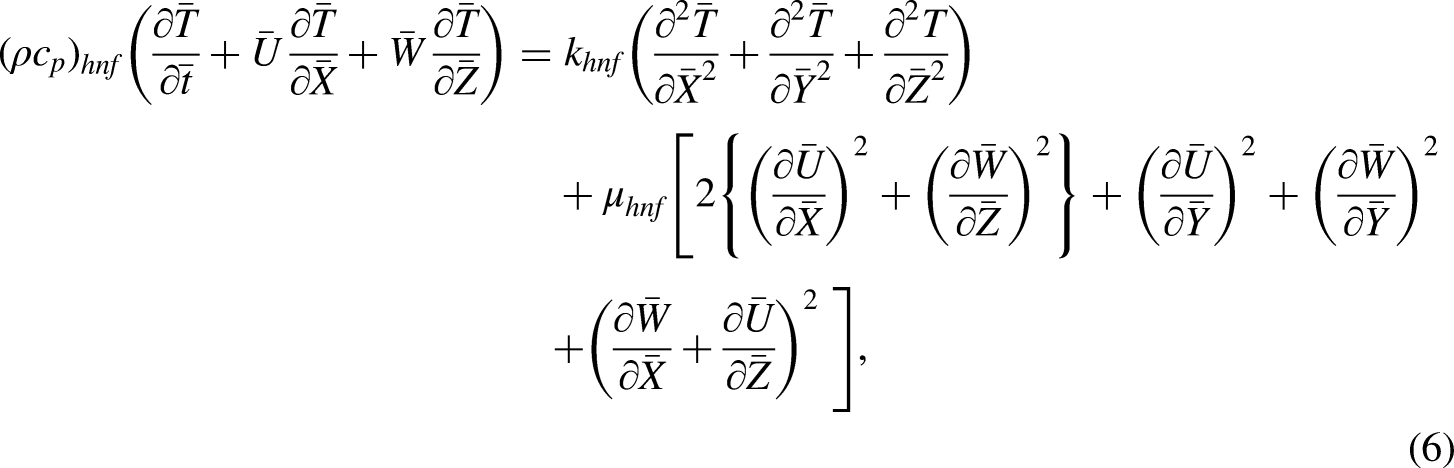





Boundary conditions in dimensionless form are:



Exact solution
The solutions of equations (12) to (16) subject to the conditions (17) to (20) are:


Where




Results and discussion
The current segment encloses the diagrammatic representation of the exact solution acquired in the previous section. The velocity profile, pressure gradient, pressure rise, and temperature profile for different increasing physical parameters like

(a) Velocity plot for increasing Q. (b) Velocity plot for increasing ϕ. (c) Velocity plot for increasing

(a)
(a)

(a) Temperature plot for increasing

(a) Streamlines for

(a) Streamlines for
Hybrid nanofluid model.

Thermo physical properties of base fluid and CNTs.

Conclusion
The heated flow of hybrid nanofluid inside a duct with rectangular cross-section and sinusoidally advancing boundaries is mathematically investigated. Eigenfunction expansion method is used for the first time to solve the complicated partial differential equations that appeared in this peristaltic flow problem. Major outcomes are highlighted below:
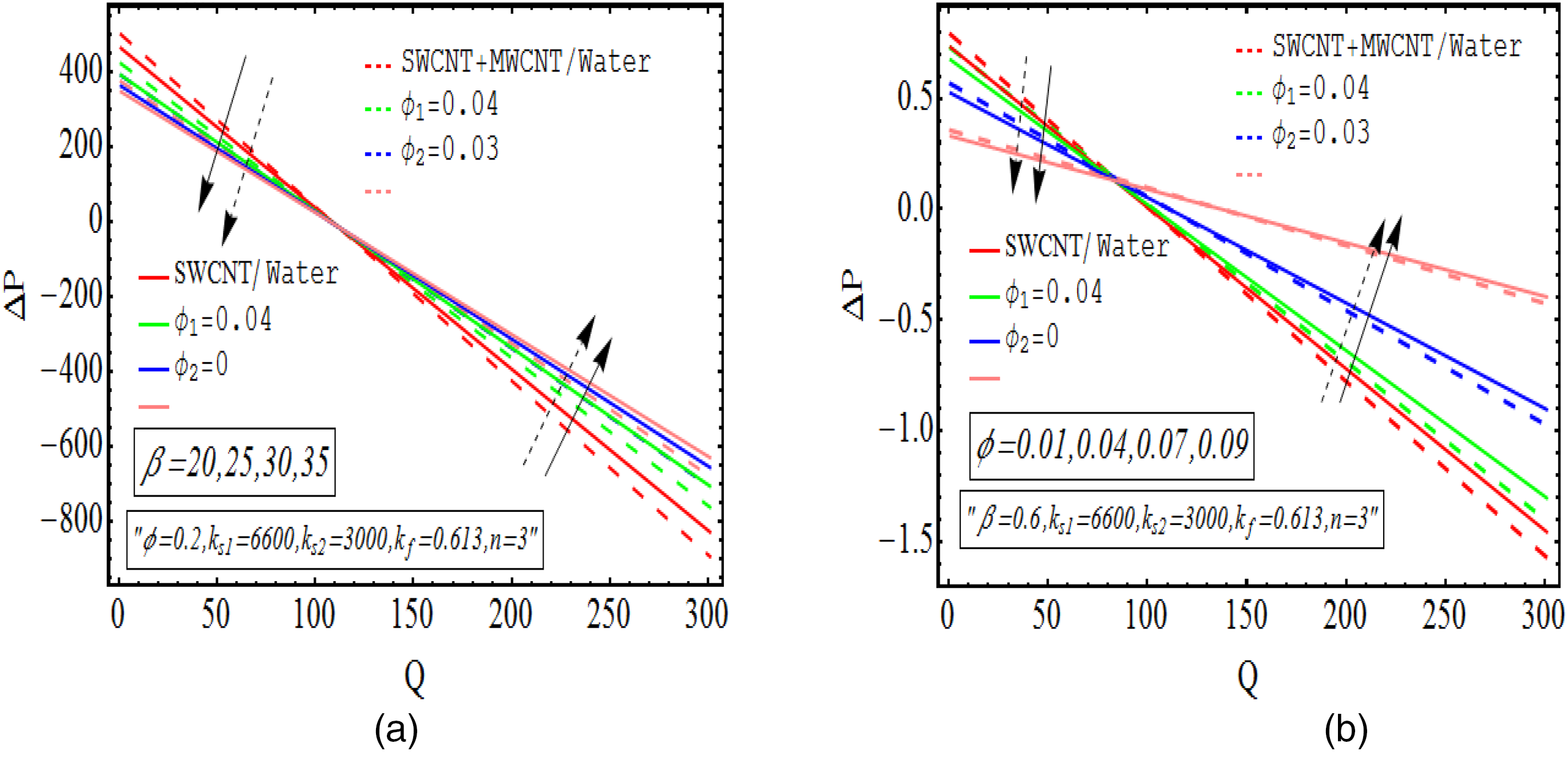
The graphical solutions of velocity and temperature depict a fully developed and parabolic profile that discloses a maximum temperature as well as flow in the central region of this rectangular cross-sectional duct. The pressure gradient rises more rapidly for hybrid (SWCNT + MWCNT/water) nanofluid model as compared to the phase flow (SWCNT/water) model. These graphical solutions of velocity and temperature clearly satisfy the considered boundary conditions and it certainly verifies the validation of our mathematical computations. The temperature profile attains higher values for phase flow (SWCNT/water) model as compared to the hybrid (SWCNT + MWCNT/water model). This is due to the enhanced thermal conductivity of hybrid nanofluid. Nanofluids play a key role in the enhancement of thermal conductivity. A comparative analysis shows that both phase flow and hybrid models have the same effects on the velocity profile but the temperature profile is increasing more rapidly for a phase flow model as compared to the hybrid one. Both the flow and heat transfer are maximum in the center of this rectangular duct and decline towards walls, just according to the boundary conditions.
Footnotes
Acknowledgement
The author (A. M. EIShafey) extend their appreciation to the Deanship of Scientific Research at King Khalid University for funding this work through research groups program under grant number (R. G. P. 1/304/42).
Declaration of conflicting interests
The authors declared no potential conflicts of interest with respect to the research, authorship, and/or publication of this article.
Funding
The authors received no financial support for the research, authorship, and/or publication of this article.
