




Abstract
With the higher rotational speeds and loads in bearings, the gaseous cavitation becomes more and cannot be ignorable in the bearing designs. However, there is no enough research in non-equilibrium gaseous cavitation model. This paper builds a new gaseous cavitation model based on the Bunsen solubility and bubble dynamics. The equilibrium pressure is calculated by the Bunsen solubility based on the local pressure and its pressure difference with the local pressure decides the cavitation mass transfer rate in this new model for gaseous cavitation. A titling-pad journal bearing at 3000 rpm and under 299 kN load is chosen as the research object with this new model and an original equilibrium model applied. As for the minimum film thickness and bearing force balance, this new model performs in better accordance with the experiment than the equilibrium model. According to the multiphase distributions in the bearing film, the gaseous cavitation rate in this new model can simulate the non-equilibrium processes of dissolution and cavitation under the high rotational speed, which is close to the physical gaseous cavitation process. This new model is developed and applied successfully in tilting-pad journal bearings for simulating the non-equilibrium gaseous cavitation.
Keywords
Introduction
As a type of fluid film bearings, tilting-pad journal bearings are used to provide static support in many rotating machineries, like gas turbines. As these rotating machineries need high-performance bearings and may work under off-design conditions, the tilting-pad journal bearings need to work with high load capacity1,2 and under various bearing loads.3–5 Thus, it is important to analyses the bearing performances. Among the relative bearing researches, the thermohydrodynamic (THD) characteristics of titling-pad bearings has been extensively studied in modern lubrication theory for titling-pad journal bearings. 6
In the THD model, the hydrodynamic flows, heat transfer, and shear heating are all considered and Reynold’s equation is included. In 2003, He7–9 and his group proposed a full thermoelastohydrodynamic model and applied it in tilting-pad bearings. Then Deng et al.10–12 have also provided turbulence corrections in Reynolds’ equation. However, the onset of transitional flow ranges in different situations.13,14 Thus, a widely accepted transitional correction in Reynold’s equation is still being looked for.
In addition to the Reynolds’ equation, researchers also use computational fluid dynamics (CFD) technique to simulate the turbulent flows in bearing films.15,16 In a tilting-pad journal bearing, the SST model with low-Re correction was found to be the most suitable for turbulent simulations. 17 Therefore, the noted SST model with low-Reynolds correction is included in this study.
In the THD model, the cavitation is another research focus. As summarized by a review, the cavitation includes the gaseous cavitation under stable bearing loads and vaporous cavitation under unstable bearing loads. 18 There exist many cavitation models available for the bearing simulations, like the widely accepted half-Sommerfeld model19–21 and the Rayleigh–Plesset model.22–27 Apart from these models, researchers also developed an equilibrium gaseous cavitation model for bearings.28–33
However, the equilibrium model do not consider the non-equilibrium process between cavitation and dissolution in the real physical gaseous cavitation. What is more, the air backflow is also not considered in the original equilibrium model. Thus, for accurate gaseous cavitation simulations in bearings, it becomes important to take the gaseous cavitation rate into consideration and develop an accurate non-equilibrium gaseous cavitation model.
Based on the gaseous cavitation rate equation and Bunsen solubility, the present work develops a new gaseous cavitation model and applies it in a THD simulation of a tilting-pad journal bearing under a high 299 kN load. 13 According to the previous researches,17,31–34 the SST model with low-Re correction and air backflow from the bearing outlets is applied for simulations and comparisons between the equilibrium model and the new model.
This work includes seven sections. The governing equations of two cavitation models and the SST model are listed in Section 2. Section 3 introduces the simulation object, a tilting-pad journal bearing. The simulation results of the bearing characteristics, the minimum film thickness, bearing force balance and air volume fraction are illustrated in Section 4, 5, and 6, respectively. Section 7 provides the conclusions.
Governing equations
Equilibrium cavitation model
According to the air solubility in oil and the previous researches,28,31–33 the volume fraction of the free air is calculated as below:

where,
With the mixture assumption, the density, laminar viscosity, and enthalpy of the cavitation oil can be calculated as follows:



where,
Non-equilibrium cavitation model
The most important development of this new model should be the gaseous cavitation rate. Based on bubble dynamics and ESI software, the mass transfer rate


where,
However,
At first, to make the definition of the volume fraction clear, the different sources of air and oil should be discussed. In bearing films, there are three sources of air, dissolved air in oil, cavitation air, and backflow air. Compared with the above model in Section 2.1, a non-equilibrium gaseous cavitation model takes the backflow air and free air from cavitation as one phase air. The material transfer between the oil and cavitation air in the above equilibrium equation is changed to the material transfer between the oil and free air, which makes the cavitation process to be simulated closer to the real condition. Apart from the free air, the dissolved air and oil are thought to have the same flow field and taken as the mixture oil. The volume fraction equation for air and oil is shown below:

In order to calculate


Considering the equilibrium pressure is decided by the local air solubility, the Bunsen solubility equation of the local air solubility can be shown as below:

In the above equation, the local solubility stands for the dissolved air volume fraction at
Based on the ideal air law, the relationship between the local air solubility and the dissolved air volume fraction is shown below:

According to equations (10) and (11), the equilibrium pressure can be calculated by the local air solubility, as shown below:

The limited dissolved air volume fraction can also be calculated based on the Bunsen solubility, as shown below:

Navier-Stokes equations
In the two-phase mixture model, the cavitation oil and backflow air phases are calculated separately and share a common flow field. The continuity equation is as follows:


The momentum equation is as follows:

where
The energy equation is as follows:

The air volume is the sum of the released air volume and the backflow air volume. Thus, the air volume fraction is as follows:

The governing equations of the SST model are as follows:
Eddy viscosity:

Turbulence kinetic energy:

Specific dissipation rate:

Motion equations
Under different static loads, the pads in the tilting-pad journal bearing tilt around the pivots because of moments. Taking the previous flow simulation results28–32 into consideration, the moments normal to the rotational direction is negligible and the moment in the rotational direction is predominant. Thus, to simplify the simulation, only the moment and tilt in the rotational direction is taken into consideration.
Assuming the simulated moment in a time step is constant, the angular velocity and tilting angle can be calculated as below:


Apart from the pad motions, the rotor motions should also be taken into consideration in various static loads. According to the previous simulation results,28–32 the force on rotor is almost in the load direction and equals to the difference between the lubricant force on rotor and the rotor load. As the rotor motion is caused by the force on the rotor, only the rotor motion and force in the load direction are taken into consideration. The moving velocity and distance can be calculated as below:


Simulation object
The tilting-pad journal bearing specifications 13 are listed in Table 1.
Bearing specifications.

This bearing has four pads. Nos. 1, 2, 3, and 4 pads are from 10° to 90°, 100° to 180°, 190° to 270°, and 280° to 360°, respectively. Between these pads, there exists four oil holes. The oil hole part mesh is four 20 × 80 × 80 (tangential by axial by radial) mesh systems. The film part mesh is a 480 × 80 × 20 (tangential by axial by radial) mesh system. The spacing ratio of the mesh from pad-side wall to oil inlet hole is 1.07. The minimum orthogonality angle, maximum element volume ratio and maximum aspect ratio are 66.9°, 4.05°, and 647°, respectively. The x, y, and z direction is set to be from 5° to 185°, from 95° to 275° and in the axial rotational direction. A 3D structured mesh is drawn for the bearing based on Table 1 and shown in Figure 1. 32 According to the real working conditions, 13 Table 2 gives the boundaries.
Boundaries.


Structured mesh.
The lubricant of the tilting-pad bearing is ISO VG32. Based on the research, 26 its physical properties are listed in Table 3.
Physical properties of ISO VG32 (at 323.15 K).

CFX, a CFD software, is used to simulate the hydrodynamic flows under various static loads. Based on the turbulence model research of this same bearing, 17 the SST model with low-Re correction can simulate the buffer flows in the low-Reynolds oil film flows accurately and is the most suitable one for predicting the flow characteristics in tilting-pad journal bearings. Thus, the SST model with low-Re correction is chosen to be used for this study. Based on the rotational speed, each time step is set to be 1e−4 s for 2°. The convergence targets of the residuals of continuity, velocity, energy, and turbulent kinetic energy are below 1e−6. The mesh deformation is calculated by using the displacement diffusion relative to the initial mesh.
To check the mesh quality, this bearing is chosen to be simulated at a 3000 rpm rotational speed and under a 299 kN load. As shown in Figure 2, the highest y plus value is less than 10, low enough for the SST model with low-Re correction.

Y plus contours of the mesh grid on: (a) rotor-side wall and (b) pad-side wall.
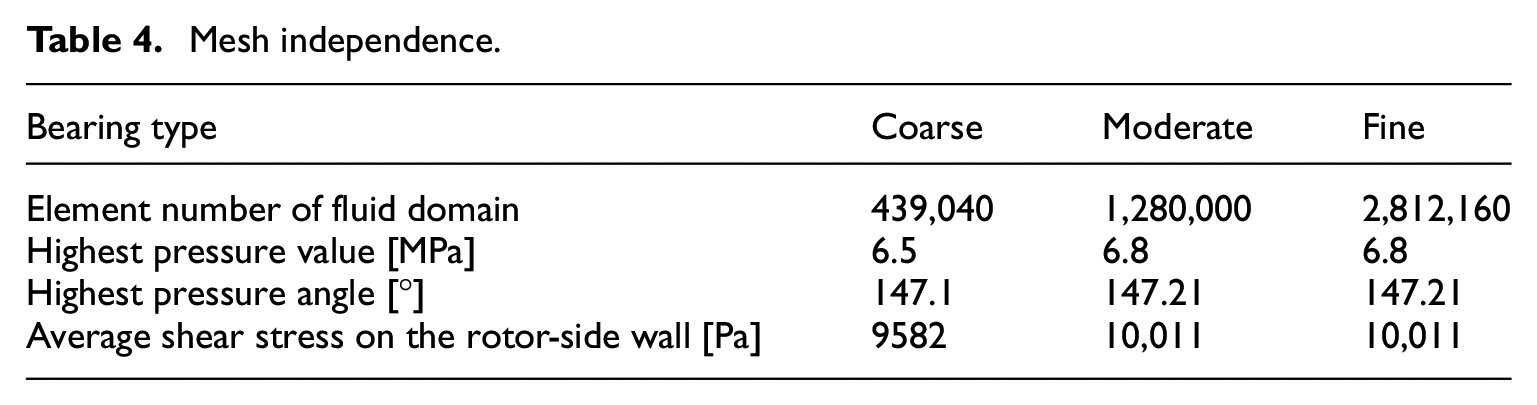
In order to prove the mesh independence, the pressure simulation results of three meshes by the non-equilibrium gaseous cavitation model are compared in Table 4 with bearing load 299 kN in the middle direction between the loaded two pads. The moderate mesh is that shown in Figure 1. The element number in each direction of the fine mesh is 1.3 times that of the moderate mesh. The element number in each direction of the coarse mesh is 0.7 times that of the moderate mesh. The simulated highest pressure value of the coarse mesh is 4.4% lower than the moderate mesh and fine mesh. Therefore, the coarse mesh is not independent. The same pressure and shear stress distribution of the moderate mesh and fine mesh shows that the moderate mesh is independent.
Mesh independence.
Discussion
Load and film thickness
Based on the experimental research, 13 the highest experimental bearing load 299 kN is used for this study. On the rotor, the simulated force balances and bearing supports are checked.
The force in Y direction stands for the bearing support. In comparison with 299 kN, the bearing support errors of the equilibrium gaseous cavitation model and non-equilibrium gaseous cavitation model are 3.15% and 1.60%, respectively, as shown in Table 5. It indicates that the bearing load is followed well by the motion equations and the simulated working conditions are same for both two models.
Simulated forces on the rotor [N].
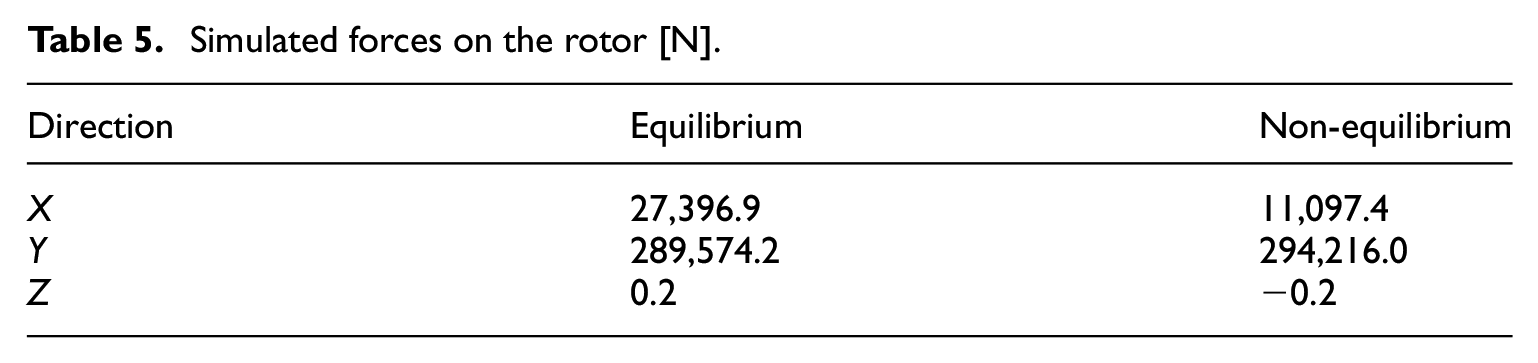
The unbalanced forces are in X and Z directions. The force in Y direction is the bearing support force. As the unbalanced force in Z direction is much lower than the unbalanced force in X direction and the support force in Y direction. Thus, the force in Z direction can be ignored. The unbalance ratio is defined as the ratio of the unbalanced force in X direction to the bearing support force in Z direction. The ratios of the equilibrium model and this new model are 9.5% and 3.8%, respectively, as shown in Table 5. It shows that the bearing force balances of the new model follows well with the experimental data, especially better than the equilibrium model. Thus, the simulation by this new model is closer to this real bearing operation than the equilibrium model with same motion equations.
Apart from the bearing load, the film geometry is also vital in bearing designs. A small film thickness difference can lead to a huge deviation of hydrodynamic results. Its simulated results are shown in Figure 3. 13 Considering experimental data, the minimum film thickness differences of the equilibrium model and this new model are 17.5% and 8.2%, respectively, as shown in Table 6. The new model performs better than the equilibrium model to predict an accurate film thickness distribution.

Film thickness distributions along the center line: (a) of four pads and (b) of No. 2 pad.
Minimum film thickness [μm].

When the bearing load increases, the eccentricity ratio increases and the film thickness in the loaded area decreases. Thus, under a higher bearing load, the change tendency from the unloaded area to the loaded area will be sharper, leading the accurate bearing simulations to be more difficult. The new model can accurately simulate the highest experimental load condition difficult to be simulated.
In sum, under the highest bearing load 299 kN in the tilting-pad journal bearing, the non-equilibrium gaseous cavitation model can predict the film geometry, bearing support, and force balance accurately, better than the equilibrium model. As film and support becomes more difficult to be predicted under higher bearing loads, the non-equilibrium gaseous cavitation model can also perform good under other bearing loads.
Pressure distribution
The bearing support is directly influenced by the pressure distribution. Based on the gaseous cavitation mechanism, only when the film pressure decreases, the gaseous cavitation will occur and the dissolved air will be released from the oil. Therefore, the film pressure distribution becomes a vital flow characteristic. The detailed pressure contours of the equilibrium model and the new model are shown in Figure 4.

Pressure contour on: (a) four pads by equilibrium model, (b) rotor by equilibrium model, (c) four pads by new model, and (d) rotor by new model.
The highest pressure of two models are different. The highest pressure values in the equilibrium model and the new model equal to 6.0 and 6.8 MPa, respectively. As the pressure in the loaded area is high and no cavitation exists, the different pressure values of two gaseous cavitation models should be caused by the film geometry difference and upstream low-pressure flow differences in unloaded cavitation area.
Based on the relationship between the pressure and bearing forces, the different bearing pressure values should be the reason why the simulated bearing forces are different. Apart from the loaded area, the pressure distribution in the unloaded area are also different by two models, shown by Figure 5. Thus, the pressure distributions of two models exist difference, leading to two different bearing force results.

Pressure contour on: (a) unloaded area by equilibrium gaseous cavitation model and (b) unloaded area by non-equilibrium gaseous cavitation model.
Based on the above bearing force analyses and relationship between forces and pressures, the pressure simulated by the non-equilibrium gaseous cavitation should also be better than the equilibrium model. It is verified indirectly by the pressure distributions in the unloaded area in Figure 5. The pressure of the new model is symmetrical, different from the equilibrium model. As the pressure is symmetrical, the force balance in the new model can be better than the equilibrium model. As the load angle is between pads, the unloaded pads should have similar flow characteristics, including the pressure distributions. Thus, the pressure distribution of the new model is closer to the real condition than the equilibrium model.
In general, the pressure distributions are influenced by the film geometry based on the moment equation. The pressure of the new model is symmetrical, not like the equilibrium model. It causes the good force balance of the new model.
Multiphase analyses
As noted by the gaseous cavitation mechanism, pressure distribution directly influences the cavitation process and air distribution. Then, the air distribution influences the material properties, like viscosity and heat capacity, which eventually affects the flow characteristics back. Therefore, the air distributions are analyzed below to make the differences between two gaseous cavitation models to be clear. The air volume fraction distributions on the rotor averaged along the bearing length direction are drawn in Figure 6.

Air volume fraction distributions averaged in the bearing length direction.
Not like the equilibrium model, the distribution of the air volume fraction is more smooth and higher in the new model. The sharp air distribution changes of the new model locate around four oil supply holes, like the area from 170° to 180°. Taking the pressure contours in Figure 4 into consideration, the oil inlet boundaries of four oil supply holes keeps the oil pressure to be the supply pressure, leading the pressure to have a sharp variation near the oil supply holes. As the equilibrium model assumes the cavitation to be equilibrium, the sharp pressure change causes sharp variations of the cavitation and air distribution as shown in Figure 7. It is the reason why the equilibrium gaseous cavitation model cannot get as smooth air distributions as the new model. As the real cavitation takes time to happen, the air should not increase or decrease sharply like the equilibrium gaseous cavitation. Thus, the smooth air distribution simulated by the new model is closer to real cavitation processes than the equilibrium model.

Air volume fraction contour on: (a) rotor by equilibrium model and (b) rotor by new model.
The contours of air volume fraction are shown below for detailed three-dimensional researches.
Apart from the above noted locations of the oil supply holes, the sharp air distribution changes of the equilibrium model also occur around the two-side bearing outlets in the unloaded area. It should be related to the air backflow boundary settings for the bearing outlets. As there exists air backflow into the films, 32 without considering the dissolution from backflow air to oil, the backflow air in the equilibrium model stays around the outlets, leading to the sharp variation of the air distribution. For the new model, the cavitation rate and mass transfer between the backflow air and oil are considered. Thus, its air volume fraction is not sharp and is close to the real cavitation process, better than the equilibrium model under air backflow condition.
Apart from the air volume fraction analyses, the temperature distributions on the rotor averaged along the bearing length direction are also drawn in Figure 8.

Temperature distributions averaged along the bearing length direction.
In the loaded area, the high temperature of the non-equilibrium model should be caused by the film thickness. As the simulated minimum film thickness of the non-equilibrium model is lower than the equilibrium model, the bearing eccentricity of the non-equilibrium model is higher than the equilibrium model. Thus, the bearing film thickness of the non-equilibrium model in the loaded area is thinner than the equilibrium model. As the shear stress equals to the product of the viscosity and the velocity gradient, the shear stress becomes high in the non-equilibrium model with the high velocity gradient under low film thickness. As friction generates heat, the high shear stress leads to the high temperature of the non-equilibrium model. In the unloaded area, its temperature is influenced by the upstream temperature in the loaded area. Thus, the flow of the non-equilibrium model has higher temperature than the equilibrium model in the unloaded area.
The temperature differences eventually influence all the bearing. Thus, in combination with the above temperature analyses of the loaded area, the high temperature of this new model in the loaded and unloaded area should be caused by much cavitation and high air volume fraction in the upstream unloaded area with the lubricant rotational motion.
In sum, the cavitation process can influence the material properties through the air distribution and the lubricant temperature. These material properties affect the velocity and pressure fields, eventually changing the bearing support forces and film geometry. Based on the above analyses, this new model takes the cavitation rate and the cavitation process of backflow air into considerations, which performs better than the equilibrium model.
Conclusion
In this study, a new non-equilibrium gaseous cavitation model considers the rates of cavitation and dissolution processes. It is applied in the numerical simulations of a tilting-pad journal bearing. The simulated characteristics at 3000 rpm and under 299 kN load are compared with the equilibrium model and experimental data obtained by Taniguchi et al. 13 Based on the above analyses and comparisons, the following conclusions are drawn:
In comparison with the equilibrium gaseous cavitation model, the minimum film thickness of the non-equilibrium gaseous cavitation model is closer to the experimental data and its bearing force balance is also better. It indicates that the non-equilibrium gaseous cavitation model can predict the film geometry and bearing support forces accurately.
As the pressure distribution of the new model is symmetric, it makes the bearing force balance better than the non-symmetric pressure distribution of the equilibrium model. For flow characteristics of bearing films, the new non-equilibrium gaseous cavitation model performs good.
There exist strong relationships among the cavitation, air distribution, material properties, flow field, and film geometry. Thus, it becomes vital to select a good gaseous cavitation model to predict an accurate flow field in bearing films. Based on the smooth air distribution results around the oil supply holes and outlet boundaries, the new model successfully is close to the real cavitation process and not achieved by the equilibrium model. In general, the new model can be applied in bearing films for accurate gaseous cavitation simulations.
Footnotes
Appendix
Declaration of conflicting interests
The author(s) declared no potential conflicts of interest with respect to the research, authorship, and/or publication of this article.
Funding
This study is supported by the Project 2017-II-0007-0021 of the National Science and Technology Major Project of China.
