




Abstract
Here, we study the effect of mixed convection and thermal radiation on unsteady boundary layer of heat transfer and nanofluid flow over permeable moving surface through a porous medium. The effect of heat generation is also discussed. The equations governing the system are the continuity equation, momentum equation and the heat transfer equation. These governing equations transformed into a system of nondimensional equations contain many physical parameters that describe the study. The transformed equations are solved numerically using an implicit finite difference technique with Newton's linearization method. The thermo-physical parameters describe the study are the mixed convection parameter α,
Introduction
The fluids have relatively low thermal conductivities when compared to the thermal conductivity of metals. The thermal conductivity of the fluid can be increased by adding small metal particles to that fluid. A fluid containing suspensions of metallic or non-metallic solid particles with sizes on the order of nanometers or micrometers is termed as nanofluid. Nanofluids can be used to cool automobile engines and welding equipment and high heat-flux devices such as high-power microwave tubes and high-power laser diode arrays. A nanofluid coolant could flow through tiny passages in micro-electro-mechanical systems to improve its efficiency. The measurement of nanofluids critical heat flux in a forced convection loop is useful for nuclear applications. Nanofluids are crucial applications in science and technology, industrial applications such as plastic, marine engineering, polymer industries, home cancer therapy, and building sciences. Flows through moving vertical flat plates also have enormous applications in aerosols engineering, aerodynamics and civil engineering, therefore researchers in these areas are interested in this field.
The wide range of applications of nanofluids has carried out significant researches in recent years to study the heat transfer characteristics of nanofluids. Xuan and Li 1 investigated the enhancement of the heat transfer for nanofluids, while Eastman et al. 2 studied the anomalously increased effective thermal conductivities of ethylene glycol-based nanofluids containing copper nanoparticles. Khan and Pop 3 studied the boundary-layer flow of a nanofluid past a Stretching sheet. Syakila et al. 4 investigated the Blasius and Sakiadis problems in nanofluids. Makinde and Aziz 5 considered the boundary layer flow of a nanofluid past a stretching sheet with a convective boundary condition. Bachok et al. 6 studied the boundary layer flow of nanofluids over a moving surface in a flowing fluid. Hamad 7 found the analytical solutions of convective flow and heat transfer of an incompressible viscous nanofluid past a semi-infinite vertical stretching sheet in the presence of a magnetic field. Hamad and Ferdows 8 investigated heat and mass transfer analysis for boundary layer stagnation-point flow over a stretching sheet in a porous medium saturated by a nanofluid with internal heat generation/absorption.
An unsteady flows, such as a start-up process and periodic fluid motion, are very much important in engineering practices. In many engineering problems, such as helicopter rotor, the ship propeller, the cascades of blades of the turbo-machinery unsteady environment occur. The investigation of the simultaneous effects of magnetic field and unsteadiness of boundary layer flow and heat transfer due to stretching sheet in the presence of heat source is investigated by Ibrahim and Shanker. 9 Elsayed et al. 10 investigated the effect of magnetic on flow and heat transfer of a nanofluid over an unsteady continuous moving surface in the presence of suction. Mukhopadhyay 11 investigated the thermal radiation effects on unsteady mixed convection flow and heat transfer over a porous stretching surface in a porous medium. Ishak et al. 12 investigated the flow of an unsteady boundary layer in a micropolar fluid over a stretching sheet. Rohnia et al. 13 discussed the heat transfer and flow over an unsteady shrinking sheet with suction in nanofluids. Mahdy 14 investigated numerically unsteady mixed convection heat transfer of nanofluid over a stretching vertical surface. Bakier 15 investigated the effect of thermal radiation on mixed convection from vertical surfaces in saturated porous media.
Transfer of heat in a liquid film on an unsteady stretching sheet explained by Liu. 16 Sheikholeslami and Ganji 17 investigated the heat transfer and unsteady nanofluid flow in the presence of thermal radiation considering the magnetic field. Keller 18 used numerical methods in boundary layer theory. Cebeci and Bradshaw 19 discussed the computational and physical aspects of convective heat transfer. Elbashbeshy et al. 20 investigated the thermal radiation effect on natural convection heat transfer around thermal spheres embedded in porous media by using the Keller box method.18,19 Maleki et al. 21 investigated the heat transfer and nanofluid flow over a porous plate with radiation and slip boundary conditions.
Much work has been done concerning the stagnation-point flow due to its essential practical applications to the industrial environment. Therefore, several research works are available in the literature regarding the heat transfer enhancement using nanofluids in addition to the study of the free and forced stagnation point of the viscous fluid flows.22,23 In recent years, the phenomenon of mixed convection flow at the inaction point of the two-dimensional geometric for mutilated physical characteristics has been discussed by many researchers, for example, see references.24,25 Some new contributions in heat transfer in magnetohydrodynamics have been investigated in Refs.26–29
The current study aims to investigate numerically the combined effects of the mixed convection and thermal radiation on unsteady boundary layer of heat transfer and nanofluid flow over permeable moving surface through a porous medium in the presence of heat source or sink. To the best of our knowledge, this problem has not been considered before.
Analysis and formulation of the problem
We consider the two-dimensional mixed convection boundary layer of an incompressible viscous liquid through porous medium along a permeable stretching vertical wall in the presence of thermal radiation. The vertical sheet is taken along x–axis and normal to y–axis. The velocity Uw(x,t) and the temperature of the sheet Tw(x,t) are supposed to have linear variation with x and an inverse for its decrease with time (Mahdy. 14 The fluid is a water-based nanofluid containing Copper Cu nanoparticles. The base fluid and the nanoparticles are assumed to be in equilibrium and no slip occurs between them as shown in Figure 1. The Thermophysical properties for the nanofluid are given in Table 1.
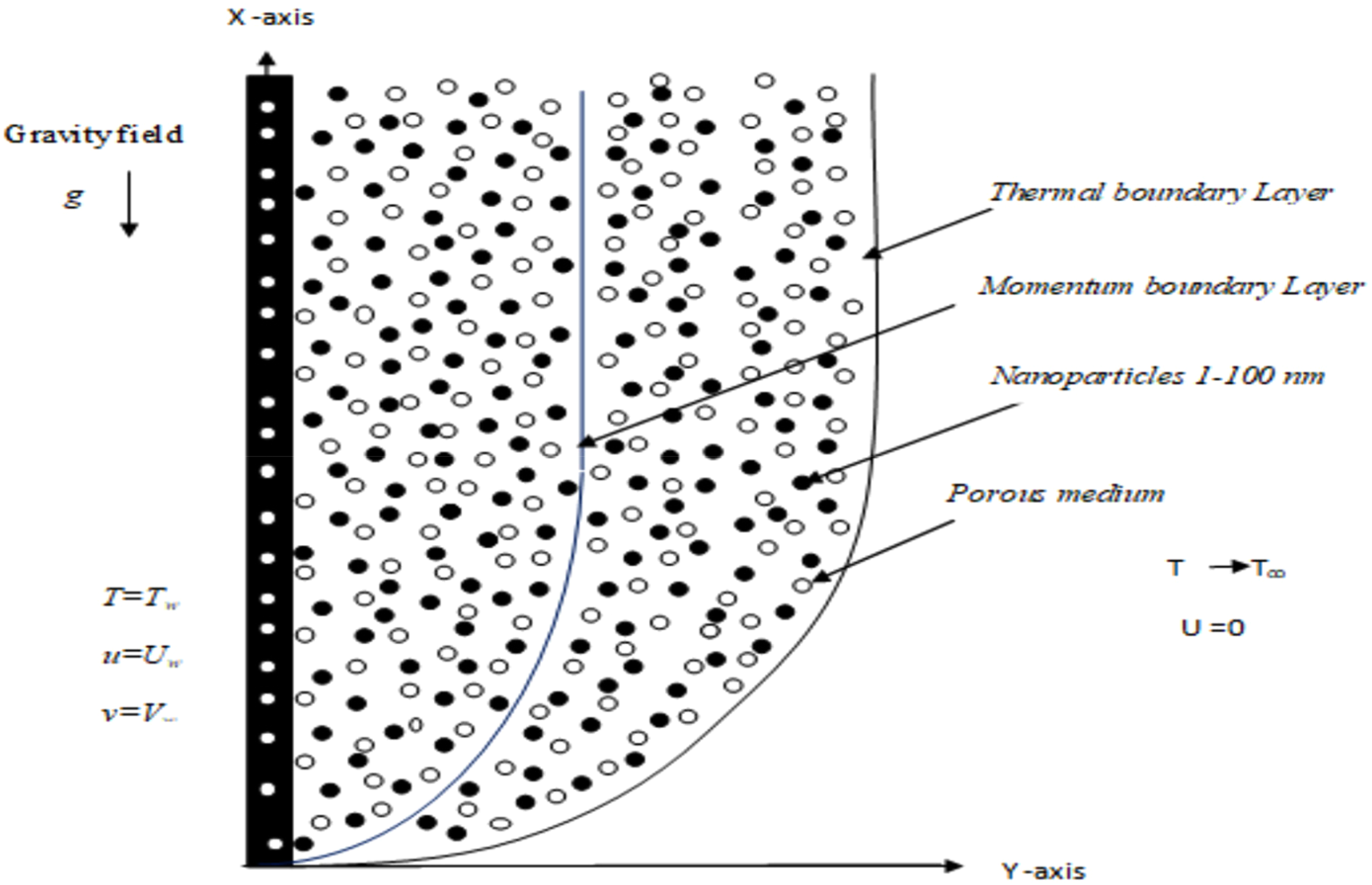
Schematic of the problem.
Thermophysical properties of the fluid (water) and the nanoparticles of Cu.

The Hamilton-Crosser's model of thermal conductivity of nanofluid is given by
The governing equations of the model are



The physical properties of the fluid are assumed to be constants and the viscous dissipation is neglected. The Rosseland approximation for radiation is considered and the radiative heat flux is given as








Now we get
Results and discussion
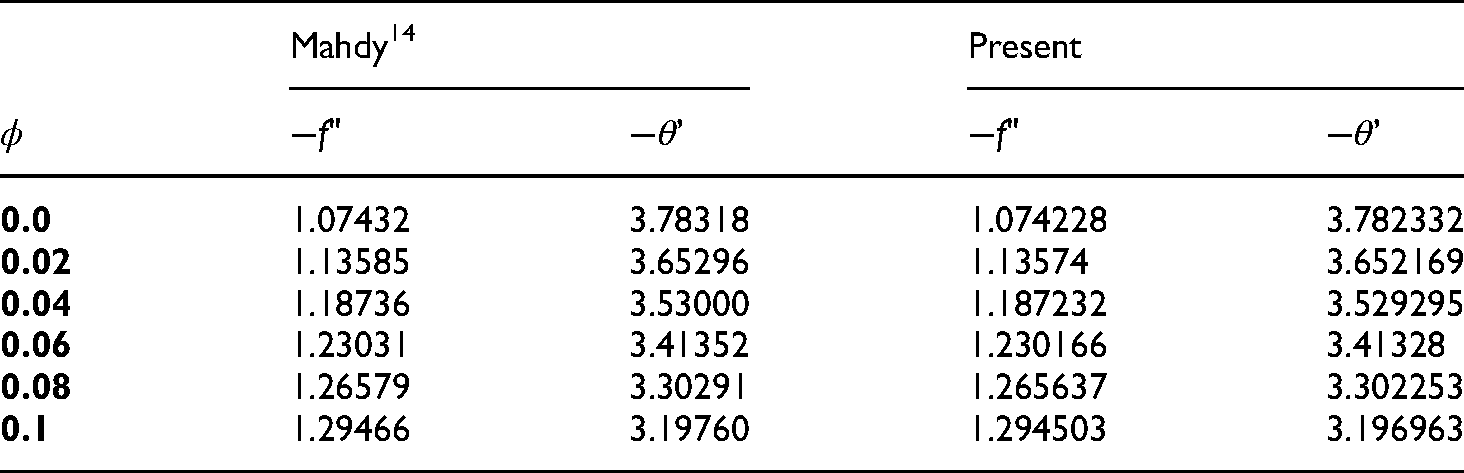
The system of nonlinear PDEs (2–6) governing the problem is converted by the similarity transformations (10) into a system of non-dimensional ODEs (13–15) containing a set of physical factors controlling the study. The problem is solved by a computational method consisting of the finite difference technique with Newton's linearization scheme. It was first introduced b Keller 18 and laboratory described by Cebeci and Bradshaw. 19 The computational results gained in terms of velocity profiles and temperature distributions are illustrated in graphical forms while the results obtained in terms of velocity gradient and the rate of heat transfer are performed in tabular forms. The computational results analyze the influence of the physical parameters governing the problem, namely the thermal radiation Rd, mixed convection α, porous medium parameter k, heat generation λ, and nanoparticles volume fraction ϕ. To validate the computational results, a comparison of special cases of the current investigation is prepared with the previous reported study by Mahdy. 14 The comparisons are performed in Table 2 and an excellent agreement is obtained. The considered values used in the computational results are Pr = 6.2, α = 0.5, Rd = 0.6, λ = 0.2, Rc = 0.1, K = 0.3, Sc = 1.0, M = 0.2, m = 0.5, ϕ = 0.1, fw = 1.0, and Nt = 1.0. The positive sign in computational results of the skin friction and Nusselt number indicates that the fluid affects a drag force on the surface while the negative sign points out that the force works in a reverse direction.
The effect of mixed convection parameter α on skin friction coefficient and the rate of heat transfer is presented in Table 3 with other physical parameters values k = 0.3, fw = 1.0, A = 1.0, Pr = 6.2, Rd = 0.60, λ = 0.5,
The effect of mixed convection.

The thermal radiation parameter Rd effect on skin fraction coefficient and the rate of heat transfer with other physical parameters values α = 0.5, k = 0.3, fw = 1.0, A = 1.0, Pr = 6.2, λ = 0.5 is reported in Table 4. Table 4 shows that an increase of thermal radiation parameter leads to a slight decrease of skin fraction coefficient and also decreases in the rate of heat transfer for both two models.
The thermal radiation effect.

The effect of the nanoparticles volume
The effect of nanoparticles volume
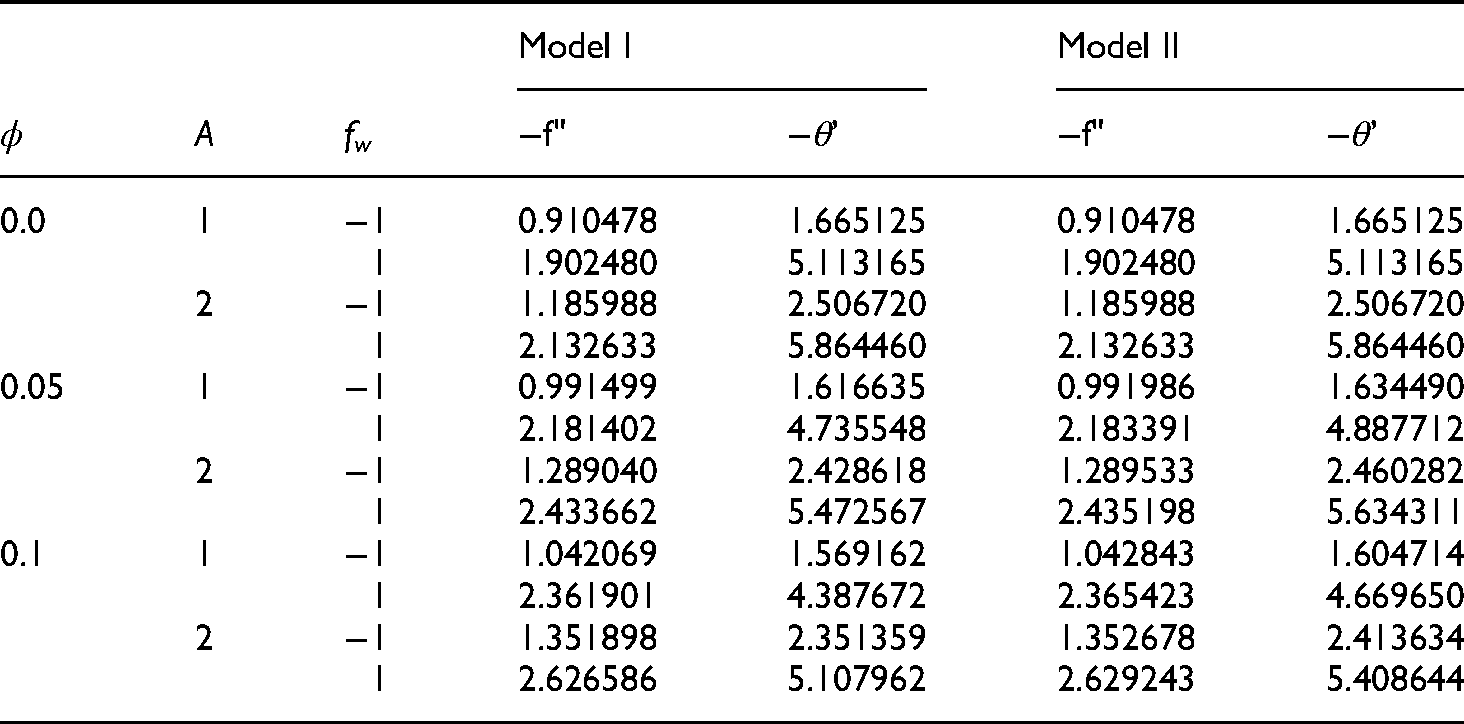
The porous medium parameter effect on skin friction coefficient and The rate of heat transfer is reported in Table 6 where porous medium parameter values are k = 0.0, 0.1, 0.2, 0.3, 0.4 and 0.5 while the other parameters values are α = 0.5, fw = 1.0, A = 1.0, Pr = 6.2, Rd = 0.60, λ = 0.5. Table 6 shows that the increase of porous medium leads to increases in values of the skin friction coefficient and decreases in values of the rate of heat transfer for both models. More details about the impact of nanoparticles volume parameter
The effect of porous medium parameter k.

The suction parameter fw (fw >0) effect on skin friction coefficient and the rate of heat transfer is presented in Table 7 while other parameters values Rd = 0.6, α = 0.5, k = 0.3, A = 1.0, Pr = 6.2, λ = 0.5. It is noted from Table 7 that the increase of the values of suction parameter fw leads to an increase of both values of the skin friction coefficient and the rate of heat transfer for models I, II.
The effect of suction or injection parameters.

The effect of the mixed convection effect on the velocity and the temperature profiles is presented in Figures 2 and 3 where the various values of mixed convection parameter α are 0. 0.3, 0.7 and 1.0 while other parameter values are k = 0.3, fw = 1.0, A = 1.0, Pr = 6.2, Rd = 0.60, λ = 0.5,

The velocity f' for various values of mixed convection parameter.

The temperature θ for various values of mixed convection parameters.
For such behavior, the physical explanation is that the fluid is brought closer to the surface and reduces the thermal boundary layer thickness in this case.
The porous medium parameter k effect on the velocity and the temperature profiles is presented in Figures (4 and 5) where the various values of porous parameter k are 0.0, 0.3, 0.7 and 1.0 while other parameter values are α = 0.5, fw = 1.0, A = 1.0, Pr = 6.2, Rd = 0.60, λ = 0.5. It is shown in Figures 4 and 5 that as the porous medium parameter k increases, the values of temperature increase but the profiles of velocity f' decrease.

The velocity f' for various values of porous medium parameter k.
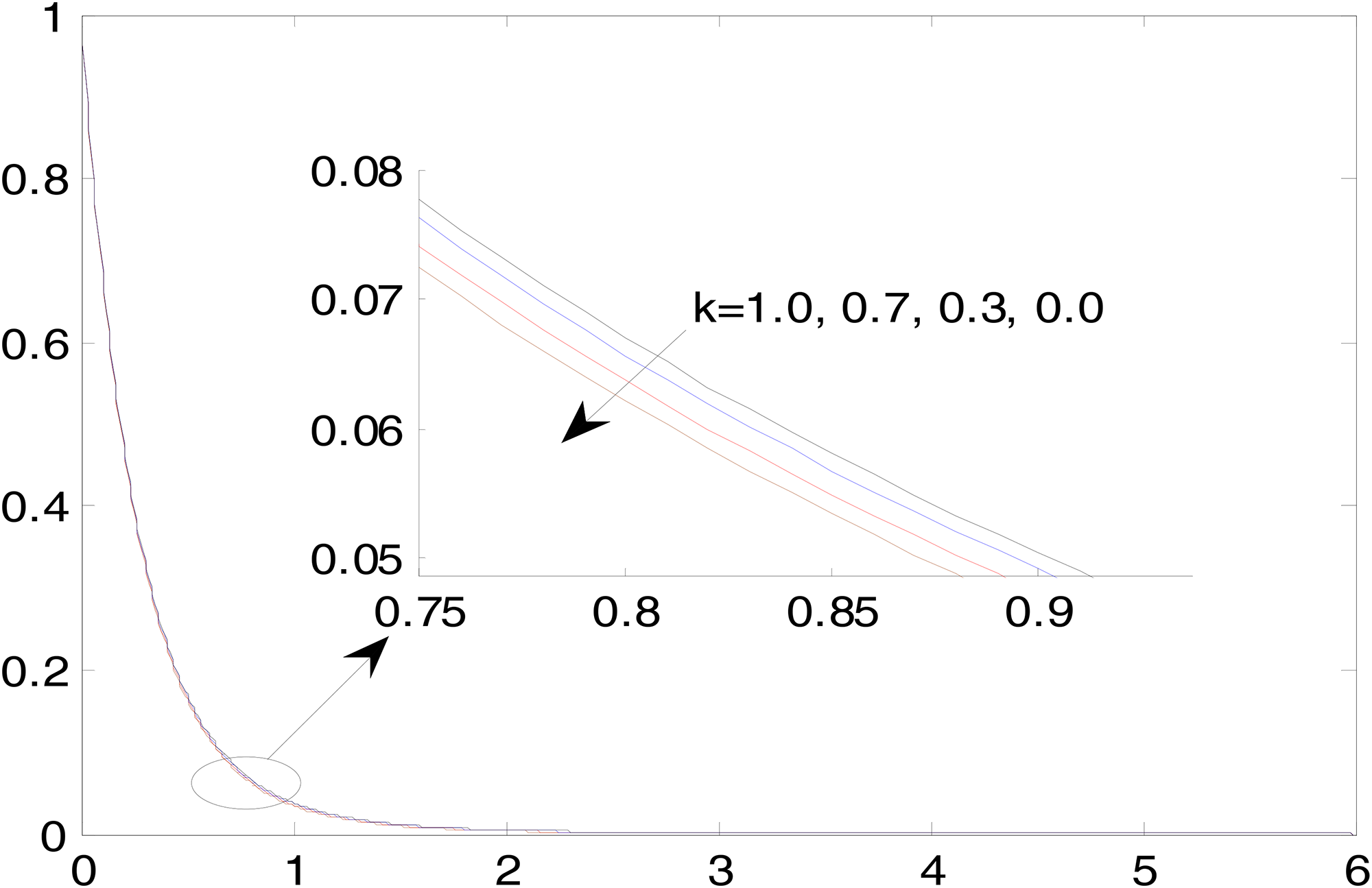
The temperature θ for various values of porous medium parameter k.
The thermal radiation parameter Rd effect on the velocity and temperature profiles are presented in Figures (6 and 7) where Rd values are 0.0, 0.4, 0.6 and 1.0 with α = 0.5, k = 0.3, fw = 1.0, A = 1.0, Pr = 6.2 R = 0.60 and λ = 0.5. It is noted from Figures (6 and 7) that as the thermal radiation parameter increase, the profiles of both velocity f' and temperature θ increase.
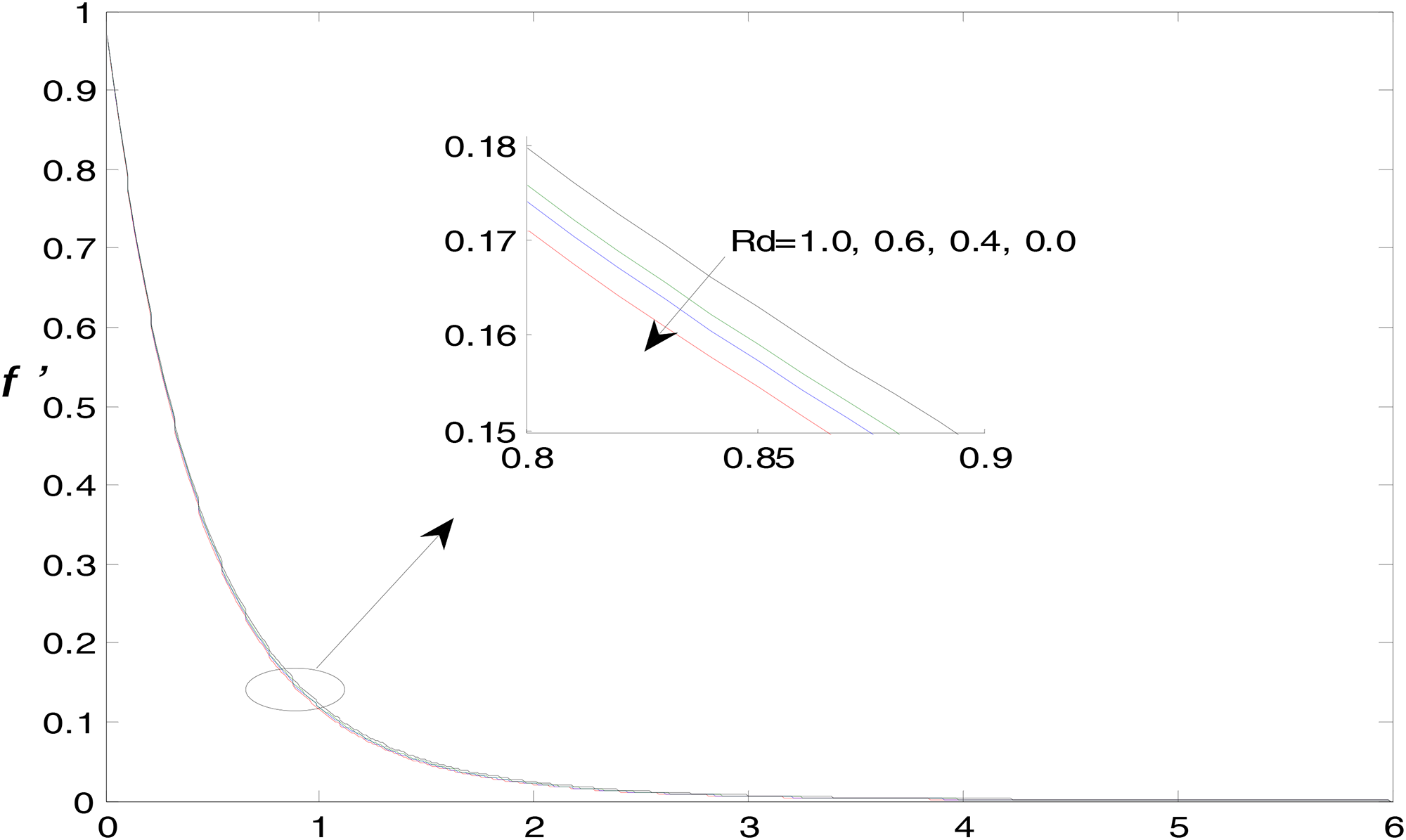
The velocity f' for various values of thermal radiation parameter Rd.

The temperature θ for various values of thermal radiation parameter Rd.
The suction parameter fw effect on velocity and temperature profiles is presented in Figures (8 and 9) with other parameter values Rd = 0.6, α = 0.5, k = 0.3, A = 1.0, Pr = 6.2 R = 0.60 and λ = 0.5. It is founded from Figures (8 and 9) that as the increase of the suction parameter fw, the profiles of both velocity f' and temperature θ decrease.

Velocity f' for various values of suction parameter fw.

The temperature θ for various values of suction parameter fw.
Physically, it clear that all external parameters have a strong impact on the phenomenon of thermal radiation effect in the presence of heat generation on unsteady mixed convection boundary layer flow and heat transfer of nanofluid over permeable stretching surface through porous medium.
Conclusions
In this study, the mixed convection and thermal radiation effect on unsteady boundary layer of heat transfer and nanofluid flow over permeable moving surface through a porous medium is investigated. These governing equations are transformed into a system of nondimensional equations contain many physical parameters. With the help of similarity transformations, the governing time-dependent boundary layer equations for momentum and thermal are reduced to couple ordinary differential equations which are then solved numerically. The transformed equations are solved numerically using an implicit finite difference with Newton's linearization method. The influence of the thermo-physical parameters is discussed and the following conclusions may be drawn:
The increase of mixed convection parameter leads to a decrease of skin fraction coefficient but a slight increase in the temperature profiles for both two models. Also as mixed convection increases, the profiles of velocity f' and the rate of heat transfer θ' increase. The increase of the thermal radiation parameter leads to a slight decrease of skin fraction coefficient and also a decrease in the rate of heat transfer for both two models but as the thermal radiation parameter increase, the profiles of velocity f' and temperature θ increase. The increase of nanoparticles volume As the porous medium parameter k increases, the values of skin fraction coefficient and the profiles of temperature increase but the profiles of velocity f' and the rate of heat transfer decrease The increase of the suction parameter fw leads to an increase in the values of skin fraction coefficient f" and the rate of heat transfer θ' but the profiles of velocity f', the temperature θ decrease.
Finally, we concluded that the results agree with the practical results and are applicable in related fields as medicine, pharmacology, jets flow, and chemical industries.
Footnotes
Acknowledgements
The authors would like to acknowledge the financial support of Taif University researchers, supporting project no. TURSP-2020/162, Taif University, Saudi Arabia.
Data availability
All data, models, and code generated or used during the study are included within the article.
Declaration of conflicting interests
The authors declare that there are no conflicts of interest regarding the publication of this paper.

Nomenclature
Greek symbols
Subscripts
Author Biographies
Ahmed M. Sedki is an assistant professor in Mathematics Department, Jazan University, Saudi Arabia. He is from Egypt. He published more than 10 papers (ISI). He works with a research group in Mathematics and Biomathematics.
S. M. Abo-Dahab is a Professor in Applied Mathematics (Continuum Mechanics), he was Born in Egypt-Sohag-El-maragha-Ezbet Bani-Helal in 1973. He obtained Masters in Applied Mathematics in 2001 from SVU, Egypt. He obtained PhD in 2005 from Assiut University, Egypt. In 2012 obtained Assistant Professor Degree in Applied Mathematics. In 2017 obtained Professor Degree in Applied Mathematics. In 2020 obtained DSc. In Physics and Mathematics. He works on elasticity, thermoelasticity, fluid mechanics, fiber-reinforced, magnetic field. He is the author or co-author of over 265 scientific publications in Science, Engineering, Biology, Geology, Acoustics, Physics, Plasma, ..., etc. He is a reviewer of 101 international Journals in solid mechanics and applied mathematics. His research papers have been cited in many articles and textbooks. He has authored many books in mathematics. He has obtained a lot of local and international awards in Science and Technology.
J. Boslimi is an assistant professor in Physics Department, Taif University, Saudi Arabia. He is from Tunis. He published more than 30 papers ISI. He works with a research group in Mathematics, Physics, and Biomathematics.
K. H. Mahmoud is an assistant professor in Physics Department, Taif University, Khurma, Saudi Arabia. He is from Egypt. He has published more than 15 papers (ISI). He works with a research group in Mathematics, Physics and Biomathematics.